
英语:unit2 language-project教案(牛津译林版必修3)
Unit2 language-Project教案Designing a bookletTeaching Aims:1.Train the students’ writing, reading and speaking abilities.2. Get the students to talk about writing a booklet about Chinese characters.3. Get the students to cooperate with others.Teaching Difficult Point:How to help the students finish the tasks of writing and speaking.Teaching Methods:1. Reading, talking and writing to improve students’ integrating skills.2. Individual, pair work and group work to make every student take an active part in class.3. Discussion to help the students cooperate.Teaching Aids:1. The multimedia2. The blackboardTeaching Procedures:Step 1 Greeting and Lead-inShow the students a picture and answer the questions.●Can you make out any of these Chinese characters?●Do the Chinese characters remain the same for thousands of years?Chinese characters are always changing!Step 2 Fast reading●Who first invented Chinese writing?Cang Jie.●When did the Chinese government introduce simplified Chinese characters?In the 1950s.Step 3 Careful readingRead the passage and answer:1. How old is the Chinese writing?Thousands of years.2. How did Cang Jie invent Chinese writing?Cang Jie saw the footprints of birds and animals in the snow and he got the idea he could use different shapes or pictures to represent objects.3. What do we call the first real Chinese characters?We call them pictograghs, which mean line drawings of physical objects.4. How did the character of “mountain” develop over time? Can you give any oth er examples?The pictograph for a mountain was originally three peaks together. Then this became one peak and three lines and finally turned into the character we use today. There are some other examples such as ‘eye’, ‘sun’, and ‘moon’.Step 4 Read the passage again and divide the passage into several parts, then give the main idea of each part.Para. 1. Brief introduction of Chinese characters.Para. 2. The origins of Chinese characters.Para.3-6 Form and development of Chinese characters.Para. 7-8 Pronunciation of Chinese characters and simplified Chinese charactersStep 5 Designing a booklet(1) PlanningAsk students to work in small groups and discuss the Chinese characters their group would like to research. Then they should discuss the layout of the booklet, and divide the work each group member will do to collect the information needed.(1)PreparingLook for information in as many sources as they can find. Then they meet, discuss and choose the information each group member has collected.(3) ProducingStudents each write a section of the booklet. They should put what they have written together and add photos or illustrations. They must proofread the draft to correct mistakes if there are any. New ideas can be added. Now the booklet is finished.(4) PresentingStudents present their booklet to the whole class by taking turns to talk about each section of their booklet. Everyone in each group should have a chance to speak.Step 6 Language points1. The way a written language developed can tell us just as much about a culture as thehistory of a spoken language. 一种书面语言的发展方式, 能告诉我们关于一种口语的历史,同样也告诉我们文化方面的东西.●我不喜欢他对待孩子的方式. I don’t like the way he treats his child.●他解决问题的方式很奇特. The way he solved the problems was strange.2. The Chinese language differs from many Western languages in that it uses characterswhich have meanings and can stand alone as words. 汉语与很多西方语言不同, 区别在于汉语使用的基本单位汉字本身就具有意义.differ from不同于; 有区别= be different from●Men are alike in their promises. It is only in their deeds that they differ (from each other).人在许诺时都一样,不同之处在于他们的行动.●I’m sorry to differ from/ with you about that question.对不起, 关于这个问题我与你的看法不同.相关链接:make a/ no/ some/little difference 有一点/没有/有些/几乎没有作用/关系/影响●对我来说,你走或留都没有关系.It doesn’t make any difference to me whether you go or stay.3. in that 因为; 原因是; 在于●He differed from other people in that he always looked farther ahead in his work.他和别人不同的是他在工作中比别人都看得远些.4. Chinese people invented numerous characters to represent ideas, objects or actions.中国人发明了无数的汉字来表达思想,物体或动物.represent vt.1). 表现;描写;描画●This painting represents a storm. 这幅画描绘暴风雨。
2). 代表●We chose a committee to represent us. 我们选出一个委员会来代表我们。
5. Chinese words are often formed by combining different characters.combine v. 使联合/结合常与介词with 连用●这两个党不可能联合在一起。
It’s impo ssible to combine the two parties.●我们应该使理论与实践相结合。
We should combine theory with practice.●这两个小店合并起来成为一个大商店。
The two small shops combined to make a large one.combination结合;联合;合并●His character is a combination of strength and kindness.他的性格是刚与柔的结合。
译林牛津版高中英语必修3课件 Unit 2 Language Project 2 课件
Preparing
Look for information as many sources as you can find. Tips (organizing information)
1. 2. 3. 4. Introduction Method Findings Conclusion
Producing
Unit 2 Language Project 2 课件
Starting the project—How to design a booklet?
•Planning •Preparing
•Producing •Presenting
Planning
• Work in small groups and discuss and choose what characters the group would like to research. • Discuss the layout of the booklet. • Divide the work each group member will do. • Collect the information needed.
Presenting
Present the booklet to the whole class by taking turns to talk about each section of their booklet.
Useful expressions:
differ from in that over time as a whole develop … into turn … into this way in the 1950s
Cooperate with your group members and finish your booklet.
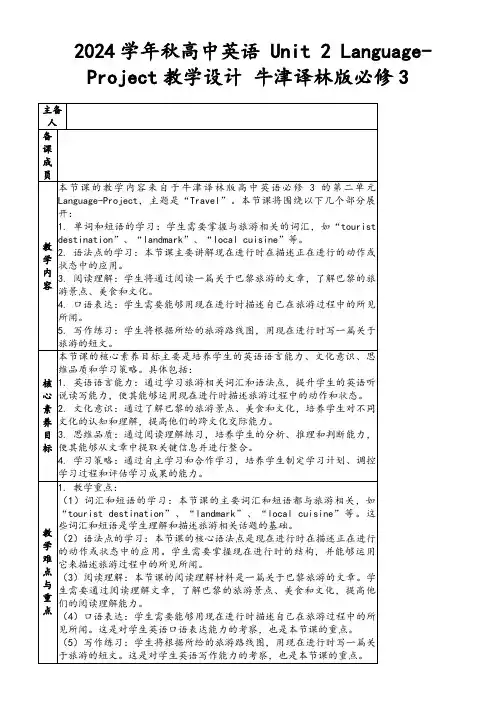
2024学年秋高中英语Unit2Language-Project教学设计牛津译林版必修3
- 写作指导和互评
- 听力练习和口语表达
教学流程
一、导入新课(用时5分钟)
同学们,今天我们将要学习的是《Unit 2 Language-Project》这一章节。在开始之前,我想先问大家一个问题:“你们是否曾有过旅行的经历?”(举例说明)这个问题与我们将要学习的内容密切相关。通过这个问题,我希望能够引起大家的兴趣和好奇心,让我们一同探索旅行的乐趣和语言的魅力。
3. 思维品质:通过阅读理解练习,培养学生的分析、推理和判断能力,使其能够从文章中提取关键信息并进行整合。
4. 学习策略:通过自主学习和合作学习,培养学生制定学习计划、调控学习过程和评估学习成果的能力。
教学难点与重点
1. 教学重点:
(1)词汇和短语的学习:本节课的主要词汇和短语都与旅游相关,如“tourist destination”、“landmark”、“local cuisine”等。这些词汇和短语是学生理解和描述旅游相关话题的基础。
- 英语学习网站,如BBC Learning English、VOA Learning English等
3. 信息化资源:
- 与旅游相关的英语学习资料,如旅游指南、旅游博客、旅游视频等
- 巴黎旅游相关的图片和地图
- 现在进行时的语法练习和测试题
4. 教学手段:
- 小组讨论和合作学习
- 角色扮演和情景模拟
A. landmark B. destination C. cuisine D. attraction
例题3:翻译题
将下列句子翻译成英语。
1. 我去年去巴黎旅游了一次。
2. 语法练习:学生需要根据本节课所学的现在进行时语法点,完成一份语法练习题。练习题包括填空、改写和句子排序等题型,以帮助学生掌握现在进行时的正确用法。
高中英语:unit2 language-project教案(牛津译林版必修3)

Unit2 language-Project教案Designing a bookletTeaching Aims:1.Train the students’ writing, reading and speaking abilities.2. Get the students to talk about writing a booklet about Chinese characters.3. Get the students to cooperate with others.Teaching Difficult Point:How to help the students finish the tasks of writing and speaking.Teaching Methods:1. Reading, talking and writing to improve students’ integrating skills.2. Individual, pair work and group work to make every student take an active part in class.3. Discussion to help the students cooperate.Teaching Aids:1. The multimedia2. The blackboardTeaching Procedures:Step 1 Greeting and Lead-inShow the students a picture and answer the questions.●Can you make out any of these Chinese characters?●Do the Chinese characters remain the same for thousands of years?Chinese characters are always changing!Step 2 Fast reading●Who first invented Chinese writing?Cang Jie.●When did the Chinese government introduce simplified Chinese characters?In the 1950s.Step 3 Careful readingRead the passage and answer:1. How old is the Chinese writing?Thousands of years.2. How did Cang Jie invent Chinese writing?Cang Jie saw the footprints of birds and animals in the snow and he got the idea he could use different shapes or pictures to represent objects.3. What do we call the first real Chinese characters?We call them pictograghs, which mean line drawings of physical objects.4. How did the character of “mountain〞develop over time? Can you give any other examples?The pictograph for a mountain was originally three peaks together. Then this became one peak and three lines and finally turned into the character we use today. There are some other examples such as ‘eye’, ‘sun’, and ‘moon’.Step 4 Read the passage again and divide the passage into several parts, then give the main idea of each part.Para. 1. Brief introduction of Chinese characters.Para. 2. The origins of Chinese characters.Para.3-6 Form and development of Chinese characters.Para. 7-8 Pronunciation of Chinese characters and simplified Chinese charactersStep 5 Designing a booklet(1) PlanningAsk students to work in small groups and discuss the Chinese characters their group would like to research. Then they should discuss the layout of the booklet, and divide the work each group member will do to collect the information needed.(1)PreparingLook for information in as many sources as they can find. Then they meet, discuss and choose the information each group member has collected.(3) ProducingStudents each write a section of the booklet. They should put what they have written together and add photos or illustrations. They must proofread the draft to correct mistakes if there are any. New ideas can be added. Now the booklet is finished.(4) PresentingStudents present their booklet to the whole class by taking turns to talk about each section of their booklet. Everyone in each group should have a chance to speak.Step 6 Language points1. The way a written language developed can tell us just as much about a culture as thehistory of a spoken language. 一种书面语言的发展方式, 能告诉我们关于一种口语的历史,同样也告诉我们文化方面的东西.●我不喜欢他对待孩子的方式. I don’t like the way he treats his child.●他解决问题的方式很奇特. The way he solved the problems was strange.2. The Chinese language differs from many Western languages in that it uses characterswhich have meanings and can stand alone as words.汉语与很多西方语言不同, 区别在于汉语使用的基本单位汉字本身就具有意义.differ from不同于; 有区别= be different from●Men are alike in their promises. It is only in their deeds that they differ (from each other).人在许诺时都一样,不同之处在于他们的行动.●I’m sorry to differ from/ with you about that question.对不起, 关于这个问题我与你的看法不同.相关:make a/ no/ some/little difference 有一点/没有/有些/几乎没有作用/关系/影响●对我来说,你走或留都没有关系.It doesn’t make any difference to me whether you g o or stay.3. in that 因为; 原因是; 在于●He differed from other people in that he always looked farther ahead in his work.他和别人不同的是他在工作中比别人都看得远些.4. Chinese people invented numerous characters to represent ideas, objects or actions.中国人发明了无数的汉字来表达思想,物体或动物.represent vt.1). 表现;描写;描画●This painting represents a storm. 这幅画描绘暴风雨。
2024学年秋高中英语Unit2Language-Project教学设计牛津译林版必修3

在线工具:利用在线翻译工具、语法检查工具等,让学生实时检测和修改自己的语法错误,提高他们的自我学习能力。
此外,我还将在课堂上提供充足的练习材料,让学生通过练习巩固所学知识。同时,我将关注学生的个体差异,给予不同程度的学生个性化的指导和关爱,确保他们能够在课堂上充分参与、积极互动。
教学过程设计
1. 导入新课(5分钟)
在行为习惯方面,学生的学习习惯和学习风格各异。部分学生养成了良好的学习习惯,能够按时完成作业,认真预习和复习,这对他们的学习效果产生了积极影响。然而,也有部分学生学习习惯不佳,拖延做作业,对学习缺乏规划,这可能影响他们对一般过去时的被动语态的学习效果。
针对学生的不同层次和特点,教师应因材施教,采取针对性的教学策略。对于基础较好的学生,可以适当提高学习难度,引导他们进行更深入的学习和思考;对于基础薄弱的学生,要加强基础知识的讲解和巩固,帮助他们建立信心,逐步提高他们的学习水平。同时,教师应关注学生的学习兴趣和动力,激发他们的学习热情,促使他们积极参与课堂活动。
课堂测试:教师在课堂上通过设计一些测试题目,了解学生对一般过去时的被动语态和一般过去时的主动语态的掌握情况。通过测试,教师可以了解学生的知识水平和运用能力,及时发现问题并进行解答。
2. 作业评价:对学生的作业进行认真批改和点评,及时反馈学生的学习效果,鼓励学生继续努力。
作业批改:教师在批改学生的作业时,要认真阅读学生的作业,了解他们对一般过去时的被动语态和一般过去时的主动语态的理解和掌握情况。通过批改,教师可以发现学生存在的问题,并及时进行解答和指导。
Unit2language--Project教案(牛津译林版必修3)
●Project Designing a booklet1. The Chinese language differs from many Western languages in that, instead of an alphabet, it uses characters which stand for ideas, objects or deeds. (p38) 汉语与西方语言不同,区别在于它不使用字母,而是用汉字表示思想、物体和行为。
differvi.1to be not like sth. or someone else, either physically or in another way:The twins look alike, but they differ in temperament.His views differ considerably from those of his parents.The findings of the various studies differ significantly/markedly/radically.standvt. & vi. 1. have, take, keep, an upright position; balance, support, the body on the feet站立,站着Her legs were so weak that she could hardly stand. I couldn’t get a seat on the bus, so I had to stand. He stood the ladder against the wall. 2. rise to the feet站起[(+up)]Stand up, please.3. bear (常用于否定句或疑问句)忍受,容[+v-ing][+to-v] I just can't stand the cold. I can’t stand the idea of cheating to win. Japanese can't stand being alone during breaks in school. 4.to have a rank or position in a range of values有……的地位;有……的地位The book stands high in my opinion. How does Britain stand among football-playing countries. 5.to be found in a particular form in writing原来形式Copy the words just as they stand on the original list. 照着原表所列的字抄下。
英语:Unit2《Language》Project&revision课件(1)(译林牛津版必修3)
6. Considering your idea as a whole I _________, think it will contribute significantly to the development of the company. However, it may cause some problems as well. 7.I was lucky in that I was able to find ______ what I wanted.
5. 整体来看,这本书值得一读。(as a 整体来看,这本书值得一读。 whole) As a whole, the book is worth reading. 6. 这个故事被简写了,以便于更容易理 这个故事被简写了, 解。(simplify) The story has been simplified to make it easier to understand.
•What can we put in a booklet?
Starting the project--How to design a booklet Planning Preparing Producing Presenting
Planning Work in small groups and discuss and choose what characters the group would like to research. Discuss the layout of the booklet. Divide the work each group member will do. Collect the information needed.
Translate the following sentences into English, using the words or phrases in the brackets. 1. 你知道大学与高中有什么不同吗 ? 你知道大学与高中有什么不同吗? (differ) Do you know how college differs from high school?
译林牛津版高一英语必修3学案Unit2LanguageProject
Teaching aims:1.Get to know the development of Chinese characters.2.Get informed of the formation of Chinese characters.3.Learn to explain the Chinese character by the way it forms.Teaching procedures:Step 1 LeadinDevelopment of Chinese charactersGet the class to think of these questions1. When did the Chinese writing begin ?2. Who invent the Chinese writing ?3. Can you tell something more about the Chinese writing?_____________________________________________________________________Step 2 Reading (the development of Chinese characters)1)Fast readingSkim the text and discuss the structure of the text between partners. Think about how many parts we can divide the whole text into.Part 1: Para 1 ________ of Chinese characters.Part 2: Para 2 ________of Chinese characters.Part 3: Para 34 ________ of Chinese characters.Part 4: Para 5 _________of Chinese characters.A.The origin of Chinese characters.B.Simplified Chinese characters.C.Brief introduction of Chinese characters.D. Form and development of Chinese characters.2) Careful readingPart1What makes the Chinese language differ from many Western languages?_____________________________________________________________________Part 2Who is said to have invented Chinese writing? _______________________________ What fired his idea of inventing Chinese characters?_____________________________________________________________________Part 3How are Chinese characters formed?1.___________________________________________________________________2.___________________________________________________________________3.___________________________________________________________________Part 4When were simplified Chinese characters introduced by the Chinese government? ________________________________Where are simplified Chinese characters used? _______________________________ Step 3 Reading(The story of Braille)Read the second passage and answer the questions:(1)Who introduced blind people to rreading?________________________________(2)At Braille’s time, what were the books for blind people like? __________________________(3) What happened to him when he was three years old?______________________(4) What did the soldier do for students when he visited the school?_____________________________________________________________________(5) What contributions did Louis Braille make for blind people?_____________________________________________________________________Step 4 Language points见基础训练P4650Step 5 语法填空The Chinese language ________(differ) from western languages. It uses characters to stand ________ ideas, objects or deeds. Chinese words are often formed by ________(put )together different characters. We can see the history of the Chinese language by looking at how these characters developed.Chinese writing began thousands of years ago. It is said that Cang Jie invented Chinese writing. He had the idea ________he could use different ________(shape) to represent different objects at the sight of the tracks of animals in the show. The first Chinese characters were drawings of physical objects. Some characters________ (simplify) and others have been made more difficult over time. However, as________whole, the characters have developed from drawings into standard form.Not all characters were developed from drawings of objects. Some characters were made by bing two________more characters together eg. ‘rest’ and ‘prisoner’. Other characters were developed for directions and numbers. ________is easy to distinguish their meanings by looking at them, eg. ‘up’ and ‘down’. Many other Chinese characters were made by having one part of a character indicate the meaning and the other suggested the pronunciation.In 1950s the Chinese government introduced simplified Chinese characters, which are ________(wide) used in China’s mainland now.。
牛津译林版高中英语必修三《Unit2 Language》 Project 教学设计3
2 They are pressing us to make a quick decision.
v.催促;敦促
3 Give the doorbell a press.
n.按,压
4 The press was not allowed to attend the trial
Step I
Expressions and phrases
Self-study guidance 1
Refer to the English book and find out the following useful expressions.
1看纸上墨水写成的字母
2把...引入;介绍...到
3在...岁时
4 While the students found the soldier's idea interesting,the system was too difficult to be of practical use.(L16)
Presentation
1 In those days,books for blind people used paper pressed against metal wire to form letters.(L7)
情感、态度与价值观
To improve students’ ability to work in groups and to learn the language points on their own.
教学
重点
1 Enable the students to master the main language points freely.
牛津译林版高中英语必修三Unit 2《Language》(Word Power)word教案
牛津译林版高中英语必修三Unit 2《Language》(WordPower)word教案Formal English and informal English & Countries and languages Teaching Aims:●To learn formal and informal English●To complete the relevant exercises to consolidate itTeaching procedure:Step One: BrainstormingShow students an informal letter and ask them to find out too formal expressions. Look at the following expressions and tell us which one you think is better. Then read the introduction to formal and informal English on Page 26.Step Two: informal expressionsAsk students to judge which expression is better a nd which i s informal.Show students some formal and informal English.Step Three: languages in different countri esShow a form and let students know one or two languages are spoken in a country. And the country and its people.Step Four: listeningAsk students to do the listening exercise and check answers together.Step Five: Work in groupLook at the map of the world. Write down as many names of countries and their of About 6,000 languages are spoken in the world today. The 10 most widely spoken languages are Chinese, Spanish, English, Hindi, Arabic, Bengali, Portuguese, Russian, Japanese and German.Look at the following pictures, tell us which country it is and what its official language is.Step Five: Homew ork1. Review what we learned in this period.2. Preview the next lesson.3. To get more information about UN, according to the website given t o you. :/ /english ://aboutun/index.html。
高中英语Unit2LanguageSectionⅤProject教学案牛津译林版必修3(new)
SectionⅤ Project[原文呈现][读文清障]The development of Chinesecharacters①The Chinese language differs from② Western languages in that③, instead of an a lphabet④, it uses characters ⑤which stand for⑥ideas, objects or deeds⑦。
Chinese words are formed by putting together different characters.In many cases⑧, a single character can also make up⑨ a word.The history of the Chinese language can be examined by looking at how these characters developed。
Chinese writing错误!began thousands of yearsago。
According to⑪ anancient story, a mannamed①Chinese character 汉字②differ from和……不同,不同于differ/'dIfə(r)/vi。
相异,有区别③in that“在于,因为”,引导原因状语从句。
④alphabet/'ælfəbet/n。
(一种语言的)字母表,全部字母⑤which引导的定语从句,修饰characters。
⑥stand for代表,象征⑦deed/diːd/n.行为,行动⑧in many cases 在许多情况下⑨make up构成错误!writing/’raItIŋ/n.文字;文字作品⑪according to根据,是介词短语,后跟名词作宾语。