
语言学名词解释
一绪论1 Linguisitics :Linguistics is generally defined as the scientic study of language2 Phonetics : The study of sounds which are used in linguistics communication is called phonetics.For example,vowels and consonants3 Phonology” : The study of how s ounds are put together and used in communication is called phonology.For example,phone,phoneme,and allophone.4 Morphology :The study of the way in which morphemes are arranged to form words is called morphology.For example,boy and “ish”---boyish,teach---teacher.5 Syntax : The study of how morphemes and words are combined to form sentences is called syntax.For esample,”John like linguistics.”6 Semantics: The study of meaning in language is called semantics. For example,:The seal could not be fou nd.The zoo keeper became worried.” The seal could not be found,The king became worried.” Here the word seal means different things.7 Pragmatics: The study of meaning in context of use is called pragmatics.For example, “I do” The word do meansdifferent context.8 Sociolinguistics: The study of language with reference to society is called sociolinguistics.Forexample,regional dialects,social variation in language. 9Psycholinguistics: The study of language with reference to workings of mind is called psycholinguistics. 二音系学1 Phonetics: The study of sounds that are used in linguistic communication is called phonetics.2 Phonology: The study of how sounds are put together and used in communication is called phonology.3 Phone: Phone can be simply defined as the speech sounds we use when speaking a language. A phone is a phonetic unit or segement. It does not necessarily distinguish meaning; some do,some don’t.4 Phoneme: Phonology is concerned with the speech sounds which distinguish meaning. The basic unit in phonology is called phoneme;it is a unit that is of distinctive value.5 allophone: The different phones which can represent a phoneme in different phonetic environment are called the allophones of that phoneme.6 Complementary distribution: These two allophones of thesame phoneme are said to be in compkenebtary distribution.7 Minimal pair: When two different forms are identical in every way except for one sound segement which occurs in the same place in the stings, the two words are said to form a minimal pair.8 Stress: When a certain syllable of a word is stressed, it means that the syllable is prounced with great force than the other or others.9 tones: Tones are pitch variation, which are caused by the different rates of vibration of the vocal cords. Pitch variations can distinguish meaning just like phoneme; therefore, the tone is a suprasegemental feature.10 intonation: When pitch, stress and sound length are tied to the sentence rather than the word in isolation, they are collectively known as intonation. Intonation plays an important role in conveying meaning in almost every language,especially in a language like English三形态学1 morphology: Morphology is a branch of grammer which studies the internal structure of words and the rules by which words are formed.2 inflectional morphology: Inflectional morphologystudies the inflections of word-formation.3 derivational morphology: Derivational morphology is the study of word-formation.4 morpheme: Morpheme is the smallest meaningful unit of language.5 free morpheme: Free morpheme are the morphemes which are independent units of meaning and can be used freely all by themselces or in combination with other morphemes.6 bound morpheme: Bound morphemes are the morphemes which cannot be used independently but have to be combined with other morphemes, either free or bound, to form a word.7 root: A root is often seen as part of a word; it can never stand by itself although it bears clear,definite meaning; it must be combined with another root or an affix to forma word.8 affix: Affixes are of two types: inflectional and derivational.9 prefix: Prefix occur at the beginning of a word.10 suffix: Suffixes are added to the end of the stems; they modify the meaning of the original word and in many cases change its part of speech.11 derivation: Derivation affixes are added to an existingform to creat a word.Derivation can be viewed as the adding of affixes to stem to form nes words.12 compounding: Like derivation, compounding is another popular and important way of forming new words in English. Compounding can be viewed as the combination of two or sometimes more than two words to creat new words.四句法学1 linguistic competence: Comsky defines competence as the ideal user’s knowledge of the rules of his language,and performance the actual realization of this knowledge in linguistic communication.2 sentence : A sentence is a structurally independent unit that usually comprises a number of words to form a complete statement question or command.3 transformation rules: Syntactic movement is governed by transformational rules. The operation of the transformational rules may change the syntactic representation of a sentence.4 D-structure : A sentence may have two levels of syntactic representation. One exists before movement take place, the other occurs after movement take place. In formal linguistic exploration, these two syntacticrepresentation are commonly termed as D-structure.5 Move а : Just as there is a general rule for all phrase structure rules,i,e. the X-bar schema, there is a general movement rule accounting for the syntactic behavior of any constituent movement. This movement rule is called Move а五语义学1 semantics: Semantics can be simply defined as the study of meaning in language.2 sense : Sense is concerned with the inherent meaning of the linguistic form. It is the collection of all the features of the linguistic form; it is abstract and decontextualized.3 reference : Reference means what a linguistic form refers to in the real, physical world; it deals with the relationship between the linguistic element and the non-linguistic world of experience.4 synonymy : Synonymy refers to the sameness or close similarity of meaning. Words that are close in meaning are called synonymy.5 polysemy : Polysemy refers to the fact that the same one word may have more than one meaning.A word having more thanone meaning is called a polysemic word.6 antonymy : Antonymy refers to the oppositeness of meaning. Words that are opposite in meaning are called antonyms.7 homonymy : Homonymy refers to the phenomenon that words having different meanings have the same form,i.e. different words are identical in sound or spelling, or in both.8 hyponymy : Hyponymy refers to the sense relation betweena more general, more inclusive word and a more specific word.9 componential analysis : Componential analysis is a way to analyze wprd meaning. It was proposed by structural semanticists.10 grammatical meaning : The grammatical meaning of a sentence refers to its grammaticality,i.e. its grammatical well-formedness. The grammaticality of asentence is governed by the grammatical rules of the language.11 semantic meaning : The semantic meaning of a sentence is governed by rules called selectional restrictions.12 predication : In semantic analysis of a sentence, the basic unit is called predication. The predication is theabstraction of the meaning of a sentence六语用学1 pragmatics: Pragmatics can be defined as the study of how speakers of a language use sentences to effect successful communication.2 context: The notion of context is essential to the pragmatic study of language. Generally speaking, it consists of the knowledge that is shared by the speaker and the hearer.3 utterance meaning: Utterance is based on sentence meaning; it is realization of the abstract meaning of a sentence in a real situation of communication, or simply in a context.4 locutionary act: A locutionary act is the act of utterance words,phrases,clauses. It is the act of conveying literal meaning by means of syntax, lexion and phonology.5 illocutionary act: An illocutionary act is the act expressing the speaker’s intention; It is the act performed in saying something.6 perlocutionary act: A illocutionary act is the act performed by or resulting from saying something: it is theconsequence of, or the change brought about by the utterance; it is the act performed by saying something. 七历史语言学1 historical linguistics: Historical linguistics is the subfield of linguistics that studies language change.2 apocope: Another well-documented sound loss is the deletion of a word-final vowel segement, a phenomenon called apocope.3 epenthesis: A change that involves the insertion of a consonant or vowel sound to the middle of a word is known as epenthesis.4 metathesis: Sound change as a result of sound movementis known as metathesis.5 compounding: Compounding is a process of combining two or more words into one lexical unit.6 derivation: Derivation refers to the process by which new words are formed by the addition of affixes to the roots.7 blending: Blending is a process of forming a new word by combining parts of other words.8 back-formation: Back-formation is a process by which new words are formed by taking away the suffix of an existing word.9 semantic broadening: Semantic broadening refers to the process in which the meaning of a word becomes general or inclusive than its historically earlier denotation.. 10 semantic narrowing: Semantic narrowing is a process in which the meaning of a word becomes less general or inclusive than its historically earlier meaning.11 semantic shift: Semantic shift is a process of semantic change in which a word loses its former meaning and acquirea new, sometimes related, meaning.12 protolanguage: It refers to a family of a language.13 sound shift: It refers to the systematic modification of a series of phonemes八社会语言学1 sociolinguistics: Sociolinguistics is the study of language in social context.2 speech community: A speech community is thus defined asa group of people who form a community and share the same language or a particular variety of language.3 speech variety: Speech variety, also known as language variety, refers to any distinguishable form of speech used by a speaker or group of speakers.4 language planning: One way out of the communicationdilemma is language standardization known as language planning. This means that certain authorities, such as the government or government agency of a country, choose a particular speech variety and spread the use of it, including its pronunciation and spelling system, across regional boundaries.5 idiolect: Such a personal dialect is refered to as idiolect.6 standard language: The standard language is a superposed, socially prestigious dialect of language. It is the language employed by the government and the judiciary system,used by the mass media.7 nonstandard language: Language varieties other than the standard are called nonstandard, or vernacular, languages.8 lingua franca: A lingua franca is a variety of language that serves as a medium of communication among groups of people for diverse linguistic backgrounds.9 pidgin: A pidgin is a variety of language that is generally used by native speakers of other languages asa medium of communication.10 Creole: A Creole language is originally a pidgin that has become established as a native language in some speechcommunication.11 diglossia: Diglossia usually describes a situation in which two very different varieties of language co-exist in a speech communication, each with a distinct range of purely social function and appropriate for certain situations.12 bilingualism: Bilingualism refers to a linguistic situation in which two standard languages are used either by an individual or by a group of speakers, such as the inhabitants of a particular region or a nation.13 ethic dialect: An ethnic language variety is a social dialect of a language ,often cutting across regional differences.14 sociolect: Social dialect, or sociolects, are varieties of language used by people belonging to particular social classes.15 register: Registers are language varieties which are appropriate for use in particular speech situations, in contrast to language varieties that are associated with the social or regional grouping of their customary users. For that reason, registers are also known as situational dialects.16 slang: Slang is a causal use of language that consists of expressive but nonstandard vocabulary, typically of arbitrary, flashy and often ephemeral coinage and figure of speech characterized by spontaneity and sometimes by raciness.17 tabo A linguistic taboo refers to a word or expression that is prohibited by the “polite” society from general use.18 euphemism: Euphemism comes from the Greek word euphemismos, meaning “to speak with good words”. A euphemism, then ,is mild, indirect or less offensive word or expression substitute when the speaker or writer fears more direct wording might be harsh, unpleasantly direct, or offensive.九心理语言学1 psycholinguistics:Psycholinguistics is the study of language in relation to the mind. As the suggests, psycholinguistics is viewed as the intersection of psychology and linguistics, drawing equally upon the language we acquire, produce and comprehend.2 cerebral cortex: The most important part of the brain is the outside surface of the brain, called the cerebralcortex.3 brain lateralization: The localization of cognitive of cognitive and percpetual functions in a particular hemisphere of the brain is called lateralization.4 linguistic lateralization: In their research of brain lateralization, psycholinguistics are particulary interested in linguistic lateralization, which is the brain’s neurological specialization for language.5 dichotic listening: Evidence in support of lateralization for language in the left hemisphere comes from researches in dichotic listening tasks6 right ear advantage: Stimuli heard in the left ear are reported less accurately than those heard in the right car. This phenomenon is knowas the right ear advantage.7 critical period hypothesis: The critical period hypothesis refers to a period in one’s life extending from about age two to puberty during which the human brain is most ready to acquire a particular language and language learning can proceed easily, swiftly and without explicit instruction.8 linguistic determinism: Whorf proposed first that all higher levels of thinking are dependent on language. Thatis, language determines thought, hence the strong notion of linguistic determinism.9 linguistic relativism: Whorf also believed that speakers of different language perceive and experience the world differently, that is, relative to their linguistic background, hence the notion10 subvocal speech: When language and thought are identical or closely parallel to each other, we may regard thought as “subvocal speech”.of linguistic relativism.十语言习得1 language acquisition: Language acquisition is concerned with language development in humans. In general, language acquisition refers to children’s development of their first language, that is, the native language of the community in which a child has been brought up.2 telegraphic speech: The early multiword utterance of children have a special characteristic. They typically lack inflectional morphemes and most minor lexical categories. Because of their resemblance to the styly of language found in telegrams, utterance at this acquisition stage are often called telegraphic speech.3 holophrastic sentence: Children’s one-word utterance are also called holophrastic sentences.4 acquisition: According to Krashen,acquisition refers to the gradual and subconscious development of ability in the first language by using it naturally in daily communicative situations.5 learning: Learning, however, is defined as a conscious process of accumulating knowledge of a second language usually obtained in school settings.6 language transfer: Learners will subconsciously use their L1 knowledge in learning a second language. This is known as language transfer.7 positive transfer: Presumably, positive transfer occurs when an L1 pattern is identical with, or similar to, a target-language pattern.8 negative transfer: Conversely, negative transfer occurs when an L1 pattern is different from the counterpart pattern of the target language.9 contrastive analysis: The Contrastive Analysis approach was founded on the belief that, by establishing the linguistic differences between the native and target language system, it was possible to predict what problemslearners of a particular second language would face and the types of errors they would make.10 interlanguage: SLA is viewed as a process of creative construction, in which a learner constructs a series of internal representations that comprises the learner’s interim knowledge of the target language, known as interlanguage.11 formal instruction: Formal instruction occurs in classrooms when attempts are made to raise learner’s consciousness about the nature of target language rules in order to aid learning.12 instrumental motivation: Thus, instrumental motivation occurs when the learner’s goal is functional.13 integrative motivation: Integrative motivation occurs when the le arner’s goal is social.14 acculturation: A related issue with integrative motivation has been the extent to which learners differ in the process of adapting to the new culture of the12community. This adaptation process is called acculturation.。
语言学的名词解释

语言学的名词解释
语言学:语言学是研究语言系统及其使用活动的科学研究。
语言学研
究手段包括语法、词汇、词汇学、发音、社会语言学、语言发展和变化等。
这些方面的研究将帮助人们更好地了解语言的构成和本质。
词汇学:词汇学是语言学的一个分支,旨在研究语言使用者有效地表
达自己的语言特性、语义和发音。
主要研究内容包括单词的拼写、含义、
发音、语法类型和词类。
语法:语法是语言使用的规则,涉及如何把句子或话语组织成正确的
形式。
它是研究语言结构和句子结构的科学,它涉及语言中的抽象概念,
如句子结构、词性、搭配、句子功能和语义等。
社会语言学:社会语言学是一种探讨语言与社会文化之间关系的学科,它研究如何使用语言以及社会文化如何影响使用语言的方式。
其主要研究
内容包括日常语言使用、语言变化、多元语言文化以及语言的政治、社会
和文化作用等方面。
发音:发音是指一种语言中每个语音的真正发音。
它研究语言中每个
语音如何组成、拼写、发音以及发声器官如何完成发音。
它不仅研究语言
中每个单词的发音,还研究语音与音素之间的关系,例如元音和辅音。
语言学名词解释

语言学名词解释语言学是研究语言的一门学科,涉及语言的结构、功能、变化和发展等方面的研究。
下面是一些常见的语言学名词及其解释。
1. 语音学(Phonetics):研究语言中各种语音的产生、传播和感知等方面的学科。
2. 语音语言学(Phonology):研究语音在特定语言中的音位(音素)和音位组合规则的学科。
3. 语法学(Grammar):研究语言的句法结构、词法结构和语义结构等方面的学科。
4. 句法学(Syntax):研究语言中句子的结构和组织方式的学科。
5. 语义学(Semantics):研究语言中词汇和句子的意义、概念和关系的学科。
6. 词汇学(Lexicology):研究语言中词汇的组成、形态、构词规则等方面的学科。
7. 词义学(Semantics):研究词汇中词义的构成、关系和词义的变化等方面的学科。
8. 语用学(Pragmatics):研究语言在具体语境中的使用方式以及语言的上下文相关性等方面的学科。
9. 文法学(Stylistics):研究语言使用中的文体、修辞手法、语言风格等方面的学科。
10. 母语(Mother tongue):一个人从小学会并用于日常交际的语言。
11. 第二语言(Second language):在学习者的母语之外学习的语言。
12. 语言接触(Language contact):不同语言之间在社会、文化接触中产生的相互影响和借用的现象。
13. 语言变异(Language variation):指同一个语言在不同社会、地理和使用者间发生的音、词、句法等方面的变化。
14. 语言变化(Language change):指语言在漫长的时间内逐渐变化和发展的过程。
15. 语言规范(Language standardization):制定和规范一个语言的正确用法、标准词汇和语法规则的过程。
16. 语言习得(Language acquisition):指儿童在自然环境中学习母语的过程。
语言学名词解释
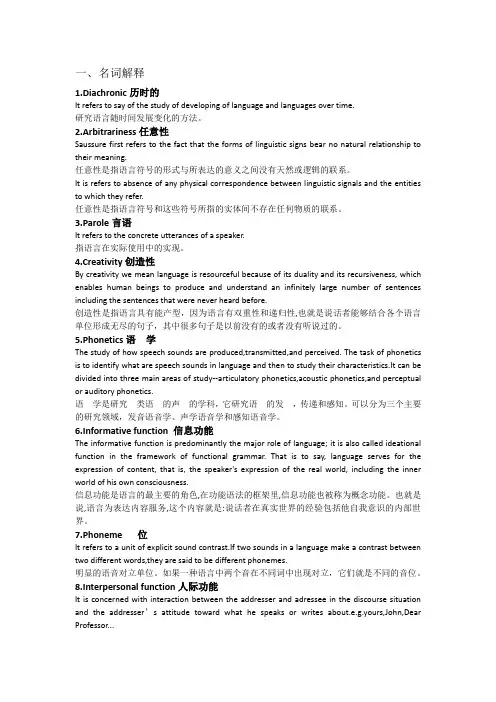
一、名词解释1.Diachronic历时的It refers to say of the study of developing of language and languages over time.研究语言随时间发展变化的方法。
2.Arbitrariness任意性Saussure first refers to the fact that the forms of linguistic signs bear no natural relationship to their meaning.任意性是指语言符号的形式与所表达的意义之间没有天然或逻辑的联系。
It is refers to absence of any physical correspondence between linguistic signals and the entities to which they refer.任意性是指语言符号和这些符号所指的实体间不存在任何物质的联系。
3.Parole言语It refers to the concrete utterances of a speaker.指语言在实际使用中的实现。
4.Creativity创造性By creativity we mean language is resourceful because of its duality and its recursiveness, which enables human beings to produce and understand an infinitely large number of sentences including the sentences that were never heard before.创造性是指语言具有能产型,因为语言有双重性和递归性,也就是说话者能够结合各个语言单位形成无尽的句子,其中很多句子是以前没有的或者没有听说过的。
语言学所有名词解释
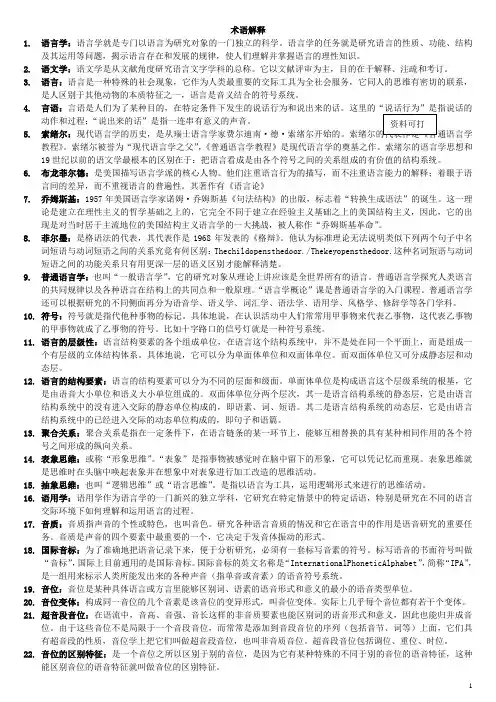
术语解释1.语言学:语言学就是专门以语言为研究对象的一门独立的科学。
语言学的任务就是研究语言的性质、功能、结构及其运用等问题,揭示语言存在和发展的规律,使人们理解并掌握语言的理性知识。
2.语文学:语文学是从文献角度研究语言文字学科的总称。
它以文献评审为主,目的在于解释、注疏和考订。
3.语言:语言是一种特殊的社会现象,它作为人类最重要的交际工具为全社会服务,它同人的思维有密切的联系,是人区别于其他动物的本质特征之一,语言是音义结合的符号系统。
4.言语:言语是人们为了某种目的,在特定条件下发生的说话行为和说出来的话。
这里的“说话行为”是指说话的5.索绪尔:教程》。
索绪尔被誉为“现代语言学之父”,《普通语言学教程》是现代语言学的奠基之作。
索绪尔的语言学思想和19世纪以前的语文学最根本的区别在于:把语言看成是由各个符号之间的关系组成的有价值的结构系统。
6.布龙菲尔德:是美国描写语言学派的核心人物。
他们注重语言行为的描写,而不注重语言能力的解释;着眼于语言间的差异,而不重视语言的普遍性。
其著作有《语言论》7.乔姆斯基:1957年美国语言学家诺姆·乔姆斯基《句法结构》的出版,标志着“转换生成语法”的诞生。
这一理论是建立在理性主义的哲学基础之上的,它完全不同于建立在经验主义基础之上的美国结构主义,因此,它的出现是对当时居于主流地位的美国结构主义语言学的一大挑战,被人称作“乔姆斯基革命”。
8.菲尔墨:是格语法的代表,其代表作是1968年发表的《格辩》。
他认为标准理论无法说明类似下列两个句子中名词短语与动词短语之间的关系究竟有何区别:Thechildopensthedoor./Thekeyopensthedoor.这种名词短语与动词短语之间的功能关系只有用更深一层的语义区别才能解释清楚。
9.普通语言学:也叫“一般语言学”,它的研究对象从理论上讲应该是全世界所有的语言。
普通语言学探究人类语言的共同规律以及各种语言在结构上的共同点和一般原理。
语言学名词解释

(一)名词解释1. 语言学: 语言学是以人类语言作为研究对象的学科, 研究人类语言的性质、结构、发展及其在社会生活中的运用以及语言研究成果的应用问题, 等等。
分理论语言学和应用语言学两个领域。
2. “小学”: 在中国古代, 小学先从教授字的形(六书)、音、义开始, 就把研究文字、训诂、音韵方面的学问统称为小学。
小学一直是经学的一部分, 包括音韵学、训诂学、文字学三个分支学科。
3.非语言交际工具或副语言交际工具: 人们在运用语言进行交际的时候, 不但动嘴, 而且脸部的表情、手的动作、乃至整个躯体的姿态等非语言的东西也都参加进来。
我们这些非语言的交际工具称为副语言交际工具。
副语言交际工具的使用范围非常有限, 只能起辅助性的交际作用, 以补充语言交际的某些不足。
4.辅助性交际工具: 指的文字、旗语、电报代码等在语言的基础上产生的交际工具。
这些交际工具若离开语言就不能独立存在。
其特点是: 都有特殊的服务领域, 使用的范围相当狭窄。
5.符号:符号, 就是指代某种事物的标记, 记号, 它是由一个社会的全体成员共同约定用来表示某种意义的标记和记号。
6.符号的任意性:任意性是语言符号的本质特征之一。
其含义是:语言符号的音义联系并非是本质的, 必然的, 而是由社会成员共同约定的, 一种意义为什么要用这个声音形式, 而不用那种声音形式, 这中间没有什么道理可言, 完全是偶然的、任意的。
语言符号和客观事物之间也没有必然联系。
7.语言符号: 特定语言系统中作为音义结合体的语言单位称为语言符号。
与一般符号相比, 语言符号的主要特点是: 音义结合的任意性、能指的线性特征、所指组合的层次性等等。
8.语言的层级体系: 语言的层级体系: 语言的底层是一套音位, 一种语言的音位的数目虽然只有几十个, 却能构成数目众多的组合。
这些组合为语言符号准备了形式的部分。
语言的上层是音义结合的符号和符号的序列, 这一层又分为若干级。
第一级是语素, 意义在这里被装进形式的口袋, 成了音义结合的最小的符号。
语言学纲要名词解释

语言学纲要名词解释语言学纲要名词解释:语言学:语言学是研究语言的科学,旨在探讨语言的结构、发展、使用和认知等方面的规律和现象。
声音:声音是由空气振动引起的,可通过耳朵感知得到的物理现象。
在语言学中,声音是语言的基本单位,用于构成语音。
语音:语音是语言学研究的一个分支,研究语言中的音素、音位等声音单位的特征和规律。
音素:音素是语音学研究的一个基本概念,指在一个语言中差异能够区分词义的最小声音单位。
语言声调:语言声调是描述不同语言或方言中声调变化和使用的规律和现象。
音韵学:音韵学是语言学中一个研究语音的分支,研究不同语音之间的相互关系和规律。
辅音:辅音是指在发音过程中需要舌头、唇等口腔器官接触或与之产生摩擦的音素。
元音:元音是指发音时空气通过喉咙、口腔等器官自由通过而不产生摩擦的音素。
音系:音系是指一个语言中所有音素的组合和制约关系。
语法:语法是研究语言结构和规则的科学,包括句法、词法等方面。
句法:句法是语法的一个分支,研究句子在语言中的组织结构和句子成分之间的关系。
词法:词法是研究词的结构和形态变化的学科,包括词的构成、词类等方面。
形态学:形态学是语言学研究的一个分支,研究词的形态构成、词的形态变化等现象。
句子:句子是语言中表达一个完整意思的基本单位。
意义:意义是语言符号所包含的符号和概念的含义。
语义学:语义学是研究语言符号意义的学科,包括词义学和句义学等方面。
语用学:语用学是研究语言使用情境和交际行为的学科,关注社会语言学、会话分析等方面。
会话分析:会话分析是语用学的一个分支,研究对话结构、对话参与者行为等方面。
语言地理学:语言地理学是研究语言在地理分布和变化中的规律和影响的学科。
语言变异学:语言变异学是研究语言变异和变体使用的学科。
语言习得:语言习得是研究人类如何学习和掌握第一语言和第二语言的过程和机制的学科。
语言分析:语言分析是对语言进行形态、句法、语用等方面的分析。
语言教学:语言教学是指通过教育和教学方法来教授和学习语言的过程。
语言学名词解释
语言学相关名词解释1.方言:通常指地域方言,它是全民族语言在不同地域的变体,是统一的全民族语言的分支。
2.亲属语言:是语言分化的产物,凡从同一种语言中分化出来的若干语言都是亲属语言。
3.社会方言:一种语言或地域方言内部同一定的社会特征和社会群体相关联的变体和特点被称为“社会方言”。
在一个语言社会中,不同的人说话可能会使用不同的语言变体而呈现出不同的特点,这些不同的语言变体和特点又同说话人的社会特征相关联,同一定的社群联系在一起,这种语言或方言内部同一定的社会特征和社群相关联的变体和特点被称之为社会方言。
4.语系:谱系分类中最大的类,凡有亲属关系的语言都属于同一语系。
8.基础方言:作为民族共同语的基础的方言。
10.地域方言:同一种语言由于语音、语汇和语法等方面的差异而在不同地区形成的地域分支或变体。
13.借词:也叫外来词,主要指语音形式和语义内容都来自外语的词。
14.仿译词:意译词的一种,指那些用本民族语言的语素逐一翻译原词语的各个成分,不但把原词语的意义,而且把原词语的内部结构形式也移植过来的那些词。
15.意译词:词的语音形式和构词方式是本民族语言的,词义来自外语的词。
16.双语现象:一个社会同时使用两种或多种语言作为交际工具,它是民族的接触、尤其是民族杂居的产物。
17.语言转用:指一种语言取代其他语言而成为不同民族的共同交际工具。
18.洋泾浜语:这是汉语对混杂语言的称呼,指母语不同的人在相互交际时所使用的两种或多种语言混杂而成的交际工具。
19.克里奥耳语:作用某个社会群体的母语来使用的、由两种或多种语言混合而成的语言。
20.双言现象:指某一言语社团使用两种方言功分别使用共同语和方言的社会现象。
22.非克里奥耳化:克里奥耳语向基础语言的方向发展,使两种语言越来越接近,甚至使克里奥耳语为基础语言的一种变体的现象和过程被称之为非克里奥耳化。
23.语言规划:社会对语言文字问题所作出的有组织、有意识的管理、调节和改进。
语言学名词解释
语言学名词解释1.语言学:研究语言的科学,语言是语言学的研究对象。
2.语言符号的任意性:所谓任意性,是指语言的声音形式和意义内容之间的联系是任意的,由社会约定俗成的,没有必然的、本质的联系。
什么样的声音表达什么样的意义,什么样的意义由什么样的声音表达,是由社会全体成员共同约定并共同遵守的。
3.线条型:所谓线条性,是指语言符号在交际使用过程中,其声音形式只能一个一个一次出现,一个音素或一个音节发出来才能紧接着发出另一个音素或音节,形成线条,随着时间的推移而延伸,在时间的线条上绵延,不能同时在空间范围内展开。
4.组合关系就是两个同一性质的结构单位(例如音位与音位、词与词等等),按照线性的顺序组合起来的关系。
所以组合关系直接体现了语言的结构规则要求,并非是任意两个词就能构成组合关系。
5.聚合关系在语言的组合结构的某一个位置上能够互相替换的几个具有相同作用的符号之间的关系就是聚合关系。
聚合关系其实就是具有相同功能特点的一群符号之间的关系,由于它们的功能相同,所以在同一结构中可以互相替换,替换后虽然具体内容有所改变,但功能与结构关系没有变化。
6.音位:音位是某一语言中能区分词的语音形式的最小语音结构单位,也就是说,音位具有区别意义的作用。
音位是从语音的社会属性角度划分出来的最小语音单位,而且音位总是属于一定语言的,离开了特定的语言,研究音位就没有了意义。
7.音素音素是语音的最小单位,它是人类语言从音质角度划分出来的最小语音单位。
8.对立所谓对立,是指两个或几个音素如果出现在相同的语音环境中,相互替换后会产生意义上的差别,即改变了原来音节所表示的意义,那么这里互相替换的几个音素,就是一种对立关系,它们不能划为一个音位,而要看作是不同的音位。
对立是鉴别一个音素能否成为一个音位的最根本的原则,是划分音位的主要根据。
9.互补所谓互补,是指几个音素不能出现在相同的语音环境中,它们的出现环境各有分工,我出现在甲处,你出现在乙处,他出现在丙处,各守一个地方,出现的环境相互补充,彼此处于互补关系之中。
语言学的名词解释
语言学的名词解释引言语言学是研究语言的结构、规律和变化的学科。
作为一门学科,语言学涉及广泛的领域,涵盖了词汇、语法、语音、语义等多个方面。
在语言学研究中,有许多重要的名词需要解释,这些名词有助于我们理解语言学的基本概念和理论。
本文将介绍几个语言学中常用的名词,并对其进行解释。
语音学1. 语音语音是指人类使用声音来进行交流和表达意思的能力。
在语音学中,语音是指语言的声音单位,包括语音的产生、分类和描述等方面。
2. 语音学语音学是研究语音的学科。
它研究语音的产生、传播、感知和分类等问题,对语音的音素、音节、音系等进行描述和分析。
3. 音素音素是语言中最小的音位单位。
一个音素可以通过替换使一个音与另外一个音有所区别。
音素可用于建立音位对比,对研究语音的差异和系统性做出描述。
4. 音节音节是语言中的基本语音单位。
它由一段连续的声音组成,包括一个或多个音素。
音节在构成词语时具有重要的作用,不同语言对音节的组合和结构有不同的规律。
语法学1. 语法语法是描述语言结构和规则的学科。
它研究语言中单词和句子之间的关系,以及语言的句法规则。
语法可以分为句法、词法、句子成分等多个层面。
2. 句法句法是语法学中研究句子结构和组织的分支。
它研究句子的成分和关系,包括主谓结构、宾语、修饰语等。
3. 词法词法是语法学中研究词汇和词法规则的分支。
它研究词汇的构成和分类,包括词根、词缀、词义等方面。
4. 句子成分句子成分是组成句子的不可再分的最小单位。
在句子中,包括主语、谓语、宾语、定语、状语等多个句子成分,它们各自具有不同的语法功能。
语义学1. 语义语义是研究词义和语言意义的学科。
它研究词汇和句子的意义,以及语言表达的信息和引申。
2. 语义学语义学是研究语言意义的学科。
它研究语言中的词义、句义、语境等方面的问题,揭示词语和句子的真正含义。
3. 词义词义是一个词所具有的意义。
在语义学中,词义可以通过定义、例句和语境等方式来解释和理解。
语言学名词解释
1.语言:语言是一种特殊的社会现象;是最重要的交际和思维的工具;是音义结合的符号体系。
2.普通语言学:以人类一般语言为研究对象,是综合各种具体语言的研究成果而建立起来的语言学3.言语:就是在特定的交际环境中为完成特定的交际任务而对语言的使用•4.语言符号:用一定的声音形式去标记某种事物或者思想从而获得意义的符号5.语言的演变:指语言中新的语言要素的产生和旧的语言要素的消亡,有时导致语言系统变得不同。
6.民族共同语:一个民族共同使用的语言7.亲属语言:•一种语言分化出来的若干种独立的语言,彼此有同源关系,这些语就是亲属语言。
8.语言的接触:指说不同语言的人在口头上或书面上经常交往所引起的•语言上的相互影响9.语素:最小的语音语义结合体10.音节:发音器官肌肉紧张度和语音响度增减过程形成的语音单位。
即语音上最小的使用单位11.音素:音节中从音质角度划分出来的最小的语音单位12.音标:专门用来记录语音的符号13.音位:一种具体语言或方言中有区别意义作用的最小的语音单位14.义素:就是对词的语义特征进行分析以后得到的最小的语义单位。
即词义的区别特征。
15.前提义素:与临界词共同的义素,是确定该词义与临界词义有共同联系的义素16.义素分析:就是把词义分割成最小的对立成分,从而描写其相互关系17.语义场:由具有某些共同义素的一群词类聚而成的场。
18.词:词是最小的能够自由运用的语言单位19.单纯词:由一个语素构成的词20.合成词:由两个以上语素构成的词21.心理语言学:研究语言行为和心理过程之间的关系的语言学22.社会语言学:用社会学的方法研究社会上的形形色色的语言变异等问题23.历史比较语言学:利用几种语言反映在语音上的对应规律去追溯它们的亲属关系的语言学24.描写语言学:对具体语言进行断代描写的语言学25.•对比语言学:对两种或两种以上不同语言的构造要素进行比较的语言学26.组合关系:指两个以上相连续的语言符号组合而成的线性关系。