
新冀教版 七年级下英语UNIT1教案
注意:如果没有提到“地点”,必须用 arrive. E.g. When will you arrive? 4. Come back to Beijing and leave Beijing. 离开某地 leave sp. E.g. He wants to leave Shanghai tomorrow. 他 明天想离开上海。 前往,离开去某地 leave for sp. E.g. He wants to leave for
宾语指物,简称―直物‖;间接宾语指人,简称―间人‖) 注意:在上述结构中,当―直物‖为代词 it 或 them 时,只能使用加 介词 to 或 for 的结构。 把它给我:send it to me (V) 给我买它:buy it for me(V) 五、短语汇总 1.学习; 了解 learn about; 路 the Silk Road 4.去…旅行 go on a trip to…=take a trip to… make a plan for… 6. 带 / 引某人去某地 lead…to… notes=make notes 8. 给某人留便条 leave sb. a note what; 10..有做…的机会 have a chance to do sth. =have a chance of doing sth 11. 一个好消息 a piece of good news; China = all over China 六、课文诵读 1、听读课文;2、诵读课文。 七、处理 Let’s Do It 练习。 八、笔头操练 I、词汇运用 1.No news_________(be) good news. 2.They invite me___________________________________(去…旅行) Beijing. 3.Mother wants him________________________(了解)their country. II、选择 ( )1.Can you give_____. 12. 全中国 around 9. 猜猜看 guess 7. 作笔记 take 5.制定…的计划 2.向…学习 learn from; 3.丝绸之 send me it (X) buy me it (X)
课题 课型 授课 班级 教学 目标 New
Lesson 1 A Trip to China
备课教师 授课教师
课时 学科组长
9
1.掌握单词、短语及重要句型 2.掌握并运用一般将来时
教学 重点 难点
掌握并运用一般将来时
一、词汇学习 1. Here is a good ________________(机会) for you. 2. ________________________(丝绸之路) has a long history. 3. Here is the ________________(短信) from school. 4. How much ______________(消息) did you get from him? 5. -Who_______________(带领) the trip? – Mr. Martin will. 二、听力训练 教 课本 P3 三、任务阅读 学 课本 P3 四、课文讲解 过 1.语法讲解——一般将来时(表示将来某个时间发生的动作或存在 的状态) ①构成 will + do(动词原形) ②常见的时间状语:a. tomorrow 明天; 程 next week 下周; next year 明年; c. soon 尽快; d. tonight=this evening 今晚; e. someday 有朝一日; f. in the future 在未来 b. next… 下….-如: Let’s Do It. Part 2. Let’s Do It. Part 1.
_______________________________________________
布置 作业
1、预习下一课; 2、复习本课。
教Байду номын сангаас 反思
课题 课型 授课 班级 教学 目标 1. 2. 3. 4. New
Lesson 2 Meet You in Beijing
备课教师 授课教师 掌握单词、短语及重要句型 询问路程; 数词表达 数次的表达
_____________________________________________________ ___________ ⑤Mom will buy some apples. (变否定句) ⑥He will draw. ( 划 线 提
问)____________________________________________ 2. May I ask you a question? May I….? 表达有礼貌的请求。肯定回答:Yes, you may. 还可以 用 Sure, Certainly, Of course. 否定回答: No, you may not. 还可以
6. 5 公里长 five kilometers long enough time to do… 8. …的一部分 part of culture of China
9. 中国的历史和文化 the history and
10. 到达某地 arrive in/at = get to = reach = get home 12. 离开某地 leave sp.
(
)3.-May we___here? A. live in B. live
III、按要求做题 1. The boy often flies a kite.(用 tomorrow 改写句子) The boy_____________________tomorrow. 2. Send him a book.( 同 意 句 )
A. me it (
B. it me
C. the book me D. it to me
)2.My friend Tom_____a new bike next week. A. buy B. buys C. will buy D. is buying -Yes, you may. C. to live D . to live in
11. 到家 arrive home
13. 离开去…;前往… leave for…
14. 忘记某物 forget sth. 15. 把某物忘在某地 leave sth. sp. 16. 足 够快 fast enough 六、课文诵读 1、听读课文;2、诵读课文。 七、处理 Let’s Do It 练习。 八、笔头操练 I、词汇运用 1.Did your father buy you _______________________(特别的东西)? 2.They___________________(前往) Beijing Next Sunday. 3.Danny was the first to ______________(到) yesterday. 4.I felt so____________after hearing the_____________ news. (兴奋) 5.Danny_______________________________( 有足够的钱 ) buy the new car. II、选择 ( )1.-Can you tell me ____it is from home to school? - Sure. It’s
自主空间
③含有 will 的句子变一般疑问句,把 will 提前。 回答时用 Yes, sb. will. 或 No, sb. won’t.
E.g. The girl will watch TV. –Will the girl watch TV? Yes, she will. No, she won’t. ④含有 will 的句子变否定句, 在 will 后加 not, 即 will not = won’t. E.g. The girl will play. –The girl won’t play. 跟踪练习 ①My brother _________________(fly) to Beijing tomorrow. ②______the boy_____________(watch) the film tonight? ③They______________(not play)basketball with us next week. ④Her father will help me.(变一般疑问句,作肯定和否定回答)
用 Sorry, you can’t. You’d better not. 3. My school is planning a trip around China. 我们学校正计划周游中 国的旅行。 ①―旅行‖辨析: trip 侧重短途旅行;travel 泛指旅行的过程,尤 其指出国等长途旅行;tour(L3) 多指跟团的观光,浏览,考察; journey(L8) 远距离的陆地旅行,尤指乘坐某种交通工具的旅行, 行程。 ②around 为―遍及,全‖,相当于 all over, 后加地点。 around the world =all over the world 全世界 4. I will send Li Ming an e-mail. 我将给李明发电子邮件。 把某物寄给某人: send sb. sth. = send sth. to sb. (双宾语——直接
课时 学科组长
9
教学 重点 难点
1、询问路程;2、数词表达 3. 数次的表达
一、词汇学习 1. It’s 10 __________________(公里) from here to Beijing. 2. You’d better__________________(离开) early tomorrow morning. 3. It’s 24 ______________________(公里) from here to there. 4. Walk________________(沿着) the street and turn left. 5. How much do you know about the history and ______________(文 教 化) of China? 二、听力训练 课本 P5 学 三、任务阅读 课本 P5 过 四、课文讲解 1. How far is it from Beijing to Xi’an? 从北京到西安多远? How far 意为―多远‖, 用来询问距离或路程的远近, 常用句型为: 程 How far is it from A to B? 或 How far is B from A? 答语为:It’s …meter(s)/kilometer(s). 2. It’s about 1,114 kilometers.他大概有 1114 公里。 基数词用来表示数目,意为―几‖。注意 A、十位数和个位数之间 加―-‖;B、百位数和十位数(如十位数为零,则在百位数和个位数 Let’s Do It. Part 2. Let’s Do It. Part 1. 自主空间
冀教版七年级下册英语Unit1词法(一般过去时)教学设计
a.完成课本练习册中与本节课相关的一般过去时练习题。
b.根据以下话题,用一般过去时写一篇短文(不少于60词):1)My last birthday party. 2)What I did last weekend. 3)A memorable day in my life.
c.收集有关一般过去时的句子或小故事,并进行分类整理。
4.预习作业:
a.预习下一课内容,了解一般将来时的基本用法。
b.尝试运用一般将来时进行句子练习,为下一节课的学习做好准备。
5.自主学习:
a.利用网络资源,查找一般过去时的相关资料,如语法知识、练习题等,提高自己的自主学习能力。
b.总结自己在本节课学习中的优点和不足,制定针对性的学习计划,提升英语水平。
c.各小组汇报讨论成果,教师给予评价和指导。
(四)课堂练习
1.教学活动设计:设计多种形式的练习,包括听力、口语、阅读和写作,让学生在练习中巩固一般过去时的知识。
2.教学目的:提高学生对一般过去时的运用能力,培养他们的语言实践技能。
3.教学过程:
a.听力练习:播放一段关于描述过去事件的录音,让学生回答相关问题。
四、教学内容与过程
(一)导入新课
1.教学活动设计:教师通过提问方式引导学生回忆过去的美好时光,如:“Can you tell me what you did last weekend?”、“Do you remember your last birthday party?”等,让学生在回答问题时自然地使用一般过去时。
3.教学过程:
a.通过图片、视频等教学资源,展示一些过去发生的动作或事件,引导学生关注动词的过去式形式。
b.讲解一般过去时的基本结构,并举例说明。
冀教版七年级下册英语Unit1词法(一般过去时)优秀教学案例
3.教育学生珍惜过去,善于总结经验,培养他们对过去的正确态度。
4.培养学生对不同文化的尊重和理解,培养他们的跨文化交际能力。
三、教学策略
(一)情景创设
1.通过引入日常生活中的实例,创设真实情境,让学生在实际语境中感知和运用一般过去时。
2.设计具有挑战性和思考性的问题,让学生通过讨论、思考等方式,深入理解一般过去时的用法。
3.引导学生通过问题解决的方式,自主探索和发现一般过去时的规律和特点。
4.鼓励学生提出问题,培养他们主动思考和质疑的能力。
(三)小组合作
1.组织学生进行小组讨论,鼓励他们分享自己的观点和经验,共同探讨一般过去时的用法。
4.反思与评价的环节:引导学生进行自我反思,让学生回顾和总结自己在学习一般过去时的过程中的收获和不足。同时,设计评价量表或评价标准,让学生对自己的学习情况进行评价,培养他们的自我评价能力。这种反思与评价的环节能够帮助学生更好地认识自己的学习情况,及时调整学习策略,促进他们的进一步发展。
5.作业小结的多样性:布置多样化的作业,满足不同学生的学习需求。通过运用一般过去时进行写作或对话练习,巩固所学知识。同时,鼓励学生在课后进行自主学习,如查阅相关资料、参加英语角活动等,提高他们的英语素养。这种作业小结的方式不仅能够帮助学生巩固所学知识,还能够培养他们的自主学习和应用能力。
2.提出问题,如“Can you remember what you did yesterday?”,激发学生对过去时的兴趣和好奇心。
3.引导学生回顾已学过的一般现在时,通过对比过去时和现在时的区别,引出一般过去时的概念。
4.明确本节课的学习目标,告知学生将学习一般过去时的用法和规则。
冀教版七年级英语下册教案Unit 1 第1课时

Unit 1 A Trip to the Silk Road 单元目标第一课时Lesson 1 A Trip to China 课时目标自主学习一、根据句意及汉语提示写出单词。
1.She led(带路)me into the drawing-room.2.Jenny's father and mother read the note(便笺).3.I had to give him a chance(机会).4.He sent (寄)me a note to thank me for the dinner.5.We won the game.What good news(消息)!二、写出下列画线短语的汉语意思。
1.Guess what!We're learning about the Silk Road this month in school.猜怎么着;了解2.Read the note from Jenny's school and take turns asking for permission to go on the trip.轮流;请求允许;去旅行自主学习环节1新课导入T:Hello, boys and girls.Do you like to travel?Ss:Yes.T:So, tell me something about your travel experiences.S1:I went on a trip to Beijing last summer with my parents.We visited many places of interest...S2...设计意图:师生之间的问答谈及旅行,这就自然而然地引出本课时的话题,为接下来的课文学习作铺垫。
环节2新课学习1.教师邀请3名学生分角色朗读教材第2页的对话内容,教师注意纠正学生的发音问题。
2.教师让学生快速阅读对话,阅读后邀请一名学生说出该对话谈论的主题。
最新冀教版初中英语七年级下册Unit1全单元教案
最新冀教版初中英语七年级下册Unit1全单元教案Unit 1 A Trip to the Silk RoadLesson 1 A trip to ChinaI. Learning aimsKey vocabulary: trip silk road lead note chance send news Key phrases: learn about(学习,了解);learn(…) from…(向……学习……、从……获得……知识);learn to do sth.(学习做某事)send sb. sth.= send sth. to sb.(把某物寄给某⼈)tell sb. sth.= tell sth. to sb.(告诉某⼈某事)think about(考虑、认为)Key structures: What does \do sb. think about sth.?Practice listening、speaking、reading and writing skills.II. Learning important pointsWe are learning about the Silk Road this month in school.这个⽉我们正在学校学习丝绸之路。
(1).learn about 学习、了解(2).learn(…) from…(向……学习……、从……获得……知识)(3).learn to do sth. 学习做某事learn to swim 学习游泳learn to ride a bike 学习骑⾃⾏车(4).the Silk Road2.Mum and dad, may I ask you a question?爸爸妈妈,我可以问你们⼀个问题吗?May I…? 此句式表达有礼貌地请求对⽅允许,语⽓⼗分委婉,还可以表达为:Could I \ Can I?其肯定回答常⽤:Yes.可以。
冀教版七年级英语下册第一单元(同步教学设计)
本节课的核心素养目标包括语言能力、文化意识、思维品质和学习能力。通过学习本单元,学生能够运用所学词汇和句型准确地介绍自己和朋友的基本信息,提高语言表达能力。同时,学生能够了解不同国家的交友方式和文化背景,培养文化意识。在课堂上,学生通过参与各种交际活动,培养善于倾听、乐于表达的思维品质。此外,学生能够通过自主学习、合作学习和探究学习等方式,提高英语学习的能力。
冀教版七年级英语下册第一单元(同步教学设计)
课题:
科目:
班级:
课时:计划1课时
教师:
单位:
一、教材分析
冀教版七年级英语下册第一单元以“My friends”为主题,主要介绍了人物名称、外貌特征、年龄、喜好等基本信息的表达。本单元关键词有friends, name, age, like, hobbies等,同时学习了一些常用句型如“What's your name?”, “How old are you?”, “I like...”, “My friend likes...”等。通过对本单元的学习,学生可以掌握人物基本信息的表达方式,提高日常英语交流能力。
七、典型例题讲解
本节课的典型例题讲解将围绕描述人物的句子编写,通过具体例题的分析,帮助学生理解和掌握如何用英语准确地描述人物。以下是五个典型例题及其答案:
例题1:
请用英语描述你的老师。
答案:My teacher is a kind and patient woman. She has long black hair and wears glasses. She is always smiling and ready to help us.
目标:培养学生的合作能力和解决问题的能力。
过程:
冀教版英语七年级下册 Lesson 1 教案
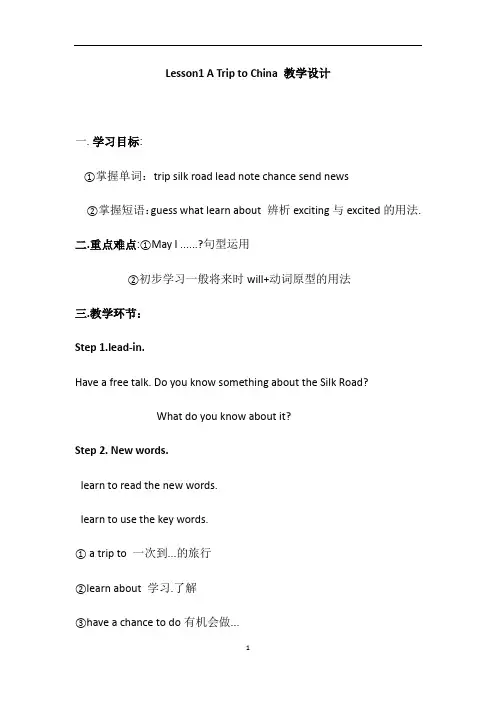
Lesson1 A Trip to China 教学设计一.学习目标:①掌握单词:trip silk road lead note chance send news②掌握短语:guess what learn about 辨析exciting与excited的用法.二.重点难点:①May I ......?句型运用②初步学习一般将来时will+动词原型的用法三.教学环节:Step 1.lead-in.Have a free talk. Do you know something about the Silk Road?What do you know about it?Step 2. New words.learn to read the new words.learn to use the key words.① a trip to 一次到...的旅行②learn about 学习.了解③have a chance to do有机会做...④lead...to...引导...去...⑤a piece of news一条新闻Step 3. Listen and answer.Listen and write true(T)or false(F).1.Jenny is learning about the Silk Road this month in school.( )2.Li Ming's school is planning a trip to Canada.( )3.Ms.Martin will go to China with the students.( )Step 4.Read and answer.1.What is Jenny's school planning?2.Who will lead the trip?3.What does Mrs.Smith think about the trip?4.Why will Jenny send Li Ming an e-mail?Step nguage points.1.We're learning about the Silk Read this monthLearn about“了解,学习,得悉”,E.g. The students learned about Chinese history last weekI learned about the news on TV.我是在电视上知道2.Mum and Dad,may I ask you a question?Mayl..?意为“我可以……吗?”肯定回答Yes,you may/Sure,you may./Sure.否定回答No,you may not/Sorry,you3.My school is planning a trip around China withplan动词,“计划”,make a plan for. 名词,“计划”We should plan our holiday.= We should make a plan for our holiday. 4.Who will lead the trip?谁将带领(你们)旅行呢?lead“带领,领导,Ms.Wang will lead us to the top of the mountain.王老师将带领我们到山顶。
新冀教版 七年级下英语UNIT1教案
2. May I ask you a question?
May I….? 表达有礼貌的请求。肯定回答:Yes, you may. 还可以
用 Sure, Certainly, Of course. 否定回答:No, you may not. 还可以
用 Sorry, you can’t. You’d better not.
明天想离开上海。
前往,离开去某地 leave for sp. E.g. He wants to leave for
Shanghai tomorrow. 他明天要去上海。(相当于 He wants to go to
Shanghai tomorrow)
注意:leave 和 forget 的区分。当表示“把某物忘在某地”时,用 leave
( )2.My friend Tom_____a new bike next week.
A. buy B. buys C. will buy D. is buying
( )3.-May we___here? -Yes, you may.
A. live in B. live C. to live D . to live in
sth sp.
E.g. He forgot his book. / He left(leave 的过去式) his book at
home.
五、短语汇总
1.见某人 meet sb. 2. 第一站 the first stop
3. 多远 how
far
4. 从…到… from…to
5. 特别的东西 something special
新冀教版 七年级下英语 UNIT1 教案
课题
Lesson 1 A Trip to China
【冀教版七年级英语下册】Unit1Lesson1ATriptoChina教案
教材课题教课目标教课要点教课难点教课方法Unit 1 Lesson 1冀教版英语讲课时间主讲人七年级下册讲课班级Lesson 1 A trip to China课课时安排型1.Remember the new words and phrases, master the meaning of text.2.Make sure the Ss can learn some trip experience.3.Learn and talk about their trip experience.Words and phrases; learn a trip to China; a few important sentences.1. Learn how to ask for permission2. Students will be able to use “ will ” to express something Listening,speaking, reading, writing and practice.教课资源教课步骤教学过程设Electronic whiteboard, Multimedia courseware, A recorder.教师活动Step 1 Analysis of the student.After a long holiday, the Ss came back to school. Now,the Ss have a new school year, so many Ss have newplans about their learning. And they have a new subject.Step 2 Lead in.1.Greet the students in English and make sure they canresponse correctly.Do the duty report: a student on duty can saywhatever he/she likes to say.2.Ask some Ss talk about the following questions:How do you like the first day of a new term? Doyou have any new subjects?Do you think you will like them?How many new classmates do you have?May I ask you a question?学生活动调整与思虑Ask one student toread the title ofLesson 1Ask the students justto listen.Let the students doLet ’ s Do it 1Let the students doLet ’ s Do it 2计Step 3 New lesson.No. 1 Prepare lessons before class.Teach the new words and phrases. Make sure theSs can read it correctly.No. 2 Text: Give them some time to read the textthemselves. Then let them act out the dialogue ingroups. Correct their pronunciation whennecessary. At last, the teacher explain the text inChinese, make sure the Ss can understand themeaning of text.No. 3 Ask the Ss to finish the following questions:1.How many new classmates does Danny have?What are their names?2.What advice does Li Ming give Danny onhow to start a conversation with Danny? Ask some students and answer in pairs.3. Li Ming has a new subject this year. What is it?4. What will Li Ming do to prepare for his class教tomorrow? Why?学No. 4 Some important phrases and sentences:trip, silk, road, lead, note, chance, send, news, learn过aboutNo. 5 Review the grammar:程 1. the present tense 2.will/ be going to 3.There be/We have设No. 6 Complete Let’ s Do it!计Step 4 Play the tape for the Ss to follow.Make the Ss listen the text, then let them read follow the tape.Ask the studentsto课Step 5 Summary.finish the exercise堂Sum up the text what we learned, the new words,phrases, and sentences.检Sum up the grammar.测Step 6 课堂检测一、用所给词的合适形式填空。
冀教版英语七年级下册Unit1Lesson1AtriptoChina.课程教学设计
Teaching PlanBackground Students: Junior high school students, Grade 1informationLesson duration: 40 minsTeaching Lesson 1 A Trip to ChinacontentsTeaching By the end of the class, students should be able to:objectives1. master these words and phrases: trip, silk, road, note,chance, send, news, guess what, learn about;2. talk about Jenny’s travel plan;3. learn how to express request;4. learn about the word will when talking about future. Teaching key Vocabulary of this lessonpointsFocus of structure: May I ask you a question;Who willlead the trip; I will send Li Ming an e -mail and tell himthe good news.Teaching The usage ofwill when we talk about the future. difficultpointsTeaching blackboard, PPTaidsTeaching Step1 Teacher lead in by the following questions:proceduresLead -in 1. Did you have a happy winter vocation?And 2. What did you do in the holiday?Warming3. Where did you go in this holiday?upThen teacher and students share theirholiday about their travel.Step2 1. Ask students to the listening of Let ’ s DoIt! No.1.Listening2. Check the answer.Step3 1. Students read the dialogue after theteacher.Reading2. Students read together.3. Let students practice the dialogue withpartners and ask several groups to show infront of the class.Step3Explain the related language points andLanguage help students understand the text better.pointsStep4 1. Give a general review of what we havelearned so far.Conclusion2. Let students read the text together again. Blackboard Lesson 1 A Trip to Chinadesign1. guess what 猜猜看;你猜怎么着2. learn about 学习;认识3.—May I ask you a question?—Yes, you may./ No, you may not.4.send sb. sth. ~ send sth. to sb. 给某人寄某物5.tell sb. sth. ~ tell sth. to sb. 告诉某人某事6.will+V 原形。
冀教版英语七下Unit1《Lesson1ATriptoChina》精品说课稿
冀教版英语七下Unit 1《Lesson 1 A Trip to China》精品说课稿一. 教材分析冀教版英语七下Unit 1《Lesson 1 A Trip to China》是一篇介绍中国旅游景点的阅读文章。
通过讲述一位美国学生在中国旅游的经历,让学生了解中国的自然风光和文化遗产,提高他们的英语阅读能力。
教材内容丰富,插图精美,激发学生学习兴趣。
二. 学情分析七年级学生已具备一定的英语基础,对日常生活和简单的人文知识有所了解。
但他们在阅读长篇阅读材料时,可能会遇到生词和语法难点。
因此,在教学过程中,需要关注学生的个体差异,调动他们的学习积极性,帮助他们克服学习困难。
三. 说教学目标1.知识目标:让学生掌握文章中的关键词汇和语法知识,提高阅读理解能力。
2.能力目标:培养学生的英语听说能力,使他们在日常生活中能运用所学知识进行交流。
3.情感目标:激发学生对中华文化的兴趣,增强他们的民族自豪感。
四. 说教学重难点1.重点:文章中的关键词汇和语法知识。
2.难点:理解文章内容,运用所学知识进行实际交流。
五. 说教学方法与手段1.交际法:通过小组讨论、角色扮演等形式,让学生在实际语境中运用英语。
2.情境教学法:利用图片、视频等资源,创设生动直观的学习情境。
3.任务型教学法:引导学生参与各种实践活动,提高他们的综合语言运用能力。
六. 说教学过程1.导入:展示中国旅游景点的图片,引导学生谈论自己喜欢的景点,激发学习兴趣。
2.阅读理解:让学生阅读文章,回答相关问题,检测他们对文章内容的理解。
3.词汇学习:讲解文章中的关键词汇和语法知识,让学生进行实际操作,巩固所学。
4.口语练习:分组进行角色扮演,让学生将所学知识运用到实际交流中。
5.听力训练:播放与文章相关的听力材料,提高学生的听力水平。
6.写作练习:让学生根据文章内容,写一篇关于中国旅游景点的短文。
7.总结与拓展:对本节课所学内容进行总结,引导学生进一步了解中国文化。