
中国海洋大学2018年《211 翻译硕士英语》考研大纲
中国海洋大学2018年《211翻译硕士英语》考研大纲
一、考试性质
本考试是一种测试应试者单项和综合语言能力的尺度参照性水平考试。
二、考察目标
要求考生:
1.具有良好的英语基本功,认知词汇量在10000以上,掌握积极词汇6000以上,能正确而熟练地运用常用词汇及其常用搭配;
2.能熟练掌握正确的英语语法、结构、修辞等语言规范指示;
3.具有较强的英语阅读理解能力和英语写作能力。
三、考试形式
本考试为闭卷考试,满分为100分,考试时间为180分钟。
试卷结构:选择50%;简答20%;写作30%。
四、考试内容
本考试包括以下部分:词汇语法、阅读理解、英语写作等。
总分为100分。
(一)词汇语法
1.测试要求
(1)词汇量要求:
考生的认知词汇量应在10,000以上,其中积极词汇量为6,000以上,能正确而熟练地运用常用词汇及其常用搭配。
(2)语法要求:
考生能正确运用外语语法、结构、修辞等语言规范知识。
2.题型:
多项选择或改错题
(二)阅读理解
1.测试要求:
(1)能读懂一般英美报刊杂志上的专题文章、历史传记及文学作品等各种文体的文章,既能理解其主旨和大意,又能分辨出其中的事实与细节,并能理解其中的观点和隐含意义。
(2)能根据阅读时间要求调整自己的阅读速度。
2.题型:
(1)多项选择题(包括信息事实性阅读题和观点评判性阅读题。
)
(2)简答题(要求根据所阅读的文章,以限定篇幅扼要回答问题,重点考查阅读综述能力。
)
本部分题材广泛,体裁多样,选材体现时代性、实用性;重点考查通过阅读获取信息和理解观点的能力;对阅读速度有一定要求。
(三)外语写作
1.测试要求:
考生能根据所给题目及要求撰写一篇400词左右的记叙文、说明文或议论文,要求语言通顺,用词得体,结构合理,文体恰当。
2.题型:
命题作文
五、是否需使用计算器
否。
文章来源:文彦考研。
西南石油大学211翻译硕士英语2018硕士研究生考试大纲

西南石油大学全日制翻译硕士专业学位(英语笔译)研究生入学考试《翻译硕士英语》考试大纲一、考试目的:《翻译硕士英语》作为全日制翻译硕士专业学位(MTI)入学考试的外国语考试,目的是考察考生是否具备进行MTI学习所要求的英语水平。
二、考试性质与范围:本考试是一种测试应试者单项和综合语言能力的尺度参照性水平考试。
考试范围包括MTI考生应具备的英语词汇量、语法知识以及英语阅读与写作等方面的技能。
三、考试基本要求1. 具有良好的英语基本功,认知词汇量在10,000以上,掌握6000个以上的积极词汇,即能正确而熟练地运用常用词汇及其常用搭配。
2. 能熟练掌握正确的英语语法、结构、修辞等语言规范知识。
3. 具有较强的阅读理解能力和英语写作能力。
四、考试形式本考试采取客观试题与主观试题相结合,单项技能测试与综合技能测试相结合的方法。
各项试题的分布情况见“考试内容一览表”。
五、考试内容:本考试包括以下部分:词汇语法、阅读理解、英语写作等。
总分为100分。
I.词汇语法1. 要求1)词汇量要求:考生的认知词汇量应在10,000以上,其中积极词汇量为5,000以上,即能正确而熟练地运用常用词汇及其常用搭配。
2)语法要求:考生能正确运用英语语法、结构、修辞等语言规范知识。
2. 题型:选择题II. 阅读理解1.要求:1)能读懂常见英美报刊上的专题文章、历史传记及文学作品等各种文体的文章,既能理解其主旨和大意,又能分辨出其中的事实与细节,并能理解其中的观点和隐含意义。
2)能根据阅读时间要求调整自己的阅读速度。
2. 题型:1)选择题(包括信息事实性阅读题和观点评判性阅读题)2) 简答题(要求根据所阅读的文章,用3-5行字数的有限篇幅扼要回答问题,重点考查阅读综述能力)3)释义题(对所阅读文章中的某些具有隐含意义或修辞特色的句子,要求用直白的语言表达其内涵含义)本部分题材广泛,体裁多样,选材体现时代性、实用性;重点考查通过阅读获取信息和理解观点的能力;对阅读速度有一定要求。
2011年中国海洋大学211翻译硕士英语考研真题及详解【圣才出品】
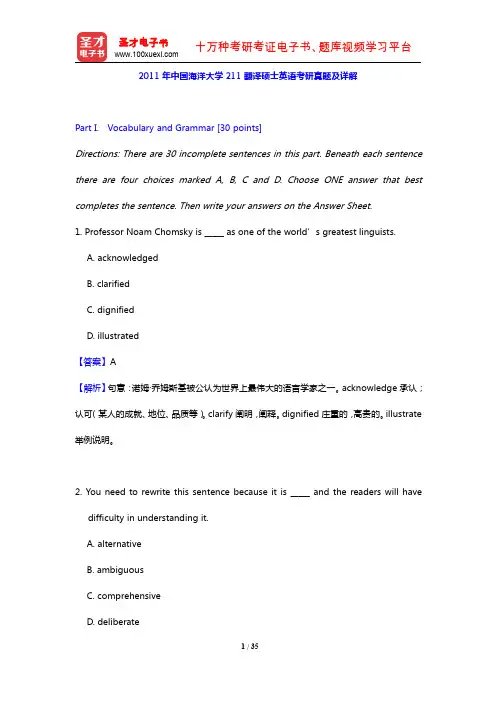
2011年中国海洋大学211翻译硕士英语考研真题及详解Part I.Vocabulary and Grammar[30points]Directions:There are30incomplete sentences in this part.Beneath each sentence there are four choices marked A,B,C and D.Choose ONE answer that best completes the sentence.Then write your answers on the Answer Sheet.1.Professor Noam Chomsky is_____as one of the world’s greatest linguists.A.acknowledgedB.clarifiedC.dignifiedD.illustrated【答案】A【解析】句意:诺姆·乔姆斯基被公认为世界上最伟大的语言学家之一。
acknowledge承认;认可(某人的成就、地位、品质等)。
clarify阐明,阐释。
dignified庄重的,高贵的。
illustrate 举例说明。
2.You need to rewrite this sentence because it is_____and the readers will havedifficulty in understanding it.A.alternativeB.ambiguousprehensiveD.deliberate【答案】B【解析】句意:你需要改一下这句话,因为意思上模棱两可,读者很难理解。
ambiguous 不明确的,模棱两可的。
comprehensive广泛的。
alternative可选择的。
deliberate故意的。
3.The social environment has a_____effect on young people’s academic progress.pleteB.grossC.profoundD.solid【答案】C【解析】句意:社会环境对年轻人的学业进步有深刻的影响。
海大《翻译硕士英语》模拟试题
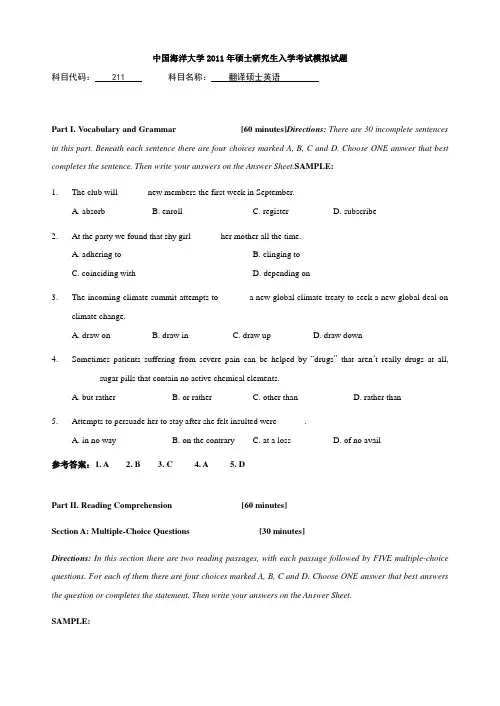
中国海洋大学2011年硕士研究生入学考试模拟试题科目代码: 211 科目名称:翻译硕士英语----------------------------------------------------------------------------------------------------------------------Part I. V ocabulary and Grammar [60 minutes]Directions: There are 30 incomplete sentences in this part. Beneath each sentence there are four choices marked A, B, C and D. Choose ONE answer that best completes the sentence. Then write your answers on the Answer Sheet.SAMPLE:1.The club will ______ new members the first week in September.A. absorbB. enrollC. registerD. subscribe2.At the party we found that shy girl ______ her mother all the time.A. adhering toB. clinging toC. coinciding withD. depending on3.The incoming climate summit attempts to ______ a new global climate treaty to seek a new global deal onclimate change.A. draw onB. draw inC. draw upD. draw down4.Sometimes patients suffering from severe pain can be helped by “drugs”that aren’t really drugs at all,______ sugar pills that contain no active chemical elements.A. but ratherB. or ratherC. other thanD. rather than5.Attempts to persuade her to stay after she felt insulted were ______.A. in no wayB. on the contraryC. at a lossD. of no avail参考答案:1. A 2. B 3. C 4. A 5. DPart II. Reading Comprehension [60 minutes]Section A: Multiple-Choice Questions [30 minutes]Directions: In this section there are two reading passages, with each passage followed by FIVE multiple-choice questions. For each of them there are four choices marked A, B, C and D. Choose ONE answer that best answers the question or completes the statement. Then write your answers on the Answer Sheet.SAMPLE:Family MattersThis month Sing apore passed a bill that would give legal teeth to the moral obligation to support one’s parents. Called the Maintenance of Parents Bill, it received the backing of the Singapore Government.That does not mean it hasn’t generated discussion. Several member s of the Parliament opposed the measure as un-Asian. Others who acknowledged the problem of the elderly poor believed it a disproportionate response. Still others believed it would subvert relations within the family: cynics dubbed it the “Sue Y our Son” la w.Those who say that the bill does not promote filial responsibility, of course, are right. It has nothing to do with filial responsibility. It kicks in where filial responsibility fails. The law cannot legislate filial responsibility any more than it can legislate love. All the law can do is to provide a safety net where this morality proves insufficient. Singapore needs this bill not to replace morality, but to provide incentives to shore it up.Like many other developed nations, Singapore faces the problems of an increasing proportion of people over 60 years of age. Demography is inexorable. In 1980, 7.2% of the population was in this bracket. By the end of the century that figure will grow to 11%. By 2030, the proportion is projected to be 26%. The problem is not old age per se. It is that the ratio of economically active people to economically inactive people will decline.But no amount of government exhortation or paternalism will completely eliminate the problem of old people who have insufficient means to make ends meet. Some people will fall through the holes in any safety net.Traditionally, a person’s insurance against poverty in his old age was his family. Lifts is not a revolutionary concept. Nor is it uniquely Asian. Care and support for one’s parents is a universal value shared by all civilized societies.The problem in Singapore is that the moral obligation to look after one’s parents is unenforceable. A father can be compelled by law to maintain his children. A husband can be forced to support his wife. But, until now, a son or daughter had no legal obligation to support his or her parents.In 1989, an Advisory Council was set up to look into the problems of the aged. Its report stated with a tinge of complacency that 95% of those who did not have their own income were receiving cash contributions from relations. But what about the 5% who aren’t getting relatives’ support? They have several options: (a) get a job and work until they die; (b) apply for public assistance (you have to be destitute to apply); or (c) starve quietly. None of these options is socially acceptable. And what if this 5% figure grows, as it is likely to do, as society ages?The Maintenance of Parents Bill was put forth to encourage the traditional virtues that have so far kept Asian nations from some of the breakdowns encountered in other affluent societies. This legislation will allow a person to apply to the court for maintenance from any or all of his children. The court would have the discretion to refuseto make an order if it is unjust.Those who deride the proposal for opening up the courts to family lawsuits miss the point. Only in extreme cases would any parent take his child to court. If it does indeed become law, the bill’s effect would be far more subtle.First, it will reaffirm the notion that it is each individual’s—not society’s— responsibility to look after his parents. Singapore is still conservative enough that most people will not object to this idea. It reinforces the traditional values and it doesn’t hurt a society now and then to remind itself of its core values.Second, and more important, it will make those who are inclined to shirk their responsibilities think twice. Until now, if a person asked family elders, clergymen or the Ministry of Communit y Development to help get financial support from his children, the most they could do was to mediate. But mediators have no teeth, and a child could simply ignore their pleas.But to be sued by one’s parents would be a massive loss of face. It would be a public disgrace. Few people would be so thick-skinned as to say, “Sue and be damned”. The hand of the conciliator would be immeasurably strengthened. It is far more likely that some sort of amicable settlement would be reached if the recalcitrant son or daughter knows that the alternative is a public trial.It would be nice to think Singapore doesn’t need this kind of law. But that belief ignores the clear demographic trends and the effect of affluence itself on traditional bends. Those of us who push for t he bill will consider ourselves most successful if it acts as an incentive not to have it invoked in the first place.31.The Maintenance of Parents Bill ______.A. received unanimous support in the Singapore ParliamentB. was believed to solve all the problems of the elderly poorC. was intended to substitute for traditional values in SingaporeD. was passed to make the young more responsible to the old32.By quoting the growing percentage points of the aged in the population, the author seems to imply that______.A. the country will face mounting problems of the old in futureB. the social welfare system would be under great pressureC. young people should be given more moral educationD. the old should be provided with means of livelihood33.The author seems to suggest that traditional values ______.A. play an insignificant role in solving social problemsB. are helpful to the elderly when they sue their childrenC. are very important in preserving Asian uniquenessD. are significant in helping the Bill get approved34.The author thinks that if the Bill becomes law, its effect would be ______.A. apparentB. indirectC. unnoticedD. straightforward35.At the end of the passage, the author seems to imply that success of the Bill depends upon ______.A. strict enforcementB. public supportC. government assuranceD. filial awareness参考答案:31. D 32. A33. C 34. B 35. DSection B: Short Answer Questions [30 minutes]Directions: In this section, there are two passages, each with five questions. Read the passages carefully. Then answer the questions by using the information given in each passage. Please write your answers on the Answer Sheet.SAMPLE:InterviewSo what have they taught you at college about interviews? Some courses go to town on it, others do very little. Y ou may get conflicting advice. Only one thing is certain: the key to success is preparation.There follow some useful suggestions from a teacher training course coordinator, a head of department and a headteacher. As they appear to be in complete harmony with one another despite never having met, we may take their advice seriously.Oxford Brookes University’s approach to the business of application and interview focuses on research and rehearsal. Training course coordin ator Brenda Stevens speaks of the value of getting students “to deconstruct the advertisement, see what they can offer to that school, and that situation, and then write the letter, do their CVs and criticize each other’s.” Finally, they role pl ay interviewer and interviewee.This is sterling stuff, and Brookes students spend a couple of weeks on it. “The better prepared students won’t be thrown by nerves on the day,” says Ms S t evens, “They’ll have their strategies and questions worked out.” She also says “the better the student, the worse the interviewee.” She believes the most capable students are lessable to put themselves forward. Even if this were true, says Ms Stevens, you must still make your own case.“Beware of infernality,” she advises. One aspira nt teacher, now a head of department at a smart secondary school, failed his first job interview because he took his jacket off while waiting for his appointment. It was hot and everyone in the staffroom was in shirtsleeves but at the end of the day they criticized his casual attitude, which they had deduced from the fact that he took his jacket off in the staffroom, even though he put it back on for the interview.Incidentally, men really do have to wear a suit to the interview and women really cannot wear jeans, even if men never wear the suit again and women teach most days in jeans. Panels respond instantly to these indicators. But beware: it will not please them any better if you are too smart.Find out about the people who will talk to you. In the early meetings they are likely to be heads of departments or heads of year. Often they may be concerned with pastoral matters. It makes sense to know their priorities and let them hear the things about you that they want to hear.During preliminary meetings you may be seen in groups with two or three other applicants and you must demonstrate that you know your stuff without putting your companions down. The interviewers will be watching how you work with a team. But remember the warning about informality: however friendly and co-operative the other participants are, do not give way to the idea that you are there just to be friends.Routine questions can be rehearsed, but “don’t go on too long,” advises the department head. They may well ask: “What have been your worst/best moments wh en teaching?”, or want you to “talk about some good teaching you have done.” The experts agree you should recognize your weaknesses and offer a strategy fo r overcoming them. “I know I’ve got to work on classroom management —I would h ope for some help,” perhaps. No one expects a new teacher to know it all, but they hope for an objective appraisal of capabilities.Be warned against inexpert questioning. Y ou may be asked questions in such a way that it seems impossible to present your best features. Some questions may be plain silly, asked perhaps by people on the panel who are from outside the situation. Do not be thrown, have ways of circumnavigating it, and never, ever let them see that you think they have said something foolish.Y ou will almost certainly be asked how you see the future and it is important to have a good answer prepared. Some people are put off by being asked what they expect to be doing in five or ten years’ time. On your preliminary visit, says the department head, be sure to give them a bit of an interview of your own, to see the direction the department is going and what you could contribute to it.The headteacher offers his thoughts in a nine-point plan. Iron the application form! Then it stands out from everyone el se’s, which have been folded and battered in the post. It gives an initial impression which may get yourapplication to the top of the pile. Ensure that your application is tailored to the particular school. Make the head feel you are writing directly to him or her. Put yourself at ease before you meet the interviewing panel: if you are nervous, you will talk too quickly. Before you enter the room, remember that the people are human beings too; take away the mystique of their roles. Listen. There is a danger of not hearing accurately what is being said. Make eye contact with the speakers, and with everyone in the room. Allow your warmth and humanity to be seen. A sense of humor is very important. Have a portfolio of your work that can link theory to practice. Many schools want you to show work. For a primary appointment, give examples from the range of the curriculum, not just art. (For this reason, taking pictures on your teaching practice is important.) Prepare yourself in case you are asked to give a talk. Have prompt cards ready, and don’t waffle.Y our speech must be clear and articulate, with correct grammar. This is important: they want to hear you and they want to hear how well you can communicate with children. Believe in yourself and have confidence. Some of the people asking the questions don’t know much about what you do. Be ready to help them.Thus armed, you should have no difficulty at all. Good luck and keep your jacket on!41.In Ms. Brenda Stevens’ view, what should applicants do before applying a job?42.How should interviewees handle the relationship between other participants during an interview?43.What are applicants suggested to do during an interview with regards to their weaknesses?44.What is the best way for applicants to deal with odd questions from the interviewers?45.Summarize the suggestions offered by the headteacher.参考答案:41.Applicants should understand thoroughly the situations before applying a job.42.When doing team work during an interview, applicants should always keep in mind that the point is todemonstrate their capacity rather than merely show friendship.43.Applicants are suggested to face their weaknesses squarely and offer possible solutions to overcome them.44.When asked odd questions, applicants should keep calm and try to be tactful in their answers.45.Suggestions put forward by the headteacher are mainly nine-fold: 1) iron the application form; 2) tailor theapplication letter to the particular school; 3) be at ease before the interview; 4) listen carefully; 5) make eye contact during the interview; 6) be warm and humor; 7) prepare a portfolio of your work; 8) prepare a talk in advance; and 9) be confident.Part III. Writing [60 minutes]Directions: Based on the information given below, please write an essay of about 400 words on the Answer Sheet. Y ou have 60 minutes to plan, write, and revise your essay.SAMPLE:With the development of human civilization, man has created countless wonders, but at what a price!Our ecological system, on which all animals’ exist ence depends, has been seriously damaged and isstill being threatened. The earth’s temperature is getting higher, more and more forests are beingfelled, large numbers of animals are facing extinction, and deserts are expanding at an incredible rate.With this growing emergency, your university plans to hold a forum, discussing global environment. Y ou are invited to deliver a speech on Global W arming. Please explain this phenomenon as thoroughly as possible so that students in your university have a better understanding of its causes.At the same time, you are required to provide feasible measures to call on students to protect our earth from getting hotter.Suggested title for the essay is:To Cope With Global W armingY ou may use your own title if you like.Marks will be awarded both for your linguistic knowledge (i.e., grammar, vocabulary and organization) and for your ability to achieve the communicative purpose.。
(NEW)中国海洋大学外国语学院《357英语翻译基础》[专业硕士]历年考研真题及详解
![(NEW)中国海洋大学外国语学院《357英语翻译基础》[专业硕士]历年考研真题及详解](https://360docs-1393072327.cos.ap-beijing.myqcloud.com/8a75da4b5ef7ba0d4b733b8f.webp)
22. 扩大内需 【答案】expand domestic demand
23. 资本市场 【答案】capital market
24. 体育彩票 【答案】sports lottery
25. 外交惯例 【答案】diplomatic practice
26. 求同存异 【答案】put aside minor differences so as to seek common ground
2. IQ 【答案】智商(intelligence quotient)
3. CPI 【答案】消费物价指数(Consumer Price Index)
2018年中国海洋大学翻译硕士(MTI)汉语写作与百科知识真题试卷(题

2018年中国海洋大学翻译硕士(MTI)汉语写作与百科知识真题试
卷(题后含答案及解析)
全部题型 2. 填空题
填空题
1.九州风气恃风雷,______。
正确答案:“万马齐喑究可哀”出自清代诗人龚自珍的诗集《己亥杂诗》。
2.天上碧桃和露种,______。
正确答案:“日边红杏倚云栽”出自唐朝高蟾的七言绝句《下第后上永崇高侍郎》。
3.好雨知时节,______。
正确答案:“当春乃发生”出自唐朝诗人杜甫的五言律诗《春夜喜雨》。
4.情人怨遥夜,______。
正确答案:“竟夕起相思”出自唐朝诗人张九龄的五言律诗《望月怀远》。
5.少小离家老大回,______。
正确答案:“乡音无改鬓毛衰”出自唐朝诗人贺知章的七言绝句《回乡偶书二首-其一》。
6.两个黄鹂鸣翠柳,______。
正确答案:“一行白鹭上青天”出自唐朝诗人杜甫的七言绝句《绝句》。
7.月落乌啼霜满天,______。
正确答案:“江枫渔火对愁眠”出自唐朝诗人张继的七言绝句《枫桥夜泊》。
8.独有英雄驱虎豹,______。
正确答案:“更无豪杰怕熊罴”出自毛泽东的七言律诗《七律-冬云》。
9.八百里分麾下炙,五十弦翻塞外声,______。
正确答案:“沙场秋点兵”出自宋代辛弃疾的词《破阵子-为陈同甫赋壮词以寄之》。
10.人生易老天难老,______,战地黄花分外香。
正确答案:“岁岁重阳。
今又重阳”出自毛泽东的《采桑子-重阳》。
中国海洋大学211翻译硕士英语2019年考研专业课真题试卷
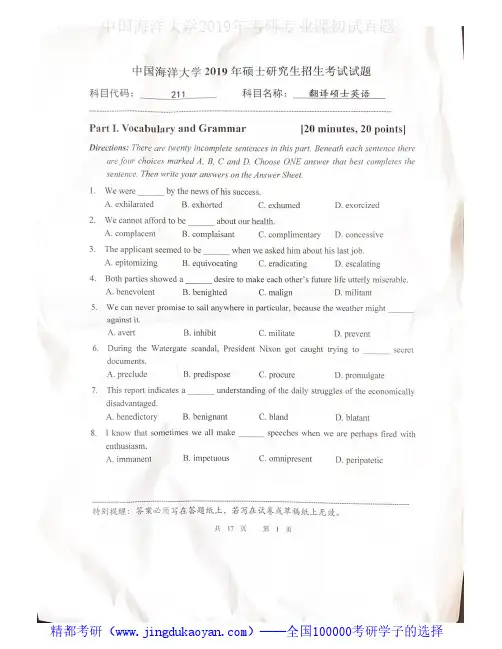
精都考研()——全国100000考研学子的选择
中国海洋大学2019年考研专业课初试真题
精都考研()——全国100000考研学子的选择
中国海洋大学2019年考研专业课初试真题
精都考研()——全国100000考研学子的选择
中国海洋大学2019年考研专业课初试真题
精都考研()——全国100000考研学子的选择
中国海洋大学2019年考研专业课初试真题
精都考研()——全国100000考研学子的选择
中国海洋大学2019年考研专业课初试真题
精都考研()——全国100000考研学子的选择
中国海洋大学2019年考研专业课初试真题
精都考研()——全国100000考研学子的选择
中国海洋大学2019年考研专业课初试真题
精都考研()——全国100000考研学子的选择
中国海洋大学2019年考研专业课初试真题
精都考研()——全国100000考研学子的选择
中国海洋大学2019年考研专业课初试真题
精都考研()——全国100000考研学子的选择
中国海洋大学2019年考研专业课初试真题
精都考研()——全国100000考研学子的选择
中国海洋大学2019年考研专业课初试真题
精都考研()——全国1000Fra bibliotek0考研学子的选择
中国海洋大学2019年考研专业课初试真题
精都考研()——全国100000考研学子的选择
中国海洋大学2019年考研专业课初试真题
精都考研()——全国100000考研学子的选择
中国海洋大学2019年考研专业课初试真题
精都考研()——全国100000考研学子的选择
中国海洋大学2019年考研专业课初试真题
2018年英语二考研大纲(精品文档).doc
文档下载后可编辑全国硕士研究生入学统一考试英语(二)考试大纲(非英语专业)(2018年版)I.考试性质英语(二)考试主要是为高等院校和科研院所招收专业学位硕士研究生而设置的具有选拔性质的全国统一入学考试科目。
其目的是科学、公平、有效地测试考生对英语语言的运用能力,评价的标准是高等学校非英语专业本科毕业生所能达到的及格或及格以上水平,以保证被录取者具有一定的英语水平,并有利于各高等学校和科研院所在专业上择优选拔。
II.考查内容考生应掌握下列语言知识和技能:(一)语言知识1.语法知识考生应能熟练地运用基本的语法知识,其中包括:(1)名词、代词的数和格的构成及其用法;(2)动词时态、语态的构成及其用法;(3)形容词与副词的比较级和最高级的构成及其用法;(4)常用连接词的词义及其用法;(5)非谓语动词(不定式、动名词、分词)的构成及其用法;(6)虚拟语气的构成及其用法;(7)各类从句(定语从句、主语从句、表语从句等)及强调句型的结构及其用法;(8)倒装句、插入语的结构及其用法。
2.词汇考生应能较熟练地掌握5500个左右常用英语词汇以及相关常用词组(详见附录相关部分)。
考生应能根据具体语境、句子结构或上下文理解一些非常用词的词义。
(二)语言技能1.阅读考生应能读懂不同题材和体裁的文字材料。
题材包括经济、管理、社会、文化、科普等,体裁包括说明文、议论文和记叙文等。
根据阅读材料,考生应能:(1)理解主旨要义;(2)理解文中的具体信息;(3)理解语篇的结构和上下文的逻辑关系;(4)根据上下文推断重要生词或词组的含义;(5)进行一定的判断和推理;(6)理解作者的意图、观点或态度。
2.写作考生应能根据所给的提纲、情景或要求完成相应的短文写作。
短文应中心思想明确、切中题意、结构清晰、条理清楚、用词恰当、无明显语言错误。
III.考试形式、考试内容与试卷结构(一)考试形式考试形式为笔试。
考试时间为180分钟。
满分为100分。
2010年中国海洋大学211翻译硕士英语考研真题及详解【圣才出品】
2010年中国海洋大学211翻译硕士英语考研真题及详解Part I.Vocabulary and Grammar[30points;60minutes]Directions:There are30incomplete sentences in this part.Beneath each sentence there are four choices marked A,B,C and D.Choose ONE answer that best completes the sentence.Then write your answers on the Answer Sheet.(30points)1.It was_____that the restaurant discriminated against black customers.A.addictedB.allegedC.ascribedD.assaulted【答案】B【解析】句意:有人指控这家餐馆歧视黑人顾客。
allege指控。
addict使上瘾。
ascribe把……归结于……。
assault袭击,攻击。
2.Professor Johnson was asked to_____his speech in order to allow the audience to raise questions.A.condenseB.conductC.constrainD.converge【答案】A【解析】句意:乔森教授被要求压缩其演讲内容,好为同学们留出提问的时间。
condense 压缩。
conduct实行。
constrain限制,约束。
converge聚集,汇集。
petition,we believe,_____the national character rather than corrupts it.A.confirmsB.enforcesC.intensifiesD.strengthens【答案】D【解析】句意:我们认为竞争只会增强而不会削弱民族性格。
2018年硕士研究生招生考试大纲.doc
2018年硕士研究生招生考试大纲014 外国语学院目录初试考试大纲 (1)211 翻译硕士英语 (1)213 翻译硕士日语 (2)216 翻译硕士朝鲜语 (4)240 英语 (5)241 日语A (7)242 法语 (8)243 德语 (9)357 英语翻译基础 (11)359 日语翻译基础 (12)362 朝鲜语翻译基础 (13)448 汉语写作与百科知识 (14)620 基础英语 (15)621 基础法语 (16)623 基础日语 (17)624 基础韩国语 (18)881 综合法语 (19)883 综合日语 (20)884 综合韩国语 (21)963 综合英语A (23)复试考试大纲 (24)050201英语语言文学 (24)050211外国语言学及应用语言学 (26)055101英语笔译(专业学位) (28)055102英语口译(专业学位) (29)050205日语语言文学 (31)055105日语笔译(专业学位) (32)055106日语口译(专业学位) (33)050210亚非语言文学 (34)055111朝鲜语笔译(专业学位) (35)050203法语语言文学 (36)初试考试大纲211 翻译硕士英语一、考试性质本考试是一种测试应试者单项和综合语言能力的尺度参照性水平考试。
二、考察目标要求考生:1.具有良好的英语基本功,认知词汇量在10000以上,掌握积极词汇6000以上,能正确而熟练地运用常用词汇及其常用搭配;2.能熟练掌握正确的英语语法、结构、修辞等语言规范指示;3.具有较强的英语阅读理解能力和英语写作能力。
三、考试形式本考试为闭卷考试,满分为100分,考试时间为180分钟。
试卷结构:选择50%;简答20%;写作30%。
四、考试内容本考试包括以下部分:词汇语法、阅读理解、英语写作等。
总分为100分。
(一)词汇语法1.测试要求(1)词汇量要求:考生的认知词汇量应在10,000以上,其中积极词汇量为6,000以上,能正确而熟练地运用常用词汇及其常用搭配。
2018考研英语大纲原文(word版)
2018考研英语大纲原文(word版)2018考研大纲于9月18日发布后,跨考考研将第一时间收录整理2018英语考研大纲原文,敬请关注!I. 考试性质英语(一)考试是为高等学校和科研院所招收硕士研究生而设置的具有选拔性质的全国统一入学考试科目,其目的是科学、公平、有效地测试考生对英语语言的运用能力,评价的标准是高等学校非英语专业本科毕业生所能达到的及格或及格以上水平,以保证被录取者具有一定的英语水平,并有利于各高等学校和科研院所在专业上择优选拔。
II.考查目标考生应掌握下列语言知识和技能:(一) 语言知识1. 语法知识考生应能熟练地运用基本的语法知识。
本大纲没有专门列出对语法知识的具体要求,其目的是鼓励考生用听、说、读、写的实践代替单纯的语法知识学习,以求考生在交际中能更准确、自如地运用语法知识。
2. 词汇考生应能掌握5500左右的词汇以及相关附表中的内容(详见附录1、2)。
除掌握词汇的基本含义外,考生还应掌握词汇之间的词义关系,如同义词、近义词、反义词等;掌握词汇之间的搭配关系,如动词与介词、形容词与介词、形容词与名词等;掌握词汇生成的基本知识,如词源、词根、词缀等。
英语语言的演化是一个世界范围内的动态发展过程,它受到科技发展和社会进步的影响。
这意味着需要对本大纲词汇表不断进行研究和定期的修订。
此外,全国硕士研究生入学英语统一考试是为非英语专业考生设置的。
考虑到交际的需要,考生还应自行掌握与本人工作或专业相关的词汇,以及涉及个人好恶、生活习惯和宗教信仰等方面的词汇。
(二) 语言技能*1. 阅读考生应能读懂选自各类书籍和报刊的不同类型的文字材料(生词量不超过所读材料总词汇量的3%),还应能读懂与本人学习或工作有关的文献资料、技术说明和产品介绍等。
对所选材料,考生应能:1) 理解主旨要义;2) 理解文中的具体信息;3) 理解文中的概念性含义;4) 进行有关的判断、推理和引申;5) 根据上下文推测生词的词义;6) 理解文章的总体结构以及上下文之间的关系;7) 理解作者的意图、观点或态度;8) 区分论点和依据。