
人教版英语七年级上册Unit 4 Where's my schoolbag教材全解及单元测试卷
人教版英语七年级上册Unit 4 Where's my schoolbag?教材全解及单元测试卷【教材内容解析】Section A1.Where are my books? (P. 19)where是疑问副词,意为“在哪里”,用来引导特殊疑问句,询问某人或者某物在哪里。
Where is your car?2.They’re on the sofa. (P. 19)on用作介词,表示“在……上”,表示位置关系,强调一个物体在另一个物体的表面上,且两个物体表面接触。
The pictures are on the wall.The book is on my desk.3.It’s under your bed. (P. 19)under用作介词,表示“在……下面”,强调处于某物的正下方,且两个物体不接触。
The car is under the tree.My shoes are under the bed.e on, Jack! (P. 20)come on此处表示“来吧、行啦”,还可以表示“加油、到这边来”。
Come on! This way, please.5.I think it’s in your grandparents’ room. (P. 20)think意为“认为、想、思考”。
I think the baseball is Bill’s.6.I don’t know. (P. 21)对他人的询问或提出的问题,若不知道或不清楚时,常用I don't know来回答,日常交际中,通常在前面加上sorry或者I’m sorry,显得更加礼貌些。
---Where is Li Ping?---Sorry, I don’t know.Section B1.tape player (P. 22)player此处用作可数名词,表示“播放机”。
a CD playera video player2.I’m tidy, but Gina is not. (P. 23)(1)tidy此处用作形容词,表示“整洁的、井井有条的”,反义词是untidy,意为“不整洁的”。
I like keeping tidy.He is a tidy boy.(2)but用作连词,意为“但是”,可以连接两个并列成分,表示前后意义上的转折或两种情况的对比。
My books are on the table, but hers aren’t.3.Gina’s books are everywhere-on her bed, on the sofa and under the chair. (P. 23) everywhere用作副词,表示“处处、到处、各个地方”相当于here and there。
In spring, we can see flowers everywhere.The balls are everywhere.4....Gina always asks. (P. 23)always用作副词,表示“总是”,表示动作发生的频率。
The boy is always late for school.【重点短语和句型归纳】重点短语1. on the sofa 在沙发上2. in the schoolbag 在书包里3. under the bed 在床底下4. come on 快点5. be tidy 整洁的6. tape player 录音机7. model plane 飞机模型8. have a clock 有一个时钟重点句型1. Where is my pencil box? 我的铅笔盒在哪?2. Where are my books? 我的书在哪?3. It’s under your bed. 它在你的床底下。
4. Come on, Jack. 快点儿,杰克。
5. I think it’s in your grandparents’ room. 我认为它在你(外)祖父母的房间里。
6. I don’t know. 我不知道7. I’m tidy. 我是爱整洁的人。
【语法讲解】方位介词in, on与under的用法介词常置于名词或代词之前,表示词与句子其他成分之间的关系。
一般在句子中不单独作任何成分。
常见的方位介词有on, in , under, at ,behind, next to等。
on 在……上面与物体有接触面on the wall 在墙上 on the floor 在地板上in 在…… 里面指在某范围或空间内in our class 在我们班上in my bag 在我的包里under 在……下面under the tree 在树下under the chair 在椅子下【单元测试卷】第Ⅰ部分听力部分(满分20分)Ⅰ. 情景反应:听录音,选择正确的答语补全对话。
每个句子读一遍。
(5分)1. A. The same to you. B. Not at all. C. OK.2. A. It’s five. B. It’s sunny. C. It’s June 1st.3. A. I think so. B. Good idea. C. I don’t think so.4. A. It’s Saturday. B. It’s June 2nd. C. It’s sunny.5. A. He is a worker. B. He is fine. C. He works in a factory.Ⅱ. 选择与所听句子内容相符的图片。
每个句子读一遍。
(5分)Ⅲ. 听对话,选择相应的图片。
每段对话读两遍。
(5分)11. ________12. ________13. ________14. ________15. ________ Ⅳ. 听短文,然后选择正确答案并给图画染色。
短文读两遍。
(5分)16. Wang Peng’s father is ________.A. in whiteB. an English teacherC. in black17. Wang Peng’s mother is ________.A. in redB. in blackC. in yellow18. Wang Peng’s father and mother ________.A. are both teachersB. are in redC. nine19. Wang Peng’s sister is ________.A. sevenB. thirteenC. nine20. Wang Peng is ________.A. studentB. in a brown sweaterC. a student第Ⅱ部分笔试部分(满分100分)Ⅰ. 根据句意和汉语或首字母提示补全单词(每小题1分,共10分)1. —Where are my pens ?—________(它们) are in the pencil case.2. The ________(数学) book is on the bed.3. I ________(能) see my CDs on the desk.4. Tom is in the ________(房间). He is sleeping(睡觉) .5. There is an alarm clock on the ________(书桌).6. B________your pictures here. Take the books there.7. The book is on the t________.8. —W________are my keys?—They are in the dresser.9. —Where’s my backpack?—It’s u________the table.10. —Where are the hats?—Sorry, I don’t k________.Ⅱ. 单项选择(每小题1分,共15分)1. —________is the baseball?—It’s under the bed.A. WhereB. HowC. WhatD. Where’s2. Please ________me to the school.A. takeB. bringC. callD. need3. —Is my book on the dresser?—________. I can see it.A. No, it isn’tB. Yes, it’sC. Yes, it isD. No, it is.4. —Where are the pencils?—________are on the desk.A. ItB. TheC. ThemD. They5. —________?—They’re our soccer balls.A. What’s thatB. What are thoseC. Who are theyD. Where are they6. —Where ________my pens?—Sorry, I ________now.A. is; don’tB. are; notC. are; don’tD. are; doesn’t7. This is ________pen. ________pen is nice.A. a; TheB. the; AC. an; AnD. the; /8. —Is the bag on the table?—________.A. It’s under the tableB. No, it isn’tC. Yes, they areD. They are on the sofa9. —Where are his pencils?—________.A. Yes, they areB. It’s on the deskC. I don’t knowD. No, they aren’t10. Where ________the CDs?A. areB. amC. isD. be11. —Where is the baseball ?—It’s ________the table ________the floor.A. on; underB. on; onC. on; underD. under; on12. My mother ________the room.A. is onB. is inC. inD. on13. Please take these things ________your mother.A. tooB. atC. toD. in14. —Is your jacket on the sofa ?—________.A. Yes, I amB. Yes , it isC. Yes, she isD. Yes, you are15. —________?—They are on the bed.A. Where are my keysB. What are theseC. Are they your keysD. Where is the keyⅢ. 选择方框中的单词补全短文,其中有两项多余(每小题1分,共5分)Hello! This is 1 room. In my room there is a bed, a desk 2 a chair. My bed 3 next to the desk. My shoes and soccer ball are 4 the bed. There are 5 pictures on the wall. They’re very nice. Oh, there is a clock and a map on the wall, too.Ⅳ. 句型转换(每小题1分,共10分)1. The ruler is on the desk. (对划线部分提问)________________the ruler?2. His books are under the chair. (对划线部分提问)________ ________his books?3. Our books are on the sofa.(改为否定句)Our books ________ ________on the sofa.4. This is my room.(改为一般疑问句并做否定回答)—________this ________room?—________, it ________.5. Where is your bag?(改为复数句)Where ________your ________?Ⅴ. 根据汉语提示完成下列句子(每小题2分,共10分)1. 你能把这些东西带到学校吗?Can you ________these things ________the school ?2. 帽子在梳妆台上。
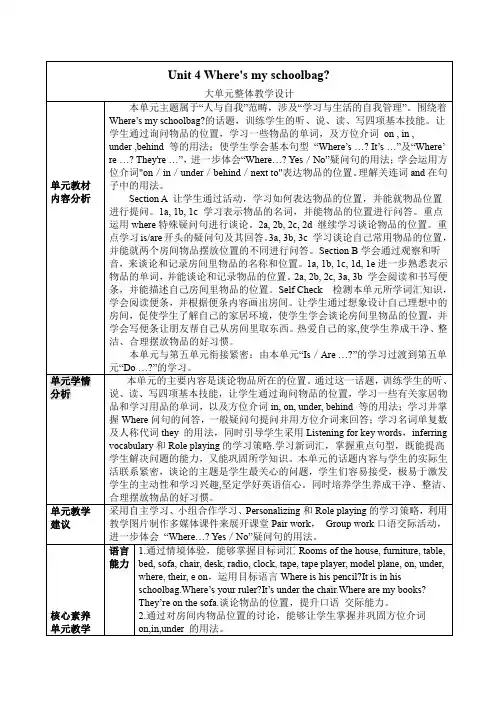
英语人教版七年级上 Unit 4 Where's my schoolbag教案

英语人教新课标七年级上Unit 4 Where's my schoolbag教案Period OneTeaching aims(教学目标)1、学会一些表示家具的名词以及学习用品的单词;2、学会方位介词:in, on, under…的用法;3、学会运用方位介词和Where句型表述物品的正确位置。
Language points(语言点)1.要求掌握以下句式:a--Where’s …?--It’s in/on/under…b--Where’re…?--They’re in/on/under…2、要求掌握以下单词:where, table, bed, bookcase, sofa, chair, in, on, under, they, they’re=they are.(Difficulties(难点):能够准确运用方位介词表达准确的物品位置。
Teaching steps(教学步骤)1.Warming up and revision(1)Daily greeting to the students:T: Hello, may I have your name?S: My n ame is…T: How are you?S: Fine, thanks.T: Nice to meet you.S: Nice to meet you, too.(2)Revision:T: What’s this ?S: It’s a pen.T: How do you spell it?S: P-E-N, pen.T: What color is it?S: It’s red.T: Good. Next, what’s that ?S: …2. Presentation(呈现新知识)Show the students a picture of a room, tell them this is a bedroom, let the students list the things in it first. Then show them the whole picture, teach the new words, ask where the things are, let the students answer, using the prepositions. 在新单词的教学过程中,一些有能力的学生可以将自己已有的认识水平与实际运用结合起来,使他们能体会到通过自主学习带来成功的满足感。
Unit4Where'smyschoolbag大单元整体教学设计人教版英语七年级上册
单元
重难点
重点:
1.学会一些表示家具的单词。
2.学会方位介词in,on,under等的用法。
3.能用方位介词和where引导的特殊疑问句谈论物品的正确位置。
难点:运用所学知识表达物品的位置。
单元
课时安排
教学内容
教学目标
教学重难点
(Grammar Focus~3c)
复习句型“Where is/are…?”及其答语,“Is it/Are they in/on/under…?”及其答语。
1.学会询问和确认物品的位置并给出答语。能够运用所学知识进行简单的会话交际,加强对语言目标的理解。
2.培养自己养成整理物品的习惯。
重点:where引导的特殊疑问句及其回答。
难点:方位介词的正确使用。
Period IVSection B
(1a~1f)
1.能正确听、说、读、写单词radio,clock,tape,player,model,plane,need等。
2.会正确运用由where,is/are开头的问句,口头描述某人房间的物品。
1.能够运用陈述句来描述物品的位置。
2.通过对房间内物品位置的讨论,能够让学生掌握并巩固方位介词on,in,under的用法。
学习
能力
1.通过观察图片,能够对听力内容进行预测,提高听力理解能力和策略运用能力。2.通过对话练习和小组合作,能够进行角色扮演并创编对话
思维
品质
1.通过各种活动,培养学生灵活运用语言知识和创新的能力,为完成学习任务而自觉采取一些适合自己的学习方法和手段。
难点:熟读短文并用方位介词复述课文,培养阅读能力。
七年级英语上册人教版Unit 4 Where’s my schoolbag?全英文教案
Where’s my schoolbag? (section A)教案Background information:Students: Class8,Grade7Teaching aims:1.Talk about where things are;2.Inquire where things are;3.Learn the using of preposition “on, in, under”Teaching contents: Talk about where things areMain structure:1.Where’s my schoolbag?It‘s under the table.2.Where are my books?They’re on the sofa.Main vocabulary:table, bed, bookcase, sofa, chair, on ,in, under.Teaching aids:Tape player, PPT.Teaching procedures:Step1. Warm-up1.Play a game.Using dialogue with the words which will be used in this class by showing pictures or things.(What’s that? It’s a/an…) (How do you spellit? ……)Step2. Presentation1.Let’s learnlearn the preposition of “in on under”.(Using cartoon pictures to help students understand these three words.)2.Let’s chant3.Pair workShow two things’ positions to teach target language (sentence).---- Where’s/Where’re …?---- It’s/They’re on/in/under the ….Look at the pictures and do the pair work.4.Activity 1aMatch the words with the pictures.Step3. Practice1.Do the exercises2.Do some listening practicesStep4.ConsolidetationPlay a game (Memory challenge).Step5. Homework1.Copy and recite the new words.2.Make a conversation to describe your room.Blackboard design:Where is-----? Where are-----?It’s on/in/under-----. They’re on/in/under-----.Lesson plan for Unit4 Where’s my schoolbag?(Section A, period 1)Teaching aims:1. Language goalsKey vocabulary: table, bed, bookcase, sofa, chair, where, on, under. Target language: Where’s my schoolbag? It’s under the table.Where are my books? They’re on the sofa2. Ability goalsTalk about where things are.Train the students’ communicative competence.3. Moral goalsKeep your room and tidy.Teaching important points:1. New words.2. How to talk about where things are.Teaching difficult points:1. Prepositions of place: in, on, under.2. Prepositional phrases: on the sofa, under the bed, etc.Teaching method:TBLTeaching procedures:Step1 Warming UpRevise some school things by asking questions: T: what is this? ----S: It is a/an…T: What are these? ----- S: They areStep2 Learn the new wordsShow the picture of my bedroom on the screen.Teach the new words: chair, table, bed ,bookcase, sofa.Read the words over and over again until the students can name each item fluently.Best eyes (read the words as quickly as they can)Pretend to look for my schoolbag here and there.T: I can’t find my schoolbag? Where is it? Do you know?Show the schoolbag in/on/under the chair.Let students perform as what teacher said.Step3 Practice(1) Present the key sentence patterns by using box, ball and erasers.(e.g., Where’s the ball? It’s in / on/ under the box.Where are the erasers? They’re in/on/under the box.)(2) Practice the key sentence patterns by pictures. (Q & A)(3) Pair work: choose some volunteer students to act out their own conversations.(4) Guessing game: guide the students to say out the positions of the things by using the sentence patterns.Step 4 SummarySummarize what students have learnt in this lesson.Step 5 Homework(1) Keep your room tidy and clean.(2) Use “in” “on” “under” to describe your bedroom.Blackboard design:总堂课,课堂气氛很活跃,学生积极发言,课堂效果不错。
七年级英语上册(人教版):Unit 4 Where's my school bag 教案
Unit 4Where's my school bag?第一课时Section A(1a-1c)1.重点单词:where,table,bed,bookcase,sofa,chair,on,under2.重点短语:on the sofa,in your bag,under your bed3.重点句型:—Where are my books?—They are on the sofa.—Where's my pencil box?—It's in your schoolbag.—Where's my computer game?—It's under your bed.1.能正确使用where引导的特殊疑问句2.用介词短语描述物品的位置1.能正确使用where引导的特殊疑问句2.用介词短语描述物品的位置一、预习课本P19新单词并背诵,完成下面的汉译英。
1.在哪里____________ 2.桌子____________3.床____________ 4.沙发____________5.椅子____________ 6.在……上________7.在……下__________二、认真预习1a,1b,1c,找出下列短语和句型。
1.在沙发上____________2.在你的书包里____________3.在你的床下____________4.—我的书在哪里?—他们在沙发上。
________________________________________________________________________ 5.—我的铅笔盒在哪里?—它在你的书包里。
________________________________________________________________________ 6.—我的电子游戏在哪里?—在你的床下。
________________________________________________________________________Step 1情景导入Teacher:We often lose our school things,like pens,pencils,erasers and other things.We must find them by ourselves,but sometimes we also ask others for help.Do you know how to ask and answer the location of the things?Let's learn together.环节说明:开门见山地提出本节课的语言知识目标,使学生能够明确学习任务,以最快的速度进入到课堂学习中去。
七年级英语上册人教版Unit4Where’smyschoolbag教学设计
七年级英语集体备课TopicUnit4 Where’ s my schoolbag?(Section B)Subject English Designer Li Huanhuan CollatorPeriod1User Date一、教课目的(知识与能力,过程与方法感情态度价值观)1.语言知识目标:1)掌握以下词汇: radio, clock, tape, tape player, model, plane, model plane, tidy, but, our, everywhere, always 。
2)能正确地描绘物件所处的地点。
3)能运用所学的句型咨询及回答物件的地点。
4)能听懂有关物件地点的对话,并能获取有关信息。
5)能阅读有关描绘物件地点的小短文,并能获取有关信息。
2.感情态度价值观目标:进一步培育学生齐整地摆放自己物件的生活习惯。
在描绘物件的地点的学习中获取英语学习的乐趣,逐渐培育学生们对英语学习的兴趣。
二、教课要点教课要点:1.经过听力训练提升学生听音辨音的能力,并能获取有关信息。
2.阅读描绘物件地点的有关短文,并能获取有关信息。
三、教课难点教课难点:阅读描绘物件地点的有关短文,并能获取有关信息。
四、教课工具教材,多媒体五、教课过程教师活动学生活动设计企图Step 1. Warm-up and revision1.Greetings.2.RevisionLet Ss look at the pictures in PPT. Ask and answer Review the words questions about the things in these pictures.and sentences.Step2. PresentationT: Let ’ s see a room of my friend and think aboutwhat are in his room and where are they.Step3. Practice1. Activity 1aT: First, let’ s read the words aloud in 1a.T:Now let’ s match the words with the things in the Ss read the words inpicture in one minute.Then T invites a S to check the answers.2. Activity 1bT asks Ss to look at the picture in 1a for three Ss match the wordswith the things in the minutes.Then close the books and write down thethings as many as possible.Invite two Ss to come picture in one minute. front and write their words on the blackboard.(Twogroups have a PK)通上内容的稳固复使学生快速融入到英堂中。
英语人教版七年级上册Unit4教案

Unit 4 –Where’s my schoolbag?Section A 1a-1cLi Ling Shangxu Middle SchoolTeaching objectives:Knowledge objectives:1) Grasp the words about the furniture, table, chair,sofa,bookcase,bed;2) Grasp some sentences to describe the positions ofthe thingsAbility objectives:1) learn to asking the location of the object andconfirm the position;2) use the sentences to have a little talk about thethings’ position.Important points:1) learn some words of furniture2) Learn the usage of some direction prepositions,such as in, on, under;Difficult points: How to use the direction prepositionsand where sentence talk about the right position ofthings.Teaching contents:New words: table, chair, bookcase, bed, sofa, in, on,under, whereNew sentences:1) Where is .....? It is on/ under/in/....2) where are .....? They are .....Teaching aids: blackboard, chalk, multimedia, paper, box.Teaching procedures:Step1. Review1.Talk with individual S to reviewing the following English:What’s this?/It’s a(n)…/Is this(that) your…/Yes,it is. It’s mine./No, it isn’t. It’s his/Are these(those) your…?/Yes, they are. They’re mine./No,they aren’t. They’re hers.T:What’s this? (There is a pen in the teacher’s hand.) S1: It's a pen.T: Is this yours?S1: Yes, it is.T: OK. Here you are. Now pay attention to this, theseare his/her books. Are these your books?S2: No,they aren’t.They’re his/hers.T: Excellent.(Hold up a pen, an erase, some books and so on. Ask the questions in the same way.)Step2. Autonomic learning ( New words)1. Prepare some pictures about furniture, ask the wholeclass “What’s this” and ask Ss to read the new words, such as bookcase, sofa, table, chair, bookcase, bed.etc.2. Ask several Ss to read and spell the new words.3. Play a game4. Finish 1a.(Write "table, sofa, chair, bookcase, bed " on the blackboard. )Step3. Lead-inShow a picture,and tell something about the picture, For example,T: A friend called Tom comes to our class today. He will have English class with you. Tom has a very big and beautiful room,Do you want to have a look?S: Yes.T: OK,but you must finish the task first,three tasks. Step4. Task 1: Look for Tom.1. Show some picture about Tom,ask the whole class T:Where’s Tom?( teach students to read where’s= where is) It’s on the box.S: It’s on the box.(teach students to read on, on ,on the box)T: Where’s Tom? It’s in the box.S:It’s in the box. (teach students to read in, in ,in the box)T: Where’s Tom? It’s under the box.S: It’s under the box. (teach students to read under, under ,under the box)(Write "in, on, under, Where’s Tom? It’s on the box " on the blackboard. )3. Do an exercise ( Look and Say)1) Show some picture , ask and answer.T: Where’s Tom?S: He’s under the table. …3)To describe the positions of the things in classroom,such as:T: Where is my book? It’s on the desk. (Put a book on the desk.)S1: It’s on the desk.T: Where is my pen? It’s in the pencil case. (Put a pen in the pencil case and ask.)S2: It’s in the pencil box.T: Where is my schoolbag? (Put a schoolbag under the desk and ask this question.)S3: It's under the desk.T: Where is my schoolbag? (To all the students)S s: It’s under the desk.4. Do actions.Ask the whole class to stand up and follow you do the actions. For example,T:on ,on ,on the desk( put the English book on the desk ) S:on ,on ,on the desk( put the English book on the desk )Put the English book in/under the desk and say. Then let the student do it by themselves again as quickly as they can.Step4. Task 2: Help Tom1. Show some picture that the student can’t see clearly,and ask,T: Where is the ball?S: It’s under the table.Show other pictures ,let the sudents ask and answer each other. Then show book on the desk, and ask,T: Where is the book?S: It’s on the desk?2. Show another book on the desk ,and ask,T: How many books are there ?S: Two.T:Where are the books? They are on the desk.S: They are on the desk.(Write " Where are the books? They are on the desk " on the blackboard. )3. Do an exercise ( Look and Say)1) Show some picture , ask and answer.T: Where are the balls?S: They are on the table. …2) To describe the positions of the things in classroom, such as:T: Whereare my book? They are on the desk. (Put somebooks on the desk.)S1: They are on the desk.T:Where are my pens? They are in the pencil case. (Put pens in the pencil case and ask.)S2: They are in the pencil box….4. Pairwork.Show some pictures and ask the students makeconversation in pairs5. GroupworkShow some sentences ,let the students discusstogether and find out the rules about how to use “is, are”.6. Do exercises1) The books ______ in the bookcase.2) The pen ______ on the desk.3) Where______ the map?4) The cat _______ under the desk.5) The keys ______ on the sofa.6) Where _______ the rulers?7) The schoolbag _______ on the bed.8) The cups _______ on the table.Step5. Task: Listen to Tom.Listeninga. Let Ss listen to the tape and finish 1b.b. Check the answers with the class.Step6. Emotion educationFinish the three tasks and get to Tom’s room. Showa picture about Tom’s room, and ask,T: Is it beautiful?S: Yes.T: Is it clean and tidy?S: Yes.Show another room ,and ask in the same way.T: Is it beautiful?S: No.T: Is it clean and tidy?S: No.Compare the two pictures ,teach students to keep their things clean and tidy.Step6. Choose the present and finish the exercises.一、英汉互译:1. 桌子 _______2.书架,书橱 _______3. 在...下______4.chair_____5. sofa ____二、翻译句子。
人教版英语七年级上册 Unit 4 Section A教案
Unit 4 Where’s my schoolbag?Section A (1a-2d)Pre-listening➢Ask Ss to see the picture and finish different tasks.Ask Ss to observe the picture and say the things in the picture.T: Look! There are many things in this picture. What can you see? (This part is about words, so T can encourage B level Ss to answer easy questions to build their confidence. )1a➢Ask Ss to match the words with the things in the picture in 1a. (Ask Ss to share the words one by one to make sure they can say the school things correctly and can spell the words correctly.)Answers: b e h g d a f c➢Ask Ss to see pictures and answer questions one by one.(Ask Ss to use the sentence pattern: —Where is …? —It’son/in/under…T must correct Ss grammar mistakes when they share their conversation in class. T can make a summary about the sentence pattern: —Where is …? T should also give examples about the sentence pattern: Where are … They are …)Language points:➢Get Ss to look at the picture of 1a again and ask them to answer the questions:Where’s my computer game?Where are my books?Where’s my pencil box?While-listening1b➢Ask Ss to listen and number the things [1-4] in 1b.T: We have talked about so many school things. Now let’s listen and number the things [1-4] in 1b.Answers: 1. books 2. pencil box 3. computer game 4. keys➢Step 2: Ask Ss to listen again and complete the conversation on P18.(When all the Ss have finished the exercise, T can ask them to read the conversation together. Then, T can show Ss the video of this conversation.)Post-listening1c & Pair work➢Ask Ss to practice the conversation in 1a with their partners. Tell Ss that they can make their own conversations using the words in the box in 1c.Native speakers do not always speak in complete sentences. This is especially true when they are responding to questions. Therefore, T may wish to have Ss practice the short answers to questions in addition to the long responses (e.g. under the table).1) come是不及物动词,其反义词为go,意为“去”。
人教新目标版七年级英语上册《Unit4-Where's-my-schoolbag》公开课说课稿
Unit4 Where’s my schoolbag? 说课稿尊敬的各位老师您们好,我今天说课的内容是:人教版新目标七年级上册第四单元的第一课时。
一、说教材料(一)教材分析本单元的话题是谈论物品的位置。
通过本课的学习,使学生学会基本句型“Where’s/Where are…? It’s/They’re on/in/under….”,进一步体会和学会运用目标语言where 引导的特殊疑问句,要求学生在掌握物品名称的基础上用方位介词on/in/under熟练地表达物品的位置,并能对where问句进行提问和回答。
通过本课的学习,既能让学生了解自己的家居环境,热爱自己的家,又能促使学生养成干净、整洁、合理摆放物品的好习惯。
(二)教学目标1、知识目标(1) 重点词汇: table,bed,bookcase,sofa,chair,where,in,on,under(2) 掌握并灵活运用重点句型: Where’s my pencil box? It’s in your schoolbag.Where’s my computer game? It’s under your bed.Where are t he books? They’re on the sofa.(3) 掌握方位介词on ,in ,under 的用法。
2、能力目标: 学会描述物品的位置,并能就物品的位置进行提问和回答。
3、情感态度与价值观目标: 培养学生养成干净、整洁、合理摆放物品的好习惯。
(三)教学重点和难点1、重点:学习掌握Where’s/Where are…?句型询问物品的位置和运用方位介词描述物品的所在位置。
2、难点:能够准确运用本课方位介词描述物品所在的位置。
代词it和they的正确使用。
(四)学情分析七年级学生的抽象思维能力较低,形象思维能力强,但注意力容易分散。
因此,我通过课件的导入,给学生展示形象的画面,在教学过程中增加有趣的游戏活动,从而增强学生的兴趣和唤起他们的注意力,进而充分调动学生的学习积极性和主动性。
人教版七年级上册英语-Unit4 Where’s my schoolbag 单元教案
Unit 4 Where’s my schoolbag?教案【单元教材分析】本单元以谈论物品位置(Things around the house)为话题,要求学生学会方位介词on,in,under,behind等的用法。
题材颇具现代气息,贴近学生日常生活,内容丰富,词汇量大,通过描述物品位置、找寻物品、设置理想化居室等系列活动,让学生在听、说、读、写、做中学习语言知识,培养运用语言知识的能力,激发创新精神。
【单元学情分析】本单元的主要内容是谈论物品所在的位置。
通过这一话题,训练学生的听、说、读、写四项基本技能,让学生通过询问物品的位置,学习一些有关家居物品和学习用品的单词,以及方位介词in,on,under,behind 等的用法;学习并掌握Where问句的问答,一般疑问句提问并用方位介词来回答;学习名词单复数及人称代词they 的用法,同时培养学生养成干净、整洁、合理摆放物品的好习惯。
【单元总体目标】知识目标:A. 掌握有关物品的新单词:table,bed,dresser,bookcase,sofa,chair,drawer,plant,bag,clock,tape,hat,etc;B. 熟练运用in,on,under介词;C. 熟练运用Where问句和一般疑问句及其回答;D. 掌握名词单复数及人称代词they的用法。
能力目标:A.学会用英语准确描述物品所在的位置;B. 学会用英语询问自己的或他人物品的具体位置;C. 能够合理地描述和设计房间。
情感目标:A. 培养学生整齐地摆放自己物品的生活习惯;B.通过小组对话、讨论、调查和设计等一系列的课堂活动,培养学生的合作精神。
学习策略:A. 交际策略: 学会与他人合作交流,并能把语言材料用到真实的生活中去;B.资源策略:学会利用一切可利用的学习资源,如词典,音像资料,网络等来获取更多的学习信息;C.认知能力:积极思考,及时反馈;D.调控策略:在反思,顿悟和自醒中不断调整自己的学习策略。
人教新目标七年级英语上册:Unit 4 Where's my schoolbag教案(含教学反思)
Unit 4Where's my schoolbag?Period 1 Section A (1a~1c)Teaching important points【教学重点】1.Key words & phrases:where,table,bed,bookcase,sofa,chair,on,under2.Key sentences:Where's my pencil box?It's in your schoolbag.Where are my books?They're on the sofa.Where's my computer game?It's under your bed.Teaching difficult points【教学难点】Be able to describe where the things are by using the prepositions correctly.Teaching aids【教具】pictures,CAI,objects,a tape playerTeaching procedures and ways【教学过程及方法】★Step Ⅰ Revision and lead-in复习导入Guessing game:T:What's in my bag?You can guess by using the sentence pattern “Is it a/an …?” to ask me.S1:Is it an apple?T:It sounds you like fruit very much.But it isn't an apple.S2:Is it a cellphone?T:No,it isn't.It's something that we need to write with.S3:Is it a pen?T:Well,let's have a look together.What's this?Ss:It's a pen.T:You are right.My pen is in my bag.Oh,where is my English book?Ss:Your English book is on the desk.T:Oh,yes,thank you!Today we will learn to tell where things are.★Step Ⅱ Self-studying and guiding自学指导Self-study guide 1:Self-study the new words:where,table,bed,bookcase,sofa,chair,on,under.Learn to pronounce them according to the phonetic symbols.And you can listen to the tapes to help you pronounce them correctly or ask others for help.Self-study guide 2:Self-study 1a,read the conversations by yourselves and match the words with the things in the pictures.Questions for thinking:(1)在桌子里面________________(2)在床上____________________(3)在椅子下面________________The teacher walks around the classroom to watch and help the students study while the students are self-studying.Encourage students to find out their problems in self-studying both in pronunciation and understanding.Time for questions:Discuss the difficulties that most students have and explain the language points that most students can't understand.Maybe it is necessary to discuss the usage of prepositions.★Step Ⅲ Check up检查核对Check up 1:Words teaching:Ask a few students to read the new words and help them correct the mistakes in pronunciation if necessary.Check up 2:Check the answers to Part 1a.Ask a team of students to give the answers one by one,and help them correct the mistakes in pronunciation if necessary.Then check the answers to exercises in self-study.Check up 3:Ask some students to make a conversation with their partner and see if they can respond correctly.★Step Ⅳ Cooperative inquiry合作探究1.Listening (1b)Listen and number the things[1-4].Play the recording twice.Then check the answers.2.Pair workMake some conversations with your partner using the words below.baseball bookcaseschoolbag tablebooks chairkeys sofaSample:A:Where is your baseball?B:It is under the chair.Where are your books?A:They are on the table.Where are my keys?B:They are on the sofa.…3.Act outAsk some pairs of students to act out their dialogs in front of the class. ★Step Ⅴ Practice 练习 一.对画线部分提问。