
冀教版七年级英语上lesson20
1. 我不得不去超市。 I have to go to the supermarket.
have to 不得不
后跟动词原形, 不得不做某事
我不得不去看医生。
I have to go to see a doctor.
What would you like to buy?
I’d like some meat. would like “想要” 和 want 用法相同 sth. would like 想要某物
to do
sth. 想要做某事
have to 不得不 后跟动词原形, 不得不做某事 would like “想要” 和 want 用法相同 sth. would like 想要某物
to do
sth. 想要做某事
4. everything 一切事物
5. meat 肉(不可数) 6. job 工作
满的;充足的 饼干 巧克力 一切事物 肉
工作
1. full
2. cookie 3. chocolate
4. everything
5.
T
1. 不得不 2. 充满…
have to
be full of write down 3. 写下来 4. 做得好! Good job!
1. 我不得不去超市?
I have to go to the supermarket.
2. 你想和我一起去吗?
Do you want to come with me?
3. 你想要买什么?
What would you like to buy?
4. 我可以把它写下来。
I can write it down.
1. Do you like to go to the supermarket? Yes, I do. 2. What would you like to buy? I’d like to buy some bread and milk.
1. full
满的;充足的
饼干 巧克力
2. cookie 3. chocolate
冀教版初中英语课件:20. Lesson 20 No Stopping!
Language Points
3. We will go past some of my favourite shops. go past“经过”,相当于walk past或pass。其中 pass作动词,past作介词 。 She saw a nice dress when she went __p_a_s_t__ the
The teacher p_o_i_n_t_e_d_t_othe blackboard and said: “you must look carefully.” The teacher _p_o_in_t_e_d_o_u__t many mistakes in my homework.
Language Points
New Words
bakery
New Words
biscuit
Pre-reading
Look at the pictures. What places do Jenny and Brian pass on their way to school?
Reading
Read and fill in the form.
2. Then cross the street. 然后穿过大街。 cross 动词,意为“横穿” 。 cross=go across,across为介词,不单独作谓语, 常和动词搭配使用。
B You must be careful when you __c_r_o_ss_ the road.
过马路时,你一定要小心。 Go _a_c_r_o_s_s_the bridge and you can see the hospital on your left. 过了桥,你就能在左边看到医院。
冀教版英语七年级上册_Lesson20_教材知识详解

Lesson20 教材知识详解1. Danny, I have to go to the supermarket. 丹妮,我得去超市。
have to表示在有外来压力的情况下“必须;不得不”,后接动词原形,可用于多种时态。
如:She had to look after her sick mother yesterday.昨天她不得不照顾她生病的妈妈。
(l)must为情态动词,也意为“必须”,表示说话人的主观看法,语气很强硬。
如:You must be careful! 你必须小心!(2)must的否定形式不能用don’t must,它和may,can这类词一样,要在后面加上not。
如:You mustn’t take the books out.你不准把书拿出去。
2. It’s full of delicious food. 它充满了美味的食物。
be full of为固定短语,意为“充满”。
如:His pockets were full of money.他的口袋里装满了钱。
(l)be filled with意为“装满了……”,相当于be full of,表示一个状态。
如:The bag is full of books.=The bag is filled with books.包里装满了书。
(2) fill...with…的主语通常是人,意为“用……装满……”,表示一个动作。
如:He filled the bag with clothes.他用衣服把包装满了。
food为名词,意为“食物”。
如:Do the twins like Chinese food? 那对双胞胎喜欢中国食物吗?(l)food意为“食物,粮食,(与饮料相对的)食品”时,为不可数名词。
(2)当表示特定种类的食品时,food可以作可数名词,其复数形式是foods。
(3)表示“饮食”要用food and drink,中英文顺序不同,不能说drink and food。
冀教版七年级上册unit 4 lesson 20 i like the supermarket
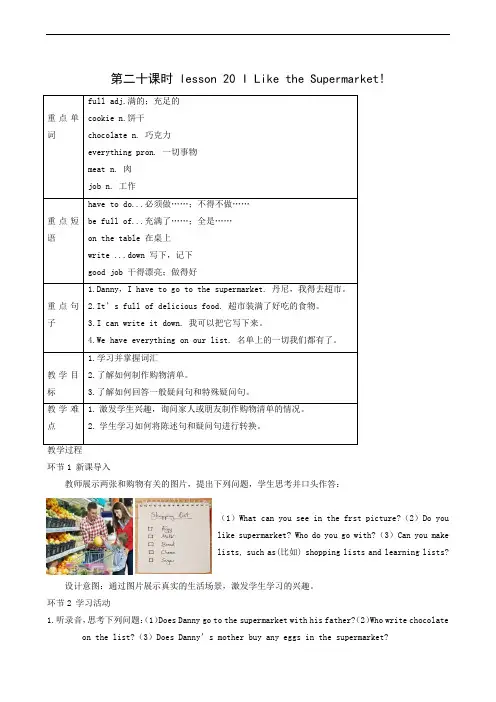
第二十课时 lesson 20 I Like the Supermarket!重点单词full adj.满的;充足的cookie n.饼干chocolate n. 巧克力everything pron. 一切事物meat n. 肉job n. 工作重点短语have to do...必须做……;不得不做……be full of...充满了……;全是……on the table 在桌上write ...down 写下,记下good job 干得漂亮;做得好重点句子1.Danny,I have to go to the supermarket. 丹尼,我得去超市。
2.It’s full of delicious food.超市装满了好吃的食物。
3.I can write it down. 我可以把它写下来。
4.We have everything on our list. 名单上的一切我们都有了。
教学目标1.学习并掌握词汇2.了解如何制作购物清单。
3.了解如何回答一般疑问句和特殊疑问句。
教学难点1.激发学生兴趣,询问家人或朋友制作购物清单的情况。
2.学生学习如何将陈述句和疑问句进行转换。
环节1 新课导入教师展示两张和购物有关的图片,提出下列问题,学生思考并口头作答:(1)What can you see in the frst picture?(2)Do youlike supermarket? Who do you go with?(3)Can you makelists, such as(比如) shopping lists and learning lists?设计意图:通过图片展示真实的生活场景,激发学生学习的兴趣。
环节2 学习活动1.听录音,思考下列问题:(1)Does Danny go to the supermarket with his father?(2)Who write chocolateon the list?(3)Does Danny’s mother buy any eggs in the supermarket?2.教师教读对话, 指导同学们勾画出重点句子,然后讲解。
初中冀教版英语七年级上册【教学课件】Unit 4 Lesson 20
河北教育出版社 七年级 | 上册
2.It’s full of delicious food. full用作形容词,意为“满的;饱 的”。be full of意为“充满了”。
The basket is full of eggs. 篮子里装满了鸡蛋。
河北教育出版社 七年级 | 上册
Finish the sentences with the correct forms of the given words. 1. He has thirteen peaches (peach). 2. She does her (she)homework at home every evening. to have 3. He wants (have)some fruit. 4. Jenny would like two bottles (bottle)of milk. 5. How manystrawberries (strawberry)do you have?
The shopping cart is full. Let’s pay the bill. The cart is full of products.
河北教育出版社 七年级 | 上册
cookie['kʊki] n. 饼干 chocolate ['tʃɔkəlit] n. 巧克力
This cookie is neither sweet nor soft. Chocolates are small sweets or nuts covered with a layer of chocolate. They are usually sold in a box.
河北教育出版社 七年级 | 上册
everything['evriθiŋ] pron. 一切事物
冀教版七年级英语上册Lesson20ILiketheSupermarket说课稿
(一)板书设计
我的板书设计注重清晰性和逻辑性,旨在帮助学生把握知识结构。板书布局分为三个部分:标题区、知识点区和总结区。标题区位于黑板顶部,清晰地标明课题“Lesson20 I Like the Supermarket”。知识点区按照教学内容的主线,从左到右依次列出本节课的核心词汇、句型以及课文要点。每个知识点旁边配以相应的实物图片或图示,增强直观性。总结区位于黑板右侧,用于总结本节课的主要学习点,包括重点词汇和句型的复习。板书风格简洁明了,避免过多冗余信息,确保学生能够快速识别和记忆关键信息。在教学过程中,我会适时更新板书内容,保持板书的整洁和有序,以确保学生能够清晰地跟随教学进度。
(二)媒体资源
在教学中,我将使用以下教具、多媒体资源或技术工具:单词卡片、PPT演示、实物图片、音频材料和在线互动平台。单词卡片有助于学生记忆和复习新词汇;PPT演示可以清晰地展示课程内容和结构;实物图片能够直观地呈现购物场景,增强学生的直观感知;音频材料可以提供标准的语音输入,帮助学生模仿和练习;在线互动平台则可以促进学生之间的交流和合作。这些媒体资源和技术工具的作用在于提供丰富的信息输入,激发学生的学习兴趣,以及促进学生的参与和互动。
课后,我将通过学生的课堂表现、作业完成情况和小组反馈来评估教学效果。具体的反思和改进措施包括:对学生的参与度进行观察和记录,分析哪些活动最有效;收集学生的作业和反馈,了解他们对知识点的掌握情况;根据评估结果调整教学计划和方法,以更好地满足学生的学习需求。此外,我还会定期与同事交流教学经验,不断优化教学策略,提高教学质量。
(3)能够运用所学知识,进行购物场景的口语交际。
2.过程与方法目标:
(1)通过阅读课文,培养学生的阅读理解能力。
(2)通过实践活动,提高学生的口语表达和交际能力。
冀教版英语七年级上册课件 Lesson 20 I Like the Supermarket!
讲解来自《点拨》
知识点 2 be full of 意思是“充满”,同义词组是be filled with。
eg:The box is full of books. =The box is filled with books.盒子里装满了书。
讲解来自《点拨》
知识点 3 everything /'evrIθIŋ/ pron.一切事物
Mrs. Dinosaur:I have a list. It’s on the table. Can you get it for me?
Danny:OK.
(Danny looks at the list.)
eggs milk bread chicken fish meat apples bananas donuts cookies chocolate
3.Danny and his mum have everything on their list. ( T )
【点拨】判断推理。根据文中“We have everything on our list.”可知。
Let's Do It !
2.Look at the pictures and fill in the blanks. 1.A:What would you like for breakfast?
讲解来自《点拨》
知识点
1 have to意思为“不得不”,有人称和数的 变化,后跟动词原形,它的第三人称单 数形式为has to。
eg:He has to go there by bus. 他不得不乘公共汽车去那儿。
考向 辨析have to 和must
讲解来自《点拨》
have to
强调由于客观原因而“不得 不”做某事,有时态变化。 否定形式为don’t have to, 意为“不必”。
冀教版英语七年级上册Unit4Lesson20教学设计
1.词汇方面:学生对与本课相关的新词汇掌握程度不一,部分学生可能在词汇记忆和运用方面存在困难。
2.语法方面:学生对一般现在时态的理解和应用能力有待提高,需要通过实例和练习来巩固。
3.阅读理解:选取一篇与本课主题相关的阅读材料,要求学生阅读并完成相关问题,提高阅读理解能力。
4.口语作业:学生分角色表演本课的对话,可以邀请家长或朋友参与,提高口语表达能力。
5.写作任务:请学生结合本节课所学的词汇和语法,编写一个关于图书馆借书的短故事,不少于50词。
6.观察作业:鼓励学生课后去图书馆实地观察,了解图书馆的布局、规则等,并将Βιβλιοθήκη 见所闻用英语记录下来,与同学分享。
3.口语表达方面:部分学生口语表达能力较弱,缺乏自信,需要在课堂上多给予机会和鼓励。
4.阅读理解方面:学生的阅读速度和阅读理解能力有待提高,需要在阅读实践中逐步培养。
因此,在教学过程中,教师应关注学生的个体差异,充分调动学生的学习积极性,采用分层教学、个性化辅导等方法,帮助学生克服学习困难,提高英语综合运用能力。同时,教师应注重培养学生的阅读兴趣,激发他们的学习内驱力,使他们在轻松愉快的氛围中学习英语。
-及时给予反馈和指导,帮助学生发现并改正写作中的错误。
6.情感态度与价值观培养:
-通过课堂讨论、小组活动等形式,引导学生树立正确的价值观。
-结合图书馆话题,教育学生遵守公共秩序,培养良好的社会公德。
-关注学生的情感需求,营造轻松、愉快的课堂氛围,提高学生的学习积极性。
四、教学内容与过程
(一)导入新课
冀教版-英语-七上--3单元 Body and Feelings-第20课教案
Lesson 20: Body◆课程导航【教学目标】1. 了解身体主要部位的名称2. 对所学内容能主动练习和实践3.让学生们在合作中完成教学任务,培养合作精神【教学重点】1. The new words and phrases of the section.2. Say the body parts in English.3. In simple E nglish , describe one’s own looking and others’.【教学难点】1. Undertand the instructions and do the right reactions, pointing out body parts.2. How to describe oneself and other people.3. Sing the song well.◆教学情景导入Hi, boys and girls. We have studied the instructions pronouns this, that. Do you know that the plurals of them? Let’s know about instructions pronouns, first keeping learning parts of our bodies. Ok, begin our class.◆教学过程设计Step 1. Revision Let some students draw body drawings on the blackboard. Then write the body parts that they have known.Step 2. Ok, let’s learn more new words. Show a picture of a body. Point at parts of the body and say the words “should, stomach, knee, finger, toe”. Make sure them understand what the meanings of the words.Step 3. Then the teacher points the parts of the body. And ask the students.T: What’s this/it? S: This/It is his …T: What are these/those? S: These/Those are his …Explain the two new words to the students, have them understand the meaning of thesentence.Step 4. Play the auditape as the students follow along in their student book.Step 5. Practise by themselves.Step 6. Show a big and a little thing, say the words “big/little” many times, let the students know about the words, in the same way, learn the words “long, short”.Step 7. Look at the pictures in Part Two and talk about monsters.Step 8. Listen to the song while the teacher does actions. And then ask students to listen to the song and do actions with you .Step 9. Ask some volunteers to sing and act in front of the class.Step 10. Homework. Singing the song until everyboday can sing the song well.◆课堂板书设计Lesson 20: Bodythere, those, little, long, shortshoulder, stomach , elbow, knee. Toe, fingerfoot – feet stomach - stomachs◆作业1. Finish the remaining exercises in the activity book.2. Preview the next reading in the student book.3. Review the words about the parts of the body.●教学反思学习语言离不开创造性思维,教学语言离不开反思研究。
冀教版七年级上册英语 Lesson 20 教案(教学设计)
Unit 4 Food and RestaurantsLesson 20 I Like the Supermarket!1.能够掌握课标要求的“四会”词汇:full,cookie,chocolate,everything,meat,job。
2.让学生了解如何制作购物清单。
3.让学生了解如何对一般疑问句和特殊疑问句进行回答。
1.掌握一些与购物清单制作有关的重点词汇:list,have,make,write,everything。
2.激发学生兴趣,询问家人或朋友制作购物清单的情况。
掌握以下重点句子:①Danny,I have to go to the supermarket.②What would you like to buy?③I can write it down.④Do we have everything on this list?Step 1:Lead-inLead-in by discussing the following questions:1.Where is the list?2.Does Danny have a list?3.What do they buy in the supermarket?Show some pictures of different food,drink and a list to the class. Let the students discuss the questions in groups. Then present their results in front of the class. The styles can be dialogues or reports.Step 2:ListeningListen to the tape and fill in the blanks with the words you hear:1.The supermarket is full of________.2.They buy________on the list.Finish the task in class orally.Step 3:ReadingRead the lesson and answer the following questions:1.Where does Mrs. Dinosaur have to go?2.What doesn’t the list have?Finish the task in class orally.Step 4:PracticeMake sentences with the language points:1.have toS1:They have to get up early tomorrow.2.write downS2:We must write down these words in our notebook.Step 5:ActivitiesAsk the students to introduce their shopping list in groups. At the same time,the teacher can walk around the classroom to see if they have any questions.Discuss for a while,and then let some students come to the front to show their introductions.Step 6:Come to “Let’s Do It!”Read the lesson again,and then ask the students to do Exercises 1—2 in class.Let the students work in groups and learn their classmates. Discuss for a while.Questions for you:1.Do you like to go shopping?2.How do you make a shopping list?1.Finish Exercises 3—5 in “Let’s Do It!”.2.Make a shopping list.。
冀教初中英语七年级上册Lesson 20 I Like the Supermarket课件
A E
B
A. Noodles. B. Eleven. C. A strawberry. D. Yes, I do. E. Yes, please.
Homework
你去超市都想买什 么,购物单分享给 你的同学。
感谢聆听
have?
Ⅲ. 从方框中找出下列各句的恰当答语。
1. What’s this?
C
2. Do you like rice?
D
3. What’s your favourite food?
4. Would you like some meat?
5. How many apples do you have?
New Words
Vocabulary
full
cookie
chocolate
everything
meat
job
Language points
Language points
Useful structures and expressions:
Do you want to come with me? be full of What would you like to buy? write down Good job!
Speaking
Exercises
Ⅰ. Exercises 1.
1. Do you like rice? Yes,__I___d_o__ . 2. Do you like meat? No, I __d_o_n_’t_. 3. Do you like fruit? Yes, I ___d_o__ . 4. Do you like peaches? No, I _d_o_n_’_t_ .