
新PEP人教版七年级下册英语Unit 6 Section A 2a-2d
wash the dishes
UNIT 6 SECTION A
exercise
What are they doing? They are exercising.
UNIT 6 SECTION A
What are they doing? They are cleaning.
Laura: Yeah. I’d love to. Jenny: Let’s meet at my home first.
Come at half past six. Laura: OK. See you then.
UNIT 6 SECTION A
Read the conversation in 2d and match.
doing? Laura: Not much. I’m just washing
my clothes. What about you?
UNIT 6 SECTION A
Jenny: I’m watching TV. Do you want to join me for dinner? My parents aren’t at home. We can eat out.
UNIT 6 SECTION A
Exercises
Ⅰ. 根据所给汉语补全下列英语句子。 1. 他们正在电话中交谈。
They are talking __o_n_ t_h__e_ p__h_o_n_e__.
2. 咱们七点钟见吧!
L_e_t_’_s_m__e_e_t_ at 7 o’clock.
3. 这个电视节目有点无聊。
人教版七年级英语下册
Unit 6
I’m watching TV.
Section A 2a-2d
UNIT 6 SECTION A
➢ Objectives
To learn to use present progressive tense.
To learn to use What questions.
To learn to talk about what people are doing.
The TV show is _k_i_n_d_ __o_f_ boring.
4. 你想和我们一起吃晚饭吗?
Do you want to _jo__in_ us f__o_r_ dinner?
5. 明天晚上见!
_S_e_e_ _y_o_u__ tomorrow evening!
UNIT 6 SECTION A
— Yes, he is. 3. Let me _s_e_e__. Oh, it’s a beautiful picture. 4. _L_o_o_k__ at the blackboard (黑板). What
can you _s_e_e__? 5. Don’t __re__a_d__ the newspaper when you walk.
UNIT 6 SECTION A
3. 他们正在和谁谈话? Who are they talking to?
4. 那听起来是个好主意. That sounds a good idea.
5. 我正在给我的朋友写信。 I’m writing a letter to my friend.
UNIT 6 SECTION A
UNIT 6 SECTION A
2a Listen and answer these questions.
1. What is Steve doing? He is watching TV.
2. What is Jack doing? He is listening to a CD.
UNIT 6 SECTION A
of _b_o_r_in_g____. Steve: Yeah, my TV show is also not very
in_t_e_r_e__st_i_n_g_. Do you want to _g_o__t_o_ the movies? Jack: That sounds good.
UNIT 6 SECTION A
UNIT 6 SECTION A
4. I'd love to. 我很乐意。 1) 交际用语,用于礼貌地接受他人邀 请,还可以说成I’d like to, 但语气比 较弱。 2) 当委婉拒绝他人邀请时,多用I’d love to, but...或Sorry, I’m afraid I can't because...等。
What is she doing? She is listening to a CD.
listen to a CD
UNIT 6 SECTION A
What is he doing? He is using the computer.
use the computer
UNIT 6 SECTION A
2. Call your best friend to know what he/she is doing.Make a conversation.
Ⅱ.用所给动词的适当形式填空。
1. It’s 7:20. Jane and her father a_r_e__w__a_lk_i_n_g (walk) in the park.
2. Look! The girl _i_s_p_l_a_y_i_n_g__(play) the piano. 3. _I__s_ Ben w__r_it_i_n_g_(write) a letter now? 4. The man _is___b_u_y_i_n_g__(buy) some vegetables
UNIT 6 SECTION A
What are they doing? They are watching TV.
watch TV
UNIT 6 SECTION A
What is she doing? She is talking on the phone.
talk on the phone
UNIT 6 SECTION A
UNIT 6 SECTION A
➢ Warming up
-What is he doing? -He is reading a newspaper.
read a newspaper
UNIT 6 SECTION A
-What is she doing? -She is making soup.
make soup
Laura
Jenny
eat out
want to
go to a movie
UNIT 6 SECTION A
Role-play the conversation in 2d.
UNIT 6 SECTION A
Let’s guess what they are doing.
Is Nancy doing homework? No, she isn’t. She’s writing a letter.
UNIT 6 SECTION A
2. Not much. (口语)没什么大事。 也可说成,nothing much 例如: A: What are you doing, Linda? 你在做什么事,琳达? B: Not (Nothing) much. I’m just reading a book. 没什么大事。我在读一本书。
UNIT 6 SECTION A
Is Tom doing homework? No, he isn’t. He’s drawing.
UNIT 6 SECTION A
1. This is Jenny. 我是詹妮。 这是打电话用语。当打电话时,介绍自己 时用“This is…”或“It’s…”;问对方 用“Is that…?”或“Who’s that?”例如: Hello? This is Bob. Who’s that? 喂?我是鲍勃,你是谁? Hi, Bob. It’s Mike here. 你好,鲍勃。我是迈克。
2b Listen again. Fill in the blanks.
UNIT 6 SECTION A
Jack: Hello, Steve. Steve: Hi, Jack. Jack: What_a__r_e__ you_d_o_i_n_g_, Steve? Steve: I’m _w_a_t_c_h_i_n_g__T_V_. What about you? Jack: I’ml_is_t_e_n_i_n_g__t_o__a__C_D_ , but it’s
Ⅳ. 翻译句子。
1. - 她正在干什么? - 她正在看电视。 - What is she doing? - She’s watching TV.
2. – Nancy 正在做她的作业吗? - 不,她没有。她正在写信。 - Is Nancy doing her homework? - No, she isn’t. She’s writing a letter.
UNIT 6 SECTION A
3. Do you want to join me for dinner? 你想和我一起吃饭吗? join sb for sth 与某人一起干某事/加入到某 人的行列一起干某事。如: Would you come and join us for party? 你愿意和我们一起聚会吗?
2c Role-play the conversation in 2b.
UNIT 6 SECTION A
2d Role-play the conversation .
Jenny: Hello? This is Jenny. Laura: Hi, Jenny. It’s Laura here. Jenny: Oh, hi, Laura. What are you
人教版七年级英语下册第六单元sectiona2a-2d学案
人教版七年级英语下册第六单元学案Unit6 It’s rainingSection A一、教师寄语:Don’t let the bad weather influence your good feeling.二、学习目标1、知识目标Words: rain,windy,cloudy,sunny,snow,weather,cook,study,bad,terrible,prettyDrills: --How’s the weather in Shanghai? --It’s cloudy.--What are you doing? --I’m watching TV2、能力目标学会谈论天气及描述你正在做的事3、情感目标培养学生热爱大自然,关心天气这种与人们生活密切相关的现象的情感。
三、教学重难点重点句型是:--How’s the weather in Shanghai? --It’s cloudy.--What are you doing? --I’m watching TV重点词汇是rain,windy,cloudy,sunny,snow,weather难点是现在进行时的用法四、Learning coursesStep1. 预习导学及自测完成下列单词。
下雨______ 下雪________ 有风的________ 阴天的______晴朗的_________cook(现在分词) ________study(单数第三人称)_________糟糕的_________Step2.情境导入1.Do 1a. Look at the pictures and match the words with the pictures in small groups.2.看图听1b的录音,把地名填入图中的方框里3.自我练习1c,根据上边的每张图进行问答:A: Hi! How’s the weather in Beijing?B: It’s sunny.(1) Practice the example conversation.(2) Make your own conversation in pairs.Step3 自主探究1.Summary:(1) 询问天气情况:_____________________ / _____________________?(2) 询问某人正在干什么:______________________________________ ?2. Do2a .Listen and number (1-4) the pictures as you hear them.Listen again and match the names with the activities.Step4 合作交流Do3a. Match the words with the faces in the box.Do3b. Pairwork.Talk about the weather with your friends in groups.Step5 拓展创新假设你是1689988信息台的话务员,请为外出的客户提供城市天气信息。
2020-2021学年人教版英语七年级下册Unit6SectionA(2a-2d)教案

1.针对语法难点,增加相关例句和练习,帮助学生更好地理解和掌握。
(五)总结回顾(用时5分钟)
今天的学习,我们了解了与天气相关的词汇、表达方式以及情态动词"may"和"might"的用法。同时,我们也通过实践活动和小组讨论加深了对天气情况的理解。我希望大家能够掌握这些知识点,并在日常生活中灵活运用。最后,如果有任何疑问或不明白的地方,请随时向我提问。
五、教学反思
在今天的教学过程中,我发现学生们对天气这个话题非常感兴趣,这让我感到很高兴。在导入新课环节,通过提问学生们日常生活中的天气情况,成功引起了他们对本节课的关注。在新课讲授中,我尝试用简单明了的语言解释了与天气相关的词汇和表达方式,学生们也表现出积极的参与态度。
-口语难点:教师可以通过角色扮演、小组讨论等活动,为学生提供实际运用英语的情境,鼓励学生大胆开口,并在必要时给予指导和纠正。
四、教学流程
(一)导入新课(用时5分钟)
同学们,今天我们将要学习的是Unit 6 Section A (2a-2d)这一章节。在开始之前,我想先问大家一个问题:“你们在日常生活中是否经常关注天气变化?”(举例说明)这个问题与我们将要学习的内容密切相关。通过这个问题,我希望能够引起大家的兴趣和好奇心,让我们一同探索天气情况的奥秘。
-口语:在实际对话中,学生可能难以灵活运用所学词汇和句和练习,帮助学生理解"may"和"might"在句子中的用法,以及它们与其他动词形式的区别。
最新人教版七年级英语下册Unit6 Section A 1a-2b公开课课件
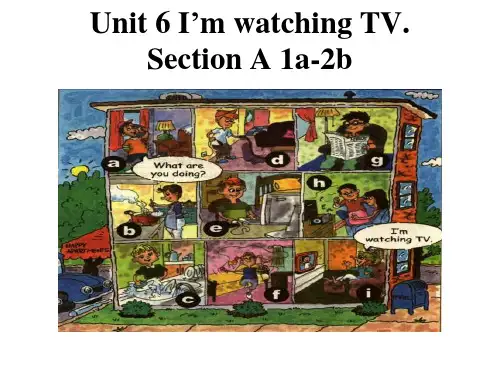
What’s he doing?
He’s making the soup.
What’s she doing?
She’s talking on the phone.
What are they doing?
They’re watching TV.
1c Ask and answer questions about what people are doing in 1a.
2c
Role-play the conversation in 2b.
1.预习下一课时的内容。 2.编写对话。 3.做练习册上的题。
Unit 6 I’m watching TV. Section A 1a-2b
What are you doing now? I’m watching TV.
At 7:30 pm, people are doing different things.
cleaning
reading a newspaper
1. Jenny is watching ________ TV.
2. John is _________ washing the dishes.
3. Dave and Mary are listening _______ to a
CD.
What’s she doing?
She’s using the computer.
Verb-ing
1a Match the activities with the pictures. i 1. watching TV __ d 2. cleaning __ g 3. reading a newspaper __ a 4. talking on the phone __ h 5. listening to a CD __ 6. using the computer __ e 7. making soup ___ b 8. washing the dishes __ c f 9. exercising ___
Unit6 SectionA 2a -2d讲义2022-2023学年人教版七年级英语下册
Unit 6 I’m watching TVSection A 2a to 2d 讲义一、Teaching aims:1.practice listening for specific items with the target languagee the target language in conversations and in a controlled manner二、teaching procedures:1.播放录音前,呈现一些包含人物活动的图片,学生根据短时回忆,两人一组轮流回答。
学生阅读2a的两个问题,教师播放录音,学生独立完成2a的任务2.阅读2b对话,预测要填信息,第二次播放录音,学生边听边记录3.两人一组朗读并表演2b对话,完成2c。
阅读2d,回答问题,再次阅读对话,找出文章中出现的电话用语,并说出中文含义,比较异同。
学生分角色朗读对话。
三、英汉互译1.Kind of 。
2.那听起来很好3.Go to the movies .4.你好,我是珍妮.5.Wash clothes 。
6.eat out7.在6:30的时候。
8.see you then .9 你正在做什么?。
四、小组合作1. Do you want to go to the movies?你想去电影院吗?go to the movies意为“去电影院”。
其中movie是名词,意为”电影”,与film同义。
表示“去电影院”,英式英语中常用go to the cinema.例: He goes to the movies once a month.他每月去-次电影院。
go不及物动词,意为”去,前往”,当其后接活动性名词时,表示“去做某事”。
例: go to the meeting去开会go to the talk去听报告go to the party去参加聚会go to the match去看比赛go后常加动词的-ing形式,表示“去进行某一活动”,一般表示休闲或是娱乐性的活动。
初中英语人教版七年级下册Unit 6(2a---2d)

七年级下英语第六单元(SectionA 2a-2d)教学设计向玉先一、教学目标:1.能够进行听力训练,培养学生听的能力。
2.能用现在进行时准确的描述和表达正在发生的动作。
3.能在日常生活中恰当理解和运用本单元的话题范围内的单词和习惯用语。
二、教学内容1.单词和短语:movie, just, go to the movies, go out , not much/nothing much , want to do sth, join, join in2.句型:1)What are you doing? I am v-ing.2)W hat’s she doing ? She’s washing her clothes.3)What are they doing? They are listening to a CD.三、教学重难点.运用现在进行时讨论正在进行的动作四、教学思路本课的教学内容是七年级英语下册六单元的第二课时,重点在于利用听力训练继续加强学生对上节课所学习的知识的理解。
多鼓励学生展示自己的表演才能,培养小组合作意识。
因此,教师可以将知识目标定位将现在进行时灵活地运用到日常学习和生活中去。
情感目标定位在趣味话题的激励下,诱导学生积极参与,充分调动他们的学习兴趣,并注重培养学生的合作竞争能力和自主探究学习的能力。
五、教学活动1.安排学生听说活动,充分利用学生已有的知识和生活经验和网络资源,创设生活化的真实情境(或半真实情境)引导学生在运用语言中学习语言,然后在学习新的语言知识后创造性地运用语言(为用而学,在用中学,学了就用)。
2通过学生自己选择角色扮演,以激发学生学习英语的兴趣。
3让学生自己观看知识点和通过练习,让学生学会使用知识。
4.安排课堂和课后练习,让学生学会在作业中和生活中,正确地表述自己正在做某事。
六、教学过程:Step1 Warming-up1.Greetings2. Duty reportStep2 Review The Present Continuous TenseStep3 Ask and answer1.T asks: What are we doing? We are having an English class .I am teaching English.You are learning English.What are you doing? ...Step4. Learn new words and phrasesStep5 Listening1. Work on 2a;T: Jack and Steve are talking on the phone. What are they doing now? Listen to the conversations and match the answers with the questions.(Play the recording for the first time, students only listen carefully. Then, listen to the recording again, and match the answers with the questions. )Check the answers.2. Work on 2b.Let Ss read the conversation in 2b first. Then play the recording for the Ss twice.The first time Ss only listen and write down the words in the blanks. Then play the recording again for the Ss to check the answers. (If necessary, press the Pause button to help.)Step6 Pair work1. Now, role-play the conversation with your partners.2. Let some pairs to act out the conversation in front of the class.Step7 Role-play1. Ask Ss to read the conversation in 2d and answer the questions below.① Are Jenny and Laura talking on the phone?(Yes, they are.)② What's Laura doing now?(She's washing her clothes.)③ What's Jenny doing?(She's watching TV.)④.Does Laura want to join Jenny for dinner?(Yes, she does)⑤When do they meet at Jenny's home?(At half past six.)2. Ss read the conversation and answer the questions above.3. Check the answers with the Ss.4. Let Ss work in pairs and role-play the conversation.Homework:一、根据语境,从方框中选择恰当的短语填空。
Unit 6 Section A 1a-2d 课件 人教版七年级英语下册
Read the conversation in 2d and answer the questions below.
1. What’s Laura doing? She’s washing her clothes.
exercise
What are they doing? They are cleaning.
What__is__ he_d_o_i_n_g_? He ____is_p__a_in_t_in__g____.
painting
paint
What __is__ he _d_o_in_g_? He i_s_r_e_a_d_i_n_g_t_h_e__n_e_w_s_p_a_p_e_r.
1b Listen. What are these people doing? Write the
numbers from 1a. a. Jenny __1_ b. John __8_ c. Dave and Mary _5__
Let’s read
Bob: Hello, Jenny! Jenny: Hi, Bob.
Hello? This is Bob. Who’s that? 喂?我是鲍勃,你是谁?
Hi, Bob. It’s Mike here. 你好,鲍勃。我是迈克。
2. Not much. (口语)没什么大事。 也可说成,nothing much 例如: A: What are you doing, Linda? 你在做什么事,琳达?
B: Not (Nothing) much. I’m just reading a book. 没什么大事。我在读一本书。
Unit6SectionA(2a-2d)课件人教版英语七年级下册
ቤተ መጻሕፍቲ ባይዱ
二、结构: 由助动词be (am/is/are)+动词的ing 形式,动词的ing 形 式叫做现在分词。
三、常用时间状语: now, these days或表示现在情景的look, listen,等。
Mary's parents drink tea after dinner.玛丽的父母饭后会喝茶。 (1)drink 作及物动词,意为 “喝,饮”。 如:Would you like to drink a cup of coffee?你想要喝杯咖啡吗? drink 还可作名词,意为“饮料”,一般情况下为不可数名词, 但当指饮料的种类或份数时为可数名词。 如:There are all kinds of drinks in the shop. 这个商店有各种各样的饮料。 (2)tea不可数名词,意为“茶,茶叶”。 如:He always drinks a cup of tea in the morning. 他每天早上都会喝一杯茶。
D. read;is watching
This is Jenny. 我是詹妮
这是打电话用语。 当打电话时,介绍自己时用 “This is …” 或 “It's …”; 询问对方用“Is that…?”或 “Who's that?”。 如: — Hello? This is Sam,who's that? 喂?我是山姆,你是谁? — Hi,Sam. It's Bob here. 你好,山姆。我是鲍勃。
例句
新人教版七年级英语下册Unit6 SectionA(2a-2d)精品课件.ppt
• 14、Thank you very much for taking me with you on that splendid outing to London. It was the first time that I had seen the Tower or any of the other famous sights. If I'd gone alone, I couldn't have seen nearly as much, because I wouldn't have known my way about.
2c
Role-play the conversation in 2b.
2d Role-play the conversation.
This is...
It's... here.
I'm just ...
Do you want to... I'd love to.
Let's meet at...
Come at...
CD.
2b Listen again.
人教版七年级英语下册课件Unit 6 Section A 2a-2d
watch TV
What is she doing? She is talking on the phone.
talk on the phone
What is she doing? She is listening to a CD.
listen to a CD
What is he doing? He is using the computer.
2d Role-play the conversation .
Jenny: Hello? This is Jenny. Laura: Hi, Jenny. It’s Laura here. Jenny: Oh, hi, Laura. What are you
doing? Laura: Not much. I’m just washing
(walk) in the park. 2. Look! The girl _i_s_p_l_a_y_i_n_g__(play) the piano. 3. _I__s_ Ben w__r_it_i_n_g_(write) a letter now? 4. The man _is___b_u_y_i_n_g__(buy) some vegetables
use the computer
What is she doing? She is washing the dishes.
wash the dishes
exercise
What are they doing? They are exercising.
What are they doing? They are cleaning.
—Oh, sorry! He __C___ a meeting now.