
译林牛津版高二英语选修7下学期Unit4 Public Transport教案 下学期
模块七高二下学期Unit 4 Public TransportWelcome to the unit1. transport: vt . 1. 输送,运送,运输(货物,人等)Transport is an important part of out lives.交通运输是我们生活的重要组成部分.That yellow bus transports passengers from airport to the city.那辆黄色公共汽车将乘客从机场运送到城里。
The goods were transported by plane.那些物品是用飞机运输的。
2. (常用被动语态) 使万分激动be ~ed with joy/anger喜不自胜/怒不可遏3. 使进入特定境地The film ~d us back to NY of th e1950s.n. 1. 运输, 搬运, inland water ~ 内河运输; a ~ network 运输网; ~ charges 运输费through ~ by land and water 经水陆联运2. 运输工具, 运输船/飞机激动, 狂喜be in a ~ of rage 大发雷霆be in a ~ (s) of delight喜不自胜相关链接:1). 美国用transportation ; 英国用transport2). transport cafe(英)公路廉价餐厅2. pick up 和drop off课本原句:Buses have routes. They pick up and drop off people at different places on the route.公共汽车在不同的地方搭客或让客人下车.1). pick up: vt. 捡起;用车接……;获得,学到,得到;好转,改进;使重新开始,继续;接受节目;课文中意为用车、船等搭载客人,驾车出去迎接等.注[可分开用pick ……up]补充例句:I am busy today, so I will ask Tom to pick you up at the station?我今天忙,我将让汤姆去车站接你.相关链接:pick up①基本意:[vt.] (可分开用)拾起;采取例句:I told you the news that I picked up a coin on the road.我告诉你个好消息我在路上拾到一枚硬币。
②[vi.] [vt.] (可分开用)(健康,景气,事态)恢复,使恢复;变好例句:I believe things will pick up soon.我相信事情很快就会好转。
③[vt.] (可分开用) (偶然地)发现,得到;得到(知识,利益等);可耳闻而学会例句:He picked up the book in a most unlikely place.他在一个非常令人意想不到的地方得到那本书。
④[vt.](可分开用)探出,接收,收听(广播)例句:I have been told that he often picks up VOA programs。
有人告诉我他经常收听美国之音节目。
2)drop off①课文中意为:(从车等)下车,使(人)下车;一个个)散去;走掉。
(词组可分开用)补充例句:I can drop you off at your place.我可以让你在你的住处下车。
We dropped our luggage off at the hotel and went sightseeingThe demand for mobile phones shows no signs of dropping off.②[vi.] (数量,兴趣等)减低,逐渐消失。
补充例句:Interest in the work has dropped off.对那工作的兴趣已逐渐消失。
引申: drop in顺便来访drop sb. a line写短信寄给某人drop behind 落后drop out 中途放弃高考链接1. He ______ some French while he was away on a business trip in Paris. (2003上海春)A. made outB. picked upC. gave upD. took in 答案:B2. Just drop me ______ at the station, please.A. outB. awayC. onD. off 答案:D3. powern.能力, 力量, 动力, 权力Some animals have the power to see in the dark.Power should be used wisely.vt.给…提供动力,用动力发动Buses and trucks are usually powered by diesel engines.In the future electricity will be used to power road vehicles.4. meansn. 方法,手段,工具The quickest means of travel is by plane.She could find no means of escape other than jumping out of the window.引申:by means of 依靠,凭借by no means决不,by this means 通过这种方法自我检测1. Every means _______ tired out, but it doesn’t work.A. isB. has beenC. areD. have been2. Though_____ rich, he was better off than at any other period in his life.A. by any meansB. by some meansC. by all meansD. by no means 答案:1-2 B D5. over: prep.课文原句:Aeroplanes are used to travel quickly over long distances.飞机被用于长距离范围内快速旅行.课本中意:(表示期间)……之中,在……中一直,知道……结束补充例句:We stayed there over Christmas.我们于圣诞节期间停留在那儿。
注:over通常表示比through (out)较短的期间。
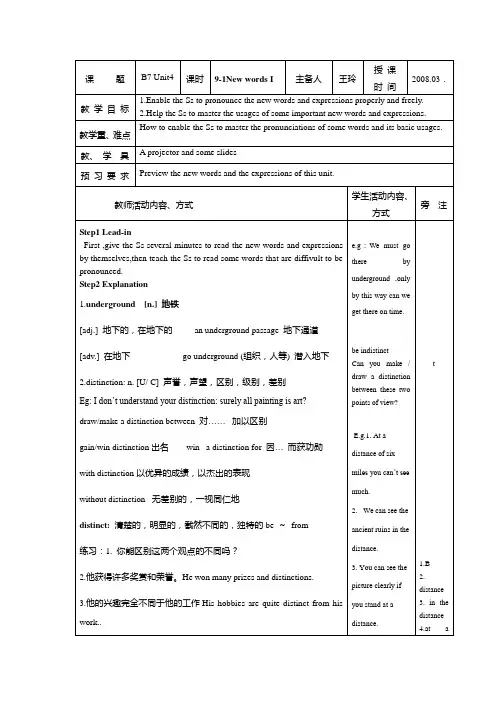
Reading1. underground: n. 地铁Welcome to the London Underground,or as it is commonly known, The Tube .欢迎来到伦敦的地下通道,也就是大家所知的地铁.We must go there by underground ,only by this way can we get there on time.我们必须坐地铁到那儿,只有这样才能按时到。
[Adj.] 地下的,在地下的,秘密的an ~ movement秘密政治活动an underground passage 地下通道[adv.] 在地下, 秘密地go underground (组织,人等) 潜入地2.distinction: n. [U/ C] 声誉,声望,区别,级别,差别eg I don’t understand your distinction: surely all painting is art?draw/make a distinction between 对……加以区别gain/win distinction 出名win a distinction for 因… … 而获功勋with distinction 以优异的成绩,以杰出的表现without distinction 无差别的,一视同仁地distinct: 清楚的,明显的,截然不同的,独特的be ~from be indistinct练习:1. 你能区别这两个观点的不同吗?2. 他获得许多奖赏和荣誉。
He won many prizes and distinctions.Can you make / draw a distinction between these two points of view?3. 他的兴趣完全不同于他的工作。
His hobbies are quite distinct from his work..3. distant [adj] 遥远的,冷淡的,疏远的,不易见be distant toward sb. 对某人冷淡distance: n. 距离,远离,一长段时间,远方in the distance 在远处at a distance 相距,相隔,稍远处from a distance 从一定距离keep sb at a distance =keep one’s distance from与… … 保持一定的距离E.g.1. At a distance of six miles you can’t see much.2.We can see the ancient ruins in the distance.3. You can see the picture clearly if you stand at a distance.高考链接1. The faces of four famous American presidents on Mount Rushmore can be seen from a _____ of 60miles.A. lengthB. distanceC. wayD. space 答案:B2. The town is some ______ away.3. I saw some smoke ________________________________(远处)4. I can’t make out the words _________________________. (在远处)Key: 1. distance 2. in the distance 3. at a distance4. boundary: n.(复数-ries)1)界线,边界课文原句:However, most trains into London only went to the distant boundary of the city.可是,大多数开往伦敦的火车都在城市的边界上.补充例句:The river forms the boundary between the two states.那条河流成为两州的界线。
牛津译林版选修7Unit4Publictransport4.1知识点课件
transport.
C 晨读晚诵 HENDUWANSONG
X 新知导学 INZHI DAOXUE
D 答疑解惑 AYI JIEHUO
一二三四
二、阅读词汇
预习Reading部分的词汇,写出画线部分的汉语意思
The cabs 1. 出租车
played an important part in conveying
A new study has shown that public transport is more efficient① than cars.The study found that the Western Australian city Perth is a good example of a city with public transport.As a matter of fact,17% of its wealth went into transport costs.Some European and Asian cities,on the other hand,spent as little as 5%.These more efficient cities were able to put the difference into attracting industry and jobs or creating a better place to live in.
Section Ⅰ Welcome to the unit & Reading
-10-
C 晨读晚诵 HENDUWANSONG
X 新知导学 INZHI DAOXUE
D 答疑解惑 AYI JIEHUO
一二三四
一、写作词汇
Pre-reading
牛津译林版英语高二下册Module 7《Unit 4 Public transport》(Welcome to the unit)word教案
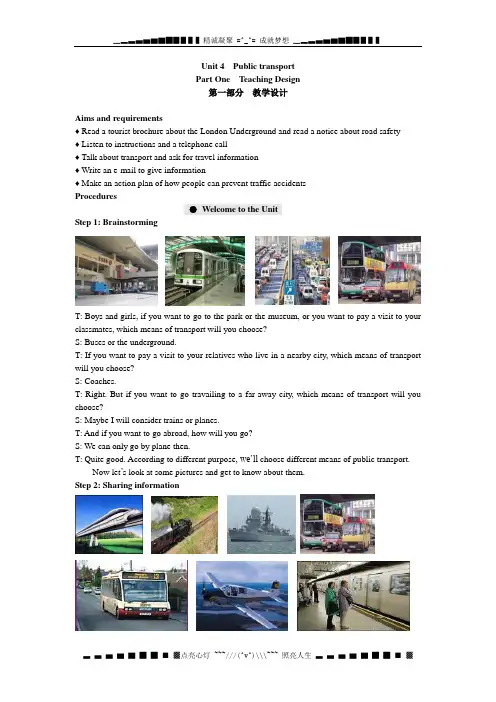
Unit 4 Public transportPart One Teaching Design第一部分教学设计Aims and requirements♦ Read a tourist brochure about the London Underground and read a notice about road safety♦ Listen to instructions and a telephone call♦ Talk about transport and ask for travel information♦ Write an e-mail to give information♦ Make an action plan of how people can prevent traffic accidentsProcedures●Welcome to the UnitStep 1: BrainstormingT: Boys and girls, if you want to go to the park or the museum, or you want to pay a visit to your classmates, which means of transport will you choose?S: Buses or the underground.T: If you want to pay a visit to your relatives who live in a nearby city, which means of transport will you choose?S: Coaches.T: Right. But if you want to go travailing to a far-away city, which means of transport will you choose?S: Maybe I will consider trains or planes.T: And if you want to go abroad, how will you go?S: We can only go by plane then.T: Quite good. According to different purpose, we’ll choose different means of public transport.Now let’s look at some pictures and get to know about them.Step 2: Sharing informationNow let’s study the seven pictures one by one. After that, make a comparison among all the meansStep 3: Discussion:Look at the three questions below the pictures on page 49. Work in groups of four to discuss them, and then I’ll ask several groups to report your answers to the class. You can exchange and1. Preview the Reading passage.2. Finish the part A1 and A2 of the workbook.。
高中英语 Unit 4 Public transport教案 牛津译林版选修7

Unit 4 Public transport【美文阅读】Who invented the traffic signal?1868年12月10日,由英国机械师德·哈特设计的一盏红、绿两色的煤气交通信号灯是城市街道的第一盏信号灯。
它的出现使城市交通大为改善,也为后来交通信号灯的完善奠定了基础。
Traffic lights had been in use even before cars were invented.In those days,people used horses,wagons(四轮马车)and other means of transport. But the traffic was still horrible. So in 1868 in London, England, traffic policemen came up with a basic device: A lantern with two lights-red and green.Green stood for “caution”and red for“stop”.A policeman would turn the lights regularly with a lever (控制杆). Unfortunately this early traffic light proved unsafe. One model exploded a year later and hurt the operator.Things made a turn for the worse when cars were invented. Some people were using new cars,and others were still riding horses, wagons or bicycles. They all shared the same roads and streets with pedestrians(行人). A lot of accidents took place as a result.A traffic police officer named William L. Potts.from Detroit, Michigan knew something had to be done.He designed a traffic signal device that could serve four-way streets. He used three colors—red, yellow and green. He put the signals together with electric controls and wires. In 1920, he had it installed on the Michigan Avenue-Woodward corner street.There were the first automatic traffic signals. Detroit police went on to add fourteen more of these in twelve months.【诱思导学】1.What did the two colors—green and red stand for in the lantern device came up with the London traffic police?________________________________________________________________________2.Why did a lot of accidents take place when cars were invented at the very beginning?________________________________________________________________________3.When was the signal device designed by William L.Potts first put into practice?________________________________________________________________________【答案】 1.Green stood for“caution”and red for“stop”.2.Because the people who were using new cars,riding horses,wagons or bicycles shared the same roads and streets with pedestrians(行人). 3.In 1920.Period ⅠPreviewing(教师用书独具)●教学目标本课时主要是通过学生对学案所给出的内容的学习,了解本课文中所出现的词汇,初步了解课文以及相关的背景知识,对下一堂课就课文的全面理解起到一个铺垫作用。
牛津译林版英语高二下册Module 7《Unit 4 Public transport》(Task)word教案
●Task Writing an e-mail to give informationThis section consists of a series of activities which provide you with an opportunity to practice your listening, speaking, reading and writing skills. The task is divided into three steps and each step is preceded with a skills building activity. Through the three steps, you will learn how to listen to instructions, how to find out different information and how to give reasons for your choices. You are expected to apply what you learn in the skills building sections to write an e-mail to give information about the travel to Dalian.Skills building 1: listen to instructionsIn this part, you will learn how to listen to instructions.T: What sentence structures are often used to give instructions?S: You should …/ You will need to…/ You will have to…Quite good. Now let’s read the guidelines and the key structures in this part. You will know what you should focus on when listening to instructions.Step 1: taking notes for future actionPart AT: If you are going somewhere for holiday, what do you need to plan?S: Where to go, when to go there, how to go there, how much money to spend, who to go with, what to do there and so on.T: Let’s come to the context of Part A. Two families are planning their May Day holiday trip to Dalian. Read the notes before you listen to the recording and make sure that you know what youNow let’s listen to the conversation in Part B and find out advantages and disadvantages of takingPart CLet’s read the information on the web page about Dalian in Part C on page 59. Compare theSkills building 2: finding out different informationT: If you are going somewhere, what information should you know before you go on the trip?S1: which way to travelS2: the timetable for the transportS3: travel timeS4: travel costS5: the number of changes needed……Read the guideline in this part first. Then read the questions and the information in the chart. If the question is not complete, you should complete the question first.Step 2: buying ticketsNow you have decided to go to Beijing and then Dalian by train, and you are going to buy the tickets for the fastest train. Work in pairs, with one person selling tickets and the other as the person who wants to buy the tickets. The student who is going to buy the tickets should ask the ticket seller some questions to decide which train should be taken. Remember to choose the fastest train within the budget. Do you still remember how much money can be spent on the tickets for you all?Work in pairs to make up a dialogue. Some of you will be asked to present your dialogue to the whole class.Skills building 3: giving reasons for your choicesBoys and girls, you are asked to write an e-mail to explain the reason why you have made the decision. Do you know what you should explain and how to explain your decisions? Now read the guidelines in this part.Step 3: writing an e-mail to your uncle1. First discuss what you should write in the e-mail according to the information gathered in steps 1 and2. You can write an outline to organize your reasons in the e-mail to help you write it well. You can take the following as an example.What to writethe decision: travel by trainthe reasons: why to travel by train;why not to travel by boat or by coach or by planethe decision: which trains to takethe reasons: why to take the chosen trains, considering travel time and travel allowance2. Now begin to write your e-mail. Then some of you will be asked to present your e-mails to theA. Read the passage about the importance of transportation and fill in the chart.Have you ever thought about how important transportation is to the world? Without transportation modern life could not exist. We have come to depend on the availability (可用性) of three principal kinds of transportation.Automobiles, railroads, trucks, and pipelines are the principal means of land transportation. Ships, barges, and submarines (潜水艇) form the chief means of water transportation. Without our principal means of air transportation, the airplane, we would have to slow down our lives and commerce. Nearly every major city in the world provides some form of public transportation. The most common form of transportation is the bus. Buses have been in use in major cities since approximately 1900. They provide transportation service on innumerable (无数的) routes from the city center to the suburbs and even to outlying rural areas that surround the city. Subways are mostly found in larger cities, such as New York, London, Beijing, Paris, Sydney, and Tokyo. The subway is an underground system of high speed trai ns. The world’s first system was built in London, and trains have been operating there since 1890. Subway trains move more quickly and efficiently than buses. They, too, are inexpensive and help solve city traffic problems. The one drawback of subway trains is that they are often crowded and noisy. Taxicabs are more expensive than buses or subways, but they deliver you to the exact location you want in the shortest time possible. Taxis are convenient if you are in a hurry or if you are taking along a number of suitcases or packages. And as an added attraction, many cab drivers will tell you stories about their adventures as taxicab drivers or even the details of their life stories. If you ever visit a major city in another country, you probably have no trouble getting around. You will quickly find out about city bus routes and schedules, and about crowds on subway trains. Like many people, of course, you may come to the conclusion that the most inexpensive and reliable form of transportation will be your own two legs.B. Tom is writing a letter to a newspaper editor, telling him his opinion about what he saw this morning. Please complete the letter by filling each blank with one proper word.Dear Editor,This morning, I saw many cars (1) ____________ for the traffic lights at the (2) ____________ road when a large number of people came to the cars. Some of them were selling newspapers while others were (3) ____________ drinks and brushes. One woman was rushing to the cars with some magazines. Another girl was running as fast as she (4) ____________ to the cars, carrying some other things. Even one beggar was (5) ____________ at the windows of the cars to ask for money!As a (6) ____________, the road looked very messy and the drivers felt so uncomfortable and frightened that they couldn’t drive even though the lights had turned (7) ____________.In my opinion, this is very bad for (8) ____________ and the environment. What’s worse, it’s very (9) ____________ for the people selling those things. Some (10) ____________ should be taken to stop it.Yours,Step 5: Homework:1. Read the passage in Part A on page 133 of the workbook.2. Finish the writing exercise in Part B.。
牛津译林版英语高二下册Module 7《Unit 4 Public transport》(Project)word教案
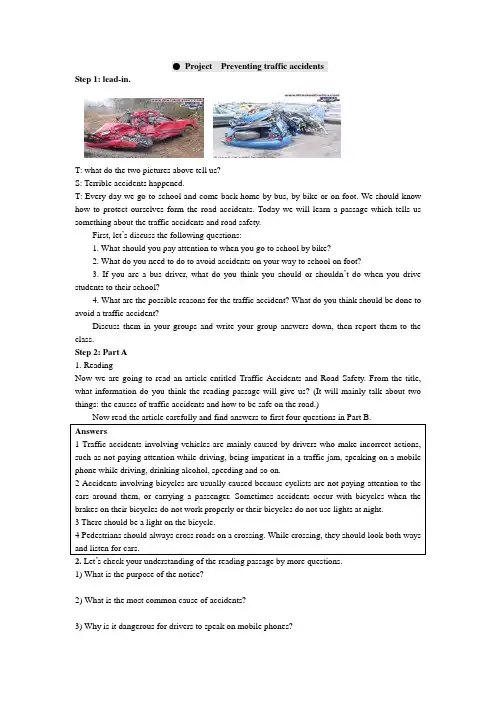
●Project Preventing traffic accidentsStep 1: lead-in.T: what do the two pictures above tell us?S: Terrible accidents happened.T: Every day we go to school and come back home by bus, by bike or on foot. We should know how to protect ourselves form the road accidents. Today we will learn a passage which tells us something about the traffic accidents and road safety.First, let’s discuss the following questions:1. What should you pay attention to when you go to school by bike?2. What do you need to do to avoid accidents on your way to school on foot?3. If you are a bus driver, what do you think you should or shouldn’t do when you drive students to their school?4. What are the possible reasons for the traffic accident? What do you think should be done to avoid a traffic accident?Discuss them in your groups and write your group answers down, then report them to the class.Step 2: Part A1. ReadingNow we are going to read an article entitled Traffic Accidents and Road Safety. From the title, what information do you think the reading passage will give us? (It will mainly talk about two things: the causes of traffic accidents and how to be safe on the road.)1) What is the purpose of the notice?________________________________________________________________________ 2)What is the most common cause of accidents?________________________________________________________________________ 3) Why is it dangerous for drivers to speak on mobile phones?________________________________________________________________________4) Can cyclists ride on the pavement? Why (not)?________________________________________________________________________ 5) What can we do to prevent accidents?The notice was released because ____________. (the number of accidents and the deaths arising from traffic accidents has increased greatly over the past year)In order to prevent accidents, drivers should_____________________________________;( pay attention to the surrounding traffic)_____________________________________; (be patient in a traffic jam)_____________________________________; (not speak on a mobile phone)_____________________________________; (not drink alcohol)_____________________________________; (not drive too fast)In order to prevent accidents, cyclists should_____________________________________; (always obey traffic laws)_____________________________________; (pay attention to the cars that surround them)_____________________________________; (not carry a passenger)_____________________________________; (have a light on the bicycle at night)_____________________________________; (keep the bicycle in good condition) In order to prevent accidents, pedestrians should_____________________________________; (always cross roads on a crossing)_____________________________________; (look both ways and listen for cars while crossingthe street)_____________________________________; (never ignore traffic lights)Step 3: Part BWork in groups of four or six to discuss the questions 5-8 in Part B. Write down your answers. Then one student from each group presents your answers to the class. Other groups can give your comments.Step 4: Exercises:Complete the sentences with proper words or phrases from the article on pages 62-63 of the Student’s Book. Change the form where necessary.1) There were 39, 000 new cases last year - an ____________ of 7 percent.2) He is still standing under the tree, not ____________ the danger.3) My father was ____________ for dangerous driving yesterday.4) He has been ____________ from his job for dishonesty.5) It would be____________ to ignore these warnings.6) Leaving your house unlocked is an open ____________ to burglars7) The western part of China is in great ____________ of teachers.8) Whenever you come into his room, it is always ____________.9) I found it hard to follow what the teacher was saying, and eventuallyI lost ____________.10) In ____________ cases, the disease can lead to blindness.1. Finish D1 and D2 on page 129 of the workbook.2. Read the newspaper article in Part B on page 131 of the Workbook to know about an aeroplane accident many years ago.。
牛津译林版高中英语选修七Unit 4《Public transport》全单元教案
旁
注
e.g : We must go there by
underground ,only by this way can we get there on time.
be indistinct Can you make / draw a distinction between these two points of view? t
教师活动内容、方式 Step1 Lead-in First ,give the Ss several minutes to read the new words and expressions by themselves,then teach the Ss to read some words that are diffivult to be pronounced. Step2 Explanation 1.underground [n.] 地铁 [adj.] 地下的,在地下的 an underground passage 地下通道 [adv.] 在地下 go underground (组织,人等) 潜入地下 2.distinction: n. [U/ C] 声誉,声望,区别,级别,差别 Eg: I don’t understand your distinction: surely all painting is art? draw/make a distinction between 对…… 加以区别 gain/win distinction 出名 win a distinction for 因… 而获功勋 with distinction 以优异的成绩,以杰出的表现 without distinction 无差别的,一视同仁地 distinct: 清楚的,明显的,截然不同的,独特的 be ~ from 练习:1. 你能区别这两个观点的不同吗? 2.他获得许多奖赏和荣誉。He won many prizes and distinctions. 3.他的兴趣完全不同于他的工作 His hobbies are quite distinct from his work.. 3. distant [adj]遥远的,冷淡的,疏远的,不易见 be distant toward sb. 对某人冷淡 distance: n. 距离,远离,一长段时间,远方 in the distance 在远处 at a distance 相距,相隔,稍远处 from a distance 从一定距离 keep sb at a distance =keep one’s distance from 与…保持一定的距离 高考链接 1.The faces of four famous American presidents on Mount Rushmore can be seen from a _____ of 60 miles. A. length B. distance C. way D. space 2. The town is some ______ away. 3. I saw some smoke ______________________________(远处) 4. I can’t make out the words _________________________. (在远处) 4.Boundary [n.](复数-ries)界线,边界 界限,范围
高中英语-Unit4-Public-transport-Word-power教案-牛津译林版选修7
Unit4 Public TransportWord power (1)Step 1: BrainstormingBoys and girls, in this section we’ll learn words and expressions related to transport. First let’s look at some pictures.Do you know what we call these roads i n English? First you can guess and write down your answer, then read the passage in Part A on page 54 to check your answer right or wrong. Step 2: Vocabulary learning1. Now let’s check your understanding of the passage.T: What are very small roads called in English?S: Lanes or paths.T: What are roads where cars can go very fast called?S: Motorways in Britain, freeways or expressways in the USA.T: What kinds of roads are called flyovers?S: Roads that go over other roads.T: What kinds of roads are called underpasses?S: Roads that go through a tunnel.T: What do people call the area where many roads link up?S: An intersection or a junction.T: What is a toll road?S: It is one where people need to pay to use the road.T: What is spaghetti? Why do people call the network of roads near Birmingham “Spaghetti Junction”?S: Spaghetti is a kind of noodles in the shape of long thin sticks. The network of roads near Birmingham is made up of many intersections and flyovers, which looks like strings of spaghetti.T: What is a street?S: A road with sidewalks in a city or town.T: what is an avenue?S: A wide road lined with trees on each side.T: What is called a way?S: A passage from one place to another.2. Part B.Well done, everyone! Now let’s come to Part B. Zhao Ning has categorized the different ways that we can travel in a flow chart. Look at the chart she has made. Make sure you know the meaning of each word. After you finish reading, I’ll ask you some questions.Who h as ever traveled by light railway or unde rground? What was it like? Do you like traveling by light railway or underground? Why or why not?Have you ever traveled by coach/ by aeroplane/ by ferry/ by ship? How do you like it?If you are traveling to Nanjing, what means of transport will you choose?If you want to go London, which means is the best choice?3. Part CRead the passage in Part C, which is an introduction to a transport project. You should complete the introduction with the words you’ve learnt in Parts A and B. Several minutes later, I’ll check your answers.Answers(1) transport (2) transport (3) main (4) motorways (5) lanes(6) paths (7) flyovers (8) land (9) sea (10) aeroplanes(11) helicopters (12) ship (13) ferry (14) land (15) motorboatStep 3: vocabulary extension2Do you know any other words or phrases related to transport besides what you have already learnt in Part A and B? For Example:T: What must we do before we go somewhere by train or by plane?S: We must book a ticket beforehand.T: Where will you go to buy the ticket?S: The ticket office.T: What must we do before we get on the train or plane?S: Make clear about your train or plane number and your seat number.T: Before we get off, what shall we do?S: We must make clear about our destination and take all the package with us.Good. You know these things very well. Now let’s come to Part D and fill in the box. You can present more words and phrases related to the correct categories.AnswersDActions Documents People/Jobsbook a seat/ ticket one-way ticket customs officerread a timetable season ticket captainboard student ticket ticket sellerland passport pilotUnit4 Public TransportWord power (2)Step 4: Consolidation exercises:1. Match the words related to transport in Column I with their definitions in Column II.I II1) lane ______ a a boat or ship for taking passengers and oftenvehicles across an area of water, especially as a regular service2) coach ______ b a public road, especially an important road that joinscities or towns together.3) ferry ______ c a vehicle designed for air travel, which has wings andone or more engines4) underground ______ d a road or path that goes under something such as abusy road, allowing vehicles or people to go from oneside to the other5) flyover ______ e a bridge that carries a road or rail way over another road.6) railway ______ f a place where things, especially roads or railways,come together7) highway ______ g a narrow road in the countryside or in a town.8) underpass ______ h. a long motor vehicle with comfortable seats, used totake groups of people on journeys9) junction ______ i the metal tracks on which trains run.10) aeroplane ______ j. a railway system in which electric trains travel alo ngpassages below ground.2. Complete the sentences with proper words or phrases in the box below. Changes the form where necessary.motorboat expressway book a ticket one-way ticket returnticketlight railway passport conductor read a timetabletoll road1) Americans usually say “____________”, but British people say “motorways”.2) It is so exciting to drive a ____________ on the lake.3) He is a kind ____________ and he always gives his passengers help in time.4) Many people are eager to go to the concert, so you’d bet ter ____________.5) Annie is going to Shanghai to visit her uncle and she’ll stay there for three weeks.So she just bought a ____________.6) Many years ago, when people were traveling on the underground, they could never imaginethere would be ____________.7) It’s a ____________. You need to pay some money to pass.48) Many refugees(难民) have arrived at the border without ____________.9) If you want to be back tomorrow, I think you need to buy a ____________.10) Since you don’t know when the next train arrives, why not ____________?3. Read the passage about public transport in Shanghai and decide which statements are true (T) and which are false (F). Correct the statements that are false.A more efficient public transport network desiredShanghai has seen great improvement of local public transport over the past decade. However, traffic jam is still an often occurrence (发生的事情) in local people's daily lives. Local people demand for a more efficient public transport network.Ten years ago, local people had no choice but to take the bus. During the winter of 1991, passengers flew on city buses averaged around 16 million pe r day. Since then, huge developments in the city's public transport infrastructure (基础设施) have been made. Three urban (城市的) rail lines stretching a total of more than 70 kilometers have been built, providing convenient light rail and subway services for the public. And the total length of city roads has doubled with the construction of elevated (提高的) ring roads and a series of cross-river links.However, with more people buying newly deve loped properties along the urban rail lines, the city's subway and light rail has become increasingly crowded. Moreover, the number of vehicles on the city's roads has skyrocketed (急剧上升) five times the figure a decade ago.Transport authorities in Shanghai say measures will be strengthened to improve public transport in the new year to ease traffic conditions. Recently, a new regulation prohibited (禁止) all vehicles coming from outside Shanghai, learner drivers and taxis with out passengers from using the city's elevated highways during rush hours. And, officials are currently cracking down on all illegal parking lots.Meanwhile, city government is planning new transport infrastructure projects to meet the demands of the city's growing population. Authorities say a number of key transport projects including the magnetic levitation train and the Lupu Bridge are expected to be completed next year and will hopefully relieve the city's current traffic pressures.1) Nowadays residents in Shanghai are satisfied with the public transport system.2) Ten years ago residents can only took buses in Shanghai.3) Transport authorities in Shanghai are taking measures to meet the demands of the local residents.4) If you are driving from Nanjing to Shanghai, you are not allowed to use the city’s elevated highways.Answers1. 1) g 2) h 3) a 4) j 5) e 6) i 7) b 8) d 9) f 10) c2. 1) expressways 2) motorboat 3) conductor 4) book aticket5) one-way ticket 6) light railway 7) toll road 8)passports9) ret urn ticket 10) read a timetable3. 1) F 2) T 3) T 4) FStep 5: Homework:1. Parts B1 and B2 on page 127 of the Workbook.2. Prepare the Part Grammar and Usage.6。
译林牛津版选修七Unit4 Public transport课件(共45张PPT)
2. The number of road accidents and the deaths arising from those accidents has increased over the past year. ◆ 【句析】 简单 句。 此句是一个_____
运送,输送;表达;传达; 1. convey v. ___________ 转让(财产) 【归纳】 ⑴ convey one’s feelings/emotions/meanings 表达某人的感情/情感/意思 ⑵ convey sth. to sb. 向某人表达/传递…… ⑶ convey sb./sth. from A to B 把某人或某物从A地运送到B地 ⑷ convey that ... 传达……,表明……
8. fill in 9. a handful of 10.split up 11.speed up 12.arise from 13.traffic jam
填写(表格);消磨(时间) 少数的,少量的 分组,分解;分离 (使)加速 起因于,由……引起 堵车,交通堵塞
1. Having seen the situation, a wealthy American businessman, Charles Yerkes, undertook improving the system in 1902 by obtaining ownership of the many different lines and setting up the Underground Electric Railways Company of London. ◆ 【句析】 简单 句。 此句是一个_____
牛津译林版高中英语选修七Unit 4《Public transport》(Welcome)教学设计
牛津译林版高中英语选修七Unit 4《Public transport》(Welcome)教学设计教学设计单元:Unit 4 Public transport板块:Welcome to the unit and word powerThoughts on the design:鉴于本单元的Welcome to the unit 和word power都涉及到各种公共交通工具以及不同交通方式之间的特点,内容有重复之处,因此对两部分进行整合调整,放在一个课时进行教学。
本节课以看、听、说、读为主,第一是温故知新,学生摸索有关交通的词汇,教师关心补充各种公共交通的方式及其优缺点,其次探究新知识,了解各种交通道路的名称,然后使用新知识,利用前面所学知识来阅读文章,最后是拓展知识,学习与使用交通有关联的专门词汇。
学生在小组讨论中分享观点、操练词汇,并在各种设置的情境中运用所学知识。
Teaching aims:After learning this period, the students will be able to:1.know different means of transport and their main functions;pare the advantages and disadvantages of public transport;3.understand different names of roads;4.enlarge their vocabulary related to transport.Teaching procedures:Step 1 BrainstormingHave a free talk to review the word “transport”, such as “How do you go to school every day?”“How did you go to Beijing this summer?”and then categorize the different ways that we can travel in a flow char t, referring to page54 word power Part B.( PPT4―5)Step 2 Sharing information and discussionDiscuss the seven pictures in the book(Page 49). Encourage the students to express what is included in “public transport” (PPT6). Ask students to have a group discussion and make a comparison among all the means of transport mentioned in this sectionBuses and CoachesBuses have routes. They pick up and drop off people at di fferent places on the route. It is a popular means of transport within a city. (PPT7)Coaches are buses that carry people over long distances. (PPT8)Ships and aero planesShips were a popular way to travel from place to place in the 20th century. (PPT9) Aeroplanes are used to travel quickly over long distances. (PPT10)Underground trainsThe Underground trains have become popular in crowded cities. (PPT11)high-speed trainshigh-speed trains run much faster than normal trains. (PPT12)Your choice (PPT13)Situation 1If you are going to Shanghai from Nanjing, what means of transport would you use? Why?(I would choose MU train bullet train动车组bec ause it is extremely fast and comfortable.)Situation 2 If you want to go to Taiwan from Xiamen, will you go there by ship or by plane? Why? (I would choose to travel by aeroplane rather than by ship.There are two reasons. First, air travel is quicker. Businessmen who value time regularly travel by aeroplane because of its speed. Second, travelling by plane is more comfortable than by ship. With the improvement of technology, many airline companies offer excellent services at a reasonable price.)Group Discussion:Means oftransportAdvantages DisadvantagesBuses or coaches cheap and convenient easily trapped in traffic jams; notso comfortable during peak hoursbecause they are usually verycrowded; cause pollutionUndergroun d fast and convenient; producefewer traffic accidents;comfortableExpensive to buildShips comfortable not comfortable for those who areseasick; relatively slow; thesafety of the trip would be affectedby stormsaeroplanes fast and convenient; relativelythe safest way of travelrelatively expensive(Different types of tran sport can meet different customers’ needs. Each type of transport has its own strengths and limitations. And under certain conditions, people may prefer to use one rather than another one. I enjoy riding my bicycle on the avenue. What about you?Step 3Word power—Vocabulary learningAsk students to read Part A on Page54 (PPT22), understanding different types of roads. Then in the form of “Question and Answer”, students are asked to speak out these words. Meanwhile, the teacher is expected to write down some words on the blackboard.P ictures of lanes or paths(PPT23)Very small roads are called lanes, paths or foot passes.Pictures of motorways freeways expressways and highways (PPT24)Roads where cars can go very fast are called motorways in Britain, freeways or expressways in the USA.Pictures of flyovers (PPT25)Roads that go over other roads are known as flyovers or overpasses.Pictures of underpasses (PPT26)Roads that go through a tunnel are called underpasses.Pictures of toll roads (PPT27)If you have to pay to use the roads, they are called toll roads.Pictures of an intersection and a junct ion (PPT28)The area where many roads link up is called an intersection or a junction Picture of Spaghetti Junction (PPT29)The road that is made up of many flyovers and intersections is called Spaghetti Junction. In the UK, there is such one near Birmingham.Step 4 Word power―Vocabulary usingAsk students to read the passage in Part C and complete the introduction with the words learnt in Part A and B (PPT30)Then Check the answers with the class. Students are asked to read the whole passage.Step 5 Word power—Vocabulary extensionAsk studen ts if they know any other vocabulary related to transport. Set a situation to introduce special expressions related to using transport (PPT31―32). Then go over Part D and fill the box (PPT33―34).Step 6 HomeworkReview what we learned today. Workbook P130 Reading A. (PPT35)[Explanation]第一步“brainstorming”让学生说出各种交通工具,教师再以“word power Part B”结构图的形式归为land、air、sea三类。
高中英语牛津译林版英语选修七Unit4Publictransport-Grammar课件
5.以cut为中心的短语
cut down
砍倒
cut down on sth
削减
cut in
插嘴
cut off
1)切除,切掉
2)切断;中断
cut out
删去,略去,戒除
cut up
切碎
①He always cuts in while other people are talking. ②She cut off a small piece of bread and gave it to me.
常见重点动词短语
1.以break为中心的短语
break away from 脱离,逃离,甩掉
break down
1) (机器、车辆等)坏了;2) (计划、谈判
等)失败;3) (健康、精神等)变坏;4) 弄
坏,打破;5)分解(化学变化)
break into
1)闯入,强行进入 2)插嘴,打岔
break out
Tips: 1)该类动词短语分及物(例①)和不及物(例②)两类。 2)带有副词的动词短语后并不总是跟宾语。
③ The music cheers Jane up. The music cheers up Jane. The music cheers her up.
Tips: 3)用作及物动词,宾语为名词时,名词位于副词 的前面或者后面皆可;宾语为代词时,代词要位于 副词的前面。
CONTENTS
01 构成方式及特点 02 补充短语 03 练习
01 构成方式及特点
① This traffic problem led to the development of the underground system. ② In 1884, the Metropolitan Railway Company and the Metropolitan District Railway linked up . ③ When London was bombed, many underground stations functioned as bomb shelters. ④ But you XXX have to fill in a form and then we XXX decide on the best way. ⑤ We came up with a plan for the summer vacation. ⑥ I can call you back later.