
Why don't you talk to your parents 优秀教学设计
人教版八年级下册Unit 4 Why don’t you talk to your parents ?Section A 3a-3c教学重难点教材分析1.教学内容分析本课例的教学内容是人教版八年级下册Unit A 3a-3c,课型为阅读课。
本单元的话题是Family Relations,功能是Talk about problems and give advice, 基本结构有:You should …Why don’t you … ? Maybe you could … 本课所选的Section A 3a是两封简短的信,第一封是一个笔名为Sad and Thirteen的女孩向她的老师Mr Hunt 写的求助信。
第二封是Mr Hunt给她提出的建议。
两封信在篇章结构和语言组织上有共同的特点:信的首句为主题句;使用不同的句式来谈论问题和提出建议;使用恰当的连词连结句子,语言紧凑连贯。
2.学生分析我校是农村学校,师资水平和城里的学校比,有一定的差距。
中学生的英语水平不如城里的学生,但是高于其他偏远学校中学生的英语水平。
本节课的话题为家庭关系,与学生的实际生活紧密相关,每个学生的家庭或多或少都有这样或那样的问题,经历相似,因而有话想说,有话可说。
【教学目标】基于对教学内容和学生情况的分析,本课预设了以下目标:1.掌握文中的词汇relation 、communication、argue 、refuse、nervous 、geton instead、explain 和secondly的用法;2.在语境中感知、理解和运用不同句式描述问题和给出建议;3.学习和掌握阅读策略,根据话题对文章的内容进行预测,通过理解首句快速提炼文章的主旨大意,通过查找关键词迅速地切入文章内容。
4.在预测中充分想象和表达;正确判断教师和同学们的建议;根据信息的逻辑关系进行分析和判断,逐步形成多元思维的习惯。
5.根据短文的文本特征让学生进行仿写练习,恰当运用主题句和连词陈述自己的问题并对他人的观点提出疑点并表达自己的观点6.认识到每个人在成长的过程中总会遇到这样那样的问题,关键是如何面对,积极寻找解决问题的办法。
7.教学重点和难点;1.使用不同的句式描述问题和建议2.正确判断师生们的建议,学会质疑他人的观点并表达自己的观点;分析、推断信息的逻辑关系。
教学设计教学过程设计【新课导入】Step 1. Lead-in1 . The teacher shows the students three photos.They are mother and daughter,husband andwife and sisters.(Mike’s two nieces ),which shows that they are close to each other.Thestudents answer the following questions.Who are they ?How do they feel ?2.学生讨论并回答以下问题:Do they like each other ?Are they friendly with each other ?So,do they get on with each other /Do they have good or bad relations3.Show a husband and wife’s photo and ask students to answer the following questions:Who do you see ?What are they doing ?Do they get on well ?Do they have good relations or bad relations /让学生讨论两种家庭的关系------good relations or bad relations(设计意图; 导入新课一般从话题开始。
成功的导入活动不仅能激发学生的学习兴趣,使学生主动参与学习活动,而且能帮助学生预先感知即将学习的文本内容和语言结构。
有效的导入设计应该紧扣文本内容,联系实际,寻找和挖掘符合学生需求的材料。
本节的活动设计不仅激活了学生对话题的相关背景知识和经验,而且为后续学习做好了铺垫) 1. The students looking at the photos discuss and predict the following questions.What is her problems: school,homework, or family ?2.The teacher writes the content on the blackboard which the students predict.(设计意图; 读前预测可以激发学生的学习兴趣和动机,激活学生相关的背景知识,训练学生的发散性思维,同时也给学生提供了读前学习生词的情境。
学生根据图片提供的情境,结合教师的问题大胆猜测,充分表达,有效地培养了创造性思维能力。
教师以一项口语输出型任务开始,要求学生就单元话题联系实际并在课堂上展开讨论和预测,在讨论中引发学生的兴趣,并促使学生发现自己想表达的内容与表达的内容之间的差异。
这种差异能激发学生的学习积极性。
)【新知学习】Step 3: Read the first letterThe teacher asks the students to read the letter,and compare the letter’s contents to thestudents’ predictions.1.学生略读文本,回答以下问题;What is her problems ?以检验自己的预测是否正确。
2.学生通过寻读找出具体细节即家庭成员和家庭具体问题,并在此基础上用完整的句子说出具体的问题。
3.学生阅读文本活动下列问题:What do the parents often do ?Is the family happy about this ? How do you know ?Is her brother kind ? Why ?(设计意图:本节课是对文本的理解活动。
教师根据文章的具体特点及篇章结构来设计教学过程和阅读活动,以帮助学生更好地掌握阅读策略和阅读技能;同时理清主次,把握重点训练策略,进行梯度设计。
教学设计思路先总分、由易到难,符合学生的认知特点和文章的内容特点。
教师对阅读策略的训练表现为让学生运用策略解决问题,而不是对阅读策略教学说教和解释。
第三个活动中的第2、3个问题关注了学生的推理、分析、概括能力的培养,训练了学生的思维。
)Step 4 : Discuss学生阅读文本后,教师对学生说:We know what her problems are .Can you help her ?Can you give her some advice ?在向上提建议之前,教师让学生就此问题先和同伴讨论,在讨论的过程中尽可能地用上不同的句型,并把这些句型写在黑板上。
She should …Maybe she could …Why don’t she …Secondly …讨论之后,一些学生在班上分享了他们对Sad and Thirteen 的建议。
例如:She should talk to her parentsWhy don’t she talk to her brother/ write her brother a letter or an email/ explain how she feels /save up and buy another TV/ talk to her parents / talk about how she feels with them ?(设计意图:本环节既是第一封信的读后延伸活动,也是第二封信的读前讨论和预测活动。
通过前面的阅读活动,学生了解了女孩的具体问题。
针对这些问题,教师引导学生进行讨论,之后提出合理的建议来帮助解决问题。
学生提出的问题也是对第二封信的预测活动。
讨论和预测活动启发了学生的思维,开阔了学生的思路,激发了学生的兴趣,为后面的阅读活动做好了铺垫,降低了阅读的难度)Step 5 : Read the second letter教师让学生阅读第二封信,并划出Mr Hunt的建议,之后比较自己和Mr Hunt的建议的异同,然后回答以下问题:Do you agree with Mr Hunt’s advice ? Why or why not ?许多学生发表了不同的观点。
他们认为其中的一些建议未必有效,如:Maybe you could do more jobs around the house so that they have more time for proper communication.并根据自身的经验提出了一些切实可行的建议。
(设计意图:此活动直奔主题,突出重点。
比较建议和回答问题的活动既关注了学生对文本信息的获取,也关注了学生对文本信息和实际生活的融合,以训练和培养学生处理、比较信息和分析问题的能力;同时,引导学生学会质疑并表达自己的观点,这有利于培养学生的批判性思维能力。
)Step 6 ; Play a word game教师在黑板上写出单词或短语,让学生五分钟内在短文中找出同义词或近义词,最早找出的学生将获得一件小礼物。
然后教师提出问题学生回答或讨论:worried (nervous ) When do you feel nervous ?get along with (get on with ) Do you get on with your parents ?Why or why not ?talk (communicate) Do you often sit down and communicate with your parents?What do you usually talk about ?(设计意图:词汇学习的最终目的是能在语境中灵活运用。
在阅读课上学习词汇的时机可以在读前,也可以在读中或读后,需视实际情况和实际效果而定。
本环节是通过读后玩游戏的方式带领学生学习词汇,并通过问题让学生运用词汇描述真实的学生生活和表达个人的观点或感受。
以游戏的方式学习词汇,切合学生的兴趣和爱好,提升了学生学习词汇和参与活动积极性。
)Step 7 :Put the sentences in order教师在课件中把第一封信的句子全部打乱顺序只保留称呼、署名以及正文的第一句和最后一句,让学生学说并对句子进行排序。
Why don't you talk to your parents(含答案) 优秀教学案

Name Group ClassTitle:Unit 4 Why don’t you talk to your parents? 期末复习Topic: Interpersonal communication.【Get ready before class】一、单词1.允许2.猜测3.关系4.代替5.交流(名词)(动词)6.争吵7.焦虑的8.主动提出9.其次10.解释11.归还12.通常的13.推动14.发展(动词)(名词)15.疯狂二、词组1.太多作业2.太多课后培训班3.因某事和某人吵架4.因某事和某人打架5.因某事和某人生气6.快速浏览7.(事情)慢慢会解决\变好8.太多压力三、句子学生常碰到的问题或烦恼:1. 我有太多的作业所以没有业余时间做我喜欢做的事。
2. 我父母不允许我和朋友闲逛。
3. 我和好朋友吵架了,我该怎么办?4. 我父母给我很多压力。
5. 我有太多的课后辅导班。
6. 我妹妹未经允许翻阅我的东西。
without asking.7. 我把作业忘在家里了。
各类建议的句子:1. 和朋友吵架的建议:你应该给他打电话。
你应该跟他谈谈以便你跟他说对不起。
你可以去她家。
2. 和家人矛盾的建议你应该跟父母谈谈。
你为什么不跟你家人谈谈你的感受呢?3. 对建议的评价:1)我不想让他吃惊。
2) 我不想在电话里说这事。
3)说“对不起”不容易SayingIt’s4) 虽然他错了,但这也不是什么大不了的事。
5)谢谢你的建议。
【Enjoy the class】Activity 1: Words revision 默写Activity 2: Exercise一、根据对话情景,填入恰当的单词。
A: You look unhapp y, Tony. What’s the problem with you?B: I have too much homework and too after-school classes. I have little free time.What should I do?A: I think you do as follows. Firstly, do your homework with greater efficiency(效率). Secondly, talk with your parents to cut some after-school classes.B: I talked to my parents, but they always me with others. I’m really sad.A: That’s a problem. And what’s your?B: I like playing foot ball. But I don’t have time to watch football matches or play it with my friends.A: That’s really a problem.【Practice after class】[美文鉴赏一]Recently I have got into trouble with my parents. My parents took me to too many after-school classes this summer vacation, such as dancing, drawing, playing the piano and even practicing basketball. I didn’t want to spend my summer vacation on these classes, so I argued with them. At first my parents were very angry and couldn’t understand me. Then, we tried t o make a goodcommunication with each other. I told them I would like to learn what I am interested in and let them see my progress(进步). At last my parents agreed that they would never complain(抱怨)about me and let me make a vacation studying plan myself.S ee, we can’t avoid(避免)problems with our parents but we can solve the problems if we tell them what we are thinking and try to make them understand us.【答案】【Get ready before class】一、1. allow 2. guess 3. relation 4. instead 5. communication, communicate 6. argue 7. nervous 8. offer 9. secondly 10. explain 11.return ual 13.push 14. develop, development 15. crazy二、1. too much homework 2. too many after-school classes 3. argue with sb. 4. get into a fight with 5.be angry with sb. 6. look through 7. work out 8. too much pressure三、学生常碰到的问题或烦恼:1. I have too much homework so I don’t have any free time to do things I like.2. My parents don’t allow me to hang out with my friends.3. I got into a fight with my good friend. What should I do?4. My parents give me a lot of pressure.5. I have too many after-school classes.6. My sister looked through my things7. I left my homework at home,各类建议的句子:1. You should call him up.You should talk to him so that you can say you are sorry.You can go to her house.2. You should talk to your parents.Why don’t you talk about these feelings with you r parents?3.1) I don’t want to surprise him.2) I don’t want to talk about it on the phone.3) sorry is not easy.not easy to say sorry.4) Although he is wrong, it’s not a big deal.5) Thanks for your advice.【Enjoy the class】Activity 2: many, should, out, compare, advice。
八年级英语人教版下册Unit4Whydon'tyoutalktoyourparents教学设计

(4)巩固:通过听力、阅读练习,帮助学生巩固所学知识,提高听力和阅读能力。
(5)拓展:鼓励学生课后观察和思考家庭成员之间的沟通问题,尝试用英语与家人进行有效沟通,将所学知识运用到实际生活中。
3.教学评价设想:
5.引导学生树立正确的人生观和价值观,关注家庭和谐,为构建和谐社会贡献自己的力量。
二、学情分析
八年级的学生已经具备了一定的英语基础,他们在一、二年级的学习中,掌握了基本的语法、词汇和日常会话。在此基础上,他们对英语学习有了更深入的了解,具备了一定的自学能力和合作学习能力。然而,在语言实际运用方面,尤其是家庭成员之间的沟通问题,学生们的表达能力和解决问题的能力还有待提高。
5.教师在教学过程中关注学生的个体差异,给予个性化的指导和鼓励,提高学生的学习信心。
(三)情感态度与价值观
1.培养学生关爱家人、尊重家庭成员之间的差异,学会与家人沟通、解决问题的情感态度。
2.培养学生团结协作、互相帮助的精神,增强团队意识。
3.培养学生面对问题时,保持积极乐观的心态,勇于承担责任。
4.增进学生对家庭、亲情和友谊的认识,培养珍惜家人、朋友之间的感情。
(1)形成性评价:关注学生在课堂活动中的表现,鼓励学生积极参与,给予及时的反馈和指导。
(2)终结性评价:通过单元测试、口语表达等形式,全面评估学生的学习效果。
(3)个性化评价:针对学生的个体差异,给予个性化的评价和指导,激发学生的学习兴趣和自信心。
四、教学内容与过程
(一)导入新课
1.教师展示一幅家庭成员争吵的图片,引导学生观察并思考:“What is happening in this picture? Can you guess why they are arguing?”
初中英语《Why don’t you talk to your parents Section A(3a-3c)》优质课教案、教学设计
Unit4 Why don’t you talk to your parents?Section A 3a-3c一、教学目标:1.语言知识目标:1) 学习掌握下列词汇:g et on with; relation, communication, argue, cloud, elder, instead, whatever, nervous, offer, proper, secondly, communication, explain, clear2)阅读短文,能按要求找到相应的信息。
3)通过阅读提高学生们的阅读能力。
4) 了解在如果生活中发生了一些不尽如人意的问题,应当如何面对理性地去解决。
2.情感态度价值观目标:人的一生并不都是一帆风顺的,难免有一些挫折的困难,如果生活中发生了一些不尽如人意的问题,我们学会冷静对待,学会合理的办法去理性地去解决。
二、教学重难点1.教学重点:1)掌握本部分出现的生词和词组,达到熟练运用的目标。
2)阅读短文,获得相关的信息。
通过阅读练习,来提高阅读能力。
2.教学难点:1)阅读短文,获得相关的信息的能力。
2)理解并运用所学的词汇及表达方式。
三、教学过程Step 1 Warm up老师自述有一个幸福的家庭,吸引学生的注意力。
Step 2 Lead in呈现一些家庭图片,通过问答一些有关家庭生活的问题来导入正题:1.Can you get on well with your family?2.Are the relations between your parents good?3.Do you have any brothers or sisters? Can you get on well with him/her?4.Who do you ask for help when you have problems?5.How do you deal with the problem? Run away from it or try to solve it.展示思维导图,为下文学习做铺垫。
2023-2024人教版英语八年级下册大单元整体教学设计【新课标】Unit 4 Why don't
能理解和掌握含有连词until,athough.so that的相关表达个人困扰的句子。
Period 3
Section A
2d + F-4c)
1.学生通过学习词汇详解,学习本课时新单词和短语。
3.能够学会在语境中感悟或体会词汇含义,找出意思相近或相同的语言表达。
课时教学目标
Period 1
Section A 1a-2c
能初步使用“should ”“why don’t you...?”谈论表达个人建议。
能简单地谈论青少年在人际交往中遇到的困扰,并能说出自己的观点。
Period 2
Section A 3a-3c
1.归纳、梳理了本单元的重要句式结构和语法。
2.强化和巩固本单元目标语言。
1.选词填空。对连词表意功能的理解和运用。
2.写出完整的表达建议的句子。
3.开放性较强的口语交际活动,训练学生对所学语言内容的实际运用能力。
Period 4
听说
课
1a-1b融入新的词汇,让学生能够使用更丰富的语言表达来描述遇到的压力,讲述他们舒缓压力的方式,1c-1d进一步巩固单元所学的语法知识,强化连词的运用意识;1d体现了词块学习的特点;1e是一个全开放式口语实战演练,学生就三个小话题展开讨论,给出舒缓压力的建议。
思维
品质
通过听说读看写等训练,能够准确表达人际关系中的问题与建议。使学生能够正视自己的问题,养成不逃避乐观宽容大度慷慨的个人品性,培养良好的人际关系。在此基础上联系自身实际,实现知识与思维能力的迁移。
Unit4-Why-don't-you-talk-to-your-parents优质课课件

第二十九页,编辑于星期四:九点 三十八分。
1b Listen and circle the
problems you hear in 1a.
第三十页,编辑于星期四:九点 三十八分。
1. I have to study too much so I don’t get enough sleep.
2. I have too much homework so I don’t have any free time to do things I like.
your parents?
I have too many after-school classes.
第十一页,编辑于星期四:九点 三十八分。
What’s wrong with you?
第十二页,编辑于星期四:九点 三十八分。
Why don’t you talk to your teachers?
I had a fight with my best friend. What should I do?
Well, you …
第三十七页,编辑于星期四:九点 三十八分。
2d Role-play the conversation.
You look sad, Kim What’s wrong?
Well, I found my sister
3. My parents don’t allow me to hang out with my friends.
4. I have too many after-school classes.
5. I got into a fight with my best friend.
第三十一页,编辑于星期四:九点 三十八分。
初中英语《Why don’t you talk to your parents》教案+试讲稿
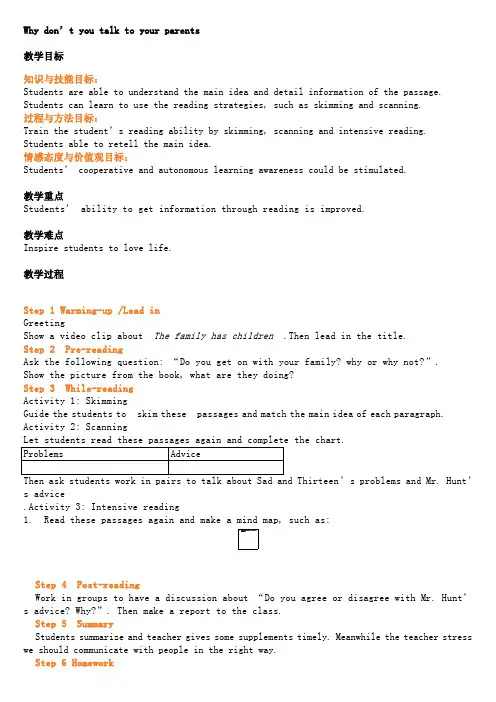
Why don’t you talk to your parents教学目标知识与技能目标:Students are able to understand the main idea and detail information of the passage. Students can learn to use the reading strategies, such as skimming and scanning.过程与方法目标:Train the student’s reading ability by skimming, scanning and intensive reading. Students able to retell the main idea.情感态度与价值观目标:Students’ cooperative and autonomous learning awareness could be stimulated.教学重点Students’ ability to get information through reading is improved.教学难点Inspire students to love life.教学过程Step 1 Warming-up /Lead inGreetingShow a video clip about The family has children.Then lead in the title.Step 2 Pre-readingAsk the following question: “Do you get on with your family? why or why not?”.Show the picture from the book, what are they doing?Step 3 While-readingActivity 1: SkimmingGuide the students to skim these passages and match the main idea of each paragraph. Activity 2: Scanning’s problems and Mr. Hunt’s advice.Activity 3: Intensive reading1. Read these passages again and make a mind map, such as:Step 4 Post-readingWork in groups to have a discussion about “Do you agree or disagree with Mr. Hunt’s advice? Why?”. Then make a report to the class.Step 5 SummaryStudents summarize and teacher gives some supplements timely. Meanwhile the teacher stress we should communicate with people in the right way.Step 6 HomeworkPlease write down your group report about 80 words.。
教师招聘初中英语Why don’t you talk to your parents教案
教师招聘初中英语Why don’t you talk toyour parents教案一、教学目标1. Students can understand the text and retell it correctly and fl uently.2. Students can grasp and use the key words such as stress, co ntinue, training, development and so on according to the context.3. After learning, students’reading skills of predicting, skimmin g, and scanning are improved through different kinds of reading ac tivities and they can guess the meaning of the words in bold accor ding to the context.4. Students will understand the attitudes and deeds that Americ an and Chinese parents have about after-school classes, which helps them to look at the problem from different perspectives and foster positive values of keeping a balance between study and relaxation.二、教学重难点1. How to understand the main idea of the text and guess the meaning of the key words in the text better.2. How to improve different reading skills, such as predicting, sk imming, and scanning through different reading activities.3. How to keep a balance between study and relaxation.三、教学过程Step 1. Lead-inPlay a video of a schoolboy’s busy weekend when he attends v arious after-school activities including ping-pong training, calligraphy courses and piano practice.Question:What’s your opinion about the phenomenon? Why is the boy u nhappy?【设计意图】通过呈现视频,激发学生的学习兴趣,创建和谐的课堂氛围。
Why don't you talk to your parents精品教案
人教版《新目标》Go for it 八年级下册Unit 4 Why don’t you talk to your parents?Section A (1a-2c )教学设计Lesson type: new lessonTeaching time: 40 minutesTeaching material analysisThis lesson is talking about students’ problems at school or ho he use of modal verb ‘should’ for giving advice in Unit 1, so they can understand some sentences easily. Some of them are good at English, they will active in class.Teaching objectivesKnowledge objectives1.Learn and master the phrases look through, get into a fight with, work out, be angry .Help students to use the sentence “Why don’t you...?” and the use of modal verbs “could / should” for giving advice.Students analysisStudents have learned angry with, hang out with, so that etc.2.Learn and master the key sentencesWhy don’t you...? Why not..?You should....You could....Ability objectives1. Enable the students to give advice about the problems atschool or home.12. Develop the students’ speaking and listening abilities. Affective objectivesStimulate students’ interest by learning English by givingadvice about the problems at school or home, thus students actively participate in communicate activities.Teaching important points1. Learn and master the key sentencesWhy don’t you...?You should....You could....2. Improve students’ speaking and listening abilities.Teaching difficult points1. How to help students master the usage of the key sentences.2. How to improve students’ speaking and listening.Teaching methodsUse listening, cooperation, mutual asking and answering forms to practice.Teaching proceduresStep 1 Lead-inPlay the video about problems at school or home.T: What problems do you have in the video?S1: They have too much homework.S2: They don’t have enough sleep.S3: They have too many after-school classes.T: Do you have problems in your life? What's your biggest problem?Step 2 Presentation21. Look at these problems. Do you think they are serious or not?Ss discuss with their partners and give some advice.① I have to study too much so I don’t get enough sleep.② I have too much homework so I don’t have any free time to do things I like.③ My parents don’t allow me to hang out with my friends.allow sb. to do sth.④ I have too many after-school classes.⑤ I got into a fight with my best friend.get into a fight with sb.2. Discuss these problems and give some advice.Why don’t you do...? / Why not do...?You should...You could…(1)I have to study too much so I don’t get enough sleep.Why don’t you go to sleep earlier this evening?(2)Ask the students to give some advice about the problemsStep 3 ListeningWork on 1b1. Tell Ss to read the sentences in 1a again. Make sure they know the meaning of the sentences.2. Play the recording for the Ss to listen and circle theproblems you hear in 1a.Work on 2aT: Peter has some problems. What advice does his friend give him? Fill in the blanks with could or should.1. Let Ss read the sentences in 2a.32. Play the recording for the Ss to listen and write the words in the blank.3. Play the recording again to check the answers.Work on 2b1. Let Ss read the sentences below. Explain some main sentencesfor the Ss. Make sure they know the meaning of each sentence.2. Play the recording for the Ss to write the letters (a-e) nextto the advice in 2a.3. Play the recording again to check the answers.Step 4 Practice1.Let Ss read the conversation in the example.A: What’s wrong? B: I'm really tired because I studied until midnight last night.A: Why don’t you go to bed earlier this evening?B: That sounds good.2.Let the students make new conversations. Talk about your problem s and your partners give some advice.Why don’t you do...? Why not do...?You should...You could…3. Let some pairs act out their conversations.4. Tell the students a real thing.Step 5 ProductionDo a survey, then fill in the chart.In our group, we have many problems. But we come up with a lot of good ideas. Mary isn’t good at English. She should ask the teacher for help. Tom.....Step 6 SummaryGive others some advice, we can use:Why don’t you do...? /Why not do...?You should...You could…Step 7 HomeworkWrite three conversations about your problems and your friends’suggestions.Blackboard designUnit 4 Why don’t you talk to your parents?Why don’t you ...?Why not ...?You could....You should....5。
人教版八年级下册第四单元Why don't you talk to your parents 教案
人教版八年级下册Unit 4 Why don’t you talk to your parents ?Section A 3a-3c教学重难点教材分析1.教学内容分析本课例的教学内容是人教版八年级下册Unit A 3a-3c,课型为阅读课。
本单元的话题是Family Relations,功能是Talk about problems and give advice, 基本结构有:You should …Why don’t you … ? Maybe you could …本课所选的Section A 3a是两封简短的信,第一封是一个笔名为Sad and Thirteen的女孩向她的老师Mr Hunt 写的求助信。
第二封是Mr Hunt给她提出的建议。
两封信在篇章结构和语言组织上有共同的特点:信的首句为主题句;使用不同的句式来谈论问题和提出建议;使用恰当的连词连结句子,语言紧凑连贯。
2.学生分析我校是农村学校,师资水平和城里的学校比,有一定的差距。
中学生的英语水平不如城里的学生,但是高于其他偏远学校中学生的英语水平。
本节课的话题为家庭关系,与学生的实际生活紧密相关,每个学生的家庭或多或少都有这样或那样的问题,经历相似,因而有话想说,有话可说。
【教学目标】基于对教学内容和学生情况的分析,本课预设了以下目标:1.掌握文中的词汇relation 、communication、argue 、refuse、nervous 、get oninstead、explain 和secondly的用法;2.在语境中感知、理解和运用不同句式描述问题和给出建议;3.学习和掌握阅读策略,根据话题对文章的内容进行预测,通过理解首句快速提炼文章的主旨大意,通过查找关键词迅速地切入文章内容。
4.在预测中充分想象和表达;正确判断教师和同学们的建议;根据信息的逻辑关系进行分析和判断,逐步形成多元思维的习惯。
5.根据短文的文本特征让学生进行仿写练习,恰当运用主题句和连词陈述自己的问题并对他人的观点提出疑点并表达自己的观点6.认识到每个人在成长的过程中总会遇到这样那样的问题,关键是如何面对,积极寻找解决问题的办法。
初中英语《Unit4 Why don't you talk to your parents》优质教学设计、教案
人教版八年级下册Unit 4 Why don’t you talk to your parents?Section A (1a-2d) 教学设计【教学目标】1、知识目标:1)能熟练掌握以下单词:allow, wrong,guess, deal,2)能正确使用以下常用短语:too much, too many, get into a fight with sb,allow sb to do sth, look through,work out3) 能熟练掌握并使用下列重点句式:What’s wrong?Why don’t you...?You should/could...2、能力目标:通过听说训练,学会谈论问题并给出相应建议, 注意连词的使用。
3、情感目标:通过本课的学习,培养学生良好的合作意识,鼓励学生大胆表达自己的想法和意愿,并能正确认识生活中的一些困难,并乐于找到解决的合理办法,建立开朗健康的人格。
【教学重难点】Talk about the problems and give advice.【教学过程】Step I. Warming-up and Leading-inWatch a video ‘Trouble is a friend’ and show the problems of 1a through pictures then ask students if they have the same problems (explaining some new words in this procedure).【设计意图:通过向学Th播放一段录像,主要内容是当前中学Th中普遍存在的问题。
背景音乐为Trouble is a friend,由此顺理成章的导入新课.】Step II. PresentationPart 1:1a Pre-listening Let’s play a game: “It’s me!”【设计意图:通过It’s me!这个游戏来呈现 1a 中的五个问题,对于比较长的句子先进行分解,由易入难,便于学Th掌握。