
人教新目标英语八年级上册unit-5单元知识点归纳总结
人教新目标英语八年级上册
Unit5 知识点归纳总结
必背词类转换:
news不可数名词culture
educate动词-----education名词-----educational形容词
-----educator名词
plan动词-----现在分词planning
find---过去式found
discuss动词-----discussion名词
stand----过去式stood
may---过去式might
perform动词--------performer名词----performance名词comedy----复数comedies
mean动词-----meaning 名词-------meaningless形容词act动词----actor(actress)名词-----action名词appear动词-----appearance名词disappear动词become动词----became过去式
rich------反义词poor
success名词----successful形容词----successfully副词-----succeed动词
luck名词----lucky形容词-----luckily副词
Unlucky形容词------unluckily 副词
lose-------过去式lost
dress-----三单形式dresses 过去式dressed
take-----过去式took
danger名词----dangerous形容词
safety名词-------safe形容词
必背短语:
let sb. do sth.
plan to do sth.
hope to do sth.
happen to do sth.
expect to do sth.
How about doing……
be ready to do sth.
try one’s best to do sth.
join sb (in)doing sth参加某人中去做某事……make s.b. do s.th.
1 talk shows 脱口秀
2 a sports show 体育节目
3 talent shows 才艺展
4 game shows 游戏节目
5 soap operas 肥皂剧
6 scary movies 恐怖电影
7 an action movie 动作电影
8 come out 出版,发行,(花)开,(太阳等)出来
9 think of认为
10 learn from从……获得;向……学习
11 find out查明;弄清楚
12 talk show谈话节目
13 game show游戏节目
14 soap opera肥皂剧
15 go on发生
16 watch a movie看电影
17 a pair of一双;一对
18 try one’s best尽某人最大努力
19 as famous as与……一样有名
20 have a discussion about就……讨论
21 one day有一天
22 such as例如
23 dress up打扮;梳理
24 take sb.’s place代替;替换
25 do a good job干得好
26 something enjoyable令人愉快的东西
27 interesting information有趣的资料28 one of……之一
29 look like看起来像
30 around the world全世界
31 a symbol of……的象征
32 be ready to do something 准备做……=get ready to do s.th.(如果接名词,则不用to ,而用for)
33 try one’s best to do something 尽最大努力做……
重点背诵:
1 a symbol of Chinese culture中国文化的象征
2 another cartoon character 另一个卡通形象
3 one of the main reasons 主要的原因之一
4 dress up like a boy 装扮得象我男孩子
5 take her father’s place to fight in the army 代替父亲的位置去参军打仗
6 play Mulan’s role well 扮演木兰演得好
7 did a good job in the movie 在这部电影中演得好
8 show her love for her family, friends and country向家人,朋友和国家显示了她的爱
9 see something enjoyable看令人高兴的东西
10 have a discussion about TV shows. 对电视节目进行讨论
11 expect to learn a lot from talk shows期待从脱口秀中学到很多知识
12 a great way to relax一个放松的好方法
13 shows that are more educational= more educational shows 更有教育意义的节目
14 a friend who is similar to you一个与你相似的朋友
15 a place where you can enjoy time一个你可以享受快乐时光的地方
16 good movies showing right now 现在正在上演的好电影
17 most of the movies on right now 大多数正在上演的电影
18 one very famous symbol in American culture 美国文化中一个非常著名的象征
19 the black mouse with two large round ears 这只有着大而圆的耳朵的黑老鼠
20 over 80 years ago 80多年前
21 first appeared in the cartoon 第一次出现在卡通中
22 when this cartoon came out…当这部卡通发行的时候……
23 the first cartoon with sound and music第一部有声配乐卡通
24 the man behind Mickey Mickey身后的男人
25 became very rich and successful变得富裕而成功
重点句子
1.Some people might ask how this cartoon animal became so popular. 有些人可能会问这个卡通动物怎样变得如此
受欢迎了呢。
2.Mickey was like a common man, but he always tried to face any danger. Mickey象一个普通人,但是他总是努力面对
任何危险。
3.Mickey was unlucky and had many problems such as losing his house or girlfriend. Mikey是不幸的,总是面对很多问
题,如推动房子或女朋友等。
4.However, he was always ready to try his best.然而,他总是准备尽最大努力。
5.Most of them wanted to be like Mickey. 他们大多数都想象Mickey一样。
6.On November 18, 1978, Mickey became the first cartoon character to have a star on the Hollywood Walk of
Fame.1978年11月18日,Mickey 成为在好莱坞星光大道上拥有一颗星星的第一个卡通形象。
7.Today’s cartoons are usually not so simple as little Mickey Mouse, but everyone still knows and loves him.今天的卡通
通常都不如Mickey Mouse那样简单,但是人人都知道他,热爱他。
8.Who has a pair of ears more famous than Mickey’s? 谁有一双比Mickey的耳朵更闻名于世的呢?
9.I think those movies are so meaningless. 我认为那些电影如此地毫无意义。
10.I’d like to find out what different people think about a subject. 我喜欢发现不同的人对同一主题的看法。
11.I hope to find out what’s going on around the world. 我希望发现世界正在发生的事情。
12.I hope to be a TV reporter one day.我希望有一我成为一个电视台记者。
13.I like to follow the story and see what happens next. 我喜欢续故事,并看看接下来会发生什么。
人教版新目标八年级英语上册各单元重点单词和短语梳理归纳

人教版八年级英语(上)重点单词短语句子归纳Unit1 Where did you go on vacation?一、重点短语1.去度假go on vacation2.待在家里stay at home3.去爬山go to the mountains4.去海滩go to the beach5.参观博物馆visit museums6.去参观夏令营go to summer camp7.相当多quite a few8.为……而学习study for9.出去go out 10.大部分时间most of the time 11.尝起来很好吃taste good 12.玩得高兴have a good time13.当然of course 14.给……的感觉;感受到feel like 15.去购物go shopping 16. 在过去in the past17.四处走走walk around 18.因为because of19.一碗……one bowl of… 20.第二天the next day21.喝茶drink tea 22.找出;查明find out23.继续go on 24.照相take photos25.重要的事something important 26.上上下下up and down27.出来come up二、重点句型及考点1. 为某人买某物buy sth. for sb. / buy sb. sth.2. 尝起来……taste + adj.3. 看起来……look+adj.4. 除了……之外什么都没有nothing…but+动词原形5.看起来……seem+(to be)+ adj.6. 到达某地arrive in+大地点/ arrive at+小地点7. 决定去做某事decide to do sth.8. 尝试做某事try doing sth .尽力去做某事try to do sth.9. 忘记做过某事forget doing sth.忘记做某事forget to do sth.10. 喜欢做某事enjoy doing sth.11. 想去做某事want to do sth.12. 开始做某事start doing sth.13. 停止做某事stop doing sth.14. 不喜欢做某事dislike doing sth.15. 继续做某事keep doing sth.16. 为什么不做……呢?Why not do. sth.?17. 如此……以至于……so+adj.+that+从句18. 告诉某人(不要)做某事tell sb. (not) to do sthUnit 2 How often do you exercise?一、根据汉语写短语。
人教版新目标八年级上册英语全册1-10单元重点短语词组总结汇编

人教版新目标八年级上册英语1-10单元重点短语词组总结汇编Unit1 Where did you go on vacation?(1)decide to go(to someplace) 决定去(某地)decide to do something 决定做某事make a decision 做决定,下决心(2)have a good time 玩得愉快have a wonderful time 玩得开心/痛快(=have fun/enjoy oneself)(3)the top of the mountain 山顶(4)stay at home 待在家里(5)go to the mountains 去山里go to the beach 去海边go to summer camp 参加夏令营(6)visit my uncle 拜访我的叔叔visit museums 参观博物馆(7)feel like 感受到,给人……的感觉(8)quite a few 相当多,不少(9)of course 当然(10)because of 由于,因为(11)try to do something努力/尽力/试图做某事try doing something试着做某事have a try 尝试一下(此处try为n.)(12)dislike somebody/something 厌恶/不喜欢某人/某物(13)be/get bored with 对……厌倦(14)have a great difference in…在……方面存在很大差异make a difference 有影响,有转折,创造不同/有所成就be different from…与……不同(15)by oneself 某人独自(= on one's own)Unit2 How often do you exercise?(1)at least 至少,不少于,起码at most 至多,最多,不超过(2)such as 例如(3)more than 多于less than少于(4)use the Internet 使用网络(5)watch television/TV看电视(6)read English books 看英语书籍(7)go online 上网go shopping 去购物(8)eat vegetables and fruit 吃水果和蔬菜(9)most of the time 大部分时间(10)stay up late 熬夜, 晚睡(=burn the midnight oil)(11)healthy habits健康的习惯(12)Old habits die hard旧习难改(13)do housework 做家务help with housework 帮忙做家务do homework 做家庭作业(14)junk food垃圾食品fast food快餐,速食instant noodles方便面instant coffee速溶咖啡(15)hardly ever 几乎从不(16)once a day一天一次once a week一周一次once a year一年一次once again再次(17)twice a day一天两次twice a week一周两次twice a year一年两次once or twice一两次,偶尔(18)be full of sth. (有)大量的,丰富的(=be filled with sth.)(19)a full bottle of wine一满瓶葡萄酒a full day of…一整天的……a full life一个经历丰富的人生the full story全部情况(20)swing dance摇摆舞(21)be good for one’s health对某人身体健康好be bad for one’s health 对某人身体健康有害(22)keep healthy 保持健康stay healthy 保持健康healthy lifestyle健康的生活方式healthy food有益健康的食物(23)one/a hundred percent百分百one percent 百分之一fifty percent百分之五十one percent of students…百分之一的学生……how many percent of the students…? 百分之几/多少的学生……?(24)常见的频度副词排序(程度从高到底)如下:always 总是100%almost always 几乎总是90%usually 通常80%often 经常60%sometimes 有时40%seldom 很少20%hardly ever 几乎不曾5%almost never 几乎从不 2%never 从不0%(25)how often…? 问频率,意为“多久一次”how soon…? 问将来,意为“多久以后”how long…? 问时间段,意为“多久”,“多长时间”(26)sometimes是副词,意为“有时”,常用于一般现在时,表示频率some times意为“几次;几倍”sometime意为“某时”,可用于过去时或将来时some time意为“一段时间”(27)be good for对……有益be good at 擅长……be good to 对……友善Unit3 I’m more outgoing than my sister.(1)care about 关心,在意care for 关心,照顾,喜欢(2)be different from 与……不同/有差异(3)bring out 使呈现,使表现出(4)the same as 和……相同/一致(5)in fact 事实上,实际上(6)be similar to 与……相似的(7)primary school 小学(8)be talented in在……方面有天赋(9)do the same things 做同样的事情(10)be good at sports 擅长运动(11)make sb. laugh让某人笑laugh at sb.嘲笑/取笑某人laugh with sb.与某人同声笑laugh loudly 大声笑(12)be quiet/keep quiet 保持安静(13)win a competition赢得一场比赛competition and cooperation 竞争与合作(14)true or false 是非,正误(15)be serious about 对……是认真的take it seriously 认真对待(16)It is (not)necessary to do sth. (没)有必要做某事(17)touch my heart触动我的心灵in touch with 和……有接触/有联系get in touch 取得联系keep in touch with 与……保持联系(18)break one’s arm摔断了胳膊break the rule违反规则(19)share…with sb.与某人分享某物lion’s share 最大的份额(20)collect information 收集信息get information 得到信息receive information 收到信息provide information提供信息a piece of information 一条消息(21)“the+比较级,the+比较级”表示“越……,就越……”The more, the better. 越多越好Unit4 What’s the best movie theater?(1)(be) close to 离……近(=next to)close friends 密友(=bosom friends知心朋友)a close game势均力敌的比赛(2)big screens 大屏幕(3)think about/ of 思考,考虑(4)do a survey of 做……的调查(5)as for 至于(6)win the prize for 获得……奖(7)the worst service 最差的服务(8)the cheapest price 最便宜的价格(9)in the south of China 在中国南部(10)talent show 才艺表演(11)have ...in common 有相同特征(12)all kinds of 各种各样的(13)be up to 是……的职责(14)play a role in…在……中发挥作用(=play a part in…)(15)make up 编造,化妆,组成(16)for example 例如(17)唱快歌sing fast songs(18)take ...seriously 认真对待……(19)come true 实现(20)be careful of 当心,小心(21)look for 寻找(强调动作)find 找到(强调结果)(22)act as 作为,担当,充当(23)How do/does sb. like ...? 意为“某人认为……怎么样?”(=“What do/does sb. think of...?”或“What do/does sb. think about ...?”)(24)so far 到目前为止,迄今为止(= till now)Unit5 Do you want to watch a game show?(1)action movie 动作片(2)find out 查明,弄清(3)take sb’s place 代替,替换(=take the place of sb.)(4)be ready to do sth. 愿意做某事get ready for 为……做准备,强调动作be ready for 为……做好了准备,强调状态get sth. ready 把某物准备好(5)do a good job干得好(6)dress up 装扮,乔装打扮dress up (in) 穿上……盛装,用……装饰dress up as sb/sth. 装扮成某人或某物(7)talk show 脱口秀(8)talent show 才艺表演(9)can’t stand 受不了,不能忍受(10)soap opera肥皂剧(11)plan to do sth. 计划去做某事make a plan/plans 制定计划(12)sth.+happens/happened +to+sb. 某人发生某事sb. Happens/happened to do sth. 某人碰巧做某事(13)happen 偶然发生(无被动形式)take place 有计划发生(无被动形式)(14)expect (sb.) to do sth. 期望(某人)去做某事be expected to do sth. 被期望去做某事(15)be famous for... 因......而著名be famous as... 作为......而出名(16)good luck to sb. 祝某人好运bad luck 倒霉,坏运气(17)stand against 反对stand for 代表,表示stand out 突出;显著(18)appear to do sth. 似乎在做某事(19)succeed in doing sth. 成功做某事(be successful in doing sth.)(20)common names 常见的名字common mistakes 常犯的错误common sense 常识common interest 共同的兴趣common language 共同语言common market共同市场(21)an ordinary worker 一个普通工人ordinary-looking 相貌平常的(22)normal temperature 正常体温normal state 正常状态(24)hope for sth. 希望得到某物hope to do sth. 希望做某事(25)wish sb. sth. 希望某人有某物wish to do sth. 希望做某事wish sb. to do sth. 希望某人做某事(hope没有这种用法)Unit6 I’m going to study computer science(1)write down 写下,记下(2)have to do with 关于,与……有关系have nothing to do with…与……无关(3)take up 学着做,开始做;占据,占用(4)agree with 同意,赞成(后面接表示人或表示“意见,观点”的词)agree to 赞同,同意(后面接表示计划,提议,办法,安排等词,to是介词)(5)personal improvement 自我改进(6)make promises 许诺give a promise 许下诺言keep a promise 信守诺言(=keep one’s word)carry out a promise 履行诺言break a promise 违背诺言promise to do sth. 答应/许诺做某事(7)have something in common 有共同点(8)improve relationships 改善关系(9)at the beginning 在……开始(10)for this reason因为这个原因(11)send for 派人去叫send away 派遣,解雇send off 送别,差遣send up 发射(12)make a resolution做决定,下决心(13)make sure(of)确信(=be sure)(14)discuss sth. with sb. 和某人谈论某事(15)grow up 成长,长大grow into 长大成为(16)be going to do sth. 打算,准备,计划做某事(将来时)(17)make a plan for…为……制定计划(18)a kind of 一种all kinds of 各种各样的kind of 有点(= a little)Unit7 Will people have robots? (1)space station太空站(2)over and over again 多次,反复地(3)hundreds of 数以百计,许多,大量(4)be able to do sth. 能够做某事be unable to do sth. 不能做某事(5)fall down 倒下,跌倒,倒塌fall asleep入睡fall behind落后于(某人或某物)fall in love with喜爱,爱上fall off 掉下fall over 跌落,被绊倒fall into落入,陷入A fall into the pit, a gain in the wit. 吃一堑,长一智(此处fall为n. 跌落)(6)look for寻找(强调动作)(7)play a part in sth.参与某事(= play a role in sth.)play a part in doing sth. 参与做某事(8)in 100 years 一百年以后(9)help with the housework帮忙做家务(10)seem impossible好像不可能(11)make robots look like humans使机器人看起来和人类一样(12)for example例如(13)have many different shapes有很多不同的外形(14)air/water pollution 空气/水污染noise pollution 噪音污染environmental pollution “环境污染(15)believe sb. 相信某人说的话believe in sb. 信任某人,相信某人的人格(16)be free to do sth. 自由地做某事(17)try sth. 尝试某事try to do sth. 尽力做某事try doing sth. 试着做某事try one’s best to do sth. 尽某人最大努力做某事(= do one’s best to do sth.)try on试穿try out 试用,试验have a try 试一试(18)look like看起来像……(应用范围最广,除了描述人、物之外,也能抽象表达事件或现象)take after像……,与……相似(最常见的是用在有血缘关系的亲子之间,外貌用的最多,也能够用在性格脾气这些内在特质上)be similar to 与……相似(一般用在相近似的物品和情境的对比上)Unit8 How do you make a banana milk shake?(1)p our…into …把……倒进……里(通常强调倾倒液体)put…into…把……放进……里(既可以放液体,也可以放固体)pour out 倒出(2)t urn on 接通,打开(电源开关)turn off 关闭,熄灭(灯、煤气等)turn up (把音量)调大,调高turn down (把音量)调小,调低turn in 上交turn into使成为;翻译成turn to转向turn over翻转(3)cut up 切碎(4)mix up混合在一起(5)peel the bananas 剥香蕉(6)a cup of yogurt 一杯酸奶(7)five spoons of honey 五勺蜂蜜(8)add…to…把……加到……add to增加;增添(其中to是介词,后接名词或代词)add up 把……加起来add up to 总计,加起来结果是(9)celebrate with 用......庆祝(10)a piece of art一件艺术品a piece of一张,一片,一件,一条in pieces 碎片,碎块(11)cover…with…用......覆盖be covered with 被……覆盖(12)at first 起初,首先from first to last自始至终first of all 首先,第一(13)be filled with 充满......(= be full of)(14)put away把……收起来放好put on穿上put off推迟,延期put out熄灭put down放下put up建造;挂起;举起put…on…把……放在……上put together 放在一起(15)sth. needs doing 某物/事需要被做=sth. needs to be done(16)have a big meal 吃大餐(17)it’s time to do sth 到/是做某事的时候了(=it’s time for doing sth/ sth)(18)make sb. sth. = make sth. for sb. 为某人做某物Unit9 Can you come to my party?(1)prepare sth. 准备......prepare to do sth. 准备做某事prepare for an exam 为考试做准备prepare for (doing)sth. 为某事做准备prepare sth. for... 为……准备某物make preparations for 做准备(2)hang out闲逛,徘徊,逗留(=hang about)hang up挂断(电话)hang on不挂断(3)take a trip 去旅行(4)reply to(sb./sth.) 对......作出回答或答复reply for 致答辞;谢辞a reply to... 对......的答复in reply (to) 作为(对……的) 答复,为答复……(5)hear from sb. 收到某人来信(6)the day after tomorrow后天(7)another time 别的时间(8)look forward to 盼望,期待(9)turn down 拒绝(10)the day before yesterday前天(11)have the flu 患流感(12)go to the doctor 看医生(13)come to the party来参加聚会(14)meet friends见朋友(16)have to 不得不(16)invite sb to do 邀请某人做某事invite sb to someplace 邀某人去某地invite sb. for a drink 请某人喝酒(17)refuse sb. 拒绝某人refuse (sb.) to do 拒绝某人去做某事refuse sb. sth.为某事拒绝某人(作为及物动词)(18)catch one's breath 喘气,吓一跳,(由惊吓)暂时停止呼吸catch out 发觉某人的过失/错误,找破绽catch up with赶上(19)to one’s surprise 使某人吃惊的是……in surprise 吃惊地be surprised at/about 对……感到吃惊/意外(20)too much强调much,修饰不可数名词much too强调too,修饰形容词或副词(21)thanks for…为……而感谢,后接名词、代词或动名词thanks to 幸亏,由于thank sb. for sth. 为某事感谢某人be thankful to sb. for sth. 因某事而对某人心存感激(22)be busy doing sth. 忙于做某事be busy with sth. 忙于……(23)call sb. 给某人打电话(=ring sb.phone sb.ring sb. upgive sb. a callgive sb. a ringmake a phone call to sb.)(24)look forward to期待,盼望(to是介词,后面接名词,代词或动名词作宾语)(25)not…until…直到……才(26)have to 客观上不得不must主观上必须(27)can’t help doing sth 禁不住做某事help oneself to 随便用……with the help of =with one’s help在……的帮助下help sb. out 帮助某人摆脱困境help sb.(to)do sth. 帮助某人做某事Unit10 If you go to the party, you’ll have a great time! (1)keep…to oneself保守秘密;不与人来往,不交际keep doing sth. 继续做某事,保持某种状态(2)in the end/at last 最后,终于(3)make a mistake/make mistakes 犯错误by mistake错误地(不是故意做某事)(4)too…to…太……而不能……(5)advise sb. (not)to do sth. 建议某人(不)做某事(6)be angry with sb. 生某人的气be / get angry at / about sth. 因某事而生气(7)cut...in half 把……切成两半/一切为二be halfway to …完成了或做了事情的一部分(此处to是介词)(8)have lots of worries 有很多烦恼(9)the first step to do sth. 做某事的第一步(10)ask for advice 寻求建议a piece of advice一条建议give sb. advice (on) 给……提(有关……)的建议take one’s advice 听从某人的建议(11)have problems with…在……某方面有问题(12)run away from 逃离(13)solve (=deal with)problems 解决问题(14)go to the party 参加聚会go fishing 去钓鱼(15)be upset with sb. 生某人的气upset oneself 使某人自己心烦气乱(16)do enough exercise 做足够的运动(17)cook/make dinner/supper 做晚饭(18)have lots of money 有很多钱(19)eat too much 吃得太多(20)help others 帮助别人(21)a great soccer player 一个伟大的足球运动员(22)travel around the world 周游世界(23)have / be an experience有/是一次经历be experienced in 在……方面有经验have no experience at all 完全没有经验rich experience 丰富的经验practical experience 实务经验,实践经验(24)in the end 最后,终于(=at last,finally)by the end of到……为止,在……以前at the end of在……末尾,在……尽头(25)be afraid of/to do sth. 害怕做某事,不敢做某事(此外be afraid of还可以表示担心可能会发生某事)(26)worry about /over sth/sb担心某事/某人worry about=be worried about 担心(27)ask sb. to do sth. 请求/要求某人做某事其否定形式为ask sb. not to do sth.第21 页共21 页。
新目标英语8年级上册1-5单元知识点

最新(2013秋)人教版八年级上册英语知识点Unit 1 Where did you go on vacation?(谈论假期生活,一般过去时)Unit 2 How often do you exercise?(谈论生活习惯,一般现在时)Unit 3 I'm more outgoing than my sister(谈论事物对比,形容词比较级)Unit 4 What's the best movie theater?(谈论事物比较,形容词最高级)Unit5 Do you want to watch a game show?(谈论内心想法,一般现在时)Unit6 I’m going to study computer science.(谈谈生活的目标,一般将来时)Unit7 Will people have robots?(对将来生活的预言,一般将来时)Unit8 How do you make a banana milk shake?(描述进程,祈使句)Unit9 Can you come to my party?(学习邀请,作出、接受和拒绝邀请,学习表请求的句子) Unit10 If you go to the party, you’ll have a great time.(作出决定,学习if的条件状语从句)①复习一般过去时②复合不定代词的用法③反身代词的用法④系动词的用法⑤动词后的to do和doing 的区别⑥ed形容词和ing形容词的区别⑦“近义词”的区别⑧本单元中的主谓一致现象⑨动词过去式的构成及不规则动词表⑩用同义短语转换同义句时谓语动词形式一致性的培养。
⑾感叹句的结构和连词的选择。
Unit1 Where did you go on vacation?重点短语1. go on vacation去度假at home 待在家里to the mountains 去爬山4. go to the beach 去海滩 5. visit museums 参观博物馆6. go to summer camp 去参加夏令a few 相当多for 为……而学习out 出去of the time 大部分时间11. taste good 尝起来很好吃 a good time 玩得高兴13. of course 当然like 给……的感觉;感受到shopping 去购物the past 在过去17. walk around 四处走走18. because of 因为19. one bowl of… 一碗……20. the next day第二天21. drink tea 喝茶22. find out 找出;查明23. go on 继续photos 照相25. something important 重要的事26. up and down 上上下下27. come up 出来28. buy sth. for sb. / buy sb. sth. 为某人买某物29. taste + adj. 尝起来…… 30. look+adj. 看起来………but+动词原形除了……之外什么都没有+(to be)+ adj. 看起来…… 33. arrive in+大地点/ arrive at+小地点到达某地to do sth. 决定去做某事35. try doing sth. 尝试做某事/ 36. try to do sth. 尽力去做某事37. forget doing sth. 忘记做过某事/ 38. forget to do sth.忘记做某事39. enjoy doing sth. 喜欢做某事40. want to do sth. 想去做某事41. start doing sth. 开始做某事42. stop doing sth. 停止做某事43. have a good time=enjoy oneself=have fun(doing sth.)玩得痛快44. keep doing sth. 继续做某事45. Why not do. sth.? 为什么不做……呢46. so+adj.+that+从句如此……以至于…… 47. tell sb. (not) to do sth. 告诉某人(不要)做某事三、重点句子:1. Where did you go on vacation? 你去哪儿度假的?2. Long time no see. 好久不见。
人教新目标八年级英语上册重难点知识点归纳
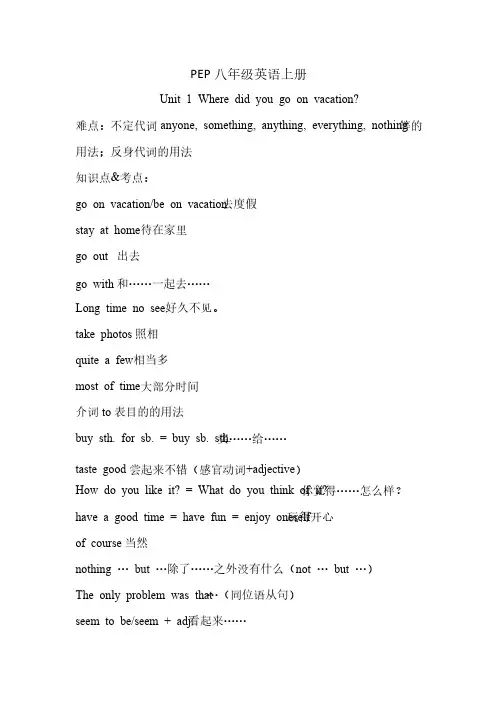
PEP八年级英语上册八年级英语上册Unit 1 Where did you go on vacation? 难点:不定代词anyone, something, anything, everything, nothing等的用法;反身代词的用法用法;反身代词的用法知识点&考点:考点:go on vacation/be on vacation 去度假去度假stay at home 待在家里待在家里待在家里go out 出去出去go with 和……一起去……和……一起去……Long time no see. 好久不见。
好久不见。
take photos 照相照相quite a few 相当多相当多相当多most of time 大部分时间大部分时间大部分时间表目的的用法介词to表目的的用法buy sth. for sb. = buy sb. sth. 买……给……买……给……taste good 尝起来不错(感官动词+adjective)How do you like it? = What do you think of it? 你觉得……怎么样?你觉得……怎么样?have a good time = have fun = enjoy oneself玩得开心玩得开心of course 当然当然nothing …but …除了……之外没有什么(not …but …)…)The only problem was that …(同位语从句)…(同位语从句)seem to be/seem + adj. 看起来……看起来……keep a diary 记日记记日记记日记 + at + 小地点小地点小地点arrive + in + 大地点大地点大地点 decide to do 决定做某事决定做某事决定做某事 try doing sth. 尝试做某事尝试做某事尝试做某事 try to do sth. 尽力做某事尽力做某事feel like 感觉到感觉到 feel like + n./ v-ing 想要……想要……ride … to …骑……到………骑……到……许多的:a lot of + 可数名词可数名词 lots of + 可数可数or 不可数名词不可数名词 I wonder that …我想知道………我想知道………我想知道…… in the past 在过去在过去在过去 enjoy doing sth. 享受做某事享受做某事享受做某事 walk around 到处逛逛到处逛逛感叹句:What + 冠词冠词 + adj. + n. + (it is) = How + adj. + 冠词冠词 + n. + (it is) start start doing doing doing sth. sth. 开始做某事开始做某事 stop stop doing doing doing sth. sth. 停止做某事停止做某事 finish finish doing doing sth. 结束做某事结束做某事because & so (不可同用)(不可同用)(不可同用) wait for …等待………等待……because of + n. a little/ a few 一些(两者的区别,以及与little/few 的区别)的区别) enough + n. / adj. + enough as + adj./adv. + as 和……一样……和……一样……one bowl of …一碗………一碗……along the way 沿着这条路沿着这条路沿着这条路 时间段+ later = after + 时间段……之后时间段……之后other, others, the other, the others, another on trip 在旅途中在旅途中find out 找到,找出找到,找出 / find 寻找寻找 / look for 寻找寻找寻找 so + adj. + that + 从句如此……以致……从句如此……以致……tell sb. (not) to do sth. 告诉某人(不要)做某事告诉某人(不要)做某事keep doing sth. / go on doing sth. 继续做某事继续做某事keep sth. + adj. 使……保持……状态使……保持……状态up and down (人)来来往往;(人)来来往往;(物)上上下下(物)上上下下in excitement = excitedly 兴奋地兴奋地come up / come out / come on / come in forget to do sth. 忘记做某事忘记做某事 forget doing sth. 忘记做过某事忘记做过某事忘记做过某事 like / dislike + n. / v-ing 喜欢/不喜欢某物/做某事做某事something + adj. ……的事情……的事情……的事情 Why not + v. = Why don ’t you + v. 为什么不……呢?为什么不……呢?Unit 2 How often do you exercise? 重点:1. How often 句型的运用;2. 2. 六个频度副词六个频度副词never, hardly ever, sometimes, sometimes, often, often, often, usually, usually, usually, always always 的差异、理解及使用;3. 频率数词once, twice 等的认识和运用;4. 一般现在时不同人称谓语形式的变化及一般疑问句的问答。
八年级上册英语1-5单元重难点知识精讲精练(人教新目标)

八年级上册英语1-5单元重难点知识精讲精练(人教新目标)Unit 1 Where did you go on vacation?一、重点词组、短语1、go on vacation去度假,2、stay at home 呆在家,3、go to the mountains 上山/进山,4、go to the beach到海边去,5、visit museums 参观博物馆,6、go to summer camp 去夏令营,7、quite a few 相当多,8、study for为……学习,9、go out 出去,10、most of the time 大部分时间/绝大多数时间,11、taste good 尝起来味道好,12、have a good time玩的开心,13、of course当然可以,14、feel like感觉像……/想要,15、go shopping购物,16、in the past 在过去,17、walk around绕……走,18、too many 太多(可数名词前面),19、because of 因为,20、one bowl of 一碗……,21、find out 查出来/发现,22、go on继续,23、take photos 照相,24、something important重要的事情,25、up and down上上下下,26、come up出来二、重要句子(Grammar focus):1.-Where did you go on vacation?你到哪里去度假了?-I went to New York City.我去了纽约城2.-Did you go out with anyone? 你出去带人吗?-No, No one was here. Everyone was on vacation.不,没有人在这儿.大家都去度假了.3.-Did you buy anything special?你买了什么特别的东西吗?-Yes, I bought something for my father.对,我给父亲买了一些东西.4.-How was the food? 食物怎么样?- Everything tasted really good.每一样东西真的都好吃.5.-Did everyone have a good time?大家玩的开心吗?-Oh, yes. Everything was excellent.对,一切都很精彩.三、习惯用法、搭配1. buy sth. for ab./ buy sb. sth. 为某人买某物2. taste + adj. 尝起来……3. nothing ….but + V.(原形) 除了……之外什么都没有4. seem + (to be) + adj 看起来5. arrive in + 大地方/ arrive at + 小地方到达某地6. decide to do sth. 决定做某事7. try doing sth. 尝试做某事/ try to do sth. 尽力做某事8. enjoy doing sth. 喜欢做某事9. want to do sth. 想去做某事10. start doing sth. 开始做某事11. stop doing sth. 停止做某事12. look + adj 看起来13. dislike doing sth. 不喜欢做某事14. Why not do sth. 为什么不做…….呢?15. so + adj + that + 从句如此……以至于……16. tell sb. (not) to do sth. 告诉某人(不要)做某事17. keep doing sth. 继续做某事18. forget to do sth. 忘记去做某事/ forget doing sth 忘记做过某事四、词语辨析Section A1.Where did you go on vacation? 你去哪里度假了?(P1)1)这是有疑问副词where引导的特殊疑问句,where用来询问地点和场所,放在句首.a._____ do you _____ ______?你从哪里来?b._____does he______?他住在哪里?2)go on vacation意为“去度假”.I want ____ ____ ____ ____in Hainan this winter.今年冬天我想去海南度假.2.visited my uncle 看望了我的叔叔(P1)visit是及物动词,意为“拜访;探望”,后接表示人的名词或代词.visit还可以意为“参观;游览”,后接表示地点的名词.a.I visited my grandmother last week. 上周我去______了我的外婆.b.Do you want to visit Shanghai? 你想______上海吗?拓展:visitor意为“参观者;游客”.eg: These visitors come from America._______________________3.buy anything special 买特别的东西.(P2)1)buy及物动词,意为“买;购买”.其过去式为______.拓展:buy sth. for sb.=buy sb. sth. 意为“给某人买某物”.My uncle_____ _____a bike.= My uncle_____ _____for me.2)anything不定代词,意为“某事;某件东西”,主要用于疑问句或否定句中.a.Do you want anything from me?b.I can’t say anything about it.3) anthing special表示“特别的东西”,形容词修饰不定代词时后置.Is there________ ________in this book?这本书里有新的内容吗?4.Oh, did you go anywhere interesting?哦,你去有趣的地方了吗?(P2)1)本句是did开头的一般疑问句2)anywhere用作副词,意为“在任何地方”.eg:Did you go anywhere during the summer vacation?辨析:anywhere与somewhereanywhere意为“在任何地方”,常用于否定句和疑问句中. eg:I can’t find it anywhere.somewhere意为“在某处;到某处”,常用于肯定句中. eg:I lost my key somewhere near here.5.We took quite a few photos there.我们在那里拍了不少照片.(P2)take photos 意为“照相;拍照”. eg:We______ ______on the Great Wall.我们在长城上照了相.辨析:quite a few与quite a littlequite a few 意为“很多;不少”,修饰可数名词复数;quite a little 意为“很多;不少”,修饰不可数名词.a. He stays here for _____ _____ _____days.b.There is _____ _____ _____water in the bottle(瓶子).6. I just stayed at home most of the time to read and relax. 我大部分时间只是待在家里读书休息. (P2)most of the time意为“大部分时间”,其中most为代词,意为“大部分;大多数”.拓展most of…意为“……中的大多数”,它作主语时,谓语动词取决于most of后所修饰的名词.a. Most of us_____(be)going to the park. 我们大多数人要去公园.b. Most of the food_____(go)bad. 大部分的食物都变质了.7.Everything tasted really good!所有的东西尝起来真的很好吃!(P3)taste在此为系动词,意为“尝起来”,其后接形容词构成系表结构.a.The food tastes really great.食物尝起来棒极了.8. Did everyone have a good time?大家都玩得很开心吗?(P3)have a good time = enjoy oneself = have fun 玩得开心(+ doing)eg: We had a good time visiting the the Great Wall.= We enjoyed ourselves visiting the the Great Wall.= We had fun visiting the the Great Wall.9.How did you like it? 你觉得它怎么样?(P3)How do/did you like……? 意为“你觉得……怎么样?”,用来询问对方的观点或看法,相当于What do you think of……?eg: How do you like your new job? = _____ _____ _____ _____ your new job?10.Did you go shopping? 你们去购物了吗?(P3)go shopping意为“去购物;去买东西”,同义短语为do some shopping.eg: I usually go shopping on Sundays.我通常星期天去购物.拓展:“go+doing”形式表示“去做某事”,常用于表达从事某一体育活动或休闲活动.go skating 去滑冰go hiking 去go sightseeing 去观光go fishing 去钓鱼go swimming 去游泳go boating 去划船11.I went to a friend’s farm in the countryside with my family.我和家人一起去了乡下一个朋友的农场.(P3)a friend’s farm是名词所有格形式.一般情况下,表示“有生命的人或物”的名词后面加’s,表示所属关系.eg:The red bike is Alice’s. 那辆红色的自行车是爱丽斯的.拓展:名词所有格的构成:1)单数名词词尾加’s ,复数名词词尾没有s,也要加’sthe girl ‘s pen女孩的钢笔women’s shoes女鞋on Children’s Day2)复数名词以s结尾的只加’the students’ reading room学生阅览室Teachers’ Day教师节3)如果两个名词并列,并且分别有’s,则表示“分别有”;只后一个名词有一个’s,则表示“共有”:John’s and Kate’s rooms.约翰和凯特(各自)的房间.Lily and Lucy’s father. 莉莉和露西的爸爸(同一个爸爸).4)表示无生命的名词一般以...of...构成短语,表示所有关系.a map of China一幅中国地图the name of the story那个故事的名字12. Still no one seemed to be bored. (即使这样)仍然没有人看起来无聊.(P3)1)seem意为“好像;似乎;看来”.eg:Everything seem s easy.一切似乎很容易.拓展a. seem+adj. “看起来……”. You seem happy today.你今天看起来很高兴.b. seem+to do sth. “似乎,好像做某事”. I seem to have a cold.我似乎感冒了.c. It seems/seemed+从句“看起来好像…;似乎…”.It seems that no one believes you.看起来好像没有人相信你.2)辨析:bored与boringa. bored意为“厌烦的;感到无聊的”,一般在句中修饰人.b. boring意为“无聊的;令人厌烦的”,一般在句中修饰事或物.eg:a. I’m ______with what he said.我对他说的话厌烦极了.b. I find the story very_______.我发现这个故事太无聊了.Section B1. What activities do you find enjoyable? 你发现什么活动让人快乐?(P5)1)activities是activity的复数形式,意为“活动”.Students like outdoor activities. ____________________________2)enjoyable形容词,意为“愉快的;快乐的”.I’m sure we will have an enjoyable vacation. 我确信我们将会有一个愉快的假期.2. I arrived in Penang in Malaysia this morning with my family. 今天早上我和家人到达了马来西亚的槟城.(P5arrive不及物动词,意为“到达”.arrive in表示到达较大的地方,如国家、省、市等;arrive at 表示到达较小的地方,如机场、商店、广场、村庄等.(注:地点副词home,here,there前介词省略)辨析:①arrive in+大地点/ arrive at+小地点②get to +地点③reach+地点eg:I (到达) school at 8:00 o’clock yesterday.3. …so we decided to go to the beach near our hotel…因此我们决定到旅馆附近的海滩上去.(P5)decide to do sth.意为“决定做某事”. eg: They _____ ______ ______the museum.他们决定去参观博物馆.拓展:decide后常跟“疑问词+动词不定式”做宾语.He can’t decide when ______ _____(leave) 他不能决定何时动身.4. My sister and I tried paragliding.姐姐和我尝试了滑翔伞运动.(P5)try此处用作及物动词,其后常接名词、动名词或不定式,意为“尝试;试图,设法;努力”She is trying my bicycle.她正在试骑我的自行车.拓展:try也可用作名词,意为“尝试”,常用短语“have a try”,意为“试一试”.I want to have a try.我想试一试.辨析:try doing sth. / try to do sth.1)try doing sth. 尝试做某事,表示一种尝试、做做看的想法,不一定付出很多努力.2)try to do sth.尽力、设法去做某事,表示想尽一切办法要把事情办成,强调付出努力设法去完成.a. I ______ ______ him, but no one answered. 我试着给他打电话了,但没有人接听.b. I’m ______ ______ ______ English well. 我正尽力把英语学好.5. I felt like I was a bird. It was so exciting! 我感觉自己就像一只小鸟.太刺激了!(P5)1)feel like意为“给……的感觉;感受到”.其后常接从句.eg: He feels like he is swimming. 他感觉像在游泳一样.拓展:feel like还可意为“想要……”,其后可接名词、代词或动名词.即:feel like sth. 想要某物feel like doing sth. 想要做某事eg:Do you feel like a cup of tea now? 你现在想要一杯茶吗?Do you feel like ______ (take) a walk in the park with me? 你想跟我在公园散步吗?2)辨析:exciting与excitedexciting 意为“令人兴奋的,使人激动的”,一般修饰某物.excited 意为“感到兴奋的,激动的”,一般修饰某人.Eg:a.The story is_________(exciting, excited) .b.He told me the_______(exciting, excited)news.c.Sarah was_______(exciting, excited)to see the singer.6. There are a lot of new buildings now…现在有许多新的建筑物……(P5)building 可数名词,意为“建筑物;楼房”.build 动词,“建造,建筑” (built,built),The workers built many tall buildings in our school last year.7. I wonder what life was like here in the past. 我想知道在这儿过去的生活是什么样的.(P5)wonder此处是及物动词,意为“想知道;琢磨”.其后常接who, what, why等疑问词引导的宾语从句.Eg:1.I wonder _______________. 我想知道那个男孩是谁.A. the boy is who B. who the boy is2. I wonder what they were doing here.我想知道他去哪里了.8.I really enjoyed walking around the town. 我真的很喜欢在镇上到处走走. (P5)1)enjoy及物动词,意为“喜爱;欣赏;享受……的乐趣”,其后接名词,代词或动名词作宾语.a. Do you enjoy your job? 你喜欢你的工作吗?b. I enjoy reading books. 我喜欢读书.(enjoy doing sth.喜欢做某事)拓展:enjoy oneself =have a good time = have fun 玩得开心(+ doing sth.)2)walk around 意为“四处走走”.He’s just walking around the village.他只是在村庄里随便走走.9. What a difference a day makes! 一天的变化有多大呀!(P5)difference可数名词,意为“差别,差异” ;其形容词形式为different,意为“不同的;有差异的”. Eg: a. What is the difference between this book and that book?b. My schoolbag is different from yours. ( be different from 意为“与……不同”)10. We wanted to walk up to the top , but then it started raining a little so we decided to take the train.(P5)1)want to do sth. 意为“想要做某事”.2)start doing sth. 意为“开始做某事”,同义短语:start to do sth.Eg: Tom started learning English last year.3)a little 意为“一点儿”,在句中修饰动词、形容词或副词.也可以修饰不可数名词.Eg: a. I can draw a little, but only as a hobby. ______________________________b. It’s a little cold outside. ______________________________c. He can speak a little English. ______________________________4) take the train意为“乘火车”,take在此意为“乘坐”.11.We waited over an hour for the train because there were too many people. 因为人太多,所以我们等了一个多小时的火车.(P5)1)wait for意为“等候”,其后可接人或物.Tom was waiting for a bus over there.2)over介词,意为“多于;超过” ,相当于more than.Eg : My father is over 40 years old.There are over eight hundred students in our school.3) too many意为“太多”,其后接可数名词复数. He always has too many questions to ask me.辨析:too many + 可数名词复数意为“太多... ”too much + 不可数名词意为“太多... ”much too + 形容词意为“太... ”eg:I have homework to do today.12.And because of the bad weather, we couldn’t see anything below.而且因为坏天气,我们也没能看到下面的任何景色(P5)辨析:because of与becausea. because of意为“因为,由于”,后可接名词、代词或动名词,不能接句子.He lost his job because of his age.b. because意为“因为”,引导状语从句,即接句子.I didn’t buy the shirt because it was too expensive.13. My father didn’t bring enough money…我爸爸没带足够的钱……(P5)1)辨析:bring与takebring意为“带来;拿来”,指从别处带到说话者所在地.take意为“拿走;带走”,指从说话者所在地带到别处去.2)enough 意为“足够的,充分的”1.用来修饰形容词或副词,一般置于被修饰词之后.2.用来修饰名词时可放在形容词前面或后面.Eg:a. We have enough time to do our homework.b. The box is big enough.14. …because we forgot to bring an umbrella…因为我们忘了带雨伞.(P6)辨析:forget to do sth.与forget doing sth.forget to do sth. 意为“忘记要做某事(事情还没做)” eg: Don’t forget to close the window. forget doing sth. 意为“忘记做过某事(事情已经做过了)” eg: I forget closing the window. 15. About one hour later, we stopped and drank some tea. 大约一小时后,我们停下来喝了些茶.(P6)1)one hour later 一小时后;一小时前__________________2)stop动词,意为“停止;中断”,过去式_________,现在分词__________;3)drink及物动词,意为“喝;饮”;还可以作名词,意为“饮料”.16. Did you dislike anything? 你不喜欢什么东西吗?(P7)dislike意为“不喜欢;厌恶”,其后可接名词、代词或动名词形式作宾语.Eg:a. Mary ______ the hamburgers. 玛丽不喜欢汉堡包.b. I _____ ______ computer 我不喜欢玩电脑游戏.17. Why not? 为什么不带呀?(P8)why not意为“为什么不呢”,一般用在疑问句中,表示提建议;why not后面需跟动词原形.注“Why not + 动词原形?” 相当于“Why don’t you+ 动词原形?”a. Why not go to the party with me? =Why don’t you go to the party with me?为什么不和我一起去参加聚会呢?b._____ _____ take a walk? = _____ ______ _____ take a walk? 为什么不去散步呢?18.Everyone in our class took a bag with some food and water. 我们班上的每一个人都随身带了装有食物和水的提袋.(P8)with介词,意为“具有;带有”. 此处介词短语with some food and water作bag的后置定语.拓展:with作介词时的其他用法:a.“和……一起’I often go to school ______ my friend. 我经常和朋友们一起去上学.b. 以(手段、材料),用(工具),Cut the apple with a knife. 用刀切苹果.19. My legs were so tired that I wanted to stop. 我的双腿太累了以至于我都想停下来.(P8)so…that… / such…that…(如此…以致)引导的结果状语从句so+adj./adv.+that…Eg:1. He is ____lovely a boy____we love him very much.2. The little boy is so young that he can’t go to school. _________________________________20.常用的感叹句的结构:1)What +adj.+ 复数名词/ 不可数名词+主语+谓语!2)What +a/an+adj.+可数名词单数+主语+谓语!3)How +ad j. +a/an+可数名词单数+主语+谓语!4)How+a dj./adv. +主语+谓语!eg: 1.What an interesting book it is! = How interesting a book is! 那本书多么有趣啊!2.____a clever girl she is! A.Who B.What C.How D.Where3. _____clever a girl she is! A.Who B.What C.How D.Where4._____important jobs they have done! A.What B.Who C.How D.Where5._____sweet water it is! A.Who B.What C.Where D. How6._____interesting the dog is! A.Who B.What C. Where D. How21. My classmates told me to keep going, so I went on. 我的同学告诉我坚持往前走,因此我便继续前进了(P8)1)tell sb. (not)to do sth.意为“告诉某人(不要)做某事.The teacher ______ ______ ______ ______ the window just now. 老师刚才告诉我们擦窗户. 2)keep doing sth. 意为“继续做某事,一直做某事”.She______ ______ TV for two hours last night. 昨晚她持续看了两个小时的电视.23. Everyone jumped up and down in excitement. 大家都兴奋地跳起来.(P8)up and down 意为“上上下下;来来回回”,在句中作状语.Eg:They looked me ______ ______ ______. 他们上上下下打量我.He walks______ ______ ______ in the room. 他在房间里来回走动.22.反身代词:myself , ourselves, yourself , yourselves, himself, herself, itself, themselves.作动词或介词的宾语:经常在enjoy, teach, hurt, buy, introduce, dress, kill等动词和by, for, to, of等介词后作宾语.一年主考宾语回自身H e is teaching himself English.她在自学英语.She was talking to herself.她自言自语.He lives by himself in the country.他独自住在乡下.1)Help yourself! 请随便吃吧!/请自己去取吧!2)Make yourself at home! 别客气!3)make yourself heard /understood. 使你的话被人听得见/理解4)teach oneself 自学=learn by oneself5)by oneself 独自6)for oneself 为自己;替自己7)enjoy oneself 玩的愉快8)dress oneself 给自己穿衣23.few, little, a few, a little:的用法few, a few修饰可数名词,little, a little修饰不可数名词.few, little具有否定意义,表示“几乎没有”,a few, a little具有肯定意义,表示“一些”.He has little money, but few students want to lend money to him.他几乎没有钱,但是几乎没有学生想借钱给他.There is a little milk and a few apples left in the fridge.冰箱里还有一些牛奶和一些苹果.Unit 2 How often do you exercise?一、词组、短语:1、help with housework 帮助做家务活,2、go shopping 购物,3、on weekends 在周末,4、how often 多久一次,5、hardly ever几乎不,6、once a week 每周一次,7、twice a month每月二次,8、go to the movies去看电影,9、every day 每天,10、use the Internet上网/用网,11、be free有空,12、have dance and piano lessons 上舞蹈钢琴课,13、swing dance摇摆舞14、play tennis 打网球,15、stay up late熬夜,16、at least至少,17、go to bed early 早睡,18、play sports 锻炼身体,19、be good for 对…有好处,20、go camping去野营,21、in one’s free time 在某人的空闲时间,22、not….at all 根本不,23、the most popular 最流行,24、such as例如,25、go to the dentist去看牙医,26、more than 超过/多于,27、Old habits die hard.旧习惯难改.28、hard=difficult 困难的,29、less than 少于/不到二、重要句子(语法):What do you usually do on weekends?你周末通常做什么?I always exercise.总是锻炼身体. What do they do on weekends?他们周末干什么?They often help with housework.他们经常帮助干家务活.What does she do on weekends? 她周末干什么?She sometimes goes shopping.她有时购物. How often do you go to the movies? 你多久看电影一次?I go to the movies maybe once a month.可能一个月看一次.How often does he watch TV? 他多久看电视一次?He hardly ever watches TV.他几乎不看电视. Do you go shopping? 你购物吗?No, I never go shopping.不,我从来就不购物.三、习惯用法、搭配1. help sb. with sth 帮助某人做某事2. How about…? =What about…? ….怎么样?/ ….好不好?3. want sb. to do sth. 想让某人做某事4. How many + 可数名词复数+ 一般疑问句….有多少…..5. 主语+ find+ that 从句…发现…6. It’s + adj.+ to do sth. 做某事是….的7. spend time with sb. 和某人一起度过时光8. ask sb. about sth. 向某人询问某事9. by doing sth. 通过做某事10. What’s your favorite…..? 你最喜欢的……是什么?11 start doing sth. 开始做某事12. the best way to do sth. 做某事的最好方式四、词语辨析Section A1. help with housework 帮助做家务(教材第9页)(1)help with sth. 意为“帮助做某事”拓展:help sb. with sth.= help sb. (to)do sth. 帮助某人做某事Eg: I often help him with his English.= I often help him (to) learn English. 我经常帮他学习英语.(2)housework 意为“家务劳动”.不可数名词.1. They have housework to do.A. many B. much2. sometimes 有时(教材第9页)辨析:sometimes ,some times ,sometime ,some timesometimes 有时候.=at times也是“有时”的意思.提问用how oftensome times 几次.time作可数名词时可作“次数”解;表示“时间”时是不可数名词.How mang timessometime 某个时候.可指过去或将来的某个时候.提问用whensome time 一段时间.常与for连用.对它提问用how long .口诀记忆:分开“一段时间” ;相聚“某个时候”.Eg:Sometimes I get up very late. 有时我起床很晚.I will go to shanghai sometime next week. 下周某个时候我要去上海.He reads the story some times. 他读这个故事几遍了.I’ll stay here for some time. 我将会在这儿呆一段时间.练习:①We plan to stay in Hainan for . 我们打算在海南呆一段时间.②I am sure that we have met before. 我肯定我们之前见过几次了.③I have letters from him. 有时我会收到他的来信.3. hardly ever 几乎不(教材第9页)hardly ever相当于hardly eg:There is hardly any food left. 几乎没有食物剩下.辨析:hardly 与hardhardly 几乎不,一般位于动词之前. hard 努力,位于动词之后.eg:He hardly works. 他几乎不工作. He works hard. 他工作努力.4. use the Internet 用互联网(教材第10页)use sth. to do sth. 用某物做某事eg:I use a knife to cut bread. 我用刀切面包.短语:on the Internet 在网上,surf the Internet 网上冲浪,上网5. What’s your favorite program?你最喜欢的节目是什么?(教材第10页)句型:What’s your favorite...?=What... do you like best?你最喜欢的......是什么?1.What’s your favorite animal?你最喜欢的动物是什么?= __________________________________________6. Are you free next week?你下周有空吗?(教材第10页)free 意为“空闲的,有空的”,反义词busy. be free 意为“闲着,有空”eg::He is free now.他现在有空.拓展:free还可译为“免费的”Eg:The tickets are free. 票是免费的.7. ... next week is quite full for me... …下周对我来说相当忙…(教材第10页)quite full 很忙,相当忙.拓展:①full 还可译为“满的,充满的”.Eg:The bus was full when they got there. 翻译________________________________________②full 还可译为“饱的”.Eg:I can’t eat any more,I am quite full. 我不能再吃了,我相当饱了.8. How come? 怎么会?怎么回事?表示某件事情很奇怪,有点想不通;可单独使用,也可引导一个问句,相当于疑问句why, 但how come 开头的特殊疑问句使用的仍然是陈述语序. How come Tom didn’t come to the party? = Why didn’t Tom come to the party?9. I have dance and piano lessons. 我要上舞蹈课和英语课.(教材第10页)have 在此意为“上……课”.Eg: They’re having an English lesson. 他们正在上英语课.扩展:have lessons 上课,Lesson One 第一课10. Well ,how about Tuesday?哦,那周二呢?(教材第10页)How about...? (=What about...?) 意为“……怎么样?”,用来征求对方的意见.Eg: How about this book? 这本书怎样?How / What about doing sth. ...? 做……怎么样?Eg:---What will we do on Sunday?星期天我们什么?---How about visiting the museum?去参观博物馆咋样?1. It’s sunny today,What about ________(play)tennis?11. I go to the movies maybe once a month. 我大概每月去看一次电影.(教材第11页)go to the movies ________________maybe 意为“也许,大概,可能”,常位于句首.Eg:Maybe he knows Tom. 也许他认识Tom.辨析:maybe 和may be1. Lily an English teacher. Lily可能是一名英语老师.=________________________________________12. He plays at least twice a week. 他至少每周踢两次(球).(教材第11页)at least 意为“至少”.其反义词为at most “最多”.Eg:There are at least 1,500 students in our school. _____________________________________. Section B1. But my mother wants me to drink it. 但我妈妈想让我喝它.(教材第12页)want sb. to do sth. 意为“想让某人做某事”,否定形式为want sb. not to do sth. 意为“不想让某人做某事”.Eg:She wants me to bring him some pens. 她想让我给她带些钢笔.拓展:1.want sth. 想要某物Do you want any story books?你想要些故事书吗?2.want to do sth. 想要做某事I want to visit my uncle. 我想去看望我的叔叔.Do you want (tell)me anything?2. She says it’s good for my health. 她说它对我的健康有好处.(教材第12页)be good for 意为“对……有益”.反义词为be bad for “对……有害”.Eg: Vegetables are good for you. 蔬菜对你有好处.拓展:be good at 擅长... be good at doing sth. 擅长做...1.I am good at (play)basketball.3. Last month we asked our students about their free time activities.上个月我们向学生询问了他们业余活动的情况.(教材第12页)ask sb. about sth. “询问某人关于某事”Eg:I asked my teacher about today’s homework. ____________________________________.4. Here are the results. 这是(调查)结果.(教材第13页)here 位于句首,句子要倒装.当主语是名词性短语时,要用全倒装,即“here +谓语+主语”;当主语是人称代词时,要用半倒装,即“here+ 主语+谓语”.Eg:Here is your jacket. 这是你的夹克.Here he comes. 他来到这儿.Here comes the bus. 汽车来了.5.…twenty percent students don’t exercise at all. …百分之20的学生根本不锻炼.(教材第13页)①. 百分数由percent来表示,构成:基数词+percent .Eg:Seventy percent of the boys like playing computer games. 男生中70%喜欢完电脑游戏.②not... at all 意为“一点儿也不,根本不”.Eg:I don’t know about it at all. 对那件事我一点也不知道.拓展:not at all = you are welcome 意为“不用谢,不客气”.Eg:--Thank you for your help. --Not at all.6.Although many students like to watch sports,game shows are the most popular.尽管许多学生喜欢看运动类节目,但游戏类节目是最受欢迎的.(教材第13页)although 连词.意为“虽然,尽管”.but 意为“但是”.英语中,although与but不能同时使用.Eg:Although it rained,the boys still played outside.= It rained,but the boys still played outside. 尽管天下雨了,但男孩们仍在外面玩耍.1. My cousin knows a lot about geography,he is only four years old.A. becauseB. soC. although7. It is good to relax by using the Internet or watching game shows.通过上网或看游戏类节目是很好的放松方式.(教材第13页)句中it 为形式主语,真正的主语是后面的动词不定式短语.此句型结构为:It’s+adj+(for sb.)+to do sth.意为“(对某人来说)做某事是……的”.Eg:It’s very important to listen carefully in class. 上课认真听讲很重要.It’s easy for us to swim. 对我们来说游泳很容易.It’s very hard for him to study English. _____________________________________---I often have hamburgers for unch.---You’d better not. It’s bad for you too much junk food.A.eatB.to eatC.eatingD. ate8.Exercise such as playing sports is fun,and you can spend time with your friends and family asyou play together. 比如进行体育活动这方面的锻炼就是有趣的,当你们一起运动的时候你可以和朋友、家人一起度过时光.(教材第13页)such as 意为“比如,例如”.Eg: I have a lot of hobbies, such as reading and singing. 我有许多爱好,比如读书和唱歌.spend 意为“度过” 或“花费(时间、金钱)”.Eg: Come and spend the weekend with us. 来和我们一起度过周末吧.重点:①spend time\money on sth. 在......上花费时间或金钱He didn’t spend much time on his homework. 他没在作业方面花很多时间.I spend 200 yuan on a new coat. ____________________________________②spend time\money (in)doing sth.花费时间或金钱做某事Don’t spend too much time watching TV. 不要花费太多时间看电视.He always spend his time playing football. ________________________________Eg: I enjoy playing computer games,but I can’t too much time that.A.take, doingB.spend, doing \C.spend, for doingD.take, to do9. However,she has some bad habits,too. 然而她也有一些坏习惯.(教材第15页)however 意为“然而,不过”.可以位于句首、句中、句末.但要用逗号与句子的其他部分隔开.Eg: She was ill. However, she still went to work. 她病了,然而她依然去上班.辨析:but和howeverbut 并列连词“然而,但是”. 可直接连接前后两个句子,表转折关系.However 副词“然而,但是”. 不能直接连接句子,必须用逗号与句子隔开.Eg:1.It began to rain, ,we went out to look for the boy. 天开始下雨了,但我们还是出去寻找那个男孩了.2. It a sunny morning,very cold. 这是个晴朗的早晨,但是却很冷.10.She usually watches TV for more than two hours a day. 她通常每天看两个多小时的电视.(教材第15页)more than 相当于over.意为“超过,多余”.There are more than 2000 books. ________________________________11. She says she is afraid. 她说她害怕.(教材第15页)afraid 意为“担心的,害怕的”.①.be afraid to do sth. 害怕做某事Eg:I am afraid to travel by plane. 我害怕乘飞机旅行.②.be afraid of sb.\ sth. 害怕某人\某物be afraid of doing sth.害怕做某事Eg:She is afraid of the dog. 她害怕那只狗.Don’t be afraid of asking questions. 不要怕问问题.be afraid to do sth.= 害怕做某事12. Less than six. 少于6小时.(教材第16页)Less than 意为“不到,少于”.其反义词为more than \ over “多余,超过”Eg:She sleeps less than seven hours every night. 他每晚的睡眠时间不到7小时.We know Tom for 20 years. 我们认识Tom超过20年了13. how often多久一次,用来提问动作发生的频率.回答用:once,twice, three times 等词语.How often do you play sports? Three times a week.how long 多长,用来询问多长时间,也可询问某物有多长.How long does it take to get to Shanghai from here? How long is the ruler?how for 多远,用来询问距离,指路程的远近. How far is it from here to the park? It’s about 2 kilometers.14.stay up late 指“熬夜到很晚,迟睡”. Don’t stay up late next time.stay up 指“熬夜,不睡觉”. He stayed up all night to write his story.15.find + 宾语+名词,发现:We have found him (to be) a good boy.find + 宾语+ 形容词,发现:He found the room dirty.find + 宾语+ 现在分词,发现:I found her standing at the door.find +it +形容词+to do sth. I found it difficult to work out this math proble.Unit 3 I’m more outgoing than my sister一、词组、短语:1. more outgoing 更外向/更开朗,2. as...as...与……一样,3. the singing competition 歌咏比赛,4. the most important最重要的,5. be talented in music 在音乐方面有天赋,6. the same as与……相同7. care about 关心/留意/关注,8. be different from与…不同,。
Unit 5 单元知识速记-八年级上册英语核心知识归纳精练一遍过(人教新目标)

Unit 5 单元知识速记词汇精讲1. plan(1)作可数名词,意为“计划,方案”。
例如:What are your plans? 你的计划是什么?Make a plan for study, please. 请制定学习计划。
(2)作动词,意为“计划,打算”,其现在分词为planning,过去式和过去分词为planned。
常用于plan to do sth.表示“计划干某事”。
例如:They are planning to go hiking this weekend.他们正在计划本周末远足的事。
2. find outfind out意为“找到,发现,查明”,多指通过调查、询问、打听、研究之后“弄明白”。
通常含有“经过困难、曲折”之后才找出难以找到的东西。
例如:Please find out when the train leaves. 请查一下火车什么时候离站。
【拓展】(1) find是动词,意为“找到”,通常指找到或发现具体的东西,强调的是找的结果。
例如:He didn’t find his book. 他没有找到他的书。
(2) look for意为“寻找”,是有目的地找,强调找的动作。
例如:Jim is looking for his little dog. Jim正在找他的狗。
3. boringboring是形容词,意为“令人厌烦的”,一般用来说明事物的特征。
例如:The story is boring. 这个故事令人厌烦。
bored也是形容词,意为“感到厌烦的”,一般用来说明人的感受。
例如:I’m bored with the book. 我对这本书厌烦了。
【拓展】英语中,带-ing的形容词,用来形容事物,指某事物的性质、特征,意为“令人……的,让人……的”,常用事物来作主语或作定语来修饰物。
而带-ed的是用来形容人的,意为“感到……的,使人……的”,其主语是人,类似的词有:exciting 令人兴奋的interesting 令人感兴趣的moving 令人感到的tiring 令人厌倦的surprising令人惊讶的excited (人)感到兴奋的interested(人)感兴趣的moved(人)感动的tired(人)感到疲倦/累/厌烦的surprised(人)感到惊讶的4. stand(1)stand用作不及物动词,意为“站(着),站起来”。
人教版新目标八年级英语上册各单元重点单词和短语梳理归纳
人教版新目标八年级英语上册各单元重点单词和短语梳理归纳Unit 1 Where did you go on n?In this unit。
we learn some XXX.1.Phrasesgo on n: XXXstay at home: not go XXXgo to the mountains: XXXgo to the beach: XXXvisit museums: go to museums for sightseeinggo to summer camp: XXXquite a few: a considerable numberstudy for: learn for a specific purposego out: leave the house for activitiesmost of the time: the majority of the timetaste good: have a good flavorhave a good time: enjoy oneselfof course: certainlyfeel like: have the feeling ofgo shopping: visit stores for shoppingin the past: before nowwalk around: stroll in an areabecause of: due toXXX: a serving ofthe next day: the following dayXXX: have tea as a XXXfind out: discovergo on: continuetake photos: use a camera to capture images XXXup and down: moving in different ns come up: appear or XXX2.Sentence Structuresbuy sth。
八年级英语上册_Units_1-5单元知识点归纳 (1)
新目标八年级上册英语Units1-5单元知识点归纳Unit1 Where did you go on vacation?go on vacation去度假 stay at home待在家里 go to the mountains去爬山go to the beach去海滩 visit museums 参观博物馆 go to summer camp去参观夏令营quite a few相当多 study for为……而学习 go out出去 most of the time大部分时间taste good尝起来很好吃 have a good time玩得高兴 of course当然 feel like给……的感觉;感受到go shopping去购物 in the past在过去 walk around四处走走 because of因为one bowl of…一碗…… the next day第二天 drink tea喝茶 find out找出;查明 go on继续take photos照相 something important重要的事 up and down上上下下 come up出来buy sth. for sb. / buy sb. sth.为某人买某物taste + adj. 尝起来…… look+adj. 看起来……nothing…but+动词原形除了……之外什么都没有seem+(to be)+ adj. 看起来……arrive in+大地点 / arrive at+小地点到达某地decide to do sth.决定去做某事try doing sth.尝试做某事 / try to do sth.尽力去做某事forget doing sth.忘记做过某事/ forget to do sth.忘记做某事enjoy doing sth.喜欢做某事 want to do sth.想去做某事 start doing sth.开始做某事stop doing sth. 停止做某事 dislike doing sth. 不喜欢做某事 keep doing sth.继续做某事Why not do. sth.?为什么不做……呢?so+adj.+that+从句如此……以至于……tell sb. (not) to do sth. 告诉某人(不要)做某事Unit2 How often do you exercise?help with housework帮助做家务 on weekends在周末 how often多久一次 hardly ever几乎从不once a week每周一次 twice a month每月两次 every day每天 be free有空go to the movies去看电影 use the Internet用互联网 swing dance摇摆舞 play tennis打网球stay up late熬夜;睡得很晚 at least至少 have dance and piano lessons上舞蹈课和钢琴课go to bed early早点睡觉 play sports进行体育活动 be good for对……有好处 go camping去野营not…at all一点儿也不…… in one’s free time在某人的业余时间 the most popular最受欢迎的such as比如;诸如 old habits die hard积习难改 go to the dentist去看牙医morn than多于;超过 less than少于help sb. with sth.帮助某人做某事 How about…? ......怎么样?/ ……好不好?want sb. to do sth.想让某人做某事 How many+可数名词复数+一般疑问句?……有多少……?主语+find+that从句. ……发现…… spend time with sb.和某人一起度过时光It’s+ adj.+ to do sth. 做某事的……的。
人教版新目标八年级英语上册各单元重点单词和短语梳理归纳
人教版新目标八年级英语上册各单元重点单词和短语梳理归纳Unit 1 Where Did You Go on n?In this unit。
we learn some XXX.Useful Phrases:1.go on n: XXX2.stay at home: not go out3.go to the mountains: visit mountains4.go to the beach: visit the XXX5.visit museums: go to museums6.go to summer camp: attend summer camp7.quite a few: many8.study for: learn something for a purpose9.go out: leave home10.most of the time: the majority of the time11.taste good: have a good taste12.have a good time: enjoy oneself13.of course: certainly14.XXX: have a feeling of15.go shopping: buy XXX16.in the past: in the us time17.walk around: stroll18.because of: due to19.one bowl of: a small bowl of20.the next day: the following day21.XXX: have XXX22.find out: discover23.go on: continue24.take photos: shoot pictures25.something important: something significant26.up and down: moving in different nse up: appearUseful Sentence Structures:1.buy sth。
新目标英语八年级上册第5单元知识点总结
Unit 5 Do you want to watch a game show? 制定规划话题:谈论喜好,制定规划一学习目标:1.知识目标知识目标○1语法询问看法语法 1.询问看法2.不定式作宾语不定式作宾语○2句型…? 句型 1. What do you think of2. I don’t mind…3. I can’t stand…4. What do you plan to…? ○3短语短语1. talk show 谈话节目谈话节目2. game show 游戏节目游戏节目3. soap opera 肥皂剧肥皂剧4. go on 发生发生5. watch a movie 看电影看电影6. a pair of 一双;一对一双;一对7. try one’s best 尽某人最大努力尽某人最大努力8. as famous as 与……一样有名与……一样有名9. have a discussion about 就……讨论就……讨论10. one day 有一天有一天11. such as 例如例如12. dress up 打扮;梳理打扮;梳理13. take sb.’s place 代替;替换代替;替换14. do a good job 干得好干得好15. something enjoyable 令人愉快的东西令人愉快的东西16. interesting information 有趣的资料有趣的资料17. one of……之一…… 之一18. look like 看起来像看起来像19. around the world 全世界全世界20. a symbol of ……的象征……的象征21. let sb. do sth. 让某人做某事让某人做某事22. plan to do sth. 计划/打算做某事打算做某事23. hope to do sth. 希望做某事希望做某事24. happen to do sth. 碰巧做某事碰巧做某事25. expect to do sth. 盼望做某事盼望做某事26. How about doing…? 做……怎么样?做……怎么样?27. be ready to do sth. 乐于做某事乐于做某事28. try one’s best to do sth. 尽力做某事动词不定式做宾语尽力做某事动词不定式做宾语29. think of 认为认为30. learn from 从……获得;向……学习从……获得;向……学习31. find out 查明;弄清楚查明;弄清楚○4单词单词二知识点1.plan用作动词用作动词plan to do sth = mean to do 计划干……打算干……计划干……打算干……如I plan to plant some vegetables in the garden had planned to do 本来计划干本来计划干如I had planned to water the vegetables yesterday, but there was no water in the well 用作名词make a plan to do sth 2.hope希望. 。