
人教版PEP小学英语六年级下册Unit 3 A Learn
read a book
was
slept stayed drank
talked watched
Pair work
A: What did you do the day before yesterday/yesterday/last weekend/?
B: I ... washed the clothes
3.
5. 4.
1. √
2. Χ Χ √
Χ
提示:划出关键词句子。
Homework 1.抄写并背诵四会短语:rode, went, hurt, camp, fish, went, camping, went fishing
2. 用本课时句型写一个对话。 Where did you go last Saturday?
教学重点:
1、学会单词和词组:rode, went, hurt, camp, fish, went, camping, went fishing。学会句子Where did you go last Saturday? I went to a forest park. What did you do there? I rode a bike.并能在实际情境中运用。
go → went
went fishing
What did John do there? He _____.
rode a horse went camping went fishing
How was John’s Labour Day holiday? It was ___go_od___/_in_te_res_tin_g _.
A. She rode a horse. B. She likes riding a horse. C. Yes, she did.
4、What did you ___ last weekend? 5、Did you ___ a film? Yes,I did.
UU33 WWhheerree ddiidd yyoouu ggoo??
I went toຫໍສະໝຸດ a forest park.板书设计
Unit 3 Where did you go? ride – rode rode a horse rode a bike, go – went went camping went fishing. hurt – hurt hurt my foot
理解认读句子:
What did you do last weekend ? I saw a film. Did you like it ? Yes, I did .I was great. How was your weekend ? It was fine ,thanks . What did you do ? I stayed at home and watched TV.
A:Where did you go on your holiday? B: I went to Hangzhou. A: What did you do there? B:I _r_od_e _a _bik_e____.
Pair-work
• A: Where did you go last Saturday? • B: I went to ______. • A: What did you do there? • B: I ______.
hurt my foot.
Fill in the blanks 填空
Wheredid___ you _go__ last Saturday? Iwe_n_t __ to a forest park.
What __di_d _ you _d_o _ there?
I _ro_de_ a bike. I __fe_ll _ off my
a
e
i
o
u a-e
-e i-e
o-e
u-e er
ir/ur ar al
or/wor le
-y/-y ai/ay th/th
ee/ea ow/ow oo/oo ou cl pl br gr ch sh ng nk wh/who
每日精选题
1、判断划线部分发音是否相同 A. forest B. work 2、___ did you go to Shanghai? --- By plane. A. What B. How C. When 3、What did she do? __________ .
Turpan
They went there ___b_y _pl_an_e _.
What did John do there?
ride → rode rode a horse
What did John do there?
go → went went camping
What did John do there?
had a cold
cleaned the room
slept
watched TV
drank tea read a film magazine
Let’s sing—The Months 点此超链接
Calendar 日历
Mar.
Apr.
May
Jun.
Labour Day holiday
五一劳动节
Where did John go?
听音,给图片排序。
1.
2.
3.
A
B
C
Last Saturday, ….
fell off his bike fall → fell
rode a bike ride → rode
hurt his foot hurt → hurt
went fishing
went camping
Catch the plane 找飞机,看谁快
A Learn P25
PEP Book8 Unit3 A Let’s learn
教学目标:
1、能听、说、读、写单词和词组:rode, went, hurt, camp, fish, went, camping, went fishing。
2、能听、说、认读句子:Where did you go last Saturday? I went to a forest park. What did you do there? I rode a bike.并能在实际情境中运用。
rode a horse
slept drank
rode a bike
did hurt my foot
fixed
saw
Read after it 跟读
Where did you go last Saturday?
I went to a forest park. What did you do there? I rode a bike. I fell off my bike and
bike and _hu_rt__ my foot.
A:Where did you go last weekend? B: I stayed at home. A: What did you do there? B:I __w_at_ch_ed_T_V___.
A:Where did you go on your holiday? B: I went to Xinjiang. A: What did you do there? B:I __ro_de_a_h_or_se___.
P25
went camping hurt his foot
got a new bike and went fishing
rode it for the whole
day (一整天)
rode horses
Db
Bc
Ca
Ad
rode a bike
went camping went fishing
fell off a horse hurt his foot
教学难点:
2、掌握不规则动词的过去式。
知识点: 一般过去式:表示过去某个时间发生的动作或存在的状态。
四会单词、词组:
cleaned ,washed ,watched ,stayed ,had , slept, read, saw, last, yesterday, before;
cleaned my room ,washed my clothes ,stayed at home ,watched TV.read a book, saw a film, had a cold.
rode a horse went camping went fishing
What’s wrong with John?
(John怎么了?)
hurt → hurt He _____hu_rt_h_is_fo_o_t __.
What happened?
(发生了什么事情)
Listen and order.
He went to Xinjiang.
Mt. Tianshan (新疆天山)
Turpan (新疆吐鲁番)
There are many peoples (民族in) Xinjiang. All of them are good at singing and dancing.
How did they go there?
Zhang Peng: Where did you go last Saturday? John: I went to a forest park.
Zhang Peng: What did you go there? John: I rode a bike.
课堂检测 1、写出下列动词的过去式 ride____ go____ hurt____ do___ watch____ 2、连词成句 Did,go,where,you,Saturday,last,(?) ___________________________________ You,do,what,did,there,(?) _____________________________________ 3、选择动词的正确形式 I ____ (ride/rode) a bike last Sunday.
人教PEP版英语六年级下册Unit 3 单元测试卷-附听力材料录音与答案
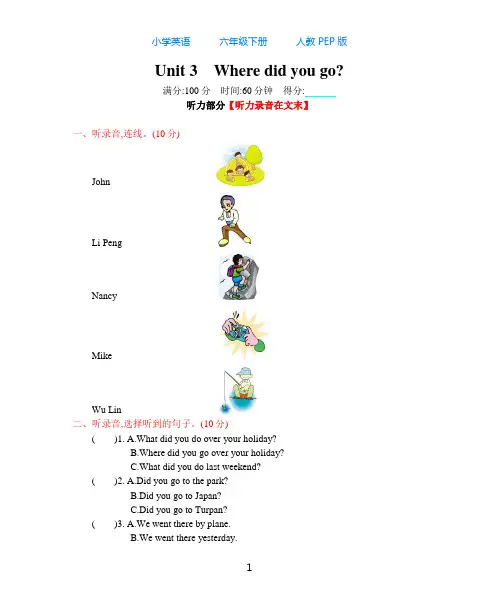
Unit 3Where did you go?满分:100分时间:60分钟得分:听力部分【听力录音在文末】一、听录音,连线。
(10分)JohnLi PengNancyMikeWu Lin二、听录音,选择听到的句子。
(10分)()1. A.What did you do over your holiday?B.Where did you go over your holiday?C.What did you do last weekend?()2. A.Did you go to the park?B.Did you go to Japan?C.Did you go to Turpan?()3. A.We went there by plane.B.We went there yesterday.C.We went there by train.()4. A.It looks like a mule.B.It’s a mule.C.It is like a mule.()5. A.How did you do?B.How did you go there?C.How did you go home?三、听录音,补全句子。
(10分)1. Amy is and than Sarah.2. I lots of pictures, and I went swimming.3. Zhang Peng usually kites on weekends but last weekend he English at home.4. Did you a book ?5. I my last night.四、听录音,判断下列句子与所听内容是(T)否(F)相符。
(10分)()1. Alice and her sister are having their holiday.()2. They went to the library by bike.()3. They ate lunch in the library.()4. Alice bought a pair of shoes.()5. Joe was very tired.笔试部分五、选择正确的答案。
人教版PEP 小学六年级英语-Unit 3 Part A Let's learn.说课稿
Unit 3 Where did you go ?Hello, everyone. Today I’m very pleased to have an opportunity to talk about some of my teaching ideas. My topic is Part A Let’s learn from Unit 3 Where did you go ,Grade 6. It is made up of four parts.Part 1 My understanding of this lessonThe analysis of the teaching material:This lesson talks about verbs. It plays a very important part in the English teaching of this unit. By studying this, Ss can learn more new verbs. At the same time, we should get the students to understand some difficult sentences better. The Ss should do some listening, speaking and writing, too. Of course, the Ss should receive some moral education. Let the Ss understand the verbs better,.Teaching aims:1. Knowledge aim: Understand the words and expressions.2. Ability aim: Make new conversations.3. Emotional aim: Make the Ss care about themselves, and study hard to make better life.Key points / Teaching important points:How to use the verbs to make new conversations..Teaching difficult points:1. Use your own words to make new conversations..2. Discuss where they went and what they did.Something about the Ss:1.The Ss have known something about what sb did in the past.2. They don’t often use English to express themselves and communicate with others.3. Some Ss are not active in the class because they are afraid of making mistakes.Part 2 My teaching theories, methods and aidsBefore dealing with this lesson, I’ll do my best to carry out the following theories: Make the Ss the real masters in class while the teacher himself acts as director;Combine the language structures with the language functions; Let the students receive some moral education while they are learning the English language.Teaching method:Double activities teaching methodQuestion-and-answer activity teaching methodWatch-and-listen activityFree discussion methodTeaching aids:1.some cards2.some objects3. a tape recorder4. the blackboardPart 3. Teaching steps / proceduresI have designed the following steps to train their ability of listening, speaking, reading and writing.The entire steps are:Greetings, Revision, Lead-in and reading, Preparation for details of the lesson, Consolidation, Discussion, Homework.Step 1 GreetingsGreet the whole class as usual.Step 2. Revision1. T: Act,let the Ss guess.2.Ask students some questions to revise the last lesson(show them on the screen).a. What did you do last Saturday?b. What did he do last Sunday?c. What did he do yesterday?d.What did you do last Monday?Step 3. Lead-in and preparationShow them some pictures and let them talk each other, and then use the pictures about places and the things we or they did in the past .Purpose: Arouse the students’interest of study.Bring in new subject: Where we or they went and what we or they did there. Method: Talk about the pictures , read the words and expressions and act. Purpose: Help the Ss remember the words and expressions best.Step 5. Play a game.Look, act and guess.Purpose: Make the Ss learn the expressions best and feel interesting. Step 6. ConsolidationRead the words and expressions , finish the conversation. Purpose: Let the Ss can communicate better.Step 7. DiscussionShow them some words and expressions, let the Ss talk freely. Purpose: Give the Ss much ,they can give us more.Step 8. Listening and exercise.Purpose:Improve the Ss listening and writing ability .Step 9. SummaryLet the Ss make a summary.Purpose:Let the Ss remember the lesson better.Step 10. HomeworkRead the words and expressions and make new conversations.Part 4. Blackboard designUnit 3 Where did you go?A: Where did you go_____? go went camping / fishing B: I went to ____________. ride rode a horseA:What did you do there? rode a bikeB: I ___________________. hurt hurt my footThat’s all , Thank you for listening!。
PEP小学英语六年级下册Unit3单元整体教学设计
PEP小学英语六年级下册Unit3单元整体教学设计PEP小学英语六年级下册Unit3单元整体教学设计一、教学目标知识与技能:1.掌握表示颜色的单词。
2.学习表达“穿”衣服的动词。
3.了解并掌握一些常见的穿衣搭配。
情感态度与价值观:1.培养学生的团队合作意识。
2.让学生学会感恩生活,并感受到彼此之间的爱与关爱。
二、教学重点掌握表示颜色的单词,学习表达“穿”衣服的动词。
三、教学难点了解并掌握一些常见的穿衣搭配。
四、教学内容1. 核心词汇:yellow, green, blue, black, white, yellow pants, blue shirt, green cap, black shoes, white socks, wear, clothes。
2. 重点句式:I’m wearing a green cap and black shoes.She is wearing a blue shirt and yellow pants.What color is your cap?What are you wearing today?五、教学方法采用任务式教学法,学生在团队合作的情境中完成任务,让学生在情景中理解单词和句型的含义并能够流利使用。
同时采用游戏、歌曲、口语交际等多种教学方式,丰富教学内容,提高课堂趣味性。
六、教学流程Step 1:Warm-up开场播放Let's learn一课关于颜色的学习flash,学生跟读,复习颜色词汇。
Step 2:Presentation and practice1. Presentation(1)Teacher wears different clothes and ask students to make sentences in the form of "I'm wearing...". For example, teacher wears a red hat and green shoes, then teacher says "I'm wearing a red hat and green shoes", then ask students to repeat. And helps students to learn the phrase “I’m wearing...”。
人教PEP版小学英语六年级上册教学设计(Unit3 A.Let's learn)
教学课件说明(A.Let’s learn)Let’s learn一、复习(review)1.通过呈现日历,复习tomorrow、next week等表示将来时间的词。
2.通过“时刻”,复习morning、afternoon、evening、tonight表示将来时间的词。
二、学习新知1.学习课本Let’s learn部分的内容:Sarah: What are you going to do today? B: I’m going to see a film.并运用此对话句型根据图片谈论其它计划。
2.将“today”替换成其它将来时间,如this morning、this afternoon、this evening、tonight等,根据图片呈现的活动,再次进行对话练习。
三、巩固练习1.Magic eyes:通过小游戏,练习学生对新词以及表示活动的动词短语的熟练程度。
2.听音,对Let’s learn部分的对话以及词汇进行巩固并加深记忆。
3.Make a plan:让学生做计划,并与同伴分享,让学生进行对话操练。
四、归纳总结总结本课学习的内容:“be going to + 动词原形”表示将要或即将发生某种状况;this morning/afternoon/evening、next year/month/Sunday等表示将来时间的词;“be going to + 地点”五、巩固练习给出动词,让学生用适当形式填空,通过练习题的形式,巩固复习本节课所学的内容。
六、Homework课外作业的布置。
让学生回归课本,通过作业的形式,巩固本次课所学内容,并为下次课的学习做准备。
PEP小学英语六年级上册重点单词和句型练习一、重点单词Unit 1:by ( ) foot( ) bike( ) bus( ) train( ) how( )go to school() traffic()traffic light()traffic rule()stop()wait() get to()Unit 2library( ) post office( ) hospital( ) cinema( ) turn( ) bookstore( ) where( ) please( )next to( ) right ( ) left( ) straight( )then ( )Unit 3next week( ) this morning( ) this afternoon( )this evening ( ) comic book( ) post card( )newspaper( ) buy( )Unit 4hobby( ) ride a bike--riding a bike( ) dive--diving( )play the violin—playing the violin( ) make kites—making kites( ) collect stamps—collecting stamps( ) live –lives( ) teach--teaches( ) go--goes( ) watch--watches( ) read--reads( ) does doesn’t=does notUnit 5singer( ) writer( ) actor( ) actress( ) artist( ) TV reporter( ) engineer( ) accountant( ) policeman( ) salesperson( ) cleaner( ) where() work()Unit 6rain( ) cloud ( ) sun( ) stream( ) come from( ) seed( ) soil( ) sprout ( ) plant( )should ( ) then( )Unit 1: ▁▁(经,乘) ▁▁(脚) ▁▁(自行车) ▁▁(公共汽车) ▁▁(火车)▁▁(怎样) ▁▁▁▁(上学)▁▁▁▁(交通)▁▁▁▁▁▁(交通灯)▁▁▁▁▁▁(交通规则)▁▁(停,停车站)▁▁(等待)▁▁▁▁(到达)Unit 2 ▁▁▁▁(图书馆) ▁▁▁▁(邮局) ▁▁▁▁(医院) ▁▁▁▁(电影院)▁▁(转弯) ▁▁▁▁(书店) ▁▁▁(在哪里,到哪里) ▁▁▁(请)▁▁▁(与…相邻) ▁▁▁ (右边) ▁▁(左边) ▁▁▁(成直线地) ▁▁▁(然后)Unit 3 ▁▁▁▁▁(下周) ▁▁▁▁▁(今天上午) ▁▁▁▁▁(今天下午)▁▁▁▁ (今天晚上) ▁▁▁▁(漫画书) ▁▁▁▁(明信片) ▁▁▁▁ (报纸) ▁▁▁(购买)Unit 4▁▁▁(爱好) ▁▁▁▁▁--▁▁▁▁▁▁(骑自行车) ▁▁▁--▁▁▁(跳水) ▁▁▁▁▁▁—▁▁▁▁▁▁▁(拉小提琴) ▁▁▁▁▁—▁▁▁▁▁▁▁(制作风筝) ▁▁▁▁▁▁—▁▁▁▁▁▁(集邮) ▁▁▁–▁▁▁(居住)▁▁▁▁--▁▁▁▁(教) ▁▁--▁▁▁(去) ▁▁▁--▁▁▁(看)▁▁--▁▁▁(读,看) does doesn’t=▁▁▁▁Unit 5▁▁▁▁(歌唱家,歌手) ▁▁▁▁(作家) ▁▁▁▁(男演员) ▁▁▁▁(女演员) ▁▁▁▁(画家) ▁▁▁▁(电视台记者) ▁▁▁▁(工程师) ▁▁▁(会计) ▁▁▁▁(男警察) ▁▁▁▁▁▁(销售员) ▁▁▁(工作)▁▁▁▁(清洁工) ▁▁▁▁(在哪里,到哪里)Unit 6▁▁▁(雨) ▁▁▁ (云) ▁▁▁(太阳) ▁▁▁▁(河,溪) ▁▁▁▁(来自,从…来) ▁▁▁(种子) ▁▁▁(土壤) ▁▁▁ (苗,芽) ▁▁▁(植物,种植) ▁▁▁(应该) ▁▁▁▁(然后)二、单词分类1)交通方式:by bus, by train, by subway, by ship, by plane, by car, on foot2)文具书籍:dictionary, newspaper, comic book, post card3)职业:singer, writer, TV reporter, actor, actress, engineer, accountant, salesperson, policeman, policewoman,artist, cleaner4)V-ing形式:riding a bike, collecting stamps, diving, making kites, playing the violin5)第三人称单数形式:lives,teaches, watches, goes, does, doesn’t6)公共场所:library,post office, cinema, hospital, science museum, bookstore7)方位:east, west, south, north, turn left, turn right, go straight8)交通灯; red light, yellow light, green light9)自然:sun, cloud, rain, vapour, stream六年级上册四会句子1.你是怎样去上学的?▁▁▁▁▁▁▁▁2.通常我走路去上学。
新版PEP小学六年级英语下册Unit-3-Where-did-you-go教案
Unit 3 Where did you go ?第一课时What can you do ? I can dance.What can you do ? I can climb a mountain.What can you do ? I can take a pictures.What can you do ? I can speak Chinese.2.用多媒体课件展示自己外出旅游的照片, 并做相关介绍。
如:s.summe.holiday..wen.t.hainan.I.wa.s.beautiful..wen.swimmin.i.th. sea.An.picke.som.seashell.o.th.beach.Ste.2.PresentationLet’s talk(从呈现完整对话到处理局部语言)1.整体感知对话并回答问题。
(1)通过提问要求学生猜测: Did yougo to John’s home ? What happened toJohn? What did they talk about later?请学生带着问题观看动画或阅读文本, 了解John脚受伤的原因: He fell of hisbike,利用图片帮助学生理解并教授fell.同时, 通过观看动画或阅读文本获得对话的主旨: They talked about John’s Labout Day holiday...(2)结合日历,让学生理解Labou.Da.holiday概念。
提问: Loo.a.th.calendar.Wha.dat.i.i..It’.Ma.1s..O.Ma.1s.,uall.hav.thre.day.ofbou.Da.holiday.(3)继续提问学生:Where did John go on his Labour Day holiday ? What did hedo there ? 要求学生带着问题观看动画或阅读文本获取信息, 并用思维导图板书对话关键信息。
人教版(PEP)(三年级起点)(主编:吴欣)六年级下册英语PDF电子课本
(三年级起点)六年级下册六年级下册(三年级起点)人民教育出版社 课程教材研究所英语课程教材研究开发中心灵通教育有限公司编著(中 国)(加拿大)·北 京·义务教育教科书(PEP)英语主 编:吴欣 Larry Swartz Beth Levy副主编:曹洁主要编写人员:马剑辉 周佳 刘荔芳 Fraser Bewick 责任编辑:马剑辉 周佳美术编辑:郑文娟封面设计:吕 郑文娟版式设计:刘欣 焦洁插 图:焦洁(含封面) 葛南 陈露茜 刘欣Copyright © 2013 by People’s Education Press Ltd. and Lingo Learning Inc. No part of this publication may be reproduced or transmitted in any form or by any means, without permission in writing from the publisher.版权共有,未经出版社书面同意,任何人不得以任何形式或方式复制或转换本作品的任何部分。
义务教育教科书 英语(三年级起点) 六年级 下册(中 国) 人民教育出版社 课程教材研究所 英语课程教材研究开发中心 编著(加拿大) 灵通教育有限公司 出 版 (北京市海淀区中关村南大街17号院1号楼 邮编:100081)网 址 经 销 全国新华书店印 刷 大厂益利印刷有限公司版 次 2014年10月第1版 印 次 2017年11月第4次印刷开 本 787毫米×1092毫米 1/16印 张 4.75 字 数 95千字书 号 ISBN 978-7-107-29071-8定 价 5.00元价格依据文件号:京发改规[2016] 13号版权所有·未经许可不得采用任何方式擅自复制或使用本产品任何部分·违者必究如发现内容质量问题,请登录中小学教材意见反馈平台:如发现印、装质量问题,影响阅读,请与本社联系。
Unit 3 Where did you go?Part A教案设计-人教版(三起)英语六年级下册
活动设计意图:通过观看视频和图片能充分调动学生的整体感观,提高参与度,并且游戏教学能够寓教于乐,激发了学生的学习兴趣,让他们对此记忆深刻,在学习知识的同时形成了积极的学习态度,又很好地巩固所学知识。
4)听录音朗读单词和句型
5)复述约翰的周六故事
请几位学生扮演约翰的一家人演周六的活动
Step3. Consolidation
1) Make a survey
提示:要求用句型Where did you go last summer/winter holiday?和What did you do ?来提问班上的同学。
Name
Where?
What?
Wu Yifan
媒介运用:PPT、调查表
媒介运用:图片、PPT、视频
活动设计意图:通过教师的暑假活动带出John的周六假期活动,观看视频引出约翰去了一个森林公园。并通过图片训练Where did you go ? I went to ….句型。视频的设置目的是把五个新单词串成一个简短的故事,情境中教学单词,以便学生记忆单词。
Step2. Presentation and practice
to Zhaoqing . He ate good
food…
4.Summing
Summing up
1. Words:
rode a horse, rode a bike, went camping, went fishing, hurt my foot.
2.Sentences:
Where did you go last Saturday? I went to a forest park. What did you do there? I rode a bike.
(完整版)PEP人教版小学英语六年级下册教材解析
吉安县中小学教师说教材活动全局把握温故知新——浅谈我对六年级英语下册教材的理解吉安县实验小学彭建林在我们的日常教学活动中,明确目标,吃透教材,选择合适的策略是非常重要的,在我们小学英语教学中也是一样。
今年我继续担任我校六年级英语的教学工作,在此,说一说我对人教版小学六年级上册英语教材的理解,与各位同仁探讨。
一、紧扣课程标准,了解教材特点。
1.《英语课程标准》对小学阶段应达到的目标作了明确的阐述,我们小学六年级应该达到的应该是二级,其要求是:对英语学习有持续的兴趣和爱好。
能用简单的英语互致问候、交换有关个人、家庭和朋友的简单信息。
能根据所学内容表演小对话或歌谣。
能在图片的帮助下听懂、读懂并讲述简单的故事。
能根据图片或提示写简单的句子。
在学习中乐于参与、积极合作、主动请教。
乐于了解异国文化、习俗。
我们的这一册教材就是人民教育出版社根据国家教育部颁布的《英语课程标准》编订的以小学三年级为起始年级的小学英语教材的最后一册课本。
通过完成此册课本的学习,学生的英语水平要达到《英语课程标准》规定的基础教育阶段英语课程的二级目标。
因此,本册教材的教学对学生在小学毕业时能否达到教学目标规定的要求有举足轻重的作用。
2.本套教材的编写特点是:*强调语言运用(如let’s do、let’s sing等)*注重能力培养(Group work、Let’s check等)*突出兴趣出发(卡通插图、图文并茂)*重视双向交流(融合中西方文化知识)*融合学科内容(贯穿自然科学、社会文化、语言艺术领域)*重视灵活扩展(选学C部分)*实现整体设计(三至六年级系统编排)3.在编写上,本套教材是这样安排的:(1)、全册共有4个单元,两个recycle是针对小学所有教学内容的总体复习单元。
(2)、新的教学内容较少,12周的时间完成新授单元的教学,2周的时间对这四个单元进行复习巩固,阶段复习;(3)、语言点较为集中,Unit One 是比较级,Unit 3 , Unit 4 是过去时,是本册的难点。
小学六年级英语第三单元
PEP 小学英语六年级下册Unit 3 Last WeekendA Let’s learn一、教学内容分析本课时的主要教学内容是Let’s learn & Let’s find out.出自《PEP 小学英语》六年级下册Unit3 《Last Weekend》Part A。
通过这一节课的学习让学生能够运用所学知识表达过去时间所做的事情并掌握表达过去的方法。
二、学情分析&教学设想六年级的学生对于英语已经有了一定的自主学习能力,同时,学生已经掌握了较多的动词短语,为本课时的学习打下了基础。
本课时,学生将在已学动词短语的基础上,掌握动词过去式的构成以及部分动词的过去时态,同时,谈论在过去时间做过的事情。
教师在分析学情的基础上可以采用以旧引新的教学方法。
通过谈论现在引出过去所做的事情,将达到事半功倍的教学效果。
三、教学目标1、知识与技能1)能够听、说、读、写短语watched TV、washed the clothes、cleaned the room、played football、visited grandparents,掌握规则动词一般过去式的构成,以及部分不规则动词的过去式形式。
2)能听懂问句What did you do last weekend?并做出正确回答; 能运用所学语言知识完成Let’s find out的任务。
2、过程与方法•通过以旧引新、创设情景帮助学生理解文本信息。
•通过多媒体创设真实情境,培养他们的听说交际能力。
•通过拓展性练习活动,培养学生语言运用的能力。
•通过小组活动,培养学生小组合作意识。
3、情感态度与价值观培养学生养成良好的生活、学习习惯。
学会用英语叙述自己做过的事情。
四、教学重难点1)重点:听说读写短语watched TV、washed the clothes、cleaned the room、played football、visited grandparents;能听说句子What did you do last weekend?并能就过去时间所做的事情进行简单回答.2)难点:学生对本课的几个短语都比较熟悉,但动词的过去式第一次出现,因此,这几个短语的动词过去式的构成及其发音是本课时的难点。
人教PEP版六年级英语上册《Unit3_A_Let’s_learn教学设计》
Unit3 A Let’s learn教学设计(A Let’s learnMake a plan)一、教学目标(一)认知目标1.能够听、说、读、写四会单词visit, film, trip, supermarket, evening, tonight, tomorrow及短语see a film, take a trip, visit my grandparents, go to the supermarket及句子Whatare you going to do today? I’m going to see a film.并能对其中的动词和时间短语进行替换操练。
2.能够听、说、读、写时间短语:next week, thismorning/afternoon/evening, tonight.3.能够合理安排自己的活动时间并与他人进行交流。
(二)能力目标能熟练运用be going to do句型。
(三)情感目标培养学生合理安排自己活动时间的能力。
二、教学重难点(一)重点掌握四会短语及灵活运用begoing to do句型。
突破方法:反复练习朗读,进行情景对话,突破重点。
(二)难点能用所学的动词和时间短语对将来的活动进行描述。
突破方法:表演情景对话,师生互动,小组交流,突破难点。
三、教法与学法引导法,点拨法。
四、教学准备教师准备多媒体课件、课文情景动画或音频MP3()。
单词卡片,图片,小球,盒子,电影票等教学道具。
五、教学过程Step 1: Warm-up1.教师出示动词短语图片,要求学生根据图片内容做动作并说出该短语,然后听写这些短语,可请几名学生在黑板上示范书写。
如:read books, watch TV, do homework, clean2.教师准备好一个盒子,里面装有写着不同动词短语的小纸条。
学生十人左右围成一圈,教师播放音乐,学生开始传递这个盒子,音乐停止,拿盒子以外的学生问:Whatare you going to do?拿着盒子的学生从盒子里取出一张纸条,根据纸条上的文字回答:I’m going to read a book.如此循环下去,直到学生把所有的动词短语说完为止。