
七年级英语下册 Unit 4 Finding your way导学案(无答案)(新版)牛津版
Huaian ________ _________ ________ ________ ________ Suqian.
上海在南京的东南方。
Shanghai________ _________ _________ ___ ______ _________Nanjing.
6. We’ll get there by bus.
解析:afraid形容词意为:害怕的,担心的
练习:她好像有点害怕。
She __________ ____________.
常见句型:be afraid of sb / sth害怕某人/某事
be afraid of doing sth害怕/担心做某事
be afraid to do sth (因害怕而)不敢做某事
north-east/west; south-east/west
in the north of范围之内的北面
on the north of接壤的北面
to the north of不相邻的北面
练习:北京在中国的北部。
Beijing________ _______ _______ _ ______ _______China.
b.up为副词意为“向上”。也可作介词,意为“在......的上端”
up反义词为是down
5.Sunsh ine Zoo is north ofSunshineMiddle School.
翻译_________________________________________________________
Unit 4 Finding your way
学习内容
Unit 4 period 1
学习目标
1.能认识有关地点和交通的图片。
2.能辨别方向。
学习重难点
能教灵活地谈论出游和交通方式的话题。
导学过程
感悟
1.预习四会单词
1.跟随,仿效_____________ 2.北,北方__________ 3.西,西方________________ 4.南,南方____________ 5.东,东方_______________ 6.旅行,旅游__________________ 7.千米,公里_________________
3.课堂知识点拨
1.follow为及物动词,之后常接sb;follow sb意为“跟随某人”
解析:常见句型:follow sb to do sth跟着某人做某事
练习:明天你跟我去看电影。
You ________ __________ ________ ________ ________ films tomorrow.
follow的形容词是:following意为:下列的,下述的
练习:请一个一个地回答下列问题
Please answer __________ __________ ___________ one by one.
2. Let’s go down here.
翻译_____________________________
翻译__________________________________________________________
解析a:have to不得不,必须
我妈生病了,我不得不在家照顾她。
My mother _________ __________.I_________ _______ _________ _______ her.
8.在.....东面/西面/南面/北面_______________________________
9.组织一次班级旅行________________________
1 0.大约有三千米 远__________________________
11.我们将怎样到达那儿?_____________________
2.重点短语
1.上去____________ 2.必须,不得不______________ 3,下去_________
4.远离____________ 5.跟着我_______________
6.不要害怕________________
7.我们去旅行吧!___________________________
be afraid + (that)从句恐怕..........,表示遗憾、抱歉或不确定的语气。
练习;我害怕狗
I’m _______ __________ ________.
他害怕晚上出去
He _______ ______ _________ __________ _________ at night.
翻译________________________________________________
解析:a. by bus意为“乘公共汽车”,在句中做状语。
= take the bus常在句中做谓语
by +交通工具乘坐........
练习:每天我乘公共汽车去学校
Every day I ________ __________ ___________ to school.
他不敢晚上出去
He _________ __________ _______ _________ _________ at night.
恐怕他不能去参加我们的聚会了。
____________________________________________________________
4.I think we have to go up again.
解析:Let sb do sth让某人做某事
类似:have / make sb do sth
练习:我们去旅行吧
Let’s _________ __________ ___________ _________
3.Don’t be afraid. Come with me.
翻译________________________________________________
解析:be +方位词+ of意为:在........的.......方向
我们学校在图书馆南边
Our school ________ _______ _________ the library.
连接:north-northern ; south-southern; west-western; east-eastern
江苏省盱眙县黄花塘初级中学七年级英语下册Unit4 Finding your way Grammar导学案(无答案)
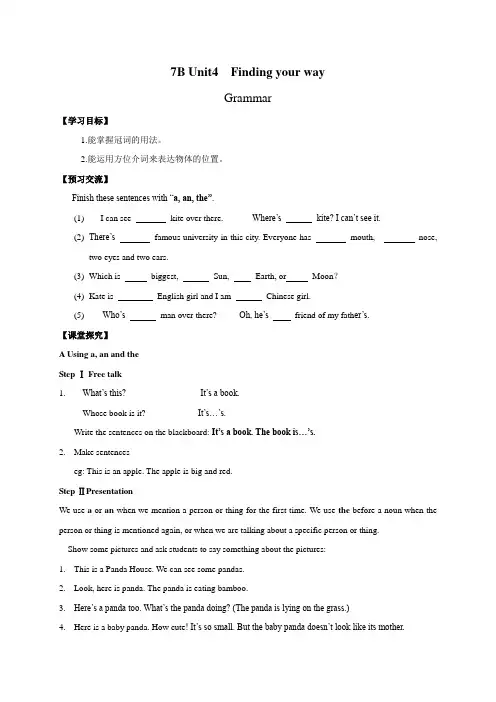
7B Unit4 Finding your wayGrammar【学习目标】1.能掌握冠词的用法。
2.能运用方位介词来表达物体的位置。
【预习交流】Finish these sentences with “a, an, the”.(1)----I can see kite over there. ----Where’s kite? I can’t see it.(2)There’s famous university in this city. Everyone has mouth, nose,two eyes and two ears.(3)Which is biggest, Sun, Earth, or Moon?(4)Kate is English girl and I am Chinese girl.(5)---- Who’s man over there? ---- Oh, he’s friend of my fath er’s.【课堂探究】A Using a, an and theStep ⅠFree talk1.---What’s this?---It’s a book.---Whose book is it? ---It’s…’s.Write the sentences on the blackboard: It’s a book. The book is…’s.2.Make sentenceseg: This is an apple. The apple is big and red.Step ⅡPresentationWe use a or an when we mention a person or thing for the first time. We use the before a noun when the person or thing is mentioned again, or when we are talking about a specific person or thing.Show some pictures and ask students to say something about the pictures:1.This is a Panda House. We can see some pandas.2.Look, here is panda. The panda is eating bamboo.3.Here’s a panda too. What’s the panda doing? (The panda is lying on the grass.)4.Here is a baby panda. How cute! It’s so small. But the baby panda doesn’t look like its mother.Step Ⅲ Practice1.Pair workHave a free talk with your partner, try to use a, an and the.2.Text book Page 47: Fun in the zooAsk students to complete the conversation with “a, an, the”. Then check the answers.3.Read and act out the conversation.B Prepositions of placeStep ⅠPresentation1.Introduce some prepositions of place.2.Ask and answer, try to make students answer with “inside , outside, beside, next to, left and right”.3.Teacher says: Look, we have some lights. The lights are above us. We have some books here. Thebooks are on the teacher’s desk. We have a national flag. It’s over the blackboard.(Make sure that students can use these words correctly.)4.Read the sentences on Page 48. Then make a simple dialogue.5.Tell other students where you sit.Step Ⅱpractice1.In the park Sandy goes to the park every weekend. Look at the picture and tell me what you can see init.2.Group work: say something about the picture.3.Make a conversation.plete the article on Page 48.5.Check the answers. Then read the article.【当堂反馈】:一、填入适当的冠词1.we'll make ______ card for our English teacher.2. The bus is running about seventy miles_____ hour.3. Mary is interested in ______ science.4. Some people don't like to talk at ______ table.5. Last night I went to______ bed very late.6. Don't worry. We still have ______ little time left.7. What ______ beautiful day! And what ______ fine weather!8. In ______ winter it is cold in ______ Beijing and warm in ________Shanghai.9. John is______ cleverest boy in his class.10. We can't live without ______ water or ______ air.二、选择填空( )1. Children get gifts ____ Christmas and ____ their birthdays.A. on; onB. at; onC. in; inD. in; on( )2 ____ a cold winter morning, I met her in the street. A. In B. On C. At D. For ( )3 .A lot of students in our school were born____March, 1981.A. inB. atC. onD. since( )4 .he suddenly returned____ a rainy night. A. on B. at C. in D. during( )5. The train is starting___five minutes. A. in B. at C. for D.still( )6 .Is the street too narrow for the bus to go ___? A. through B. across C. on D. in ( )7. Mike does his exercises ____ seven _____ the evening.A. on; toB. at; inC. by; ofD. at; on( )8. A mother camel was walking ___ her son ___ the desert.A. without; alongB. with; throughC. next to; passD. beside; through( )9 .The river runs____ the city. A. across B. through C. over D. from( )10. It took us over an hour to walk___ this street. A. from B. through C. over D. across。
牛津译林版七年级下册学案:Unit 4 Finding your way Grammar 第4课时学案

7下Unit 4 Finding your way Grammar (第4课时)学习过程一、预习导航I.看课本120页有关冠词的用法。
II.预习完成47页内容。
III. 我们学过很多介词,表示方位的介词有哪些?请写下来:_____________________________________________________________________________________________________________________________________二、展示交流I. 看课本120页有关方位介词的用法并完成课本48页下图的内容。
II. 请你帮助Hobo填正确的介词吗?1) My father lives ________ Room 88, the third floor ________ that building .2) The broom is _______ the door, so I can not see it .3) Andy sits ________Tom and her .4) The park is next_______ the shop.5) Would you like to come to my house ________ Mid-autumn Day .III. 识记以下重点知识点。
1. The flowers are in front of the shop.(1)in front of 意为“在---的前面”,是指外部的前面;in the front of意为“在---的前”部,是指内部的前面。
如:There are lots of flowers in front of the building.大楼的前面有许多花。
There is a blackboard in the front of the classroom.教室的前面有一块黑板。
七年级Unit4 Finding your way(Grammar)导学案
导学案年级七年级主备人课题Unit4 Finding your way(Grammar)一、自主学习:1、学习目标(重、难点):1.掌握冠词与不定冠词的用法。
2.学习常用的方位介词及用法2、自学指导:根据句意,用适当的冠词填空。
1.Is______book on the desk yours ? Yes,it is.It’s______interesting book.2.Where is your mother? She is in______dining room.3.There is_____very large playground in my school.4.Beijing is_____capital of China .5.LiMing is always_______first to get to school .6.______girl in red under the tree is one of my good friends .7.______apple a day keeps the doctor away .8.There is______”s “and_______”u”in the word use .9.My father is_______office worker and he is very busy on weekdays .10.Where is______football? It’s under our desk .3、分组合作探究:将下面句子改为同义句。
1.He is on my left and she is on my right .I am______ ________ _________ _________.2.The basketball is beside the football.The basketball is________ ________the football.3.The boy is standing behind the girlThe girl is standing_______ _______ ________the boy .4.His flat is two floors above mine .My flat is two floors_______ _________.5.There is a boat under the bridge .The bridge________ ________the boat .二、学生展示:三、教师精讲:1.冠词:不定冠词一般用于单数名词前,表示泛指;而定冠词既可修饰可数名词,又可修饰不可数名词,表示特指。
七年级英语下册Unit4Findingyourwayreading2教案
七年级英语下册Unit4Findingyourwayreading2教案Unit 4 Finding your way reading2教学⽬标:1、To practice intensive reading and retell the text.2、To understand and master the new points in the text.3、T o understand :Trying to do everything is very important.教学重点:To retell the text.教学过程:Step 2 Presentation1.T 呈现B1部分的简易地图,帮助学⽣掌握问路语⾔点的⽤法:Here is the South Gate. Go straight on, and you’ll fi nd the Panda House. Walk along the road. To the north of the Panda House, you’ll find the lions. Turn left, and to the west of the Lions’ Area, you’ll find the World of Birds. To the north of the World of Birds is the Monkeys’ Forest. Then turn right, and to the east of Monkeys’ Forest. Then turn right, and to the east of Monkeys’ Forest, you’ll see the giraffes. North-east of the giraffes there’s a bridge. Cross the bridge, and you’ll see the elephants.2.对呈现的其中语⾔点交流体会。
第7讲 Unit 4 Finding your way(教案)七年级英语下册(译林牛津版)
主题7B Unit 4(Finding your way) 学习目标1. 掌握Comic strip—Grammar重点词汇、句型;2. 掌握Integrated skills—Self-assessment重点词汇、句型;3. 掌握冠词的用法;4. 掌握表示地点的介词的用法。
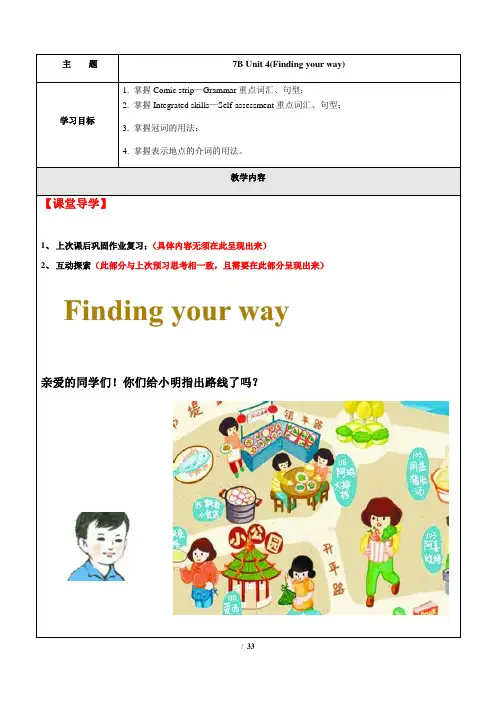
教学内容【课堂导学】1、上次课后巩固作业复习;(具体内容无须在此呈现出来)2、互动探索(此部分与上次预习思考相一致,且需要在此部分呈现出来)亲爱的同学们!你们给小明指出路线了吗?First, go straight on and turn right at the park.Next, walk along the Shengping Road and then turn left at the first turning.At last, you will see the barbecue bar at the end of the road.must “必须”,没有人称、数、时态的变化,否定式mustn ’t 表示“禁止” 表示说话人主观上的看法,强调主观上的需要【知识梳理5】Sunshine Zoo is north of Sunshine Middle School. 阳光动物园在阳光中学的北部。
(1) north 名词,意为 ,固定结构为 ,表示 。
指范围之外,且中间有一段距离。
(2) 方位名词与介词in, on, to 连用时的区别含义 用法 in+方位名词在……之内 强调 on+方位名词在……之外 强调 to+方位名词在……之外 强调 【例题精讲】1. The tree is in the north of the school.2. The hill is on the north of the school.3. The cinema is to the north of the school.答案:(1) north 名词,意为“北,北方”,固定结构为be+方位词+of ……,表示“某地在另一地的……方向”。
七年级英语下册《Unit 4 Finding your way》复习教案
《Unit 4 Finding your way》一、教学目标:复习第四单元内容二、教学重点:复习第四单元内容三、教学难点:复习第四单元内容四、达标检测:一、单项选择( ) 1. —Hi, Daniel.Let’s play football after school. —But we don’t havefootball now.A. / ; aB. a ; aC. / ; /D. a ; /( ) 2. —Would you like to my home to have supper with us? —Sounds great! ( ) 3. Thank you very much for ______us so well.A.teachB. teachesC. teachingD.to teach( ) 4. _____ your brother a member of the basketball team? No, he ___ __ like playing basketball.A. Does, isB. Do, doesn’t C. Is, doesn’tD. Is, isn’t( ) 5. The boy is not friendly, so ________ students like him.A littleB a littleC fewD a few( ) 6 . They ______ watch Unusual Weekend. They think the actors act the wo rst.(差)A. oftenB. alwaysC. sometimesD. seldom( ) 7.--What’s the date today? ___________A. On 9 OctoberB. 1 OctoberC. On SundayD. At 10 o’clock( ) 8. --I have three apples, Do you want to have _____? --Yes,please. Thank you very much.A. itB. thisC. thatD. one( ) 9. The park is 500 metres ________ our school.A far away fromB far fromC away fromD far away ( ) 10. We often eat dinner at home on weekends, but ______ we eat out.A. sometimesB. seldomC. neverD. always( ) 11. Mum, can you at 8:00 tomorrow morning? _-- Of course, dear.A. wake up IB. wake I upC. wake up meD. wake me up( ) 12. ___ does your mother go for a walk?Every afternoon.A、How longB、How muchC、How oftenD、How many( )13. His father was born in Shanghai _______ the night________ Oc tober 1,1963.A. on; inB. at;ofC. at; onD. on; of( )14. --Do you have good friends at school? --Yes, they_________ me.A. are all nice forB. are all nice toC. all are nice toD. all are nice for二.根据句意,用所给单词的适当形式填空1.What time do you ________ get up in the morning? (通常)2.Andy is not strong. He ________ some exercise. (需要)3. Sandy enjoys _______ volleyball after class. (练习)4.I get best_________ from my friends. (祝愿)5.We do many after-school __________ in our school. (活动)6. Lily is a good girl. We all like _______ (she)7.Tens of peop le lost(失去) their _______ in the rainstorm(暴雨) inBeijing this summer. (life)8. The _________meeting will begin at 2:30 this afternoon. (parent) 9.My parents go to see a film with me ________ a month. (one)10. Shall we ______ with each other after lunch today? (chat)三.所给动词的形式填空。
牛津译林版七年级下册Unit 4《Finding your way》(task)教学设计
牛津译林版七年级下册Unit 4《Finding your way》(task)教学设计一. 教材分析《Finding your way》是牛津译林版七年级下册Unit 4的一篇任务型阅读课文。
课文通过介绍一位游客在伦敦寻找大本钟的过程中,向不同的人询问路线,最终找到目的地。
课文内容涉及到方位词、问路和指路的相关表达,旨在让学生掌握如何用英语询问和描述路线。
教材通过任务型教学法,让学生在实际情境中运用英语,提高学生的语言运用能力。
二. 学情分析七年级的学生已具备一定的英语基础,能够听懂并运用简单的日常用语进行交流。
但学生在实际运用英语描述路线方面可能存在一定的困难,因此教师需针对这一点进行重点指导。
此外,学生对于英语阅读的兴趣会影响他们对课文内容的学习,教师应充分激发学生的学习兴趣,提高他们的阅读积极性。
三. 教学目标1.知识目标:学生能够掌握表示方位的词汇和短语,如up, down, left,right, turn left, turn right等;能够用英语询问和描述路线。
2.能力目标:学生能够在实际情境中运用英语询问和描述路线,提高语言运用能力。
3.情感目标:培养学生乐于助人的品质,学会在遇到困难时,主动向他人寻求帮助。
四. 教学重难点1.重点:表示方位的词汇和短语,以及询问和描述路线的句型。
2.难点:如何将这些词汇和句型运用到实际情境中,进行流畅的交际。
五. 教学方法1.任务型教学法:通过设置各种任务,让学生在实际情境中运用英语,提高语言运用能力。
2.情境教学法:创设生动、真实的情境,激发学生的学习兴趣。
3.交际法:引导学生进行小组合作,进行实况模拟,提高交际能力。
六. 教学准备1.教学课件:制作包含课文内容、图片、动画等的多媒体课件。
2.教学道具:准备一些表示方位的标志,如地图、路标等。
3.练习题:设计一些关于询问和描述路线的练习题。
七. 教学过程1.导入(5分钟)利用课件展示伦敦的风景图片,引导学生谈论自己对伦敦的印象。
译林版七年级下册unit4:Fingding your way(Welcome)教学设计
we use to find our ways? T: what’s can we use to find our ways?T: Yes, map and compass can help us.Let’s get today’s learning aims.3.Get students to learn the learning aims.Ss: a map,a compass3.Learn thelearning aims.and attractstudents’interest.To helpstudentsprepare forthe lesson.Step2Pre-listening 8minutesT: Compass can help us findthe way,. Do you know howto read the compass?1.Show a picture ofcompass and teachdirections..2.Show some pictures and amap of Qinzhou, getstudents to learn some placeof interests in Qinzhou andlearn the structures“in the+方位词+of”, get the wholeclass read the sentencestogether.3.Get students to read all1.Learn the newwords.2. Learn some placeof interests inQinzhou and learnthe structures“in the+方位词+of”, thewhole class read thesentences together.To helpstudentsmaster thenew wordsand phrases.To learn themeanings ofthe wordsPrepare forlistening.( )Sunshine Zoo ( )Sunny Garden ( )Lake Park( )Sunshine ParkT: There are other great places in Sunshine town, let’s listen and find more places on the map.3.Show the third task andsome listening tips to students and get them listen and find more places on the map.T: There are also some place around our school,let’s talk about them.4.Show the fourth task to students and get them to talk about places around school. 3. Learn thelistening tips , listenand find more placeson the map.4. Work in pairand talk about placestown.To helpstudents getdetailinformationfromlistening.To helpstudentspractice theirT: Daniel and Simon are talking about the trip,let’s listen and choose the correct answers.5. Show the fifth task, get students to listen the dialogue and choose the correct answers.1. Where are they going for their class trip?A. Sunshine zooB. Sunshine parkC. Sunshine Garden2. The zoo is ____ of Sunshine Middle School. A.west B.northC. south3. How will they get there?A.By carB. on footC. By bus around school.Thenshow.5.Listen and choosethe correct answers.oral English.Step4Post-listening 12minutesT: Ok, How do Simon andDaniel plan their trip?1.Show the sixth task andget students to work inpairs and discuss how toplan a trip. Then work in1.Work in pairs anddiscuss how to plan atrip. Then work inpair drill theTo helpstudents learnto cooperatewith others.pair drill the dialogue and perform.T: Well done. There are so many wonderful places in Qinzhou .Where are you going for a trip? Write a trip you like.2.Give the seventh task to students. Show some places of interest in Qinzhou . Get them to write something about Qinzhou. Then show.3.SummaryGet students to conclude what they learn according the Mind map. dialogue andperform.2. write aMini-writing to tellsomething aboutQinzhou.Then share theirideas.3.conclude what theylearn according theMind map.To helpstudentspractise theiroral English.To helpstudentsknow wellabout theplaces ofinterest intheirhometownand love theirhometown.Step5 Homework 1minutes1.Read the dialogue fluently.( P43 PartB)。
牛津译林英语七年级下册第四单元全套教案
牛津译林英语七年级下册第四单元全套教案Unit4Finding your way第一课时Comic strip & Welcome to the unit教学过程一、方法指导1.观察Page 42中的图片,提前了解小故事的内容。
2.预习本课时的短语和句型。
二、预习检测根据首字母及汉语提示补全单词1.We are afraid(害怕) of tigers.2.I’m sure(确信) I know the way.ke Park is south(南) of Sunny Garden.4.There was a narrow path(小路) through the forest.5.The children often follow(跟随) the teacher to cross the road after class.Step1情景导入Teacher:Good morning,everyone.Look,I have a map here.When do we need a map?Can you read a map?Step2完成教材Comic strip的任务1.让学生认真听录音,回答下列问题。
(1)Where are Hobo and Eddie?They are on a hill.(2)What does the sign say?The sign says “Dogs this way”.(3)Do they have to go up the hill again?Yes,they do.2.让学生再次听录音,并跟读,注意语音和语调。
3.讲解语言知识点。
4.组织学生两人一组,结对练习对话。
然后找几组学生上台展示,老师点评。
Step3完成教材Welcome to the unit的任务1.呈现Part A的地图,让学生说出图中的东、南、西、北四个方向。
2.老师朗读阴影部分的四个句子,让学生在地图上找出这四个地方的位置。
牛津译林版英语七下Unit 4《Finding your way》(第4课时)教学设计
牛津译林版英语七下Unit 4《Finding your way》(第4课时)教学设计一. 教材分析牛津译林版英语七下Unit 4《Finding your way》主要介绍了如何描述路线和问路。
本单元通过介绍不同的交通方式,如公交、地铁、自行车等,让学生学会如何描述自己的出行路线,同时学会如何礼貌地问路和指路。
本课时的教学内容为该单元的最后一课时,主要是对前面所学内容的巩固和拓展。
二. 学情分析七年级的学生已经具备了一定的英语基础,能够进行简单的日常交流。
但是,对于描述路线和问路的表达方式,部分学生可能还不是很熟练。
因此,在教学过程中,需要关注学生的个体差异,针对不同水平的学生给予适当的引导和帮助。
三. 教学目标1.能熟练地用英语描述路线和问路。
2.能听懂并正确回答关于路线的询问。
3.能运用所学知识,实际操作,找出目的地。
四. 教学重难点1.重点:掌握描述路线和问路的表达方式。
2.难点:能够灵活运用所学知识,实际操作,找出目的地。
五. 教学方法1.任务型教学法:通过设定各种实际场景,让学生在完成任务的过程中,学会描述路线和问路。
2.情境教学法:创设各种生活情境,让学生在真实的语境中学习英语。
3.合作学习法:鼓励学生之间互相交流、讨论,提高学习效果。
六. 教学准备1.教学课件:制作课件,包括本节课的主要内容、图片、视频等。
2.教学素材:准备一些关于描述路线和问路的实际场景,如地图、公交站牌等。
3.计时器:用于控制每个环节的时间。
七. 教学过程1.导入(5分钟)利用图片或视频展示不同的交通方式,引导学生谈论自己最喜欢的交通方式,从而引入本节课的主题。
2.呈现(10分钟)展示一张地图,上面标注了学校、图书馆、电影院等地点。
让学生观察地图,尝试用英语描述从学校到图书馆的路线。
教师在旁边给予适当的引导和帮助。
3.操练(10分钟)学生分成小组,每组轮流扮演问路者和指路者。
一组学生问路,另一组学生指路。
教师巡回指导,纠正学生的发音和表达错误。