
北师大版初中英语七年级下册知识讲解--Unit 5 Now and Then(句式)
Unit 4 Seasons and Weather(句式)句式精讲精练::句式精讲1. We were friendly to each other, just like a big family.(1) friendly是形容词,意为“友好的;亲切的”,可作定语或表语。
friend是名词,意为“朋友”;friendship是名词,意为“友谊”。
例如:He talks to his students in a friendly way. 他和他的学生友好地交谈。
Lucy and I are good friends. I came here for our friendship. 我和Lucy是好朋友,我是为我们的友谊而来的。
(2) be friendly to意为“对……友好;对……友善”。
例如:The girl is very friendly to customers. 这个女孩对顾客很友好。
2. But it’s easy to travel around the town, right?本句的句子结构是“It is +adj.+ to do sth.”,意为“做某事是……的”。
It是形式主语,真正的主语是后面的动词不定式“to do sth.”。
例如:It’s important to stay healthy. 保持健康是很重要的。
It’s necessary to study English hard. 努力学习英语是很有必要的。
3. I feel like I’m in Beijing.(1)“feel like + 从句”意为“觉得好像是……”。
例如:I feel like I know him. 我觉得好像认识他。
(2)“feel like + 名词”意为“摸上去像……;觉得像……”。
例如:This feels like a potato. 这东西摸上去像个土豆。
(3) feel like doing sth. 意为“想要做某事”。
例如:I don’t feel like eating anything now. 我现在什么都不想吃。
4. I was sure things were OK, but I walked back and checked.be sure意为“确信;确定”。
例如:I think he’s coming, but I’m not quite sure. 我想他会来,但我不太确定。
【拓展】(1) 祈使句“Be sure + 不定式”表达说话人向对方所提出的要求,意为“务必,千万”。
例如:Be sure to give it back in time. 务必要及时归还。
(2) “be sure + 不定式”还可意为“一定,肯定”,往往表示说话人的一种推测或判断,主语可以是人,也可以是物。
例如:It’s sure to rain tomorrow. 明天一定会下雨。
(3) be sure of/about表示主语“相信”或“对……有把握”,后接名词、代词或动词-ing形式,主语必须是人。
例如:He is sure of success.= He is sure that he will succeed. 他自信会取得成功。
(4) “be sure + 从句”表示“肯定,有把握”,主句的主语必须是人。
例如:I’m sure who he is. 我知道他是谁。
5. He stopped crying and was with Lisa, his first school friend.stop doing sth意为“停止做某事”。
例如:He stopped watching TV and began to read English.他不看电视了,开始读英语。
The students stopped talking when the teacher came in. 老师进来的时候,学生们停止了讲话。
【拓展】stop后还可以接动词不定式,即stop to do sth意为“停下来原来做的事,做另一件事”。
例如:He watched TV for an hour. At 8 he stopped to do his homework.他看了一个小时的电视,八点钟他停下来(看电视)去做作业。
He stopped to take pictures. 他停下来去拍照。
6. Chen didn’t do well in school at first.(1) do well in意为“在……方面做得好”,相当于be good at。
in和at均为介词,其后接名词、代词或动名词形式。
例如:He does well in history. = He is good at history. 他历史学得好。
Tom does well in/ is good at playing basketball. Tom擅长打篮球。
(2) at first意为“起初”,可位于句首或句末,位于句首时其后常用逗号。
例如:At first, I couldn’t speak English well. 起初我英语说得不好。
【辨析】at first; first of all与for the first time7. Don’t worry too much.too much此处相当于副词,意为“太”,在句中作状语。
例如:Don’t eat them too much; it’s bad for your health. 不要吃他们太多,对你的健康不利。
【拓展】(1) too much作为形容词词组,意为“太多的”,用来修饰不可数名词。
例如:You drink too much water every day.你每天喝水太多。
We two have too much work to do.我们俩要做的工作太多了。
(2) too much作为副词词组,意为“太多”,用来修饰动词。
例如:You talked too much at the meeting.你在会上讲得太多了。
(3) too much作为代词,意为“太多”,在句中作宾语。
例如:You have given me too much.你给我太多了。
8. When I listen, I still don’t understand every word, but I don't give up.give up意为“放弃”,其后应跟名词、代词或动词-ing形式。
例如:English is difficult. But I’ll never give it up. 英语很难,但我不会放弃的。
You should really give up smoking. 你真的需要戒烟了。
【拓展】与up相关的短语归纳:(1) clear up意为“打扫干净;放晴等”。
例如:Betty,clear up your table and let’s have supper.贝蒂,把桌子收拾干净,咱们吃饭了。
The weather cleared up when the storm was over. 风暴过去,天放晴了。
(2) set up意为“树立, 建立, 创立等”。
例如:You should set up a good example for your brothers.你应该为你的兄弟们树立一个好的榜样。
The travelers set up a tent after they had walked for nearly two hours.那群旅行者在行走了近两个小时后搭起了帐篷。
(3) call up意为“打电话给……、征招(服兵役)等”。
例如:When I arrive in Beijing,I’ll call you up. 我到北京时, 会给你打电话的。
When the war broke out,he was called up. 战争爆发时他应征入伍。
句式精练I.句型转换,每空一词。
1. The train was very slow. (改为否定句)The train ____________ very slow.2. Lisa was in the classroom just now. (改为一般疑问句)____________ ____________ in the classroom just now?3. Were your parents at home? (作否定回答)No, ____________ ____________.4. Was your sister in the army two years ago? (作肯定回答)Yes, ____________ ____________.5. He did his homework last night. (改为否定句)He ____________ ____________ his homework last night.6. Mary met one of her old friends on her way home. (改为一般疑问句)____________ ____________ ____________ one of her old friends on her way home?7. Did they like their old house? (作肯定回答)Yes, ____________ ____________.8. Did Tom have a good time last night? (作否定回答)No, ____________ ____________.9. He left home for school at 7 00 a.m. (改为否定句)He ____________ ____________ home for school at 7 00 a.m.10. Did you grow apple trees?(作肯定回答)Yes, I ____________. I ____________ some apple trees here.II.根据汉语提示,完成句子。
1. 我们应该对新同学友好。
We should __________ __________ __________ new classmates.2. 老师要我们互相帮助。
The teacher asked us to help __________ __________.3. 我想住得远离繁忙的街道。
北师大初中英语七下《Unit 5 Now and Then》PPT课件 (1).ppt
Years ago, …
There was a little shop near my home. I was there a lot.
And candies were really cheap then.
Read the dialogue again. Circle and pay attention to be: was, were, was not (wasn’t) or were not (weren’t).
[iə], [eə]
[iә] 发这个音的字母和字母组合ear eer ear: ear hear dear tear eer: deer beer
[eә] 发这个音的字母和字母组合 air ear ere are
air: hair chair pair stair ear: pear bear wear ere: where there are: careful
Listen and complete the words with ear, ere, air, or are. Then listen and read aloud.
Be c_a_re__ful! I can h_e_a_r_ a b_e_a_r_. Wh_e_r_e is it? It’s out th_e_r_e_. Can you h_e_a_r_ it? I think it’s coming in h_er_e__. Quick! Run up the st_a_ir__s!
We were like a big family.
Years ago, …
Years ago, …
There weren’t so many cars. There weren’t many buses, either.
北师大初中英语七年级下册Unit5 Now and Then8
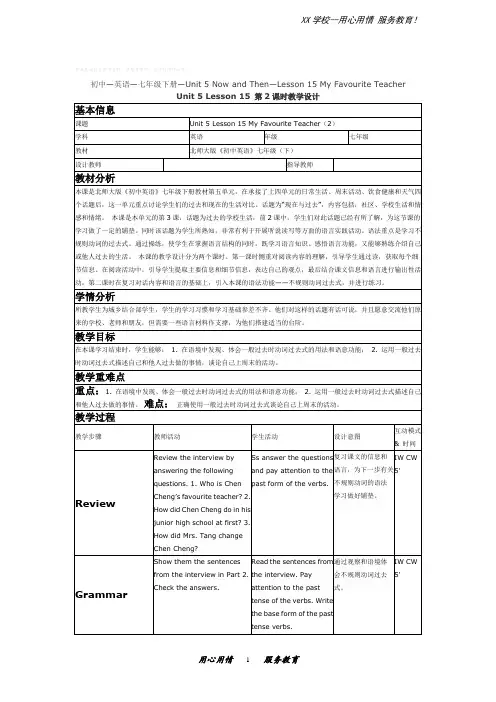
Ss complete the table with the correct past tense verbs from the box. Read them aloud.
初步运用不规则动词过去式描述自己和他人过去做的事情。
IW CW 6’
Speaking
Ask a more proficient student. “What did you do last weekend?” Elicit an appropriate response, for example, I went to a basketball game.
Read the sentences from the interview. Pay attention to the past tense of the verbs. Write the base form of the past tense verbs.
通过观察和语境体会不规则动词过去式。
IW CW 5’
熟悉/ʒ/, /dʒ/的发音。
IW CW 5’
Blackboard design
Unit 5 Lesson15 MyFavourite Teacher
last summer
yesterday
last weekend
last Friday
this morning
Homework
Do workbook page 95, Exs.1, 2 and 4.
学生在真实语境中,再次感知和体会目标语言,进一步落实本课的教学目标。
北师大版七年级英语下册 Unit 5 笔记
三、知识梳理
7. angry的用法:be angry with sb.生某人的气; be angry at sth.因某事而生气。 8. excited“对...感到兴奋”,其主语为人; exciting"令人兴奋的",其主语为物。 9. laugh “大笑”,常与介词 at 连用,组成词组 laugh at嘲笑。 10. different 为形容词,意为“不同的”, be different from“与...不同”;反义词为same,the same as“和...一样”。 11. forget的用法:forget to do sth. 忘记做某事; forget doing sth.忘记做过某事。 12. pay attention“注意”,常与介词to连用。
二、关键句型
1. Back then our house was small, but we were close to our neighbours. 在那时,我们的房子很小,但是我们同邻居的关系亲密。 2. There weren't so many cars. There weren't many buses, either. 没有太多的小车,也没有许多公共汽车。 3. Was my mum there a lot? 我妈妈经常去那儿吗? 4. Where were you at 7:30 yesterday morning? 昨 天早上7:30你在哪里?
三、知识梳理
18. 表示“花费”的词有:pay, spend, cost, take. 其中人pay和spend 要求“人”做主语;cost和take 要求“物”做主语. 常见的搭配:pay... for; spend ... (in) doing sth./ on sth. It takes sb. +时间+ to do sth. 19. ask sb. to do sth. 让某人做某事,该短语的否定 为:ask sb. not to do sth. 类似结构还有:tell sb. to do sth./ tell sb. not to do sth 20. It is / was + adj + (for me) to do sth“(对某人 来说)做某事是怎么样的”。例如:It's important for us to learn English well. 对我们来说学好英语 是很重要的。
北师大初中英语七下《Unit 5 Now and Then》PPT课件 (3).ppt
Sharing time
Pronunciation
The hunter held a gun in his hand and hid himself behind the house.
A young girl yelled to her young brother yesterday: yum,yum,you only know yummy food all year.
• Do Ex.2 on page 95. • Check the answers in pairs.
Speaking
Work in pairs to role-play an interview. One is our school radio station host, the other is the monitor of Class 1.
Example: The questions like the following ---Do you still remember your first day at your junior high school? ---How did you feel? ---Did you know anyone? ---Who was your first friend? ---What did you do? ….
Lesson 14 My First Day (The second period)
门头沟区新桥路中学 张文美
Competition
Who is the quickest?
Task 1: Find the opposite in the text. (Ex.4) Task 2: Find the past form of all of the verbs in
北师大初中英语七下《Unit 5 Now and Then》PPT课件 5北师大附属教育集团专用课件.ppt
Read a large number of books.
Talk in English with other people often.
Learn to sing a lot of English songs.
Take part in English Corner.
Watch English movies / TV programmes.
Make an outline of the writing.
• 1. How did your English learning change in the last two years?
• 2. What is it like now?
Homework
•
思考并完善自己的写作提纲。
Unit 5
Communication Workshop(1)
What do you think are good ways of learning English?
Listen to lots of recordings.
Learn a lot of grammar rules.
Keep hundreds of words in mind.
Read the diary again and answer the questions.
1.What were Nancy’s problems in learning English two years ago? She had a lot of trouble with listening and speaking.
北师大初中英语七下《Unit 5 Now and Then》PPT课件 (2).ppt
Read the four sentences and predict what the interview is about.
It may be about his teacher and him.
Read the interview and put the four sentences in order.
c b a d
Read the questions in Ex.3. Think about them.
Read the interview again and answer the questions.
1. How did Chen Cheng do in his junior high school at first?
的句型一般用表示人物的性格品德表示主观感情或态度的形容词如goodkindnicecleverfoolishright等
大峪中学分校 马广玲
Who are your favourite teachers? What are they like? Why are they your favoutite teachers?
Listen to the interview. You can read after it.
Make a dialogue according to the passage or act out the dialogue in Lesson 15.
Language points
1. pay v. 付出;付费 (过去式是paid)
完成下列句子
1.It was stupid (愚蠢的) _o_f__ me to talk in that way to my mother.
2. It is very important _f_o_r us to study English.
Now+and+Then-Lesson+1+Changes+in+Our+Town+教案 北师大版
北师大版英语七年级下册Unit 5: Now and ThenLesson 1: Changes in Our Town 教案教学目标1)语言知识目标重点词汇:change, development, modern, traditional, building, transportation, crowded, spacious, peaceful, shopping mall重点句型:"Our town has changed a lot over the years.""There used to be small houses, but now there are tall buildings.""Transportation has improved, making travel faster and easier.""The old market was replaced by a modern shopping mall."2)能力目标学生能够用英语描述家乡或城镇的变化。
学会比较现在与过去的不同之处,并使用合适的表达方式说明变化的原因和影响。
3)情感目标引导学生关注家乡的发展和变化,培养热爱家乡的情感。
教学重点和难点➢教学重点学习与描述变化相关的词汇和句型。
用英语表达过去与现在的对比。
➢教学难点理解并正确使用“used to”和现在时进行比较。
描述变化时合理组织语言,清晰表达原因和结果。
教学过程Step 1: 导入(Warm-up) (5分钟)➢问题导入教师提问:"What changes have you noticed in your town or city?""Do you think these changes are good or bad? Why?"➢图片展示展示一组对比图片(如过去和现在的街道或建筑),引导学生讨论:"What differences can you see in these pictures?""Which one do you like better, the old town or the new town?"➢引出主题告诉学生:今天我们将学习如何用英语描述家乡的变化,主题是“Changes in Our Town”。
北师大版七年级下册Unit 5 Now and ThenPPT课件 (5)
3. What suggestions did her teacher give on her listening problem?
not afraid of mistakes
Talk about Nancy’s English learning experience according to the descriptions.
Now, she doesn’t give up, tried to understand general meaning, and is not afraid of mistakes. Two years ago, she was good at writing and reading, but she spoke slowly and didn’t understand fast recordings.
Read the diary and answer the questions.
• How many paragraphs are there in the diary?
• WhTathdrideeth.e student have trouble with?
• What is the main idea of each paragraph?
Listening and speaking.
Paragraph 1 talks about her English learning experience in the past, two years ago. Paragraph 2 talks about how her teacher helped her. Paragraph 3talks about her English learning improved and how she feels now.
七年级英语下册知识讲义-重点句型(下册Unit 5 Now and Then(13 Changes in Our Town))
【句型学习】1. Where were you at 7:30 yesterday morning? 昨天早晨7:30你在哪里?本句用来询问昨天早晨7:30的情况,故在时态上用一般过去时。
一般过去时用来描述过去某个时间或某段时间内呈现的状态或发生的动作。
当谓语是be动词时,单数的be动词(am, is)变形为was,复数的be动词(are)变形为were;构成否定句时,直接将not添加在was/were之后(或缩写为wasn’t和weren’t);构造疑问句时,则直接将was/were置于主语之前。
对一般过去时进行时态判断时,主要依据句子中出现的时间状语。
例如:before, back then, two years ago等。
What was the traffic like then? 当时的交通是什么样子的?含有be动词的一般过去时there be句型的一般过去时直接将be动词变为相应的was或were即可。
例如:There weren’t many tall buildings.当时没有很多高楼。
My father ill yesterday.A. isn'tB. aren'tC. wasn'tD. weren't答案:C思路分析:由yesterday可知用过去时,is的过去时为was,故选C。
2. It’s easy to travel around the town, right? 绕这个城市旅行很容易,对吧?这是it's easy to do sth. 的句型,意思是做某事很容易。
句中it作形式主语,句中的动词不定式作真正的主语,把it放在句首是为了避免句子头重脚轻,保持句子的平衡。
It's easy to make a mistake.犯错误很容易。
句型“It is+ adj.+(for sb.)to do sth.”和“It is+ adj.+(of sb.)to do sth.”两个句型中,for sb.和of sb. 怎么区别,在使用时要注意adj.是说明sb.的品质特点的还是说明to do sth.的就可以了,说明sb.的品质特点用of sb.;说明to do sth.用for sb.。
北师大版初中英语七年级下册知识讲解--Unit 5 Now and Then(词汇)
Unit 5 Now and Then(词汇)词句精讲精练::词汇精讲1. expensiveexpensive是形容词,意为“昂贵的;花钱多的”。
其反义词为cheap,expensive和cheap都用来说明事物。
例如:The camera is very expensive. 这台照相机非常贵。
The bracelet is very cheap. 这个手镯很便宜。
【拓展】high和low可修饰price来说明物品的贵贱。
例如:The price of the ring is high. 这枚戒指的价格高。
The price of the coat is low.这件外套的价格低。
【助记】物品有贵贱,价格有高低。
注:用expensive或cheap来说明物品;用high或low来修饰price。
2. buildingbuilding是可数名词,意为“建筑(物)。
其动词形式是build, build的过去式及过去分词是built和built,意为“建造,建筑”。
例如:That is a tall building over there. 那边是一个高楼。
There are a lot of tall buildings in the city.在这个城市有很多高楼大厦。
We will build a park here next year.我们明年将要在这里建一个公园。
3. stillstill是副词,意为“仍然,还”。
例如:The teacher is still at work in his office. 老师还在办公室里工作。
【拓展】still与yet的辨析:(1) still意为“还,仍然”,多用于肯定句,也可用于否定句和疑问句中,还可以修饰形容词或副词的比较级,意为“更加”,相当于even。
例如:Li Lei and Lin Tao are still neck and neck. 李雷和林涛还是齐头并进。