
仁爱英语七年级下册导学案全集完整详细版
仁爱英语七年级下册导学案Unit5- Unit8合集一、学习目标:1、知识与技能:A:学习并掌握本节课生词:gate---group . 通过预习达到会读、识记要求,上课时默写,要求在听写本上做好准备,标清序号(15个),条理清晰,每行4个,成绩计入个人周成绩表。
只要你肯下决心并付诸行动,你一定会赢在起跑线上的!B:学习频度副词:如usually(通常),你在P1 还能够找到两个,试一试:____________(经常);______________(总是)C:学习交通方式的表达法:骑自行车:by bike ;你来试一试:乘火车_______________乘飞机_______________乘地铁_______________乘轮船_______________乘小船_______________乘公交_______________乘小轿车_______________特别注意!:步行_______________ (可以参考课本P2)以上词组要求熟背,课堂上个人,小组进行竞赛展示,期望你是最棒的!更期望你是小组的骄傲!D:能够用一般现在时谈论交通方式,尝试翻译:How do you usually come to school ____________________________I usually come to school by bus . _______________________________康康总是怎样回家的______________________________________2、过程与方法课前做好预习,预习中做好预测,标出不会的内容,寻求同桌、小组帮忙,聆听别人的见解,专注于老师的总结。
3、情感态度价值观:(1)随着社会经济的发展,人们的生活水平和生活质量越来越高,各种交通工具开始进入人们的日常生活,我们要学会珍惜,学会感恩,更要学会创造!(2)交通安全时时刻刻要牢记!二、重点难点他总是步行回家。
__________________________________________.1、频度副词2、交通方式3、对交通方式的一般现在时谈论三、知识链接:1、默写下列单词:自行车_______公交车_______小轿车______火车______飞机_______轮船________小船_______地铁_______脚_______2、写出下列动词的单三形式A. come _______ look_______ work_______ live _______teach_______ dress_______ watch______ catch_______C. try _______study _______carry_______ fly ______________do _______have_______ be _______3、补全对话:A: Nice to see you again ! B: ________________________!A: Your new bike looks very new ! B:___________________!A: Happy birthday ! B:_________________!A: Happy New Year ! B:___________________!四、学习内容:Step1 : Read 1a . 理解并翻译下列词组或句子1.at the gate2.Happy New Year !The same to you !3.look very nice .4.by bike by subway by bus5.How about …. = _______________6.It’s time for class !=___________________!7.It’s time _____ sth = It’s time ____ _____ sth .8.It’s time ____sb ____ sth . – It’s time ___ sb ___ ____ sth .六、学习小结:1、交通工具的表达法:by +______________.2、对交通工具的提问用:_____+_______________________________4、当节日属于大家共同拥有时,面对别人的祝贺我们应该说:_____________!当节日属于你个人拥有时,面对别人的祝贺你应该说: _____________!七、达标检测:(一)根据句意和首字母提示完成句子1. My mother o_______ goes to work by bus .a_______ play games after school .3. They are brothers , they look the s________.4. It’s a long way , you must go there by t____________.5. Do you often come to school on f__________(二) 单项选择题( ) New Year ! _________________!you ! B. You are right ! C. The same to you ! D. Sorry !( )2. ___ do you usually have lunch At school .A. WhenB. WherC. HowD. Why( )3. How are you going to the Summer Palace We are going there ____ bike .A. forB. atC. ofD. by( )4. _____ do you usually go to your office By bus .A.How oftenB. What timeC. WhenD. How( )5. It’s five o’clock . It’s _____ go home .A.time toB. time forC. timeD. time to go to( )6. Kangkang’s new shoes look _________.A. happyB. wellC. niceD. the same( )7. ___________________ It’s half past six.A. What’s the o’clockB. What’s the time is.C. What time is itD. What’s the time is it( )8. Hi, Li Ming , your book is very interesting (有趣). _____________.A.Thank you .B. Don’t say so !C. That’s rightD. You are right ( )9. I usually take the subway to school . __________I usually go to school by bus .A. How are youB. How do youC. What do you about you(三)对划线部分提问1. Jane usually goes to school by subway .2. They always go to work by bus.Unit5 Topic1 section B一、学习目标:1、知识与技能:A:学习并掌握本节课生词:weekday --- park要求:熟读、识记会默写,在听写本上做好准备,上课默写,再创一个辉煌100分!B:学习频度副词:通常经常总是有时很少从来都不C:学习交通方式的动词词组表达法:乘火车:take a train . 你来试一试:乘飞机______ ____乘轮船_______________乘小船_______________乘公交_______________乘小轿车_______________★★★步行:walk ;骑自行车ride a /one’s bike ;乘地铁take thesubway2、过程与方法注意上一节课和本节课的联系;熟读课文,做好预习;借助资料或别人理解课文,不懂之处做好标注,课堂认真听讲。
3、情感态度价值观:“黑发不知勤学早,白首方悔读书迟”,我们要惜时珍时,更要勤奋。
二、重点难点1、频度副词总结2、交通方式的动词表达方式及于介词表达方式的转换三、知识链接:1、使用介词翻译下列词组:骑自行车乘公交乘地铁乘火车乘飞机乘轮船乘小船步行2、写出下列频度副词always →_________ → often →__________ → seldom →★★★对以上频率副词提问,使用:How often …. 牢记哦!四、学习内容:Step1 : Read 1a . 理解并翻译下列词组或句子,然后在文中标出。
1.what time2.get up ___3.on weekdays ____________________________4.at about six o’clock _______________________5.go to school______________________________6.on foot__________________________________7.by bike__________________________________8.How about … = What about …_____________9.walk to school = go to school on foot __________10.by subway _______________________________11.take a bus ________________________________12.The early bird catches the worm . ______________Step 3 : Underline the important sentences (在课本中画出重点句子并用上节课所学过的内容转换成同义句)1.I seldom walk to school .=___________________________________2.I always take a bus to school.= _______________________________Step 5: Observe and continue(观察并续写)1.take a bus to school = go to school by bus2.take a plane to Beijing .=_______________________________________3.take the subway to work .=_____________________________________4.drive a car to the Great Wall . =_________________________________5.ride a bike home .= ___________________________________________6.walk to his office = ____________________________________________★★★牢记规律总结:交通方式的动词词组和介词词组之间的转换1.take a bus /plane/train/ship/boat to +地点= go/come to +地点+by bus /plane/train/ship/boat2.walk to +地点=go/come to +地点3.ride a / one’s bike to +地点= go / come to +地点+by bike4.drive a/one’s car to +地点=go / come to +地点+by car .★★★当后面的地点是home /there/here等副词时,要去掉toStep 8: 翻译并识记:1. get up early _________________2. walk to school _________________3. do my homework at school ____________________________________4. help my parents ___________________5. see a movie________________6. watch TV in the evening .____________六、学习小结:1、频度副词:_______ ________ ________ ________ _________ _________2、交通工具的动词表达法:take a +工具单数= __________________________ride a bike = go ….by bikewalk … = go … on footdrive a car …= go … by cartake the subway …= go … by subway3、翻译“早起的鸟儿有虫吃” _________________________________七、达标检测:(一)根据汉语意思和句意写出单词1. What do you usually do on ____________(平日)2. The early bird _________(捉住) the worm .3. Mary often ____________(骑) her bike to school .4. Jim often gets up _________(早地) to catch the bus .5. I __________(很少)watch TV on weekdays .(二)单项选择( )1. I don’t want ______ so early . A. to get up B. gets up C. get up D. getting up( )2. My father never _____. A. cooks B. cook C. cooking D. is cooking ( )3. Will you get there by ____ train No, I’ll take ______ taxi (出租车) A. / a B. a / the C. / / D. the / a( )4. Does your mother get up early every day _________.A. Yes, she does , she does C. Yes, she does D. No, she don’t .( ) Ming never _____ home on foot . She often takes the subway .A. go toB. goes toC. walksD. goes .(三)句型转换1. I usually go to school on foot . (同义句转换)2. He always goes home by bike . (同义句转换)3. Jane sometimes gets up at 6:00 (对划线部分提问)4. My father always watches TV in the evening .(改为否定句)5. Maria often does her homework at 7:00.(改为一般疑句)Unit5 Topic1 sectionC and section D一、学习目标:1、知识与技能:A:学习并掌握本节课生词:homework--talk要求:熟读、识记会默写,在听写本上做好准备,上课默写,再接再厉!B:学习频度副词组:every day 每天; every week______________ ; every Sunday _____________;once a week 一周一次; twice a week _____________________;three times a year_________________ ; very often ________________★★★对以上词组提问用how often …一定要记牢哦!C:能够运用频度副词谈论日常生活:(在课文中找出一下句子做好批注)How often do they have ball games 他们多久进行一次球赛Four times a year . 一年四次2、过程与方法注意上一节课和本节课的联系;熟读课文,做好预习;借助资料或别人理解课文,不懂之处做好标注,课堂认真听讲。
仁爱科普版七年级英语下册导学案
仁爱科普版七年级英语下册导学案全文共5篇示例,供读者参考仁爱科普版七年级英语下册导学案篇1七年级学生学习英语的兴趣比较高,但是基础比较差,两级分化严重。
七年级的学生,由于年龄小,又加上生性活泼好动,喜欢直观形象思维,对游戏、竞赛、画画特别感兴趣。
在实际操作过程中,却有很多问题。
有的学生已经说得很好,有的学生可能说的不好,有的还不敢说,小学也对英语的重视程度不高且参差不齐,学生一开始对英语还有兴趣,但随着英语知识的深入,这种兴奋往往会很快地减退,还很容易产生厌学情绪。
因此最后能有一定英语基础的学生并不多。
老师针对学生现状,在课堂上尽量以鼓励表扬为主,注重培养学习英语的兴趣,营造学英语的氛围,鼓励学生开口说英语、特别是给差生创造机会,让他们尝试成功的喜悦。
另一方面,学生有一定的分化,但也不是全部都差,没基础。
麻烦的是,也有不少对语言学习接收较快的学生,对英语学习特别感兴趣的'学生,他们到六年级结束时,英语知识已经达到了一定的水平。
有些甚至已经把八年级要学的内容也掌握了一部分。
换句话说,现在七年级的学生的英语水平分化得更早,更大。
这对于七年级的教师的教学来说是相当困难的,并且这种困难从教学字母就开始了。
可想而知,面对那些连字母、你我他、be动词也理解不了的同学,老师不可能放弃他们,只能一遍又一遍的重复和练习,而此时那些已经具有大量英语基础知识的学生面对这样的同学和老师的教学,一开始或许还有一种自豪感,但很快便会十分无聊而影响课堂。
因此在初学阶段,教师大多希望这些孩子还不如全部都没有一点基础。
一、所以针对以上情况,采取以下措施:1、及时帮助,以防为主初中英语的教学重点是基础知识和基本技能,因此教学应面向全体同学,争取做到人人基本达标。
在教学过程中学生学习出现差距是不可避免的。
一旦出现,就应该及时找学生谈,分析他们掉队的原因,课下及时找她们谈话,了解她们的内心想法。
同时给予学习方法的指导,耐心帮助他们补习功课。
仁爱英语七级下册导学案
by bus .
A. How are you B. How do you C. What do you D.How about you
(三)对划线部分提问
1. Jane usually goes to school by subway .
2. They always go to work by bus. Unit5 Topic1 Section B
A. for B. at
C. of D. by
( )4. _____ do you usually go to your office ? By bus .
A. How often B. What time C. When D. How
( )5. It ’ s five o ’clock . It ’s _____ go home .
4. ride a bike home .= __________________ 5. walk to his office
= __________
6. drive a car to the Great Wall . =_____________________________
★★★ 牢记规律总结:交通方式的动词词组和介词词组之间的转换
三、知识链接:
1、默写下列单词:自行车 _______ 公交车 _______ 小轿车 ______ 火车 ______
飞 机 ______ _ 轮 船 ________ 小 船 _______ 地 铁 _______ 脚
_______
2、写出下列动词的单三形式
A. come _______ look_______ work_______ live _______
A.Thank you ! B. You are right ! C. The same to you ! D. Sorry !
仁爱英语七年级下册导学案全册64177

课题: Unit 5 Our School LifeTopic 1 I usually come to school by subway.Section A第一课时课题: Unit 5 Our School LifeTopic 1 How do you usually come to school?Section B第二课时课题: Unit 5 Our School LifeTopic 1 I usually come to school by subway.Section C第三课时课题: Unit 5 Our School LifeTopic 1 I usually come to school by subway.Section D第四课时课题:Unit 5 Our School LifeTopic 2 A few students are running around the playground .Section A(第一课时)Step 5 我能完成3并和同伴核对答案。
【盘点收获】【盘点收获】我究竟学会并掌握了多少词汇和句子呢?让我来露一手。
____________________________________________________________________________________________________________________________________________________________________________________【当堂检测,点击中考】(一)根据句意和首字母提示完成句子。
1. My father is sleeping at the m_________.2. Look, Jane is m________ cards .3. The boys are playing basketball on the p__________________.4. The students are having lunch in the d________ hall .5. S_______ is Paul’s favorite sport .(二) 用适当的单词填空。
仁爱英语七年级下册导学案全册24164
课题: Unit 5 Our School LifeTopic 1 I usually come to school by subway.Section A第一课时课题: Unit 5 Our School LifeTopic 1 How do you usually come to school?Section B第二课时课题: Unit 5 Our School LifeTopic 1 I usually come to school by subway.Section C第三课时课题: Unit 5 Our School LifeTopic 1 I usually come to school by subway.Section D第四课时课题:Unit 5 Our School LifeTopic 2 A few students are running around the playground .Section A(第一课时)Step 5 我能完成3并和同伴核对答案。
【盘点收获】【盘点收获】我究竟学会并掌握了多少词汇和句子呢?让我来露一手。
____________________________________________________________________________________________________________________________________________________________________________________【当堂检测,点击中考】(一)根据句意和首字母提示完成句子。
1. My father is sleeping at the m_________.2. Look, Jane is m________ cards .3. The boys are playing basketball on the p__________________.4. The students are having lunch in the d________ hall .5. S_______ is Paul’s favorite sport .(二) 用适当的单词填空。
【学习实践】七年级英语下册全册导学案(仁爱英语)
七年级英语下册全册导学案(仁爱英语)本资料为woRD文档,请点击下载地址下载全文下载地址课题:Unit8TheSeasonsandtheweatherTopic3Let’scelebrate!SectionA(第一课时)备课人:薛静(柳园中学)审核人:班级:学生:【学习目标】.学习节日名称:SpringFestival,christmas,LanternFestival,Thanksgiving,Easter,mid-autumnFestival2.学习并掌握新单词:dumpling,sweet,luck,riddle,pie,believe,full,moon3.谈论中国和其他国家的一些重要节假日及其庆祝方式,了解中外风俗文化的差异。
chinesepeopleeatdumplingsandperformlionanddragondan ces.Peopleinmanycountriescelebratechristmasandgiveeacho therpresents.onLanternFestival,peopleeatsweetdumplingsforgoodluc k.onThanksgiving,manypeopleeatturkeyandpumpkinpie.【知识链接】Twelvemonthsinayear:____________________________________________________________________________________________________________________________Sevendaysinaweek:______________________________________________________what'sthedatetoday?It's_____________.whatdayisittoday?It's_____________.【预习达标】XX9月10日XX2月25日XX1月24日星期四XX2月31日十二月初七XX月23日正月初一XX2月6日正月十五________________________________ ______________A.SpringFestivalB.Teachers’Dayc.christmasD.Newyear’sEveE.ThanksgivingnternFestival【学习流程】自学指导下面这些图片让你想起了哪些节日呢?你能把英文名称写下来吗?___________________________合作探究.认真阅读1a,完成下列表格。
仁爱英语七年级下册导学案全集完整详细版
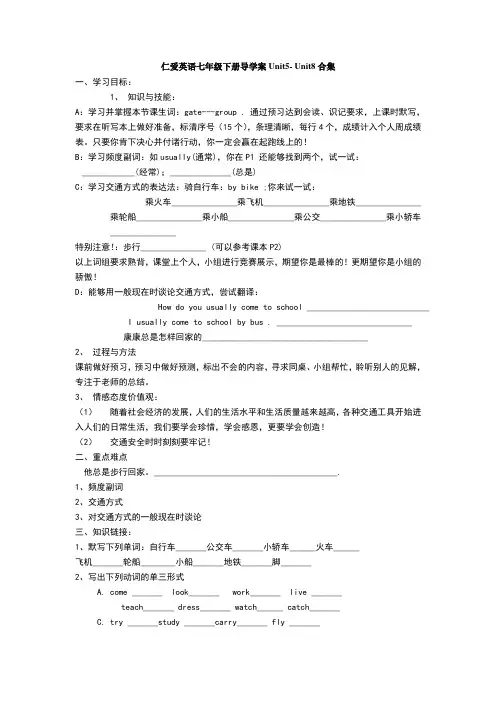
仁爱英语七年级下册导学案Unit5- Unit8合集一、学习目标:1、知识与技能:A:学习并掌握本节课生词:gate---group . 通过预习达到会读、识记要求,上课时默写,要求在听写本上做好准备,标清序号(15个),条理清晰,每行4个,成绩计入个人周成绩表。
只要你肯下决心并付诸行动,你一定会赢在起跑线上的!B:学习频度副词:如usually(通常),你在P1 还能够找到两个,试一试:____________(经常);______________(总是)C:学习交通方式的表达法:骑自行车:by bike ;你来试一试:乘火车_______________乘飞机_______________乘地铁_______________乘轮船_______________乘小船_______________乘公交_______________乘小轿车_______________特别注意!:步行_______________ (可以参考课本P2)以上词组要求熟背,课堂上个人,小组进行竞赛展示,期望你是最棒的!更期望你是小组的骄傲!D:能够用一般现在时谈论交通方式,尝试翻译:How do you usually come to school ____________________________I usually come to school by bus . _______________________________康康总是怎样回家的______________________________________2、过程与方法课前做好预习,预习中做好预测,标出不会的内容,寻求同桌、小组帮忙,聆听别人的见解,专注于老师的总结。
3、情感态度价值观:(1)随着社会经济的发展,人们的生活水平和生活质量越来越高,各种交通工具开始进入人们的日常生活,我们要学会珍惜,学会感恩,更要学会创造!(2)交通安全时时刻刻要牢记!二、重点难点他总是步行回家。
仁爱英语七年级下导学案
仁爱英语七年级下Unit6 Topic2 Section D导学案平都中学范洁学习目标(Learning Objects)1.正确使用方位介词和短语表达物体间的位置关系。
2.正确使用there be句型及本话题所学知识描述住房。
3.写出介绍自己理想中的家的短文。
4.热爱家,热爱生活。
学习过程(Learning Procedure)Ⅰ.Revision自主复习1.看视频复习方位介词和短语。
2.结合图片复习there be句型及本话题中谈论住房的句子。
Ⅱ.Self check 自我检测1.完成P41 Grammar和Functions。
2.大声朗读、理解并识记这两部分的句子。
Ⅲ. Process writing 过程写作1. Pre-writing写前(1)熟悉写作的基本结构。
(2)了解一些简单的写作方法。
2. While-writing写中(1)根据以下问题写提纲。
Where do you live?(住在哪里)What kind of home do you live in?(房屋的类型)What’s your home like?(家是什么样的:可以写家里有哪些房间,房间里有什么东西等内容)(2)画出自己理想中的家。
(3)根据图画完成短文。
注意:正确使用人称和时态,合理使用方位介词。
___________________________________________________________ ___________________________________________________________ ___________________________________________________________ ___________________________________________________________ ___________________________________________________________ ___________________________________________________________ ______________________________________________________________________________________________________________________ 3. Post-writing写后小组内互评,用红笔改出文中的错误,并选出小组中最好的一篇。
完整word版仁爱英语七年级下导学案Unit5Topic2导学案
Topic 2She is reading in the librarySection A一、讲堂导学(本课必背单词、短语、句型)I.单词:b(laboratory)13.swimmingputer14.pool3.boring9.room15.clean4.soon10.hall16.run5.classroom11.gym17.dance6.playground12.buildingII. 短语:1.制作卡片 make cards8.游泳池 swimming pool2.玩卡片 play cards9.老师的办公室 teachers ’ office3.在打电话,经过电话on the telephone10.在图书室 in the library4.在教室里 in the classroom11.在体育馆 in the gym5.电脑室 in the computer room12.打扫卫生 do some cleaning6.餐厅 dining hall13.在操场 on the playground7.教课楼 classroom buildingIII. 句型 :1.What are you doing now?你此刻正在做什么?I ’ m making cards.我正在制作卡片。
2.Are you doing your homework?你正在做你的作业吗?Yes,I am. 是的。
我在造作业。
3.See you soon. 待会儿见。
See you.再会。
4. Where is he/she? 他 /她在哪儿?He/She is in the library.5.What is he/she doing now?他/她此刻正做什么?He/She is reading. 他 /她正在念书。
IV . 难点分析:1. 打扫卫生译为 __________________ 你还知道近似的短语吗?试着再写 3 个:________________________ ________________________________________________ 2.What are you doing now?be(is,am,are)+ 词本句使用的是此刻进行时。
(完整word版)仁爱英语七年级下导学案Unit5Topic3导学案
Topic 3 My school life is very interesting.Section A一、课堂导学(本课必背单词、短语、句型)I.单词:星期名词:1.星期一 2.星期二 3.星期三4.星期四5.星期五(联想:6.星期天7.星期六)学科名词:1.历史 2.地理 3.物理4.政治5.数学6.体育7.生物8.美术,艺术9.科学(联想:1.英语 2.汉语 3.音乐)其它: 1.会议II.短语1.what day 星期几2.have a music class 上音乐课III.句型:1.-What day is it today? -(It’s) Wednesday.It’s my favorite day.今天星期几?星期三。
它是我最喜欢的一天。
2.-Why? -Because we have a music class on Wednesday.为什么?因为在星期三我们上音乐课。
3.-What class are they having?-They are having a music class.他们正在上什么课?他们正在上音乐课。
4.-What time is the class over? -At 10:40.这节课几点钟下课?10:40.-What time does the next class begin? -At 10:50.下节课几点开始?10:50.6.-How many lessons does he have every weekday? -Six.他每个工作日上几节课?IV. 知识点击1. -What day is it today?今天星期几?--Wednesday.星期三。
句型What day ...?常用来询问星期几或节日。
如:-VLhat day is it Loday?今天是什,么节日?-It's Children`s nay.是儿童节。
2. --What class are they having?他们在上什么课?-They are having a music class.他们在上音乐课。
仁爱英语七年级下册导学案全册
课题: Unit 5 Our School LifeTopic 1 How do you usually come to schoolSection A第一课时【学习目标】1、Remember new words.2、Read the text and act out the dialog.3、How to transform the traffic tools.【知识链接】1、I usually come to school (步行).2、Jim usually comes to school (坐公共汽车).3、Do you always come home (骑自行车)【预习达标】1、A:Happy New Year!B: .2、Your bike (看起来)very nice!3、How do you (通常)come to school4、I come to school (坐地铁).5、It’s time (到上课的时间了).【学习流程】自学指导Step 1、Act out the dialog.Step 2、英汉互译1、新年快乐 4、Comeon!2、坐地铁 5、bytrain3、坐船 6、onfootStep 3、用所给词的适当形式填空1、I usually (come)to school by bus.2、Jane usually (come)to school by bike.3、Does Michael often (come)to school on foot4、Helen always (come)to school by subway.5、Kangkang (go)to school on foot.6、How does Jane usually (come)to school合作探究1、Jane (go)to school (坐地铁).2、Michael (come)home (坐公交).3、Helen (go)home (步行).4、Kangkang (go)shopping (骑自行车).5、I (go)for a picnic (坐船)展示提升Step 1、Make a similar dialog as 1a.Step 2、Act out the dialog group by group.Step 3、The teacher corrects their mistakes if needed.【盘点收获】1、我记住并能灵活运用的新单词有。