
What do you usually do at school
2. A: What do you usually do after class?
B: I do my homework, listen to pop ____ music, do some sports and sometimes____________. surf the Net
句型: 一般都做什么
Page 21 Task 2 1.What do they think of the weekend and what do they usually do on weekends? 2. Who helped who to fine a part-time job?
3. How does Peter like the job? Why?
2.What subject are you interested in? I’m interested in Chinese. 3.What subject do you like best? I like Engsh best. 4. What do you usually do at school/in class/ after class/in your spare time? 5. What subjects do you take? 6.Why do you like PE? I think PE is funny and useful. 7.Why don’t you like math? I find math boring.
I think it’s Because it’s I find it
interesting /useful/ boring/ difficult/ easy.
1.你最喜爱的科目是什么?我最喜欢的科目是(计算机) 2.你对什么科目感兴趣?我对(语文)感兴趣。 3.你最喜欢什么科目?我最喜欢(英语) 4.你一般在学校/在课上/放学后/空间时间做什么? 5.你们都上什么课? 6.你为什么喜欢体育? 我认为体育很有趣而且有用。 7.你为什么不喜欢数学? 我发现数学很无聊。 1.What’s your favorite subject? My favorite subject is computer
A Useful Way Father: so much water? Jack: I have just had an apple, Dad. Father: What"s that got to do with it?
Jack: I forgot to wash the apple.
What subjects do you like best?
My favorite subject/sport/music is---I’m interested in --I like --- best.
句型:
为什么。。
回答
Why do you like----? Why don’t you like---?
soccer sing and do B: We take ____ classes, play ______, other sports.
A: What do you usually do in class? B: We listen to the teacher, and discuss questions.
Unit 2 School and Daily life 学校和日常生活
Lesson 1 What do you usually do at school?
Page 17 Task 3: Listen and fill in the blanks 1.A: What do you usually do at school?
找出下列短语: 1. 参加聚会 2. 上网 3. 喜欢某事物/做某事 4. 帮某人做某事 go to parties surf the Internet (Net) enjoy sth/doing sth help sb (to) do sth
Page 25 Task 5 1. Who is Wang Xia? 2. Does she live far from school 3. Is she always late for school? 4. Does she work hard and what is she good at? 5. What are her interests? 6. Does she often help her mother? 7. Is she happy with her life? be late for sth / doing sth 1. 迟到 be good at sth / doing sth 2. 擅长 3. 唱歌好/说英语好/ 我身体好 sing songs well/ speak English well/ I am well. 4. 对。。感到满意 be happy with .. 5. 离。。远 be far from
1.--What do you usually do
﹛
in class at school after class after school on weekends in your spare time
?
--I….
上课 唱歌 做运动 take sing songs do some sports classes 听流行音乐 上网 listen to surf the pop music Net 踢足球play soccer 做兼职
听老师讲课 listen to the teacher
做笔记 打乒乓球 take notes play pingpong 做作业do homework
do a part-time job
你知道怎样询问别人的喜好以及如何回答此类问题吗?
What’s your favorite subject/sport/music? What subjects are you interested in?
unit_2_what_time_do_you_usually_go_to_school_Section_A

always, usually, often, seldom, never, sometimes 柱状图
表示频度方面的区别
1. always是频度最大的词,意为“总是;永远”。 I always remember my first day at school. 我将永远记住我上学的第一天。 usually意为“通常”,即很少例外,频度仅次于 always。 What do you usually have for breakfast? 你通常早餐吃什么?
2. often 意为“经常”,在频度上不如 usually那么频繁。 Li Ping often does his homework in the afternoon. 李平经常在下午做作业。 never 从未;永不;决不。 I have never been there. 我从未到过那里。
3. sometimes意为“有时候”,频度比 often小,表示动作偶尔发生,间断较大。 既可以放在be动词、助动词之后,行为动 词之前,也可以放在句首,还可以放在句 尾。 I sometimes go to the library. 我有时去图书馆。 Sometimes I read a book in the evening. 我有时在晚上看书。
Language points
1. What a funny time to eat breakfast! 这是一个感叹句。在英语中,感叹句 由what或how开头,what后接名词, how后接形容词或副词。后面所接部分 为陈述语序。What开头的感叹句中, 主谓部分可以省略。 e.g. What an interesting book (it is)! How well Wang Fei sings!
思维导图Whattimedoyougotoschool?完整版课件
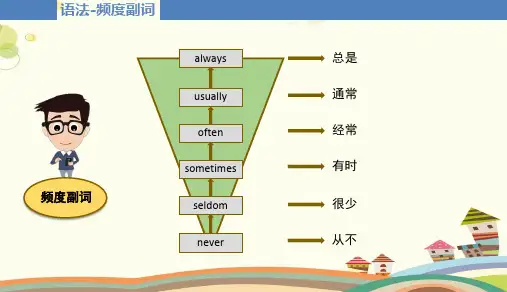
频度副词
always usually often sometimes seldom never
总是 通常 经常 有时 很少 从不
语法-What time/when引导的特殊疑问句
1 对时间状语提问时,有时两者以对时间进 行提问,表示“什么时候”。 what time用来询问具体的时间; when既可以用来询问具体的时间 点,还可以用来询问时间段。
— When is the Music Festival? — It’s on January 2nd.
重点词汇、短语及句型
Adverbs of frequency
Daily activities
always, usually, sometimes, never
Times
get up, get dressed, brush one’s teeth, eat/have breakfast, go to school/work, go home, go to bed, take a shower, do homework, clean one's room, take a walk, play sports, exercise, run
What time/ When do you usually go to school?
What time/ when引导的特 殊疑问句
2 询问具体时间时,即几点几分,只能用what time,不能用when。
—What time is it? — It’s seven o’clock.
3 询问年份、月份、日期时,只能用when,不能用what time。
B: I get up at six thirty.
初二英语口语试题及答案

初二英语口语试题及答案一、自我介绍(Self-introduction)问题:1. Can you tell us something about yourself?2. What are your hobbies?答案示例:1. My name is Li Ming. I am a student in Grade 8. I like reading and playing basketball.2. My hobbies include reading, playing basketball, and listening to music.二、日常对话(Daily Conversations)问题:1. What do you usually do on weekends?2. How do you usually go to school?答案示例:1. On weekends, I usually play basketball with my friends and do my homework.2. I usually go to school by bus.三、描述天气(Describing the Weather)问题:1. What's the weather like today?2. Do you like this kind of weather?答案示例:1. Today is sunny and warm. I feel very comfortable.2. Yes, I like sunny days because I can go outside and play.四、谈论学校生活(Talking about School Life)问题:1. What subjects do you like best?2. Who is your favorite teacher?答案示例:1. I like English and math best because they are interesting.2. My favorite teacher is Mr. Wang. He is very kind and funny.五、表达喜好(Expressing Likes and Dislikes)问题:1. What kind of music do you like?2. Do you like going to the movies?答案示例:1. I like pop music because it's very catchy and easy to sing along.2. Yes, I like going to the movies. It's a great way to relax.六、询问意见(Asking for Opinions)问题:1. What do you think of your school?2. How do you feel about homework?答案示例:1. I think our school is very nice. There are many trees and flowers, and the teachers are very friendly.2. I feel homework is necessary because it helps us to review what we have learned.七、表达将来计划(Expressing Future Plans)问题:1. What do you want to do after school?2. Do you have any plans for the summer vacation?答案示例:1. After school, I want to join the basketball club and improve my skills.2. For the summer vacation, I plan to visit Beijing and see the Great Wall.结束语:That concludes our English oral test for Grade 8. I hope you have enjoyed practicing your speaking skills. Remember, practice makes perfect. Keep up the good work and continue to improve your English communication abilities. Good luck!。
一般现在时专项训练题30题
一般现在时专项训练题30题The present simple tense is one of the most basic and commonly used tenses in the English language. It is used to describe general truths, habitual actions, and permanent situations. In this article, we will explore 30 practice questions related to the present simple tense.1. Do you like to eat fruits and vegetables?Eating fruits and vegetables is important for maintaining a healthy lifestyle. They provide essential vitamins and nutrients that our bodies need. Therefore, it is crucial to incorporate them into our daily diet.2. Does your friend play any musical instruments?Playing a musical instrument is a wonderful way to express oneself creatively. It requires dedication and practice. If my friend plays a musical instrument, it shows their passion for music and their commitment to honingtheir skills.3. What time does the sun rise in your city?The rising of the sun is a beautiful and awe-inspiring natural phenomenon. The exact time of sunrise varies depending on the time of year and geographical location. Knowing the time of sunrise can help plan activities and make the most of daylight hours.4. How often do you exercise?Regular exercise is essential for maintaining good physical and mental health. Engaging in physical activities helps improve cardiovascular health, build strength, and reduce stress. It is recommended to exercise at least three to four times a week for optimal benefits.5. Does your family have any pets?Having pets can bring joy and companionship to a family. They provide unconditional love and can teachresponsibility and empathy. Whether it's a dog, cat, or any other animal, pets become an integral part of the family.6. What do you usually do on weekends?Weekends are a time to relax and recharge after a long week of work or school. Different people have different preferences for how they spend their weekends. Some may enjoy outdoor activities like hiking or going to the beach, while others may prefer staying at home and indulging in hobbies or spending time with loved ones.7. How often do you visit your grandparents?Visiting grandparents is an opportunity to connect with family, learn from their wisdom, and create cherished memories. The frequency of visits may vary depending on factors such as distance, availability, and personal circumstances. However, it is important to make an effort to spend quality time with grandparents whenever possible.8. Does your favorite book have a happy ending?Books have the power to transport us to different worlds and evoke a wide range of emotions. A happy ending can leave the reader feeling satisfied and uplifted. It gives a sense of closure and hope, leaving a lasting impression on the reader's mind.9. What time do you usually go to bed?Getting enough sleep is crucial for overall well-being and cognitive function. The recommended amount of sleep for adults is around 7-9 hours per night. Establishing a consistent bedtime routine can help improve sleep quality and ensure a well-rested mind and body.10. Do you enjoy cooking?Cooking can be a creative and enjoyable activity for many people. It allows individuals to experiment with flavors, try new recipes, and share delicious meals with others. Whether it's a hobby or a necessary skill, cooking can bring a sense of accomplishment and satisfaction.11. How often do you go to the cinema?Going to the cinema is a popular form of entertainment for movie lovers. The frequency of cinema visits may vary depending on personal preferences, movie releases, and availability. It can be a fun way to immerse oneself in a captivating story and experience the magic of the big screen.12. Does your city have a good public transportation system?A well-developed public transportation system is essential for efficient and sustainable urban living. It provides an affordable and convenient mode oftransportation for residents and reduces traffic congestion and pollution. Accessible public transportation promotes inclusivity and connectivity within a city.13. What do you usually have for breakfast?Breakfast is often referred to as the most important meal of the day. It provides the necessary fuel tokickstart the day and maintain energy levels. Popular breakfast options include cereal, toast, eggs, fruit, and yogurt. It is important to choose a balanced and nutritious meal to support overall health and well-being.14. How often do you check your email?Email has become an integral part of communication in both personal and professional settings. The frequency of checking emails may vary depending on individual circumstances and preferences. Some people may check their emails multiple times a day, while others may prefer to check them less frequently to maintain productivity and focus.15. Do you enjoy going for walks?Walking is a simple yet effective form of exercise that can be enjoyed by people of all ages and fitness levels. It promotes cardiovascular health, strengthens muscles, andimproves mental well-being. Going for walks in nature can also provide a sense of tranquility and connection to the environment.16. What time does your favorite TV show start?Television shows have become a popular form of entertainment, offering a wide range of genres and storylines. The start time of a favorite TV show may vary depending on the broadcasting schedule and time zone. It is important to be aware of the start time to ensure not to miss an episode.17. Does your city have a lot of parks?Parks play a vital role in enhancing the quality oflife in a city. They provide green spaces for recreation, relaxation, and socialization. The presence of parks promotes physical activity, improves air quality, and enhances the overall aesthetic appeal of a city.18. What do you usually do before going to work orschool?Morning routines set the tone for the rest of the day. Before heading to work or school, individuals may engage in activities such as exercising, having breakfast, getting dressed, and preparing for the day ahead. Establishing a consistent routine can help improve productivity and mental preparedness.19. How often do you listen to music?Music is a universal language that has the power to evoke emotions and create connections. The frequency of listening to music may vary depending on personal preferences and daily routines. Some people may listen to music throughout the day, while others may reserve it for specific occasions or activities.20. Do you have any hobbies?Hobbies are a wonderful way to pursue personal interests, unwind, and explore new skills. Whether it'spainting, playing a musical instrument, gardening, or any other activity, hobbies provide a sense of fulfillment and joy. They can also serve as a form of self-expression and a means of personal growth.21. What time do you usually have lunch?Lunchtime varies depending on individual schedules and cultural norms. It is recommended to have lunch around midday to refuel the body and maintain energy levels. A balanced and nutritious lunch can contribute to overall health and well-being.22. Does your favorite sports team often win?Supporting a sports team can be an exciting and emotional experience. The success of a favorite sports team may vary from season to season. Wins and losses are part of the game, and the outcome can evoke a range of emotions, from elation to disappointment.23. How often do you read books?Reading books is a valuable and enriching activity that stimulates the mind and expands knowledge. The frequency of reading books may vary depending on personal interests, available time, and individual preferences. Some people may read daily, while others may reserve reading for leisurely weekends.24. Do you enjoy going to museums?Museums offer a unique opportunity to explore art, history, and culture. They provide a space for learning, reflection, and appreciation of human achievements. Whether it's a local museum or a renowned institution, visiting museums can be a source of inspiration and intellectual stimulation.25. What time do you usually have dinner?Dinner is often considered the main meal of the day, providing an opportunity to unwind and share a meal with loved ones. The timing of dinner may vary depending onindividual schedules and cultural norms. It is important to have a balanced and nourishing dinner to support overall health and well-being.26. Does your city have a lot of traffic congestion?Traffic congestion is a common issue in many cities around the world. It can lead to increased travel times,air pollution, and frustration among commuters. Efforts to improve public transportation, promote alternative modes of transport, and implement traffic management strategies can help alleviate congestion and create more livable cities.27. What do you usually do before going to bed?Bedtime routines are essential for winding down and preparing the body for sleep. Activities before bed may include brushing teeth, reading a book, practicing relaxation techniques, or listening to calming music. Establishing a consistent bedtime routine can promotebetter sleep quality and overall well-being.28. How often do you travel?Traveling allows individuals to broaden their horizons, experience different cultures, and create lasting memories. The frequency of travel may vary depending on personal circumstances, such as work commitments, financial resources, and personal preferences. Some people may travel frequently, while others may plan occasional trips.29. Do you enjoy spending time in nature?Nature has a calming and rejuvenating effect on the mind and body. Spending time in nature can reduce stress, improve mood, and enhance overall well-being. Whether it's hiking in the mountains, strolling along the beach, or simply sitting in a park, connecting with nature can be a source of solace and inspiration.30. What do you usually do during the holidays?Holidays provide an opportunity to relax, spend time with loved ones, and engage in activities that bring joyand fulfillment. Different people have different traditions and preferences for how they spend their holidays. Some may travel, while others may prefer to stay at home and enjoy quality time with family and friends.In conclusion, the present simple tense is a versatile and widely used tense in the English language. It allows us to describe general truths, habitual actions, and permanent situations. By practicing various questions related to the present simple tense, we can improve our understanding and usage of this fundamental aspect of English grammar.。
鲁教版英语(五四制)六年级下册_Unit4_单元要点梳理总结
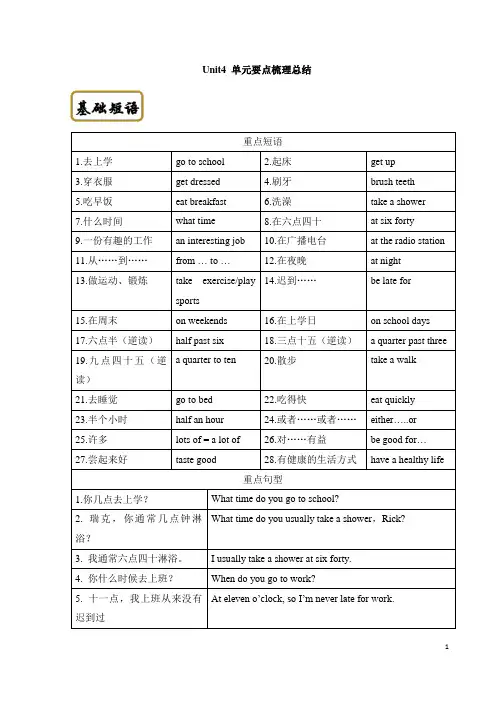
Unit4 单元要点梳理总结重点短语1.去上学go to school2.起床get up3.穿衣服get dressed4.刷牙brush teeth5.吃早饭eat breakfast6.洗澡take a shower7.什么时间what time 8.在六点四十at six forty9.一份有趣的工作an interesting job 10.在广播电台at the radio station 11.从……到……from … to …12.在夜晚at night13.做运动、锻炼take exercise/play14.迟到……be late forsports15.在周末on weekends 16.在上学日on school days17.六点半(逆读)half past six 18.三点十五(逆读) a quarter past threea quarter to ten 20.散步take a walk19.九点四十五(逆读)21.去睡觉go to bed 22.吃得快eat quickly23.半个小时half an hour 24.或者……或者……either…..or25.许多lots of = a lot of 26.对……有益be good for…27.尝起来好taste good 28.有健康的生活方式have a healthy life重点句型1.你几点去上学?What time do you go to school?What time do you usually take a shower,Rick?2. 瑞克,你通常几点钟淋浴?3. 我通常六点四十淋浴。
I usually take a shower at six forty.4. 你什么时候去上班?When do you go to work?At eleven o’clock, so I’m never late for work.5. 十一点,我上班从来没有迟到过6. 他们几点钟穿上衣服?What time do they get dressed?They always get dressed at seven twenty.7. 他们总是七点二十穿上衣服。
七年级下册英语Unit2单项选择专练(含答案)

七年级下册英语Unit2单项选择专练( )1.—What’s his _______?—He is a musician.A. numberB. workC. jobD. time( )2.We do Chinese kung fu _______four _______ the afternoon.A. at; inB. in; inC. at; onD. in; on( )3.What time does your sister _______ school and _______ home every day?A. get; getB. get; get toC. get to; get toD. get to; get ( )4.A group of students _______ in the classroom.A. isB. amC. areD. be( )5.We have _______ clubs in our school.A. muchB. lots ofC. lot ofD. a lots of( )6.—________ does he have English class?—On Monday morning.A. WhenB. WhatC. What timeD. Where ( )7.—What time do you go to bed?—_______.A. At half past eightB. At half to eightC. In thirty eightD. In half past ten( )8.—Excuse me. What’s the English for“6:45”?—It’s _______.A. a quarter to six B. a quarter past sixC. a quarter to sevenD. six past a quarter( )9.That’s a funny time _______ reading.A. forB. withC. atD. of( )10. Either you or your father _______ TV in the evening.A. watchB. watchesC. don’t watchD. watchs( )11. What time does Jane ________ after school?A. do her homeworkB. does her homeworkC. do her homeworksD. does her homeworks( )1 2. Do you want to listen to the ________ story?A. funnilyB. funnyC. funyD. funer( )13. —Here some cards for you, Kate.—Really? Thank you very much.A. isB. areC. hasD. have() 14. —What do you usually do after you ________?—I take a shower and have my breakfast at home.A. go to bedB. go to schoolC. get upD. go home( ) 15. I often do my homework _______ the evening, but I watch TV _______ Sunday evenings.A. in; atB. on; atC. in; onD. at; on( ) 16. Students usually go to the park _______ Sundays. They play _______ theirfriends there.A. in; withB. on; withC. on; andD. in; and( ) 17. Jack usually gets up at six ________ the morning ________ Sunday.A. on; atB. in; atC. at; onD. in; on ( ) 18. “12:45” reads (读作) ________.A. twelve forty-fiveB. a quarter past twelveC. a quarter to twelveD. three quarters past twelve( ) 19. Scott ________ a shower after breakfast.A. haveB. takeC. takesD. bring( ) 20. Please ________ me about your school life. I want to know about it.A. thinkB. tellC. learnD. listen( ) 21. —Does your sister ________ a radio station?—Yes, she does.A. workB. worksC. work atD. works at ( ) 22. We don’t have ________ time for lunch.A. lotB. a lotC. manyD. lots of( ) 23. The boy ________ watches TV ________ plays computer games after school.A. or; andB. or; orC. either; orD. or; either ( ) 24. —________ do you have dinner?—I eat it at about 6:30.A. HowB. WhatC. WhereD. When ( ) 25. —________?—Sorry, I don’t have a watch.A. What’s thatB. What time is itC. What is itD. How are you ( )26. — _______ do you play basketball? —On weekends.A. WhenB. HowC. What timeD. Where( )27. She gets up _____ six fifty.A. atB. onC. inD. for( )28. I like ______ a little longer in the morning.A. sleepsB. to sleepC. sleepD. to sleeping( )29. The book is so _______, and everyone is _______ in it.A. interested, interestingB. interesting, interestedC. interesting, interestingD. interested, interested( )30. When do you usually get ______ home every day?A. toB. atC. forD. /( )31. Miss Gao runs ______ the morning, but ______ Saturday morning she doesn’t.A. in, inB. on, onC. in, onD. on, in( )32. What time ______ your sister ______ lunch?A. does, hasB. does, haveC. do, haveD. do, has( )33. What _______ she usually ______ on Sunday?A. is; doB. does; doC. does; doesD. did; do( )34. It’s good ________ our health______ vegetables.A. for ; to eatB. to ;eatC. for; eatingD. at ; eating ( )35. They don’t have time ______ breakfast in the morning.A. to eatB. eatingC. to eat theD. for eat ( )36. Tom is the best student in my class. He _______ gets good grades.A. alwaysB. sometimesC. neverD. often( )37. My father often __________ at 7:00 in the morning.A. get upB. brushs teethC. goes to workD. goes to bed ( )38. How dirty (脏的)you are! Go and take a ______.A. lookB. showerC. mealD. show( ) 39. Susan _______ her homework at school every weekend.A. doesn’tB. doesn’t doC. don’tD. don’t do( )40. ------Do you often go to the gym?------No, _________. I don’t like sports at all.A. alwaysB. neverC. sometimesD. usually( )41. She plays basketball for ________ every day.A. half an hourB. a half hourC. an half hourD. half hour ( )42. I love my school. And I am never late ______ school.A. atB. toC. ofD. for( )43. My brother has __________ in Shanghai.A.a interesting jobB. a interesting workC. an interesting jobD. an interesting work( ) 44. The ice-cream ______, so many students like it.A. taste wellB. sound wellC. tastes goodD. sounds good( ) 45. Either Jim or Tom _________ at a radio station.A. workB. worksC. to workD. working( ) 46. _____ your father ______ watching TV in the evening?A. Does, likesB. Does, likeC. Is, likesD. Do, likes( ) 47. --- When does your father go swimming?. --- _______ Saturday evening.A. OnB. InC. OfD. At( ) 48. Music is good ______ our life, and my friend is good ________ music.A. at, forB. for, atC. with, forD. at, with( ) 49. The cakes sell _______ and taste _______.A. well, wellB. well, goodC. good, wellD. good, good ( ) 50. I always do my homework _____ after school.A. firstB. oneC. onesD. once( )51.My brother often _____ English on the radio.A. hearsB. listensC. listen toD. listens to( )52.It’s six o’clock in the morning. It’s time ________.A. get upB. for get upC. to get upD. of getting up( )53. Look at the clock. It's six fifteen.A. fifteen to fiveB. fifteen past sixC. a quarter to sixD. a quarter past five( )54. You can either take a bus ________ go there on foot.A. andB. orC. butD. so( )55. My mother usually gets up five the morning.A. in;atB. at;inC. on;inD. around;on( )56. —Did you do _________ last weekend?—Yes, I went to the zoo.A. something interestingB. interesting somethingC. anything interestingD. interesting anything( )57. I sometimes play tennis for half hour.A. aB. anC. /D. the( )58.--Does your grandfather have rice lunch? --Yes, he does.A. forB. or C at D. from( )59.Tina usually watches TV 7:00 8:30 in the evening.A. from ; atB.at ; toC. from;toD.to;from( )60.Sam has a relaxing .He only works on the weekend.A.showB.jobC.familyD.game( )61.Alan always gets up late and then goes to school,so he has enough (充足的) time to eat breakfast.A.alwaysB.neverC. usuallyD.sometimes( )62. Please tell me something _______ your new teacher.A. inB. forC. aboutD. on( )63. We have ________ things to do this week, but I think we have ________ time to do them.A. much; a lot ofB. a lot of; manyC. many; lots ofD. lots of; many( )64. Ice-cream is not good our health.A. aboutB. forC. withD. of( )65. My mother usually at 5:30 in the afternoon.A. get homeB. get to homeC. gets to homeD. gets home( )66.---What about to the supermarket with me?---That’s a good idea.A. goingB. to goC. wentD. goes ( )67.-Do you want to join me for dinner? -______ .A.Yes, I’d love to. B .That’s a good ideaC. That’s for sure.D. Sorry, I’d love.( )68.We couldn’t connect Malaysia MH370 _______ Mar8th,2014.A. onB. toC. atD. of ( )69.Our teacher told us _______________ carefully in class.A. listenB. to listenC. listenedD. listens ( )70.I’ll work hard to make a lot of money ______ I can buy a big house.A. ifB. becauseC. althoughD. so that ( )71.Every year, ______ people go to visit the factory.A. a hundred ofB. hundredC. hundred ofD.hundreds of ( )72.--___________________?--It’s Thursday.A. What is it tomorrowB. What day is it tomorrowC. It is Thursday tomorrowD. Do you like Sunday( )73.-What time do you usually get up on weekends , Lily?-I get up 7:00.A.byB.forC.inD.at( )74.I wish you _______ to my birthday party.A. comeB. comingC. comeD. to come( )75.I gave her _____ address and she gave me ______.A. my ; herB. my; hersC. mine; herD. mine; hers( )76.She’s _____________ girl.A. an fifteen-years-oldB. a fifteen-year-oldC. a fifteen-years-oldD. an fifteen-year-old( )77._______the Shouxihu Park, please turn right after you _______ the bridge.A. To arrive; crossB. Arrive at; acrossC. Get to; acrossD. To get to; cross( )78.My father doesn’t like milk. My mother doesn’t like milk, _______.A. tooB. alsoC. orD. either( )79.There are eight _______ students in our school. They must be _______ every day.A. hundreds, on timeB. hundreds of , in timeC. hundred, on timeD. hundreds of , on time( )80. Oh, your shirt is the same_________.A. as meB. with herC. with mineD. as hers参考答案1-5 CADCB 6-10 AACAB 11-15 ABBCC 16-20 BDACB21-25 CDCDB 26-30 AABBD 31-35 CBBAA 36-40 ACBBB 41-45 ADCCB 46-50 BABBA 51-55.DCBBB 56-60.CBACB 61-65.BCABD 66-70 AAABD 71-75 DBDDB 76-80 BDDCD。
Unit 5 Topic 1 How do you usually come to school
Unit 5 Topic 1 I usually come to school by subway. (总第1、2课时)Section A______________ 学号:_________________ 姓名:_____________________【学习目标】:1.学习并掌握本节课生词通过预习达到会读、识记要求,上课时默写,要求在听写本上做好准备,标清序号(15个),条理清晰,每行4个,成绩计入个人周成2. 利用How do you usually ......?这个句子学习频度副词。
3. 表达交通方式:by+表示交通工具的单数名词。
【学习重点】:表达交通方式:by+表示交通工具的名称【学习难点】:学习频度副词【知识点预习指导】A:学习频度副词:如usually(通常),你在P1 还能够找到两个,试一试:____________(经常);______________(总是)B:学习交通方式的表达法:骑自行车:by bike ;以下的由你来试一试:乘火车_______________ 乘飞机_______________ 乘地铁_______________乘轮船_______________ 乘小船_______________ 乘公交_______________乘小轿车_______________ 特别注意!:步行_______________ (可以参考课本C:能够用一般现在时谈论交通方式,尝试翻译:How do you usually come to school ?____________________________?I usually come to school by bus . _______________________________康康总是怎样回家的?______________________________________?自主学习】Read 1a理解并翻译下列词组或句子at the gate _________________ Happy New Year !______________The same to you ! ____________ look very nice ________________by bike___________ by subway _____________ by bus__________How about ….? = ______________? It’s time for class !=___________________!It’s time ________ sth. = It’s time _______ _____ sth.It’s time _______sb _______ sth. – It’s time ______ sb ______ _______ sth.观察2a中的图片,思考:by+交通工具意为“___________”。
新技能英语基础教程1教学课件Unit 1(思政版)
Listening and Speaking
4 Listen and practice. 听录音,谈论学校课程。
Sophie: What subjects are you taking this term, Li Wei? Li Wei: We all take maths, English and computer basics. Sophie: Do all of you take the same skill-training classes? Li Wei: No. Some of us learn cookery, some learn
in the afternoon
where
in the classroom
in different places
what to do study English and maths do skills training
Reading and Writing
3 Read and learn. 读以下三个专业的介绍。
Reading and Writing
3 Read and learn. 读以下三个专业的介绍。
Major: Travel and Tourism Main subjects: Chinese, English, Customer Service Future job: tour guide
专业:旅游 主要课程:语文,英语,客户服务 未来职业:导游
Major: Secretarial Skills Main subjects: Chinese, Computer Basics,
Business Communication Future job: secretary in a company
初中英语_Unit4 What time do you go to school 教学设计学情分析教材分析课后反思
Unit4 What time do you go to school?复习课教学设计教学目标:知识与技能:一、能力目标:谈论自己的日常生活及作息习惯二、知识目标:(1) 重点词汇:up, dress, brush, tooth, shower, forty, never, early, fifty, job, work, station, o’clock night, funny, exercise, best, group, half, past, quarter, homework, run, clean, walk, quickly, either, lot , sometimes(2)重点短语:get up, get dressed, take a shower, radio station, on weekends, do one’s homework, take a walk, either—or, lots of, play volleyball, be good for, half past six, go to bed, brush one’s teeth, go to school, later for(3)重点句型1. What time do you usually get up ?I usually get up at six thirty.2. When do your friends exercise?They usually on weekends.3. I don’t like to get up early.4. I sometimes play basketball for half an hour.5. I either watch TV or play computer games.6. She eats lots of fruit and vegetables for lunch.7. She knows it’s not good for her, but it tastes good.8. At nine thirty, she goes to bed.9. I have lunch at a quarter to twelve.10. I have a very healthy life.(4) 核心语法:时间的表达法。
五年级下册英语-Lesson 11 When do you usually get up? 科普版
根据图中的信息写一小段对话
生词短语:1.summer camp 夏令营 2.team sport 团队活动 3.go hiking 去远足 4.campfire 营火会
Read
Is Lily’s clock slow?
Reading the passage in the book, what have you learned?
Let’s learn
When do you usually get up?
How do you usually go to school?
I usually get up six.
I usually go to school on foot.
When do you usually get up? How do you usually go to school?
6:00, on foot 6:20, by bike 6: 30, by bus 6:40, by car
Let’s practice
what time does Peter go to school?
组织学生讨论时,建议从以下三个方面进行指导:第一,教师要提出明确的要求,把事情说具体,表达出自己的敬佩之情;第二,分组 ,每个同学都说一说自己身边最值得敬佩的人,并进行组内评比;第三,每组推选代表在班上交流,教师要引导全班同学就所说的人物 的品质和事例是否具体,以及口语交际的要求(如态度大方、认真倾听、语句通顺连贯等)进行评价。 3、他在学校念书的时候,同学们就称他为“辩论家”: 那天我们上岛时,已近黄昏,很快就发现一只大龟巢。突然,一只幼龟把头探出巢穴,却欲出又止,似乎在侦察外面是否安全。正当 幼龟踌躇不前时,一只嘲鸫突然飞来,它用尖嘴啄幼龟的头,企图把它拉到沙滩上去。