
七年级英语上册(Unit 4 Where’s my backpack)单词巧记 句型语法剖析 人教新目标版
七年级上册单词巧记+句型语法剖析Unit 4 Where’s my backpack单词巧记+句型语法剖析三点剖析单词·巧记·典句·考点【巧记提示】 w+here(这里)【经典例句】Where are you?你在哪?【考点聚焦】 where是特殊疑问词,用来引导特殊疑问句。
当我们不知道某东西在什么地方时,常用Where is/are...?来询问。
【活学活用】 1.对画线部分提问The shop is near our school.答案:Where is the shop?【巧记提示】 t+able(能;能力【经典例句】 There is a dog under the table.桌子下面有一条狗。
【考点聚焦】 1)注意与desk的区别:2)常用词组:at table在吃饭;at the table在桌旁【活学活用】 2.翻译爸爸叫我吃饭时不要说话。
答案:Father asks me not to talk at table.【经典例句】海底有很多奇怪的植物。
【考点聚焦】注意与其他几个方位词的区别:【活学活用】3.根据字母完成单词My book is (d r e u n)your desk.答案:under【经典例句】 He often helps me with my math.他经常帮我学数学。
【考点聚焦】 1)全拼为mathematics,通常用作单数。
美语中简称math,英语中简称maths。
2)相关学科:Chinese语文;English英语;P.E.体育;art艺术;music音乐【活学活用】 4.选词填空(Math,Book)is a kind of subject.答案:Math【巧记提示】拿着(take)蛋糕(cake)到湖(lake)边去。
【经典例句】It’s going to rain,please take要下雨了,请随身带把伞。
【考点聚焦】 1)看图体会注意与bring的区别:2)take的常见词组:take photos 照相;take away拿走; take a look一看【活学活用】 5.选词填空Here are some books.Please(take,bring)them to my office.答案:【巧记提示】家里(home)来(come)了一些(some)人。
【经典例句】Some students like playing football,others like playing basketball.一些学生喜欢踢足球,另一些喜欢打篮球。
【考点聚焦】注意与any “一些”的区别:some和any 都有“一些”之意,它们既可以修饰可数名词又可以修饰不可数名词,但some常用在肯定句中,而any则常用在否定和疑问句中。
【活学活用】 6.变为一般疑问句答案:【巧记提示】 need(需要)→f eed(饲养)。
【经典例句】1)need作为情态动词表示“需要;必须”,通常用于否定句和疑问句。
2)need作为实义动词时,通常用法是:①人+need +to do;②物+need +doing;③物+need +to be done。
另外,need后还可以直接跟名词。
如:I need a watch.我需要一块手表。
【活学活用】 7.变为否定句答案:I don’t need any help.短语·典句·考点on the sofa 在沙发上【经典例句】他的书在沙发上。
【考点聚焦】 1)英语中有一些表示方位的介词,用于名词或代词前,这时名词或代词称为介词宾语。
介词后的人称代词要用宾格形式。
介词与后面的名词或代词构成介词短语。
如:①in表示“在……中;在……内”。
如:in the room在这个房间里;in the backpack在背包里②on表示“在……上”。
如:on the floor在地板上;on the desk在课桌上③under表示“在……下”。
如:under the bed在床下;under the tree在树下④behind表示“在……后面”。
如:behind the door在门后;behind the tree在树后⑤near表示“在……附近”。
如:near the school在学校附近;near my home在我家附近2)当介词短语充当表语时,千万不要忘了be 动词(is,am,are)。
【活学活用】 8.选择The door is the wall,but the pictures are theA.in;inB.on;onC.on;inD.in;on答案:Dtake...to sb. 把……带给某人【经典例句】 Please take the umbrella to请把雨伞带给你爸爸。
【考点聚焦】 take sth.to sb.意为“把某物带给某人”; take sb./sth.to+地点意为“带某人/物去某地”; bring sth. to+地点意为“把某物带到某地来”。
【活学活用】 9.翻译下列句子(1)把椅子拿到教室里去。
(2)我爸爸将于这周日带我去北京动物园。
(3)明天把作业带到学校来。
答案:句子·剖析·拓展我的背包在哪里?【剖析】这是由where引导的特殊疑问句。
句中动词用is还是用are,要根据句中主语的单复数(或不可数名词)来确定。
主语是单数(或不可数名词)用is,主语是复数用are。
【拓展】 1)当知道某物在哪里时,回答用It is...或They are...。
2)如果不知道某物在什么地方,回答用I don’t know.你可以把一些物品带到学校来吗?【剖析】 Can you...?是一般疑问句。
这一句型常用于朋友、熟人之间请求对方帮忙做某事。
【拓展】1)如果是表示有礼貌的请求或委婉地提出问题,则常用Could you...?2)对Can you...?作肯定回答常用Certainly 或 Sure;作否定回答用Sorry,Ican’t 或Sorry,然后说出理由。
这是我的房间。
【剖析】此句是一个倒装句,here 放在句首,经常使用倒装结构,其结构为Here+is/are+名词。
通常翻译成“这是……”。
由于此句的主语是my room,所以本句应用全部倒装结构。
【拓展】如果主语是人称代词,则常用部分倒装。
语法·聚焦快来认识“我”——Hi!我叫where,汉语名字是“哪里、哪儿”。
我与who,what等兄弟一样,也喜欢提问。
不过,我是疑问副词,我的职责是用来对“地点”进行提问。
这样跟你说吧,我总喜欢问“某人在哪里”或“某物在哪里”。
大家喜欢与我交朋友吗?那就快来了解一下我的特点吧。
【特点一】我常用来提问表示地点的副词或介词短语。
带where的句中不能再有表示地点的副词或in,at,on,under等构成的介词短语。
如:—Where do you l你住在哪里?(这里不用live in)—我住在北京。
【特点二】我爱问“哪里”,如果问句中出现表示来源或方向的介词时,此时where具有代词的性质,介词就不能省掉。
如:Where are you from?你从哪里来?Where are you driving to?你开车到哪里去?【特点三】当我询问的物品数量为单数时,be动词要使用is,因为该物品在问句中提到过,所以回答时用代词it代替该物品就可以了。
如:—Where is my baseball?我的棒球在哪儿?—It’s in the backpack.在背包里。
当所询问的物品数量为复数时,be动词使用are,因为该物品在问句中提到过,所以回答时用代词they代替该物品。
如:—Where are my books?我的书在哪儿?—They’re on the sofa.在沙发上。
【特别提醒】 Where is可以缩写成Where’s,但Where are不能缩写。
经典题型例1Please the chair away and a desk hA.take;takeC.take;bring思路解析:本题句意为:请把椅子拿走,带张课桌来。
“拿走、带走”要用动词take,“带黑色陷阱:take...away是固定搭配,但不要只根据第一空而误选A,要瞻前顾后,才能正确无误。
例2(2010金华模拟模拟 )Could you please pass the bo思路解析:动词pass后面跟两个宾语,构成词组pass sb.sth.,所以这里需要人称代词的锦囊妙计房间的地面(floor)真美丽,sofa,TV和CD;table,chair放整齐,录像带(video tape)要放抽屉(drawer)里。
no与know是同音兄弟,bring(带来),take(拿走)是反义;这里那里放哪里(where)?左掌右掌,需要(need)换位置,随我来记一些(some)介词:下面under,上面是on,后面(behind)的植物(plant)在帽子里面(in the hat)藏。
小新的东西(thing)还很多,一定用心记住了。
七年级英语上册 unit4 where's my backpack课件 人教新目标版
Where are the keys? They are on the table. They’re on the table.
Where are the keys? They’re in the drawer.
Where are the keys? They’re under the table.
Do you know these words:
on
under behind
in
beside in front of
Put the right prep.:
Where’s the girl? She’s on/in/under the box. on
in
under
Where’s the cat? It’s … under the case
The books __________________.
This is my room. The bed is beside the door. ...
Where are the plants? I think they are on / in / under / …
They’re on the table.
Where are the books? I think they are on / in / under /…
They’re in the bookcase.
Where’s the bag ? I think it is on / in / under / …
It’s behide the sofa.
Where’s the backpack? I think it is on / in / under / …
It’s under the chair.
新目标英语七年级上册单词巧记,句型语法剖析(Unit1-Unit12)
【活学活用】7.同义句改写
I often give my uncle a telephone.
答案:I often phone my uncle.
短语·典句·考点
Nice to meet you!
【经典例句】—Nice to meet you.
见到你很高兴。
思路解析:1.本题所给选项均为形容词性物主代词,所以要根据意思进行选择。首先排除C、D项。而A项不符合汉语习惯,也应排除。2.book是名词,前面应用形容词性物主代词,排除A、C项。系动词am前面要用人称代词,排除D项。3.family name相当于last name,意思为“姓”。根据西方人名字书写的规则可知,在Jim Smith中,Smith是姓。4.在中国人的名字里,姓放在前面,名放姓的后面。Wang Hai中的Hai是名字,即first name。5.系动词be要和主语保持一致。在本句中,主语为名词单数number,所以应用be的第三人称单数形式is。
telephone number电话号码
【经典例句】My telephone number is 010-6781532.
我的电话号码是010 6781532。
【考点聚焦】telephone number可缩写为Tel.No.如:
“Tel.No.926-3125”意思为“电话号码:9263125”。
【活学活用】1.用I的适当形式填空
name is Jim Green.am 12 years old.
答案:My,I
【巧记提示】name(名字)→game(游戏)
【经典例句】His name is Tony.
他叫托尼。
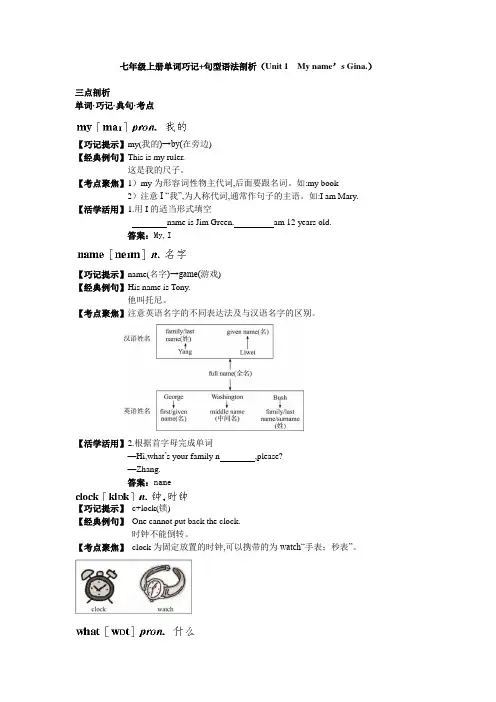
【考点聚焦】注意英语名字的不同表达法及与汉语名字的区别。
新目标英语七年级上册unit 4 Where is my backpack课件

• Teaching Methods:
(1)Task-based teaching (2)Question-and-answer method (3)Pair work and group work (4)Co-operative teaching method.
• Teaching aids:
A mu1timedia system, a blackboard
• on
在...上面
• Under 在...下面
Where is Tom?
in
on
under
Hale Waihona Puke Let’s chant• Where is the pen ? • The pen is on the pencil case.
• Where is the pen ? • The pen is in the pencil case.
• Where is the pen ? • The pen is under the pencil case.
Pair work
A: Where’s the… …? B: It’s in/on/under/… …
Where’re the books? They’re in the bookcase.
• To train the students’ co-operative consciousness, and to promote the formation of innovation ability.
新目标英语七年级上册Unit 4 Where’s my backpack SectionA 1a-1c教案附教学反思
新目标英语七年级上册Unit 4 Where’s my backpack? SectionA 1a-1c教学设计教材分析:新目标英语七年级上册第四单元,主要通过谈论话题"Things around the house"学习询问“物品的位置”,使学生学会基本句型"Where’s my backpack? It’s under the chair.”,进一步体会“Where…? Yes/No”疑问句的用法;学会运用方位介词"on/in/under/behind/next to"表达物品的位置。
通过以上几个方面的学习,使学生学会运用听关键词、推测词意的学习策略,识别不同物品的位置;既能促使学生了解自己的家居环境,热爱自己的家,又能促使学生通过想象设计自己理想中的房间。
本单元知识点是中考重点考查的一个单元,同时与第五单元衔接紧密:由本单元“Is/Are …?"的学习过渡到第五单元"Do …?”的学习。
学情分析:本课学生是成都航天中学划片区招生的第一届学生,学生英语基础差,很多学生上课不太敢开口。
因此,课堂设计上尽量考虑学生的实际情况,由浅到深,循序渐进的提高学生动口和动手能力。
Teaching aims:1. Learn the new words: on, under, in, bed, sofa, table, chair, bookcase, dresser, drawer, plant etc.(知识目标)2. Learn the new drills: (知识目标)A: Where’s my backpack?B: It’s under the table.A: Where are my books?B: They’re on the sofa.3. Learn to use the drills to talk about where things are.(技能目标)4. Learn to put away one’s things. (情感目标)Teaching key points:1. Learn the new words.2. Learn the new drills.Teaching difficult points:Talk about where things are.Teaching methods:Illustrating, memorizing and summarizingTeaching aids:Pictures, real objects, tape-recorder, mass mediaTeaching procedures:Step 1 Lead—in (5 minutes)1. Greetings.2. Duty report.Step 2 Learn the new words: (15 minutes)1.Present the new words: (5 minutes)Show students the pictures on the screen and ask:T: Look at these pictures and what are they? Please tell me one by one.What’s this?Ss: It’s a bed.T: Spell it, please.Ss: B-E-D.Notes: ①Write the new word “bed” on the blackboard while the students are spelling it.②Teach and learn the other new words in the same way.2. Practice the new words: (10 minutes)①Read after the teacher.②Read together.③Teacher points and students read.④Match the words with the things in 1a.⑤Read and remember these words for 1 min.⑥Ask two students to teach the other students to read the words.⑦Play a game: Look at the pictures only. Teacher points to the pictures and students say the words.Step 3 Learn the new drills (10 minutes)1. Present the new drills:(5 minutes)Show students some pictures on the screen and ask:T: Where is the backpack?S1:It’s under the table.T: Where is the backpack?Ss: It’s under the table.Notes: ①Write the new drills on the blackboard.②Show students some more real objects and ask them like this.2. Practice the drills: (5 minutes)①Read the drills on the blackboard.②Listening practiceT: The people in the picture are talking. Now listen and number the things you hear.③Check the answers one by one.Step 4 Oral pracrice (7 minutes)1. Look at these things in the picture and talk about where they are with your partner.2. Now use your things to make conversations.3. Students show their conversations to the class.Step 5 Consolidation and summary. (3 minutes)Homework:1. Listen and read the words of page 19.2. Copy the conversations in the picture and make your own conversations. Blackboard designUnit 4 Where’s my backpack? Section A 1a—1c bed A: Where is the backpack?sofa B: It’s under the table.table A: Where are the books?chair B:They are on the bed.……教学反思:1. 在导入新单词时,通过图片的形式,直观形象的呈现了事物的名称,调动了学生的兴趣,有利于让学生开动脑筋,吸引学生的注意力,以达到迅速记忆的目的。
七年级英语上册-unit4-where's-my-backpack课件-人教新目标版
Where are the plants? I think they are on / in / under / …
They’re on the table.
Where are the books? I think they are on / in / under /…
They’re in the bookcase.
Where’s …? It’s …
Where are the keys? They are on the table. They’re on the table.
Where are the keys? They’re in the drawer.
Where are the keys? They’re under the table.
Where’s the bag ? I think it is on / in / under / …
It’s behide the sofa.
Where’s the backpack? I think it is on / in / under / …
It’s under the chair.
Where are …? They’re …
Where’s the clock? I think it is on / in / under / …
Where’s the chair ? I think it is on / in / under / …
It’s beside the table.
Do you know these words:
on
in
under beside
behind in front of
Put the right prபைடு நூலகம்p.:
新目标初中英语七年级上册Unit 4 Where’s my backpack教案

Unit 4 Where’s my backpack?教案Section B 1a—2b【教材分析】本单元主要是谈论物品所在地。
在第一单元我们接触到了what 引导的特殊疑问句和介词in, 第二单元接触到了名词的复数。
本单元开始正式学习where引导的特殊疑问句,名词的复数和介词in, on,under。
为以后特殊疑问句,名词的复数和介词的继续学习奠定了坚实的基础。
它在本册书中乃至整个初中阶段占有极其重要的位置,起着一个承上启下的作用。
本课为本单元的第三课时,在SectionA部分学生已经能基本使用目标句型表述物品的位置,这一课以Tommy为主线,通过各种活动使学生进一步巩固对物品位置的描述,尤其是房间里的物品,同时也为下一课时学生读写能力奠定基础。
【学情分析】七年级的学生好奇心强,有初生牛犊不怕虎的热情和积极性。
但学生的近景性动机较强,注意力不能持久,所以我尽量通过各种活动给他们提供一个愉悦而宽松的学习情境。
【教学目标】通过本课的学习,使学生能够较熟练运用所学的英语知识描述房间物品的位置。
1.语言知识目标:(1)掌握本课的重点词汇。
(2)能准确表达物品的位置。
2.情感态度目标:促使学生了解和关心自己和他人的家居环境,热爱自己的家,养成良好的生活习惯。
从完成任务的过程中,学会互相合作,互相帮助,互相提高的社会交际意识。
【教学重点】1.重点单词、词组:math book ,alarm clock, video tape , CD, hat, computergame, need sth for…, bring…to …, take… to…2.重点句型:where’s the..?Is it in /on/under…?He/She has…3.话题:Talk about where things are【教学难点】如何准确地表达物品的位置。
教学步骤Unit4 Where’s my backpack?Class_____________ Name____________ 1. Listen again and write down where the things are.(再听一遍写出这些物品的位置)2.If you are Tommy, what do you think your room should be? Please decorateTommy ’s room with your group members, then show your design. (假如你是Tommy ,你觉得你的房间应该是怎样的?请和组员一起装扮Tommy 的房间然后秀出你们的设计。