
动词wish后宾语从句中的虚拟语气
虚拟语气与习题1.动词wish后宾语从句中的虚拟语气1) 用wish表示现在的祝愿和抱歉。
其句子结构为:宾语从句的谓语be用were(was),实义动词用过去式。
例:I wish they were at home this time.2) 用wish表示对过去事情的遗憾。
其句子结构为:宾语从句的谓语用过去完成时,或could+现在完成时。
例:I wish I hadn' t hurt him so much。
3) 用wish表示对将来事情的愿望。
其句子结构为宾语从句的结构,谓语为would/could/might+动词原形。
例:I wish I might be able to come tomorrow。
2. 用在一般虚拟条件句中的虚拟语气1) 表示与现在、过去、将来事实相反的假设①与现在事实相反的假设。
其句子结构为:从句:if+主语+动词的过去式(be变were)+其他主句:主语+would(should, could, might)+动词原形+其他例:If I were you, I would go with him.②与过去事实相反的假设。
其句子结构为:从句:If+主语+过去完成时+其他主句:主语+should(would, could, might)+现在完成时+其他。
例:If you had studied harder last term, you could have passed the exam.③表示对将来事实实现的可能性不大的假设。
其句子结构为:从句:If+主语+should (were to )+动词原形+其他主句:主语+would (could, should, might)+动词原形例:If he were to go tomorrow, he might tell you.2.) 从句和主句要根据各自发所生的时间选用符合具体时间的虚拟语气形式①从句表示过去,主句表示现在。
If they had started the early morning yesterday, they would be here now.②从句表示将来,主句表示过去。
If I were not to make a preparation for my experiment this afternoon, I would have gone to see the film with you last night。
③从句表示过去,主句表示将来。
If we hadn' t made adequate preparations, we shouldn' t dare to do the experiment next week。
④从句表示将来,主句表示现在。
If we shouldn’t have an exam this afternoon, I would go shopping now.3. 可以引起与事实相反的方式状语从句,用虚拟语气;由as if、as though引起的与事实相反的句子,不论主句的谓语是现在时或者说过去时,其谓语表示的时间概念和句子结构,都基本上与wish 后的宾语从句相同。
例:John pretends as if he didn' t know the thing at all, but in fact he knows it very well.(用过去式表示与现在事实相反的假设)The old man looked at the picture, he felt as though he had gone back to time 20 years ago.(用过去完成式表示与过去相反的事实)They talked and talked as if they would never meet again (would+动词原形,表示与将来事实相反)4. 在表示建议、命令、要求、忠告等动词的后面,其宾语从句的谓语用“should+动词原形”表示虚拟语气常用的此类动词有:表示“要求”的:ask, desire, request, demand, require, beg表示“提议、劝告、建议”的:move, propose, suggest, recommend, advise, vote表示“决定、命令”的:decide, order表示“主张”的:maintain, urge表示“同意、坚持”的:consent, insist例:The doctor suggested that he (should) try to lose his weight.He insisted that we (should) tell him the news.上述动词的名词形式,demand, desire, requirement, advice, order, decision, recommendation, suggestion, 以及necessity, preference, plan, motion, idea等名词,其后的表语从句或同位语从句,也用“should+动词原形”表示虚拟语气。
现代英语,特别是美国英语,常省去“should”,例:The advice is that we (should) leave at once.The idea that we (should)visit Great Wall was warmly welcomed.5. 在“It is (was)+形容词(或过去分词)+that……”结构中,主语从句的谓语也用“should+原形动词“表虚拟语气美国英语中省去should, 常用的形容词和过去分词有:表示“要求”的:required, demanded, requested, desired。
表示“建议”的:suggested, recommended,表示“迫切、紧近、重要”的:imperative, urgent, necessary, essential, important, vital 表示“适当、较好”的:appropriate, advisable, better, preferable表示“可能”的:probable, possible表示“命令”的:ordered例:It was necessary that we (should) make everything ready ahead of time.It is required that nobody (should)smoke here.6. 由下列名词或短语引导,或含有某些词的从句中应用的虚拟语气1) “Iest 以免、惟恐”引导的从句用“should+动词原形”。
He took a map with him lest he (should ) lose his wag there.2) “whether不管、无论”引导的让步状语从句,有时用动词原形。
All things, whether you know or don' t know, exist in the world.3) 用“would rather/had rather' would just as soon"表示“宁愿、但愿”,后面的宾语从句谓语用过去式或动词原形表示对将来的要求,用过去时表示对现在的愿望,用过去完成时表示对过去做的事的懊悔。
Don' t live in the world, I would rather( I would just as soon) you die.I would rather you go tomorrow.I would rather everything hadn' t happened in the past.4) 用“had hoped”表示原来希望做到而实际上未能实现的事情,其宾语从句的谓语用“would+动词原形”。
I had hoped that she would go to the U.S. and study there, but she said she liked to stay in China.5) 在“It is(high/about)time+that”引导的定语从句中,定语从句的主谓语用一般过去时,偶尔也可以用would(或should)+动词原形,或had rather (would rather)+动词原形。
It is high (about)time that we left/should leave/ had better leave/had rather leave/ were leaving.(注意与“This is the first/second…time”后从句中用现在完成时的区别。
6) 用“without/but for/in the absence of ”表示“要不是”,“如果没有”(相当于if it were not for…)表示条件时,句中一般用虚拟语气。
(也可用陈述语气)Without your help, I couldn' t finish my work on time.In the absence of water and air, nothing could live7) 由“providing (that)/ provided (that)/on condition that/ in order that”引导的条件从句或目的从句,根据情况,可用虚拟语气。
(有时也可用陈述语气)They are willing surrender provided they are given free passage.8) 在if引导的虚拟条件句中,若有were, had, should, 在书面语中可省去if ,将were等提到主语前,形成倒装。
Should there be a good film tomorrow. I would go to the theatre with you.Were it not for your help. I wouldn' t be succeed.例1:Christie stared angrily at her boss and turned away, as though____ out of the office.A. wentB. goneC. to goD. would go[答案] C. to go[注释] as though或as if引导的状语从句中, 从句主语和主句主语相同时, 从句中可省略主语和部分谓语, 如:1) She paused, as if to let the painful memories pass. (省略she wanted)2) From time to time Jason turned round as though searching for someone. (省略he were)3) The boy started, as if awakened from some dream. (省略he were)由此可见,本题中省略she wanted。
虚拟语气的八种情况
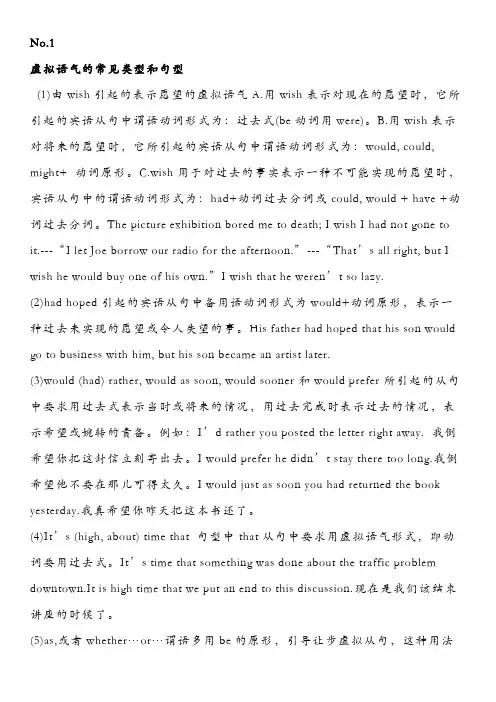
No.1虚拟语气的常见类型和句型(1)由wish引起的表示愿望的虚拟语气A.用wish表示对现在的愿望时,它所引起的宾语从句中谓语动词形式为:过去式(be动词用were)。
B.用wish表示对将来的愿望时,它所引起的宾语从句中谓语动词形式为:would, could, might+ 动词原形。
C.wish用于对过去的事实表示一种不可能实现的愿望时,宾语从句中的谓语动词形式为:had+动词过去分词或could, would + have +动词过去分词。
The picture exhibition bored me to death; I wish I had not gone to it.---“I let Joe borrow our radio for the afternoon.”---“That’s all right, but I wish he would buy one of his own.”I wish that he weren’t so lazy.(2)had hoped引起的宾语从句中备用语动词形式为would+动词原形,表示一种过去未实现的愿望或令人失望的事。
His father had hoped that his son would go to business with him, but his son became an artist later.(3)would (had) rather, would as soon, would sooner和would prefer所引起的从句中要求用过去式表示当时或将来的情况,用过去完成时表示过去的情况,表示希望或婉转的责备。
例如:I’d rather you posted the letter right away. 我倒希望你把这封信立刻寄出去。
I would prefer he didn’t stay there too long.我倒希望他不要在那儿可得太久。
wish的用法
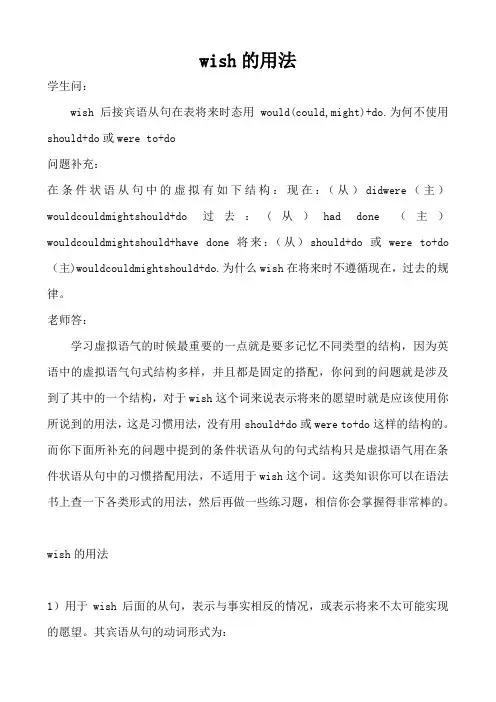
wish的用法学生问:wish后接宾语从句在表将来时态用would(could,might)+do.为何不使用should+do或were to+do问题补充:在条件状语从句中的虚拟有如下结构:现在:(从)didwere(主)wouldcouldmightshould+do 过去:(从)had done (主)wouldcouldmightshould+have done 将来:(从)should+do或were to+do (主)wouldcouldmightshould+do.为什么wish在将来时不遵循现在,过去的规律。
老师答:学习虚拟语气的时候最重要的一点就是要多记忆不同类型的结构,因为英语中的虚拟语气句式结构多样,并且都是固定的搭配,你问到的问题就是涉及到了其中的一个结构,对于wish这个词来说表示将来的愿望时就是应该使用你所说到的用法,这是习惯用法,没有用should+do或were to+do这样的结构的。
而你下面所补充的问题中提到的条件状语从句的句式结构只是虚拟语气用在条件状语从句中的习惯搭配用法,不适用于wish这个词。
这类知识你可以在语法书上查一下各类形式的用法,然后再做一些练习题,相信你会掌握得非常棒的。
wish的用法1)用于wish后面的从句,表示与事实相反的情况,或表示将来不太可能实现的愿望。
其宾语从句的动词形式为:真实状况wish后从句动作先于主句动词动作现在时过去时(be的过去式为 were)从句动作与主句动作同时发生过去时过去完成时(had + 过去分词)将来不大可能实现的愿望将来时would/could +动词原形I wish I were as tall as you. 我希望和你一样高。
He wished he hadn't said that. 他希望他没讲那样的话。
I wish it would rain tomorrow. 我希望明天下雨就好了。
wish跟从句一定要用虚拟吗
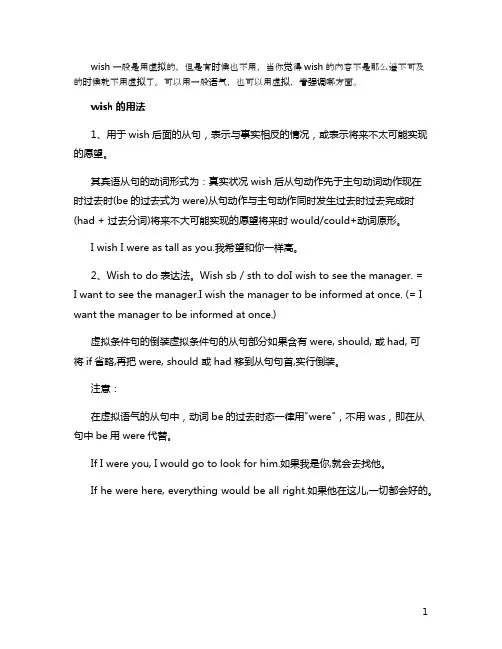
wish一般是用虚拟的。
但是有时候也不用,当你觉得wish的内容不是那么遥不可及的时候就不用虚拟了。
可以用一般语气,也可以用虚拟,看强调哪方面。
wish的用法1、用于wish后面的从句,表示与事实相反的情况,或表示将来不太可能实现的愿望。
其宾语从句的动词形式为:真实状况wish后从句动作先于主句动词动作现在时过去时(be的过去式为were)从句动作与主句动作同时发生过去时过去完成时(had + 过去分词)将来不大可能实现的愿望将来时would/could+动词原形。
I wish I were as tall as you.我希望和你一样高。
2、Wish to do表达法。
Wish sb / sth to doI wish to see the manager. =I want to see the manager.I wish the manager to be informed at once. (= I want the manager to be informed at once.)虚拟条件句的倒装虚拟条件句的从句部分如果含有were, should, 或had, 可将if省略,再把were, should 或had 移到从句句首,实行倒装。
注意:在虚拟语气的从句中,动词be的过去时态一律用"were",不用was,即在从句中be用were代替。
If I were you, I would go to look for him.如果我是你,就会去找他。
If he were here, everything would be all right.如果他在这儿,一切都会好的。
1。
英语语法:虚拟语气的用法

虚拟语气的用法一、虚拟语气在宾语从句中的用法1. 在动词wish后的宾语从句中,表示与现在或过去的事实相反,或对将来的主观愿望,从句通常省略连词that。
表示对现在情况的虚拟:从句动词用过去式或过去进行式(be动词一般用were)例:1) I wish I knew the answer to the question.我希望知道这个问题的答案。
2) I wish it were autumn in Beijing all the year around.但愿北京全年是秋天。
表示对过去情况的虚拟:从句动词常用“had+过去分词”例:1) I wish I hadn’t spent so much money.我后悔不该花那么多钱。
2) He wishes he had not lost the chance.他真希望没有失去机会。
表示对将来的主观愿望:从句动词形式为“would+动词原形”注意:主句的主语与从句的主要不能相同,因为主句的主语所期望的从句动作能否实现,取决于从句主语的态度或意愿(非动物名词除外)。
例:1)I wish it would stop raining.但愿雨能停止。
2)I wish you would come soon.但愿你立刻来。
2. 在一个坚持(insist),两个命令(order, command),三个建议(suggest, advice, propose),四个要求(ask, demand request, require)等动词后的宾语从句中,谓语动词用“(should)+动词原形”,表示建议、要求、命令等。
例:1) I suggest that we (should) set off at once.我建议马上动身。
2) The students insisted that they (should) have more English classes学生们坚持要多上英语课。
英语语法:宾语从句中用虚拟语气的10种类型
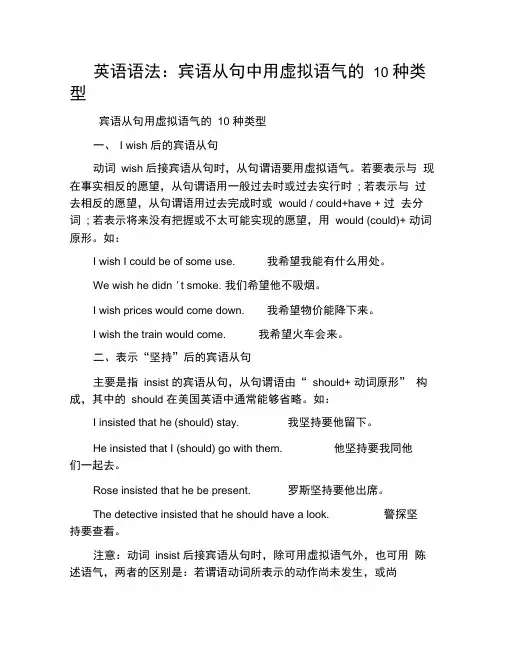
英语语法:宾语从句中用虚拟语气的10 种类型宾语从句用虚拟语气的10 种类型一、I wish 后的宾语从句动词wish 后接宾语从句时,从句谓语要用虚拟语气。
若要表示与现在事实相反的愿望,从句谓语用一般过去时或过去实行时; 若表示与过去相反的愿望,从句谓语用过去完成时或would / could+have + 过去分词; 若表示将来没有把握或不太可能实现的愿望,用would (could)+ 动词原形。
如:I wish I could be of some use. 我希望我能有什么用处。
We wish he didn 't smoke. 我们希望他不吸烟。
I wish prices would come down. 我希望物价能降下来。
I wish the train would come. 我希望火车会来。
二、表示“坚持”后的宾语从句主要是指insist 的宾语从句,从句谓语由“ should+ 动词原形” 构成,其中的should 在美国英语中通常能够省略。
如:I insisted that he (should) stay. 我坚持要他留下。
He insisted that I (should) go with them. 他坚持要我同他们一起去。
Rose insisted that he be present. 罗斯坚持要他出席。
The detective insisted that he should have a look. 警探坚持要查看。
注意:动词insist 后接宾语从句时,除可用虚拟语气外,也可用陈述语气,两者的区别是:若谓语动词所表示的动作尚未发生,或尚未成为事实,则用虚拟语气; 若谓语动词所表示的动作已经发生,或已经成为事实,则要用陈述语气。
比较:He insisted that I had read his letter. 他坚持说我看过他的信。
He insisted that I should read his letter. 他坚持要我看他的信。
wish虚拟语气

wish虚拟语⽓wish虚拟语⽓“wish+宾语从句”表⽰不能实现的愿望,汉语可译为“可惜……”、“……就好了”、“悔不该……”、“但愿……”等。
表⽰现在不能实现的愿望,从句的谓语动词⽤过去式;表⽰将来不能实现的愿望,⽤"would(could)+动词原形";表⽰过去不能实现的愿望,⽤"had+过去分词"或"(could)would+have+过去分词"。
例如:1). 与现在事实相反:动词过去式或wereI wish we could go to the seaside today.I wish I were as tall as you.我希望和你⼀样⾼。
I wish I were a pop singer. (=I am sorry I am not a pop singer..)I wish I were a pilot.但愿我是个飞⾏员。
I wish I knew how to operate the machine.我要是会操作这架机器该有多好啊! (= I'm sorry I don't know.)2).与过去事实相反:主语+wish(that)+主语+ 动词过去完成式We wish we had arrived there two hours earlier.He wished he hadn't said that. 他希望他没讲过那样的话。
I wish I had never stopped teaching. (=I am sorry I stopped teaching.)I wish he hadn't gone.他要是没⾛该多好!(= I'm sorry he has gone.)We wish you had come to our New Year's party.我们真希望你来参加我们的新年联欢会。
宾语从句中的虚拟语气使用
宾语从句中的虚拟语气使用一、在动词wish后的宾语从句中的虚拟语气在动词wish后的宾语从句中的虚拟语气,常省去宾语从句的引导词that。
一)、对现在情况的虚拟(与现在的事实相反):从句用过去式或过去进行式(时间上是同时的)。
其句子结构为:宾语从句的谓语be和were(was),实义动词用过去式。
例:1. i wish (that可省略,下同)i knew the answer to the question.(wish, 动词过去式knew)我希望知道这个答案。
(事实上是不知道)2. i wish it were spring in my hometown all the year around.(wish, were)但愿我的家乡四季如春。
(事实上不可能)3. i wish i were a bird.(wish, were)但愿我是只小鸟。
(事实上不可能)4. when she was at the party,she wished she were at home.(wished,过去虚拟动词were)(事实上并不在家)5. now that he is in china, he wishes he understood chinese.(wishes,过去虚拟动词understood)现在他在中国,他希望能懂得中文。
(事实上并不懂)6. when we begin the trip, they will wish they were with us.(will wish,过去虚拟动词were)(事实上并不和我们在一起)二)、对过去情况的虚拟(和过去的事实相反):用wish表示对过去事情的遗憾。
其句子结构为:宾语从句的谓语用过去完成时,或would, could, might+现在完成时。
例:1. i wish (that可省略,下同)i hadn't wasted so much time.我后悔不该浪费这么多时间。
高中英语 破题致胜微方法(虚拟语气2)4无法实现的愿望-wish后宾语从句中的虚拟语气
4.“无法实现的愿望”——wish后宾语从句中的虚拟语气英语单词“wish”的意思是“但愿……;要是……就好了”,经常用来表示“几乎无法实现的愿望”或“与事实相反的愿望”,所以wish后的宾语从句中需要使用虚拟语气。
具体怎么使用呢?这节课老师和同学们一起来学习一下。
一. wish后宾语从句的时态规则注意:wish后的宾语从句中“对现在情况进行虚拟”时,如果谓语动词是be动词,不管主语是第几人称,系动词都使用were。
I wish I were a little younger. (对现在的虚拟)我希望我能够年轻一点。
This watch has gone wrong. I wish I had bought a better make. (对过去的虚拟)这只表坏了,我真希望我买的是好一点的牌子。
I wish you would go with us tomorrow. (对将来的虚拟)要是你明天同我们一起去就好了。
二. 解题方法1. 看到wish,想到宾语从句需要使用虚拟语气;2. 根据句子中的时间状语或语境判断出虚拟的时间;3. 根据虚拟的时间,找出对应的时态;4. 牢记wish后宾语从句的时态规则三. 经典例题1. The picture exhibition bored me to death. I wish I__________to it.A. had not goneB. have not goneC. did not goD. can not have gone解析:本题考查wish后宾语从句的虚拟语气。
句意:这次的图片展真把我烦死了。
我真希望我没有去看。
由句意可知“我希望自己没有去看图片展”是与事实相反的,所以这里需要使用虚拟语气。
由前一句中动词“bored”的形式可知是对过去事实的虚拟,所以wish后的宾语从句中应该使用过去完成时had not gone。
答案:A2. How I wish every family__________a large house with a beautiful garden.A. hasB. hadC.will haveD.had had解析:本题考查wish后宾语从句的虚拟语气。
2022年五年级英语虚拟语气2----在 wish 后的宾语从句中
2022年五年级英语虚拟语气2----在 wish 后的宾语从句中-五年级2022年英语虚拟语气2----在 wish 后的宾语从句中II虚拟语气用在 wish 后的宾语从句中虚拟语气用在wish后的宾语从句中,常常省去连词that,表示不可能实现的愿望。
1表示与现在事实相反的愿望构成:主语 wish that从句主语动词过去式be 一律用were例如:I wish I new everything in the worldI wish that the ee soonEamy brother when he flies to England netweeA could goB had goneC will goD are goingEXERCISE1 I wish you ______ lie thata don’t talb wouldn’t talc won’t tald not to tal2 I wish I _____ how to oachinea have nown bnow c can now dnew3 He is not a millionaire but he _____ he werea wishesb hoy uncle the day after tomorrowa shallb havec would d am going to5 I wish it ______ setimes wishes that she ______ in the big citya was not livingb did not livedc were not livingd does not live9 James wishes he ______ the football game instead of the filma had seenb sawc had been seen d see10 While you’re here, I wish ______ have a loo around the housea you’llb you’vec you’d d you better11 Looing bac on it, I wish you ______ me firsta asedb have asedc asd had ased12 “Do you want me to lend you some money”“I wish you ______ I would ight13 I wished it ______ but it dida had not occurredb would not occurc was not occurred d did not occur14 He didn’t go to her birthday ay c will d could今天就为大家介绍到这里,!。
虚拟语气与各种句型
虚拟语气与各种句型一、I wish句型中的虚拟语气I wish后面的宾语从句,表示不可能实现的愿望。
其动词形式有三种:1. 动词用过去式,表示与现在事实相反的一种愿望。
2. 动词用过去完成式,表示与过去事实相反的愿望。
3. 动词用would/should +动词原形,表示与将来事实很可能相反或不可能实现的愿望。
如:I wish I were a doctor.我希望我是一名医生。
I wish you hadn’t given him my telephone number.我真希望你没把我的电话号码给他。
I wish you’d come back before Christmas.我多么希望你在圣诞节之前回来。
[典型考例]How I wish every family_________a large house with a beautiful garden!(NMET02上海春)A. hasB. hadC. will haveD. had had二、If only句型中的虚拟语气If only引导的句子表示“但愿”,“要是……就好了”。
其用法和I wish 的句型基本相同,只是更具感情色彩。
在If only句型中,动词用过去式,表示一种意愿或假设;动词用过去完成式,表示希望出现和过去事实相反的情况;动词用would +动词原形,表示一时很难实现的愿望。
如:If only I had more time to think about it!但愿我有更多的时间去考虑它。
If only the explosion had not happened!爆炸要是没有发生就好了。
If only he had not eaten so much sugar!要是他不吃那么多糖就好了。
[典型考例1]If only he_________quietly as the doctor instructed, he would not suffer so much now. (NMET2000上海)A. liesB. layC. had lainD. should lie[典型考例2] Look at the trouble I am in! If only I_________your advice. (NMET’03 上海)A. followedB. would followC. had followedD. should follow三、“It’s (high) time that…”句型中的虚拟语气“It’s time that...”句型表示“该是……的时候了”,谓语动词用一般过去式,有时为了强调,在time之前加high一词,表示“早该是……的时候了”。