
七年级英语下册 Unit 2 Neighbours Grammar导学案 (新版)牛津版
7B Unit2 NeighboursGrammar学习目标:能用will, shall和be going to表示将来能正确使用一般将来时的肯定、否定、疑问形式和肯定、否定回答重点词汇:shall; fire重点短语:be sure to happen一定会发生 watch the film 看电影take an umbrella with sb. 随身带伞 plan a day out 计划一日出行wait for us to call back 等我们回电话 wait for your call等你的电话make a fire 生火 the day after tomorrow 后天some plates and forks 一些盘子和叉子 cook some food煮一些食物语法点:一般将来时(1)基本概念表示将来某个时间要发生的动作或存在的状态,常与一些表示将来的时间状语连用。
例如:I am going to / will watch a football match on TV this evening.今天晚上我将在电视上看一场足球比赛。
(2)基本结构a. “助动词will+动词原形” (will是助动词,不能独立使用,前面的主语不管是什么人称,其后总用will。
在名词或代词后常简缩为’ll,并与主语连写在一起。
will的否定形式是will not,缩略形式是won’t)。
b.“be going to+动词原形” (be going to结构中的be动词很少用原形,它一般有三种形式,即:am,is,are。
当主语是I时用am;当主语是第三人称单数时用is;当主语是其他人称时用are。
)例如:I am going to buy something tomorrow morning.明天早上我打算去买些东西。
He is going to see Mr Wang this afternoon. 她打算今天下午去看望王先生。
c. shall+动词原形(只可用于第一人称,主语是第一人称I; we 时,常用助动词 shall + 动词原形。
否定形式是shall 后加not构成,shall not可缩写成shan’t。
)例如:We shall be very happy if you accept it. 如果你接受了它,我们将会很高兴。
I shall write you a letter next month. 下个月我会给你写信。
We shan’t be in the same room all day. 我们不会整天待在同一房间里。
(3)常用的时间状语a. 由tomorrow组成的, 如:tomorrow morning/evening明天早晨/晚上, the day after tomorrow后天b. 由next组成的, 如:next week (Tuesday/Sunday/month, year …)c. 由this 组成的, 如:this afternoon/evening今天下午/晚上d. 由in组成的, 如:in + 时间段(in two hours/in a few days), in the future在未来e. 其它:soon, from now on例如:Tom will come back in two days.汤姆两天后回来。
I’ll be more careful from now on.从现在起我会更加小心的。
(4)基本句型a. “助动词will+动词原形”●肯定句: 主语+will+动词原形+其他He will come here at once.他马上来这儿。
●否定句: 主语+ will + not + 动词原形+其他He will not(won’t)go to the party.他不去参加聚会。
●一般疑问句: Will+主语+动词原形+其他?Will he help you with your English? 他会帮助你学习英语吗?其答语为:Yes,主语+shall/will. /No,主语+shan't/won't..●特殊疑问句:疑问词+一般疑问句?—What will the students have for lunch today? 学生们今天午饭吃什么?—They will have bread.他们将吃面包。
b.“be going to+动词原形”●肯定句: 主语+be going to+动词原形+其他We are going to climb the hill this afternoon.我们打算今天下午去爬山。
●否定句: 主语+be + not + going to+动词原形+其他He isn’t going to do morning exercises tomorrow.明天他不去做早操。
●一般疑问句: Be动词(Am,Is,Are)+主语+going to+动词原形+其他?Are you going to play computer games tomorrow afternoon?你打算明天下午玩电脑游戏吗?其答语为:Yes,主语+am/is/are./No,主语+isn't/aren't./No,I'm not.另外,I am…在改为一般疑问句时常常改为“Are you…?”。
课堂检测:一、根据所给词,用一般将来时完成句子1. David_______________(help)Amy with her homework this evening.2. The Wang family_________________(have)a holiday soon.3. It_______________(be) cold tomorrow.4. Grandpa and Grandma_______________(come)to see us this weekend.5. Next year the school_______________(have) a new basketball court.6. They_______________(not have) a farewell party next Monday.二、英汉互译1.this afternoon_____________ 4.下周二____________2. the day after tomorrow __________ 5. 谈论_____________3.this Sunday ______________ 6.郊游一天____________三、句型转换1.Nancy is going to study French.(否定句)Nancy_____________________study French.2. I will go and join them. (否定句)I _____________go____________join them.3.We will meet at the bus stop at 10.30a.m.(一般疑问句)____________ ____________meet at the bus stop at 10.30a.m?4.My father and mother are going to see a play the day after tomorrow.(对画线部分提问)_____________ ___________going to see a play the day after tomorrow?四、根据中文,完成句子1.我打算明天和朋友去野炊。
I __________ ____________ ____________have a picnic with my friends.2.下周一我们将要去打篮球。
We __________ ___________ __________play basketball next Monday.3.你母亲这个周末去购物吗?_____________your mother_________ ___________go shopping this____________?4.你们打算什么时候见面?What time________you__________ _________meet?5.我认为今晚不会下雨。
I _________think it_________ _______tonight.6.我表姐不想参加我们。
My cousin would___________ __________ _____________ ___________us.7.我该乘哪辆车?_______________bus___________I______________?8.我们将在街对面向左转。
We____________ ________ ___________ at the other side of the road.答案:一.1.will help2. will have3. will be4. will come5.will have6. won’t have二.1.今天下午2. 后天3. 这周日4.Next Tuesday5. talk about6. plan a day out三.1.isn’t going to2.won’t;go3. Will you4. Who are四.1.am going to2. are going to3. Is; going; to; weekend4.are going5. don’t; will rain6. not like to join7.Which; shall; take 8. will turn left。
七年级英语下册Unit2NeighboursGrammar教案(新版)牛津版

Unit 2 NeighboursGrammarI. Teaching aims and learning objectivesBy the end of the lesson, students should be able to:1. know what the simple future tense is;2. learn how to use the simple future tense correctly;4. talk about things that will happen in the future.II. Teaching contentsNew words and phrases: shall, fire, the day after tomorrow, make a fireIII. Focus of the lesson and predicted area of difficulty1. To use the simple future tense correctly.2. To talk about the actions that will happen in the future.IV. Teaching proceduresA Simple future tense with will and shallStep 1 Revision1. Enjoy a songT: First, please enjoy a song. Let’s sing together. How will the school be today?2. About Simon(1) Where does Simon live?(2) What do you think of his neighbours?(3) Do you think Simon is lucky to live in such a neighbourhood? Why?3. About Simon’s neighboursT: Some of Simon’s neighbours have some problems. How can they get help from the community centre?T: In these sentences, we use be going to and will to talk about things that will happen in the future. This tense is called the simple future tense.【设计意图:从一开始的歌曲中引出will,再通过对Simon和其邻居的提问,创设情境,引出用will和be going to,快速导入本节课的教学内容。
牛津译林版七年级下册Unit2《Neighbours》(Grammar2)说课稿

牛津译林版七年级下册Unit 2《Neighbours》(Grammar2)说课稿一. 教材分析《Neighbours》是人教版牛津译林英语七年级下册第二单元的Grammar 2部分。
这部分主要讲述了一般现在时和一般疑问句的构成及用法。
通过学习,学生能够掌握一般现在时的构成和基本用法,能够运用一般现在时描述自己的邻居,并能够使用一般疑问句进行询问。
二. 学情分析七年级的学生已经接触过英语一段时间,对基本的语法知识有一定的了解,但还需要进一步巩固。
他们对英语学习的兴趣浓厚,但可能在口语表达和听力方面存在一定的困难。
因此,在教学过程中,需要注重培养学生的口语表达能力和听力技巧。
三. 说教学目标1.知识目标:学生能够掌握一般现在时的构成和基本用法,能够运用一般现在时描述自己的邻居,并能够使用一般疑问句进行询问。
2.能力目标:学生能够听懂、会说、会读一般现在时和一般疑问句,能够在实际情景中运用。
3.情感目标:通过学习,学生能够培养对邻居的关心和尊重,增强社区意识。
四. 说教学重难点1.教学重点:一般现在时的构成和基本用法,一般疑问句的构成和用法。
2.教学难点:一般疑问句的构成和用法,学生对一般现在时在实际情景中的运用。
五. 说教学方法与手段1.教学方法:采用交际法、情境教学法和任务型教学法,让学生在实际情景中学习和运用语言。
2.教学手段:利用多媒体课件、图片、录音机等辅助教学,激发学生的学习兴趣,提高学习效果。
六. 说教学过程1.引入:通过谈论自己的邻居,引出本节课的主题,激发学生的兴趣。
2.讲解:讲解一般现在时的构成和基本用法,一般疑问句的构成和用法。
3.练习:学生进行小组活动,用一般现在时和一般疑问句描述自己的邻居。
4.拓展:通过听力材料,学生听懂、会说、会读一般现在时和一般疑问句。
5.巩固:学生进行课堂练习,运用一般现在时和一般疑问句进行实际交流。
七. 说板书设计板书设计要清晰、简洁,能够突出本节课的主要内容。
2016春牛津译林版英语七下Unit2NeighboursGrammarword导学案

【课前导学】一、翻译短语:1后天_____________________________2 生火 __________________3…有问题_________________ 4叫某人做某事__________________5 等候_____________6回电话______________7不用谢_________________8看电影_____________9下周__________________二、用will,shall 或be going to填空1.Look at the clouds in the rain tonight2.When and where we meet?3.The students have a picnic next week.4. Mr Green take Jack to the park?5.My parents and I fly to London next month.【课堂学习】Step 1: Free talk.(1). Check preview work(2). Talk about your neighboursStep 2: Learn new words and phrasesStep 3: Lead-ina game to test your memory then discuss to find the rule of simple future tense with “will ’’and ‘’shall’’simple future tense with “will ’’and ‘‘shall’’some exercisesand explain simple future tense with “be going to’’ in the same way.Step 4: Practice句型转换:will play basketball after school.否定句He_______ _____basketball after school一般疑问______he _____ basketball after school?肯定回答: ______,_____ ______ 否定回答:____,_____ _____对划线部分提问______ _____he play basketball?are going to study c omputer this afternoon.否定句We _____ going to study computer this afternoon.一般疑问句_____ _____ going to study computer this afternoon?肯定回答: ______,_____ ______ 否定回答:____,_____ _____对划线部分提问_______ _______ you going to study?【课后拓展一、用适当的动词填空1.We hope you__________(come )to my party tomorrow.2.______she______(go) to Yancheng next month ?3.Tom_____(be)18 years old next year.4.Where______you______(visit) the day after tomorrow ?5.What______(be)you going to do af ter class ?6.—______he__________(play) basketball the day after tomorrow ?—Yes, he is.! Daniel _______________ (sing) an English song.(have) a dinner in a restaurant next weekwe _________(see) a film this afternoon?____________(watch) a football match on TV tonight.’s 4.30 in t he afternoon. The students ________(clean) the classroombrother __________(do) his homework this Sunda y.二、句型转换Wang is going to take his son to school.(改为否定句)Mr Wang ____________ _____ ______ his son to school.will bring you some storybooks.(改为一般疑问句)Will______ ______ you _____ storybooks?students are swimming in the river now.(用tomorrow改写句子)The students ____________ in the river tomorrow.are you going this Saturday?(改为同义句)Where ______you ______this Saturday?are going to have a sports meeting next_week.(对画线部分提问)_____________ they going to have a sports meeting?三、根据汉语意思完成句子1.我将邀请我所有的同学参加我的生日聚会I _______ _________ all my classmates to my birthday party.2.我相信他将来会成为一名老师。
牛津七年级下册Unit2NeighboursGrammar导学案(含答案)

情感目标: 学会谈论未来的事。(ABC)
教学重难点: 学会使用 will, shall, be going to 以及它们的疑问句和肯定、否定回答形式。
课时安排
1
课型
综合解决课
预习案(Previewing Case)
请你仔细研究 P23-24,在书上划出词组, 并写在横线上; 完成练习 P23-A 和 P24-B 部分的练习。(ABC) 1. 今天下午将要下雨。It will rain this afternoon. 2. 我将带把伞在身边。I will take an umbrella with me . 3. 你需要一些帮助吗?Do you need any help ? 4. 请一个工程师来为你检查它 ask an engineer to check it for you 5. 那个工程师什么时候有空?When will the engineer be free ? 6. 先打电话给他 call him first 7.等着我们回电话 wait for us to call back 8. 等你的电话 wait for your call 9. 天空乌云密布,我认为天要下雨了。It is so cloudy . I think it is going to rain 10. 计划外出一天 plan a day out 11.后天 the day after tomorrow 12. 买一些盘子和叉子 buy some plates and forks 13.生火 make a fire 14. 我的电脑有问题。(4)There’s something wrong with my computer.=Something is wrong with my
7B Unit2 Neighbours Grammar 导学案
牛津译林版七年级英语下册《Unit 2 Neighbours》Grammar教案
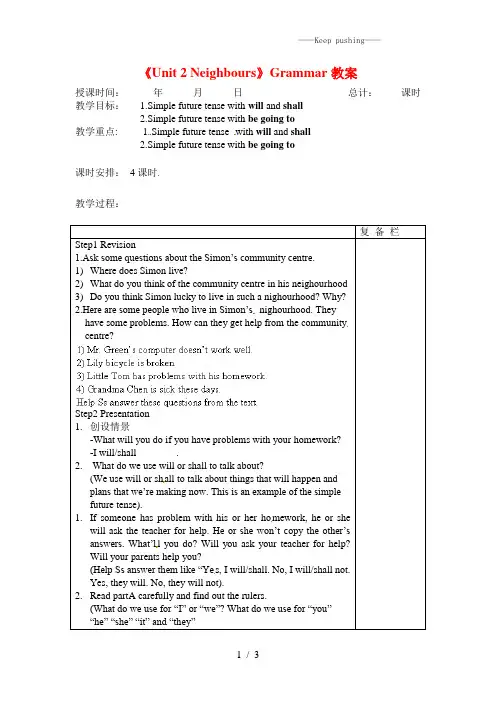
《Unit 2 Neighbours》Grammar教案授课时间:年月日总计:课时教学目标: 1.Simple future tense with will and shall2.Simple future tense with be going to教学重点: 1.Simple future tense with will and shall2.Simple future tense with be going to课时安排:4课时教学过程:复备栏Step1 Revision1.Ask some questions about the Simon’s community centre.1)Where does Simon live?2)What do you think of the community centre in his neighourhood3)Do you think Simon lucky to live in such a nighourhood? Why?2.Here are some people who live in Simon’s nighourhood. Theyhave some problems. How can they get help from the communitycentre?Step2 Presentation1.创设情景-What will you do if you have problems with your homework?-I will/shall________.2. What do we use will or shall to talk about?(We use will or sh all to talk about things that will happen andplans that we’re making now. This is an example of the simplefuture tense).1.If someone has problem with his or her ho mework, he or shewill ask the teach er for help. He or she won’t copy the other’sanswers. What’l l you do? Will you ask your teacher for help?Will your parents help you?(Help Ss answer them like “Ye s, I will/shall. No, I will/shall not.Yes, they will. No, they will not).2.Read partA carefully and find out the rulers.(What do we use for “I” or “we”? What do we use for “you”“he” “she” “it” and “they”Step3Practise1.Do the practice of Part A(Simon’s computer is broken. He’s asking Mr. Lin for help.Please complete their conversation with the simple future tense.2.Read the dialogue about Mr Lin and Simon’s.Step4 Presentation1.创设情景(Do you think community centers are helpful? I think they are. Thecommunity centre in my nighourhood is going to have a “helpinghands’ meeting the day after tomorrow. I’m going to teach childrenEnglish songs. My daughter is going to dance for the old people.My parents are going to cook some delicious food.2.What do we use be going t o to talk about?(We use be going to to talk about something w e decide to doand things that wil l probably happen).Step4 Practiceplete part B(Simon is telling Amy about his plan for a day out with hisuncle’s family. Please help him complete his plan).2.Answer these questions with your partner.1)What are you going to do for old people this Sunday?2)What’s your father/mother going to do for your neighourstomorrow?3)What are you going to do for poor children the day aftertomorrow?4)What’s your father/mother going to do for your communitynext week?Step5 Homework1.《课课练》P15.2.预习Integrated skills.教师的职务是‘千教万教,教人求真’;学生的职务是‘千学万学,学做真人’。
七年级英语下册Unit 2 Neighbours导学案

七年级英语下册Unit 2 Neighbours导学案
以下是为您推荐的七年级英语下册Unit 2 Neighbours导学案,希望本篇文章对您学习有所帮助。
七年级英语下册Unit 2 Neighbours导学案
名词邮局生病的;恶心的
邻居人较好;更好
参观者,访问者工作年纪较长的
(餐馆等)服务员将来代词
街区,居民区艺术家某事;某物
志愿者布告、通知某人
社区信息任何人
技能,技巧组、群任何事
问题,难题动词介词
工程师检查像,类似;---怎幺样
学院设计,构思副词
火修理下面
经理情态动词感叹词
办公室1)将,将会哇,呀
办公室职员2)将,将会词组
警察系动词帮助某人解决某种困难
邮递员听起来买东西
公司形容词后天
局、所、站有用的生火。
牛津译林版七年级下册Unit 2《Neighbours》(Grammar)说课稿
牛津译林版七年级下册Unit 2《Neighbours》(Grammar)说课稿一. 教材分析《Neighbours》是人教版牛津译林英语七年级下册第二单元的核心语法部分。
本节课主要围绕着“There be”句型以及一般现在时的用法进行展开。
通过本节课的学习,学生能够掌握There be句型的结构以及一般现在时的构成,同时能够运用所学知识描述周围的环境以及人物的特征。
二. 学情分析通过对学生的了解,大部分学生在之前的学习中已经接触过一般现在时的概念,但对There be句型的掌握还不够熟练。
因此,在教学过程中,教师需要重点引导学生理解和运用There be句型,同时巩固一般现在时的用法。
三. 说教学目标1.知识目标:学生能够掌握There be句型的结构以及一般现在时的构成,理解其用法。
2.能力目标:学生能够运用There be句型和一般现在时描述周围的环境和人物特征。
3.情感目标:通过学习,学生能够培养对邻居的关心和尊重,增强社区意识。
四. 说教学重难点1.重点:There be句型的结构和一般现在时的用法。
2.难点:There be句型的运用和一般现在时在具体情境中的运用。
五. 说教学方法与手段本节课采用任务型教学法,结合情境教学法和小组合作学习法,充分利用多媒体教学手段,激发学生的学习兴趣,提高学生的参与度和实践能力。
六. 说教学过程1.导入:教师通过提问学生对邻居的了解,引出本节课的主题。
2.新课呈现:教师通过展示一幅住宅区的图片,引导学生观察并描述图片中的环境。
3.语法讲解:教师讲解There be句型的结构和一般现在时的用法,并通过示例进行说明。
4.实践环节:学生分组进行角色扮演,运用There be句型和一般现在时描述邻居的特征。
5.巩固环节:教师设计一系列练习题,让学生进行听力、阅读和写作的训练。
6.总结:教师引导学生回顾本节课所学内容,并进行情感教育。
七. 说板书设计板书设计包括There be句型的结构、一般现在时的构成以及相关例句。
七年级英语下册 Unit 2 Neighbours Grammar教案 (新版)牛津版
Neighbours教学目标1、能用will、shall和be going to表示将来。
2、能正确使用一般将来时的肯定、否定、疑问式和肯定、否定回答。
3、能用正确的表达方式谈论将来的计划和打算。
教学内容四会内容词汇:shall fire 词组:the day after tomorrow make a fire 教学准备实现写好的纸条。
教学步骤 A simple future tense with will and shallStep I 复习1、指导学生回顾reading中有关Simon社区中的community centre的情况。
2、通过创设语境,帮助学生复习课文,并为下面的学习做准备Step II 呈现1、教师为学生创设情境,其噶他们用will和shall来表达自己的观点。
2、教师引导学生通过黑板上的例句来理解本课时语法项目。
3、利用黑板上的例句,教师可以继续呈现。
4、指导学生认真阅读A部分,并介绍will和shall的用法。
5、指导学生看A部分,鼓励他们自主探究并总结变化规则。
Step III 操练1、指导学生完成A部分中的练习,巩固所学知识。
2、安排学生朗读对话。
3、教师为学生提供更多情境,两人一组来问答,练习用will和shall来表达。
Step I 1、教师通过语言描述学生创设情境,2、接着教师引导学生看黑板上的例句并引导他们理解be going to的用法。
启发学生自我总结或看B部分的说明并告知学生用法。
3、创设情境与学生交流,呈现be going to的疑问句和肯定、否定回答,4、指导学生看B部分,鼓励自主探究并总结变化规则。
Step II 操练。
七年级英语下册7BUnit2NeighboursGrammar导学案新版牛津版
7B Unit 2 Neighbours Grammar班级____________ 姓名 ___________ 备课组长【学习目标】1. 能用will, shall 和be going to 表示将来;2. 能正确使用一般将来时的肯定,否定,疑问形式和肯定,否定回答;3. 能用正确的表达方式谈论将来的计划和打算;【课前预习】翻译下列短语。
请求帮助__________________________ 需要一些帮助__________________________我的电脑出问题了________________________ =_ _________________________有空___________________ 等我们回电话 ___________________________________等你的电话____________________ 计划外出一天 _____________________________后天_________________________ 买一些盘子和叉子 ____________________________带一些水来_____________________ 生火_______________________________【学习过程】Step 1:Revisi on: A sking the stude nts some questio ns about Readi ng.By answering this question, we can get the s tudents to review the Reading part while thinking about what Simon ' s community centre is like. Step 2:Leadi ng-i n: Creati ng con text to get stude nts an swer questi ons with will or be going toQs(1). Mr Green ' s computer doesn ' t work well.(2) . Lily ' s bicycle is broken.(3) . Little Tom has problems with his homework.(4) . Gran dma Chen is sick these days.Here are the possible an swers:(1) He' s going to ask a computer engineer to che ck his computer.(2) She' s going to ask some one to fix it.(3) Some college students will help him.(4) Some people will visit her and do some shopping for her.Step 3: Presentation: simple future tense with will and shallUses: Things that are sure to happe n in the future;Plans that we are making now.Step 4: Exercises: Asking for help on Page 23Step 5: Prese ntati on: simple future tense with be going toUses: Someth ing we decide to do;Things that will probably happe n .Step 6: Exercises: Pla nning a day out on Page 24【当堂训练】1.1 shall / will buy a new bike n ext week.(1)否定句:_______________________________________(2)一般疑问句:________________________________________(3)肯定/否定回答:____________________________________________(4)对next week 提问:_______________________________________(5)对I提问:________________________________________2. 他打算今天下午踢足球。
牛津译林版英语七下Unit 2《Neighbours》(Grammar)教学设计
牛津译林版英语七下Unit 2《Neighbours》(Grammar)教学设计一. 教材分析牛津译林版英语七下Unit 2《Neighbours》主要讨论了与邻居相关的日常交流情景。
通过本单元的学习,学生将掌握如何描述邻居的特点、交流邻居之间的互动以及表达自己对邻居的看法。
本单元的核心语法是现在进行时态,用于描述正在进行的动作或状态。
此外,学生还需熟悉和掌握一些与邻居相关的词汇和表达方式。
二. 学情分析七年级的学生已经具备了一定的英语基础,能够听、说、读、写一些简单的英语句子。
但他们在使用现在进行时态和描述邻居特点方面可能存在一定的困难。
因此,在教学过程中,需要关注学生的个体差异,有针对性地进行教学。
三. 教学目标1.知识目标:–掌握现在进行时态的用法;–学会描述邻居的特点和交流邻居之间的互动;–学会表达自己对邻居的看法。
2.能力目标:–能够熟练运用现在进行时态进行日常交流;–提高听力、口语、阅读和写作能力;–培养合作意识和团队精神。
3.情感目标:–增强对英语学习的兴趣;–学会尊重和理解他人,培养良好的邻里关系。
四. 教学重难点•现在进行时态的用法;•描述邻居特点和交流邻居之间的互动;•表达自己对邻居的看法。
•现在进行时态的运用;•准确描述邻居特点和交流邻居之间的互动。
五. 教学方法1.情境教学法:通过设定真实的邻里场景,让学生在实际语境中学习和运用英语;2.交际教学法:鼓励学生进行角色扮演,模拟邻里之间的交流,提高口语表达能力;3.任务型教学法:通过完成小组任务,培养学生合作意识和团队精神;4.反馈与激励:及时给予学生反馈,鼓励学生积极参与课堂活动。
六. 教学准备1.教材:牛津译林版英语七下Unit 2《Neighbours》;2.多媒体课件:图片、视频、音频等教学资源;3.学习任务单:用于引导学生进行小组讨论和任务完成;4.板书用品:黑板、粉笔等。
七. 教学过程1.导入(5分钟)利用图片或视频展示邻居之间的日常生活场景,引导学生谈论自己的邻居。