
Unit1 Festivals around the world
Skimming (5minutes)
• What’s the main idea of the passage?
• How many parts can the passage be divided and what are they?
What’s the main idea of the passage? • The passage is mainly about different festivals around the world ___________________________and celebrations the ways of _________________ and why people celebrate them the reasons_____________________ all over the world.
• 1. The end of the cold weather. • 2. Planting in spring and harvest in autumn. • 3. Hunters catch animals.
For what origins do we hold festivals and celebrations today?
western mainly Japan countries religious 4)_____ countries
Para.6.The general meaning of festivals
• Why do people love festivals according to the passage? • A.Because festivals let us enjoy life. • B.Because festivals make us proud of our customs. • C.Because festivals can make us have fun with each other. • D.All the above.
Lead-in
Guess
• The rain falls thick and fast on All Souls'Day, • The men and women sadly move along the way。 • They ask where wineshops(酒屋) can be found or where to rest, • And there the herdboy’s(牧童) fingers Almond-Town suggest。
Unit1 Festivals around the world
Warming up & Reading
Warming up
• What do you think is the most important festival in China? • What do think about this important festival?
dragon boat festival best,it is celebrated I like______________ Qu Yuan 5th May on __________in memory of __________, It one day eat Zongzi and usually lasts __________People __________ ____________________ hold dragon boat race.
Names
1)_____ The ______ Spring ______ Festival __ China
2)______ Carnivals ________ _____
3)______ Easter ________ _____
Cherry Blossom Festival
Countries
Para.3. Festivals to honor people. Para.4. Harvest festivals. Para.5. Spring Festivals. Para.6.The meaning of festivals.
Scanning
• Paragraph1. General idea of the origin of the festival
What festival do foreign countries spend to honor the dead?
Obon
Mexico
Halloween
Japan
The Day of the Dead
Westo celebrate the festival?
Festivals
Obon
Cleaning graves 1)______; lighting incense 2)_______ and lamps; playing music 3)______
Activities
The Day of the Dead Eating cakes with bones on 4)_____ them; offering food, flowers and gifts to 5)____ the dead
• Under what situation did festivals and celebrations be held in ancient time?
• For what origins do we hold festivals and celebrations today?
Under what situation did festivals and celebrations be held in ancient time?
Summary
In ancient times, if food was hard to find, people would starve (starve).So some ancient festivals were 1. held to celebrate the harvest. They often took place 2. after hunters had caught animals. Today's festivals have many different 3. origins (origin), some religious, some seasonal, etc. Some festivals are held 4. to (honour)the dead or to honour satisfy 5. ancestors (ancestor) .
How many parts can the passage be divided? and what are they?
1.
2. 3. 4. 5. 6.
Para.1.General idea of the origin of the festival.
Para.2.Festivals of the dead.
dress up set off fireworks and firecrackers Dragon boat racing eat zongzi get together to have big meals
Discussion
Introduce one of your favorite festival.
How do you think about Christmas Day?
• • • • • • • • Christmas tree Santa Claus Reindeer Christmas Stocking Present Christmas dinner Christmas song Mistletoe(槲寄生)
Halloween
Children up 6) dress _______ and ask for sweets
Para3. Festivals to Honour People
Gandhi The Dragon Boat Festival
Gandhi’s Day
Qu Yuan
Columbus Day
• Lucky money • Dressing up
• Long vacation
• Big family dinner • Dragon dance
• Carnivals
What do foreigners think about Spring Festivals?
• How many aspects (方面)of Spring Festival do they mention(提到) in this video? • What aspects of Spring Festival are mentioned? (write down the key words.)
Tomb-Sweeping Day
• Tomb-Sweeping Day : a traditional Chinese festival which is held to honor the dead or to satisfy the ancestor.
What festival do foreign countries spend to honor the dead ?
Columbus
Para.4. Harvest festivals.
gathered agricultural Thanksgiving Midautumn festival
China
decorate
awards
Para5. Spring Festivals
Purpose To look forward to the end of winter and to the coming of spring
20版:(步步高) (全国) Unit 1 Festivals around the world
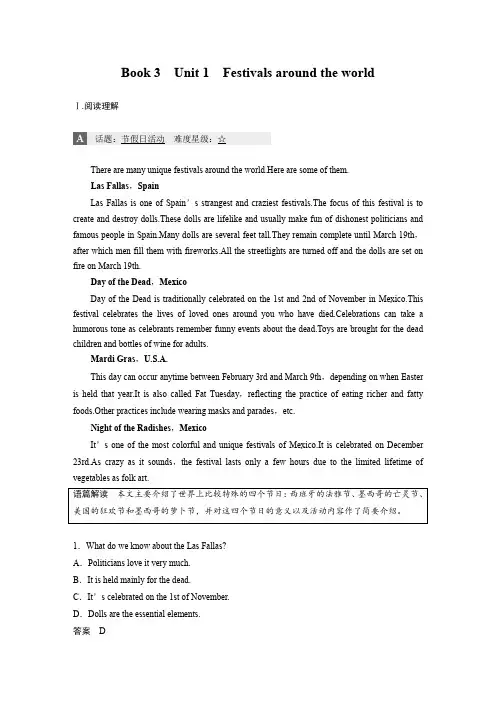
Book 3Unit 1Festivals around the worldⅠ.阅读理解话题:节假日活动难度星级:☆There are many unique festivals around the world.Here are some of them.Las Fallas,SpainLas Fallas is one of Spain’s strangest and craziest festivals.The focus of this festival is to create and destroy dolls.These dolls are lifelike and usually make fun of dishonest politicians and famous people in Spain.Many dolls are several feet tall.They remain complete until March 19th,after which men fill them with fireworks.All the streetlights are turned off and the dolls are set on fire on March 19th.Day of the Dead,MexicoDay of the Dead is traditionally celebrated on the 1st and 2nd of November in Mexico.This festival celebrates the lives of loved ones around you who have died.Celebrations can take a humorous tone as celebrants remember funny events about the dead.Toys are brought for the dead children and bottles of wine for adults.Mardi Gras,U.S.A.This day can occur anytime between February 3rd and March 9th,depending on when Easter is held that year.It is also called Fat Tuesday,reflecting the practice of eating richer and fatty foods.Other practices include wearing masks and parades,etc.Night of the Radishes,MexicoIt’s one of the most colorful and unique festivals of Mexico.It is celebrated on December 23rd.As crazy as it sounds,the festival lasts only a few hours due to the limited lifetime of vegetables as folk art.语篇解读本文主要介绍了世界上比较特殊的四个节日:西班牙的法雅节、墨西哥的亡灵节、美国的狂欢节和墨西哥的萝卜节,并对这四个节日的意义以及活动内容作了简要介绍。
高一Unit 1《Festivals around the world》教案人教版

高一Unit 1《Festivals around theworld》教案人教版高一Unit1《Festivalsaroundtheworld》教案人教版本单元为人教版《高中英语》(NSEc)必修模块3Unit1.Festivalsaroundtheworld.本单元的中心话题是“谈论世界各地的节日”,该阅读课Reading:APioneerForAllPeople。
是本单元第一课时,内容涉及到各国的节日名称,时间,方式和原因,使学生了解不同国家的文化和风俗。
以独立的内容块进行叙述。
的结构特点是平行并列。
针对内容和结构的特点,本课以培养学生阅读比较信息和归纳信息的能力为主,分别将获取的信息通过列表比较,图片匹配,问答游戏等方式,进行比较,使学生找到各国节日庆祝方式的相同和不同之处,归纳总结各国节日产生的原因,推理出人们到对节日的态度,探究到节日是人类对生活怀有美好祝福的心理,是生命的传承实践,从而提高学生跨文化交际的能力和意识。
教学目标知识与技能目标:Thestudentswillbeableto.identifythedifferentfestivalsbycomparingtheinf ormationaboutcelebrations.2.explainthereasonwhythefestivalscomeintobeingbyfin dingoutthesimilaritiesanddifferences.3.describetheirfavoritefestivalsbyusingthelanguagef romthetext.教学重点和难点)为全体学生进行有效性阅读策略的指导,包括语篇分析、猜测词义,逻辑推理、归纳概括等技巧。
2)通过比较信息,归纳总结各国节日产生的原因,推理出人们到对节日的态度和节日的意义。
教学过程教学步骤教学活动设计意图Pre-reading:Step1.Brainstorm:motivatetheSsbyaskingsomequestions.Q1:Doyouanyfestivalsaroundtheworld?Step2.matchthecelebrationwiththefestivals.Q2:DoyouknowhowpeoplecelebratetheseFestivals?Doaquiz.Step2.DiscussionSsdiscussthefollowingquestionsQ1:Howdotheycomeintobeing?Q2:whatdotheyhaveincommon?Andwhataretheredifference amongthem?问题引发了学生的思考,调动学生的已知,将学生的思维活动引导到课文主题上来。
人教版高二英语必修三《Unit1 Festivals around the world》评课稿

人教版高二英语必修三《Unit1 Festivals around the world》评课稿一、课程背景与目标本课是人教版高二英语必修三《Unit1 Festivals around the world》的评课稿。
本单元旨在让学生了解世界各地的不同节日和文化,并通过听、说、读、写等综合训练,提高学生的英语语言能力和跨文化意识。
通过本课的学习,学生将能够:•学会描述不同国家和地区的节日并比较它们之间的差异;•掌握相关的词汇和表达方式,提高听、说、读、写的能力;•培养跨文化意识和欣赏文化差异的能力。
二、教学内容和步骤1. 引入 (5分钟)老师可以准备一段相关的视频或音频,引入课程话题。
比如,播放一段庆祝春节的短视频,或者播放一段庆祝圣帕特里克节的音频。
引起学生的兴趣,并激发他们对不同节日的好奇心。
2. 介绍新课 (10分钟)老师通过展示教材中的相关图片,向学生介绍本单元要学习的节日和文化。
提问学生对这些节日是否有所了解,帮助他们建立起初步的认知。
3. 听力训练 (15分钟)在教材中选择一段听力材料,要求学生在听的过程中关注细节和关键词,并回答相关问题。
可以适当使用一些听力技巧和策略,帮助学生更好地理解听力材料。
4. 口语训练 (20分钟)让学生以小组为单位进行讨论,分享自己国家或地区的一个重要节日。
学生要利用所学的知识,描述节日的起源、庆祝方式、食物、活动等方面,激发他们的口语表达能力。
同时,鼓励学生积极提问和回答其他组的问题,增进彼此之间的交流。
5. 阅读训练 (15分钟)在教材中选择一篇与节日相关的短文,让学生阅读并回答相关问题。
引导学生根据文章内容,理解作者的观点和态度,并从中获取信息。
6. 写作训练 (20分钟)要求学生根据所学节日的相关信息,撰写一篇短文进行介绍。
鼓励学生运用适当的词汇和句型,表达自己的观点和看法。
同时,要求学生注意写作的逻辑结构和语法正确性。
7. 小结与反思 (5分钟)总结学生所学的重点内容,帮助他们回顾和巩固所学的知识。
高教版(2023)基础模块3 Unit 1 Festivals Around the World 第

高教版(2023)基础模块3 Unit 1 Festivals Around the World 第3课时课件(18张ppt)(共18张PPT)送给同学们的一碗鸡汤:“相信枯燥重复的日常也有意义,那些曲曲折折的弯路也有它的道理,偶尔多走一些路,多绕一些弯也没有关系,只期望最后一页要是花开万里。
”Unit 1 (3)Festivals Around the World学习目标1.知识目标:掌握本课的单词、短语以及句型。
2.能力目标:学生可以运用所学内容完成相应题目。
3.情感目标:锻炼学生英语表达能力和提高学生学习英语的积极性。
自学任务1. 阅读课本P3第五部分内容。
2. 尝试将以下单词填入适当的空中。
festival harvestMid-Autumn Festivalreunion(团聚) bright一、词汇1.foreignadj.外国的,外来的foreigner【C】n. 外国人,外来人练习造句:他是一名外国学生。
2. vocation n.职业,工作vocational adj. 职业的,职业技术的vocational school:职业学校例:我在一所职业学校上学。
vacation n.假期v.度假summer vacation 暑假winter vacation 寒假go on vacation: 去度假例:我计划暑假去海南度假。
句子练习:1.她是一名职业学校的学生。
2.他的职业是一名警察。
He chose teaching as his _________ vocational B. vocationC. vacationD. vacational3. celebrate v. 庆祝,赞美celebration n. 庆祝,颂扬We had a________ in the hall yesterday.celebrated B. celebrateC. celebratesD. celebration4.familyfamily :“家人” ,不可数名词。
《高中英语新课标-必修1-Unit1 Festivals around the world 课件》
不同国家和文化中的节日
了解世界各国和不同文化中的庆典与节日,体验不同人群庆祝节日的方式, 感受文化的多样性与人类共同的欢庆。
节日的文化意义
探究节日在不同文化中的重要地位,了解它们对于文化传统、身份认同和价 值观的深远影响。
节日的历史渊源
追寻节日的历史根源,了解节日与人类历史和传统之间的联系,以及随着时 间推移如何演变和发展。
宗教节日及其意义
探索各大宗教中的重要节日,了解它们在信仰和宗教-必修1Unit1 Festivals around the world 课件
Explore the fascinating world of festivals! From cultural celebrations to religious traditions, discover the rich tapestry of festivals that bring joy and meaning to people around the globe.
为什么庆祝节日?
了解不同文化中庆祝节日的原因,从人们的欢乐和团结之中体会为什么庆祝节日的重要性。
世界各地不同类型的节日
探索世界各地独特的节日,从传统文化节日到现代庆典,领略各种不同类型 的节日给人们带来的喜悦与意义。
节日 - 生活的庆祝
了解节日作为人们庆祝与享受生活的方式,体验节日带来的喜庆氛围与人们 团聚的温暖。
英语必修三教材参考答案

英语必修三教材参考答案Unit 1 Festivals Around the World1. Vocabulary Exercise- (1) Tradition: The act of passing down customs and beliefs from generation to generation.- (2) Harvest: The gathering of crops at the end of a growing season.- (3) Belief: A conviction or acceptance that certain things are true or real.2. Grammar Focus- The present continuous tense is used to describe actions that are happening at the moment of speaking.- The past simple tense is used to describe completed actions in the past.3. Reading Comprehension- Main Idea: The reading passage introduces various festivals celebrated around the world, highlighting their cultural significance and traditions.- Detail Questions:- Q1: What is the Mid-Autumn Festival? Answer: It is a festival celebrated in China, where people admire the full moon and enjoy mooncakes with family.- Q2: Why is Thanksgiving celebrated in the United States? Answer: It is a holiday to give thanks for the harvest and blessings of the past year.4. Listening Exercise- Summary: The listening material describes the preparation and celebration of a local festival, emphasizing the community's involvement and the joy it brings.5. Writing Task- Sample Answer: If I were to describe a festival, I would choose the Spring Festival in China. It is a time for family reunions, and we celebrate by setting off fireworks, having a feast, and exchanging red envelopes filled with money for good luck.Unit 2 Healthy Eating1. Vocabulary Exercise- (1) Balance: A state of equilibrium in which different elements are equally matched.- (2) Nutrient: A substance that provides nourishment essential for the maintenance of life and growth.- (3) Decrease: To become smaller or less in size or amount.2. Grammar Focus- The passive voice is used to emphasize the action or the receiver of the action rather than the doer.- Modal verbs are used to express ability, permission, or obligation.3. Reading Comprehension- Main Idea: The passage discusses the importance of abalanced diet and the role of various nutrients in maintaining health.- Detail Questions:- Q1: What is a balanced diet? Answer: A balanced diet includes a variety of foods from all the major food groups in the right proportions.- Q2: Why is fiber important in our diet? Answer: Fiber is important for maintaining digestive health and can help prevent certain diseases.4. Listening Exercise- Summary: The listening material talks about the benefits of eating fruits and vegetables, and how they contribute to a healthy lifestyle.5. Writing Task- Sample Answer: A healthy diet should include plenty of fruits and vegetables, whole grains, lean proteins, and low-fat dairy products. It's also important to limit the intake of sugars, salts, and unhealthy fats.Unit 3 The Million Pound Bank Note1. Vocabulary Exercise- (1) Generous: Showing a readiness to give more of something, such as money or time, than is strictly necessary or expected.- (2) Fortune: A large amount of money or resources.- (3) Suspicious: Having or showing a feeling that something is wrong or illegal.2. Grammar Focus- The present perfect tense is used to describe actions that have occurred at an unspecified time before now or that started in the past and continue to the present.- The past continuous tense is used to describe an action that was happening at a specific time in the past.3. Reading Comprehension- Main Idea: The story revolves around a man who finds a million-pound banknote and how it changes his life, highlighting themes of wealth and human nature.- Detail Questions:- Q1: What happens when Henry Adam finds the banknote? Answer: He is treated with great respect and generosity by people who believe he is wealthy.- Q2: Why does the attitude of the people change towards Henry? Answer: Their attitude changes because they think he has a large amount of money.4. Listening Exercise- Summary: The listening material is a conversation between two characters discussing the impact of wealth on social interactions.5. Writing Task- Sample Answer: The story "The Million Pound Bank Note" illustrates the power of perceived wealth. It shows how people's attitudes can change drastically when they believe someone has money, even if that person is not actually wealthy.Unit 4 Astronomy: The Science of the Stars1. Vocabulary Exercise- (1) Galaxy: A massive, gravitationally bound system consisting of stars, stellar remnants, interstellar gas and dust, and dark matter.- (2) Telescope: An optical instrument that makes distant objects appear nearer and larger, allowing for their detailed observation.- (3) Universe: All existing matter and space considered as a。
Unit-1--Festivals-around-the-world
Unit 1 Festivals around the worldI.教学内容分析本单元的中心话题是“节日”,主要讲述了不同地区不同种类的节日。
Warming Up部分设计了小组活动,通过图表填写让学生区分中国的传统节日与别国节日的异同,目的在于激活学生已有的节日背景知识,引出主题,为以后几堂课学习热身。
Pre-reading 通过几个问题,调动学生已有的知识和经验,激发学生想了解更多节日的好奇心,让他们主动参与到主题教学活动中,为下面学习阅读文章作铺垫。
Reading 部分先简要介绍了一下早期各种节日的起源以及存在的原因,然后又分别介绍了几种世界各地的节日,依次的顺序是亡灵节、纪念名人的节日、丰收节、春天的节日等。
Comprehending 由四个部分组成。
第一、三、四部分通过表格形式,第二部分通过让学生回答问题的方式,鼓励学生积极思考,加深对课文的理解。
Learning about Language 部分主要突出了本单元的语法项目——情态动词的用法。
这些情态动词主要有:can,could,may,might,will,would,shall,should,must,can’t 等的用法。
Using Language 部分中包括了听、说、读、写几个部分的内容。
学生可通过对Trinidad Carnival、情人节等一些节日的学习,分析问题,锻炼自己的思维能力。
阅读后的习题及讨论不仅帮助学生理解文章的主旨大意,更重要的是让学生寻找解决问题的方法。
Learning Tip 部分主要建议学生搜集各种资料,查询与世界各地节日有关的信息,了解各种节日的来源与内涵。
II.教学重点和难点1. 教学重点(1) 本单元的生词和短语;(2) 掌握一些情态动词的基本用法;(3) 了解有关节日和民俗,掌握有关词汇,如custom,religious等。
2. 教学难点(1) 增进学生对中国节日的理解,了解和感悟外国的节日;(2) 提高学生的社会文化素质,加强跨国文化素质;(3) 培养学生运用资源策略。
Unit1Festivalsaroundtheworld(新课标版高一英语必修三教案教学设计)
Unit 1 Festivals around the world(新课标版高一英语必修三教案教学设计)Unit 1 Festivals around the worldThe First Period (Warming up & Pre-reading)Step One: Lead-inFree Talk: Did you have a good time in your winter holidays?When did you feel most happy and excited? Why?( At the Spring Festival. Because it's the most important festival in our country....)Step Two: Warming up1. Let the Ss think about the other Chinese festivals.( Lantern Festival, Pure Brightness Festival, Dragon Boat Festival, Mid-Autumn Festival, New Year's Day, Chung Yeung Festival....)2. Discussion One1)Let the Ss look at the information about Chinese festivals and discuss another four Chinese festivals according to the example in warming up: When does the festival come?What do people celebrate?What do people do?Festivals Date festivals DateNew Year January1st Teachers' Day September 10thInternational Women's Day March 8 National Day October 1stArbor Day March 12th The Spring Festival Lunar New Year International labor Day May 1st Dragon Boat Festival the fifth day of the fifth lunar monthInternational Children's Day June 1st Mid-Autumn Festivalthe 15th day of the 8th lunar monthArmy Day August 1st Lantern Festival the 15th day of the 1st lunar monthChinese Youth Day May 4th Pure Brightness Day April the fifth2) Let the Ss fill in the form in the warming up and ask some to share their opinions with the whole class.3 Discussion TwoTalk about some foreign festivals.( Christmas, April Fools Day, Easter Day, Halloween, Valentine's Day, Thanksgiving Day, Obon...)Step three: Pre-readingLet students think about the questions:1) What is your favourate holiday of the year? Why?2)What festivals or celebrations do you enjoy in your city or town? Do you like spending festivals with your family or with friends? What part of a festival do you like best- the music, the things to see, the visits or the food?Step Four: Language Points1.mean to do 打算做某事mean doing 意味着….I never meant him to work for us.Passing the entrance examination means being admitted into college.2. celebrate vt.(1) do sth to show that a day or an event is important 庆祝;祝贺celebrate Christmas / one’s birthday / a wedding anniversary / a victory(2) praise and honor 赞扬;称颂The names of many heroes are celebrated by the poets.词语辨析:celebrate, congratulatecelebrate后常接日期、事情或场合。
Unit1Festivalsaroundtheworldreading课件
At spring festivals, people usually have dances, carnivals and other activities to celebrate the end of winter and the coming of spring.
festivals;
mid-autumn China and
festivals
Japan
Kinds of Names of
Countries
Festivals Festivals
Spring Spring Festival China
Festivals Easter and
some Western
4). What is one important reason to have festivals and celebrations? It is important to have festivals and celebrations so we can enjoy life/ be proud of our customs/ forget our work for a little while.
ቤተ መጻሕፍቲ ባይዱ
5). Compare the festivals of the dead in Mexico, Japan and China. What things are similar? What things are different? The Chinese, Japanese and Mexican festivals of the dead all have customs to honour the dead. The Chinese and Japanese go to clean their ancestors’ graves, and the Mexicans offer food, s and gifts to the dead.
人教版|高中英语必修3必考的10篇英语作文
人教版|高中英语必修3必考的10篇英语作文【作文一】话题:节日(Unit1 Festivals around the world)假如你是李华。
你的美国笔友Mike即将随其父母来中国,并中国度过中秋节。
他来信向你询问有关中秋节的习俗,请你告诉他有关中秋节的习俗。
要点如下:1历史悠久。
2 中国人独有的传统节日。
3 家庭团圆。
4 共进晚餐。
5 吃月饼。
6 赏月。
要求:1 词数100左右。
2 可适当添加细节。
3 开头已给出,不计入总词数。
Dear Mike,I’m glad to know that you are coming to China with your parents and spend the Mid-Autumn Day here.The Mid-Autumn Day is a traditional festival with a long history which is celebrated only by Chinese people. It falls on August 15th of the Chinese lunar year, when people of a family get together and enjoy the dinner together. After that they eat mooncakes, which stands for the spirits of the festival-unity. Often if the weather permits, they will go out of thehouse to enjoy the bright moonlight, talking about something pleasant. It is one of the most important festivals for Chinese people.I wish you a pleasant journey and I’m sure you will like our traditional Mid-Autumn Day. Yours, Li Hua【作文二】话题:节日介绍(Unit1 Festivals around the world)假设你的外国朋友Eric对中国的端午节非常感兴趣,请根据下面的提示写一篇5句话作文,向他介绍这一节日。