
冀教版七年级英语下册 Unit 1 A Trip to the Silk Road Lesson 2 课件
1.How far is it from Beijing to Xi’an?
北京到西安有多远?
句中 how far 意为 “多远”,是询问距离的表达法。例如: How far is it to Shanghai?到上海有多远? How far is the shop?那家商店有多远? 回答时可以用 “It’s…kilometres from…to… . ”
2.It’s about 1 114 kilometres. 大约有1 114千米。 句中 about 是副词,意为 “大约;大概”。例如: It is about 8:30 now. 现在大约8:30了。 It’s about two kilometres from here to the post office. 从这儿到邮局大约有两千米远。 About fifty people come here. 约有五十人来到这里。
Lesson 2 Meet You in Beijing
1
Lead-in
Free Talk
How far is your home from school?
Do you know how long is the Silk Road?
How can you go to Beijing?
Presentation
The Terra Cotta Warriors
Dunhuang
Let’s remember the new words.
exciting adj.使人激动的
along
kilometre special culture arrive leave
prep. 沿着„„
n. 千米,公里 adj. 特别的;特殊的 n. 文化;文明 v. 到达,抵达 v. 离开;动身;出发
Practice
用动词的适当形式填空 will come (come) in ten minutes. 1. He ________ 2. My father ___________ will arrive (arrive) next week. will buy (buy) a new one this 3. I can’t find my pen. I ________ afternoon. Will you ______ leave (leave) home tomorrow? 4. ______
Homework
假如你的朋友要来找你玩4天,请你编写一个旅游计 划,写明每天去玩的地方。70个词左右。
Architecture is frozen music.
—Goethe
建筑是凝固的音乐。
——歌德
冀教版七年级英语下册A Visit to LanzhouA Trip to the Silk Roa
6. Theg_r_o_u_p__(团体) takes a train to Lanzhou. 7. She likes to eat _c_h_e_e_s_e_(奶酪) very much.
8. H__ow__w__id_e__(多宽) is the river?
• 单项选择
Xi’an—the Walled City
Xi’an—the Walled City
Words and expressions
group bridge
cross wide cheese
n. 群,组;团体 n. 桥梁 v. 横跨,横穿 adj.宽的,广泛的 n. 干酪,奶酪
Phrases:
Language points
2.go for a walk意为“去散步”=take a walk=go for walks
考向
go +for +a /an + n.意为“去做某事”, 类似
的短语有: go for a drive 开车兜风 go for a swim去游泳
3.over /'əʊvə(r)/ 作介词, ①意为“在……上面”, (指垂直的正上方)。② 越过
典例 There is a sofa ____B____the TV. John likes to watch
TV on the sofa.
A.in the front of B.in front of
C.above
D.over
一、根据首字母或图片提示完成句子 1. Be careful when you c_r_o_ss_____ the road. 2. Do you want to put some c_h_e_es_e____ on the bread? 3. The new road from my home to the city is very w_id_e______. 4. The workers are building a new __b_r_i_d_g_e_.
冀教版七年级下课文翻译
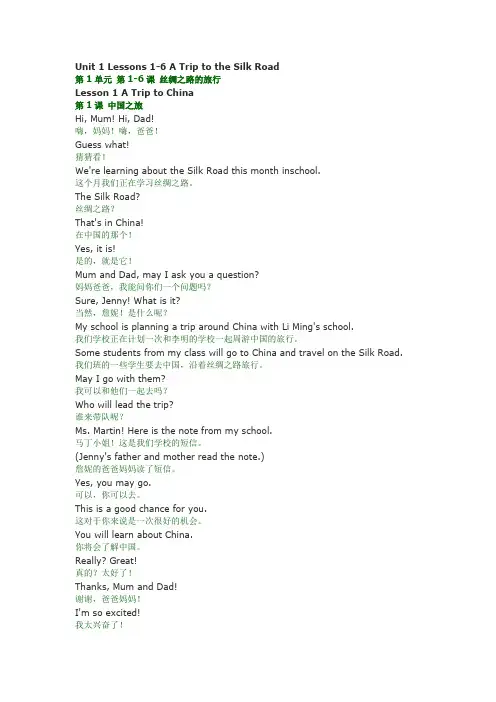
Unit 1 Lessons 1-6 A Trip to the Silk Road第1单元第1-6课丝绸之路的旅行Lesson 1 A Trip to China第1课中国之旅Hi, Mum! Hi, Dad!嗨,妈妈!嗨,爸爸!Guess what!猜猜看!We're learning about the Silk Road this month inschool.这个月我们正在学习丝绸之路。
The Silk Road?丝绸之路?That's in China!在中国的那个!Yes, it is!是的,就是它!Mum and Dad, may I ask you a question?妈妈爸爸,我能问你们一个问题吗?Sure, Jenny! What is it?当然,詹妮!是什么呢?My school is planning a trip around China with Li Ming's school.我们学校正在计划一次和李明的学校一起周游中国的旅行。
Some students from my class will go to China and travel on the Silk Road. 我们班的一些学生要去中国,沿着丝绸之路旅行。
May I go with them?我可以和他们一起去吗?Who will lead the trip?谁来带队呢?Ms. Martin! Here is the note from my school.马丁小姐!这是我们学校的短信。
(Jenny's father and mother read the note.)詹妮的爸爸妈妈读了短信。
Yes, you may go.可以,你可以去。
This is a good chance for you.这对于你来说是一次很好的机会。
You will learn about China.你将会了解中国。
冀教版七年级英语下册教案Unit 1 第1课时

Unit 1 A Trip to the Silk Road 单元目标第一课时Lesson 1 A Trip to China 课时目标自主学习一、根据句意及汉语提示写出单词。
1.She led(带路)me into the drawing-room.2.Jenny's father and mother read the note(便笺).3.I had to give him a chance(机会).4.He sent (寄)me a note to thank me for the dinner.5.We won the game.What good news(消息)!二、写出下列画线短语的汉语意思。
1.Guess what!We're learning about the Silk Road this month in school.猜怎么着;了解2.Read the note from Jenny's school and take turns asking for permission to go on the trip.轮流;请求允许;去旅行自主学习环节1新课导入T:Hello, boys and girls.Do you like to travel?Ss:Yes.T:So, tell me something about your travel experiences.S1:I went on a trip to Beijing last summer with my parents.We visited many places of interest...S2...设计意图:师生之间的问答谈及旅行,这就自然而然地引出本课时的话题,为接下来的课文学习作铺垫。
环节2新课学习1.教师邀请3名学生分角色朗读教材第2页的对话内容,教师注意纠正学生的发音问题。
2.教师让学生快速阅读对话,阅读后邀请一名学生说出该对话谈论的主题。
冀教版初中七年级下册英语单词及短语

冀教版初中七年级下册英语单词及短语Unit 1 A Trip to the Silk Roadtrip n. 旅行,旅程J7BU1L1silk n. 丝,丝绸J7BU1L1 road n. 路,公路J7BU1L1lead (led led) v.带领,指路J7BU1L1* Martin n.马丁(姓氏)J7BU1L1note n. 便笺,笔记J7BU1L1chance n. 机会,运气J7BU1L1send (sent sent) v.寄,送J7BU1L1news n. 新闻,消息J7BU1L1exciting adj. 使人激动的J7BU1L2along prep. 沿着J7BU1L2kilometer n. 千米,公里J7BU1L2special adj.特殊的,特别的J7BU1L2culture n. 文化J7BU1L2 arrive v. 到达,抵达J7BU1L2* Terra Cotta Warrior兵马俑J7BU1L2leave (left left) v.动身,出发,离开J7BU1L2 * Wild Goose Pagoda大雁塔J7BU1L3hit (hit hit) v.击,击中J7BU1L3ancient adj. 古代的,古老的J7BU1L3* drum n.鼓J7BU1L3 ring (rang rung)v.敲(钟),打电话,按,响J7BU1L3J7BU1L5* yay int. 哇(因高兴而欢呼) J7BU1L6diary n. 日记,日志J7BU1L6last a dj. 最后的,上一个J7BU1L6* clothing n. 衣物J7BU1L6* nest n. (鸟的)窝,巢J7BU1L6few adj. 少数的,很少的J7BU1L6* building n. 建筑物J7BU1L6hold v. 举行,拿着J7BU1L6Olympics n.奥林匹克竞赛,奥运会J7BU1L6 thousand num. 千J7BU1L6instrument n.乐器,仪器J7BU1L6* someday adv. 将来有一天J7BU1L6guess what猜猜看,你猜怎么着J7BU1L1learn about 学习,了解J7BU1L1How far is it from…to…?从…到…多远?J7BU1L2 climb up 爬上,攀登J7BU1L3No photos! 禁止拍照J7BU1L3go for a walk 散步J7BU1L4take a picture 照相J7BU1L4take a tour 参观,旅游J7BU1L5be famous as 作为……而出名J7BU1L5on one's way to 某人在去……的路上J7BU1L5 fall off 跌落,下降,减少,离开J7BU1L5all right 可以的,好的J7BU1L5a few 一些,几个J7BU1L6thousands of 数以千计的,J7BU1L6Unit 2 It's Show Time! project n. 课题,计划J7BU2L7interest n. 兴趣J7BU2L7 still adj. adv. 不动的,静止的;仍旧J7BU2L7anywhere adv. 任何地方,无论何处J7BU2L7 joke n. & v. (开)玩笑J7BU2L7* Italy n. 意大利J7BU2L8 age n. 年龄J7BU2L8* goods n. 商品,物品J7BU2L8Europe n. 欧洲J7BU2L8Asia n. 亚洲J7BU2L8journey n. 旅行,旅程J7BU2L8king n. 国王J7BU2L8coal n. 煤J7BU2L8discover v. 发现,了解J7BU2L8invent v. 发明,创造J7BU2L8other adj. 别的,其它的J7BU2L9describe v. 描写,描述J7BU2L9build (built built) v. 修建,建造J7BU2L9ago adv. 前,以前J7BU2L9army n. 军队,陆军J7BU2L9* clay n. 黏土J7BU2L9* soldier n. 战士,士兵J7BU2L9important adj. 重要的J7BU2L9tool n. 工具,用具J7BU2L9* desert n. 沙漠,荒漠J7BU2L9more(many, much的比较级)较多J7BU2L9* Lily n. 莉莉(女名)J7BU2L9realize v. 认识,实现J7BU2L10rich a dj. 丰富,富有的J7BU2L10western adj.西方的,西式的J7BU2L10violin n. 小提琴J7BU2L10 * dancer n. 跳舞的人J7BU2L10online adj. 在线的,联网的J7BU2L11especially adv. 尤其,特别J7BU2L11treasure n. 宝物,财富J7BU2L11end n. 最后,末端J7BU2L11product n. 产品,结果J7BU2L11worth adj. 值得(做某事),J7BU2L11* hand-made adj. 手工的J7BU2L11taste v. 尝起来,品尝,体验J7BU2L11* Dora n. 多拉(人名) J7BU2L11* Monica n.莫尼卡(人名) J7BU2L11true a dj. 真实的,正确的J7BU2L11* supper n. 晚餐J7BU2L11* Paul n. 保罗(男名) J7BU2L11once a dv. 从前,一度,一次J7BU2L11* blog n. 博客(网络电子日记) J7BU2L12experiencev.&n.体验经历,经验J7BU2L12 alive adj. 活着的,有活力的J7BU2L12own adj. 自己的J7BU2L12should v. aux 应该,将要J7BU2L12anyone pron.任何人无论谁J7BU2L12suggestion n. 建议J7BU2L12 * yum int. 好吃,或气味非常好J7BU2L12places of interest名胜古迹J7BU2L7talk about 谈论J7BU2L7make a joke 开玩笑,讲笑话J7BU2L7work on 从事于,努力改善或完成J7BU2L7at the age of 在……岁时J7BU2L8be new to 对…..陌生J7BU2L8try one's best 尽力J7BU2L9a long time ago很久以前J7BU2L9well done做得好J7BU2L9a little bit一点点J7BU2L9make…from…用……制作J7BU2L9think about 考虑J7BU2L10can't wait to do迫不及待要做事J7BU2L10play music 演奏音乐J7BU2L10I hope so. 我希望如此J7BU2L10take part in 参加,参与J7BU2L10get back 回来J7BU2L12Unit 3 School Lifelife n. 生活J7BU3L13term n. 学期J7BU3L13 start v. 开始,出发J7BU3L13finish v. 完成,结束J7BU3L13twice adv.两次,两倍J7BU3L13win (won won) v.赢得,获胜J7BU3L13* yeah int. (口语)是,对J7BU3L13social adj.社会的J7BU3L13* shop n. 手工艺课J7BU3L13myself pron. 我自己J7BU3L13* Edmonton埃德蒙顿J7BU3L14middle adj.中等的J7BU3L14*Greenwood Middle School 格林伍德中学7BU3L14grade n. 年级J7BU3L14 * wood n. 木头,木材J7BU3L14print v. 印图案于,印刷J7BU3L14guitar n. 吉它J7BU3L14fair n. 展览会J7BU3L14 * worm n. 蠕虫J7BU3L14 * silk worm蚕 J7BU3L14 difference n.差异,差别J7BU3L15village n. 村庄,乡村J7BU3L15* education n.教育J7BU3L15yourself pron.你自己J7BU3L15drop v.放弃,停止J7BU3L15possible adj.可能的J7BU3L15never adv.从来没有,决不J7BU3L15future n. 未来J7BU3L15 * Jason Glen杰森.格伦(人名) J7BU3L16* Riverside High School 河畔中学J7BU3L16terrible adj.可怕的,非常严重的J7BU3L16 happen v.发生J7BU3L16lose (lost lost) v. 失去,失败J7BU3L16fire n.火,火灾J7BU3L16raise v.筹募(钱财) J7BU3L16prize n.奖品,奖赏J7BU3L17video n.录像,视频J7BU3L17piece n.张,片J7BU3L17visitor n. 参观者J7BU3L17teach (taught taught) v. 讲授J7BU3L18quite adv.非常,十分J7BU3L18nervous adj.紧张的,不安的J7BU3L18comfortable adj.舒服的J7BU3L18* relaxed adj.轻松的,放松的J7BU3L18helpful adj.有用的,有帮助的J7BU3L18How is…going?…怎么样?J7BU3L13sports meet 运动会J7BU3L13twice a week /year 一周两次J7BU3L13long /high jump 跳远/跳高J7BU3L13be good at 擅长J7BU3L13social studies 社会科学J7BU3L13by oneself 独立地,单独J7BU3L13on one's own 单独,独自J7BU3L14make a difference 有作用J7BU3L15give up 放弃J7BU3L15 drop out of school 退学,辍学J7BU3L15in the future 将来J7BU3L15come up with 想出,提出(主意、答案等) J7BU3L16car wash 洗车(筹款)J7BU3L16cookie sale 卖饼干(筹款) J7BU3L16win first prize 赢得一等奖J7BU3L17be interested in 对…感兴趣J7BU3L17a piece of 一片/张…... J7BU3L17different kinds of 不同种类的J7BU3L17move from…to…从…移动J7BU3L18Unit 4 After-School Activitiesactivity n. 活动J7BU4L19* Steven 史蒂文(男名) J7BU4L19volleyball n.排球,排球运动J7BU4L19practice n. & v. 练习J7BU4L19chess n. 国际象棋J7BU4L19club n. 俱乐部,社团J7BU4L19 * volunteer v. n. 自愿帮助,志愿者J7BU4L19 * bingo n.宾戈游戏J7BU4L19both a dj. pron. 二者(的) J7BU4L19nothing n. &pron. 无事,无物J7BU4L19join v.参加J7BU4L20improve v.提高,改善J7BU4L20* thinking adj.思想的,理性的J7BU4L20skill n.技能,技巧J7BU4L20challenge v. & n.挑战J7BU4L20meeting n.聚会,会议J7BU4L20act v. & n.行动,扮演J7BU4L20useful adj.有用的,有益的J7BU4L20role n.职能,角色J7BU4L20team n.队,组J7BU4L20shape n.样子,形状J7BU4L20level n.水平,标准,质量J7BU4L20pool n.水池,水塘J7BU4L20* type n.类型,种类J7BU4L21* following adj.接着的,下述的J7BU4L21which adj. &pron.哪(那)一个J7BU4L21circle v. n.圈出,圆J7BU4L21add v.加,增加,添加J7BU4L21score n.得分J7BU4L21relax v.放松,休息J7BU4L21free a dj.空闲的,自由的J7BU4L21mind n.头脑,思想J7BU4L21active adj.积极的,活跃的J7BU4L21* quietly adv.安静地,平静地J7BU4L21must v. aux必须,应当J7BU4L21without prep.没有,不用J7BU4L21bored adj.无聊的,无趣的J7BU4L21example n.例如,范例J7BU4L21hurry n. & v.赶紧,匆忙J7BU4L22somewhere adv.在某处J7BU4L22* actually adv.的确,真实地J7BU4L22* cooking n.烹调J7BU4L22* surf v.冲浪J7BU4L22 Internet n.因特网,互联网J7BU4L22housework n. 家务劳动J7BU4L22phone n. v.电话,打电话J7BU4L23* bookworm n.书迷,书虫J7BU4L23anything pron.任何事物,某事J7BU4L23* grocery n.杂货J7BU4L23expensive adj. 昂贵的J7BU4L23* yummy adj.好吃的,美味的J7BU4L24everybody pron.每人,人人J7BU4L24come over 过来,来访J7BU4L19do well in在…方面做得好J7BU4L19make friends 交朋友J7BU4L20at the same time 同时J7BU4L20enjoy doing 享受……,喜欢…….J7BU4L20stay in shape 保持体型J7BU4L20add up 把……加起来J7BU4L21in one's free time 在某人的闲暇时间7BU4L21 play an instrument弹奏乐器J7BU4L21go on a trip 旅游,游玩J7BU4L21for example 例如J7BU4L21have lunch 吃午饭J7BU4L22in a hurry to do 匆忙做……J7BU4L22surf the Internet 网上冲浪,J7BU4L22help …with帮助……做……J7BU4L22I would love …我想……J7BU4L22on the phone 在通电话J7BU4L23have a great /good weekend 周末玩得愉J7BU4L24take a bus乘公共汽车J7BU4L24It's …away from 从…到..有多长时间(或多远距) Unit5 I Love Learning English!foreign adj.外国的J7BU5L25could v.aux能,可能J7BU5L25* loudly adv.高声地,吵闹地J7BU5L25 understand (understood understood) v懂得,理解cartoon n.动画片,漫画J7BU5L25Canadian adj. n.加拿大(人)的,J7BU5L25Alicia艾丽西娅(女名)J7BU5L26Russia n. 俄罗斯J7BU5L26reply n.&v. 回答,答复J7BU5L26competition n. 比赛,竞赛J7BU5L26proud adj.自豪的,引以为荣的J7BU5L26such a dj.那么的,这样的J7BU5L26letter n.字母J7BU5L27exactly adv.确切地,精确地J7BU5L27fact n.事实,真实的事物J7BU5L27sentence n.句子J7BU5L27quick adj.快的,迅速的J7BU5L27* fox n.狐狸J7BU5L27 lazy a dj.懒惰的J7BU5L27* forwards (=forward) adv.向前J7BU5L27* backwards (=backward) adv.向后,倒* therein adv.在那里,在其中J7BU5L27even adv. 甚至,还,其实J7BU5L27dig (dug dug) v.挖,掘J7BU5L27* Teresa 特里萨(人名) J7BU5L28* Hong Kong 香港J7BU5L28* storybook n.故事书J7BU5L28magazine n.杂志J7BU5L28newspaper n.报纸J7BU5L28mistake n.错误J7BU5L28silly adj.愚蠢的,傻的J7BU5L28* Susan苏珊(女名) J7BU5L28oops int.哎哟,啊呀(摔倒或出小错时用)article n. 文章J7BU5L29* opportunity n.机会J7BU5L29knowledge n.知识,学问J7BU5L29communicate v.交流J7BU5L29connect v.连接,联结J7BU5L29* pal n.伙伴,朋友J7BU5L30* Jessica 杰西卡(男名) J7BU5L30introduce v.介绍J7BU5L30have a good talk谈得很好J7BU5L25Good for you! 干得好,好样的J7BU5L26 be proud of…为…感到骄傲J7BU5L26in fact事实上J7BU5L27dig in开始认真工作,钻研J7BU5L27look up查阅,查找J7BU5L28enjoy oneself 玩得痛快,J7BU5L28in /after class 课上/下 J7BU5L28be afraid to do …害怕做……J7BU5L28make a mistake /mistakes 犯(一个)错误laugh at 嘲笑,取笑J7BU5L28right now现在,目前J7BU5L28a door to…通向……的门J7BU5L29communicate with…与……交流ask for 寻求帮助,要求得到J7BU5L29help…(to) do 帮助……做…J7BU5L29connect …with把…和…联系起来play chess下象棋J7BU5L30try to do …努力做……. J7BU5L30look forward to…期待J7BU5L30Unit6 Seasonsstrange adj.奇怪的,奇特的,不熟悉的J7BU6L31notice v. n.注意到,看到;布告,启事J7BU6L31 * wild a dj.怪异的,荒诞的,野生的J7BU6L31wake (woke woken) v.醒J7BU6L31* surprised adj. 感到惊讶的J7BU6L31become (became become) v.变得,成为7BU6L31 dark adj. & n.黑暗(的)J7BU6L31* ski v.滑雪J7BU6L31* snowball n.雪球J7BU6L31research n. & v.研究,调查J7BU6L32website n.网站J7BU6L32hill n.山丘,小山J7BU6L32ice n.冰J7BU6L32* snowman n.雪人J7BU6L32clear adj. 晴朗的,明亮的,清澈的J7BU6L32 temperature n.温度J7BU6L33pie n.馅饼J7BU6L33 * clap v. & n.拍手,鼓掌J7BU6L33* happily adv.幸福地,满足地J7BU6L33* maple n.枫树J7BU6L34 * syrup n.糖浆J7BU6L34 * goose (pl. geese) n.(加拿大)雁,鹅J7BU6L34* honk n.鹅(雁)声,汽车喇叭声J7BU6L34cloud n.云J7BU6L34wet adj.湿的J7BU6L34 * surfing n.冲浪运动J7BU6L35* mate n.朋友,伙伴J7BU6L35* Aaron 艾伦(女名) J7BU6L35reach v.到达,达到J7BU6L35degree n. 度数,度J7BU6L35sea n.海洋,海J7BU6L35* surfboard n.冲浪板J7BU6L35popular adj.流行的,普及的J7BU6L35* surfer n.冲浪者J7BU6L35everywhere adv.到处,处处J7BU6L36strawberry n. 草莓J7BU6L36wake up 醒来J7BU6L31 go away 消失J7BU6L31 go swimming /skiing/skating 去游泳/滑雪J7BU6L31have snowball fights 打雪仗J7BU6L31Good /Great work!做得好J7BU6L31wait for 等待J7BU6L32 do some research 做研究J7BU6L32get …together召集……J7BU6L32It is a great season for 这是……的好季节。
冀教版英语七年级下册课件 unit1 A Trip to the Silk Road lesson 1 (PPT15张)

so excited! I will send Li Ming an-email and tell him the good news.
text:
Jenny: Hi, mum! Dad! Guess what! We’re learning about the silk road this month in school.
Mr. Smith: The silk road? That’s in China! Jenny: Yes, it is! Mum and day, may I ask you a
Mr. smith: Who will lead the trip? Jenny: Ms. Martin! Here is the note from my
school.
(Jenny’s father and mother read the note) Mrs. Smith: Yes, you may go. This is a good chance
1. We’ re learning about the Silk Road this month in school.
learn/know about 学习,了解,获悉,得知 2.May I go with them? May I ask you a question?
Yes, you may./ Sure. No, you can’t. /No, you may not. 3.My school is planning a trip around ... plan n.n. planning make a plan for/to do We should make a plan for our holiday. We should plan our holiday. She planned to travel around the world.
七年级英语下册Unit1AtriptotheSilkRoad词句精讲精练新版冀教版

Unit 1 A trip to the Silk Road精讲精练词汇精讲1. tripschool trip 意为“学校郊游”。
trip 名词,“旅行、旅游、观光旅行”,常指较短距离的旅行,常回到原出发点,例如:(1)trip作名词,意为“旅行,远足”。
trip指休闲或因商务而进行的短程旅行,通常含有会回到出发地之意,口语中可与journey互换;journey指陆海空旅行,并且是有预定地点的长途旅行。
其常见的词组为:take / make a trip 旅行,go on a trip 出去旅行,a bus trip 汽车旅行。
例如:a round trip 往返的路程Have a good trip. 旅行愉快。
(2)a trip to +地点,表示“……之行,……之旅”。
例如:Would you like to have a trip to Africa? 你愿意去非洲旅行吗?They will make a trip to Australia. 他们将去澳大利亚旅行。
2. chance(1)chance表示“机会”,是可数名词,要表示“做某事的机会”,其后可接to do sth 或of doing sth。
例如:It is a good chance to study English. 这是学习英语的好机会。
I have a chance of going to Beijing. 我有机会去北京。
(2)表示“希望”、“可能性”,可用作可数名词或不可数名词。
要表示“做某事的可能性”,通常后接“of doing”形式。
例如:He has a good chance of winning. 他很有希望获胜。
There is still chance that you will pass the exam.你考试及格还是有希望的。
(3)用于by chance, 意为“偶然地”、“无意中”。
例如:He met her by chance. 他是偶然遇到她的3.sendsend是及物动词,意为“寄,发送”,过去式和过去分词都是sent,其后能接双宾语,即send sb. sth.=send sth. to sb.。
2024七年级英语下册Unit1ATriptotheSilkRoadReview习题课件新版冀教版
2. It’s really __a_m__a_z_in_g__ (amaze)that a tortoise (陆龟) can live up to 150 years old.
【点拨】句意为“陆龟能活到150 岁,真是令人惊讶”。 修饰事物应用形容词amazing。
3. More and more young people enjoy ___re_a_d_i_n_g__ (read) poems.
【点拨】10. 句意为“这是很令人激动的”。excite 使激动,动词;exciting“令人激动的”,形容词。 is 后加形容词,且修饰事物it,故填exciting。
此处指的是“沿着这条路走”,故选B。
10. In our city museum, there are many old things
from two ____C___ years ago on show.
A. thousands
B. thousands of
C. thousand
D. thousand of
Unit 1 A Trip to the Silk Road
Unit Review
练语法 一、 单项选择
1. [2023河北] I ____D___ ice skating this Sunday. Do you want to come?
A. go B. went C. was going D. will go 【点拨】根据时间状语“this Sunday”和句子 “Do you want to come?”可知,事情还没有 发生,所以应该用一般将来时。故选D。
friends this time.
A. visit
B. visited
Unit1AtriptotheSilkRoad教案冀教版七年级英语下册
Teaching planUnit 1 A trip to the Silk RoadI Teaching aims1. Students will prehensively grasp the conversation material through selfreading and role play, as well as the structure “be doing” and “will do”.2. Students will broaden their horizon about the history of the Silk Road through the teacher’s assistance and making the travel brochure.3. Students will be able to orally express their ideas about how to get parents’permission in regard to outing.4. Students will be more interested in outing to learn more knowledge outside the school.II Teaching key & difficult pointsKey points:1. To understand the conversation material.2. To grasp the difference between “be doing” and “will do”.Difficult pointTo orally express their ideas about how to get parents’ permission.III Teaching proceduresStep 1 Warmingup1. Greet students about summer holiday activities.2. Share a proverb with students: Read ten thousand books, travel ten thousand miles. Guide students to translate it, catch what it conveys and how to fulfill it. Then conclude that stepping out of the classroom enable them to broaden horizon and enrich their insight. Then lead in the topic.Step 2 PrereadingPresent the title “A trip to China” to activate students’ mind about any places that are worthy of being visited.Step 3 Whilereading1. First readingGuide students to get characters’ relationship and the destination they want to go in the dialogue: student and parents; the Silk Road in China. Introduce the Silk Road to students: The Silk Road gets its name from the Chinese silk trade along it during the Han Dynasty.2. Second readingAsk students to read the conversation again to find the answer of task 2 in the schoolbook. While checking the answer, explain the structure “be doing” and “will do” and classify the differences between them. For the first structure, it is used to describe an actionwhich is bound to happen, while the second one, to describe an action without any plans or intentions. The sentencemaking could help students to practice the usage of these structures.3. ImitationAsk students to repeat after the tape to recognize the tone and intonation of different characters.Step 4 PostreadingGuide students to refer to task four in the schoolbook to finish a group work. Read the note and take turns asking for permission to go on the trip. They can include: What do they want to do? Where/ When do they want to go? Who will you go with? They should focus on how to organize their ideas to get parents’ permission. The knowhow is: the more, the better. Supplement the usage of “ask for permission” which is similar to “be allowed to do”.Step 5 Summary & HomeworkSummary: Invite students to role play the conversation to review the listening material. Homework: Ask students to make a travel brochure about the Silk Road in groups, picture group, route group, wording group, etc. IV Blackboard designUnit 1 A trip to the Silk RoadA trip to Chinabe doingbe bound to happenwill dowithout any plans or intentionsV Teaching reflection Who: Ms. Martin and classmates Where: the Silk Road in ChinaWhy: a chance to learn China。
冀教初中英语七下《Unit 1 A Trip to the Silk Road》PPT课件
一、will的用法 【观察领悟】 仔细观察例句,体会并翻译画线部分。 IwillsendLiMingane-mailandtellhimthegoodnews.
() 2. WewilltravelalongtheSilkRoadtogether. ()
【思路点拨】
(1)体裁:_记__叙__文__。 (2)人称:___________________。
第一人称或第二人称 (3)时态:_______________________。
一般将来时和一般现在时
【佳作鉴赏】 Summerholidayiscoming. DoyouwanttotakeatourtoXi’an? Wehaveathree-daytriptoXi’an. It’sabout900kilometresfromShijiazhuangtoXi’an. Wewillgotherebytrain. WeplantoleaveShijiazhuangat6:00intheeveningonMondayanda rrivethereat8:00inthemorningonTuesday. Thenwewillvisitsomeplacesofinterestthere. Xi’anisfamousasaWalledCity, sowewillwalkalongthewall
twohundredandnine;
twothousandfivehundredandsixty-seven
4. 那个老人103岁了。今天是他103周岁的生日。 Theoldmanis________________________________yearsold. Itishis________________________________birthdaytoday. 5. 昨天数千名学生看了那场比赛。 ________________studentswatchedthematchyesterday. 答案:4. onehundredandthree; onehundredandthird 5. Thousandsof
七年级英语下册 Unit 1 A Trip to the Silk Road教案 (新版)冀教版
Unit 1 A Trip to the Silk Road【教学目标】掌握单词、短语及重要句型。
【教学重点】掌握并运用一般将来时【教学难点】同上【教学过程】一、词汇学习1. Here is a good ________________(机会) for you.2. ________________________(丝绸之路) has a long history.3. Here is the ________________(短信) from school.4. How much ______________(消息) did you get from him?5. -Who_______________(带领) the trip? – Mr. Martin will.二、听力训练课本 P3 Let’s Do It. Part 1.三、任务阅读课本 P3 Let’s Do It. Part 2.四、课文讲解1.语法讲解——一般将来时(表示将来某个时间发生的动作或存在的状态)①构成 will + do(动词原形)②常见的时间状语:a. tomorrow明天; b. next…下….-如:next week下周;nextyear明年; c. soon 尽快; d. tonight=this evening 今晚;e. someday 有朝一日;f. in the future 在未来③含有will的句子变一般疑问句,把will提前。
回答时用Yes, sb. will. 或 No, sb. won’t.Eg. The girl will watch TV.–Will the girl watch TV? Yes, she will. No, she won’t.④含有will的句子变否定句,在will 后加not,即will not = won’t.Eg. The girl will play. –The girl won’t play.跟踪练习①My brother _________________(fly) to Beijing tomorrow.②______the boy_____________(watch) the film tonight?③They______________(not play)basketball with us next week.④Her father will help me.(变一般疑问句,作肯定和否定回答)________________________________________________________________⑤Mom will buy some apples. (变否定句)⑥He will draw. (划线提问)____________________________________________2. May I ask you a question?May I….? 表达有礼貌的请求。