
信号与系统课后习题答案
第1章 习题答案1-1 题1-1图所示信号中,哪些是连续信号哪些是离散信号哪些是周期信号哪些是非周期信号哪些是有始信号解: ① 连续信号:图a 、c 、d ; ② 离散信号:图b ; ③ 周期信号:图d ;④ 非周期信号:图a 、b 、c ; ⑤有始信号:图a 、b 、c;1-2 已知某系统的输入ft 与输出yt 的关系为yt=|ft|,试判定该系统是否为线性时不变系统; 解: 设T 为此系统的运算子,由已知条件可知: yt=Tft=|ft|,以下分别判定此系统的线性和时不变性; ① 线性 1可加性不失一般性,设ft=f 1t+f 2t,则y 1t=Tf 1t=|f 1t|,y 2t=Tf 2t=|f 2t|,yt=Tft=Tf 1t+f 2t=|f 1t+f 2t|,而|f 1t|+|f 2t|≠|f 1t+f 2t|即在f 1t →y 1t 、f 2t →y 2t 前提下,不存在f 1t +f 2t →y 1t +y 2t,因此系统不具备可加性; 由此,即足以判定此系统为一非线性系统,而不需在判定系统是否具备齐次性特性; 2齐次性由已知条件,yt=Tft=|ft|,则Taft=|aft|≠a|ft|=ayt 其中a 为任一常数即在ft →yt 前提下,不存在aft →ayt,此系统不具备齐次性,由此亦可判定此系统为一非线性系统;② 时不变特性由已知条件yt=Tft=|ft|,则yt-t 0=Tft-t 0=|ft-t 0|,即由ft →yt,可推出ft-t 0→yt-t 0,因此,此系统具备时不变特性; 依据上述①、②两点,可判定此系统为一非线性时不变系统; 1-3 判定下列方程所表示系统的性质: 解:a ① 线性 1可加性由 ⎰+=tdx x f dtt df t y 0)()()(可得⎪⎩⎪⎨⎧→+=→+=⎰⎰tt t y t f dxx f dt t df t y t y t f dxx f dt t df t y 01122011111)()()()()()()()()()(即即则即在)()()()()()()()(21212211t y t y t f t f t y t f t y t f ++前提下,有、→→→,因此系统具备可加性; 2齐次性由)()(t y t f →即⎰+=tdx x f dtt df t y 0)()()(,设a 为任一常数,可得 即)()(t ay t af →,因此,此系统亦具备齐次性; 由上述1、2两点,可判定此系统为一线性系统;② 时不变性)()(t y t f → 具体表现为:⎰+=tdx x f dtt df t y 0)()()( 将方程中得ft 换成ft-t 0、yt 换成yt-t 0t 0为大于0的常数,即 ⎰-+-=-tdx t x f dtt t df t t y 0000)()()( 设τ=-0t x ,则τd dx =,因此⎰--+-=-0)()()(00t t t d f dt t t df t t y ττ也可写成⎰--+-=-0)()()(00t t t dx x f dtt t df t t y , 只有ft 在t=0时接入系统,才存在)()(00t t y t t f -→-,当ft 在t ≠0时接入系统, 不存在)()(00t t y t t f -→-,因此,此系统为一时变系统;依据上述①、②,可判定此系统为一线性时变系统; b ① 线性 1可加性 在由)2()()(3)(2)(''''-+=++t f t f t y t y t y 规定的)()(t y t f →对应关系的前提下,可得 即由)()()()()()()()(21212211t y t y t f t f t y t f t y t f ++可推出→−−→−⎭⎬⎫→→,系统满足可加性;2齐次性 由)()(t y t f →,即)2()()(3)(2)(''''-+=++t f t f t y t y t y ,两边同时乘以常数a,有 即)()(t ay t af→,因此,系统具备齐次性;由1、2可判定此系统为一线性系统;② 时不变性分别将)()(00t t f t t y --和t 0为大于0的常数代入方程)2()()(3)(2)(''''-+=++t f t f t y t y t y 左右两边,则左边=)(3)(2)(00202t t y dt t t dy dtt t y d -+-+- 而 ,)()()(000t t y dt d t t y t t d d -=-- )()]()([)(022000t t y dtd t t y t t d d t t d d -=---所以,右边=)(3)(2)(00202t t y dt t t dy dtt t y d -+-+-=左边,故系统具备时不变特性; 依据上述①、②,可判定此系统为一线性时不变系统; c ① 线性 1可加性在由式)(3)(2)(2)('''t f t y t ty t y =++规定的)()(t y t f →对应关系的前提下,可得即在)()()()(2211t y t f t y t f →→、的前提下,有式)()()()(2121t y t y t f t f +→+存在,即系统满足可加性;2齐次性 由)()(t y t f →,即)(3)(2)(2)('''t f t y t ty t y =++,两边同时乘以常数a,有)]([3)]([2)]([2)]([)(3)(2)(2)(''''''t af t ay t ay t t ay t af t ay t aty t ay =++⇒=++,即有 )()(t ay t af→,因此,系统具备齐次性;依据上述1、2,此系统为一线性系统; ② 时不变性分别将)()(00t t f t t y --和 t 0为大于0的常数代入方程)(3)(2)(2)('''t f t y t ty t y =++ 左右两边,则因此,系统是时变的;依据上述①、②,可判定此系统为一线性时变系统; d ① 线性 1可加性在由式)()()]([2't f t y t y =+规定的)()(t y t f →对应关系的前提下,可得而不是:)]()([)]()([})]'()({[2121221t f t f t y t y t y t y +=+++ 即在)()()()(2211t y t f t y t f →→、的前提下,并不存在)()()()(2121t y t y t f t f +→+因此系统不满足可加性,进而系统不具备线性特性;下面的齐次性判定过程可省略 2齐次性 由)()(t y t f →,即)()()]([2't f t y t y =+,两边同时乘以常数a,有)()()]([2't af t ay t y a =+,即式)]([)]([})]({[2't af t ay t ay =+不成立,不存在)()(t ay t af →因此,系统也不具备齐次性;单独此结论,也可判定此系统为一非线性系统; ② 时不变性分别将)()(00t t f t t y --和 t 0为大于0的常数代入方程)()()]([2't f t y t y =+ 左右两边,则即以式)()()]([2't f t y t y =+规定的)()(t y t f →关系为前提,存在)()(00t t y t t f -→-因此,系统是非时变的;依据上述①、②,可判定此系统为一线性时不变系统; 1-4 试证明方程)()()('t f t ay t y =+所描述的系统为线性系统;提示:根据线性的定义,证明满足可加性和齐次性; 证明:1证明齐次性2证明可加性由以上1、2,可知系统是线性的;1-5 试证明题1-4的系统满足时不变性;提示:将方程中的t 换为t-t 0,导出ft-t 0与yt-t 0对应; 证明:分别将)()(00t t f t t y --和 t 0为大于0的常数代入方程)()()('t f t ay t y =+ 左右两边,则即以式)()()('t f t ay t y =+规定的)()(t y t f →关系为前提,存在)()(00t t y t t f -→-因此,系统满足时不变性;1-6 试一般性的证明线性时不变系统具有微分特性;提示:利用时不变性和微分的定义推导; 证明:设线性时不变系统的激励与响应的对应关系为)()(t y t f →,则由线性可加性可得)()()()(t t y t y t t f t f ∆--→∆--因此tt t y t y t t t f t f ∆∆--→∆∆--)()()()(所以t t t y t y t t t f t f t t ∆∆--→∆∆--→∆→∆)()()()(lim lim即)()(''t y t f → 线性时不变系统具有微分特性;1-7 若有线性时不变系统的方程为)()()('t f t ay t y =+,若在非零ft 作用下其响应te t y --=1)(,试求方程)()(2)()(''t f t f t ay t y +=+的响应;解:已知tet y t f --=→1)()(,由线性关系的齐次性特性,有又由线性系统的微分特性,有 再由线性关系的可加性特性,可得。
信号与系统MATLAB实验课后习题答案
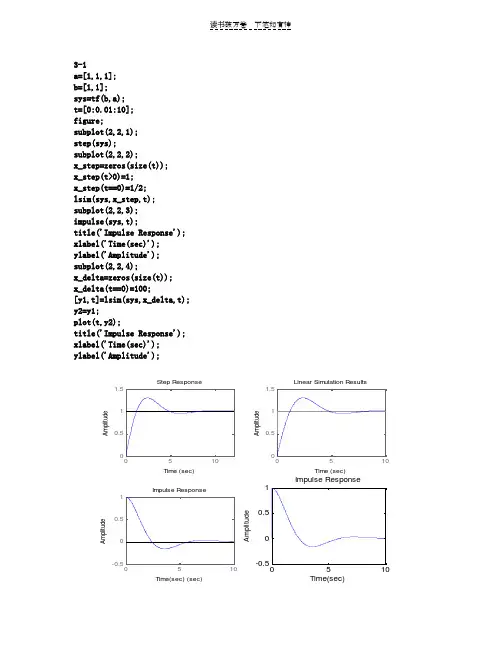
a=[1,1,1]; b=[1,1]; sys=tf(b,a); t=[0:0.01:10]; figure;subplot(2,2,1); step(sys);subplot(2,2,2);x_step=zeros(size(t)); x_step(t>0)=1; x_step(t==0)=1/2; lsim(sys,x_step,t); subplot(2,2,3); impulse(sys,t);title('Impulse Response'); xlabel('Time(sec)'); ylabel('Amplitude'); subplot(2,2,4);x_delta=zeros(size(t)); x_delta(t==0)=100;[y1,t]=lsim(sys,x_delta,t); y2=y1;plot(t,y2);title('Impulse Response'); xlabel('Time(sec)'); ylabel('Amplitude');00.511.5Step ResponseTime (sec)A m p l i t u d e0.511.5Linear Simulation ResultsTime (sec)A m p l i t u d e510-0.500.51Impulse ResponseTime(sec) (sec)A m p l i t u d e510-0.50.51Impulse ResponseTime(sec)A m p l i t u d e函数int1如下:function [F,tF]=int1(f,tf,a)T=tf(2)-tf(1);F=zeros(size(tf)); tF=zeros(size(tf)); tF=tf; for n=1:length(tf)-1;F(n+1)=F(n)+T*f(n); end验证如下:t=[-1:0.01:4]; e=zeros(size(t)); e=(t>-1/2&t<1);[z,zz]=int1(e,t,-1); figure;plot(zz,z);-1-0.500.51 1.52 2.53 3.5400.511.5T1=1;N1=10000; t1=linspace(0,T1-T1/N1,N1)';f1=1-2*t1;OMG=32*pi;K1=100;omg=linspace(-OMG/2,OMG/2-OMG/K1,K1)';X1=T1/N1*exp(-j*kron(omg,t1.'))*f1;fs1=OMG/2/pi/K1*exp(j*kron(t1,omg.'))*X1;T2=5;N2=10000;t2=linspace(0,T2-T2/N2,N2)';fs2=0*t2;f2=sawtooth(t2*2*pi,0);X2=T2/N2*exp(-j*kron(omg,t2.'))*f2;fs2=fs2+OMG/2/pi/K1*exp(j*kron(t2,omg.'))*X2;figure;subplot(2,2,1);plot(omg,abs(X1),'r');xlabel('Frequency'),ylabel('Amplitude')title('单个锯齿周期幅频特性曲线');subplot(2,2,2);plot(t1,fs1,'r');xlabel('Time'),ylabel('Amplitude')title('Function after recovered');subplot(2,2,3);plot(omg,abs(X2),'r');xlabel('Frequency'),ylabel('Amplitude')title('五个锯齿周期幅频特性曲线');subplot(2,2,4);plot(t2,fs2,'r');xlabel('Time'),ylabel('Function after recovered')title('Function after recovered');-100-5005000.20.40.60.8FrequencyA m p l i t u d e单个锯齿周期幅频特性曲线00.51-1-0.500.51TimeA m p l i t u d eFunction after recovered-100-5005000.511.52FrequencyA m p l i t u d e五个锯齿周期幅频特性曲线246-2-1012TimeF u n c t i o n a f t e r r e c o v e r e dFunction after recovered4-2fsana 函数如下:function F=fsana(t,f,N)omg1=2*pi/(max(t)-min(t)); k=[-N:N]';F=1/length(t)*exp(-j*kron(k*omg1,t.'))*f; fssyn 函数如下:function f=fssyn(F,t)omg1=2*pi/(max(t)-min(t)); N=floor(length(F)/2); k=[-N:N];f=exp(j*kron(t,k*omg1))*F; 验证如下: clc clearclose allT1=1;N1=256; t=linspace(0,T1-T1/N1,N1)'; f=1-2*t;subplot(3,1,1); plot(t,f);title('验证原函数') N=25;F1=fsana(t,f,N); subplot(3,1,2); stem(abs(F1),'s');title('前N 项傅立叶级数系数幅度曲线') f2=fssyn(F1,t) ;subplot(3,1,3); plot(t,f2);xlabel('time[s]'),ylabel('Amplitude'); title('傅立叶逆变换后时域函数');00.10.20.30.40.50.60.70.80.91-101验证原函数00.20.4前N 项傅立叶级数系数幅度曲线00.10.20.30.40.50.60.70.80.91-202time[s]A m p l i t u d e傅立叶逆变换后时域函数。
信号与系统课后习题与解答第三章

3-1 求图3-1所示对称周期矩形信号的傅利叶级数(三角形式和指数形式)。
图3-1解 由图3-1可知,)(t f 为奇函数,因而00==a a n2112011201)cos(2)sin(242,)sin()(4T T T n t n T n Edt t n E T T dt t n t f T b ωωωπωω-====⎰⎰所以,三角形式的傅利叶级数(FS )为T t t t E t f πωωωωπ2,)5sin(51)3sin(31)sin(2)(1111=⎥⎦⎤⎢⎣⎡+++=指数形式的傅利叶级数(FS )的系数为⎪⎩⎪⎨⎧±±=-±±==-= ,3,1,0,,4,2,0,021n n jE n jb F n n π所以,指数形式的傅利叶级数为Te jE e jE e jEe jEt f t j t j t j t j πωππππωωωω2,33)(11111=++-+-=--3-2 周期矩形信号如图3-2所示。
若:图3-22τT-2τ-重复频率kHz f 5= 脉宽 s μτ20= 幅度 V E 10=求直流分量大小以及基波、二次和三次谐波的有效值。
解 对于图3-2所示的周期矩形信号,其指数形式的傅利叶级数(FS )的系数⎪⎭⎫⎝⎛=⎪⎭⎫ ⎝⎛====⎰⎰--22sin 12,)(1112212211τωττωππωττωωn Sa T E n n E dt Ee T T dt e t f T F tjn TT t jn n则的指数形式的傅利叶级数(FS )为∑∑∞-∞=∞-∞=⎪⎭⎫⎝⎛==n tjn n tjn ne n Sa TE eF t f 112)(1ωωτωτ其直流分量为T E n Sa T E F n ττωτ=⎪⎭⎫ ⎝⎛=→2lim100 基波分量的幅度为⎪⎭⎫ ⎝⎛⋅=+-2sin 2111τωπEF F 二次谐波分量的幅度为⎪⎭⎫ ⎝⎛⋅=+-22sin 122τωπEF F 三次谐波分量的幅度为⎪⎭⎫ ⎝⎛⋅=+-23sin 32133τωπE F F 由所给参数kHz f 5=可得s T s rad 441102,/10-⨯==πω 将各参数的值代入,可得直流分量大小为V 110210201046=⨯⨯⨯--基波的有效值为())(39.118sin 210101010sin 210264V ≈=⨯⨯⨯- πππ二次谐波分量的有效值为())(32.136sin 251010102sin 21064V ≈=⨯⨯⨯- πππ三次谐波分量的有效值为())(21.1524sin 32101010103sin 2310264V ≈=⨯⨯⨯⨯- πππ3-3 若周期矩形信号)(1t f 和)(2t f 的波形如图3-2所示,)(1t f 的参数为s μτ5.0=,s T μ1= ,V E 1=; )(2t f 的参数为s μτ5.1=,s T μ3= ,V E 3=,分别求:(1))(1t f 的谱线间隔和带宽(第一零点位置),频率单位以kHz 表示; (2))(2t f 的谱线间隔和带宽; (3))(1t f 与)(2t f 的基波幅度之比; (4))(1t f 基波与)(2t f 三次谐波幅度之比。
【信号与系统(郑君里)课后答案】第三章习题解答

3-1 解题过程:(1)三角形式的傅立叶级数(Fourier Series ,以下简称 FS )f ( t ) = a ++∞cos ( n ω t) + b sin ( n ω t ) a 0 ∑ n 1n 1 n =1式中ω1 =2π,n 为正整数,T 1 为信号周期T 11 t +T(a )直流分量a 0 = 0 ∫ 1 f ( t ) dtT1 t2 t +T(b )余弦分量的幅度a n = 0∫ 1f ( t ) cos ( n ω1t ) dtT1 t 02 t +T(c )正弦分量的幅度b n = 0 ∫ 1f ( t ) sin ( n ω1t ) dtT 1 t(2)指数形式的傅立叶级数+∞f ( t ) = ∑ F ( n ω1 )e jn ω1tn =其中复数频谱F n= F ( n ω1 ) = 1 ∫t 0 +T 1f ( t ) e − jn ω1t dt T 1 t 0F n =1( a n − jb n ) F − n = 1 ( a n + jb n ) 2 2由图 3-1 可知, f ( t ) 为奇函数,因而a 0 = a n = 04 Tb n = T ∫02= 2Eπ n4TE−2EEf (t ) sin ( n ω t ) dt =sin ( n ω t ) dt = cos ( n ω t = 1 − cos ( n π2T 1 ∫0 2 1 n t 1 n ) 1n = 2, 4,n = 1, 3,所以,三角形式的 FS 为2 E1 12π f ( t ) =sin ( ω1t ) +sin ( 3ω1t ) +sin ( 5ω1t ) +ω1 =π 3 5T指数形式的 FS 的系数为1n = 0, ±2, ±4,F n = − jb n jE=2 n = 0,−± 1, ±3,n π1所以,指数形式的 FS 为f ( t ) = − jE π ej ω1t+ πjE e − j ω1t − 3jE π e j 3ω1t + 3jEπ e − j 3ω1t +3-15 分析:半波余弦脉冲的表达式 f ( t ) =πτ E cos t u t+ τ 2求 f ( t ) 的傅立叶变换有如下两种方法。
信号与系统(第1章)上册课后习题答案

0, 0 等幅 0, 0 增幅振荡 0, 0 衰减
第 21 页
4.抽样信号(Sampling Signal)
O
2
2
第 37 页
c.表示符号函数 符号函数:(Signum)
1 sgn( t ) 1
1 u( t ) [sgn( t ) 1] 2
sgnt
t 0 t0
O
t
sgn( t ) u( t ) u( t ) 2u( t ) 1
第 38 页
e
j t
cost j sint
第 20 页
3.复指数信号
f ( t ) Ke st
Ke t cos t jKe t sin t
为复数,称为复频率
( t )
s j
, 均为实常数
的量纲为1 /s , 的量纲为rad/s 讨论
瞬态信号:除准周期信号外的 一切可以用时间函数描述的非 周期信号。
第 10 页
3.连续信号和离散信号
连续时间信号:信号存在的 时间范围内,任意时刻都有定 义(即都可以给出确定的函数 值,可以有有限个间断点)。 用t表示连续时间变量。 离散时间信号:在时间上是 离散的,只在某些不连续的规 定瞬时给出函数值,其他时间 没有定义。 用n表示离散时间变量。
f t f at a 0 波形的压缩与扩展,尺度变换
f (t ) f t 2
f t
2
1
t f 2
2
信号与系统(第5版) 配套习题及答案详解

《信号与系统》(第5版)习题解答目录第1章习题解析 (2)第2章习题解析 (6)第3章习题解析 (16)第4章习题解析 (24)第5章习题解析 (32)第6章习题解析............................................................................ 错误!未定义书签。
第7章习题解析 (50)第1章习题解析1-1 题1-1图示信号中,哪些是连续信号?哪些是离散信号?哪些是周期信号?哪些是非周期信号?哪些是有始信号?(c) (d)题1-1图解 (a)、(c)、(d)为连续信号;(b)为离散信号;(d)为周期信号;其余为非周期信号;(a)、(b)、(c)为有始(因果)信号。
1-2 给定题1-2图示信号f ( t ),试画出下列信号的波形。
[提示:f ( 2t )表示将f ( t )波形压缩,f (2t )表示将f ( t )波形展宽。
] (a) 2 f ( t - 2 )(b) f ( 2t )(c) f ( 2t ) (d) f ( -t +1 )题1-2图解 以上各函数的波形如图p1-2所示。
图p1-21-3 如图1-3图示,R 、L 、C 元件可以看成以电流为输入,电压为响应的简单线性系统S R 、S L 、S C ,试写出各系统响应电压与激励电流函数关系的表达式。
题1-3图解 各系统响应与输入的关系可分别表示为)()(t i R t u R R ⋅= t ti L t u L L d )(d )(= ⎰∞-=t C C i Ct u ττd )(1)(1-4 如题1-4图示系统由加法器、积分器和放大量为-a 的放大器三个子系统组成,系统属于何种联接形式?试写出该系统的微分方程。
S R S L S C题1-4图解 系统为反馈联接形式。
设加法器的输出为x ( t ),由于)()()()(t y a t f t x -+=且)()(,d )()(t y t x t t x t y '==⎰故有 )()()(t ay t f t y -='即)()()(t f t ay t y =+'1-5 已知某系统的输入f ( t )与输出y ( t )的关系为y ( t ) = | f ( t )|,试判定该系统是否为线性时不变系统?解 设T 为系统的运算子,则可以表示为)()]([)(t f t f T t y ==不失一般性,设f ( t ) = f 1( t ) + f 2( t ),则)()()]([111t y t f t f T ==)()()]([222t y t f t f T ==故有)()()()]([21t y t f t f t f T =+=显然)()()()(2121t f t f t f t f +≠+即不满足可加性,故为非线性时不变系统。
信号与系统课后习题与解答第一章

1-1分别判断图1-1所示各波形是连续时间信号还是离散时间信号,若是离散时间信号是否为数字信号?图1-1图1-2解 信号分类如下:图1-1所示信号分别为⎪⎪⎩⎪⎪⎨⎧⎩⎨⎧--⎩⎨⎧--))(散(例见图数字:幅值、时间均离))(连续(例见图抽样:时间离散,幅值离散))(连续(例见图量化:幅值离散,时间))(续(例见图模拟:幅值、时间均连连续信号d 21c 21b 21a 21(a )连续信号(模拟信号);(b )连续(量化)信号;(c )离散信号,数字信号;(d )离散信号;(e )离散信号,数字信号;(f )离散信号,数字信号。
1-2 分别判断下列各函数式属于何种信号?(重复1-1题所示问)(1);)sin(t e at ω-(2);nT e -(3);)cos(πn (4);为任意值)(00)sin(ωωn (5)。
221⎪⎭⎫ ⎝⎛解由1-1题的分析可知:(1)连续信号;(2)离散信号;(3)离散信号,数字信号;(4)离散信号;(5)离散信号。
1-3 分别求下列各周期信号的周期T :(1);)30t (cos )10t (cos -(2);j10t e (3);2)]8t (5sin [(4)。
[]为整数)(n )T nT t (u )nT t (u )1(0n n ∑∞=-----解 判断一个包含有多个不同频率分量的复合信号是否为一个周期信号,需要考察各分量信号的周期是否存在公倍数,若存在,则该复合信号的周期极为此公倍数;若不存在,则该复合信号为非周期信号。
(1)对于分量cos (10t )其周期;对于分量cos (30t ),其周期。
由于5T 1π=15T 2π=为的最小公倍数,所以此信号的周期。
5π21T T 、5T π=(2)由欧拉公式)t (jsin )t (cos e t j ωωω+=即)10t (jsin )10t (cos e j10t +=得周期。
5102T ππ==(3)因为[])16t (cos 2252252)16t (cos 125)8t (5sin 2-=-⨯=所以周期。
信号与系统第七、八章课后习题
N k
当
2
2.线性时不变离散时间系统 ①线性 线性=叠加性+均匀性(齐次性)
c1 x1 (n) c2 x2 (n)
系统
c1 y1 (n) c2 y2 (n)
②时不变
x(n N )
系统
y (n N )
x ( n)
1 E
y ( n)
y ( n)
a
ay(n)
单位延时
1 T D z ( )
已知激励初始状态y(-1)=0,y(-2)=1/2, fk=2ku(k),求系统 的零输入响应,零状态响应和全响应. 解: (1) 零输入响应 根据定义,零输入响应满足方程:
yx (k ) 3 yx (k 1) 2 yx (k 2) 0
其初始状态
1 yx (1) y (1) 0, yx 2 y 2 2
x(n)(n n0 ) x(n0 )(n n0 )
n
x(n)(n) x(0) (n) x(0)
n
n
x(n)(n n ) x(n ) (n n ) x(n )
0 0 n 0 0
x ( n)
k k 零状态响应
2 1 k k k (1) (2) (2) , k 0 3 3
离散时间系统的单位样值响应
(n)
零状态系统
h( n)
单位样值响应h(n)是系统在零状态时,由单位样值信 号作用之下产生的响应。因此,它是一个零状态响应。
同样,单位样值信号δ(n)仅在n=0时刻等于1,其它时 刻δ(n)=0,因此系统在n>0时的响应是零输入响应。
奥本海姆《信号与系统》配套题库【课后习题】(线性时不变系统)
第2章线性时不变系统2.1 设x[n]=δ[n]+2δ[n-1]-δ[n-3]和h[n]=2δ[n+1]+2δ[n-1],计算下列各卷积:;;。
解:(a)(b)(c)2.2 考虑信号将A和B用n来表示,以使下式成立:解:故A=n-9,B=n+3。
2.3 已知输入x[n]和单位脉冲响应h[n]为,求输出y[n]=x[n]*h[n],并画出y[n]。
解:设,h1[n]=u[n],则x[n]=x1[n-2],h[n]=h1[n+2]即y[n]的波形如图2-1所示。
图2-1 2.4 计算y[n]=x[n]*h[n],这里解:当,即12≤n≤18时,当,即7≤n<12时,当即18<n≤23时,当n为其他值时,y[n]=0,故2.5 设和,式中,N≤9是一个整数。
已知y[n]=x[n]*h[n]和y[4]=5,y[14]=0,试求N为多少。
解:当n<0及n>9+N时,y[n]=0。
由于y[14]=0,故9+N <14,即N<5。
而当即N≤n≤9时,有又y[4]=5,由此可得N=4。
2.6 计算卷积y[n]=x[n]*h[n],其中解:当n≥0时,当n<0时,故2.7 一个线性系统S有如下输入-输出关系:y[n]=,式中g[n]=u[n]-u[n-4]。
(a)当x[n]=δ[n-1]时,求y[n];(b)当x[n]=δ[n-2]时,求y[n];(c)S是线性时不变的吗?(d)当x[n]=u[n]时,求y[n]。
解:(a)(b)(c)S是线性的但非时不变的,因为当x[n]向右平移了1个单位时,y[n]向右平移了2个单位,故S不是线性时不变的。
(d)2.8 确定并并粗略画出下列两个信号的卷积:解:则y(t)的波形如图2-2所示。
郑君里《信号与系统》(第3版)笔记和课后习题(含考研真题)详解(1-2章)【圣才出品】
第1章绪论
1.1复习笔记
本章作为《信号与系统》的开篇章节,是整个信号与系统学习的基础。
本章介绍了有关信号与系统的基本概念和术语,给出几种典型的信号和系统的表现形式,讲述了各信号与系统的特点以及信号之间的运算和转换。
通过本章学习,读者应掌握:如何判断信号类型、不同信号之间的运算、信号的分解以及系统类型的判断。
一、信号概述
1.信号的概念及分类(见表1-1-1)
表1-1-1信号的概念及分类
2.典型的连续信号(见表1-1-2)
表1-1-2典型的信号及表示形式
3.信号的运算(见表1-1-3)
表1-1-3信号的运算
4.阶跃函数和冲激函数
阶跃信号和冲激信号是信号与系统中最基础的两种信号,许多复杂信号皆可由二者或二者的线性组合表示。
具体见表1-1-4及表1-1-5。
(1)单位阶跃信号u(t)
表1-1-4单位阶跃信号u(t)
(2)单位冲激信号δ(t)
表1-1-5单位冲激信号δ(t)表示形式及性质
5.信号的分解
一个一般信号根据不同类型可分解为以下几种分量,具体见表1-1-6。
表1-1-6信号的分解
二、系统
1.系统概念及分类(见表1-1-7)
表1-1-7系统的概念及分类
系统模型如下:
输入信号经过不同系统可得到不同输出信号,具体见表1-1-8。
表1-1-8不同系统特性
1.2课后习题详解
1-1分别判断图1-2-1所示各波形是连续时间信号还是离散时间信号,若是离散时间信号是否为数字信号?
(a)
(b)
(c)
(d)
(e)
(f)。
信号与系统第二版课后习题解答(6-7-9)奥本海姆
Chap 66.1 Consider a continuous-time LTI system with frequency response()()|()|H j H j H j e ωωω=and real impulse response h(t). Suppose that we apply an input 00()cos()x t t ωφ=+ to this system .The resulting output can be shown to be of the form0()()y t Ax t t =-Where A is a nonnegative real number representing anamplitude-scaling factor and 0t is a time delay.(a)Express A in terms of |()|H j ω.(b)Express 0t in terms of0()H j ω Solution:(a) For 0()()y t Ax t t =-So 0()()jt Y j AX j e ωωω-=0()()()j t Y j H j Ae X j ωωωω-== So |()|A H j ω=(b) for 0()H j t ωω=- So 0()H j t ωω=-6.3 Consider the following frequency response for a causal and stable LTI system:1()1j H j j ωωω-=+ (a) Show that |()|H j A ω=,and determine the values of A. (b)Determine which of the following statements is true about ()τω,the group delay of the system.(Note()(())/d H j d τωωω=-,where ()H j ωis expressed in aform that does not contain any discontinuities.)1.()0 0for τωω=>2.()0 0for τωω>>3 ()0 0for τωω<>Solution:(a) for |()|1H j ω== So A=1(b) for )(2)()()1()1()(ωωωωωωarctg arctg arctg j j j H -=--=+∠--∠=∠ 212)()(ωωωωτ+=∠-=d j H d So ()0 0for τωω>>6.5 Consider a continuous-time ideal bandpass filter whose frequency response is⎩⎨⎧≤≤=elsewherej H c c,03||,1)(ωωωω (a) If h(t) is the impulse response of this filter, determine a functiong(t) such that)(sin )(t g tt t h c πω= (b) As c ω is increased, dose the impulse response of the filter get more concentrated or less concentrated about the origin?Solution(a) Method 1. Let1()()()()()()2h t x t g t H j X j G j ωωωπ=↔=* They are shown in the figures,where1,sin ()(){0,c c ctx t X j t ωωωωωωπ<=↔=> So we can get()2cos(2)()2[(2)(2)]c c c g t t G j ωωπδωωδωω=↔=-++Method 2. Using the inverse FT definition,it is obtained331(){}2c c c cj t j t h t e d e d ωωωωωωωωπ--=+⎰⎰ 11{sin 3sin }{sin }{2cos 2}c c c c t t t t t tωωωωππ=-= (b) more concentrated.Chap 77.1 A real-valued signal x(t) is know to be uniquely determined by its samples when the sampling frequency is 10,000s ωπ=.For what values of ω is ()X j ω guaranteed to be zero?Solution:According to the sampling theorem 2s M w w > That is 110000500022M s w w ππ<== So if 5000M w w π>=,0)(=jw X7.2 A continuous-time signal x(t) is obtained at the output of an ideal lowpass filter with cutoff frequency 1,000c ωπ=.If impulse-train sampling is performed on x(t), which of the following sampling periods would guarantee that x(t) can be recovered from its sampled version using an appropriate lowpass filter?(a) 30.510T -=⨯(b) 3210T -=⨯(c) 410T -= Solution: π1000==c M w wFrom the sampling theorem,∴π20002=>M s w w ,that is 3102000222-==<πππM s w T ∴the conditions (a) and (c) are satisfied with the sampling theorem,(b) is not satisfied.7.3 The frequency which, under the sampling theorem,must be exceeded by the sampling frequency is called the Nyquist rate. Determine the Nyquist rate corresponding to each of the following signals:(a)()1cos(2,000)sin(4,000)x t t t ππ=++ (b)sin(4,000)()t x t tππ=(c) 2sin(4,000)()()t x t t ππ= Solution: (a))4000sin()2000cos(1)(t t t x ππ++=max(0,2000,4000)4000M w πππ==∴ the Nyquist rate is 28000s M w w π>= (b) sin(4000)()t x t tππ= 4000M w π=∴ the Nyquist rate is 28000s M w w π>= (c) 2sin(4000)()t x t t ππ⎛⎫= ⎪⎝⎭ 2sin(4000)()t x tt ππ⎛⎫= ⎪⎝⎭221(1cos(8000))2t t ππ=- ∴8000M w π=∴the Nyquist rate is 216000s M w w π>=7.4 Let x(t) be a signal with Nyquist rate 0ω. Determine the Nyquist rate for each of the following signals:(a)()(1)x t x t +- (b)()dx t dt(c)2()x t(d)0()cos x t t ωSolution:(a) we let 1()()(1)y t x t x t =+-So 1()()()(1)()j j Y j X j e X j e X j ωωωωωω--=+=+So the Nyquist rate of signal (a) is 0ω.(b) we let 2()()dx t y t dt= So 2()()Y j j X j ωωω=So the Nyquist rate of signal (b) is 0ω.(c) we let 23()()y t x t = So 31()()*()2Y j X j X j ωωωπ= So the Nyquist rate of signal (c) is 20ω.(d) we let 40()()cos y t x t t ω=For 000cos [()()]FT t ωπδωωδωω→-++ So 4001()((()(())2Y j X j X j ωωωωω=-++ So the Nyquist rate of signal (d) is 03ω7.9 Consider the signal 2sin 50()()t x t tππ= Which we wish to sample with a sampling frequency of 150s ωπ= to obtain a signal g(t) with Fourier transform ()G j ω.Determine the maximum value of 0ω for which it is guaranteed that0()75() ||G j X j for ωωωω=≤Where ()X j ω is the Fourier transform of x(t).Solution: 2sin(50)()t x t t ππ⎛⎫= ⎪⎝⎭))100cos(1(2122t t ππ-= ∴100M w π=But π150=s wthe figure about before-sampling and after-sampling of )(jw H isWe can see that only when π500≤w , the before-sampling and after-sampling of )(jw H have the same figure.So if 0..)..(75)(w w for jw X jw G ≤=The maximum value of 0w is π50.Chap 99.2 Consider the signal 5()(1)tx t e u t -=- and denote its Laplace transform by X(s).(a)Using eq.(9.3),evaluate X(s) and specify its region of convergence. (b)Determine the values of the finite numbers A and 0t such that theLaplace transform G(s) of 50()()t g t Ae u t t -=-- has the same algebraic form as X(s).what is the region of convergencecorresponding to G(s)?Solution:(a). According to eq.(9.3), we will getdt e t x s X st -∞∞-⎰=)()(dt e t u e st t --∞∞--=⎰)1(5dt e t s )5(1+-∞⎰= )5()5()5()5()5(1)5(+=+--=+-=+-+-∞+-s e s e s e s s t s ROC: Re{s}>-5(b). )()(05t t u Aet g t --=-−→←LT 0)5(5)(t s e s A s G ++-=, Re{s}<-5 ∴If )()(s X s G =then it ’s obviously that A=-1, 10-=t , Re{s}<-5.9.5 For each of the following algebraic expressions for the Laplace transform of a signal, determine the number of zeros located in the finite s-plane and the number of zeros located at infinity: (a)1113s s +++ (b) 211s s +- (c) 3211s s s -++ Solution :(a).1, 1 )3)(1(423111+++=+++s s s s s ∴it has a zero in the finite s-plane, that is 2-=sAnd because the order of the denominator exceeds the order of the numerator by 1∴ X(s) has 1 zero at infinity.(b). 0, 1 11)1)(1(1112-=-++=-+s s s s s s ∴it has no zero in the finite s-plane.And because the order of the denominator exceeds the order of the numerator by 1∴ X(s) has 1 zero at infinity.(c). 1, 0 11)1)(1(112223-=++++-=++-s s s s s s s s s ∴it has a zero in the finite s-plane, that is 1=sAnd because the order of the denominator equals to the order of the numerator∴ X(s) has no zero at infinity.9.7 How many signals have a Laplace transform that may be expressed as 2(1)(2)(3)(1)s s s s s -++++ in its region of convergence?Solution:There are 4 poles in the expression, but only 3 of them have different real part.∴ The s-plane will be divided into 4 strips which parallel to the jw-axis and have no cut-across.∴ There are 4 signals having the same Laplace transform expression.9.8 Let x(t) be a signal that has a rational Laplace transform with exactly two poles located at s=-1 and s=-3. If2()() ()t g t e x t and G j ω=[ the Fourier transform of g(t)]converges, determine whether x(t) is left sided, right sided, or two sided.Solution:)()(2t x e t g t =∴)2()(-=s X s G ROC: R(x)+Re{2}And x(t) have three possible ROC strips:),1(),1,3(),3,(+∞-----∞∴g(t) have three possible ROC strips: ),1(),1,1(),1,(+∞---∞ IF jw s s G jw G ==|)()(Then the ROC of )(s G is (-1,1)∴)(t x is two sides. 9.9 Given that1(),{}Re{}sat e u t Re s a s a -↔>-+ Determine the inverse Laplace transform of22(2)(),Re{}3712s X s s s s +=>-++ Solution: It is obtained from the partial-fractional expansion:22(2)2(2)42()712(4)(3)43s s X s s s s s s s ++-===+++++++,Re{}3s >-We can get the inverse Laplace transform from given formula and linear property.43()4()2()t t x t e u t e u t --=-9.10 Using geometric evaluation of the magnitude of the Fourier transform from the corresponding pole-zero plot ,determine, for each of the following Laplace transforms, whether the magnitude of the corresponding Fourier transform is approximately lowpass, highpass, or bandpass. (a):1}Re{,.........)3)(1(1)(1->++=s s s s H (b):221(),{}12s H s e s s s =ℜ>-++ (c):232(),{}121s H s e s s s =ℜ>-++ Solution:(a). 1}Re{,.........)3)(1(1)(1->++=s s s s H It ’s lowpass.(b).21}Re{,.........1)(22->++=s s s s s H It ’s bandpass.(c). 1}Re{., (1)2)(223->++=s s s s s H It ’shighpass.9.13 Let ()()()g t x t x t α=+- ,Where ()()t x t e u t β-=. And the Laplace transform of g(t) is 2(),1{}11s G s e s s =-<ℜ<-. Determine the values of the constants αand βSolution:()()()g t x t x t α=+-,and ()()t x t e u t β-=The Laplace transform : ()()()G s X s X s α=+- and ()1X s s β=+,Re{}1s >-From the scale property of Laplace transform,()1X s s β-=-+,Re{}1s < So 2(1)(1)()()()111s G s X s X s s s s βαββαβαα--+=+-=+=+-+-,1Re{}1s -<< From given 2()1s G s s =-,1Re{}1s -<< We can determine : 11,2αβ=-=。