
九年级英语下册 Unit 3 Robot Reading导学案新牛津版
1
Robots
班级__________ 姓名__________ 学号__________
【学习目标】
知识点
词汇:单词见词汇表P81;词组见课前预习翻译词组。
重难点
【知识要点】
1. own v./a. on one’s own = by oneself = alone
She __________ (拥有) a car. Please describe it in your __________(自己的)
words.
2. in order to do sth. in order not to do sth.
为了上学不迟到,学生们都起得很早。
Students get up early __________ __________ __________ __________ __________ l
ate.
3. no longer = not any longer
她不再需要那双鞋了。
She __________ __________ ____________ the pair of the shoes.
She __________ need the pair of the shoes __________ __________.
4. be happy with = be satisfied with = be pleased with
她对现在的工作不满意。 She _________ __________ __________ her present job.
5. make a mess in a mess.
这个房间杂乱不堪。 The room __________ _________ ________ __________.
孩子们把浴室搞得一塌糊涂。 The kids ___________ ________ __________ in the ba
throom.
6. stay open, stay out, stay up
商店开门营业到晚上10点。 The shop __________ __________ till 10 p.m.
你不应该待在外面这么迟。 You ought not ___________ __________ ___________.
不要熬夜太晚,对你的身体不好。
Don’t ___________ _________ ____________. It’s bad for your health.
7. a bit/ a little a bit of/ a little
请给我一点面包。Please give me _________ __________ bread.
Please give me _________ __________ __________ bread.
【课前预习】
读一读读课文完成表格
Before catching the virus
Before he got up
While he was at work
After dinner
After catching the virus
Problems:
2. 完成书后P40 B1 B2。
2
3. T/F:
( ) 1. Mr. Jiang’s robot changed his life a little.
( ) 2. None of the changes in his life are bad.
( ) 3. He is a salesman who lives in Moonlight Town but works in Sunshine Town.
( ) 4. He is too busy to have time for hobbies.
( ) 5. He wanted to own a robot as he looked forward to more free time.
( ) 6. The robot brought him too much trouble because it was too lazy.
4.通过预习,你感觉还有哪些困惑呢,你想得到哪些帮助呢?
找一找
翻译词组
1.太忙而没有时间放松_________________ 2.使他的生活更容易_____________
3.在上班________________________________ 4.下班回到家_____________________
5.为他准备好____________________________ 6.对.....感到满意________________
___
7.发生故障________________________ 8.把......打翻________________________
9.一团糟___________________ 10.感染一个病毒____________________11.
太多的麻烦_______________________ 12.撒的满地都是_____________________
【学习检测】
一、根据汉语解释或首字母提示写出适当单词
1. Put the litter into the __________ (垃圾箱) please.
2. A __________ (硬币) has two sides.
3. My old coat needs to be __________ (熨烫) once a week.
4. The new road through our village is very __________ (平坦).
5. We must be careful when we use __________ (炊具) at home .
二、用括号中单词的适当形式填空。
1. My father bought a __________ (wash) machine yesterday.
2. __________ (learn) English well, he spends much time reading and writing En
glish.
3. Li Hong stayed up late __________ (get) ready for the next day’s exam.
4. The father got angry when he saw the __________ (break) radio.
5. Two days __________ (late), the old man left his hometown.
6. There are many _________ (different) between British English and American E
nglish.
7. Life is becoming much __________ (easy) but we seem to be busier.
8. The family have moved to another city and no __________ (long) live here.
三、课文填空
Mr. Jiang bought a robot. It made his life much __________. It made breakfast
for him. It could __________ his shirts and make a lunch box for him. While
he was at work, it would clean his flat. It would do the __________, wash the
dishes, __________ the floor and __________ the bed. When he __________ home
from work, his flat would be as __________ as new. A delicious dinner would
be __________ for him. He was very __________ with his robot. But a few weeks
later, the robot __________ a __________ and __________ a lot of problems. Mr.
Jiang’s flat was always in a __________. It __________ Mr Jiang very much.
3
In the end, he decided to return it to the shop.
【学习评估】
学生:__________________________________________________
教师:__________________________________________________
家长:__________________________________________________
九年级英语下册 Unit 3 Robot Task教案 (新版)牛津版

Unit 3 RobotsTaskI. Teaching aims and learning objectivesBy the end of the lesson, students should be able to:1. complete a complaint letter according to the questionnaire;2. write a letter to complain about your robot or a reply to a complaint letter.II. Teaching contents1. New words and phrases: satisfied, completely, regret, product, quality, besatisfied with, first of all, at most, last for at least twomonths, up to standard, get my money back2. New structures: How long do you expect your robot’s batteries to last?How often do you think your robot should be checked?I am not satisfied with it at all.A good robot should only need checking every six months.III. Focus of the lesson and predicted area of difficultyWrite a letter to complain about your robot or a reply to a complaint letter.IV. Teaching proceduresStep 1 Lead-in1. RevisionT: Robots can do a lot of things for us. What good things could Mr Jiang’s robot do for him?S: It could make breakfast for him in the morning, iron his business suit, prepare his lunch box, do all the housework when he was at work, go shopping at the supermarket, prepare a delicious dinner for him and tidy up after dinner. 2. Your ideal robotT: If you have a robot, what do you look for in it? Here is a questionnaire for you. Discuss with your partners and complete it.【设计意图:由对reading部分所学内容的回顾,引导学生在此基础上展开自己的思考,并为完成问卷调查的任务做好铺垫。
中学九年级英语下册 Unit 3 Robot Reading 1课件 (新版)牛津版

his favourite TV programmes
Read Paragraphs 6 & 7 and choose the wrong things that the robot did
He cooked breakfast at the right time. ➢ He woke up Mr Jiang at the wrong time. ➢ He threw Mr Jiang’s breakfast into the dustbin. ➢ He threw Mr Jiang’s clean shirts into the dustbin. ➢ He moved around the house and knocked things over. ➢ He went out and often lost his way home. ➢ He made a mess in Mr Jiang’s flat.
Retelling 1: Fill in the blanks
Mr. Jiang is __b_u_s_y_ and have n_o___ time for his hobbies.So he _b_o_u_g_hta robot to help him. It brought many changes. Mr. Jiang needn’t do any housework .he could stay in bed for longer. Mr. Jiang was very happy with the robot.But later,things changed. The robot caught a v_i_r_u_s_ and caused many problems.Mr. Jiang’s flat was in a_m__e_s_s . Mr. Jiang was very unhappy. In the end ,he decided to return the robot to the robot shop.
牛津译林版英语九下Unit 3《Robot》(Welcome to the unit)教学设计

牛津译林版英语九下Unit 3《Robot》(Welcome to the unit)教学设计一. 教材分析牛津译林版英语九下Unit 3《Robot》主要介绍了机器人的发展、种类和应用。
通过本单元的学习,学生能够了解机器人的基础知识,提高英语语言运用能力,激发对科技领域的兴趣。
本单元包括两个阅读文章,分别是《The Development of Robots》和《Types and Applications of Robots》。
此外,还有相关的词汇、语法和听力练习。
二. 学情分析九年级的学生已经具备了一定的英语基础,对于日常生活中的话题能够进行简单的交流。
但是,对于科技领域的专业知识,学生可能较为陌生。
因此,在教学过程中,需要帮助学生建立起知识桥梁,引导学生运用已有的英语知识去理解和表达科技领域的内容。
三. 教学目标1.知识目标:学生能够掌握关于机器人的相关词汇和表达方式,了解机器人的发展、种类和应用;2.能力目标:学生能够运用英语进行简单的交流,描述机器人的特点和功能;3.情感目标:激发学生对科技领域的兴趣,培养学生的创新意识。
四. 教学重难点1.重点:机器人的相关词汇和表达方式的掌握,以及阅读理解能力的提升;2.难点:对于机器人的专业知识的理解和运用,以及听力理解的提升。
五. 教学方法1.任务型教学法:通过设定各种任务,引导学生主动参与课堂,提高学生的英语运用能力;2.合作学习法:学生分组讨论,培养学生的团队协作能力和沟通能力;3.情境教学法:创设各种情境,帮助学生理解机器人的应用场景。
六. 教学准备1.教师准备:对于机器人的相关知识进行深入了解,准备教学PPT和教学素材;2.学生准备:预习本单元内容,对于机器人的基础知识有所了解。
七. 教学过程1.导入(5分钟)教师通过展示一些机器人的图片,引导学生谈论关于机器人的话题,激发学生的兴趣。
2.呈现(10分钟)教师通过PPT展示本节课的主要内容,包括机器人的发展、种类和应用。
九年级英语下册Unit3RobotsTask教案(新版)牛津版
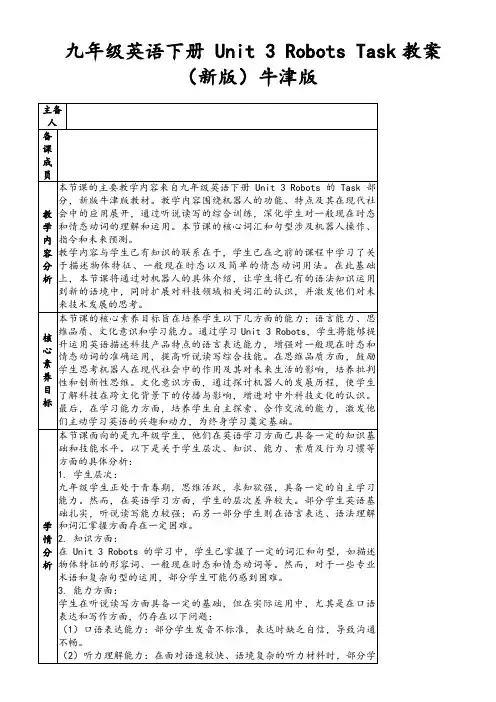
(2)课堂表现:学生在课堂上积极参与,但部分学生注意力容易分散,课堂纪律有待加强。
(3)学习方法:部分学生尚未形成适合自己的学习方法,导致学习效果不佳。
学具准备
多媒体
课型
- 一种自动执行任务的机器
- 机器人功能
- 操作机器
- 控制温度
- 执行危险任务
- 机器人未来应用
- 空间探索
- 医疗服务
- 家庭助手
- 语法点
- 一般现在时态
- 情态动词
板书设计应简洁明了,通过清晰的逻辑关系,帮助学生将知识点串联起来,形成完整的知识体系,便于学生理解和记忆。
教学反思
本节课的教学过程中,我深刻感受到了学生们的热情和对机器人知识的浓厚兴趣。在课堂导入环节,我通过展示一些机器人的图片和视频,成功吸引了学生的注意力,并激发了他们对本节课内容的好奇心。在新课呈现环节,我通过讲解机器人的定义、功能和应用,以及一般现在时态和情态动词的运用,帮助学生建立了对机器人知识的基本认识。在互动探究环节,我设计了小组讨论,让学生围绕机器人在生活中的应用展开讨论,这不仅提高了学生的合作精神,还培养了他们的沟通能力。
- 询问机器人的能力:Can/May the robot do...?
- 表达对机器人的预测:The robot might/could be used in the future for...
4. 课文内容理解:
- 了解机器人的定义、类型和功能。
- 掌握机器人技术的发展和应用。
- 理解一般现在时态和情态动词在描述机器人时的运用。
情感升华:
牛津译林版九年级英语下册Unit3RobotsReadingLivingwithrobots教学设计

在教学过程中,关注学生的个体差异,对基础薄弱的学生给予更多关注和指导,帮助他们克服学习困难,提高自信心。对基础较好的学生,则可以适当提高要求,引导他们拓展思维,发挥潜能,使全体学生在本章节的学习中都能得到提升。
二、学情分析
九年级学生经过前两年的英语学习,已具备一定的英语基础,但在阅读理解方面,尤其是对科技类文章的阅读仍存在一定的困难。在本章节的学习中,学生对机器人的概念有一定了解,但对机器人的分类、功能及在生活中的应用等方面的知识掌握不足。此外,学生在用英语表达科技类话题时,可能会出现词汇量不足、表达不清晰等问题。
1.教师带领学生阅读文章,指导学生运用阅读策略,如略读、寻读、精读等,捕捉文章关键信息,理解文章大意。
2.教师针对文章中的重点词汇和语法点进行讲解,如artificial intelligence、prototype、function、perform等词汇,以及被动语态的运用。
3.教师通过示例、问答、讨论等方式,帮助学生理解文章细节,提高阅读理解能力。
2.针对阅读文章,请学生撰写一篇关于机器人在生活中的应用的短文,至少包含三个应用场景,并运用所学词汇和语法进行表达。字数在100-120词左右,以提高学生的写作能力。
3.学生分组,每组选择一个主题,如:“Robots in the Future”、“The Impact of Robots on Our Lives”等,进行小组研究。要求小组成员分工合作,收集资料、整理观点,并在下节课上进行汇报,以培养学生的团队合作能力和口语表达能力。
Unit3Reading学案牛津译林版英语九年级下册

Unit 3 Reading【学习目标】1.能记住并能正确运用本节课词汇order, suit, smoothly, iron, in general, satisfy, need, virus, no longer, properly, plete, mess, lay, store, coin, bill, private, paper, spread, wheel。
2.提高阅读能力,了解机器人是如何改变蒋先生的生活的。
3.了解机器人的利弊,学会辩证地看待事物。
【预习导学】一、词汇记忆1.订购2.放,搁3.(使)散开4.熨烫5.满足6.储藏7.平整地8.完全的9.私人的二、根据句意和首字母提示补全单词1.Mr Li bought a s yesterday. He wears it to work today.2.When I got home this morning, I found my room in a m —my books and clothes were everywhere.3.My father always pays the b after we finish the meal in a restaurant.4.We all know a bike has two w .三、想一想。
机器人除了能给我们带来方便,还会有令人不满意的地方,请你举几个例子1.______________________________________________________________2.______________________________________________________________3.______________________________________________________________【答案】一、词汇记忆1.ordery3.spread4.iron5.satisfy6.store7.smoothly8 plete9.private二、根据句意和首字母提示补全单词1.suit2.mess3.bill4.wheels三、想一想。
九年级英语下册 Unit 3 Robot Task教案 (新版)牛津版
Unit 3 RobotsTaskI. Teaching aims and learning objectivesBy the end of the lesson, students should be able to:1. complete a complaint letter according to the questionnaire;2. write a letter to complain about your robot or a reply to a complaint letter.II. Teaching contents1. New words and phrases: satisfied, completely, regret, product, quality, besatisfied with, first of all, at most, last for at least twomonths, up to standard, get my money back2. New structures: How long do you expect your robot’s batteries to last?How often do you think your robot should be checked?I am not satisfied with it at all.A good robot should only need checking every six months.III. Focus of the lesson and predicted area of difficultyWrite a letter to complain about your robot or a reply to a complaint letter.IV. Teaching proceduresStep 1 Lead-in1. RevisionT: Robots can do a lot of things for us. What good things could Mr Jiang’s robot do for him?S: It could make breakfast for him in the morning, iron his business suit, prepare his lunch box, do all the housework when he was at work, go shopping at the supermarket, prepare a delicious dinner for him and tidy up after dinner. 2. Your ideal robotT: If you have a robot, what do you look for in it? Here is a questionnaire for you. Discuss with your partners and complete it.【设计意图:由对reading部分所学内容的回顾,引导学生在此基础上展开自己的思考,并为完成问卷调查的任务做好铺垫。
九年级英语下册Unit3RobotTask教案(新版)牛津版
1. To read and understand a questionnaire
2. To use information from a questionnaire to complete a complaint letter.
化解重难点的方法与手段
讲解
教学流程设计
Step 1 Review
My robot
Keys: 2 months, 24 to be successful.
父母们期望他们的孩子成功。
We are expecting to
结果as a result
至少at least
一直发出指令give instructions all the time
….怎么了What’s wrong with…?
4. ___________________ my washing machine? I need to _____________________.
5.My watch doesn’t work . It ___________ (repair).
6.If you can’t mend the computer well, I’ll __________________.
Ask students to read the questionnaire and think about whether or not you agree with Daniel’s answers.
Step 4 Help Daniel finish . I think they should last for at least (1) __________.
I think a robot shБайду номын сангаасuld work (2) ______________, and I want my robot (3)
Unit3Robots教案牛津译林版英语九年级下册
Step 3 Learning and explanation
Learn some language points and translate something : 1.be too busy to have any time to relax 2.order one from a robot shop order v. 订购;命令; n. 订单;命令;秩序 He ordered a new suit for himself. They ordered him to stop. He received the order to cut the flight short. 3.a delicious dinner would be ready for him. be ready for 为…准备好= be ready to do … 4.It seemed that in general the robot satisfied Mr Jiang’s needs. 句中 satisfy 是动词,意为“满足(需求、需要)”。 Sb. be satisfied with 对……感到满意(满足)
教 学过 程
Step 1 :Leadin
Task1:Free talk Is he a real man ? Do you like robots? Why or why not?
九年级英语下册 Unit 3 Robot Welcome to the unit教案 (新版)牛津版
Unit 3 RobotsComic strip and Welcome to the unitI. Teaching aims and learning objectivesBy the end of the lesson, students should be able to:1. know how robots could help us;2. talk about the usage of robots.II. Teaching contents1. New words and phrases: robot, post, brain, whatever, explore, outer space, put out fires2. New structures: I’m complaining about you to the robot shop.I don’t know when I’ll post the letter for you.So they could do whatever they are asked toIII. Focus of the lesson and predicted area of difficultyTalk about the usage of the robots.IV. Teaching ProceduresComic stripStep 1 Lead-inFree talkT: What is Hobo?S: It is an e-dog.T: Yes. We can also call it a robot dog. What can it do for its master Eddie? (Showing pictures)S: Hobo can read books/watch TV/plant trees.T: Look at this picture. What can it do for Eddie?S: It can post a letter for Eddie.【设计意图:通过谈论Hobo为Eddie所做的事情,引出新词汇robot和post a letter,并以此引出Comic strip的内容。