
无被动语态情况
无被动语态的情况
1) 不及物动词或动词短语无被动语态:
appear, die, disappear, end , fail, happen, last, lie, remain, sit, spread, stand ,break out, come true,
fall asleep, keep silence, lose heart, take place.
比较: rise, fall, happen是不及物动词;raise, seat是及物动词。
(错) The price has been risen.
(对) The price has risen.
(错) The accident was happened last week.
(对) The accident happened last week.
(错) The price has raised.
(对) The price has been raised.
(错) Please seat.
(对) Please be seated.
2) 不能用于被动语态的及物动词或动词短语:
fit, have, hold, marry, own, wish, cost, notice, watch agree with, arrive at / in, shake hands with,
succeed in, suffer from, happen to, take part in, walk into, belong to,listen to,walk into,fall off
This key just fits the lock.
Your story agrees with what had already been heard.
3) 系动词无被动语态:
appear, be, become, fall, feel, get, grow, keep, look, remain, seem, smell, sound, stay, taste, turn
It sounds good.
4. 祈使句一般没有被动语态。如:
正:Look at the blackboard,please.
误:The blackboard is looked at by you.
5. 宾语和主语所指的对象相同时不能用于被动语态。如:
正:We must help each other.
误:Each other must be helped by us.
6. 某些及物动词的宾语表示处所、地点、组织时不能用于被动语态。如:
正:He joined the League in 1998.
误:The League was joined by him in 1998.
7. 动词不定式或动词-ing形式作宾语时不能用于被动语态。如:
正:They like to watch TV.
误:To watch TV is liked by them.
正:He enjoys listening to the radio.
误:Listening to the radio is enjoyed by him.
8. 主动句中有表示数量、长度、大小或程度的单词或短语作宾语时往往不使用被动语态。如:
正:She pays three yuan for the tomatoes.
误:Three yuan is paid for these tomatoes by her.
9. 由“动词+名词”构成的英语习语(如make faces,make friends,take place等)一般不可改为被动语态。如:
正:The boy make faces in class.
误:Faces are made by the boy in class.
10. 反身代词在句中作宾语时,不能用被动语态。如:
正:You must look after yourself.
误:Yourself must be looked after.
句子改错:
1. The boy was made cry by his sister.
2. The strange was let to go.
3. My coat is washed easily.
4. Her forehead is felt hot. I’m afraid she is ill.
5. Eggs won’t be kept long in summer.
6. Who was the book written?
7. English is not easy to be learnt.
8. The traffic accident was happened yesterday.
9. This desk needs to mend.
10. The People’s Republic of China was found on October 1, 1949.
11. Wet clothes are often hanged up near a fire in rainy weather.
12. Newly-born babies are taken good care in hospital.
13. The price has been risen.
14. Please seat.
15. I’ll come after the meeting if time is permitted.
16. A red sky in the morning says to be a sign of bad weather.
17. He is looked down because he is a liar.
18. A dictionary shall be given me by Father on my birthday.
19. An interesting story was told me last night.
20. They have married for 2 years.
21. I have got used to get up at six.
22.The book is well worth to be read.
23. He was laughed by them.
24. I was made do it.
25. Maths is difficult to be learned.
26. Great changes have been taken place.
27. I still don’t know what was happened just now.
28. The price of the cleaner has been risen quickly.
29. He read it as loud as possible so as to make himself hear.
与被动语态无缘的八种情况

与被动语态无缘的八种情况
徐保国
【期刊名称】《英语学习辅导:中考指导版》
【年(卷),期】2003(000)011
【总页数】1页(P7)
【作 者】徐保国
【作者单位】无
【正文语种】中 文
【中图分类】H314
【相关文献】
1.不用被动语态的几种情况 [J], ;
2.2008年高考英语专项点拨——习惯上不用被动语态的情况 [J], 李霞
3.二语习得中典型性和语言迁移的关系——基于大学生英语被动语态使用情况的调查 [J], 杨馨
4.不能用于被动语态的情况 [J], 崔贤文;
5.不用被动语态的情况 [J], 文洪炳;周启平
因版权原因,仅展示原文概要,查看原文内容请购买
汉语无标记被动句与有标记被动句的认知辨析
第37卷第6期 2016年l1月 云梦学刊 Journal of Yunmeng Vo1.37.NO.6 NOV.2016
汉语无标记被动句与有标记被动句的认知辨析
汤敬安
(吉首大学外国语学院,湖南张家界427000)
摘 要:汉语无标记被动句即受事主语句和有标记被动句即被字句的关系一直是颇受争议的话题,已有研究主要从二 者的句式义、动词的句法语义特征辨别其差别,这种判别办法的实际操作性不强。分析二者的构式差别,对二者的认知过程 进行研究,可发现,受事主语句和被字句具有不同的构式意义;二者是受事注意范围、详略度、扫描方式等识解差异在语言结 构上的体现。 关键词:受事主语;被字句:认知辨析 中图分类号:H146.3 文献标识码:A 文章编号:1006.6365(2016)06.0l 10.05
一、引言 汉语无标记被动句也叫“受事主语句”,或者
“意念被动旬”,其形式为:“受事+动词”。有标记被
动句也叫被字句,其形式为:“受事+被(施事)+动
词”。二者都表达被动意义,但二者的关系,尤其是 二者的差异,一直是学界热议的话题。普通语言学
的被动语态定义为:被动语态主要用于及物动词,
及物动词带上被动态后,其主语便不再由施事而是
由受事充当,同时该动词失去带宾语的能力。根据
这一定义,受事置于动词之前且动词带上被动标记
是被动态的基本形态。很多欧洲语言采用助动词加 动词形态变化的半分析、半综合的被动形式,而汉 语是意合型的语言,形态不发达,动词没有被动形
态变化,“被”字的功能是引导施事,施事省略后,它
便直接位于动词之前.成为被动态的标记词汇。汉
语的被动语态用P+VP和P+被(A)+VP两种形式
表达。二者动词皆无形态变化,区别在于动词前是 否出现“被”字,前者为无标记意合被动形式,后者
为有标记被动形式,“被”为被动标记词汇,前者的
使用频率远高于后者。因为汉语是话题优先语言,
话题优先语言的有标记被动态不发达,被动态常以
被动语态的特殊形式

外教一对一
文章来源: 被动语态的特殊形式
被动语态的形式除了BE+过去分词外,还有其他的形式。
1. 主语+get+过去分词在多数情况下不接by+宾语。
All three criminals got shot in the crossfire.
在交火时三名罪犯全部被击中。
Three cops got shot in the crossfire with the criminals.
在与罪犯交火时三名警察被击中。
2. have无被动语态,但可用于"主语+have(or get)+宾语+过去分词"的结构,表示宾语被...,多用于叫人或雇人作某事,有时表示遭遇不幸的事。
A man has his hair cut every other year.
一个男人每两年理一次头发。
I have my hair cut every other week.
我每两周理一次头发。
表示叫人或雇人作某事。
I had my only property burnt last year.
我唯一的财产于去年被火烧掉了。
表示遭遇不幸的事,宾语的被动行为并非出自主语的本意。
3. 带有不定词的被动结构。
Your vice will have to be paid for.
你们的行为是要付出代价的。
Your behavior will have to be paid for.
你的行为是要付出代价的。
4. 动词+介系词或动词+副词用于被动结构时,动词之后的介系词或副词不可拆开或丢掉。 外教一对一
文章来源: This has never been heard of before.
谓语动词用主动表被动的五种情形
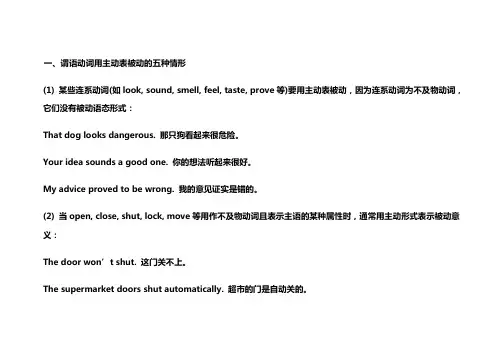
一、谓语动词用主动表被动的五种情形
(1) 某些连系动词(如look, sound, smell, feel, taste, prove等)要用主动表被动,因为连系动词为不及物动词,它们没有被动语态形式:
That dog looks dangerous. 那只狗看起来很危险。
Your idea sounds a good one. 你的想法听起来很好。
My advice proved to be wrong. 我的意见证实是错的。
(2) 当open, close, shut, lock, move等用作不及物动词且表示主语的某种属性时,通常用主动形式表示被动意义:
The door won’t shut. 这门关不上。
The supermarket doors shut automatically. 超市的门是自动关的。 【注】该用法的不及物动词通常与can’t, won’t 等连用,注意它与用被动语态含义不同:
The window won’t shut. 这窗户关不上。(说明主语的属性——窗户有问题了)
The window won’t be shut. 这窗户将不用关上。(窗户本身没问题,只是不用关)
有时可能用主动和被动形式均可,只是强调重点稍有不同:
Suddenly the door opened. 突然门开了。(不强调动作执行者)
The door was suddenly opened. 门突然被打开了。(强调动作执行者)
(3) 当read, wash, clean, cook, cut, wear, carry等用作不及物动词且表示主语的某种属性时,通常要用主动形式表示被动意义:
The cloth washes well. 这种布料好洗。 The book sells quickly. 这书销售得快。
This cheese doesn’t cut easily. It’s too soft. 这乳酪不容易切,太软了。
举例说明汉语和英语被动语态的差异

举例说明汉语和英语被动语态的差异
在将近半个学期的汉译英的学习中,我对汉语和英语被动语态有了初步的认识,大概总结如下:
1.汉语被动语态:汉语的动词基本上无形态变化,所以动词本身无被动语态,主动与被动主要使用一些词汇手段,或纯粹靠意合,依靠动词本身的意义和上下文来显示主动和被动。
(1)有形式标志的被动句。这类被动句的标志有“被”、“给”、“让”等。例如:
他被一块大石头砸伤了。
He was hurt by a big stone.
庄家让洪水冲毁了。
The crops were washed away by the flood.
(2)使用一些词汇手段表示被动句,如“受到”、“遭到”、“得到”等。例如:
他们在工厂受到欢迎。
They were welcomed in the factory.
计算机的应用应予以足够的重视。
The application of computers should be paid enough attention to.
(3)意义被动,被动意义完全靠汉语的意合来体现。例如:
他已派到国外当翻译。
He has been sent abroad as an interpreter.
这种菜闻起来很香。
The dish smells wonderful.
2.英语被动语态:通过词的屈折变化来体现。
(1)英语结构被动句:
施事原因。因各种因素,不愿说出施动者。例如:
Children should be taught to respect the old.
应该教导孩子们尊重老人。
修辞和结构的需要。有时为了更好的连接上下文,避免变换主语。例如:
The teachers should respect student first,and then still be respected by the students.
英语被动态的基本形式
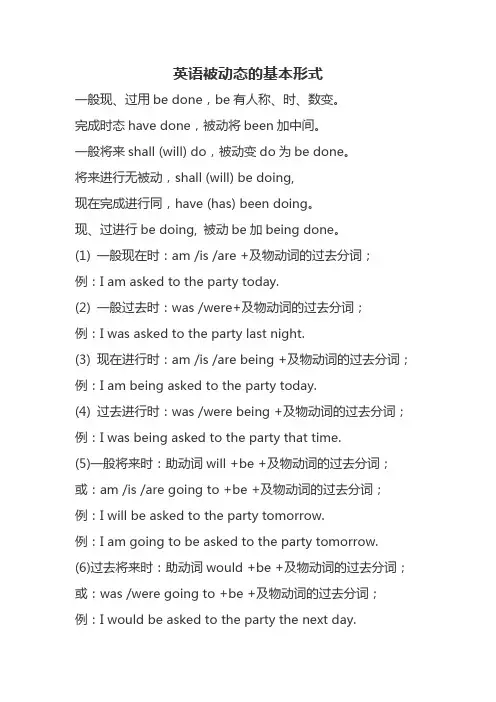
英语被动态的基本形式
一般现、过用be done,be有人称、时、数变。
完成时态have done,被动将been加中间。
一般将来shall (will) do,被动变do为be done。
将来进行无被动,shall (will) be doing,
现在完成进行同,have (has) been doing。
现、过进行be doing, 被动be加being done。
(1) 一般现在时:am /is /are +及物动词的过去分词;
例:I am asked to the party today.
(2) 一般过去时:was /were+及物动词的过去分词;
例:I was asked to the party last night.
(3) 现在进行时:am /is /are being +及物动词的过去分词;
例:I am being asked to the party today.
(4) 过去进行时:was /were being +及物动词的过去分词;
例:I was being asked to the party that time.
(5)一般将来时:助动词will +be +及物动词的过去分词;
或:am /is /are going to +be +及物动词的过去分词;
例:I will be asked to the party tomorrow.
例:I am going to be asked to the party tomorrow.
(6)过去将来时:助动词would +be +及物动词的过去分词;
或:was /were going to +be +及物动词的过去分词;
例:I would be asked to the party the next day. 例:I was going to be asked to the party the next day.
德语主被动语态的相互转换
德语主被动语态的相互转换
德语主动语态与被动语态之间的相互转换,是最基本的句型转换形式之一。
将主动句转换为被动句的方法:
1.在主动句中寻找受及物动词支配的第四格(名词或代词),找到后将其改写为第一格,作为被动句中的主语。若主动句动词不支配第四格,则被动句的主语用e s.
2.将主动句的动词按人称和时态改成werden+第二分词的形式。注意,如果句子是现在完成时和过去完成时,则最后应是worden,而不geworden.
3.主动句的主语在被动句中用介词von或durch带出,一般说来人用von,而物用durch.如果是man的话则把man去掉。
4.在助动词和分词中间按原样写上主动句的其他成分。
5.注意在第一点中提到的es只能出现在句首,一般可把句子的其他成分放在句首并省略这个es.
6.若主动句中有情态动词的话,则保留情态动词,但要注意人称的变化。句子的结构是:情态动词+……+分词+werden.
【例1】Heute hat er das Zimmer sauber gemacht. 1.das Zimmer->Das Zimmer
2.hat……saubergemacht->ist……sauber gemacht worden 3.er->von ihm 4.Das
Zimmer ist heute von ihm sauber gemacht worden.(完成)
【例2】Man muss am Sonntag nicht arbeiten. 1.无第四格->Es
2.muss……arbeiten->muss……gearbeitet werden 3.man->无4.Es muss am Sonntag
nicht gearbeitet werden.或Am Sonntag muss nicht gearbeitet werden.(完成)
无被动语态的情形
1. 不及物动词没有被动语态
因为不及物动词没有宾语,所以若将其用于被动语态则没有主语,故不能用于被动语态。但是值得注意的是,有些英语中的不及物动词,翻译成汉语时却可能是“及物”的,很容易出错,这类动词如:take place(发生), happen(发生),come about(发生), braeak
out (爆发), appear(出现), disappear(消失),last(持续),arise(出现、发生)等:
A fire broke out during the night.夜间发生了火灾。
Influenza usually breaks out in winter. 流感通常发生在冬季。
Use this money when the need arises. 有需要时就使用这笔钱。
2. 某些静止动词不用于被动语态
英语有些静态动词(如have, lack, fit, hold, suit, resemble等)通常不用于被动语态,如以下各句均不能用被动语态:
My shoes don’t fit me. 我的鞋不合适。
The young man lacks experience. 这个年轻人缺乏经验。
The hall holds 1000 people. 大厅可容纳1000人。
3. 宾语为相互代词和反身代词通常不能用作主语,所以当它们用作动词宾语时,句子不能转换成被动语态。
We should help each other. 我们应该相互帮助。
He could see himself in the mirror. 他在镜子中可以看到自己。
英语不能用被动语态的情况
-------------精选文档-----------------
可编辑 不能用被动语态的情况
初中语法:
1) 不及物动词或动词短语无被动语态:
appear, die disappear, end (vi. 结束), fail, happen, last, lie, remain, sit, spread, stand
break out, come true, fall asleep, keep silence, lose heart, take place.
After the fire, very little remained of my house.
比较: rise, fall, happen是不及物动词;raise, seat是及物动词。
(错) The price has been risen.
(对) The price has risen.
(错) The accident was happened last week.
(对) The accident happened last week.
(错) The price has raised.
(对) The price has been raised.
(错) Please seat.
(对) Please be seated.
要想正确地使用被动语态,就须注意哪些动词是及物的,哪些是不及物的。特别是一词多义的动词往往有两种用法。解决这一问题唯有在学习过程中多留意积累。
2) 不能用于被动语态的及物动词或动词短语:
fit, have, hold, marry, own, wish, cost, notice, watch agree with, arrive at / in, shake
hands with, succeed in, suffer from, happen to, take part in, walk into, belong to
不用被动语态的N种情况
不用被动语态的N种情况
1.不及物动词不能用于被动语态。例如:
太阳冉冉升起。当这件事情发生?
2.表示状态特征的系动词,如look、sound、feel、smell、taste、appear、seem、go、prove、turn、e、fall、get、grow、keep等的主动形式表示被动意义。例如:
听起来很好。
3.表示开始、结束、运动的动词不用于被动语态。这类动词有begin、start、finish、open、close。end、shut、run、XXX等。例如:
课程在8点开始。
4.read、write、wash、sell、wear、lock等动词和well、easily、XXX等连用时,主动形式表示被动意义。例如:
这支笔书写流畅。
这件外套容易洗涤。
5.一部分动词用进行时表示被动意义。这类动词有print、cook、fry、hang、build、make等。例如:
这本小说正在印刷。
晚餐正在烹饪中。 6.need、want、require、deserve等动词以物做主语时,后接动名词的主动形式表示被动意义。
我的手表需要修理。
谁说那男孩应该受到惩罚。
7.宾语是反身代词、相互代词、同源宾语时,不用被动语态。例如:
我自学英语。
我们互相帮助。
他们过着幸福的生活。
8.一部分及物动词不用于被动语态。常见的有:fit、have、wish、cost、leave、enter、reach、suit、benefit(受益)、lack、own等。例如:
他走进房间并拿起了他的书。
我有一本书。
Some phrasal verbs cannot be used in passive voice。such as
breakout。take place。lose heart。come true。belong to。consist
of。add up to。agree with。arrive at/in。shake hands with。succeed in。walk into。suffer from。happen to。take part in。etc。For example。the group of five people has achieved its goals.