
最强专八改错总结 华研 星火
改错主要考查:1.语法2.词汇的搭配与用法3.对篇章结构(句子间逻辑关系)??八大类错误:1.短语搭配错误;2.易混词错误;3.逻辑关系错误;4.代词错误(一致错误);5.冠词错误;6.形容词和副词使用错误;7.成分残缺或冗余;8.动词时态或语态错误。
(注意:带—>的表示前边的是错误的,后边的是改正之后的;其他的没有正确错误之分)?1.短语搭配错误(大部分为介词错误)carry/getwiththings–>c arry/getonwiththings toletalone–>letalone inreturnto–>inreturnfor theneedof–>theneedfor substituteAwithB–>subs tituteAforBaccount70%?-->accoun tfor70% underthegroundsof/that –>onthegroundsof/that attitudeonlife–>attitude towards/tolife inaquickspeed–>ataquic kspeed withmanyrespects–>inmanyrespectsatthefaceof–>intheface(s)ofconsiderationsto…–>considerationsfor…becomevictimsof…?-->becomevictimsto…rideinatrain–>rideonatraintheproblemswiththegovernment–>theproblemsforthegovernmentresistiveagainst–>resistivetoresistanceof–>resistancetoembarksth–>embarkonsthwiththebeliefthat–>inthebeliefthatatadvanceofsth–>inadvanceofsthinterpret…to–>interpret…asinlineto–>inlinewithtovaringdegrees–>invaringdegreestakeprideof–>takeprideinleapouttome–>leapoutatmeinjectthemlethalstrains–>injectthemwithlethalst rains chargehimwiththesame price–>chargehimthesa meprice imbalanceofAandB–>im balancebetweenAandB shortageofproteinwithth em–>shartageofprotein amongthem fortifysbforsth–>fortifys bagainststh(加强…以抵御…)shedlighttosth–>shedlig htonsth inproportionwith–>inpr oportionto payforitwithdollars–>pa yforitindollars beinlibertyto–>beatliber tyto beginatdoing–>beginwithdoingbecontrastedto–>becontrastedwithcommitanoffenceto–>c ommitanoffenceagainstmoderntime–>moderntimesabilityof(doing)sth–>abilityin(doing)sthdefendsthagainst–>defendsthfromatthefirstplace–>inthefirstplacepaymoneyindoing–>paymoneyfordoingtaketodo–>taketodoing(“求助于,开始”,to为介词)yearnto–>yearnforataverage–>onaverageidentifyoneselfto–>identifyoneselfwithbesuccessfulondoing–>besuccessfulat/indoinggetone’steethon–>getone’steethinto(埋头做,认真做)theactionofformation–>theactionofforming(of后应接动名词而非名词)approachtodo…–>approachtodoing…onecontributorof–>onecontributortoconsumersdemandofluxurygoods–>consumersdemandforluxurygoodson one’s30s–>inone’s30sbalkto–>balkat(回避,绕过)differAfromB–>distingui shAfromBsuittosb/sth–>suitforsb/ sthvaryby–varywith emphasisof–emphasiso n?2.易混词错误(1)形近异义词imaginative–imaginary adapt–adoptconfirm–conform former–formaldiary–dairypersonal–personnel beside–besides principal–principle intelligent–intelligible conscious–conscientious stationary–stationeryconsiderate–considerableaffect(影响)–effect(致使、达成)contact–contractmoral–moraleindustrious–industrialdesert–dessertrequire–acquire–inquirepresence–presentationsensible–sensitivetransformation–transmissionvalue–evaluatetense–tensionanything–somethingcooker–cookcomplexity(复杂性)–complex(合成体)insurance–assuranceprovide(提供)–provided/providing(假设,如果)perceive–conceiveeffective(有效的)–affective(受…影响的,由…引起的)(2)形近(形异)近义词latter–laterlate(迟的,已故的)–latest(最晚的,最新的)farther(距离更远)–further(程度更进一步)healthy(健康的)–healthful(有益健康的)effective–efficientcontinual(连续的)–continuous(持续不断的)respectable–respectful historic–historicalrise–arise–raise–arouse sure–insure–ensure–ass ureinreturnto–inresponseto opposite–opposition producing–productive lonely–aloneacross–cross impressed--impressive permit(n.通行证)–permission relating–related memorizing–memorable normal(n.常态,通常标准,一般水平)–norm(规范,行为标准)favorite–favorableacceptability–acceptanceeconomical–economicfew–littleafew–fewlittle–alittleinvent–discoverbefore–agoanother–otheragent(代理人)–agency(代理机构)reward(回馈)–award(奖赏)special–specific(3)兼有两种形式的副词firstly–first(firstly用于列举条目或者表示顺序,first表示时间上“第一次、首次”)hardly(几乎不)–hard(努力地)sure–surelylate–latelyclear(完全地、径直地)–clearly(显然、清楚地)high(高度高地)–highly(程度高地、非常)close(接近地、紧密地)–closely(紧密地、严密地)most(最)–most(大部分)(4)反义词with–withoutpossible–impossiblesubjective–objective import–exportbetter–worse employee–employer employment–unemploy mentmodifiable–unmodifiabl enatural–unnatural discernable–indiscernab lelent–borrowed exclusive–inclusive independency–depende ncywilling–unwilling nothingmorethan–nothi nglessthanagree–disagree rarely–frequently/often specific–generalless–more(stillmore–stillless)most–leastknown–unknownrespective–irrespective(irrespectiveof表示“不管…”)majority–minorityresultin–resultfromfortunately--unfortunatelypowerful–powerlesseasiness–uneasinessprofessional–amateuraware–unawareinclude–exclude(5)名词单复数异义moral–morals(作名词时用复数形式,表示“道德、伦理”)collection(不可数名词表示“各种因素集合体”)–collections(可数名词表示“收藏品”)manner(方法,方式)–manners(礼仪,礼节)saving–savings(复数表示“存款”)specie(硬币)–species(种类)(species只有单数)mean(n.平均值)–means(方法)(6)易混短语livewith(同…一起生活,忍受)–liveby(靠…过活)goabout(doing)sth(开始做某事,四处走动,流传,经常从事于)–goaround(四处走动,绕道走)tendto–intendto innextweek(以当下时间为基准点)–inthenextweek(以过去的时间为基准点) spend…indoingsth–spen d…onsthdieof(内部)–diefrom(外部)ratherthan–otherthan havesbdosth–havesthdo netakeon(从事,开始对付,呈现)–goon(继续) takeplace–taketheplace ofconsistin(在于)–consistof(包括) inall(总共)–afterall(毕竟)inreturn(作为报答)–inturn(反过来,轮流)onereasonfor+短语–onereasonwhy+句子bringout(使显露,使显现)–bringup(教育,培养,提出,(船)抵达目的地)beworthdoing–beworthwhiletodoreactto(对…作出反应)–reactwith(以…作出反应)apply…to(将…应用于)–applyfor(请求,申请)3.逻辑关系错误(连词使用错误)therefore–nevertheless/however(大部分therefore都要改为however,反之亦然)and–but/whileor–andbut–becausemoreover–howeverafter–beforesince–althoughthereisno…–thereisalso…that–iffromnowon–fromthenonall–nonebesides–yetif–unlessbesides–excepttherefore–becauseso–becausesodoeshe…–neither/nor doeshe…that’swhy+结果–that’sbecause+原因asif–evenifwhether–if4.代词错误(一致错误)their–itsthat–those(需要特别注意)which–that(有些情况下关系代词只能用that) which–whatit–itself(主宾相同,宾语用反身代词)that/this–it(只有it可作形式主语)his–one’s(泛指时用one) you–yourselfit–they this–suchXXislesssophisticatedthanwhattheyaretoday–XXi slesssophisticatedthantheyaretoday??5.冠词错误(1)定冠词多余ontheeitherside–>oneithersideintheEurope–>inEuropeinthewinter–>inwinter(季节前不加定冠词)Kaufman,the/anauthorofarecentbook–Kaufman, authorofarecentbook(同位语间完全对等关系,不必使用冠词)taketheissue–>takeissue(对…持异议,不同意)(2)定冠词缺漏amongmost–>amongthemostoneoffirst–>oneofthefirstatmosphere–>theatmosphere(表示独一无二的事物)(另外还有如:theEquator,theOuterspace)betweenusandrest–>betweenusandtherestinminority–>intheminorityaroundfloor–>aroundthefloorpiano–>thepiano(西洋乐器的前面要有定冠词)Englishlanguage–>theEnglishlanguageatheartof–>attheheartofworld–>theworld(表示“地球”这种独一无二的事物要加定冠词) inlongrun–>inthelongru n(3)定冠词与不定冠词之间的误用illustratethefurtherdiffer ence–>illustrateafurther difference(diference第一次提及)注意以下短语的区别inchurch–inthechurch atcollege–atthecollege incourt–inthecourt inhospital–inthehospital inoffice–intheoffice inprison–intheprison atsea–atthesea inschool–intheschool attable–atthetable?6.形容词与副词使用错误havebeencurrently–>currentbewellequippedas–>beaswellequippedasheavyindustrialized–>heavily-industrializedspreadcolossal–>spreadcolossallysimilarstrong–>similarlystrongkeepthenumberconstantlyatXayear–>keepnumberconstantatXayearfeelhopelessthwarted–> feelhopelesslythwarted comparativehighproportion–>comparativelyhighproportion(quakes)startdeeplyintheearth–>startdeepintheearthinthepassed5years–>inthepast5yearscultureembeddedattitudes–>culturallyembeddedattitudesasmuchas–>asoftenasfromonemeterafar–>fromonemeterawayincreasing–>increasinglysimple–>simplypure–>purelymuch–>manymany–>morelarge–>largerearly–>earlier?7.成分残缺多余(单复数)aworldwhichIcouldget…–>aworldinwhichIcould get…shows–>thatshows(先行词在定语从句中作主语,关系代词不可省略) takeforgrantedthat–>ta keitforgratedthat 1980–1980s oneofthemostglaringfor m–>oneofthemistglarin gforms theirjobsengageintheirin terest–>theirjobsengag etheirinterest(engage单独使用表示“占用(某人时间),吸引(某人注意力)”) complainaboutsth–>co mplainsthworksth–>workoutsth believein–believe(believe单独使用表示一般的“相信”,believein表示“信任某人,信仰…”)pointsth–>pointoutsth20percents–>20percenteyescontact–>eyecontactseven–sevenththeprocesswhichitfunction–>theprocessbywhichitfunctioncommunicationservice–>communication s service(通信服务、通讯服务)averageincomes–>averageincome(income为不可数名词)thelikeof–>thelikesof(诸如此类的)bereferredtoXX–>bereferredtoasXXbeviewedasworkofare–>beviewedasaworkofart(work作为“作品”讲时,为可数名词)8.时态或语态错误went–goagreeing–agreedconsisted–consistingbored–boringfavoring–favoredifshewas–>ifshewere(非真实条件句)involves–involvingwill–would(虚拟语气中)delaying–delayed(已完成概念或者被动概念)thepromiseofimprovingqualityoflife–>thepromiseofimprovedqualityoflife(已完成概念或者被动概念)assure–assures(第三人称单数)have–has(要看清句子真正的主语) developing–developed confronting–confronted theleastunderstanding–>theleastunderstood whatthehavetold–whatt heyhavebeentold ifcircumstancesbecomef avorable–ifcircumstance sshouldbecomefavorabl e。
专八改错总结

C. 在表示命令、建议或要求等动词(ask, advise, commed, decide, determine, insist, intend, move, prefer, propose, order, recommend)后的宾语从句中要求用虚拟语气,谓语形式为“(should)+动词原形”。
专八改错总结
词汇
短语搭配
1.名词与介词的搭配
235
2.动词搭配
236
3.形容词搭配
237
4.介词搭配
238
易混词
1.形近异义词
240
2.形近近义词
240
3.兼有两种形式的副词
241
代词
1.关系代词的用法
A. 当先行词为something, anything, nothing, little, few, all, much等不定代词时,引导定语从句的关系代词应该用that而不用which。
If, unless, ony if, so that, on condition that..
6.表示时间的连词
When, while, as, whenever, after, before...
B. 形容词和副词的不规则变化形式有:well-better-best, badly-worse-worst, little-less-least, much-more-most, far-farther-farthest, far-further-furthest....
C. 有些形容词在表示比较的时候,跟to而不用than,如:prior to较早的,较重要的;superior to优越,高于;inferior to下等的,次的;senior to年长的,地位高的;junior to年幼的,地位低的;preferable to更好的
专八改错知识点总结
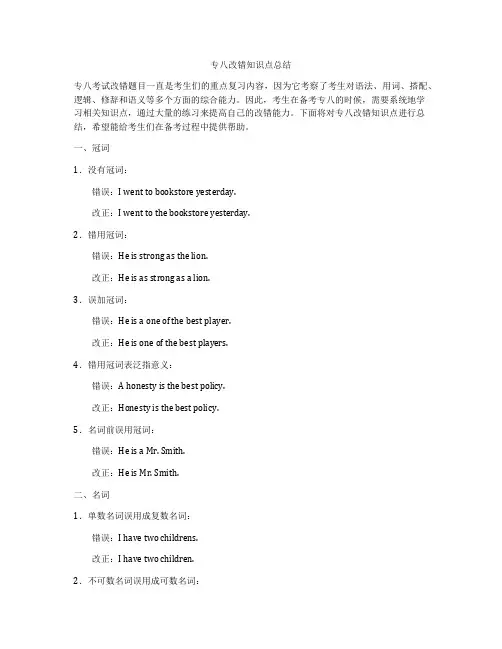
专八改错知识点总结专八考试改错题目一直是考生们的重点复习内容,因为它考察了考生对语法、用词、搭配、逻辑、修辞和语义等多个方面的综合能力。
因此,考生在备考专八的时候,需要系统地学习相关知识点,通过大量的练习来提高自己的改错能力。
下面将对专八改错知识点进行总结,希望能给考生们在备考过程中提供帮助。
一、冠词1.没有冠词:错误:I went to bookstore yesterday.改正:I went to the bookstore yesterday.2.错用冠词:错误:He is strong as the lion.改正:He is as strong as a lion.3.误加冠词:错误:He is a one of the best player.改正:He is one of the best players.4.错用冠词表泛指意义:错误:A honesty is the best policy.改正:Honesty is the best policy.5.名词前误用冠词:错误:He is a Mr. Smith.改正:He is Mr. Smith.二、名词1.单数名词误用成复数名词:错误:I have two childrens.改正:I have two children.2.不可数名词误用成可数名词:错误:We need some advices to help us.改正:We need some advice to help us.3.名词前缺少形容词:错误:She is a worker.改正:She is a hard-working worker.4.名词前误用成形容词:错误:I bought three furnitures for the new house.改正:I bought three pieces of furniture for the new house.三、代词1.误用主格代词和宾格代词:错误:Me and my friend went to the movie.改正:My friend and I went to the movie.2.误用主格代词和形容词性物主代词:错误:He is a friend of my.改正:He is a friend of mine.3.不定代词误用:错误:Does anyone disagree with me?改正:Does anyone disagree with what I say?4.人称代词误用:错误:Mary and me were at the party.改正:Mary and I were at the party.5.没有用it作形式主语:错误:To see is to believe.改正:It is to believe that is to see.四、动词1.时态误用:错误:I am knowing the truth for a long time.改正:I have known the truth for a long time. 2.语态误用:错误:The house built a few years ago.改正:The house was built a few years ago. 3.情态动词误用:错误:He can to speak English fluently.改正:He can speak English fluently.4.动词单复数误用:错误:The people in the classroom is playing.改正:The people in the classroom are playing. 5.动词后缺少宾语:错误:She enjoys.改正:She enjoys reading books.五、形容词1.错误把副词写成形容词:错误:You did so good in the test.改正:You did so well in the test.2.缺少形容词:错误:It is a idea.改正:It is a good idea.3.误用比较级:错误:He is more fatter than her.改正:He is fatter than her.【成语的替换与考查专项】要把成语说成是一个新的造词技术,也是中国人的特长,这就是成语。
英语专八改错题技巧总结
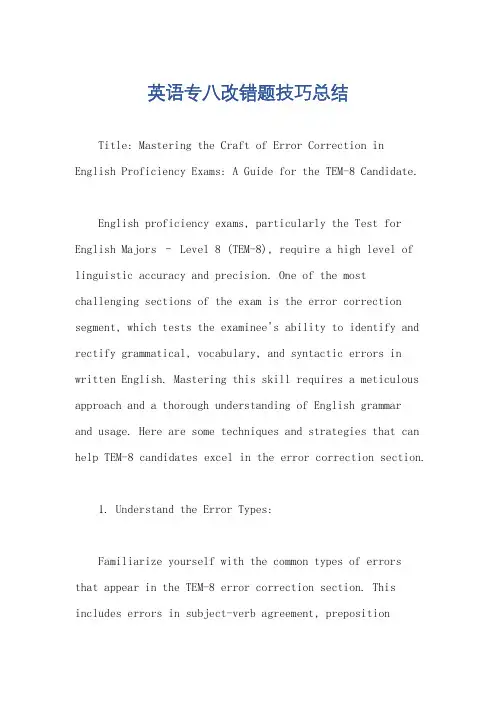
英语专八改错题技巧总结Title: Mastering the Craft of Error Correction in English Proficiency Exams: A Guide for the TEM-8 Candidate.English proficiency exams, particularly the Test for English Majors – Level 8 (TEM-8), require a high level of linguistic accuracy and precision. One of the most challenging sections of the exam is the error correction segment, which tests the examinee's ability to identify and rectify grammatical, vocabulary, and syntactic errors in written English. Mastering this skill requires a meticulous approach and a thorough understanding of English grammarand usage. Here are some techniques and strategies that can help TEM-8 candidates excel in the error correction section.1. Understand the Error Types:Familiarize yourself with the common types of errorsthat appear in the TEM-8 error correction section. This includes errors in subject-verb agreement, prepositionusage, tense consistency, article usage, comma splices, and more. By recognizing the patterns of these errors, you can quickly identify and correct them.2. Practice with Sample Questions:Utilize practice materials and sample questions to familiarize yourself with the format and difficulty level of the TEM-8 error correction section. This will help you gain confidence and identify your weak areas, which you can then focus on improving.3. Read Carefully and Slowly:When presented with a sentence containing errors, take your time to read it carefully. Do not rush through the sentence as this may lead to overlooked mistakes. Reading slowly allows you to focus on each word and its context, making it easier to detect errors.4. Prioritize Errors:Not all errors in a sentence are created equal. Some errors may be more significant than others in terms of affecting the meaning or grammar of the sentence. Learn to prioritize the more serious errors, such as those that affect the overall meaning or structure of the sentence, over minor errors like typos or punctuation mistakes.5. Use Your Intuition:Sometimes, your gut feeling can be a powerful tool in error correction. If a phrase or sentence sounds awkward or off, there's a good chance there's an error somewhere. Trust your intuition and double-check those areas for potential mistakes.6. Review Your Work:After correcting the errors in a sentence, take a moment to review your work. This step is crucial as it helps you catch any missed errors or correct any incorrect corrections. It's also a good idea to read the corrected sentence aloud to check for flow and naturalness.7. Seek Feedback:Practicing error correction alone can be limiting. Seek feedback from teachers, peers, or online communities to validate your corrections and learn from alternative perspectives. This feedback loop will help you identify and correct any blind spots in your error correction skills.8. Stay Current with Language Changes:English is a constantly evolving language, and new usages and grammar rules emerge over time. Stay updatedwith the latest language trends and developments to ensure that your error correction skills are relevant and accurate.9. Develop a Systematic Approach:Create a system or strategy for approaching error correction questions. This could involve marking potential errors, classifying them by type, and then making the necessary corrections. Having a consistent and organizedapproach will improve your efficiency and accuracy.10. Maintain a Positive Mindset:Error correction can be challenging, but it's also a valuable skill that can be improved with practice and dedication. Maintain a positive mindset and approach each practice question with confidence, knowing that every mistake is an opportunity for growth and improvement.In conclusion, mastering error correction in the TEM-8 exam requires a combination of knowledge, practice, and strategic thinking. By understanding the common error types, practicing with sample questions, reading carefully, prioritizing errors, trusting your intuition, reviewingyour work, seeking feedback, staying current with language changes, developing a systematic approach, and maintaininga positive mindset, candidates can significantly improve their chances of success in the error correction section of the TEM-8 exam.。
专八改错技巧总结
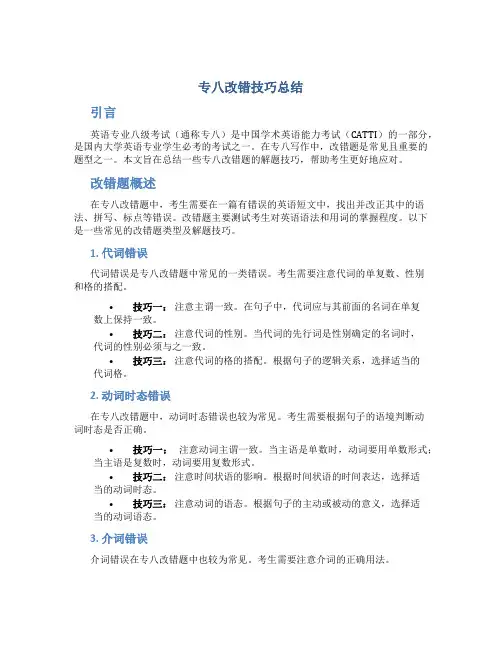
专八改错技巧总结引言英语专业八级考试(通称专八)是中国学术英语能力考试(CATTI)的一部分,是国内大学英语专业学生必考的考试之一。
在专八写作中,改错题是常见且重要的题型之一。
本文旨在总结一些专八改错题的解题技巧,帮助考生更好地应对。
改错题概述在专八改错题中,考生需要在一篇有错误的英语短文中,找出并改正其中的语法、拼写、标点等错误。
改错题主要测试考生对英语语法和用词的掌握程度。
以下是一些常见的改错题类型及解题技巧。
1. 代词错误代词错误是专八改错题中常见的一类错误。
考生需要注意代词的单复数、性别和格的搭配。
•技巧一:注意主谓一致。
在句子中,代词应与其前面的名词在单复数上保持一致。
•技巧二:注意代词的性别。
当代词的先行词是性别确定的名词时,代词的性别必须与之一致。
•技巧三:注意代词的格的搭配。
根据句子的逻辑关系,选择适当的代词格。
2. 动词时态错误在专八改错题中,动词时态错误也较为常见。
考生需要根据句子的语境判断动词时态是否正确。
•技巧一:注意动词主谓一致。
当主语是单数时,动词要用单数形式;当主语是复数时,动词要用复数形式。
•技巧二:注意时间状语的影响。
根据时间状语的时间表达,选择适当的动词时态。
•技巧三:注意动词的语态。
根据句子的主动或被动的意义,选择适当的动词语态。
3. 介词错误介词错误在专八改错题中也较为常见。
考生需要注意介词的正确用法。
•技巧一:注意介词和动词的搭配。
不同的动词搭配不同的介词,考生需要熟悉常见的搭配关系。
•技巧二:注意介词和名词的搭配。
不同的名词搭配不同的介词,考生需要熟悉常见的搭配关系。
•技巧三:注意介词和形容词的搭配。
不同的形容词搭配不同的介词,考生需要熟练掌握这些搭配关系。
4. 冠词错误冠词错误也是专八改错题中常见的一类错误。
考生需要注意冠词的用法。
•技巧一:注意可数名词和不可数名词的用法。
可数名词单数形式前常用不定冠词a/an,复数形式前不使用不定冠词;不可数名词前不使用不定冠词。
专八考试改错技巧讲解及练习题集附答案
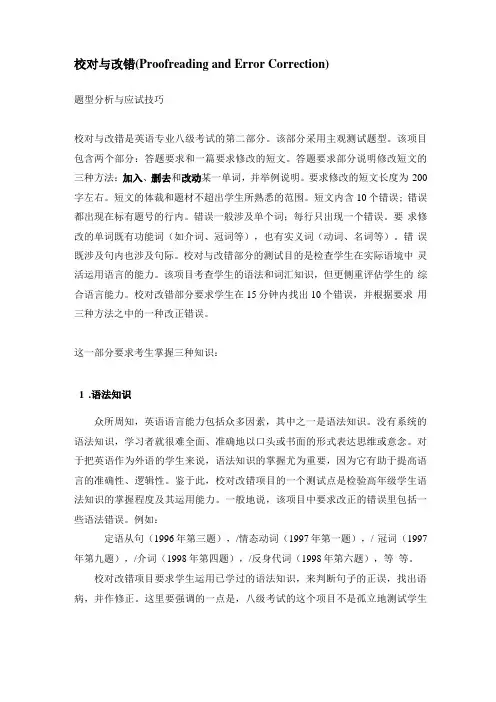
校对与改错(Proofreading and Error Correction)题型分析与应试技巧校对与改错是英语专业八级考试的第二部分。
该部分采用主观测试题型。
该项目包含两个部分:答题要求和一篇要求修改的短文。
答题要求部分说明修改短文的三种方法:加入、删去和改动某一单词,并举例说明。
要求修改的短文长度为200字左右。
短文的体裁和题材不超出学生所熟悉的范围。
短文内含10个错误; 错误都出现在标有题号的行内。
错误一般涉及单个词;每行只出现一个错误。
要求修改的单词既有功能词(如介词、冠词等),也有实义词(动词、名词等)。
错误既涉及句内也涉及句际。
校对与改错部分的测试目的是检查学生在实际语境中灵活运用语言的能力。
该项目考查学生的语法和词汇知识,但更侧重评估学生的综合语言能力。
校对改错部分要求学生在15分钟内找出10个错误,并根据要求用三种方法之中的一种改正错误。
这一部分要求考生掌握三种知识:1.语法知识众所周知,英语语言能力包括众多因素,其中之一是语法知识。
没有系统的语法知识,学习者就很难全面、准确地以口头或书面的形式表达思维或意念。
对于把英语作为外语的学生来说,语法知识的掌握尤为重要,因为它有助于提高语言的准确性、逻辑性。
鉴于此,校对改错项目的一个测试点是检验高年级学生语法知识的掌握程度及其运用能力。
一般地说,该项目中要求改正的错误里包括一些语法错误。
例如:定语从句(1996年第三题),/情态动词(1997年第一题),/ 冠词(1997 年第九题),/介词(1998年第四题),/反身代词(1998年第六题),等等。
校对改错项目要求学生运用已学过的语法知识,来判断句子的正误,找出语病,并作修正。
这里要强调的一点是,八级考试的这个项目不是孤立地测试学生的语法知识;它更偏重学生运用语法知识的能力,即怎样把书本知识转化成实际能力。
因此,对于学生来说,在平时一要巩固已学过的语法知识,理清概念;二要注重提高运用语言知识解决具体问题的能力。
专八英语改错题技巧

专八英语改错题技巧专八英语改错题技巧如何提高我们的英语能力呢?有什么好的办法吗?那么下面是店铺为大家整理的一些资料,一起来看看吧。
专八英语改错题技巧篇1一般现在时一般现在时态中,动词一般用原形。
表述事实讲真理,习惯动作常发生。
动词词尾加-s(es),只表单数三人称。
若变一般疑问句,得看句型是哪种。
系表结构和there be, be放句首可完成;若遇实义动词句,do或does莫忘用!现在进行时Look, Listen是标志,现在进行正发生;有时now在句中现,“be+v-ing”时态成。
若问be用何形式,须看主语数、人称。
He / She is, I am. We, you, they后are紧跟。
v-ing形式更好记,三种构成要分清。
一般问句be提前,be后加not否定成!基数词变序数词基变序,很容易,一二三,特殊记,th从四起。
八去t来九去e,遇到ve,f替,ty变为tie,后加th莫迟疑,若想表示几十几,只变个位就可以。
时间介词巧记歌年、月、季节前须用in,(如:in 2008, in September, in spring)日期前面行不通。
遇到几号改用on,(如:on January 1)上午、下午、晚上仍用in。
(如:in the morning/afternoon/evening)若是某日上下午,也是用on才能行。
(如:on the evening of the Mid-autumn Day) 正午、夜里用at,(如:at noon, at night)时、分用法也同理。
(如:, at two, at two)如若“差”点须加to,(如:two to two)如若“过”点改past。
(如:half past one)多说勤练牢牢记,学好英语非儿戏。
谓语be的用法我用am,你用are除此之外的单数包括他她还有它统统都是用is我们你们和他们只要复数都用are一般疑问句和否定句的变化一般问句并不难,谓语调到主语前。
专八改错
专八改错知识总结:特点:近年题目每行必定有错,每行错误只有一处且只能改一个词。
作题步骤:第一步:通读全文了解大意同时改正明显错误;第二步:逐句开始改错但是不要把目光只是盯在要改的这一句。
要前后结合,有的错误在前句(上一行埋下伏笔),错误出现在要改的这一行。
需要特别注意的就是介词、动词、平行结构、一副一形修饰名词,两形修饰名词。
不会做的先空着第三步:整体最后把握,对实在不会的行,针对考点来猜。
常见错误:1,从语篇的角度判断逻辑衔接词是否有误;2,分析句子结构,判断句子成分是否有误;3,结合上下文判断动词的时态是否有误;4,区分动词的及物、不及物性质;5,判断动词或者分词的主被动情况;6,判断冠词是否有误;7,判断介词搭配是否有误;8,判断代词是否有误;9,判断词性是否有误;10,判断比较结构是否有误;11,排查名词。
动词单复数的问题;12,判断词义表达是否准确;名词:1,可数名词永远不能单独使用,前面要有限定词,或者后面要有复试形式。
2,名词可以做定语,但是一般用单数形式。
3,Poetry 诗歌总称poem 一首诗歌复数:poems4,Person复数是people,但是当表示郑重或者贬义时,可以出现persons。
5,Human being(单)human beings(复)动词:1,及物动词:Inhabit sp.Approach sp (当作……的方法讲时,用介词to)Remove 作迁移、移居,不及物;作去除、排除,及物;Date sb. 与……约会2,如果动词出现在句尾,一定要注意这个动词后面是否缺少介词。
3,当一个句子从头到尾都似乎正确,这时可以把注意力集中到动词上面。
看动词到底是及物动词还是不及物动词。
不及物动词就要借助介词来表达意思。
4,Keep/have/make 后面要接形容词做宾语补足语,而不是接副词。
5,注意有些动词为或者可以做系动词,其后面加的是形容词,而不是副词。
这些动词有:Be,keep,remain,stay,lie,stand,seem,appear,look,feel,smell,sound,taste,become,grow,turn,fall,get,go,come,run,prove,turn out;6,return back home back要去掉1,遇到形容词最高级时,注意该形容词是单音节还是多音节。
最强专八改错总结(华研、星火)
八大类错误:1.短语搭配错误;2.易混词错误;3.逻辑关系错误;4.代词错误〔一致错误〕;5.冠词错误;6.形容词和副词使用错误;7.成分残缺或冗余;8.动词时态或语态错误。
〔注意:带—>的表示前边的是错误的,后边的是改正之后的;其他的没有正确错误之分〕1.短语搭配错误〔大局部为介词错误〕carry/get with things –>carry/get on with thingsto let alone –> let alonein return to –> in return for the need of –> the need forsubstitute A with B –> substitute A for Baccount 70% --> account for 70%under the grounds of/that –> on the grounds of/thatattitude on life –> attitude towards/to lifein a quick speed –> at a quick speedwith many respects –> in many respectsat the face of –> in the face(s) ofconsiderations to… –> considerations for…become victims of …--> become victims to …ride in a train –> ride on a train the problems with the government–> the problems for thegovernmentresistive against –> resistivetoresistance of –> resistance toembark sth –> embark on sthwith the belief that –> in thebelief thatat advance of sth –> in advanceof sthinterpret… to –> interpret…asin line to –> in line withto varing degrees –> in varingdegreestake pride of –> take pride inleap out to me –> leap out at meinject them lethal strains –>inject them with lethal strainscharge him with the same price–> charge him the same priceimbalance of A and B –>imbalance between A and Bshortage of protein with them –>shartage of protein among themfortify sb for sth –> fortify sbagainst sth (加强…以抵御…)shed light to sth –> shed lighton sthin proportion with –> inproportion topay for it with dollars –> payfor it in dollarsbe in liberty to –> be at libertytobegin at doing –> begin withdoingbe contrasted to –> becontrasted withcommit an offence to –> commitan offence againstmodern time –> modern timesability of (doing) sth –>ability in (doing) sthdefend sth against –> defend sthfromat the first place –> in thefirst placepay money in doing –> pay moneyfor doingtake to do –> take to doing (“求助于,开场〞,to为介词)yearn to –> yearn forat average –> on averageidentify oneself to –> identify oneself withbe successful on doing –> be successful at/in doingget one’s teeth on –> get one’s teeth into(埋头做,认真做)the action of formation –> the action of forming (of后应接动名词而非名词)approach to do … –> approach to doing …one contributor of –> one contributor toconsumers demand of luxury goods –> consumers demand for luxury goodson one’s 30s –> in one’s 30s balk to –> balk at (回避,绕过)differ A from B –> distinguish A from Bsuit to sb/sth –> suit forsb/sthvary by – vary withemphasis of – emphasis on 2.易混词错误(1)形近异义词imaginative – imaginaryadapt – adoptconfirm – conformformer – formal diary – dairypersonal – personnelbeside – besidesprincipal – principleintelligent – intelligibleconscious – conscientiousstationary – stationeryconsiderate – considerableaffect(影响) – effect(致使、达成)contact – contractmoral – moraleindustrious – industrialdesert – dessertrequire – acquire – inquirepresence – presentationsensible – sensitivetransformation – transmissionvalue – evaluatetense – tensionanything – somethingcooker – cookcomplexity(复杂性) –complex(合成体)insurance – assuranceprovide(提供) –provided/providing(假设,如果)perceive – conceiveeffective(有效的) –affective(受…影响的,由…引起的)(2)形近(形异)近义词latter – laterlate(迟的,已故的) –latest(最晚的,最新的)farther(距离更远) – further(程度更进一步)healthy(安康的) – healthful(有益安康的)effective – efficientcontinual(连续的) –continuous(持续不断的)respectable – respectfulhistoric – historicalrise –arise –raise –arousesure – insure – ensure –assurein return to – in response toopposite – oppositionproducing – productivelonely – aloneacross – crossimpressed -- impressivepermit(n.通行证) – permissionrelating – relatedmemorizing – memorablenormal(n.常态,通常标准,一般水平) – norm(规,行为标准)favorite – favorableacceptability – acceptanceeconomical – economicfew – littlea few – fewlittle – a littleinvent – discoverbefore – agoanother – otheragent(代理人) – agency(代理机构)reward(回馈) – award(奖赏)special – specific(3)兼有两种形式的副词firstly –first (firstly用于列举条目或者表示顺序,first表示时间上“第一次、首次〞)hardly(几乎不) – hard(努力地)sure – surelylate – latelyclear(完全地、径直地) –clearly(显然、清楚地)high(高度高地) –highly(程度高地、非常)close(接近地、严密地) –closely(严密地、严密地)most(最) – most(大局部)(4)反义词with – withoutpossible – impossiblesubjective – objectiveimport – export better – worseemployee – employeremployment – unemploymentmodifiable – unmodifiablenatural – unnaturaldiscernable – indiscernablelent – borrowedexclusive – inclusiveindependency – dependencywilling – unwillingnothing more than –nothing lessthanagree – disagreerarely – frequently / oftenspecific – generalless –more (still more–stillless)most – leastknown – unknownrespective – irrespective(irrespective of表示“不管…〞)majority – minorityresult in – result fromfortunately -- unfortunatelypowerful – powerlesseasiness – uneasinessprofessional – amateuraware – unawareinclude – exclude(5) 名词单复数异义moral – morals(作名词时用复数形式,表示“道德、伦理〞)collection(不可数名词表示“各种因素集合体〞) –collections(可数名词表示“收藏品〞)manner(方法,方式) – manners(礼仪,礼节)saving – savings(复数表示“存款〞)specie(硬币) – species(种类)〔species只有单数〕mean(n.平均值) – means(方法)(6) 易混短语live with(同…一起生活,忍受) –live by(靠…过活)go about (doing) sth(开场做某事,四处走动,流传,经常从事于) – goaround(四处走动,绕道走)tend to – intend toin next week(以当下时间为基准点)– in the next week(以过去的时间为基准点)spend… in doing sth –spend…on sthdie of(部) – die from(外部)rather than – other thanhave sb do sth – have sth donetake on(从事,开场对付,呈现) –go on(继续)take place – take the place ofconsist in(在于) – consistof(包括)in all(总共) – after all(毕竟)in return(作为报答) – inturn(反过来,轮流)one reason for +短语– one reason why +句子bring out(使显露,使显现) –bring up(教育,培养,提出,(船)抵达目的地)be worth doing – be worthwhile to doreact to(对…作出反响) – react with(以…作出反响)apply… to(将…应用于) – apply for(请求,申请)3.逻辑关系错误〔连词使用错误〕therefore –nevertheless/however (大局部therefore都要改为however,反之亦然)and – but / whileor – andbut – becausemoreover – howeverafter – beforesince – althoughthere is no…–there is also…that – iffrom now on – from then onall – none besides – yetif – unlessbesides – excepttherefore – becauseso – becauseso does he… –neither/nor doeshe…that’s why +结果–that’sbecause +原因as if – even ifwhether – if4.代词错误〔一致错误〕their – itsthat – those (需要特别注意)which – that (有些情况下关系代词只能用that)which – whatit – itself (主宾一样,宾语用反身代词)that/this – it (只有it可作形式主语)his –one’s (泛指时用one)you – yourselfit – theythis – suchXX is less sophisticated thanwhat they are today –XX is lesssophisticated than they aretoday5.冠词错误(1)定冠词多余on the either side –> on eithersidein the Europe –> inEuropein the winter –> in winter (季节前不加定冠词)Kaufman, the/an author of arecent book –Kaufman, author ofa recent book(同位语间完全对等关系,不必使用冠词)take the issue –> takeissue(对…持异议,不同意)(2)定冠词缺漏among most –> among the mostone of first –> one of the firstatmosphere –> the atmosphere(表示独一无二的事物)〔另外还有如:the Equator, the Outerspace〕between us and rest –> betweenus and the restin minority –> in the minorityaround floor –> around the floorpiano –> the piano (西洋乐器的前面要有定冠词)English language –> the Englishlanguageat heart of –> at the heart ofworld –> the world(表示“地球〞这种独一无二的事物要加定冠词)in long run –> in the long run(3)定冠词与不定冠词之间的误用illustrate the further difference –> illustrate a further difference (diference第一次提及)注意以下短语的区别in church – in the churchat college – at the collegein court – in the courtin hospital – in the hospital in office – in the officein prison – in the prisonat sea – at the seain school – in the schoolat table – at the table6.形容词与副词使用错误have been currently –> currentbe well equipped as –> be as well equipped asheavy industrialized –> heavily-industrializedspread colossal –> spread colossallysimilar strong –> similarly strongkeep the number constantly at X a year –> keep number constant at X a yearfeel hopeless thwarted –> feel hopelessly thwarted comparative high proportion –>comparatively high proportion(quakes) start deeply in theearth –> start deep in the earthin the passed 5 years –> in thepast 5 yearsculture embedded attitudes –>culturally embedded attitudesas much as –> as often asfrom one meter afar –> from onemeter awayincreasing –> increasinglysimple –> simplypure –> purelymuch –> manymany –> morelarge –> largerearly –> earlier7.成分残缺多余(单复数)a world which I could get… –>a world in which I could get…shows –> that shows (先行词在定语从句中作主语,关系代词不可省略)take for granted that –> take itfor grated that1980 –1980sone of the most glaring form –>one of the mist glaring formstheir jobs engage in theirinterest –> their jobs engagetheir interest (engage单独使用表示“占用〔某人时间〕,吸引〔某人注意力〕〞)complain about sth –> complainsthwork sth –> work out sthbelieve in –believe (believe单独使用表示一般的“相信〞,believe in表示“信任某人,信仰…〞)point sth –> point out sth20 percents –> 20 percenteyes contact –> eye contactseven – sevenththe process which it function –>the process by which it functioncommunication service –>communication s service (通信效劳、通讯效劳)average incomes –> averageincome (income为不可数名词)the like of –> the likes of(诸如此类的)be referred to XX –> be referredto as XXbe viewed as work of are –> beviewed as a work of art(work作为“作品〞讲时,为可数名词)8.时态或语态错误went – goagreeing – agreedconsisted – consistingbored – boringfavoring – favoredif she was –> if she were(非真实条件句)involves – involvingwill – would (虚拟语气中)delaying – delayed (已完成概念或者被动概念)the promise of improving quality of life –> the promise of improved quality of life (已完成概念或者被动概念)assure –assures (第三人称单数)have – has (要看清句子真正的主语)developing – developedconfronting – confrontedthe least understanding –> the least understoodwhat the have told – what they have been toldif circumstances become favorable – if circumstances should become favorable。
专八英语改错技巧口诀
专八英语改错技巧口诀专八英语改错技巧口诀短文改错对考生的要求较高,是对语言知识综合运用能力的考查,检测考生发现、判断、纠正文章错误的能力,进而考查学生的词法、句法及行文逻辑等方面的水平。
下面是店铺为大家收集整理的专八改错技巧口诀,欢迎阅读。
专八英语改错技巧口诀通读全文,了解大意通过阅读全文,从宏观上把握文章的主旨、时态、人称,做到心中有数。
逐句推敲,仔细审查仔细阅读每个句子,从语法角度审查重读全文,完善答案改完后对全文进行重新回顾,检查已修改的部分是否符合语法逻辑等。
检查对象1. 句中各部分的结构是否完整,特别是每个句子要有动词;2. 谓语动词的时态、语态;3. 非谓语动词的用法;4. 名词的单、复数,格的使用是否正确;5. 定冠词和不定冠词是否正确;6. 代词的格和性的使用是否有误;7. 定语从句中关系代词、关系副词是否准确无误;8. 并列句中的'并列连词、主从复合句中的从属连词用的是否得当。
从语法角度审查1. 查看时态是否一致My favorite sport is football. I was a member of our football team.全文都是用的一般现在时,此句中的was显然与上下文语境不符,应改为am。
2. 查看主谓是否一致Anyone may borrow books, and it cost nothing to borrow them.cost应改为costs,因其主语是it(为形式主语),且上下文均为一般现在时。
3. 查指代是否一致The Smiths did his best to make me feel at home.句中的主语the Smiths表的是Smith一家人,因此指示代词his 应改为their。
4. 查平行结构是否平行一致由and, or, but, either...or..., neither...nor..., not only...but also..., as well as等并列连词和词组连接的结构可称为平行结构。
专八改错技巧总结
专八改错技巧总结专八改错技巧总结专四、专八是中国的两个重要的英语水平考试,对于许多英语学习者而言,通过这两个考试是他们追求的目标。
其中,专八考试中的改错题是英语学习者们较为头疼的题型之一。
因此,掌握改错技巧对于备考专八至关重要。
以下是一些专八改错题的技巧总结。
首先,理解题意是解决改错题的关键。
在做改错题时,必须认真阅读句子,理解上下文的意思,判断句子中哪个部分存在错误。
有时候,错误可能出现在主语、谓语、宾语、介词等不同的部分,因此要仔细判断。
此外,有些错误可能是隐藏的,需要仔细体察语法规则和句子的逻辑关系。
其次,掌握常见的语法错误是必要的。
在专八改错题中,经常出现的错误包括代词的使用、动词时态和语态、冠词的使用等。
例如,一些学生容易在使用代词时出现指代不清或主谓不一致的错误。
此外,动词时态和语态的使用也是改错题中常见的错误项目。
学生们应该掌握这些常见错误,通过刻意练习来提高自己的语法水平。
此外,注意句子的逻辑关系也是解决改错题的关键。
在改错题中,有时句子的结构和语法并没有错误,但句子之间的逻辑关系却存在问题。
例如,有些学生在连接两个句子时使用错误的连词或者错用从属连词。
这会导致句子之间的逻辑关系不明确,给阅读者造成困惑。
因此,在做改错题时,需要注意句子之间的逻辑关系,判断连词的使用是否正确。
最后,提高阅读理解能力是解决改错题的关键。
在专八改错题中,要求学生能够在短文中发现错误,并加以修正。
因此,阅读理解能力是解决改错题的基础。
阅读理解不仅包括对句子意思的理解,还包括对语境的把握。
为了提高阅读理解能力,学生们可以多读一些英文原文,从中学习正确的语法和表达方式。
综上所述,专八改错题是考查学生英语水平的重要环节。
学生们只有掌握了改错题的解题技巧,才能更好地备考专八。
因此,我们需要理解题意、掌握常见的语法错误、注意句子的逻辑关系,并提高阅读理解能力。
通过不断的练习和积累,相信大家一定能够在专八考试中取得好成绩。