
8A Unit 1 Main Task 教学反思英文版(附教案)
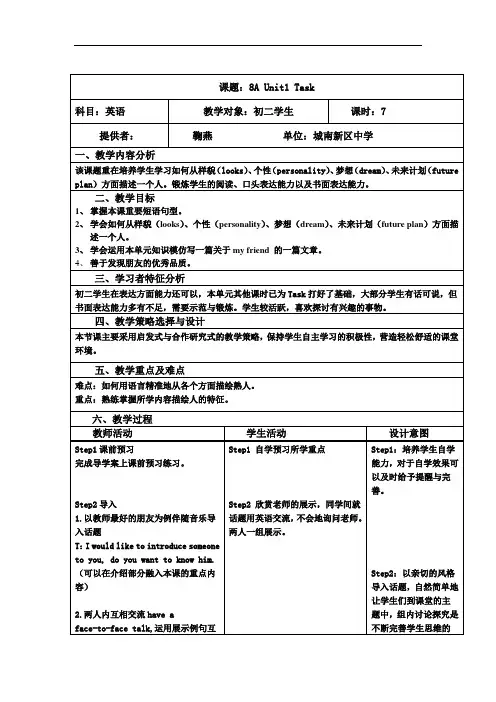
8A Unit 1 Main Task 教学反思英文版(附教案)Teaching reflection:In order to advance with the development of the new curriculum reform, the Yancheng Teaching and Research Institute sponsored the annual Top-quality Courses Competition. I, luckily, took this rare opportunity to participate in this competition on December 7th. All of the competitors were from different counties. They had the same goal, that is, to show their teaching style so as to promote academic changes between themselves. I felt a little nervous at first, because it was my first time to take part in such a competition. In addition, there was little time for me to do enough preparation and put it into practice. With the help of my colleagues and their encouragement, I decided to try my best. I chose the part of Main Task as my teaching material. After I studied the text, I found that the main goals of this period were to make the students master the new words about people’s personality, appearance and to train the students’ability to write an article about himself/herself or his/her best friend. Based on the knowledge aims, I also had to help realize students’emotional aim, say, to enable the students to know what kind of a friend is a true friend and how to make good friends. This was a valuable experience for me. After this competition, I realized that I had learnt a lot from practice and others.Now I’d like to analyze my teaching from the following aspects:ⅠPreparation and teaching processDuring my preparation, I prepared a lot of pictures to realize the revision and teaching of the new words. I found that they were quite attractive when students saw them during the teaching. To some extent, the use of the pictures of some famous stars could cultivate students’interest to use the adjectives to describe their appearance, personality and etc. When I had to teach the related words about the face, for example, round and square, I presented some cartoons for comparison. As far as the adjectives of eyes and nose were concerned, I also used some flashcards for presentation and comparison. The students inclined to look and say something about the pictures, using the related adjectives. When I taught the words of one’s figure and personality, I first called some students to tell me what kind of friends they would like to choose as their best friends. I gave them some hints when they met some difficulties. Then, I presented some pictures for a small talk, getting students to talk about the personalities of different people and what kind of person they would like to be. After this, I gave students some time to describe the famous stars, for instance, Yao Ming, Harry Porter, S.H.E and etc., which could help them to understand the meanings of the adjectives. During the reading part, I presented some questions and tasks for students to answer and fulfill. Owing to the use of multimedia, students could answer the questions quickly and effectively. In order to avoid the one-sidedness of comprehension, I gave students more time to read and practice. The total goal was to develop students’ability to write an article about his/her best friend. To serve this goal, I designed some questions for them to answer in advance and got students to talk and make a conclusion. In this part, I used a game to help, say, a guessing game, asking students to write down something about his/her friend and read it aloud for others to guess who he/she was. This method, I thought, conquered the monotony of writing. I outlined the importance of being an honest, kind-hearted and helpful person. At last, I played a poem for students to enjoy and imitate, which, as I saw it, would possibly raise the theme to a higher level. ⅡStudents’learning processThis was the first time that I came to Jianhu. All of the things were strange to me. I knewnothing about the school and the students. In order to make better exchanges between the students and me in class, I stepped into their classroom and introduced myself to them before my class. They felt quite strange initially, but later they felt excited. I asked them to try their best in my class. All of them nodded and it seemed that we became closer. However, when it came to my class, they felt quite nervous just in front of the teachers from different places. Before class, I tried to relax them by singing a song and asking them to wave their hands. They were very cooperative. I felt a little more confident. During the class, I proceeded well as I designed. Once I raised a question, most of the students could undertake brainstorm and gave me the correct answers. When the discussion time came, I divided them into groups of four, asking them to do related tasks. What I didn’t expect was that they preferred not to come to the front for acting. I felt a bit embarrassed at first, but I respected their choices and dealt with it properly. For most of the time, all of the students were very hard-working. It seemed that they had grasped all the knowledge effectively in this period. However, I found some problems when they stood up to give me answers. At that time, I felt nervous about my teaching effect. “Was my teaching method unsuitable for them?”, I said to myself, but I had no time to think. I tried to speak more slowly and clearly, giving them more time to think and speak. It really worked. The students and I cooperated well during the following steps. In my teaching process, I felt it a pity that I didn’t give the students time to present their papers and correct their mistakes, which I thought I should keep in mind for future teaching. After the class, our instructor gave me some advice, which was quite acceptable and suitable to me.ⅢThe organization of the classIn terms of my organization of the class, there were seven steps in detail. They were warm-up, revision, presentation, practice, conclusion, discussion and writing. From the angle of the time control, all of the steps were carried out successfully during my class. Warm-up and revision occupied about 8 minutes; presentation occupied 5 minutes; practice accounted for half of the class; writing lasted about 7 minutes. I was quite satisfied with the part of oral practice, because every student participated in listening and talking. They could give correct answers when they stood up. The feedback information was ideal at this point. Meanwhile, I was not satisfied with the writing part, as I mentioned in partⅡ.Although students had time to write their compositions, they didn’t have the opportunities to know how well they had written. They should get some comments on their composition, for instance, grammar, sentence structure, hand-writing and so on. If I had five more minutes, I would present their papers to the whole class and gave some corrections if necessary. The last part was enjoying a poem, which was related to the theme of the class. Because of the limited time, I didn’t realize the teaching aim of this part. I just called them to read it. If I removed this part, I thought it would be better for the writing exercise.All in all, on one hand, this was a comparatively successful class. On the other hand, during my competition, I found some unsatisfactory elements in my teaching. I think it would be better for me to improve the teaching procedure for future use. In addition, the classed should be practical and adhere to the students’ability. I learned a lot from my experience and my instructor’s guide. In order to realize the new concept of teaching, I think I need to do more research on the textbook and learn more from the others.by Zhong PingpingDecember 12th, 20068A Unit One Main Task teaching planZhong Pingping from Dafeng Middle SchoolTeaching aims:(1). Knowledge aims:A. To make the Ss. master some new words about people’s personality. appearance and future plans.B To let Ss understand the passage better.(2). Ability aims:A. To develop the Ss’abilities of listening, speaking, reading and writing.B. To train the Ss’ability of working in groups.(3). Emotional aims:A To enable the Ss to know what kind of friend is a true friend and how to make good friends.B. To enable the Ss to communicate with each otherTeaching focuses: To help to train the students’abilities of expressing themselves in EnglishA. To help the Ss to communicate with each other.B. To enable the Ss to study in groups and co-operate skillfully.C. To develop the Ss’interest in English.Teaching difficulties:(1) How to describe a person.(2) How to write a passageTeaching Methods:(1). Communicative teaching method(2). “Task-based”teaching methodTeaching ProceduresStep1 warm up1. Free talk between T and Ss.Such as: Fine weather, isn’t?Do you like this kind of weather?What will you do on such a find day?Who do you want to do with?Step2. revision1. ask a few questions about friends.For example: What does your friend look like?What kind of person is your friend/What does your friend like?What does your friend do or want to do in the future?What made you become good friends?2. let students practice in pairs.Step3.presentation1. show pictures of stars and let Ss say sth. about appearance and guess their personalities. let Ss work in pair to describe persons2. play a gameI will let Ss describe a person in our class to ask other students guess.Step4.listening and practice1. play the tape recorder. Let the Ss listen and answer some questions. For example, Who isDaniel’s friend? Where does she live? What is she like? What would she like to do when she grows up?2. play the tape again ask the student read aloud after the tape then fill a table. is employed to make the Ss grasp the main idea of the text. .Step5.make a conclusionHow to write a passage:Introduction: say who is your best friend is.Main body: describe his/her appearancedescribe his/her personalityConclusion: describe his/her future planStep6discussionI will say: we have learnt a lot about friends. If you choose a boy or a girl as your best friend, what will you thank about? Here are some questions for you to discussion.What is his/her nameWhat is he/she like (appearance)What’s his/her personalities, qualities and abilities?What does he/she like doingWhat would he/she like to do in the futureThen let them have a competition.Then make a conclusion: a friend in need is a friend indeed.Step7.Homework:(1)Recite the words as many as possible after class.(2) Write an article about your friend.。
教学反思英文版(附教案)

8A Unit 1 Main Task 教学反思英文版(附教案)大丰实验初中钟萍萍Teaching reflection:In order to advance with the development of the new curriculum reform, the Yancheng Teaching and Research Institute sponsored the annual Top-quality Courses Competition. I, luckily, took this rare opportunity to participate in this competition on December 7th. All of the competitors were from different counties. They had the same goal, that is, to show their teaching style so as to promote academic changes between themselves. I felt a little nervous at first, because it was my first time to take part in such a competition. In addition, there was little time for me to do enough preparation and put it into practice. With the help of my colleagues and their encouragement, I decided to try my best. I chose the part of Main Task as my teaching material. After I studied the text, I found that the main goals of this period were to make the students master the new words about people’s personality, appearance and to train the students’ability to write an article about himself/herself or his/her best friend. Based on the knowledge aims, I also had to help realize students’emotional aim, say, to enable the students to know what kind of a friend is a true friend and how to make good friends. This was a valuable experience for me. After this competition, I realized that I had learnt a lot from practice and others.Now I’d like to analyze my teaching from the following aspects:ⅠPreparation and teaching processDuring my preparation, I prepared a lot of pictures to realize the revision and teaching of the new words. I found that they were quite attractive when students saw them during the teaching. To some extent, the use of the pictures of some famous stars could cultivate students’interest to use the adjectives to describe their appearance, personality and etc. When I had to teach the related words about the face, for example, round and square, I presented some cartoons for comparison. As far as the adjectives of eyes and nose were concerned, I also used some flashcards for presentation and comparison. The students inclined to look and say something about the pictures, using the related adjectives. When I taught the words of one’s figure and personality, I first called some students to tell me what kind of friends they would like to choose as their best friends. I gave them some hints when they met some difficulties. Then, I presented some pictures for a small talk, getting students to talk about the personalities of different people and what kind of person they would like to be. After this, I gave students some time to describe the famous stars, for instance, Yao Ming, Harry Porter, S.H.E and etc., which could help them to understand the meanings of the adjectives. During the reading part, I presented some questions and tasks for students to answer and fulfill. Owing to the use of multimedia, students could answer the questions quickly and effectively. In order to avoid the one-sidedness of comprehension, I gave students more time to read and practice. The total goal was to develop students’ability to write an article about his/her best friend. To serve this goal, I designed some questions for them to answer in advance and got students to talk and make a conclusion. In this part, I used a game to help, say, a guessing game, asking students to write down something about his/her friend and read it aloud for others to guess who he/she was. This method, I thought, conquered the monotony of writing. I outlined the importance of being an honest, kind-hearted and helpful person. At last, I played a poem for students to enjoy and imitate, which, as I saw it, would possibly raise the theme to a higher level. ⅡStudents’learning processThis was the first time that I came to Jianhu. All of the things were strange to me. I knewnothing about the school and the students. In order to make better exchanges between the students and me in class, I stepped into their classroom and introduced myself to them before my class. They felt quite strange initially, but later they felt excited. I asked them to try their best in my class. All of them nodded and it seemed that we became closer. However, when it came to my class, they felt quite nervous just in front of the teachers from different places. Before class, I tried to relax them by singing a song and asking them to wave their hands. They were very cooperative. I felt a little more confident. During the class, I proceeded well as I designed. Once I raised a question, most of the students could undertake brainstorm and gave me the correct answers. When the discussion time came, I divided them into groups of four, asking them to do related tasks. What I didn’t expect was that they preferred not to come to the front for acting. I felt a bit embarrassed at first, but I respected their choices and dealt with it properly. For most of the time, all of the students were very hard-working. It seemed that they had grasped all the knowledge effectively in this period. However, I found some problems when they stood up to give me answers. At that time, I felt nervous about my teaching effect. “Was my teaching method unsuitable for them?”, I said to myself, but I had no time to think. I tried to speak more slowly and clearly, giving them more time to think and speak. It really worked. The students and I cooperated well during the following steps. In my teaching process, I felt it a pity that I didn’t give the students time to present their papers and correct their mistakes, which I thought I should keep in mind for future teaching. After the class, our instructor gave me some advice, which was quite acceptable and suitable to me.ⅢThe organization of the classIn terms of my organization of the class, there were seven steps in detail. They were warm-up, revision, presentation, practice, conclusion, discussion and writing. From the angle of the time control, all of the steps were carried out successfully during my class. Warm-up and revision occupied about 8 minutes; presentation occupied 5 minutes; practice accounted for half of the class; writing lasted about 7 minutes. I was quite satisfied with the part of oral practice, because every student participated in listening and talking. They could give correct answers when they stood up. The feedback information was ideal at this point. Meanwhile, I was not satisfied with the writing part, as I mentioned in partⅡ.Although students had time to write their compositions, they didn’t have the opportunities to know how well they had written. They should get some comments on their composition, for instance, grammar, sentence structure, hand-writing and so on. If I had five more minutes, I would present their papers to the whole class and gave some corrections if necessary. The last part was enjoying a poem, which was related to the theme of the class. Because of the limited time, I didn’t realize the teaching aim of this part. I just called them to read it. If I removed this part, I thought it would be better for the writing exercise.All in all, on one hand, this was a comparatively successful class. On the other hand, during my competition, I found some unsatisfactory elements in my teaching. I think it would be better for me to improve the teaching procedure for future use. In addition, the classed should be practical and adhere to the students’ability. I learned a lot from my experience and my instructor’s guide. In order to realize the new concept of teaching, I think I need to do more research on the textbook and learn more from the others.by Zhong PingpingDecember 12th, 20068A Unit One Main Task teaching planZhong Pingping from Dafeng Middle SchoolTeaching aims:(1). Knowledge aims:A. To make the Ss. master some new words about people’s personality. appearance and future plans.B To let Ss understand the passage better.(2). Ability aims:A. To develop the Ss’abilities of listening, speaking, reading and writing.B. To train the Ss’ability of working in groups.(3). Emotional aims:A To enable the Ss to know what kind of friend is a true friend and how to make good friends.B. To enable the Ss to communicate with each otherTeaching focuses: To help to train the students’abilities of expressing themselves in EnglishA. To help the Ss to communicate with each other.B. To enable the Ss to study in groups and co-operate skillfully.C. To develop the Ss’interest in English.Teaching difficulties:(1) How to describe a person.(2) How to write a passageTeaching Methods:(1). Communicative teaching method(2). “Task-based”teaching methodTeaching ProceduresStep1 warm up1. Free talk between T and Ss.Such as: Fine weather, isn’t?Do you like this kind of weather?What will you do on such a find day?Who do you want to do with?Step2. revision1. ask a few questions about friends.For example: What does your friend look like?What kind of person is your friend/What does your friend like?What does your friend do or want to do in the future?What made you become good friends?2. let students practice in pairs.Step3.presentation1. show pictures of stars and let Ss say sth. about appearance and guess their personalities. let Ss work in pair to describe persons2. play a gameI will let Ss describe a person in our class to ask other students guess.Step4.listening and practice1. play the tape recorder. Let the Ss listen and answer some questions. For example, Who isDaniel’s friend? Where does she live? What is she like? What would she like to do when she grows up?2. play the tape again ask the student read aloud after the tape then fill a table. is employed to make the Ss grasp the main idea of the text. .Step5.make a conclusionHow to write a passage:Introduction: say who is your best friend is.Main body: describe his/her appearancedescribe his/her personalityConclusion: describe his/her future planStep6discussionI will say: we have learnt a lot about friends. If you choose a boy or a girl as your best friend, what will you thank about? Here are some questions for you to discussion.What is his/her nameWhat is he/she like (appearance)What’s his/her personalities, qualities and abilities?What does he/she like doingWhat would he/she like to do in the futureThen let them have a competition.Then make a conclusion: a friend in need is a friend indeed.Step7.Homework:(1)Recite the words as many as possible after class.(2) Write an article about your friend.。
《牛津初中英语》Main Task的教学误区及对策-最新文档

《牛津初中英语》Main Task的教学误区及对策由译林出版社和牛津大学出版社联合编写出版的《牛津初中英语》,该教材在编排和设计上突破了传统的模式,体现了语言教学的整体性和综合性。
其中的MainTask板块更是具有写作指导的特色,突显了新的教学理念。
下面,笔者根据教学《牛津初中英语》Main Task部分的教学实践和体会,谈谈Main Task在英语教学中的重要作用、存在的种种误区以及本人在教学实践中探索出的行之有效的教学方法。
一、Main Task在英语教学中的重要作用《牛津初中英语》每个单元由九个板块组成,它们分别是卡通漫(Comic strip),导入(Welcome to the unit),阅读(Reading),词汇(Vocabulary),语法(Grammar),综合技能(Integrated skill),学习技巧(Study Skill)/语音(Pronunciation),中心任务(MainTask)和检测(Checkout)。
而其中的中心任务(MainTask)则体现了这一单元的最终结果,也是每个单元的高潮部分。
在这里,教师要引导帮助学生综合运用本单元所学的知识和形成的技巧能力,完成特定的书面表达,即“写”的任务。
在整个中学阶段,写的训练应贯穿于教学的全过程。
《牛津初中英语》按照任务型教学的原则设计了语言实践活动。
MainTask是整个单元的精华所在,它是一个使学生综合语言运用能力得到升华的板块。
如何将它上得精彩,发挥出它的应有的教学作用,是一个非常值得探讨和研究的问题。
二、Main Task内容的构成及教学中存在的误区1.Main Task内容的构成。
Main Task在内容上大致分为两块:第一块要求学生通过阅读文章或流程图等获取信息,并用获取的信息来回答问题或完成短文填空等练习。
这一部分可以看作是一种语言的“输入”。
学生通过这一部分的训练,可以理解和领悟到文章的篇章结构、词汇的基础知识、词、句与文章结构的组织方式等,为以后写作奠定基础;第二块要求学生在学习第一部分和整个单元的基础上进行仿写,这是学生对整个单元所学的语言知识、语言技能的“输出”。
8A牛津英语教学反思

《对8A牛津英语U5 Look It Up导入课的教学反思》Teaching Aims:1. To discover and activate any background of the topic “Look it up2.To increase knowledge and develop skills.3. To motivate the students’ interest of learning English.Important and difficult points: To enable the students to get a general idea of what the text is about.Teaching aids: multi- mediaTeaching procedure:I. Warming up1.Quick responses:What’s the answer of 9 plus 4?What’s the answer of 9 minus 3How much is 3 multiplied by 7?What’s the answer of 12 divided by 4?Can you explain the word “develop” in English?If you don’t know how to use a word, what will you do?2.Cartoon picture --Is my encyclopedia useful, Lo?--Yes, Hi. Very useful.II Presentation:1. Picture showing.通过直观教学图片展示,提高学生的学习兴趣,问题切入:What do you know about? Do you know anything about dinosaurs, Diogenes and Walt Disney? 2. Ask students to look at the pictures and try to complete the exercise.III: Short stories.1.Read the story and answer the questions.通过英语故事“Mickey Mouse And Donald Duck.”及Three Pigs Build A House的阅读进一步培养学生学习英语的兴趣2.Retell the story with the help of the questions. 通过对故事的复述培养学生的语言表达能力。
新牛津译林版八年级上册第一单元task教学设计和教学反思
Step4:以文章为例,锻炼学生总结框架,并根据框架复述课文能力,小组竞争激发学生斗志,多放框架实例描述人,为写作文打好铺垫与基础。
Step5:为了培养学生的实际运用能力,让学生根据之前的铺垫,亲自动手设计,强调不落俗套。动用评价手段,小组成员推选优秀作文进行比赛,从学习中获得乐趣。
二、教学目标
1、掌握本课重要短语句型。
2、学会如何从样貌(looks)、个性(personality)、梦想(dream)、未来计划(future plan)方面描述一个人。
3、学会运用本单元知识模仿写一篇关于my friend的一篇文章。
4、善于发现朋友的优秀品质。
三、学习者特征分析
初二学生在表达方面能力还可以,本单元其他课时已为Task打好了基础,大部分学生有话可说,但书面表达能力多有不足,需要示范与锻炼。学生较活跃,喜欢探讨有兴趣的事物。
3.请两三组同学展示对话
Step3课内探究
1.请同学们思考如何描述一个人(how to say something about somebody)?从几个方面?
2.请同学们总结并给出答案。(小组讨论竞争)
Name:
Address:
Appearance:
QualiDaniel
七、教学评价设计
见附件
八、板书设计
Unit1 Task My Best Friend
Name:
Address:
Appearance:eyes(bright, dark brown, small) hair(...) build(...)
Qualities:
8aUnit1Maintask
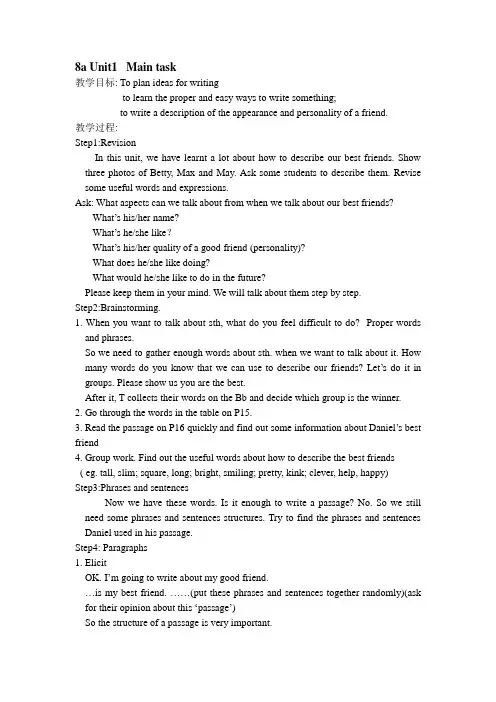
8a Unit1 Main task教学目标: To plan ideas for writingto learn the proper and easy ways to write something;to write a description of the appearance and personality of a friend.教学过程:Step1:RevisionIn this unit, we have learnt a lot about how to describe our best friends. Show three photos of Betty, Max and May. Ask some students to describe them. Revise some useful words and expressions.Ask: What aspects can we talk about from when we talk about our best friends?What’s his/her name?What’s he/she like?What’s his/her quality of a good friend (personality)?What does he/she like doing?What would he/she like to do in the future?Please keep them in your mind. We will talk about them step by step.Step2:Brainstorming.1. When you want to talk about sth, what do you feel difficult to do? Proper words and phrases.So we need to gather enough words about sth. when we want to talk about it. How many words do you know that we can use to describe our friends? Let’s do it in groups. Please show us you are the best.After it, T collects their words on the Bb and decide which group is the winner.2. Go through the words in the table on P15.3. Read the passage on P16 quickly and find out some information about Daniel’s best friend4. Group work. Find out the useful words about how to describe the best friends( eg. tall, slim; square, long; bright, smiling; pretty, kink; clever, help, happy)Step3:Phrases and sentencesNow we have these words. Is it enough to write a passage? No. So we still need some phrases and sentences structures. Try to find the phrases and sentences Daniel used in his passage.Step4: Paragraphs1. ElicitOK. I’m going to write about my good friend.…is my best friend. ……(put these phrases and sentences together randomly)(ask for their opinion about this ‘passage’)So the structure of a passage is very important.2. Ask Ss to find out the structure of the passage by themselves. T can help them when needed.Introduction—Body(appearance—personality and ability)—Conclusion(hobbies and future plans)Unit5:Go back to the beginning of this class.Have we learnt how to write about these in this unit? Can you remember what we talked about at the beginning of this class?What’s his/her name?What’s he/she like?What’s his/her quality of a good friend (personality)?What does he/she like doing?What would he/she like to do in the future?Are you ready to write about your good friends? Let’s have a try. (They can talk about sb in the class in groups first. In this way, the weak students will know what to write and how to write it.)Step6:Writing and checkingAfter they finish writing, use some of their passages as a model. Show them to the whole class and ask the other students to find out the good points in each passage. After talking about some passages, ask them to rewrite their passages to make them better.Step7:Hw.Write a passage about their good friends.。
《教学分析》-Unit1Maintask
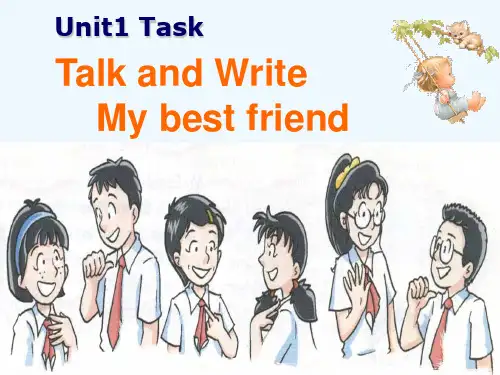
Looks
black, long, short, straight, dark brown, ponytail
beautiful,pretty, good-looking, handsome, lovely, cute, short, tall, fat, slim, smart, strong
Face:
a round face
Eyes :
bright smiling eyes
Nose:
a small nose
Hair:
long hair
looks:
tall, slim
Personality: friendly,happy,helpful ,
patient,
Future plans: would like to be a teacher
conclusion
Describe his/her future plans.
Time to practice Time to share
• Sample writing
Jim is my best friend. We live in the same building. I have known him for a long time.
Homework:
plete the article about your best friend. 2. Review this unit.
Jim is always friendly and helpful. When I feel bored or happy, he tells funny jokes and makes us laugh. He is generous. He is ready to share his things with his friends.
八年级英语unit1教学反思
八年级英语unit1教学反思英语教学反思,是教师在教学实践中对自身教学行为不断地进行反思的一种行为。
下面学习啦小编为大家整理了八年级英语unit1教学反思,欢迎参考。
新课改倡导全人教育,强调课程要促进每个学生身心的健康发展,培养学生良好的品质和终身学习的能力,新课改提倡交流与合作、自主创新学习,课程改革的成败关键在于教师,教师是课程改革的实施者。
下面简单地回顾、反思两年多来的英语教学工作。
一、面向全体学生,为学生全面发展和终身发展奠定基础。
1、创设各种情景,鼓励学生大胆地说英语,对他们在学习过程中犯的错误采取宽容的态度。
根据教材中的情境,真实再现于课堂并创造新的怀境,如教“What’s your name? How old are you?”时,情境有“小歌手大赛报到处”、“迷路的小孩子与警察”、“结识新朋友”、“医生与生病的孩子”、“自我介绍”等等一些语境,使学生积极参与,到讲台上锻炼英语表达能力和胆量。
如师生早晚问好、道谢、道别等,学生已经习惯用Hello、Good morning、 thank you、You are welcome、 See you、Goodbye……与我交流。
这样就无形中发展学生运用英语交际能力,培养他们创新灵活运用英语的习惯。
、在教学过程中注重学生的听、说、读、写综合能力,鼓励他们大胆的说并运用到实际中去。
每课的对话让学生先听后读,然后表演,每小组不宜超过四人。
表演前应让各小级操练准备,鼓励其拓展创新对话内容。
表演过程中,除要求学生语音语调正确外,还应让学生注意到交流手段如表情、手势、姿态等。
、创造条件让学生能够发现他们自己的一些问题,并自主解决问题。
二、创造宽松、和谐的气氛在教学过程中,注重与学生沟通,让学生消除对英语学习的恐惧感,只有对英语感兴趣,才能保持英语学习的动力并取得好成绩。
刻板的学习,不仅会影响英语学习的效果,适得其反让他们厌恶学习英语。
因此创造宽松、和谐的学习氛围有利于英语学习。
牛津译林版-英语-八上-1单元 Main task教学案
课题:Unit 1 Main Task学习目标:1.熟练掌握下列单词或词组1)smiling dark general appearance fat neat pleasant squarebright straight sporty2)hard-working, make sb do sth , talk to sb, tell jokes, wear a smile on one’s face ,would like to be, grow up3) I got to know her ten years ago.She always wears a smile on her face and looks happy.I believe she will be a very good teacher.2.能够使用一些形容词来描述人的外貌和品质。
3.运用合适的形容词来修饰男孩和女孩。
4.了解文章的组成:导入,主体和结论。
教学重难点:四会单词和重点词组与句型。
学习程序:Step1:Presention1:学习目标见上2:学习手册1)Kate is both my best friend and my neighbour .凯特既是我最好的朋友又是我的邻居。
both… and…意思是:两者都….e.g. Both my father and mother are teachers.2)I got to know her ten years ago .got 是get 的过去式get to do sth 意思是:有机会做某事get to know 开始认识…3)I like her bright ,smling eyes .我喜欢她那明亮的带着微笑的眼睛。
smile v. 微笑smiling adj. 带着笑容的4)They make her look really pretty .它们让她看起来真得很漂亮。
Main Task(中心任务)课堂教学的三个“注重”——例谈牛津初中英语8A Unit 1 Friends Main Task教学
热 身运
M i ak( anT s 中心 任 务 ) 牛 津 初 中英 是
组内的同学猜一猜。如猜不对 , 必须继续 描述 , 到组内同学猜对为 止。然后 , 直 再 由被描述 的人继续 游戏 ,并要 求学生记 录 好组 内所有成 员的外 貌特征和性格 爱 好 。通过以上一 系列 的热身活动 , 学生能 对不 同人 的特征 ,如 F c E e、Ns 、 ae、y s oe
阅 , 是 应 把 此作 为 与 老 师 、 而 同学 进 行 有 意 义 交 流 的 机 会 。在 交流 中 , 生 既 能 用 学
、
注 重 ManT s 中心 任 务 ) i a k( 的热
即注重 M i ak ( anTs 中心任务)的热 身活 动、 写作指导和 习作 交流 , 以提 高学生 的 语言运用技能 , 促进个性和特点的发展。 关 键 词 : anT s 注 重 M i ak
动 写作 指 导 习作 交 流
安排 了一个 小游戏 , 班学生 自由分 组 , 全 由一位 学 生描 述 自己 小组 里 的 一个 同
M i ak 堂 教 学 中提 高 语 言 的 运 用 能 akT s 课 力 , 本 文 以 牛 津 初 中 英 语 8 nt 1 AU i FinsM i ak re d anTs 为例 谈 了三 个 “ 重 ” 注 , 1 F insM i ak时 ,如 何 使 现 其 教 re d anTs 离 , 且 激 发 了 学 生 写作 的兴 趣 。 而 二 、 重 ManT s 中心任 务 ) 写 注 i a k( 的 作 指 导 我 们 知 道 , M i ak 中 心 任 务 ) 在 an T s( 板 块 中 , 材 仅 给 予 教 学任 务相 关 的 语 言 教
8BUNIT1Main task教案
<<8B unit 1 main task>>
【设计理念】
现代教育理念要求教学应当以学生为主体,教师为主导。
在教学中,按照任务型教学的原则设计语言实践活动。
每个单元都围绕一个话题,让学生通过体验、实践、参与、合作、交流和探究等方式,学习和使用英语,完成教学任务。
让学生在理解文章的基础上,联系家乡的变化及个人感受,帮助学生树立正确的人生观,培养他们口笔头交际能力、动手能力、自主学习能力、创新能力及合作精神。
【教材分析】
1.地位和作用
8Bunit 1选自牛津初中英语教材(八年级上)第一单元第九课时。
本单元主要围绕家乡的前后变化,引出一般过去时和一般现在时的比较和相关的运用。
是既承担了落实本单元教学重点的任务,又承担了对学生口笔头的实际动手能力,因此是很好的学习题材。
2.文本分析
因此,学习本单元不仅要落实具体的学习任务,更要培养学生热爱家乡的情感。
【学情分析】
初二学生有了一定的英语语言的基础,所以教师可以采取激励机制,激发他们的表达欲望,激发他们的参与意识,培养他们的合作精神和探究精神。
从而形成自己的审美观和价值观。
因此要加强写作方面的训练。
【教学手段】
采用多媒体课件教学。
利用图片、音乐、视频等多媒体素材。
【课时安排】一节课(45分钟)
【教学方法】情景教学法,谈话法,合作讨论研究法,评点阅读法。