
冀教版九年级英语全册教案
英语全册教案(冀教版九年级)Lesson 1: Poetry, PleaseTeaching Content:Mastery words and expressions: poem, decide, nature, express, learn/know ...by heart, pleased, happiness, shutOral words and expressions: poetry, description, continue, beyondTeaching Aims:1. Learn about the poems in foreign countries.2. Know the differences between Chinese and foreign poetry.Teaching Important Points:1. How to make suggestions.2. The grammar: infinitives.3. Some words and expressions: learn/know ...by heartTeaching Difficult Points:The grammar: infinitivesTeaching Preparation: picturesTeaching Aids: audiotape, flashcards, picturesType of lesson: new lessonTeaching Procedure:Step1: Come to "THINK AOBUT IT".Let the students talk about the questions in groups.1. Have you written a poem in Chinese? Is it hard? Why?2. What kinds of poetry do you like best?After a while, let the students in each group present their ideas to the class in front of the class. Step2: Listen to the tape and find the answers to the questions:1. Have Brian finished his poem?2. What's Danny's poem about?Step3: Reading task:1. Read the text and underline the new words in this lesson.Present the meanings of the words with the help of the media computer. We can use our body language if necessary.3. Tell the main idea of this lesson.Step4: Read the text again and decide the statements are true or false.1. Jenny wrote a Chinese poem.2. Brian wrote a poem about nature.3. Danny learned his poem by heart. Step5: Deal with the language points.How to make a suggestion:Maybe you could write a description of your favourite place.The infinitives:I haven't decided what to write about.Would you like to hear my poem?Do you really want to hear?I don't need to read it.Let the students sum the use of infinitives of this lesson. Then encourage them to make more sentences with the grammar.Step5: Activities1. Divide the class into several groups. Then let them translate a Chinese poem written by Li Bai or other famous poets. Then compare the translations of the groups. Let's see which is the best.2. Each group writes an English poem about the familiar things around us. Then let them change the poems in groups. They may give their own advice to the poems written by others.Step6: Describe the picture in English.Ask the students work in their formal groups. Then let them read their poems in class loudly. Step7: Come to "LET'S DO IT".Work with a partner. Let the students talk about the question: which do you think is more difficult to understand, English poetry or Chinese poetry?All of the students have seen much Chinese poetry, but few of them have seen English poetry. So present the students several English poems. Let them discuss the mean ideas of the poems. Then let them finish the task.Step8: Homework1. Finish off the activity book.2. Get more information about the English poetry after class.Summary:The students more little of the English, so that the teacher provides them more information about the English poetry is very necessary. We can use the Internet to help us. The teacher should stimulate the students' interests about the English poetry. The students can have more time to search more information on the Internet after class.Lesson 2: Poems About NatureTeaching Content:Mastery words and expressions: hill, clear, brave, pale, golden, softly, kiss, noisyOral words and expressions: swiftly, tiny, warmth, scene, related, topicTeaching Aims:1. Cultivate the students' guessing ability of the whole text.2. Enjoy the charming of the English poetry.3. Compare the differences between the English and Chinese poetry.Teaching Important Points:1. Learn the English poetry about nature by hearty.2. Know how to write an English poem.Teaching Difficult Points:Use what we learn to write an English poem.Teaching Preparation: picturesTeaching Aids: audiotape, flashcards, picturesType of lesson: new lessonTeaching Procedure:Step1: Come to "THINK ABOUT IT".Divide the class into several groups. Talk about the next questions:Have you read any poems in English? Which one do you like best? Why?What should you do first if you want to write a poem about winter?Choose several best poems and let the students read them in front of the class. Show some pictures of winter to the students. Help them to find more words to describe winter.Step2: Listen to the tape and fill in the blanks.1. Does the poem make you think of _______?2. You can write a poem about _______, too.3. Before you start writing your poetry, think about your _______.Step3: Read the text and find the new words.1. Let the students guess the meanings of the new words.Most of the new words are related nature. So present some pictures to the students to help them understand the new words.2. Ask some students to tell the main idea of this text.Step4: Do with the language points.Make sentences with the new words we learn in this text.Ask if someone can tell a story with the words we learn today. Encourage them to stand in front of the class and tell his story to us.Step5: Reading taskEncourage the students to ask questions about this text.Finish the task in groups. Let the students design questions and exchange them in groups. They can ask questions like this:1. What are your ideas for a nature poem?2. What can you do to describe about something?Step6: Activities.Work in groups.Write a poem about the two pictures. Finish a poem. Then each student in the group correct it before reading it to the class.Step7: Come to "LET'S DO IT!" The task is similar to the step6. Finish it in class. Try to write a poem about one of the seasons. The teacher shows some pictures about the seasons to the students.Step8: Homework1. Finish off the exercises in activity book.2. Go on the next reading in the student book.Summary:It is fun and interesting to write a poem in English. The teacher tries to write a poem and presents it to the class. Let the students correct it if they have any good ideas. Some students are interested in English, and they are also interested in poems. So give them more chances to create their minds. Lesson 3: Say It in ThreeTeaching Content:Mastery words and expressions: direction, form, poet, simply, a set number of, middle, clearly, dark, sleepy, unexpected, frog, feelingOral words and expressions: petal, cherry, grebe, Matsuo Basho, Haiku, particular, pattern, set, syllable, interruption, plop, splash, limerick, adverbTeaching Aims:1. Cultivate the students' reading comprehension.2. Know more about the foreign culture.3. Compare the differences between the Chinese and Japanese poems.Teaching Important Points:1. Learn about an old style of Japanese poem: Haiku.2. Know some styles of poems: Haiku, Nature Poem and Limerick.Teaching Difficult Points:The old form of Japanese poetry: Haiku.Teaching Preparation: picturesTeaching Aids: audiotape, flashcards, picturesType of lesson: new lessonTeaching Procedure:Step1: Show pictures of Japanese poets and poems. Then introduce Haiku to the students. The teacher can find some music to match the poem.Step2: Listen to the tape and fill in the blanks.Usually Haikus are about _______.Haiku always has ______ lines.The first line of a Haiku has _______ syllables.Check the answers in class in oral.Step3: Read the text and guess the meanings of the new words.Sometimes some new words are too hard to understand, so the teacher can find some related pictures to help them.If the students bring some pictures about nature to the class, let them show them in front of theclass.Step4: Read the text and find the answers to the questions:1. Do Haikus tell a story?2. What's a syllable?Step5: Come to "PROJECT".1. Divide the class into groups to finish the task.2. Finish the three poems in the text. Use the sentence: I need a ______. Let the others give the answers, one student write the words down.3. After finishing the poems, read it to the class. All the groups have different poems. Do they sound funny?4. Decide a subject by each group. Then make a pattern according to the subject. Then finish the poem as the models in the text.5. Read the poem to the class.Step6: Homework1. Finish off the exercises in activity book.2. Go on the next reading in the student book.Summary:Some students may think the foreign poems are funny and easy. The teacher may also think so. It is possible for the students to create poems like those we have learned in the class. Give them more chances to create their minds. The teacher can try some poems, too. The class and the teacher can find much fun in learning foreign poems.Lesson 4: The WishTeaching Content:Mastery words and expressions: wish, in the middle of, stone, friendship, reciteTeaching Aims:1. Learn how to sing foreign songs.2. Know more about the foreign culture.3. Learn about the styles of all kinds of poems in other countries.Teaching Important Points:1. Master the main idea of the song.2. Grasp the use of "without".3. Make a similar song like this.Teaching Difficult Points:The use of "without".Teaching Preparation: picturesTeaching Aids: audiotape, flashcards, picturesType of lesson: new lessonTeaching Procedure:Step1: Listen to the tape for several times. At the same time, ask the students to sing after it. Test how long they grasp the rhythm of the song.Step2: Read the song as a poem. Let the students read the poem as a lyric line by line.Step3: Make a poem like this.Divide the class into several groups. Make the similar this. Every group makes a poem. Then present it to the class. If the others have other better ideas, they can give their advice.Step4: Do with the language points.Make sentences with the important phrases: in the middle, without.S1: Danny sits in the middle of the classroom.S2: There is a stone in the middle of the road.S3: Fish can't live without water.S4: We can't finish the work without your help.Step5: Come to "PROJECT".Finish the task in groups.1. Everyone in the group chooses one pattern of these poems and writes one by yourself.2. After writing the poem, show it to the others in the group.3. Each exams the others' poems and gives his advice.4. After examine all of their poems, change them with the other group. Give their reasonable advice.5. The teacher gives them chances to express themselves.Step6: Homework.1. Finish off the exercises in the activity book.2. Go on the next reading in the student book.Summary:The students are familiar to the Chinese poetry, but the foreign ones are hard for them. When the students practice, the teacher should give them a hand if necessary. It is a challenge for the Chinese students to write foreign poems. Encourage them more in order to stimulate their interests of learning English.Lesson 5: That's a Funny Limerick!Teaching Content:Mastery words and expressions: both...and...Oral words and expressions: blank, motionTeaching Aims:1. Cultivate the students' ability of learning by themselves.2. Master one of the patterns of foreign poems.3. Compare the differences between the Chinese and foreign poetry.Teaching Important Points:1. Know more about the limerick.2. Learn more words about describing weight, size, feeling and age.Teaching Difficult Points:Know how to write a limerick.Teaching Preparation: picturesTeaching Aids: audiotape, flashcards, picturesType of lesson: new lessonTeaching Procedure:Step1: Come to "THINK ABOUT IT".Let the students answer the questions in class in oral.1. Ask several students to say funny sayings in English. If they can't express themselves in English, they can say them in Chinese.2. Let some students tell jokes. Encourage them to tell jokes in English.Step2: Listen to the tape and fill in the blanks.1._______ and _______ help Jenny fill in the blanks in her limerick.2. They choose _______ to describe the weight.Step3: Read and get the main idea of the text.1. Let the students scan the text. Then tell the main idea of the text.2. Find the new words and guess their meanings according to the text.Step4: Do with some language points.Either...or..., both...and...Let some students make sentences with the help of the pictures.S1: He eats either apples or oranges.S2: Either he or I am good at dancing.S3: Both his teachers and his parents love him.S4: Susan loves both reading and listening.Step5: Come to "LET'S DO IT".Limerick is a kind of poem that has a pattern.Study the "Limerick". Get the results.1. There are five lines in the limerick.2. From Jenny's limerick, we can see the first, second and fifth lines have rhyme.Look in the library or search on the Internet to find some information about limericks. Show them to the class and let them find the patterns of "limerick".3. Let different groups act the dialogue out in front of the class.Step6: Homework1. Finish off the exercises in activity book.2. Go on the next reading in the student book.Summary:Limerick is fun. It's interesting for the students. The students may like to practice it very much. Everyone writes a limerick. The class will be full of laughter. Ask the students to begin the similar dialogue in class to practice the limerick.Lesson 6: Say It in Five Teaching Content:Mastery words and expressions: create, single, thoughtOral words and expressions: fur, stretch, hum, adjectiveTeaching Aims:1. Improve the students' listening and reading abilities.2. Know more about the foreign poetry.3. Learn the American five-line poems.Teaching Important Points:1. Grasp the pattern of the five-line poem.2. Use the pattern to describe something.Teaching Difficult Points:Use the pattern to describe something.Teaching Preparation: picturesTeaching Aids: audiotape, flashcards, picturesType of lesson: new lessonTeaching Procedure:Step1: Come to "THINK ABOUT IT".We all know Chinese poetry has different kinds of patterns. Let the students give some examples. Step2: Listen to the tape and answer the following questions:1. Who created the five-line poem?2. How many poems does the text show us?Finish the listening part in class in oral.Step3: Reading task:Read and tell the main idea of the text. This is a game to practice the students' memories. It can improve the students' summary abilities.Step4: Read and decide the statements are true or false.1. Today we learn a pattern of French poetry.2. The second line has three words.3. The topic of the poem is a noun.Finish the questions in class in oral.Step5: Activity:Show some pictures to the students. Let them the favourite one to describe. They can work in pairs. Then show their poems to the class.It's easy to finish the task, but it is hard to do it well.Step6: Come to "LET'S DO IT".Work in groups of three or four students.1. Say the differences between a Haiku and a five-line poem. Say about their different forms and different patterns.A haiku is just a description of a scene. It is simply what is happening in this place, at this moment.Five-line poem has five lines. It is always about a single topic. Each line has a set number of words. The first line has one word. The second line has two words. The third, or middle, line has three words. The fourth line has four words. The last line has one word.2. Finish the task in groups. Choose one topic as they like. Then exchange the poems among the groups.Step7: Homework1. Finish off the exercises in activity book.2. Ask the students to find more topics after class.Summary:We learn different kinds of foreign poetry. They are limericks, five-line poems and Haiku. The students may think they are very interesting. Some students have surprising poems that you didn't think of. Give them more chances to practice so that they can create their minds.Lesson 7: Trading PoemsTeaching Content:Mastery words and expressions: awake, riddleOral words and expressions: avenueTeaching Aims:1. Know more about the foreign culture.2. Create the student's cooperation ability.Teaching Important Points:1. Master the written style, letter.2. Learn the differences between Chinese and foreign poetry.Teaching Difficult Points:Write a letter with what we learn in this unit.Teaching Preparation: picturesTeaching Aids: audiotape, flashcards, picturesType of lesson: new lessonTeaching Procedure:Step1: Show the type of the letter. Let the students sum how to write a letter. Pay attention to the written style of the envelope.Step2: Listening taskListen to the tape and fill in the blanks.1. _______ is a beautiful way to express thoughts and feelings.2. Danny's teacher says Danny's always saying _______ things.Let the students listen to the tape and finish the listening task in class in oral.Step3: Read the text and answer the following questions:1. Does Danny think it is hard to write a poem?2. Did Li Ming write back to Danny?Ask the students scan the text and answer the questions. Step4: PracticeWrite a letter to your friends about what we learn in this unit. The teacher encourages them to write a poem to their friend, too. It's hard, so they can choose any topic that they like. They only write for friends. We don't need to demand too much.Step5: Come to "LET'S DO IT".Finish the task in groups of three or four students. In a small group, write a poem like the one in Li Ming's postcard.1. First, choose a word your group like. They can choose any word that they like. Because the task is to begin a poem with the letters in this word, everyone can write a word on a piece of paper. Then they can choose one from these.2. Use each letter in this word to begin a line of our poem. Everyone in the group can write different poem according to the word. Then they can exchange their poems and give advice to each other.3. Make a poster to display your poems on the wall. It takes some time to design the poster.4. Which one do you think is the best? Give your reasons.Let the students choose the best poem that they like best and give their reasons in front of the class.Step6: Homework1. Finish off the exercises in activity book.2. Go on the next reading in the student book.Summary:The last poem that we learn in Li Ming's postcard is very interestLesson 8: Unit ReviewTeaching Content:Mastery words and expressions from Lesson1 to Lesson7.Oral words and expressions from Lesson1 to Lesson7.Teaching Aims:1. Improve the students' ability of using what we learn in this unit.2. Stimulate the students' mind of learning about Chinese and foreign poetry.3. Know the differences between Chinese and foreign poetry.Teaching Important Points:1. Making suggestions.2. Master the use of infinitives.Teaching Difficult Points:The use of infinitives.Teaching Preparation: picturesTeaching Aids: audiotape, flashcards, picturesType of lesson: review lessonTeaching Procedure:Step1: Listen to some beautiful poems in Chinese or in English. Music usually creates atmospherefor the students.If anyone can recite some English poems, the teacher can give them chances to recite in front of the class.Step2: Do the exercises in Lesson8. At the same time, the teacher walks in the classroom and see if they have any trouble to solve.Step3: Let the students write some difficulties on the blackboard. Then let's try to solve them together.The most important grammar is the infinitive. For example:I haven't decided what to write.Li Ming has something important to do, so he can't come to your party.My wish is to go to space.It's not easy to walk against a strong wind.Step4: Practice the spoken English.Make a similar dialogue according to the Speaking the Language part. It's how to make suggestions.Ask the students work in pairs to make up dialogues like this. Then present it in front of the class. Step5: Play "Story Game'.Work in groups to finish the task. When the students play the game, the teacher walks around the classroom and see if any group needs help.At last, ask each group presents their stories to the others in front of the class. Whose story is the funniest?Step6: Homework1. Finish the exercises in activity book.2. Preview the next lesson.Summary:Poetry is an important part of culture. So it is useful to learn it well. This unit gives us opportunities to practice. Making suggestions is important, too. So let the students make dialogues to practice it. The teacher should pay attention to the infinitives in this unit. We should practice more in this class. Lesson 9: What's a "Horkey"?Teaching Content:Mastery words and expressions: helpful, at the same timeOral words and expressions: DNA, combine, juicy, mule, donkeyTeaching Aims:1. Know more about cloning.2. How to combine two different things.Teaching Important Points:1. Talk about the ability and inability.2. The use of coordinating conjunctions.3. Combine two different things. Teaching Difficult Points:Talk about the ability and inability.Teaching Preparation: picturesTeaching Aids: flashcards, audiotape, picturesType of lesson: new lessonTeaching Procedure:Step1. Lead in the class by showing some pictures about combining to the students. They may be about different things, such as food, fruit, animals and other things.Step2. Listen to the tape and answer the following questions:1. Can Danny combine a donut and a pizza?2. Who wants to combine a cow and a chick?Let the students answer the questions with the help of the pictures. Finish the task in oral in class. Step3. Read the text and fill in the blanks with the correct words.1. We can combine two different ______ or two different ______.2. Brian would combine ______ and ______.Look through the whole text quickly and answer the questions in class in oral.Step4. Encourage the students find the new words in this lesson. Give more examples and let the students understand more about the words.I would combine a donut and a pizza.Then I could have breakfast and lunch together.Then I would have little, juicy bananas.Do you know what a mule is?It has a horse as mother and a donkey as a father.Step5. Read the text again and encourage them to find more questions about the text. One student stands up and asks a question. The others who want to answer can stand up and answer it as quickly as he can. For example:1. What would you combine?2. What about combining a duck and a deer?3. Can we combine apples and bananas?Step6. Come to "PROJECT".Finish the task in groups of three or four students.Think about something that is combined by two different things. Each of the group writes his answer down and shows it to others. Then choose the most meaningful one to study.What will your group combine? What if you combine the two things? What can it do for us? What's its advantage?Talk about the questions above, then sum their ideas.Give a report in front of the class. Demonstrate your ideas. Describe the thing that you combine in detail. Describe its advantages and disadvantages.Step7.Homework1. Finish off the exercises in activity book.2. Go on the next reading in the student book.SummaryIn this lesson, we learn to combine two different things together. In order to get new living things, we must make full use of our imagination. What can the things that we combine are used for? It is important for us to discuss. During the discussion, we practice our spoken English.Lesson 10: What is DNA?Teaching Content:Mastery words and expressions: generally, twin, clone, not only...but alsoOral words and expressions: blueprint, identical, egg, identifyTeaching Aims:1. Know how to write a passage on science.2. Learn something about DNA.3. Know more about our body.Teaching Important Point:1. Master the words and expressions of this lesson.2. The ability and inability.3. The use of coordinating conjunctions.Teaching Difficult Point:The use of DNA.Teaching Preparation: picturesTeaching Aids: flashcards, audiotape, picturesType of lesson: new lessonTeaching Procedure:Step1.Lead in the text by discussing what DNA is. Divide the class into several groups. Then talk about the subject for several minutes. Then one of the groups presents their opinions in front of the class.Step2. Listening task:Listen to the tape and fill in the blanks with the correct words you hear.1. Generally speaking, a ______ is a drawing.2. ______ for identical twins, each living thing has its own unique DNA.Play the tape once. Then let the students try to finish the task in class in oral.Step3. Reading task:Read the text quickly and answer the following questions:1. Where does your DNA come from?2. Is your DNA in every part of your body?Finish the reading task in class in oral. Try to get more information about the text at the same time. Step4. Read the text again. Find the sentences with the new words. Try to create situation about the new words. Then make sentences with the new words. If someone can make a whole story with the new words that we learn in this lesson, the teacher must encourage her.The sentences with the new words:Generally speaking, a blueprint is a drawing.Identical twins are two children that grew from the same egg.They are clones.From your DNA, scientists can identify not only you, but also people related to you.Step5.Let some students tell some details about the text.What is DNA?Where is your DNA from?What is DNA used for?Step6. Come to "LET'S DO IT".Finish the task with a partner. Find the things about you that show your parents' DNA. Talk about if for a while. Then let some volunteers come to the front to talk about the subject.Step7.Homework1. Finish off the exercises in the activity book.2. Go on the next reading in the student book.Summary:You look like your father or your mother. That identifies the DNA of your body from your parents. DNA is very fascinating. Each living thing has its own unique DNA. Try to find more ways to use the DNA in many fields. Discuss the use of DNA in this class. Make full use of it to help more people in the world in more fieldsLesson 11: Cloning People?Teaching Content:Mastery words and expressions: exactly, divide, crazyOral words and expressions: human being, original, adult, Dolly, insectTeaching Aims:1. Know more about cloning.2. Create the students' spirit of cooperation.Teaching Important Points:1. The advantages and disadvantages of cloning.2. The expression of ability and disability.3. The use of coordinating conjunctions.Teaching Difficult Points:The advantages and disadvantages of cloning.Teaching Preparation: picturesTeaching Aids: flashcards, audiotape, picturesType of lesson: new lessonTeaching Procedure:Step1: Show a picture of Dolly. Then let the students discuss what our life will be if we make a clone。
2021冀教版初中英语九年级全册教案(英文版)
冀教版九班级英语上册整册英文教案Unit1教案(英文版)Unit 1 The OlympicsLesson 1:Higher, Faster, StrongerTeaching Content:Mastery words and expressions: modern, gold, record, event, twentiethOral words and expressions: ancient, Athens, Beamon, medal, shooting, athlete, silver, bronze, sprintTeaching Aims:1. Learn about the history of Olympics.2. Encourage the students to work hard for our country.Teaching Important Points:1. Learn something about the Olympics.2. Wishes and congratulations.Teaching Difficult Points:Some words and expressions used in the Olympics.Teaching Preparation: some pictures of OlympicsTeaching Aids: audiotape, flashcards, picturesType of lesson: new lessonTeaching Procedure:Step1.Show some pictures of Olympics to the class. Let the students say something about the Olympics. Show some new words to the students with the help of the pictures. At the end, introduce the topic of the unit to the class.e to “THINK ABOUT IT.”Step3.Listen to the tape and answer the following questions.1. When were the first Olympics?2. When did the modern Olympics start?Step4.Now let’s learn how to use the new words. Make some sentences with the new words. Sometimes they can guess the meanings of the new words.Step5. Read the text and find out the words that stand for places, time, medals, sports and events. Places: Greece, Athens, Sydney, Mexico City, Los AngelesTime: ancient, modern, BC (Before Christ), ADMedals: gold, silver, bronzeSports and events: race, sprint (a short race), long jumping, shootingStep6. Discuss the main ideas of the text. Answer the questions in Quick Quiz! Have the students talk about the history, sports and events, and famous athletes of the Olympics.Step7. Divide the class into several groups. Talk about the 2008 Olympics Games. What do the students know about it?e to “LET’S DO IT”.Play the game in the class. Divide the class into several groups. Then each group have a student in front of the class to imitate a sport. The others guess by using “Is it______?”Step9. Homework1. Finish the activity.2. Search on the Internet for more words about the Olympics.Summary:Today’s subject is familiar to the students, but the English words about the Olympics are difficult for them. So we must spend a little time to deal with the new words. Show some pictures to help the students know more about Olympics. The pictures also help the students know about the history of Olympics.Lesson 2: Swimming for GoldTeaching Content:Mastery words and expressions: close, race, seem, tie, up and down, beat, the others, volleyball Oral words and expressions: Barcelona, freestyle, Thompson, swimmer, spectatorTeaching Aims:1. The sports that Chinese are good at.2. Stimulate student s’ learning interest.Teaching Important Points:1. Express wishes and congratulations.2. Learn Direct Speech and Indirect Speech.Teaching Difficult Points:Direct Speech and Indirect SpeechTeaching Preparations: picturesTeaching Aids: audiotape, flashcards, picturesType of lesson: new lessonTeaching Preparation:Step1. Play a game.Divide the class into several groups. Every group says a sport. The others must say two sentences about the sport. When they are in trouble, the others and the teacher can help theme to “THINK ABOUT IT’.Talk about swimming.1. What do you think of swimming?2. Where do you like to swim?3. Is swimming good for us? Is it dangerous?Let the students talk about the questions in pairs. Then give their answers in front of the class.If you like swimming, you must pay attention to the safety. Don’t go swimming alone. Don’t swim in the deep water. You must keep touch with the others.Step3.Listen to the tape and answer the following questions:1. Who won China’s first gold in swimming?2. Who was the second in the match?If the students can’t write Jenny Thompson correctly, please write it on the blackboard for them. Step4. DiscussLet the students talk about the swimming about China. They can talk according to the following order.The players’ names: Zhuang Yong, Luo Xuejuan, Qian Hong, Lin Li, Yang WenyiThe events: freestyleStep5. Read the text and analyze the text in details.1. In which event did Zhuang Yong win the gold medal?2. Was it a tie?3. Did she win the other medals at the same time?4. Who else won Olympic medals in swimming at the 1992 Olympic Games?e to “LET’S DO IT.”Divide the class into several groups. Talk about why they can get the gold medal. What can we learn from them?It’s their love to our country that supports them to get the gold. They need spirit to overcome themselves. That’s what we need in our learning.Step7. Homework1. Finish off the activity book.2. Go on the nest reading in the student book.Summary:We are Chinese. We are proud of ourselves. How can Zhuang Yong get the gold medal? They love our country. They want to do better than the others. It’s not easy for them to get medals. They pay their sweat and hard work. What can we do now? We must study hard from now.Lesson 3: Are You an AthleteTeaching Content:Mastery words and expressions: volleyball, table tennis=ping-pong, luck, tennisOral words and expressions: design, rope, jump rope, sit-up, push-upTeaching Aims:1. Learn about the Olympics events.2. Cultivate the spirit to compete in life and study.Teaching Important Points:1. The Direct Speech and Indirect Speech.2. The Object Clause.3. Wishes and Congratulations.Teaching Difficult Points:The Direct Speech and the Indirect Speech.Teaching Preparation: some ballsTeaching Aids: audiotape, flashcards, picturesType of lesson: new lessonTeaching Procedure:Step1. Divide the class into groups. One student acts, the others in the g roup guess the sport. Let’s see which group can get the most scores.Step2. Show the students the language points with the flashcards. Such as: the same as, good luck, jump over, two more timesMake sentences with the expressions.The book is the same colour as that one.Good luck to you.Don’t jump over the wall. It’s too high.You can jump two more times.Step3. Class OlympicsHave a class Olympics in the classroom. The teacher brings rope and ball to the classroom. Divide the class into several groups. Every group has two students in front of the class at a time. One student is the player, the other is the timekeeper. Now compete in the classroom.Step4. Listen to the tape and answer the following questions:What’s Danny’s idea?Step5. Read the text and find out what Jenny’s idea is. Is it OK? At the same time, practice how to express wishes and congratulations.e to PROJECTLet the students find out the event that they fit. They must think carefully:What will they need if they want to have the event?How many people do they need?How will you keep the score?How will you measure the time?Step7. Homework1. Finish the activity book.2. Go on reading the student book.Summary:We have classroom Olympics in our classroom. It’s good for the students. It will increase students’ interest of learning English. Prepare some techniques before the class. Keep the time in one minute. You’d better give them praise if they get the first. When they are doing the sports, let the others practice the expressions: good luck, the same to you, congratulations.Lesson 4: Good Luck to YouTeaching Content:Mastery words and expressions: do one’s best, give up, believeTeaching Aims:1. Learn more about the Olympics.2. Study hard for our country.Teaching Important Points:1. Wishes and congratulations.2. Some language points.Teaching Difficult Points:Some language points: do one’s best, good luck to you, up and down, believe inTeaching Preparation: picturesTeaching Aids: audiotape, flashcards, picturesType of lesson: new lessonTeaching Procedure:Step1.Show some pictures of the champions. Liu Xiang got the gold medal in 110-metre hurdle race. Show the picture to the students. Then let them listen to the Chinese song.Step2.Show more pictures of Chinese athletes to the students. Then let them discuss the following questions:Who is the athlete?What does he do?How many Olympics did he take part in?Did he get medals in the Olympics?Step3. Listen to the tape and sing the song to gether. If they can’t follow it, play the tape again. Step4. Read the tape as a poem. Then show some language points to the class. Let them make sentences with the language points or organize a short passage. Remember the language points ina certain situation.Step5. Let the students sing after you. Act out when you are singing. All the students stand up and sing loudly.e to “LET’S DO IT”Divide the class into several groups. Every group sends a few students to the front to tape part in some events. Begin the events, while the others cheer for their players. Try their cheers or songs in the class. We can change it as the events change.Summary:Play songs of our country or show more pictures of our country’s athletes. Let the students feel the strength of our country. All the people come to the same place to complete. We remember friendship is the first and the competition is the second.Lesson 5:Danny’s Very Special GuestTeaching Content:Mastery words and expressions: guest, such, able, great, practiseOral words and expressions: Jeff JohnsonTeaching Aims:1. Know more about the foreign athletes.2. Know the saying: Failure is the mother of success.Teaching Important Points:1. The tense of the object clause.2. The use of the Direct Speech and Indirect Speech.Teaching Difficult Points:The tense of the object clause.Teaching Preparation: picturesTeaching Aids: audiotape, flashcards, picturesType of lesson: new lessonTeaching Procedure:Step1. Come to “THINK ABOUT IT”.Ask some students to answer the questions. If some students can imitate the famous singer or player, they can act in front of the class.Ask the students to come to the front and act. The others guess who the man is and what his job is. Step2. Listen to the tape and answer the following questions.1. Who will come to Danny’s school?2. What does the man do?Step3. Read the text. Encourage the students to ask questions by themselves.1. Why does Danny have to write the diary?2. W hat’s Danny’s favourite sport?3. What should Danny do if the wants to be in Olympics some day?Step4.DiscussionImagine you are a report. You are going to see your favourite star today. What will you ask him. Work with your partner. Now imagine he is the star.After five minutes, ask the students to act their dialogue out in front of the class.Step5. Come to “LET’S DO IT”.Give them a little time. Then let the students finish it in front of the class.After a student tells his story, the others can ask questions.Step6. Homework1. Finish off the activity book.2. Go on the next reading in the student book.Summary:We all have dreams so we like film stars or players. Sometimes we don’t think we can do well in class. But we are better at swimming or skating. Everyone has shortcomings. If we want to do better, we must work hard at it. If we need help, we can ask our classmates and teachers for it. Work on!Lesson 6: Diving “Dream Team”Teaching Content:Mastery words and expressions: dream, age, victory, catch up withOral words and expressions: Dream Team, Sydney, dive, diver, Atlanta, platform, springboard, champion, coachTeaching Aims:1. Learn about the spirit of Olympics.2. Works hard to have our dreams come true.Teaching Important Points:1. Know more about the Chinese Dream Team.2. The history of diving in the Olympics.Teaching Difficult Points:Understand the history of the Chinese diving.Teaching Preparation: picturesTeaching Aids: audiotape, flashcards, picturesType of lesson: new lessonTeaching Procedure:Step1. Come to “THINK ABOUT IT”.Ask the students what they think of the Dream Team. Talk about the Dream Team of China. What sports are much stronger in China?Let the students work in pairs. Talk about the questions in this part. Then let some students speak in front of the class.Step2. Show the picture of Fu Mingxia who is diving. Now talk about the diver. What do the students know about her? All of the students take part in the brainstorm and make a complete answer. Then we can write down.Step3. Listen to the tape and answer the following question:1. Who is in this text?2. What is she?Step4. Read the text and check the answers. Now we know more about Fu Mingxia. Then ask some students to retell the experience of her.Step5.Show some pictures of Chinese and foreign divers. Sum how the diving is going in Chinese. If we want to keep the record, what should we do?e to “LET’S DO IT.”Give them a little time. Try to finish the task in this class. Divide the class into several groups. Then let them discuss this part.Ask some students speak in front of the class. The others listen carefully and say their different opinions.Step7. Homework1. Finish off the activity book.2. Go on the next reading in the student book.Summary:“All work and no play make Jack a dull boy.” We all know this saying. Don’t make your students study all the time. Ask them to care about the development of our country in many ways. In their free time, they can watch TV and read newspaper.Lesson 7: Don’t Fall off the PizzasTeaching Contents:Master words and expressions: result, none, fewTeaching Aims:1. Learn the spirit of Olympics.2. Make use of the spirit in class.Teaching Difficult Points:1. How to demonstrate something clearly.2. How to write e-mails.Teaching Difficult Points:The tense of Object Clause.Teaching Preparation: picturesTeaching Aids: audiotape, flashcards, picturesType of lesson: new lessonTeaching Procedure:Step1.Divide the class into several groups and sum what we learned in this unit. Do you think what Jenny wrote in her diary?Let some students give their answers in front of the class.Step2.Listen to the tape and answer the following questions:1. How many events did Jenny’s class invent?2. Whose invention did Jenny like best?Step3. Read the text and check the answers. Then encourage the students to ask more questions about this part. They can stand in front of the class and point out which student to answer the question.Step4. Make sentences with the language points: one by one, be fun, catch up with, think ofWe go into the classroom one by one.Playing football is fun.Nobody can catch up with me in the race.Who can think of better idea/Divide the class into several groups. Every group has the same people as other teams. We play a making sentences game with the four phrases. The team who finishes the work first is the winner. Step5. Use the same groups to read the text. Which team can finish the text first? Every group has a student to see if the others read the text correctly.Step6. Come to “LET’S DO IT’.Write e-mails to your pen pals. Try to finish the task in front of the class. Ask some students topresent their e-mails in front of the class.Step7. Homework1. Finish off the activity book.2. Go on the next reading in the student book.Summary:The best way to learn a foreign language well is to use it. Give the students more time to practice in the class. The use of the teacher is to instruct them. Give them help when they are in trouble. Class is a large stage for the students to act.Lesson 8: Unit ReviewTeaching Content:Mastery words and expressions from Lesson1 to Lesson 7.Oral words and expressions from Lesson 1 to Lesson 7.Teaching Aims:1. Learn more about the Olympics.2. Learn the spirit of the Olympics.Teaching Important Points:1. Wish and congratulations.2. Direct speech and indirect speech.Teaching Difficult Points:Direct speech and indirect speech.Teaching Preparation: picturesTeaching Aids: audiotape, flashcards, picturesType of lesson: review lessonTeaching Procedure:Step1. Ask the students to develop an event in groups. Ask them to say the rules of the game clearly and the play the game in front of the class. If they can’t play the game in the class, they must tell why not.Step2. Do the exercises in Lesson 8. Discuss some problems on the blackboard. At the same time, explain some important language points again. Remember to give examples.Step3. Come to “Do You Know”.Let the students to make examples to use the expressions. Can they find the correct situation to use them? If they are in trouble, the teacher can help them.Step4. Come to “Class Review Activity”.Bring some techniques to the classroom. We can play the class activities. Let the students speak English as much as possible.Step5. Sing the song “Good Luck to You”.Step6. Homework1. Finish off the activity book.2. Preview the last unit.Summary:Playing games is what the students like to do. So put the language points into the games. Let the students grasp the grammars and learn to use them in the happiness. Learning English happily is the aim that we are hunting for. So pay more attention to design suitable games for the students. Unit 2教案(英文版)Unit 2 Biggest, Longest, WidestLesson 9: Be a Champion!Teaching Content:Mastery words and expressions: whetherOral words and expressions: ordinaryTeaching Aim:1. Let the students learn about the world records in a variety of categories.2. Cultivate the spirit of teamwork.Teaching Important Points:1. Expressing happiness.2. Comparative and Superlative Degrees of Adjective and Adverbs.Teaching Difficult Points:Comparative and Superlative Degrees of Adjective and Adverbs.Teaching Preparation: picturesTeaching Aids: audiotape, flashcards, picturesType of lesson: new lessonTeaching Procedure:Step1. Show the picture of Liu Xiang in the 2004 Olympics. He broke the world record of 100-metre hurdle race.Let the students talk about the race the perfect performance of Liu Xiang.Step2. Come to “THINK ABOUT IT”.Divide the class into groups of three or four. Discuss the following questions:1. Do you know of any world records? What are they?2. Who broke the world record in the last Olympic Games? What can you learn from them?3. What world record do you think you can break?After five minutes, ask every group sends a student to speak in front of the class.Step3.Listen to the tape and decide the following questions are true or false.1. Brian’s idea is to play basketball without stopping.2. Danny ate a banana for lunch.3. Brian said Danny was the world’s funniest d inosaur.Step4.Read the text and finish the exercises.Read the text and fill in the blanks.Jenny, Brian and Danny are talking about how ordinary people can ______a world record. Brian’s idea is to _______ ______ for a ______ _______ without stopping. He thinks they could _______ ______. Some of them would _______ while some others slept and ______. Danny is going to drink a lot of _______. He will eat more fruits and ______ to be the world’s ______ dinosaur. Give the students about five minutes to read the text, and then finish the exercise.Let’s check the answers in oral in class.Step5. Come to “PROJECT”.Divide the class into groups of three or four. Let’s have brainstorm. Discuss what they have done differently in their life. What do you think are great in your life? Share your opinion with the class. Let’s see if it can be a world record.Search on the Internet for some of the world records. Then the class will have more laughs. Askeach group to record what they think are interesting. Why? Let them give reports to the class.We finish the project in two classes.Step6. Homework1. Finish off the activity book.2. Go on the next reading in the student book.SummaryWe can practice the main grammars with the objects around us. We observe and feel the things around us more carefully. We have a chance to enjoy our life deeply. Encourage the students to search on the Internet. Internet is the most important means in our today’s life.Lesson 10: Where’s the Highest HotelTeaching Content:Mastery words and expressions: tower, thick, wholeOral words and expressions: Grand Hyatt, locate, length, astronaut, dam, gorge, the Three Gorge DamTeaching Aim:1. Learn the different styles of adjectives and adverbs.2. Know more about the w orld’s records.Teaching Important Points:1. Master the comparative and superlative degrees of adjectives and adverbs.3. Learn more about the world’s buildings and structures.Teaching Difficult Points:How to describe the buildings’ length, width, and depth in English?Teaching Preparation: picturesTeaching Aids: audiotape, flashcards, picturesType of lesson: new lessonTeaching Procedure:e to “THINK ABOUT IT’.Let some students answer the questions loudly in class. If one can’t say it completely, the others can add the content.The teacher asks the students: Do you like traveling? Where did you traveled to?If the student that you ask didn’t travel ago, let him imagine where he will go if he has the chance to travel.Step2.Listen to the tape and tell if they are true or false.Listening task: True or False1. The Grand Hyatt Shanghai in Pudong is the highest hotel in the world. T2. Liu Yutian walked the whole length of the Great Wall for three years. F3. The Three Go rges Dam will be the world’s biggest dam. TFinish the exercise in class in oral.Step3. Read the text and answer the following questions:1. Which tower is the tallest building in China?Jin Mao Tower.2. How long is the Great Wall?It’s more than 7240 kilometres long.3. How much will the Three Gorges Dam cost?It will cost 205 billion yuan.Step4. Do with the language points using the flashcards.7240 kilometres long. 9.75 metres thick. 2.3 kilometres long, 185 metres tall.Make some examples to practice the phrases.The river is 10 metres wide.The house is 2 metres tall.Step5. Do with the language with the objects.The teacher points to the classroom and lets the students to describe it.Point to a dictionary and ask the students to describe it.Let the student find other things and describe them.Step6. Come to “LET’S DO IT”.Do it in the class in oral. This is similar to step 5. Practice more. Let the students do it in turns. For example: 2They can say like this: I want to be two metres tall.The tree is two metres tall.The river is about 250 000 metres long.Step7.Homework1. Finish off the activity book.2. Go on reading the student book.SummaryIt is a good way to practice the language points with the help of the flashcards. They can remember the grammars easily because of the colourful pictures. Another way is to use the things around us. The students can go near it or touch to begin his report. The students will be more interested in English than before.Less on 11: Don’t Fall, Danny!Teaching Content:Mastery words and expression: weigh, ton, including, humanOral words and expressions: whale, average, bumblebee, bat, gram, centimeter, Thailand, tortoise, cheetahTeaching Aims:1. Learn more about the an imal’s world records.2. Stimulate the students’ learning interests.Teaching Important Points:1. Comparative and superlative degrees of adjectives and adverbs.2. Some words and expressions.Teaching Difficult Points:Comparative and superlative degrees of adjectives and adverbs.Teaching Preparation: picturesTeaching Aids: audiotape, flashcards, picturesType of lesson: new lessonTeaching Procedure:Step1.Let the students talk about the world records of the animals.What do you know about the world records?How do you know this information?Can you see something about the anima, such as: Where do they live? What do they like to eat? Divide the class into groups of three or four and discuss the questions. Then ask one of the groups give a report in front of the class.Step2. Now let’s listen to the tape and tell us what Danny is doing, why does he do so?Ask them try to listen to the world’s longest, smallest, oldest and fastest animals.If there are some students can answer the questions, remember to praise it.Step3. Role-playAsk the students to act out a dialogue in former groups. They must think of a world record that they are going to break. Then let one student do this. The others say something about the world record. You’d better let them search for a real world record before the performance. They try to imitate the action. Now they can begin their dialogue.After five or six minutes, let them act it out in the front. The others can correct their mistakes. Step4. Read the text and try to answer the following questions:1. What’s the world record of standing on one foot?2. What’s the world’s largest animal?3. What’s the world’s smallest animal?4. What’s the world’s oldest animal?5. What’s the word’s fastest animal?Check the answers in the class in oral.Step5. Let’s discuss the text in details.1. How long has Danny stood on one foot when Jenny saw him?2. How largest is the world’s largest animal?3. How small is the world’s small est animal?4. How old can the tortoises live in the world?5. How fastest can the cheetah run?Discuss the questions in former groups. Then give a report to the class.Step6. Come to “LET’S DO IT”.Begin this part in groups. They can imagine the appearances of the animals and the habits of the animals.Work together and then present their results to the class. Give a vivid demonstration of the animal they create.Step7. Homework1. Finish off the activity book.2. Go on the next reading in the student book.Summary:Ask them to search on the Internet for the information of the animals. Then report in class. Now they use the grammars we are going to build: Comparative and superlative degrees of adjectives and adverbs. Compare some animals with the others. Tell the differences between two animals that they say one time.Lesson 12: Let’s Go the Farthest!Teaching Content:Mastery words and expressions: father, farthest, bridgeOral words and expressions: falconTeaching Aims:1. Learn more about the foreign culture.2. Know more about the world records.Teaching Important Points:Comparative and superlative degrees of adjectives and adverbs.Teaching Difficult Points:Superlative degrees of adverbs.Teaching Preparation: picturesTeaching Aids: audiotape, flashcards, picturesType of lesson: new lessonTeaching Procedure:Step1.Listen to the tape and the students imitate after it. Play the tape for two times; let them feel the rhyme and the feeling.Step2. Read the text as a poem. This is a beautiful poem. It is worth for two times.Step3. Let several students sing the song in front of the class. If they can’t, ask the students to listen to the tape again.Step4. Teach the students to sing the song line by line. Let’s sing t ogether.Step5. Do with the language points.Give examples to practice the grammar: Superlative degrees of adverbs.Step6. Homework1. Finish off the activity book.2. Go on the next reading in the student book.SummaryThere are many beautiful songs in the student book. It is the summary of the main grammars of this unit. It is the short for the main idea of important grammars. We must learn the song by our hearts. It is very useful for the students to learn more about the foreign culture.Les son 13: Who’s the Champ?Teaching Content:Mastery words and expressions: list, anybodyOral words and expressions: JonesTeaching Aims:1. Create the spirit of competing.2. Practice the spoken English.Teaching Important Points:1. Grasp the rules of comparative and superlative degrees of adjectives and adverbs.2.Choose and write down a list of records.Teaching Difficult Points:The using of comparative and superlative degrees of adjectives and adverbs.Teaching Preparation: picturesTeaching Aid: audiotape, flashcards, picturesType of lesson: new lessonTeaching Procedure:Step1. Come to “THINK ABOUT IT”.The teacher can begin like this: What activities did you take part in? Did you win or lose?Let the students discuss the questions in groups in three or four. Talk about the questions for a。
冀教版九年级英语全册Unit10Lesson55教学设计
-通过对比、例句分析等方式,引导学生掌握一般过去时态的构成和用法,结合实际场景进行练习。
2.针对难点内容的突破:
-对于新词汇的准确运用,通过例句展示、词汇游戏等方式,帮助学生理解和记忆词汇的搭配和用法。
-对于一般过去时态的掌握,设计分层练习,从简单句型到复杂句子,逐步提高学生的运用能力。
5.情感态度:九年级学生正处于青春期,个性鲜明,团队合作意识和责任感有待培养。
因此,在本章节的教学中,教师应关注学生的个体差异,因材施教,激发学生的学习兴趣,提高他们的自信心和自主学习能力。同时,注重培养学生的团队协作能力和跨文化交际意识,使其在英语学习过程中取得更好的成果。
三、教学重难点和教学设想
5.通过阅读、写作、听力等环节,培养学生的综合语言运用能力。
(三)情感态度与价值观
在本章节的教学中,学生将形成以下情感态度与价值观:
1.培养学生的自信心,使其在面对困难和挑战时,保持积极的心态,勇于克服困难。
2.培养学生的团队精神,使其懂得与他人合作,共同解决问题。
3.培养学生具有坚持不懈的精神,使其明白只有通过努力和坚持,才能实现自己的目标。
c.教师针对学生的错误,进行针对性讲解,帮助学生纠正。
(五)总结归纳
1.教学活动:教师引导学生回顾本节课所学的新词汇、语法点和课文内容,进行总结归纳。
2.设计意图:通过总结归纳,帮助学生巩固所学知识,提高记忆效果。
3.操作步骤:
a.教师提问:“What have we learned today?”,引导学生回顾所学内容。
a.教师展示旅行照片,提问:“Have you ever been to any interesting places? Can you share your experience with us?”
冀教版英语九年级全册Lesson15教学设计
在本节课的教学过程中,教师将采用以下方法和策略:
1.通过导入活动,激发学生的兴趣和好奇心,引导学生主动参与课堂学习。
2.采用任务型教学法,设计丰富的课堂活动,如小组讨论、角色扮演、问题解决等,让学生在实践中学习和运用英语。
3.利用多媒体教学资源,如图片、视频等,辅助教学,提高学生的理解和记忆效果。
难点:一般现在时和一般过去时的区别与联系;高级词汇和短语的理解与运用;阅读策略的掌握。
2.重点句型的理解和运用,如:“It is + adj. + for sb. to do sth.”、“Insist on doing sth.”等。
难点:句型的实际运用,特别是在口语表达和写作中的应用。
(二)教学设想
5.学生的学习策略和自主学习能力有待培养,部分学生对课堂活动的参与度不高。
针对以上学情,教师应关注以下几点:
1.在教学过程中,注重时态的讲解和练习,帮助学生巩固和掌握语法知识。
2.丰富课堂词汇教学,引导学生运用词汇记忆技巧,提高词汇学习效果。
3.通过阅读训练,培养学生的阅读技巧,提高阅读理解能力。
4.鼓励学生开口说英语,创设轻松愉快的课堂氛围,增强学生的自信心。
1.设计练习题,涵盖词汇、语法、阅读和写作等方面,让学生在练习中巩固所学知识。
2.教师巡回指导,针对学生的错误进行纠正,并提供帮助。
3.学生互相批改练习,提高学生的自主学习能力。
(五)总结归纳
1.教师带领学生回顾本节课所学知识,包括核心词汇、短语、时态和阅读策略等。
2.邀请学生分享学习收获,鼓励他们在今后的学习生活中运用所学知识。
作业布置注意事项:
1.作业量适中,难度适中,确保学生能在规定时间内完成。
冀教版英语九年级全一册Unit2:Lesson10TouchtheWorld.教学设计
为了巩固本节课所学知识,确保学生对科技类词汇、语法和话题的理解与应用,特布置以下作业:
1.词汇巩固:请学生将本节课所学的科技类词汇和短语整理成词汇表,并尝试用这些词汇和短语造句,以加深记忆。
2.阅读理解:请学生阅读一篇关于科技对生活影响的文章,并完成相关阅读理解练习,如填空、选择等。旨在提高学生的阅读速度和理解能力。
作业布置要求:
1.作业布置应考虑学生的实际水平,难易适中,以确保学生能够顺利完成。
2.鼓励学生自主完成作业,培养独立思考和解决问题的能力。
3.家长应协助教师监督学生完成作业,关注学生的学习进度,并及时与教师沟通。
4.教师在批改作业时,要关注学生的错误,给予针对性指导,帮助学生提高。
针对以上学情,本章节教学将从以下几个方面进行改进:
1.丰富科技类词汇教学,帮助学生扩大词汇量,提高表达能力。
2.结合生活实际,强化时态训练,让学生在实际语境中熟练运用语法知识。
3.引导学生运用阅读策略,提高阅读效率,培养良好的阅读习惯。
4.创设轻松、愉悦的课堂氛围,鼓励学生积极参与讨论,增强自信心。
2.难点:如何引导学生运用阅读策略,提高阅读速度与理解能力,以及如何让学生在实际语境中熟练运用时态知识进行论述。
(二)教学设想
1.采用情境教学法,创设与科技相关的真实语境,让学生在具体的语境中感受、体验和运用所学词汇和语法知识。
2.利用多媒体教学资源,如:视频、图片等,激发学生的学习兴趣,提高课堂参与度。
2.学习并运用一般现在时与现在进行时描述科技对生活的影响,以及人们在日常生活中如何使用科技。
3.能够理解并运用本课所学的阅读策略,如:预测、扫描、略读等,提高阅读速度与理解能力。
4.学会通过小组讨论、分享观点的方式,就科技对生活的影响展开论述,并能够运用所学知识进行有逻辑的论述。
冀教版九年级英语上册教案

冀教版九年级英语上册教案教学目标:1. 熟练掌握九年级英语上册的词汇、语法和句型;2. 提高学生的听、说、读、写能力;3. 培养学生的跨文化交际能力。
教学重点和难点:1. 重点:学生能够熟练运用本册课文中的词汇和句型进行交流;2. 难点:学生能够理解并运用本册课文中的语法知识。
教学准备:1. 教材:《冀教版九年级英语上册》;2. 多媒体设备:投影仪、音响等;3. 教学辅助工具:图片、单词卡片等。
教学过程:第一课:Unit 1 My New Teachers1. 创设情境,引入新课。
通过展示教师的照片和简单介绍,引导学生了解新老师,并激发学生对新学期的期待。
2. 师生互动,学习新词汇。
通过图片、单词卡片等教学辅助工具,帮助学生掌握本单元的新词汇,如teacher, math, science等。
3. 听力训练,提高学生的听力能力。
播放录音,让学生听并跟读课文,帮助他们提高英语听力和语音表达能力。
4. 语法讲解,学习新句型。
通过教师的讲解和示范,引导学生学习本单元的语法知识,如一般现在时的肯定句、否定句和疑问句等。
第二课:Unit 2 My School Day1. 复习巩固,巩固词汇和语法知识。
通过小组活动、游戏等形式,让学生进行词汇和语法知识的复习巩固,加深对知识点的理解和掌握。
2. 阅读训练,提高学生的阅读能力。
让学生阅读课文,理解文章内容,并进行相关问题的讨论和回答,提高学生的阅读理解能力。
3. 书面表达,培养学生的写作能力。
通过让学生描述自己的一天,或者写一篇关于学校生活的短文,培养学生的书面表达能力。
第三课:Unit 3 My Weekend1. 听力训练,提高学生的听力能力。
播放录音,让学生听并跟读课文,帮助他们提高英语听力和语音表达能力。
2. 口语训练,提高学生的口语表达能力。
通过角色扮演、小组讨论等活动,让学生进行口语训练,提高他们的口语表达能力。
3. 跨文化交际,培养学生的跨文化交际能力。
冀教版英语九年级全册Lesson6教学设计
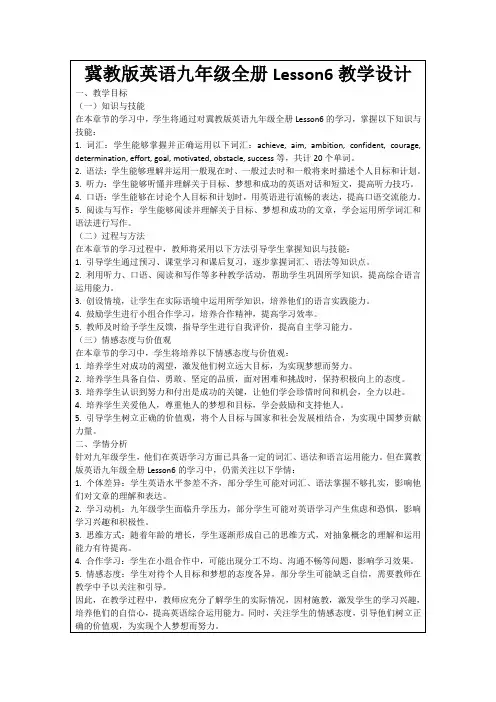
一、教学目标
(一)知识与技能
在本章节的学习中,学生将通过对冀教版英语九年级全册Lesson6的学习,掌握以下知识与技能:
1.词汇:学生能够掌握并正确运用以下词汇:achieve, aim, ambition, confident, courage, determination, effort, goal, motivated, obstacle, success等,共计20个单词。
(二)讲授新知
1.教师以PPT形式呈现新课的词汇和语法,结合实际语境进行讲解,帮助学生理解并掌握。
2.教师通过播放与目标、梦想和成功相关的听力材料,引导学生。
3.教师讲解课文,分析文章中描述成功人士的经验和策略,帮助学生了解如何实现自己的目标。
4.鼓励学生进行小组合作学习,培养合作精神,提高学习效率。
5.教师及时给予学生反馈,指导学生进行自我评价,提高自主学习能力。
(三)情感态度与价值观
在本章节的学习中,学生将培养以下情感态度与价值观:
1.培养学生对成功的渴望,激发他们树立远大目标,为实现梦想而努力。
2.培养学生具备自信、勇敢、坚定的品质,面对困难和挑战时,保持积极向上的态度。
2.语法练习:根据本节课学习的一般现在时、一般过去时和一般将来时,完成课后练习册中的语法练习题,巩固语法知识。
3.听力训练:学生需课外观看一段关于梦想与成功的英文视频,并回答相关问题,提高听力理解和信息提取能力。
4.口语任务:学生以小组为单位,讨论并录制一段关于组员梦想的对话,要求每个成员都参与其中,培养团队合作和口语表达能力。
2.学生分享学习收获,教师给予肯定和鼓励。
3.教师强调梦想与目标的重要性,激发学生为实现梦想而努力奋斗的信心。
Lesson10TouchtheWorld教案2023-2024学年冀教版九年级英语全册
Lesson 10 Touch the World教案 2023-2024学年冀教版九年级英语全册一、教材分析本课内容选自冀教版九年级英语全册Lesson 10 "Touch the World"。
本课主要围绕世界各地的文化、习俗和风景展开,通过描述不同国家的生活场景,让学生了解世界各地的风土人情,培养学生的跨文化交际意识。
本课关键词包括:Japanese culture, Chinese culture, Korean culture, Italian cuisine, French fashion, etc.。
学生通过本课的学习,将能够掌握描述各国文化、习俗和风景的词汇,提高听说读写的能力,并能够运用所学知识进行实际交流。
同时,学生通过对比不同国家的文化差异,增强对多元文化的认识和理解,提高跨文化交际能力。
二、核心素养目标本课旨在培养学生的英语学科核心素养,包括语言能力、文化意识、思维品质和学习能力。
通过学习关于不同国家文化、习俗和风景的知识,学生将提高听说读写能力,增强对多元文化的认识和理解,提升跨文化交际能力。
同时,通过分析比较不同国家的文化差异,学生的思维品质将得到锻炼,学习能力也将得到提升。
三、重点难点及解决办法重点:学生能够掌握描述各国文化、习俗和风景的词汇和表达方式。
难点:学生能够运用所学知识进行实际交流,并能够正确表达文化差异。
解决办法:通过小组讨论、角色扮演等互动活动,让学生在实际语境中练习和使用新词汇。
同时,通过案例分析、文化比较等方式,帮助学生理解和掌握跨文化交流的技巧。
此外,教师可提供丰富的视觉和听觉材料,如图片、视频等,以增强学生对不同文化的感知和理解。
四、教学方法与手段教学方法:1. 互动式教学法:通过小组讨论、角色扮演等形式,让学生在实际语境中练习和使用新词汇,提高学生的语言运用能力。
2. 案例分析法:通过分析不同国家的文化案例,帮助学生理解和掌握跨文化交流的技巧,培养学生的文化意识。
冀教版英语九年级全册Lesson3教学设计
(3)个性化评价:针对学生的个体差异,给予有针对性的评价和建议,激发学生的学习积极性。
四、教学内容与过程
(一)导入新课,500字
在导入环节,教师将通过以下方式激发学生的学习兴趣,为新课的学习做好铺垫:
1.教师向学生提问:“What are your goals for the future?”,让学生分享自己的目标和梦想,为新课主题“goals”做好预热。
1.作业应在课后及时完成,保证作业馈。
3.学生在完成作业过程中,要注重思考、总结,发现问题及时与同学或老师交流。
4.教师将在下节课对作业进行讲评,针对学生的完成情况进行指导和鼓励。
4.学生在阅读理解方面,具备一定的阅读能力,但需要进一步培养关注细节、把握文章主旨的能力。
5.在写作方面,学生能够完成简单的句子写作,但对于篇章结构和逻辑性表达,仍需加强指导和练习。
针对以上学情,教师在本章节的教学中应注重以下几点:
1.激发学生的兴趣,引导他们积极参与课堂活动,提高口语表达能力。
2.注重词汇教学的循序渐进,帮助学生扎实掌握本课的高级词汇和短语。
冀教版英语九年级全册Lesson3教学设计
一、教学目标
(一)知识与技能
在本章节的学习中,学生将掌握以下知识与技能:
1.掌握本课的生词和短语,如:responsibility, independence, achieve, goal, commit等,并能熟练运用这些词汇进行口语交流。
2.学会使用一般现在时和一般过去时描述个人经历和目标,并能够运用这两种时态进行简单的句子创作。
2.培养学生具备责任感,明白自己的努力和付出对个人成长的重要性。
冀教版九年级英语教学教案5篇
冀教版九年级英语教学教案5篇冀教版九年级英语教案1一、教学目标:1. 语言知识目标:1) 学习掌握下列词汇:cream, workday,pie, show up, bean, market, by the endof,2)进行一步复习巩固学习Section A 部分所学的生词和词组。
3)巩固过去完成时的用法2. 情感态度价值观目标:1)能运用所掌握的语法,句型和词汇进行交流。
2)能比较流利地讲述自己曾经有的特别的经历。
二、教学重难点1. 教学重点:1) 复习巩固Section A 部分所学的生词和词组,达到熟练运用的目标。
2) 总结过去完成时的不同句型。
3)总结过去完成时的用法。
2. 教学难点:过去完成时的用法三、教学过程Ⅰ. Revision1. Have adictationof the new words learned in the last class.2. Review somemainphrases we learned in the last class. Check the homework.把下列短语翻译成英语1. 即将2. 倒杯咖啡3. 排队等候4. 起床5. 出去6. 迟到7. 到时候 8. 闹铃响9. 开始做某事 10. 搭便车3. Revision过去完成时的构成:had+动词的过去分词II. Lead-inT: What happenedtoyou on a bad morning?Ss…引导学生用过去完成时回答。
III. GrammarFocus.1. 过去完成时讲解。
2. 学生阅读Grammar Focus中的句子,然后做填空练习。
1)当我到达学校的时候,我才意识到我把书包忘在家里了。
When I gottoschool, I realized I ______ ______ my backpack at home.2)到我返回学校的时候,铃声已经响过了。
_____ _____ _____Igot back to school, the bell ______ _______.3)我到达公共汽车站之前,汽车已经离开了。
冀教版九年级英语全册Lesson9China’sMostFamous“Farmer”教案
Lesson 9China’s Most Famous “Farmer”Teaching Contents:1. words: introduction, leader, produce, peanut, hybrid, variety, production, super2. patterns: since then, together with, in the+年代’sTeaching Objectives:1. Grasp mastery words and patterns.2. Enable to tell something about Y uan LongpingLESSON STRUCTURECLASS OPENINGFor ideas and tips on beginning a class, see "Teaching Techniques" at the back of this teacher's guide. KEY STEPSStep1. Show the new words with the flashcards. Let the students read the words and expressions after you. Read more times to the difficult words.Play a game to see if they have read them fluently. Divide the class into two groups. One group asks the words, the other answers. Then change their roles. They get one score if they can read a word correctly. At last, let’s see who has the higher score. The winner is the group who gets more scores.Step2.Skim the text and tell us the main idea of this lesson.Give the students three minutes. Let’s see how many students can finish the reading task in the limited time.Ask some students to demonstrate their opinion. If others think isn’t complete, they can add others in the opinion. If the teacher thinks their answers are not perfect, he or she can pay more attention to the part in the next steps.Step3.Read the text and ask questions.Finish the task in groups. Find questions about this part. Then ask the other group to answer them. If someone wants to add his own opinion, he can stand up and say his suggestion.The questions are like these:What’s Professor Yuan’s childhood dream?When was he born?What did he succeed in developing?Did foreigner countries use Professor Y uan’s technology?They can ask more questions as they like.Step4. Make sentences with the language points with the help of the flashcards.graduate fromI graduate BeijingUniversity in 2019.Where did he graduate from?come up withAt last, he came up with a good idea.When we are in trouble, he always comes up with good ideas.in the field ofHe is famous in field of art.since thenThe man has worked in that factory since then.together withThe girl moved to France together with her parents.in the+年代+sThe scientist was born in the 1980s.Step5. Play the tape for several times. Let the students listen carefully and have the correct pronunciation. Let some students read important paragraphs.Step6. PracticeFinish Exercise 1, 2 and 3 on Page 23. Encourage students to do them independently. Then check answers as a class.Step7. HomeworkFinish off the activity book.Go on the next reading in the student book.Summary:It is necessary for us to study the performance. What have the old scientists done for us? How great they are? We must work hard at all our subjects. Whatever you do when you grow up, we must devote ourselves to the society. We must be a useful person to the world. If someone is very interested in rice, too, we canget more information on the Internet.。