
译林版四年级下册英语Unit 2 After school素材
1 Unit 2 After school
一、单词
Monday 星期一 Tuesday 星期二 Wednesday 星期三 Thursday 星期三
Friday 星期五 Saturday 星期六 Sunday 星期日 get up 起床
二、词组
play table tennis 打乒乓球 what day 星期几 a football match 一场足球比赛
a swimming lesson 一节游泳课 all right好的 get up起床 every day每天
good morning早上好 at five在五点钟 what lessons 什么课 on Saturday在星期六
play table tennis 打乒乓球 what day is it today?今天星期几? what a pity真遗憾
come and play table tenn来打乒乓球 at school 在学校 after school 放学后
三.句型
1. What day is it today? 今天星期几? It's Friday. 今天是星期五。
拓展:What date it is today?今天是几号? It’s August 13th.今天是八月13号。
What time is it now? 现在时几点? It’s half past ten. 现在时十点半。
2. She has a skating lesson. 她有一堂溜冰课。
3. We don’t have any lessons on Wednesday.我们在星期三没有课。
4. Let’s go and play table tennis.让我们去打乒乓球。
5. I have a basketball match today. 今天我有一场篮球比赛。
6. When do you get up every day? 你每天几点起床?
7. I get up at five. / At five. 我五点钟起床。
四、短语
Aa / æ / bag书包 cap 帽子 hamburger 汉堡包 sandwich 三明治 snack 快餐
dad 爸爸 Maths 数学 match 比赛 Saturday 星期六
apple 苹果
五.练习
(一)、单项选择。
1. ---Can you play ball games _____ ? ---Yes, I can.
2 A. good B. nice C. well
2. ---Oh, I can’t swim. ---Don’t be sad. I can’t swim _____ .
A. too B. either C. good
3. --- _____ ? ---No, I like Science. It’s fun.
A. Do you like Science B. Do you like Chinese C. What do you like
4. ---Can you _______ ? ---No. But I have a lesson.
A. swim; swim B. swim; swimming C. swimming; swim
5. ---I can’t go to play table tennis. ---______!
A. What a pity B. How nice C. How beautiful
(二)根据句意及首字母提示,写出正确的单词。
1. Peter is an E boy. He can’t speak(说)C .
2. John can sing(唱)well. He likes M .
3. ---What d is it today? ---It’s W .
(三)从方框中选择合适的句子完成对话。
A: Hi, Liu Tao. Let’s go and play basketball.
B:
A: It’s Friday.
B: Sorry, I have a swimming lesson today.
A:
Hi, Wang Bing. Come and play basketball.
C:
A:
C: He has a football match.
We don’t have any lessons on Sunday.
A: Let’s play on Sunday.
A. What a pity!
B. Sorry, I have a Music lesson.
C. What about Mike?
D. What day is it today?
E. All right.
F. What about Sunday?
资料《Unit2课文原文与翻译(素材)译林版九年级英语下册》
1 译林版九年级下册英语课文及翻译
UNIT 2英中对照版
UNIT2
Comic strip
1. Who do you think is the greatest person in history,Eddie?
埃迪,你认为史上最伟大的人是谁?
2. I think it’s Paul Yum.
我认为是保罗•亚姆。
3. Paul Yum? I’ve never heard of him.Who’s he?
保罗•亚姆?我从没听说过他。他是谁?
4. He’s an inventor.He invented my favourite food.
他是一位发明家。他发明了我最喜爱的食物。
九下 · p21-23
Reading
The first man to walk on the Moon
Neil Armstrong(1930 – 2012)was the first man to walk on the
Moon. Simon is now reading an article about the astronaut and his
space travel. Here is the article.
尼尔。阿姆斯特朗(1930-2012)是首位漫步月球的人。西蒙 2 现在正在阅读一篇关于这位宇航员和他的太空旅行的文章。这是那篇文章。
NEIL ARMSTRONG
尼尔•阿姆斯特朗
Neil Armstrong was born on 5 August 1930 in Ohio,the USA. He
became interestedin flying when he took his first flight at the age
of six, He received his student pilot’s licence when he was 16.
尼尔•阿姆斯特朗于1930年8月5日出生于美国俄亥俄州。在他6岁参加第一次飞行时,他就开始对飞行感兴趣。他16岁获得了学生飞行员许可证。
新版-牛津上海版(深圳用)四年级英语下册 名校期中检测卷(含答案及素材
8 / 8 期中检测卷
时间:60分钟 满分:100分+10分
题号 一 二 三 四 五 六 七 八 九 十 十一 口语 总分
得分
听力部分 (40分)
一、听录音,选出你所听到的内容。(10分)
( )1. A. all B. or C. ball
( )2. A. a bag of mangoes B. a bag of gold C. a bag of apples
( )3. A. in the morning B. in the evening C. in the afternoon
( )4. A. play the violin B. play the piano C. play the guitar
( )5. A. play basketball B. play football C. play volleyball
二、听录音,给下列图片排序。(10分)
( ) ( ) ( )
( ) ( )
三、听录音,圈出正确的单词,完成短文。(10分)
My name is Susan. I'm 1. (eight/nine). I have a brother. His name is Ben. I like 2.
(watermelons/pears). Ben likes apples. I like Music and 3. (PE/Art). Ben likes English
and 4. (Maths/Science). We both like playing the 5. (violin/piano).
四、听录音,在表格相应的位置打“√”。(10分)
五年级英语上册素材-Unit2 Going to school知识点梳理 沪教牛津版(深圳用)
Unit2 Going to school
一、单元单词(17个)
by (表示方式);靠近
walk 走;步行
Ms 女士
journey 旅程;旅行
primary school 小学
underground 地铁
station 车站
take 乘坐(交通工具);带领
after 在……后
hour 小时
bus stop 公共汽车站
by bus 乘公共汽车
far from 离……远
on foot 步行
by bike 骑自行车
by car 乘小汽车
get off 下车
二、重点句子:
Listen and say
How do you come to school, Joe?
乔,你怎么去上学?
I come to school by bus.
我乘公共汽车去上学。
I live far from our school.
我家离学校很远。
How do you come to school, Alice? 你怎么去上学,爱丽丝?
I come to school on foot.
我步行上学。
I live near school.
我住在学校附近。
How do you come to school, Kitty?
你怎么去上学,凯蒂?
I come to school on foot, too.
我也步行上学。
Alice and I walk to school together.
爱丽丝和我一起走路上学。
What about you, Peter?
你呢,彼得?
How do you come to school?
你怎么去上学?
I come to school by bus.
我乘公共汽车来上学。
Look and read
Ms Guo’s journey to work
郭女士的上班旅程
Ms Guo is a teacher at Happy Primary School.
英语模块一素材 Unit 1 School life(1)
英语必修1(译林牛津版)素材(含教案和练习)
Unit 1 School life(1)
一. 教学内容:
Unit 1 School life
二. 教学目标:掌握阅读技巧skimming and scanning
掌握Unit1词汇及词性变化
三. 教学重难点:掌握课文中的重点句型的结构、用法
Unit 1 School life
(一)词汇
woodwork n. 木工
enjoyable adj. 愉快的,快乐的
(二)课文重难点
1)Going to a British high School for one year was a very enjoyable and exciting
experience for me.
动名词做主语,例:
Playing basketball is an easy job while learning English is really hard work for me.
Collecting stamps is my hobby. 我的嗜好是集邮。
2)Britain ----- England, Scotland, North Ireland, Welsh
British------English
辨析Britain与England
前者指英国,等同于UK,而England指英格兰,它只是英国的一部分。
国名 国家的 语言 国人 国人复数
America American English American Americans
France French French Frenchman Frenchmen
Germany German German German Germans
China Chinese Chinese Chinese Chinese
Japan Japanese Japanese Japanese Japanese
四年级下册英语素材一般将来时态be going to的用法与练习 全国通用
第 1 页 语法知识:be going to do sth
be going to句型的两种不同用法 I’m going to the school.我正要去学校。
I’m going to go to the school.我打算去学校。
第一句是动词go的进展时表将来,(to)之后须加名词。(come, go等趋向动词的如今进展时表将来。)
第二句那么为be going to的一般将来时句型,to之后须加动词原形。
一般将来时
一、概念:表示将要发生的动作或存在的状态及打算、方案或准备做某事。句中一般有以下时间状语:tomorrow,
next day(week, month, year…), the day after tomorrow〔后天〕等。
二、根本构造:①be going to + do;
be going to的特殊疑问句形式:构成方式:疑问词+be going to的一般疑问句。一个口诀献给大家:
疑问词在句首,系动词be跟着走,
主语、going紧相随,其它成分不要丢。
如何把陈述句形式转换成特殊疑问句形式呢?一个方法,那就是:一定、二变、三去掉。
一定:即确定划线局部的疑问词;
二变:即把be going to变为一般疑问句形式;
三去掉:去掉划线局部。例如:We are going to have a meeting next Monday.
A:确定疑问词为when(什么时候)
B:把原句改为一般疑问句are you going to have a meeting next Monday?
C:去掉划线局部,即When are you going to have a meeting?你们打算什么时候开会?
【注意】假如对to后面的动词短语进展提问那么要用What...do...?对例句中的have a meeting进展提问应为:
牛津译林版-英语-九上-牛津译林版-4单元 单元主题写作四
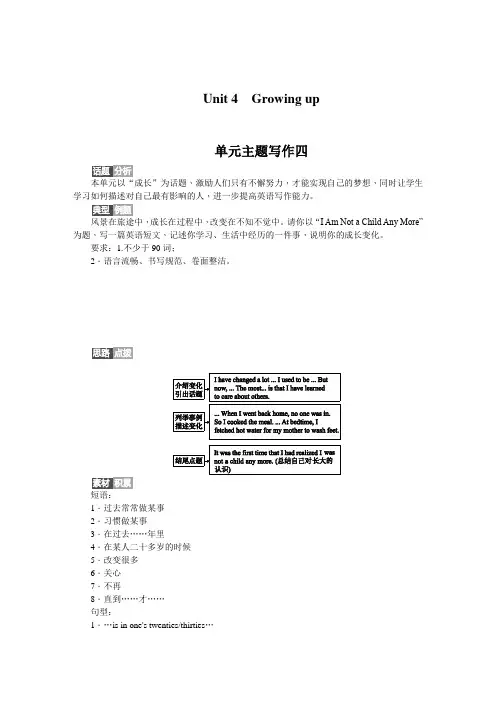
Unit 4 Growing up
单元主题写作四
本单元以“成长”为话题,激励人们只有不懈努力,才能实现自己的梦想,同时让学生学习如何描述对自己最有影响的人,进一步提高英语写作能力。
风景在旅途中,成长在过程中,改变在不知不觉中。请你以“I Am Not a Child Any More”为题,写一篇英语短文,记述你学习、生活中经历的一件事,说明你的成长变化。
要求:1.不少于90词;
2.语言流畅、书写规范、卷面整洁。
________________________________________________________________________
________________________________________________________________________
________________________________________________________________________
________________________________________________________________________
________________________________________________________________________
________________________________________________________________________
短语:
1.过去常常做某事________________
2.习惯做某事________________
3.在过去……年里________________
4.在某人二十多岁的时候________________
5.改变很多________________
6.关心________________
7.不再________________
Unit3课文翻译素材-高中英语牛津译林版(2020)选修第二册
高中英语译林版选修二课文翻译(原文+中文翻译)
Unit 3 Helping people
帮助他人
Reading
The United Nations- -bringing people together
联合国-把人们团结在一起
In 1945, the world was on its knees. Cities lay in ruins, economies were destroyed, tens of
millions of people were killed, and families across the globe were homeless and mourning the loss
of loved ones. World War II, the deadliest human conflict of all time, had shattered people's lives
everywhere. From the ashes of this utter destruction rose the organization that we now know as
the United Nations (UN), offering hope to a world desperate for lasting peace and security. It is
my privilege and pleasure to stand before you today and share with you a little bit about this
wonderful organization.
1945年,世界陷入了困境。城市成为废墟,经济被摧毁,数千万人丧生,全球各地的家庭无家可归,哀悼失去的亲人。第二次世界大战是有史以来最致命的人类冲突,它摧毁了世界各地人民的生活。从这场彻底毁灭的灰烬中诞生了我们现在所知的联合国,它为渴望持久和平与安全的世界带来了希望。今天,我很荣幸也很高兴站在你们面前,与你们分享一些关 于这个了不起的组织的情况。
英语下册Unit4Drawinginthepark知识点梳理素材译林牛津版
Unit 4知识点总结
一、重点单词
drawing/draw画画park 公园 flower花,花朵 them他们;她们;它们(宾格)difficult
难的,困难的try 试hill小山,山丘again再一次,又一次
boat小船river河;江 lake 湖泊,湖
二、核心词组
in the park在公园里
draw some pictures画一些图画
good idea好主意
draw them画它们
over there在那边
some flowers一些花
well done干得好
on the river在河上
make a cake做个蛋糕
in this big box在这个大盒子里
have a look看一看
great fun很有趣
try again再试一次
on the lake在湖面上
ten to ten 9点50
before ten在十点之前
三、重点句型
’s draw some pictures here.让我们在这儿画一些画吧。
2.What can you seeover there?在那儿你能看见什么?
I can see a tree and some flowers.我能看见一棵树和一些花。
3. Can you draw them?你能画它们吗?
4. Can you seethe boat on the river?你能看见河面上的船吗?
5. It’s difficult,but I can try.它很难,但是我能试试。
6. What’s in this big box?这个大盒子里有什么?
7. It’s great fun.它很有趣。
四、语法知识
1.情态动词can
(1)、情态动词,表示“能够、可能”,后面必须加动词原型
例如:I can swim very well.
(2)、I/ You/ He/ She/ It / We/ You/ They,所有人称都用can,不分单复数
五年级下册英语素材期中复习之易考词汇句型译林版
五下英语期中复习之易考词汇句型
1. help sb do sth 帮助某人做某事
help sb with sth
2. don’t have ... or ... 没有...和...
3. have a good time 玩得开心
4. try on 试穿 *try 代词(宾)on
5. put on 穿上 *put 代词(宾)on
6. take off 脱掉 *take 代词(宾)off
7. have to + 动词原形 不得不
must + 动词原形 必须
should + 动词原形 应该
8. go to the party 去派对
9. find 找到 find some mushrooms 找到一些蘑菇
look for 寻找 look for my key 找我的钥匙
10. pick some apples/mangoes 摘一些苹果/芒果
11. my feet hurt 我的脚受伤了(双脚)
my foot hurts 我的脚受伤了(一只脚)
12. be late for 迟到
13. leave ... behind 留下
14. understand the story 理解故事
15. in the basket 在篮子里
16. be bad for 对...有坏处 17. be good for 对...有好处
18. before bedtime 睡觉前
19. after school 放学后
20. at one’s birthday party 在某人的生日派对上
21. a taxi driver 的士司机
22. go to ... on foot = walk to ... 步行去某地
go to ... by bike = ride a bike to ... 骑自行车去某地
小学四年级英语教学设计5篇
【 导语】教学设计是根据课程标准的要求和教学对象的特点,将教学诸要素有序安排,确定合适的教学⽅案的设想和计划。⼀般包括教学⽬标、教学重难点、教学⽅法、教学步骤与时间分配等环节。以下是⽆忧考整理的《⼩学四年级英语教学设计5篇》相关资料,希望帮助到您。
1.⼩学四年级英语教学设计
学情分析:
四年级(⼆) 班的学⽣对于英语的学习是⽐较感兴趣的,他们的基本功较好,因此对于新知的认识也掌握得较快较好。这⼀模块学习的是与正在进⾏时态有关的内容,⽽对于正在进⾏时这⼀时态学⽣们在上⼀模块已经有所认识了。因此, 中上以上⽔平同学对正在进⾏时时态的基本⽤法有了⼀定的掌握,但中下⽔平的同学对于语⾔的表达和知识的运⽤会有不同程度的困难。⽽这⼀模块的重点是让学⽣们在35分钟内通过对知识的拓展操练和“精讲精练”来突破本节课所要达到的⽬标。所以为了避免课堂上的枯燥⽆味,就要想办法制造⼀些轻松的学习⽓氛,⿎励学⽣通过相互提问⽅式(你来做、我来答。⼤家做、我来答。我来做、⼤家答。)等等⽅式进⾏⽐较,提⾼学⽣的学习积极性是必要的。
教学⽬标:
1、知识⽬标(Knowledges aims)
(1)学习单词 : running jumping (
2)学习如何询问他⼈正在⼲什么及其应答。 What are they doing? They are playing…… Whats she / he doing? She /He is running……
(3)学习歌曲《Row your boat》
2、能⼒⽬标(Abilities aims)
(1)使学⽣能够运⽤现在进⾏时,询问回答并描述他⼈正在⼲什么。
(2)通过学习,使学⽣能听懂会唱英⽂歌曲《Row your boat》。
3、情感⽬标
①培养学⽣相互交流,相互合作学习的良好品德
②指导学⽣对英语语法结构的认识
③树⽴信⼼、战胜学习和⽣活中的困难。
教学重点:
能运⽤ What are they doing? Whats he / she doing? 询问别⼈正在⼲什么?并根据情况回答Theyre doing sth. 、 He /She is doing sth.