
七年级英语下册Unit4Findingyourway复习教学案新版牛津版
七年级英语下册Unit4Findingyourway复习教学案新版牛津版
Unit 4 Finding your way
复习目标:
1.能看懂地图,并在地图上找到要找的地点
2. 用正确的词汇给他们指明路线, 掌握指点路线的句式; 能用英语表达怎样去
某地。
3. 进一步领会本单元的主要内容并学会写邀请函
重点词汇:掌握重点词汇的词义和用法。
follow, south, west, trip, straight, bamboo, remember,
dangerous, forest,
funny, laugh, leaf, cross, across, above, below, over, past,
treasure,
traffic lights, corner, prepare, plenty, bank, sound, north-east,
east,
path, crossing, turning, outside, bridge, neck, bench
重点短语:
follow me = come with me,go down here,a path between
the hills,be far
away from the ho spital,the king of the animal world,a trip
to the zoo,
start their visit from the North Gate,half an hour later=after
half an hour,
walk /go along the path next to the river,at the corner of
the street,
write an invitation letter,prepare plenty of food and drinks
for us,remember
to do sth,to the north of the Panda House,cross the bridge = walk/go across
the bridge,go on a nice class trip= have a nice class trip
重点句型:掌握重点句型用法。
Where are we going f or our class trip? Go straight on, and
you will
find the Panda House. =If you go straight on, you will find
the Panda House. Monkeys are clever and funny. They jump
around and make people laugh. Baoying is in the north of Jiangsu.
Japan is (to the) east of China. How can/do I get to the theatre?
=Which is the way to the theatre? = Can
you tell/show me the way to the theatre? = Can you tell
/show me which is
the way to the theatre? = Can you tell/show me how to/how
I can ( how to)get
to th e theatre? = Where is the theatre? Take the second
turning/crossing on the right. = Turn right at the second
turning/crossing. Pandas are cute. They like to eat bamboo and
lie down all day long.
语法:Using a,an and the; prepositions of place
写作:学会写邀请函
复习要点:
1. [词汇篇] :写出下列四会单词;(见导学案)
2. [短语篇] :翻译短语:(见导学案)
3.[句型篇]:
1. Follow me. 跟我来 follow sb. 跟某人来
Eddie often follows James. 埃迪经常跟着吉姆。
[拓展] follow sb. to do sth 跟着某人做某事
We followed the old worker to visit the car factory yesterday.
昨天我们跟着那位老工人参观了汽车厂。
2. Are you sure? 你确定吗?此句中sure意为“确定的,确信的”,此前我们
学过该词,意为“当然,一定”。用来应答别人的要求。
a.你能帮助我吗?当然可以。
b.你确信他会来帮我们补习英语吗?
3. be afraid 害怕
afraid意为“害怕的”,它不能用于名词前,只能和连系动词连用。
It was very dark and I felt a little afraid. 天很黑,我感到有点害怕。
be afraid of sb /sth. 害怕某人/某事 be afraid to do sth 害怕做某
事
My little sister is afraid to go out at night. 我小妹妹害怕晚上出去。[拓展]
I’m afraid + 从句恐怕……(用于感到遗憾或有礼貌地表示不同意时)
I’m afraid he is not at home now. 恐怕他现在不在家。
---Is Mike there? 迈克在那里吗? ---I’m afraid not. 恐怕不在。
a.你怕狗吗? _________________________
b.我怕上学迟到。_______________________
c.恐怕你现在在学校找不到她。______________________________
3. I think we’ll have to go up again.我想我们将不得不再上去了。
I think放在句首一般是用来表示说话人的一种主观认为。类似I’m afraid的用法
如要表示我认为…不…则只能用I don’t think +肯定句表示
I don’t think you are a good teacher. 我认为你不是个好老师。
have to表示客观/ must表示主观
1. We are in Grade 9, we ______ study hard to go to an ideal
high school. 2.It’s getting dark. I _______ go home now.
3. His mother is ill. He _________ look after himself.
Must I finish homework before 7? No, you
____________________.
*回答must引起的问题时,否定回答用needn’t / don’t have
to, 不用mustn’t, mustn’t表示“禁止,绝对不可以”。must*
must be可表示肯定的推测,其否定用can’t be
4. north of Beijing Sunshine Secondary School. 在北京阳光中学的北面。
north of = to the north of 在……北
[辨析] A在B东
A is in the east of
B (A地包括在B地的范围内) A is on the east of B (A地和B地相连) A is to the east of B (A地不包括在B地的范围内)
[拓展] eastern 东部的 western 西部的 southern 南部的
northern 北部的 in the north of = in the northern part of
The Great Wall is in the northern part of China. 长城在中国北部。4.【语法详解】
(一) 定冠词the 可指特定的人或物,可指谈话双方都能体会到的人或物,可指已提到过的人或物,可指独一无二的事物,请同学们仔细体会下列几道题目:
Plese give me salt. baby is crying.
Mrs Zhang is principal of our school. I see a boy. boy is
Tom’s brother.
sun is too bright . May I close door ?
△但有些说法不加the ,球类之前play football,固定词组listen
to music,国家名称不加the,England,China,节日、季节、星期、年前不加the等等。
冠词口诀
冠词分为定冠、不定冠,不定冠词a和an,“—”的含义表泛指 表示特指要用the,次序、方位、最高级; 世上物体独一个,人或事物再次提以下情况冠词免,学科球类三顿饭; 名词复数表泛指,季节星期月份前
(二)方位介词
常见的方位介词:above→below, behind→in front of, at, in,
beside, between, among, inside→outside, next to, on, opposite,
over→under, on the left/right of…
【巩固练习】
一、根据所给中文解释,及句意,首字母提示完成句子。
1. To get to the park, turn left when you come to the
__________(十字路口)。
2. Don’t ______________(横穿) the street.
3. This sign tells us that we can go ______________(径直) on.
4. My brother works in Sunshine _______________(宾馆).
5. It is ________(危险的)for the children to go across the
________.(森林)
6. This sign tells us that we can go ______________(径直) on.
7. He ____________ (不属于) my grandfather.
8. Thanks for _____________(邀请) me to your birthday party.
9. They walked __________(通过) the hotel and didn’t find it.
七年级英语下册Unit4Findingyourway教案6新版牛津版

Unit 4 Finding your way
Study skills
Teaching Aims:
Learn falling tone and rising tone.
Step 1. Study skills
1. Explain
1).When we speak, we drop our tone at the end of a statement.
2). When we ask a yes / no question, our tone rises at the end of the question.
3). When we ask a wh-question, our tone usually falls at the end of the question.
4). We make our tone rise at the end of a sentence to show surprise.
2. Listen and read aloud Part A.
Step 2. Exercises
1. Read the sentences below. Put a falling arrow or a rising arrow at the end of the
sentence.
1 Just cross the road.
2 Would you like to come?
3 Go out and turn left.
4 –Mr Wu is going to be on TV tonight.
–Mr Wu?
2. Complete Part B. Then read them aloud.
Step 3. Homework
1. Read the article on page 44. Make your tone rise or fall when needed.
牛津译林版英语七下Unit 4《Finding your way》(第6课时)教学设计
牛津译林版英语七下Unit 4《Finding your way》(第6课时)教学设计
一. 教材分析
《牛津译林版英语七下Unit 4》主要讲述了如何寻找路线和方向。本单元通过引入新的词汇、短语和句型,帮助学生掌握描述路线和方向的表达方法。第6课时主要教学内容为阅读理解,通过一篇关于如何在学校找到各个地点的文章,让学生学会如何运用本单元所学知识解决实际问题。
二. 学情分析
学生在学习本单元前,已经掌握了基本的英语语法和词汇知识,具备一定的听、说、读、写能力。但部分学生对于描述路线和方向的表达方式尚不熟悉,需要在本节课中进行针对性的训练和指导。
三. 教学目标
1. 学生能够掌握描述路线和方向的常用表达方式。
2. 学生能够运用所学知识,解决实际生活中的导航问题。
3. 学生能够提高阅读理解能力,理解并运用文章中的描述路线和方向的句子。
四. 教学重难点
1. 描述路线和方向的表达方式。
2. 如何在实际情境中运用所学知识解决导航问题。
五. 教学方法
1. 情境教学法:通过设置各种实际情境,让学生在实践中学会描述路线和方向。
2. 任务型教学法:通过完成各种任务,让学生在实践中运用所学知识。
3. 交际式教学法:引导学生进行小组讨论和互动,提高学生的交际能力。
六. 教学准备
1. 教学课件:制作包含本节课主要内容的教学课件。
2. 阅读材料:准备一篇关于描述路线和方向的文章,用于课堂阅读理解环节。
3. 地图:准备一张学校地图,用于实践环节。 七. 教学过程
1. 导入(5分钟)
利用图片或视频展示学校地图,引导学生谈论自己熟悉的地点和路线。提问:“Can you show me the way to the library?”,激发学生的学习兴趣。
2. 呈现(10分钟)
呈现文章标题《How to Find Your Way in School》,引导学生阅读文章,并回答问题:“What’s the mn idea of the passage?”。让学生关注文章中描述路线和方向的句子。
七年级英语下册Unit4FindingyourwayIntegratedskills教案(新版)牛津版
Finding your way
教学目标 知识目标 To get the information with the listening materials.
能力目标 To finish different tasks with the information that got.
情感目标 To discuss how to get the right route.
教学重点 To get the information with the listening materials.
教学难点 To discuss how to get the right route.
教学准备 Tape recorder, Computer,
Read the words and the text.
学情分析 The topic of this unit is “Finding your way”. In this “Integrated
Skills” period, we will learn something about the directions . The
students will listen to the guide’s introduction and learn And they
are not familiar with shorthand skills. So in this teaching period, I will
teach students some skills, especially focus on the key words in the
sentences.
教学过程
教学环节 教 师 活 动 学 生 活 动 设计意图
Step 1
Lead in
Step2
Level 1
Learn new words
Step 3
Level 2
七年级下册英语Unit 4 Finding your way教案(牛津版)
七年级下册英语Unit 4 Finding ur a教案(牛津版)
七年级下册英语Unit4Findingura教案(牛津版)
Unit4Findingura
istripandelettheunit
TeahingAis:
Intrduethelatinandtraffitpi
2Talabutvisitandtraffide
3Distinguishdiretins
Step1Presentatin
Shsepiturestlearnserdsabutdifferentdiretins
trip
path
nrth
suth
east
est
nrth-est
nrth-east
suth-est
suth-east
2Thenreadaludthenerds fll
vt
跟随,效仿
path
n
小路,小径
nrth
n,ad≈adv
北,北方
est
n,ad≈adv
西,西方
suth
n,ad≈adv
南,南方
east
n,ad≈adv
东,东方
trip
n
旅行,旅游
iletre= n
千米,公里
havet
不得不,必须
Step2Pratise
Pratiseinpairsliethisttalabutheretheplaeis
A:hereis…?(旅游)?
B:It’snrth/suth/east/estf…
2AsstudentstpletePartAnPage43
Step3Presentatin
PresentsepituresfrSstlearnhtgetthereThenasSstaesedialgues
Step4Listenandanser
七年级英语下册Unit4FindingyourwayReading2教案(新版)牛津版
Unit4 Reading2
课 题 Reading(2) 课型 New
教学目标 知识目标 To understand and use the key phrases and sentences in
the text.
能力目标 To retell the text in the students’ own words.
情感目标 Change into another style of retelling like role-play
in this article
教学重点 To understand and use the key phrases and sentences in the text.
教学难点 To retell the text in the students’ own words.
教学准备 Tape recorder, Computer, Pictures
课前预习 Preview the new words.
Listen to the tape.
教学过程
教学环节 教 师 活 动 学 生 活 动 设计意图
Step 1
Revision
Step 2
Presentation
1. Play a game with the students to
let them guess the animals.
2. Ask students to say something
about the animals they have
learned.
3. Ask the students to read and
recite the text by themselves and
complete B4.
4. Invite some of the students to
read the dialogue in roles.
1. Write the important words and
江苏省东海县横沟中学七年级英语下册 Unit 4 Finding your way Integrated skills教案 (新版)牛津版
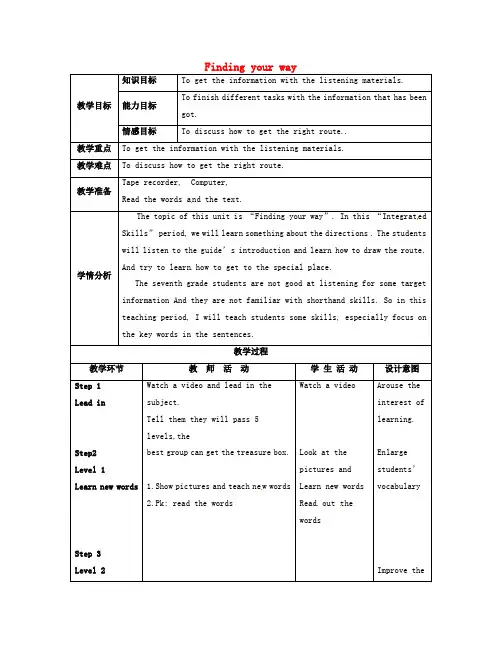
Finding your way
教学目标 知识目标 To get the information with the listening materials.
能力目标 To finish different tasks with the information that has been
got.
情感目标 To discuss how to get the right route.
教学重点 To get the information with the listening materials.
教学难点 To discuss how to get the right route.
教学准备 Tape recorder, Computer,
Read the words and the text.
学情分析 The topic of this unit is “Finding your way”. In this “Integrated
Skills” period, we will learn something about the directions . The students
will listen to the guide’s introduction and learn how to draw the route.
And try to learn how to get to the special place.
The seventh grade students are not good at listening for some target
information And they are not familiar with shorthand skills. So in this
teaching period, I will teach students some skills, especially focus on
牛津译林版七年级下册Unit 4《Finding your way》(task)教学设计
牛津译林版七年级下册Unit 4《Finding your way》(task)教学设计
一. 教材分析
《Finding your way》是牛津译林版七年级下册Unit 4的一篇任务型阅读课文。课文通过介绍一位游客在伦敦寻找大本钟的过程中,向不同的人询问路线,最终找到目的地。课文内容涉及到方位词、问路和指路的相关表达,旨在让学生掌握如何用英语询问和描述路线。教材通过任务型教学法,让学生在实际情境中运用英语,提高学生的语言运用能力。
二. 学情分析
七年级的学生已具备一定的英语基础,能够听懂并运用简单的日常用语进行交流。但学生在实际运用英语描述路线方面可能存在一定的困难,因此教师需针对这一点进行重点指导。此外,学生对于英语阅读的兴趣会影响他们对课文内容的学习,教师应充分激发学生的学习兴趣,提高他们的阅读积极性。
三. 教学目标
1. 知识目标:学生能够掌握表示方位的词汇和短语,如up, down, left,
right, turn left, turn right等;能够用英语询问和描述路线。
2. 能力目标:学生能够在实际情境中运用英语询问和描述路线,提高语言运用能力。
3. 情感目标:培养学生乐于助人的品质,学会在遇到困难时,主动向他人寻求帮助。
四. 教学重难点
1. 重点:表示方位的词汇和短语,以及询问和描述路线的句型。
2. 难点:如何将这些词汇和句型运用到实际情境中,进行流畅的交际。
五. 教学方法
1. 任务型教学法:通过设置各种任务,让学生在实际情境中运用英语,提高语言运用能力。
2. 情境教学法:创设生动、真实的情境,激发学生的学习兴趣。
3. 交际法:引导学生进行小组合作,进行实况模拟,提高交际能力。
六. 教学准备
1. 教学课件:制作包含课文内容、图片、动画等的多媒体课件。
2. 教学道具:准备一些表示方位的标志,如地图、路标等。 3. 练习题:设计一些关于询问和描述路线的练习题。
七年级英语下册 Unit 4 Finding your way welcome教案 (新版)牛津版
Unit 4 Finding your way welcome
教学目标:
1.To introduce the topic of places and transport.
2.To activate existing vocabulary and identify the meaning of new words related
to the topic.
3.To guess meaning from pictures.
4.To talk about visits and means of transport using model sentences.
教学重点:
1. To learn the prepositional phrases about directions.
2.To talk about visits and means of transport using model sentences1.
2.To talk about visits and means of transport using model sentences
教学过程:
Step 1:Lead-in (复习旧知)
Let Ss talk about the Sunshine Town
T: Do you remember the Sunshine Town?
S: Yes.
T: What is in the Sunshine Town?
S: A park, a school, many shopping malls, lots of restaurants and a local theatre.
Step 2:Presentation (引出新知)
1. Show Ss a map of the Sunshine Town
Point at the places in it and ask “Where is/are...?”
七年级英语下册Unit4FindingyourwayTask教案(新版)牛津版
1 Finding your way
Teaching Aims:
Learn to write an invitation letter.
Step 1. Presentation
Present the new words by showing some pictures
Step 2. Lead-in
l. Discuss some questions.
When is your birthday?
Do you have a birthday party?
2. Ask and answer in pairs.
Where will you have the party?
When will you have the party?
What will you have for food?
Who will you invite?
Step 3. Listening
1. Listen and answer
1). Who will have a birthday party?
2). Where will she have the party?
3). When will she have the party?
4). Who will she invite?
2. Read after the tape.
Step 4. Complete the directions according to the map.
1. Draw the map and find out the way to Suzy’s home.
2. Complete the directions.
3. Check the answers.
Step 5. Explanation
1. have a birthday party
举行一个生日聚会
e.g. We will have a birthday party this weekend. 2 这个周末我们将举行一个生日聚会。
牛津译林版七年级下册Unit 4《Finding your way》(reading1)教学设计
牛津译林版七年级下册Unit 4《Finding your way》(reading1)教学设计
一. 教材分析
《Finding your way》是牛津译林版七年级下册Unit 4的一篇阅读材料。文章主要讲述了一个关于如何在城市中找到目的地的故事。通过这个故事,学生可以学习到如何描述路线和地点,以及如何使用相关的词汇和句型。本篇文章内容贴近生活,能够激发学生的学习兴趣,同时培养他们的阅读能力和思维能力。
二. 学情分析
七年级的学生已经具备了一定的英语基础,能够进行简单的听、说、读、写操作。但是,对于描述路线和地点的词汇和句型,他们可能还不太熟悉。因此,在教学过程中,需要注重引导学生掌握这些词汇和句型,并能够运用到实际情景中。
三. 教学目标
1. 知识目标:学生能够掌握描述路线和地点的相关词汇和句型,如:turn left, go strght, cross the road等。
2. 能力目标:学生能够阅读并理解文章内容,能够用英语描述简单的路线和地点。
3. 情感目标:学生能够通过学习,提高自己的独立出行能力,增强对英语学习的兴趣。
四. 教学重难点
1. 重点:描述路线和地点的词汇和句型。
2. 难点:如何将这些词汇和句型运用到实际情景中。
五. 教学方法
1. 任务型教学法:通过设计各种实际任务,让学生在完成任务的过程中,自然地学习和掌握描述路线和地点的词汇和句型。
2. 情境教学法:创造各种情境,让学生在真实的语境中,运用所学知识。
3. 合作学习法:鼓励学生之间相互合作,共同完成学习任务。
六. 教学准备
1. 教师准备:熟悉教材内容,了解学生情况,设计教学活动。
2. 学生准备:预习课文,了解基本内容。
3. 教学资源:多媒体课件、地图、实物等。 七. 教学过程
1. 导入(5分钟)
教师通过提问方式,引导学生谈论日常生活中如何找到某个地方。例如:“你们在日常生活中,是如何找到某个地方的?”学生可以回答:“我通常会查看地图。”、“我会问路人。”等。教师进而引导学生思考:“如果要用英语描述如何找到某个地方,我们可以说些什么?”从而引出本节课的主题。