
仁爱版英语七年级unit3topic2
====Word行业资料分享--可编辑版本--双击可删====
源-于-网-络-收-集 1. Mom,I'm home. 妈妈,我到家了。
be home在这里意为"在家",常用在口语中。at home意为"在家"。
如:I have a pet at home. 我家里有一只宠物。
拓展:由home构成的常用短语有:
go home 回家
get home 到家
be back home 返回家里
at home 在家
in one's home 在某人家里
2.Kangkang, what does your mother do? 康康,你妈妈是干什么的?
这一特殊疑问句是用来询问对方职业或身份的常用句型。其结构为:what + 助动词(do/does)+ 主语 + do?
回答方式是:人称代词主格 + be(am/is/are)+ 职业
如:—What do you do? 你是干什么的?
—I am a teacher. 我是教师。
—What does your father do? 你爸爸是干什么的?
—He is a doctor. 他是医生。
—What do they do? 他们是干什么的?
—They are policemen. 他们是警察。
拓展:询问职业和身份还可以用下面的结构
1、 What + be的适当形式+ 主语?
如:—What is your mother? 你妈妈是干什么的?
—She is a teacher. 她是教师。
—What are you? 你是干什么的?
—I am a doctor. 我是医生。
2、What's one's job?也是用来询问对方职业的句型。job是名词,意思是“工作”,one's要使用形容词性物主代词或名词所有格的适当形式。
如:—What's your sister's job? 你妹妹是做什么的?
—She is a student. 她是学生。
—What's his job? 他是干什么的?
—He is a driver. 他是司机。
练习:同义句转换
1)What does your sister do?
2)What are they?
3)What's his job?
3、They are both office workers. 他们都是办公室职员。
(1)both意为“两者都,双方都”,指两个人或物,常与and连用构成both...and...句式;
all意为“都,完全”,指三者或三者以上的人或物。 ====Word行业资料分享--可编辑版本--双击可删====
源-于-网-络-收-集 如:Both of us are Chinese. 我们两都是中国人。
Both Lily and Lucy are students. 露西和莉莉都是学生。
We all like playing football. 我们都喜欢踢足球。
(2)both 与 and作副词时,要放在be动词之后,实义动词之前。
如:We are both students. We both study hard.
我们俩都是学生。 我们俩学习都很努力。
They are all cooks. They all cook well.
他们都是厨师。他们的烹饪手艺都很好。
[拓展]:both/all of +...作主语时,谓语动词用复数形式;作定语是,both/all修饰复数名词,但all后面还可以接不可数名词。
如:Both of them are 12. 他们俩都是12岁。
All of the boys like playing football. 男孩子们都喜欢踢足球。
Both students are boys. 两个学生都是男孩子。
All the milk is hers. 牛奶都是她的。
【即时演练】
1)Jack's parents teachers.
A、are all B、all are
C、are both D、both are
2) the ten students are here today.
A、all B、both
C、All D、Both
4、—Where does he work? 他在哪工作?
—He works in a hospital. 他在医院工作。
这是询问工作地点的特殊疑问句及其答语。
(1)work作动词时,意为“工作,任务”。
如:He works on a farm. 他在农场工作。
work作名词时,意为“工作,任务”,为不可数名词。
如:go to work 上班 after work 下班后
Look for work 找工作 out of work 失业
(2)“在农场”用介词on,但其他的许多工作场所前用in.
如:in a school 在学校 in an office 在办公室
in a hospital 在医院
5、This is a photo of my family. 这是一张我家的全家福。
(1)a photo of... 一张......的照片
如:a photo of a classroom 一张教室的照片
a photo of a cat 一张猫的照片
(2)family为集合名词,既可看成单数,也可看成复数,烟根据具体情况而定。作为一个整体时,意为“家庭”,作主语时谓语动词用单数形式;如果把family看做家庭成员时,应理解为复数,后面的谓语用复数形式。
如:My family is a big one. 我的家庭是个大家庭。
My family are very happy. 我们全家人都很开心。
[拓展] 名词所有格
1)表示有生命的名词所有格,一般是在名词词尾加's ====Word行业资料分享--可编辑版本--双击可删====
源-于-网-络-收-集 如:David's bike
Lily's eraser
2)表示无生命的名词的所有格时,一般用"of+名词"。凡不能加's名词,都可以用"of+ 名词"结构来表示所有关系。
如:the name of our school 我们学校的名字
[即时演练]
单项选择
1)This is Ms. Black. She is mother.
A、Sue and Susan's B、Sue's and Susan's
C、Sue and Susan D、Sue's and Susan
2)—What is your school?
—Beijing Ren'ai International School.
A、name of B、the name of
C、name D、the name
6、My grandparents live with us and look after Rose at home. 我祖父母和我们住在一起,他们在家照顾罗斯。
(1)live with 是由动词live+介词with构成的,后面接表示人或物的名词,意为"和某人或某物住在一起"。
如:We live with our parents. 我们和我们的父母住在一起。
(2)look after 是由动词look+ 介词after构成的,意为"照顾,照料"。
如:look after my sister 照顾我的妹妹
Ⅰ.单项选择。
( ) 1. — Welcome, kids! Glad to meet you.
— _________
A. Thank you. B. We’re happy.
C. Nice to meet you. D. You’re welcome.
( ) 2. Mrs. Zhang is _________ office worker.
A. a B. an C. / D. the
( ) 3. — What’s that?
— _________ a photo _________ our family.
A. Its’; of B. Its; of C. It’s; of D. It’s; for
( ) 4. — Does your father often live _________ you, Jim?
— No, he isn’t _________ home. He often goes to England.
A. in; at B. with; at C. with; in D. with; /
( ) 5. — _________
— He’s a high school student.
A. Where does he work? B. What does he look like?
C. What does he do? D. Who is he?
( ) 6. She is a nurse. She works _________ a hospital. ====Word行业资料分享--可编辑版本--双击可删====
源-于-网-络-收-集 A. in B. at C. on D. /
( ) 7. — Who is the old man _________ brown?
— Chen Feng.
A. in B. of C. on D. with
( ) 8. — What do her parents do?
— Her parents _________ English teachers.
A. are all B. all are C. are both D. both are
( ) 9. — Who’s that in the car?
仁爱版七下英语 Unit 8 Topic1 Topic2 Topic3单元词汇练习
仁爱版七下英语 Unit 8 Topic1 Topic2 Topic3单元词汇练习
Unit8 Topic1
I.根据句意和汉语提示或首字母提示完成句子
1.The ____ (温度)in the greenhouse is suitable for vegetable to grow.
2.In spring, the ___ (树叶)on the trees turn green.
3.She takes an ____ (雨伞) with her every day because of the bad weather.
4.The sun ____ (照耀) brightly yesterday.
5.There are four ____ (季节) in a year.
6.Here is the __ _ (天气预报)on June 1st for some big cities in the
world.
7.The light (熄灭)suddenly when they were working last night.
8.He (从…掉下来)the tree when he was picking apples.
9.Is the weather in England ___ ___ (不同于)that in Australia.
10.It is ________(热的)in summer. I like ______(游泳)in the river.
11..The rain _______ _______(持续) five days this month
12.It often snows in winter. We can ________ _________(堆雪人)
七年级英语仁爱版上册Unit3_Topic3_课时同步练(解析版)_
Unit3 Topic3 课时同步练
一、基础巩固
Ⅰ.单项选择。
1. —Help yourselves, kids!
—______
A. Me, too. B. Thank you. C. All right. D. That’s OK.
【解析】 B Help yourself/yourselves(to sth.)!常用在招待客人时,表示“请随便(吃/喝点……)”。其答语为“Thank you./Thanks.”,故选B。
2. —Would you like ____ bananas?
—Yes, please.
A. a lot B. much C. some D. lot
【解析】 C some一般用于肯定陈述句中,也常用于提建议或希望得到肯定回答的疑问句中;much接不可数名词;a lot修饰动词或形容词比较级,故选C。
3. —What would you like ____?
—Some milk, please.
A. eat B. to eat C. drink D. to drink
【解析】D would like接名词或动词不定式,由答语“some milk, please.”可知上句问的是想喝什么,故选D。
4. —What about some ____?
—Good idea!
A. apple juice B. apple juices C. apples juice D. apples juices
【解析】A juice是不可数名词,没有复数形式;apple修饰juice时用单数形式,故选A。
5. —What do you have ____ lunch?
—I often have chicken ____vegetables.
A. for; in B. for; with C. to; and D. to; of
仁爱版七年级英语上册《Unit3 Topic 3 What would you like to drink》专项训练含答案

仁爱版七年级英语上册《Unit3 Topic 3 What would you like to drink》专项训练含答案
Unit3 Topic3 Would like, Could...等表示礼貌请求的结构
一、单项选择
1. —Would you like to live with me?
—Yes, ________.
A. I would B. I would love C. I’d love D. I’d love to
2. —May I use (使用) your pen?
—Sure. ________
A. Here you are. B. Here are you. C. You are here. D. Here we are.
3. —May I take your order?
—________
A. Rice, eggs and vegetables, please. B. What about you?
C. You’re right. D. Yes, I am.
4. —Why not have glasses of milk?
—________
A. Yes, I do. B. Good idea.
C. That’s all right. D. No, I don’t like it.
5.—I like bread a lot. How about you?
—_______
A. I, too B. Me, too C. My, too D. I’m, too
6. —What would you like to drink, boys and girls?
—______, please.
A. Two glass of milk B. Two glasses of milks
七年级英语仁爱版上册Unit2_Topic2_同步梳理检测卷(原卷版)
1 / 7
2019-2020仁爱英语七年级上 Unit2 topic2测试卷
(满分100分)
一、单项选择(共15分,每小题1分)
1.
What’s this English? It’s eraser.
A. in, an B. for, a
C. in, a
2. We are in ___________ school, but we are in __________ grades.
A. different; the same
B. the same; different
C. same; different
3. — What color is the T-shirt?
—It’s ____.
A.an orange
B. orange
C. the orange
4. — Can you give this book ____ Jack?
—Yes, I can.
A.at B. to
C. in
5. I’m in Class 4. Are you in Class 4, ____?
A. Please B. too
C. and
6. This is my teacher, Miss Chen. ____ is from Hebei.
A. She
B. He C. Her
7.—Are those cars? —_____. They are buses.
A. No, it isn’t
B. Yes, they are C. No, they aren’t
8.— What’s this? —It’s a pair _____ shoes.
A. of B. for C. In
中学七年级英语上册 Unit 2 Topic 2 What color is it教案 仁爱版 教案
备课内容 执教人随笔
Topic 2 What color is it?
第十七课时 Section A
Teaching periods: 2
The main activities are 1a and 2a.
Ⅰ. Teaching aims and demands
1.(1) Learn some new words about the colors:
black, blue, pink, red, purple, brown, white, gray, green, yellow
(2) Learn some other new words: both, color, here
2. Learn some useful sentences:
(1)You look the same. (2)That’s right. (3)We are good friends.
(4)It’s here.
3. (1)Continue to talk about people’s appearances:
①We both have black hair and black eyes. ②I have blond hair and
blue eyes.
③We don’t have the same looks.
(2)Identify colors:
①—What color is it? —It is pink.
②—What’s red and yellow? —It’s orange.
Ⅱ. Teaching aids
实物/教学挂图/录音机/小黑板/调色盘/白纸/彩笔
Ⅲ. Teaching Plan
Step 1 Review
1. (One by one练习,对Does she/he have …?句型进行复习。)
仁爱版七年级上册英语笔记 Unit3 Topic3-Unit4 Topic1知识点总结
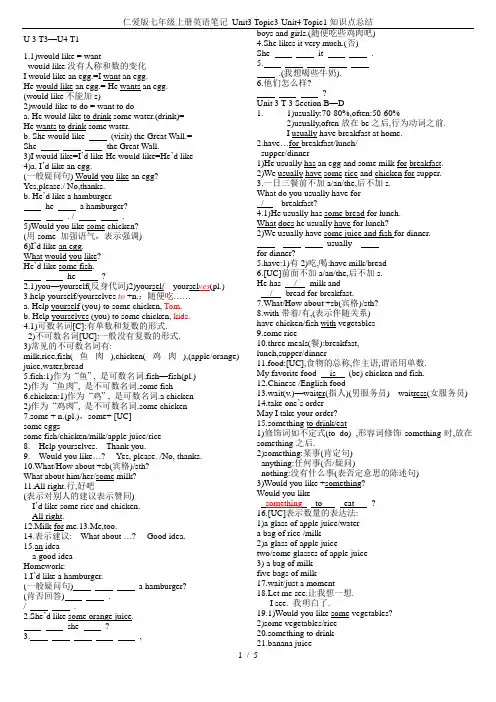
仁爱版七年级上册英语笔记 Unit3 Topic3-Unit4 Topic1知识点总结
1 / 5 U 3 T3—U4 T1
1.1)would like = want
would like没有人称和数的变化
I would like an egg.=I want an egg.
He would like an egg.= He wants an egg.
(would like不能加s)
2)would like to do = want to do
a. He would like to drink some water.(drink)=
He wants to drink some water.
b. She would like (visit) the Great Wall.=
She the Great Wall.
3)I would like=I’d like He would like=He’d like
4)a. I’d like an egg.
(一般疑问句) Would you like an egg?
Yes,please./ No,thanks.
b. He’d like a hamburger.
he a hamburger?
. / .
5)Would you like some chicken?
(用some 加强语气,表示强调)
6)I’d like an egg.
What would you like?
He’d like some fish.
he ?
2.1)you—yourself(反身代词)2)yourself---yourselves(pl.)
3.help yourself/yourselves to +n.:随便吃……
仁爱版七年级英语上册Unit3Topic3WhatwouldyouliketodrinkC优质教案(2)
课题:Topic3Whatwouldyouliketodrink?
SectionC第1课时
一、导学目标
1、复习SectionB的重要句型
2、学习重要句型
1)Wouldyouliketohavedinnerwithme?
2)Whatwouldyouliketodrink?
3)Helpyourse
4)Whynotdo…?句型
【阅读质疑合作探究】
一)课前预习本课新单词,并自我检测:
吃__________在外面___________下馆子__________
吃正餐__________随便吃些鱼___________为什么不_______________
一些喝的东西___________让我想想_______________在餐馆_______________
二)走入新课
1、熟读1a对话.注意文中MayIhelpyou,sir?这句话的使用情景
2、自主完成课本P75页1b和P76页2、3、4a/4b.
二、精讲点拨
① letsb.dosth..让某人做某事。e.g.Letmehelpyou.
②Whynot+动词原形…….?用来提出建议或表示责备。也可以变成Whydon’tyou+动词原形…….?e.g.Whydon’tyouhavesomejuice?
注意:在whynotdosth.?=whydon’tyoudosth.?这两个句型中,因都表示建议、请求等委婉语气,故含有some时不能换成any.
【多元互动合作探究】
1、Heworkson a farm.(对划线部分提问)
he ?
2、I’dlikesome apples.(同上)
like?
3、Wouldyouliketodrinksomewater.(做否定回答)
No,
4、I’dlikesomecakes.(改为一般疑问句)
you cakes?
新课标背景下信息技术融合初中英语听说教学创新案例——以仁爱版初中英语七年级上册Unit3_Topic
79ENGLISH ON CAMPUS2023年34期总第682期
新课标背景下信息技术融合初中英语
听说教学创新案例
——以仁爱版初中英语七年级上册
Unit3 Topic3 Section B“Food and meals”为例
摘 要:理解性技能中的“听”与表达性技能中的“说”,是学生应熟练掌握的英语语言技能。近年来,不少地方
的中考英语口语考试采用“人机对话”测评方式,取代了以往“人人对话”的传统测评方式。随着信息技术与英语教学
的不断融合与渗透,如何更好地利用信息技术开展初中英语听说教学,优化听说教学策略,提高听说教学效率,规范听说
测评方式,是广大专家学者、一线教师关注的问题。本文以仁爱版初中英语七年级上册Unit3 Topic3 Section B“Food and
meals”为例,探讨信息技术与初中英语听说教学深度融合的方法与路径。
关键词:人机对话;信息技术;初中英语听说教学
作者简介:黄颖婷(1993.08-),女,福建漳州人,福建省漳州第一中学,中学二级教师。
一、引言
《义务教育英语课程标准(2022年版)》(以下简称“新
课标”)指出,重视教育信息化背景下英语课程教与学方式
的变革,充分发挥现代信息技术对英语课程教与学的支持与
服务功能。新课标鼓励教师合理利用、创新使用数字技术和
在线教学平台,开展线上线下融合教学,为满足学生个性化
学习需要提供支撑,促进义务教育均衡发展。作为英语学科
语言的重要组成部分,听说能力是语言输入和产出的主要方
式。理解性技能中的“听”和表达性技能中的“说”,相互关联、
相互影响、相互作用,在发展学生语言能力和思维能力,培
养学生跨文化交际能力,引领学生树立国际视野、涵养家国
情怀,落实学科核心素养培养等方面,起着至关重要的作用。二、英语听说教学现状分析
进入21世纪以来,信息时代逐渐向智能时代过渡。在
教育教学领域,人工智能技术支撑教育教学质量的提升,图
像识别、语音识别、人机交互、智慧课堂等技术不断引入英
七年级英语仁爱版上册Unit2_Topic2_SectionB_优质课教案(吉林省)
1 / 8
Unit2 Looking Different
Topic 2 what does she look like?
Section B:(3-4)教学设计
一、Material analysis
本节课主要活动是3和4,进一步询问人物外貌特征的表达方法“what does he/she look
like?"同时还学习综合颜色、身体部位类单词,以及询问和描述他人外貌特征的表达法,语言板块儿将学习l, w和组合wh的发音规则。
二、Teaching aims
1.Knowledge aims
能够掌握并应用新学习的单词:letter、sorry、like、look like、tall、will
能够用英语询问和描述人物外貌特征的表达方法:she is tall and she has long straight black
hair.
能够用英语询问人物外貌特征的表达方法:What does the she look like?
2.Skill aims
能听懂有关询问人物外貌特征的表达方式。
能运用表示询问人物外貌特征的表达方式进行简单的交流。
能根据图片内容口头做对话。
能正确地朗读对话,并能注意语音语调。
能正确书写和使用新学习的单词。
3.Emotional aims
能够与同学积极合作参与课堂活动大胆实践。
能够认真、规范地书写单词。
能够培养学生善于观察周围人或物的能力。
三、The key points and difficult points
Key points
1、学会问属于第三人称人物的国籍、外貌、肤色等
2、相关形容词的学习:small big long round wide…
3,possessive pronouns
Difficult points
2 / 8
1.have/has在句中的运用及否定表达方式
2.物主代词在句中的形式及表达
仁爱版七年级上册英语笔记Unit3Topic3-Unit4Topic1知识点
仁爱版七年级上册英语笔记Unit3Topic3-Unit4Topic1知识点
U 3 T3—U4 T1
1.1)would like = want
would like没有人称和数的变化
I would like an egg.=I want an egg.
He would like an egg.= He wants an egg.
(would like不能加s)
2)would like to do = want to do
a. He would like to drink some water.(drink)=
He wants to drink some water.
b. She would like (visit) the Great Wall.=
She the Great Wall.
3)I would like=I’d like He would like=He’d like
4)a. I’d like an egg.
(一般疑问句) Would you like an egg?
Yes,please./ No,thanks.
b. He’d like a hamburger.
he a hamburger?
. / .
5)Would you like some chicken?
(用some 加强语气,表示强调)
6)I’d like an egg.
What would you like?
He’d like some fish.
he ?
2.1)you—yourself(反身代词)2)yoursel f---yoursel ves(pl.)
3.help yourself/yourselves to +n.:随便吃……
a. Help yourself (you) to some chicken, Tom. b. Help yourselves (you) to some chicken, kids.