
牛津译林版八年级英语全册语法知识点总结
1.句子结构:
a.主语+谓语+宾语
b.主语+谓语+间接宾语+直接宾语
c.主语+谓语+宾语+宾语补足语
d.主语+谓语+宾语+宾语补足语+定语
e.主语+系动词+表语
f.主语+不及物动词
2.时态:
a.一般现在时:表示现在经常性、习惯性的动作或状态。
b.现在进行时:表示现在正在进行的动作。
c.一般过去时:表示过去发生的动作或状态。
d.过去进行时:表示过去其中一时刻正在进行的动作。
e.一般将来时:表示将来的动作或状态。
f.将来进行时:表示将来其中一时刻正在进行的动作。
3.语态:
a.主动语态:主语是动作的执行者。
b.被动语态:主语是动作的承受者。
4.动词时态和语态的被动形式:
a. 一般现在时的被动形式:am/is/are+动词的过去分词。 b. 一般过去时的被动形式:was/were+动词的过去分词。
c. 将来时的被动形式:will be+动词的过去分词。
d. 现在进行时的被动形式:am/is/are+being+动词的过去分词。
e. 过去进行时的被动形式:was/were+being+动词的过去分词。
5.情态动词:
a. can:表示能力、允许和请求。
b. may:表示许可、可能性和祝愿。
c. must:表示肯定、必要性和推测。
d. should:表示建议、责任和承诺。
e. might:表示推测、可能和祝愿。
f. would:表示假设、请求和习惯。
6.虚拟语气:
a.虚拟语气用于表达虚构、假设、愿望、建议等。
b. 虚拟语气主要涉及以下几个时态:一般过去时、现在将来时、与现在相对的过去将来时、would/could+动词原形。
7.上文一致性:
a.当主句用一般现在时态表述,宾语从句中的谓语动词将会保持不变。
b.当主句用过去时态表述,宾语从句中的谓语动词将用相应的过去时态。 总结完毕,以上是牛津译林版八年级英语全册所涉及的主要语法知识点。
Unit1Unit2重点内容梳理江苏省常州市牛津译林版八年级英语上册
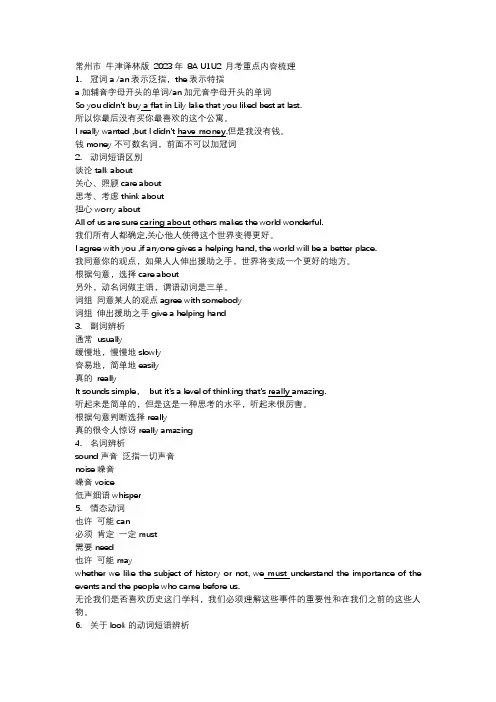
常州市 牛津译林版 2023年 8A U1U2 月考重点内容梳理
1. 冠词a /an表示泛指,the表示特指
a加辅音字母开头的单词/an加元音字母开头的单词
So you didn't buy a flat in Lily lake that you liked best at last.
所以你最后没有买你最喜欢的这个公寓。
I really wanted ,but I didn't have money.但是我没有钱。
钱money不可数名词,前面不可以加冠词
2. 动词短语区别
谈论talk about
关心、照顾care about
思考、考虑think about
担心worry about
All of us are sure caring about others makes the world wonderful.
我们所有人都确定,关心他人使得这个世界变得更好。
I agree with you ,if anyone gives a helping hand, the world will be a better place.
我同意你的观点,如果人人伸出援助之手,世界将变成一个更好的地方。
根据句意,选择care about
另外,动名词做主语,谓语动词是三单。
词组 同意某人的观点agree with somebody
词组 伸出援助之手give a helping hand
3. 副词辨析
通常 usually
缓慢地,慢慢地slowly
容易地,简单地easily
真的 really
It sounds simple, but it's a level of thinking that's really amazing.
听起来是简单的,但是这是一种思考的水平,听起来很厉害。
根据句意判断选择really
真的很令人惊讶really amazing
4. 名词辨析
译林版牛津英语8B 全册八单元知识点总结+单元测试卷及答案
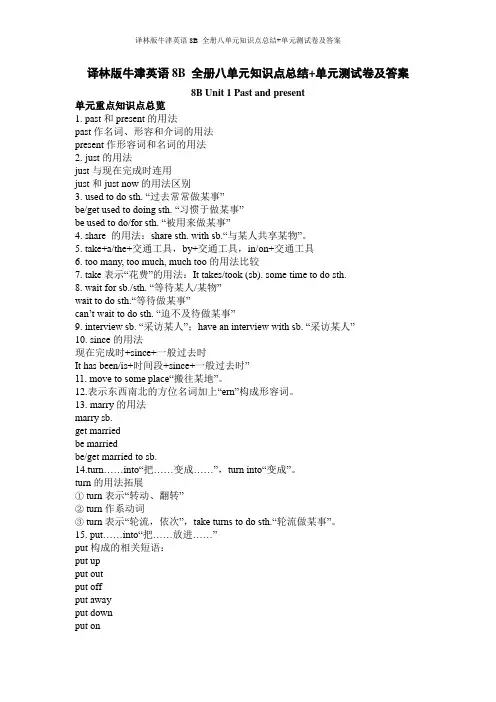
译林版牛津英语8B 全册八单元知识点总结+单元测试卷及答案
译林版牛津英语8B 全册八单元知识点总结+单元测试卷及答案
8B Unit 1 Past and present
单元重点知识点总览
1. past和present的用法
past作名词、形容和介词的用法
present作形容词和名词的用法
2. just的用法
just与现在完成时连用
just和just now的用法区别
3. used to do sth. “过去常常做某事”
be/get used to doing sth. “习惯于做某事”
be used to do/for sth. “被用来做某事”
4. share 的用法:share sth. with sb.“与某人共享某物”。
5. take+a/the+交通工具,by+交通工具,in/on+交通工具
6. too many, too much, much too的用法比较
7. take表示“花费”的用法:It takes/took (sb). some time to do sth.
8. wait for sb./sth. “等待某人/某物”
wait to do sth.“等待做某事”
can’t wait to do sth. “迫不及待做某事”
9. interview sb. “采访某人”;have an interview with sb. “采访某人”
10. since的用法
现在完成时+since+一般过去时
It has been/is+时间段+since+一般过去时”
11. move to some place“搬往某地”。
12.表示东西南北的方位名词加上“ern”构成形容词。
13. marry的用法
marry sb.
get married
be married
be/get married to sb.
14.turn……into“把……变成……”,turn into“变成”。
译林版牛津英语8A全册知识点总结+测试
译林版⽜津英语8A全册知识点总结+测试
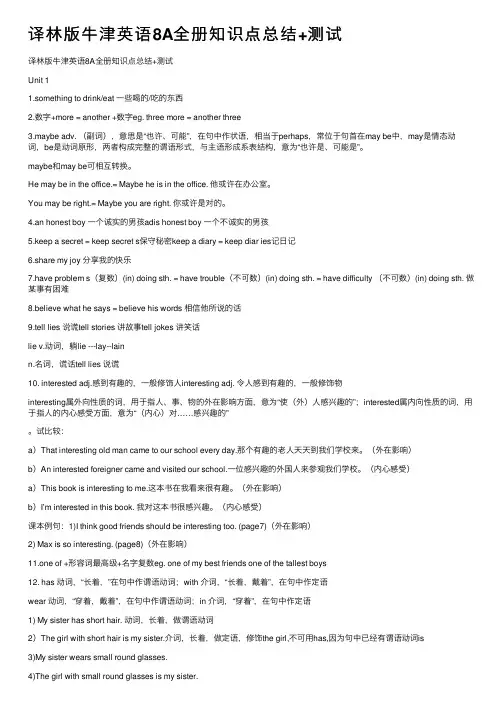
译林版⽜津英语8A全册知识点总结+测试Unit 1
1.something to drink/eat ⼀些喝的/吃的东西
2.数字+more = another +数字eg. three more = another three
3.maybe adv. (副词),意思是“也许、可能”,在句中作状语,相当于perhaps,常位于句⾸在may be中,may是情态动词,be是动词原形,两者构成完整的谓语形式,与主语形成系表结构,意为“也许是、可能是”。maybe和may be可相互转换。
He may be in the office.= Maybe he is in the office. 他或许在办公室。
You may be right.= Maybe you are right. 你或许是对的。
4.an honest boy ⼀个诚实的男孩adis honest boy ⼀个不诚实的男孩
5.keep a secret = keep secret s保守秘密keep a diary = keep diar ies记⽇记
6.share my joy 分享我的快乐
7.have problem s(复数)(in) doing sth. = have trouble(不可数)(in) doing sth. = have difficulty (不可数)(in) doing sth. 做某事有困难8.believe what he says = believe his words 相信他所说的话
9.tell lies 说谎tell stories 讲故事tell jokes 讲笑话
lie v.动词,躺lie ---lay--lain
n.名词,谎话tell lies 说谎
10. interested adj.感到有趣的,⼀般修饰⼈interesting adj. 令⼈感到有趣的,⼀般修饰物
牛津译林版八年级英语下册:非谓语动词用法总结
初中英语语法精华卷 八年级下 非谓语动词卷
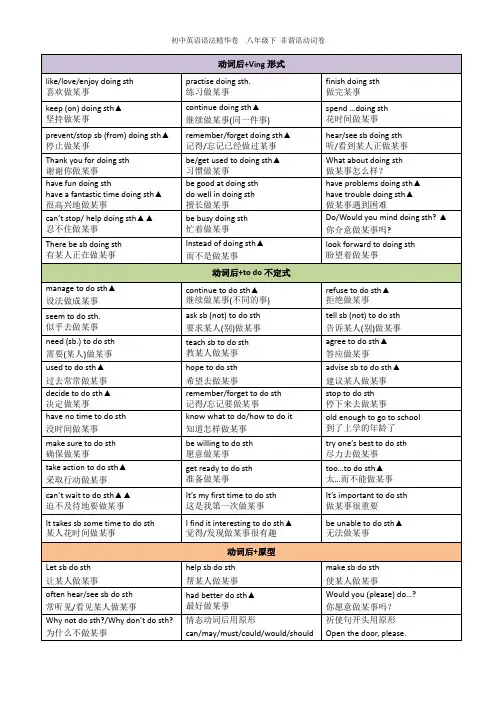
动词后+Ving形式
like/love/enjoy doing sth
喜欢做某事 practise doing sth.
练习做某事 finish doing sth
做完某事
keep (on) doing sth▲
坚持做某事 continue doing sth▲
继续做某事(同一件事) spend …doing sth
花时间做某事
prevent/stop sb (from) doing sth▲
停止做某事 remember/forget doing sth▲
记得/忘记已经做过某事 hear/see sb doing sth
听/看到某人正做某事
Thank you for doing sth
谢谢你做某事 be/get used to doing sth▲
习惯做某事 What about doing sth
做某事怎么样?
have fun doing sth
have a fantastic time doing sth▲
很高兴地做某事 be good at doing sth
do well in doing sth
擅长做某事 have problems doing sth▲
have trouble doing sth▲
做某事遇到困难
can’t stop/ help doing sth▲▲
忍不住做某事 be busy doing sth
忙着做某事 Do/Would you mind doing sth? ▲
你介意做某事吗?
There be sb doing sth
有某人正在做某事 Instead of doing sth▲
而不是做某事 look forward to doing sth
盼望着做某事
动词后+to do不定式
manage to do sth▲
设法做成某事 continue to do sth▲
译林牛津英语8上unit12英语知识点
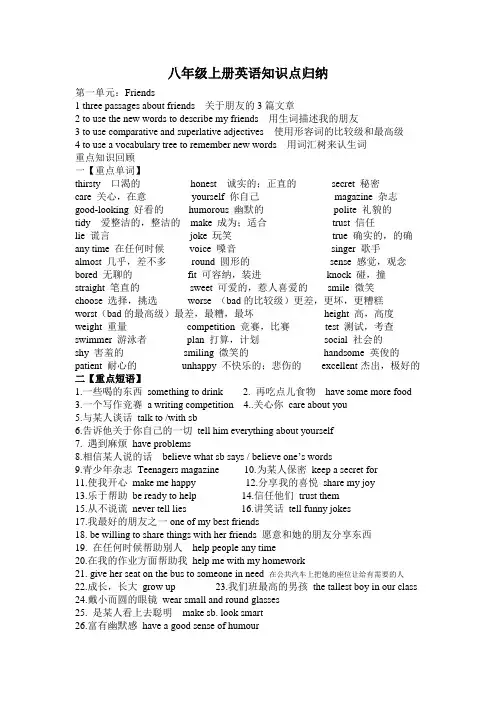
八年级上册英语知识点归纳
第一单元:Friends
1 three passages about friends 关于朋友的3篇文章
2 to use the new words to describe my friends 用生词描述我的朋友
3 to use comparative and superlative adjectives 使用形容词的比较级和最高级
4 to use a vocabulary tree to remember new words 用词汇树来认生词
重点知识回顾
一【重点单词】
thirsty 口渴的 honest 诚实的;正直的 secret 秘密
care 关心,在意 yourself 你自己 magazine 杂志
good-looking 好看的 humorous 幽默的 polite 礼貌的
tidy 爱整洁的,整洁的 make 成为;适合 trust 信任
lie 谎言 joke 玩笑 true 确实的,的确
any time 在任何时候 voice 嗓音 singer 歌手
almost 几乎,差不多 round 圆形的 sense 感觉,观念
bored 无聊的 fit 可容纳,装进 knock 碰,撞
straight 笔直的 sweet 可爱的,惹人喜爱的 smile 微笑
choose 选择,挑选 worse (bad的比较级)更差,更坏,更糟糕
worst(bad的最高级)最差,最糟,最坏 height 高,高度
英语牛津译林版八年级下册语法大全

英语牛津译林版八年级下册语法大全
(UNIT1)现在完成时的重点和难点
一、现在完成时的〃完成用法〃和“未完成用法〃
1 .现在完成时的“完成用法〃
现在完成时的〃完成用法〃指的是动作发生在过去某一时刻并已结束,但该动作对现 在产生了影响,与现在情况具有因果关系。例如:He has turned off the light.
他已把灯关了。
(动作结束于过去,但说明的是现在的情况一灯现在不凫了。)
现在完成时〃完成用法〃的特点是动作不延续,因此,该时态只能与表示不定的
过去时间状语(如:already, yet, before, recently等)、频度时间状语(如: never,
ever, once等)、包括现在时刻在内的时间状语(如:this morning / month / year... ,
today 等)连用。
例如:Have you found your pen yet你已找到你的钢笔了吗
2 .现在完成时的〃未完成用法〃
现在完成时的〃未完成用法〃指的是动作开始于过去某一时刻,一直延续到现
在,或可能还要继续下去。
例如:He has lived here since 1978.自从1978年以来,他一直住在这儿。(动 作起始于1978年,一直住到现在,可能还要继续住下去。)
1 have been in the army for more than 5 years.我在部队已经呆了五年多 了。(动作开始于5年前,一直延续至今,有可能还要继续下去。)
此种用法的句中常需一个表示一段时间的状语汕since或for引导),或表示 与现在时刻相连的时间状语(如:up to now, so far到目前为止)等。
例如:I have heard nothing from him up to now.到目前为止我没有他的任 何消息。
注意:(1)现在完成时的未完成用法只适用于延续性动词,不可用于终止性动
牛津译林版八年级英语上册Unit6词组、句型及语法知识点归纳
牛津译林版八年级英语上册Unit6词组、句型及语法知识点归纳
一、【精选词汇】
重点短语
1. go birdwatching at the market在市场观鸟;去市场观鸟 (p74)
2. roast chicken烧鸡,roast duck烤鸭,Beijing duck北京烤鸭
3. fly to northern countries飞往北方的国家 (p75)
〈知识链接〉north→northern, south→southern(注意发音有变化), east →eastern, west →western
4. in north-east China在中国东北 注意“东北”的中英文写法不同。
〈知识链接〉in south-west China在中国西南,in South China在华南,in the south of China在中国南部,in North China在华北,in the north of China在中国北部,in East China在华东,in
the east of China在中国东部,in the west of China在中国西部
5. one of the world’s most important wetlands最重要的湿地之一
〈知识链接〉one of the/物主代词+最高级+名词复数,作主语时谓语动词用单数形式。
6.provide food and shelter for wildlife为野生动物提供食物和栖息处
〈知识链接〉provide sth for sb=provide sb with sth为某人提供某物
We provided the poor children with some stationery.
=We provided some stationery for the poor children.
期末Unit5-Unit8Grammar语法汇总牛津译林版八年级英语下册
牛津译林版 八年级下册 Unit 5 - Unit 8 Grammar 语法汇总
Unit 5 enough...to...和too...to...
一、enough...to...的用法
主语 + be + adj. + enough to do sth. 表示一个人的品质和能力。
句型转换:
(1)It is + adj. + of sb. to do sth.
eg: She is clever enough to learn all the subjects well. = It is clever of her to learn all the subjects well.
(2)so...that...
eg:He is tall enough to reach the ball on the shelf. = He is so tall that he can reach the ball on the shelf.
二、too...to...的用法
too +adj./adv. + 动词不定时 “太……而不能”。
句型转换:
(1)so...that...
eg:She is too careless to get full marks in the exam. = She is so careless that she can’t get full marks in the
exam.
(2)not + 该形容词的反义词 + enough + to do sth.
eg:She is too careless to get full marks in the exam. = She is not careful enough to get full marks in the exam.
Unit 6 It’s + adj. (+ for.../of...) + to do sth.
【51】译林牛津版八年级上册英语(8A)Unit6 Natural Disasters复习讲义
牛津英语8A Unit 6 复习讲义
一、重点词汇
1. mind/idea/opinion
基本含义 用法辨析
mind “想法;精神” 指一个人的精神所处的状态或者是思维活/心理活动
idea “主意;想法” 指特定情况下做某事的办法或是对“将来发生”的事情的“粗略”的构想
opinion “主意;想法” 指某人对某件事情的看法、观点(是纯粹的个人见解、主观判断)
【小试牛刀】
1. He has no idea how to deal with it. 他不知道怎么去把这个事处理好。
2. The man changed his mind in the end. 这个男子最后改变了主意。
3. In my opinion, it’s easy for us to finish the work on time.在我看来,我们很容易准时完成工作。
2. alive/living/live/lively
基本含义 用法辨析
alive “活着的” 表语形容词,不能放在它所说明的名词之前
living “活(着)的” 既可用作表语形容词,又可用作定语形容词;主要指在某个时候是活着的
live “活的” 通常只作前置定语,且一般用于动物
lively “活泼的;生动的” 可作定语、表语或宾补,既可指人,又可指物
【小试牛刀】
1. He had a strange way of making his classes___________and interesting.
2. We found the snake _____________.
3. He said he had seen a___________whale.
3. “名词+by+名词”短语
此类短语大多含有“一个一个”之意,或“逐渐”的意思,强调变化,在句中做状语。例如:
[原创]译林牛津版八年级上语法知识点合集总纲
Zhong Emperor
译林牛津八年级上语法知识点大全
[弄会这些语法知识点,期末考试基本过关]
I.形容词/副词 比较级与最高级
[定义]
两者比较,要用比较级,通常than引出比较的对象;三者及三者以上比较用最高级,此时通常会有比较的范围或者群体。
[构成]
①规则变化
Zhong Emperor
②不规则变化
[精华提点]
1.A.....than B的句型
than是比较级的标志词,也是单选题和单词拼写题的字眼。
①Jack is ________than Tom.
A .tall B. taller C.the taller D.the tallest
①Now I have_______(多)homework than before.
2.of the two的结构中形容词的比较级前须要有定冠词the.
He is the shorter of the two.
3.形容词比较级前用不定冠词表示类指,翻译成“一个......”。
-How do you like the movie we saw yesterday?
-Wonderful.I have never seen a better movie than this one.
4.any other+名词单数与 any+名词单数的区别
any other+名词单数 表示比较的两个对象在同一个范围,此时可以用the other+名词复数和the rest of+名词复数替换。
Suzhou is larger than any other city in Jiangsu.
=Suzhou is larger than the other cities in Jiangsu. Zhong Emperor
=Suzhou is larger`than the rest of the cities in Jiangsu.