
牛津译林版七年级英语上册复习教案:7A unit one
牛津译林版七年级英语上册Unit One词组1.read this book 读这本书2.look after 照看、照料3.make friends at the new school 在新学校交朋友4.at Beijing Sunshine Secondary School 在北京阳光中学5.each other 彼此6.meet new friends 遇见新朋友7.start school 开学8.their first English lesson 他们的第一堂英语课9...years old ……岁数10.in Class 1, Grade 7 在7 年级1班11.live in Beijing 住在北京12.love reading 喜爱看书13.in the Reading Club 在读书兴趣小组14.be born 出生15.play football 踢足球16.after school 放学后e from / be from 来自18.tall and slim 高而苗条19.have long black hair 有长长的黑头发20.listen to music 听音乐21.work hard 努力学习22.be good at doing sth 擅长做某事23.enjoy doing sth 喜爱做某事24.play computer games 打电子游戏25.wear glasses 戴眼镜26.be polite and helpful 有礼貌而助人为乐27.a football field 足球场28.badminton court 羽毛球场29.swim in the swimming pool 在游泳池里游泳30.have breakfast 吃早餐31.at lunchtime 在午餐时间32.every day 每天33.take… for a walk 带……去散步34.play volleyball 打排球35.walk home 步行回家36.take a bus 乘公共汽车37.watch TV 看电视38.at the weekend 在周末39.half an hour 半小时40.fly a kite 放风筝41.my favourite football player 我最喜爱的足球运动员42.in the school football team 在学校足球队43.tall and strong 高而强壮44.dark brown eyes 深褐色的眼睛45.listen to music 听音乐46.at school 在校47.have lots of friends 有许多朋友48.play with sb 和某人一起玩49.live with my family 和我全家人住在一起重点词汇与词组,句型1. glad adj. 高兴的be glad to do sth.做某事很高兴Eg :Glad to see you . = Nice to see you.(回答)Glad/Nice to see you, too.例句:我很高兴帮你。
.2. welcome v. 欢迎Welcome to Class 1,Grade 7! 欢迎来到七年级一班。
1. vt. 欢迎welcome to sp. 欢迎到某地welcome sb. to sp. 欢迎某人到某地adj. “受欢迎的”:“令人喜欢的”。
Eg. a welcome teacher 受欢迎的老师例句:他们热情地(warmly)欢迎我们,并把我们带到我们住的房间里。
.3.love的用法love doing sth.= like doing sth.= enjoy doing sth.4. How to Look After Your E-dog? (P. 6)①How to do sth.意为“如何做某事”。
②look after意为“照顾、照看”,相当于take care of。
例句:我不知道如何去大润发..你应该照顾好你的宠物。
. . .5.Now let’s meet my new classmates. (P. 8)Let’s do sth.意为“让我们做某事吧”(征求对方意见,用于祈使句)make sb do sth 侧重表示强迫某人做某事(要求)例句:1.让我们用掌声(warm applause)欢迎他。
.2.周日,妈妈让我为全家人做饭。
.6. He is from Nanjing. (P. 8)be from=come from来自于例句:1. the tiger North China.No,it is a tiger from South China.A.Does; fromB.Is;come fromC. Is; come fromD.Is ;from2.他来自于南京吗?不,他来自于北京。
(2种表达)..7. He is good at Maths. (P. 8)be good at= do well in 擅长于be good at doing sth. 擅长做某事例句:1.在所有的科目中,他最擅长英语。
.2.他不擅长和女孩子聊天。
.8. Look, Sandy is over there. (P. 12)①read, look, see , watch, look at, have a look at[考点精炼]用look, look at, see, watch, read填空。
1. Kangkang's sister _____ a book in her room.2. Please _____the blackboard, boys and girls.3. What other things can you _____ on the table?4. _____! What are they doing under the tree?5. My brother and I are _____ TV.6. Are they _____ a football game?7. It's good to _____ all my friends again.8. Let me have a ____.9. Lucy and Lily are twins. They _____ the same.10. I want to _____ the doctor.②over there 在那儿(指相对较远的地方)例句:我的书包在那儿。
9. The classrooms are big too. (P. 12)too作副词,表示“也”,通常用于肯定句句末。
1.also副词“也,而且,并且”用于肯定句或疑问句,但一般位于句中,通常位于be动词,助动词或情态动词之后,行为动词之前。
他擅长英语,他也擅长日语。
.2.too副词表示“也”,常用于肯定句或疑问,常和also相互替换,一般放在句末。
同上.3.either副词,“也不”用于否定句,而且只能放在句末.我妹妹也不喜欢这首歌。
.4.as well “也”,常与“too”替换。
你能做这件事,我也能。
. .用too,also,either或as well填空:1)I'll go to see the film,________.2)If you don't come here,I shouldn't, ______ .3)I,________ ,will help him.4)Jack can speak Chinese,and his brother can speak Chinese.10. Hello, everyone. (P. 16)everyone是代词,意为“每人、人人”,强调全部,在句中作主语时,谓语动词用单数。
例句:我们班的每个女孩都很漂亮。
.11. ...I wear glasses...(P. 16)①wear作及物动词,意为“穿、戴”,后接穿戴的对象。
The man wears an old shirt.【拓展】wear意为“穿着、戴着”,强调穿戴的状态;put on意为“穿上、戴上”,强调动作和过程。
He is wearing a black shirt today. Put on your shoes.②glasses意为“眼镜”,是可数名词,作主语时,谓语动词用复数形式,作可数名词,还可以表示“玻璃杯”,glass作不可数名词时,表示“玻璃”。
a pair of glasses 一副眼镜例句:戴眼镜的那个女孩是我的同班同学。
.12. I like all the lessons at Sunshine Middle School...(P. 16)all此处用作形容词,意为“所有的、全部的”①修饰可数名词复数或者不可数名词,但要放在be动词之后(但是若be动词是句子中的最后一个词时,all要放在be动词之前).如:All the boys study well.—Are you Young Pioneers?你们是少先队员吗?—Yes,we all are.是的,我们都是少先队员.②2.all指“三个(以上)的数目”,反义词是none;both指“两个数目”,反义词是neither.如:I have three brothers.All of them are college students.我有三个哥哥,他们都是大学生.③不能说“all + 代词”,要说“代词+ all”或“all of + 代词”.如:误:All they like her.正:They all like her./All of them like her.他们都喜欢她.翻译:所有学生都喜欢和他玩。
.( )1.Eddie has e-dog. name is Hobo.A. an; It’sB. an; ItsC. a; It’sD. a; Its( )2.Now let’s our new classmates.A. meetB. meetingC. to meetD. to meeting( )3. —What class are you in— .A. I’m in One ClassB. I’m in Class OneC. Yes, I amD. I’m in Class one ( )4.Everyone here now. Let’s .A. are; beginB. are; to beginC. is; startD. is; to start( )5.Jim is good basketball, but he is weak in football.A. at playingB. at playC. for playD. in playing( )6. —Where he—Nanjing.A. is; come formB. is; fromC. does; fromD. do; come from( )7. Hello, Lucy Millie.A. he isB. she isC. this isD. that is( )8. —Excuse me, are you and Simon in Class 3, Grade 7— .A. Yes, I’mB. No, I’m notC. Yes, we’reD. No, we aren’t( )9. My classmates me. And I like them, too.练习翻译句子1. 在周末,他通常在早晨去跑步半小时。
牛津译林版七年级英语上册7AUnit1Period7教案
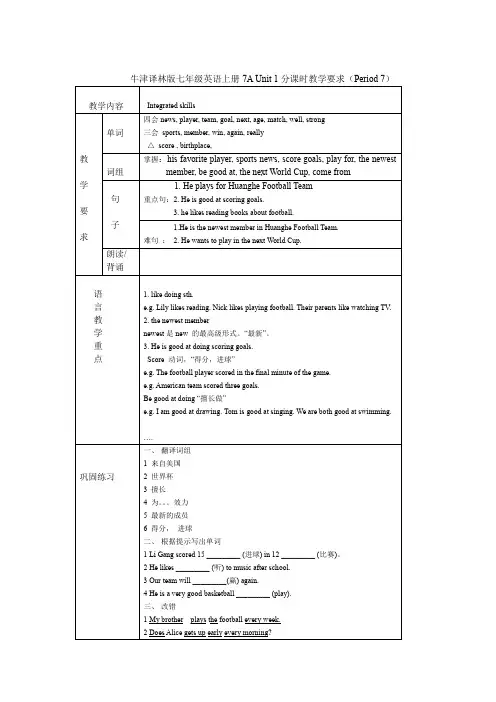
1My brotherplaysthefootballevery week.
2DoesAlicegets upearlyevery morning?
3 HehavesportsonTuesday afternoon.
4 Hedoesn’tlikeplay basketballinthe playground.
牛津译林版七年级英语上册7A Unit 1分课时教学要求(Period 7)
教学内容
Integrated skills
教
学
要
求
单词
四会news, player, team, goal, next, age, match, well, strong
三会sports, member, win, again, really
牛津译林版七年级英语上册7A
重点句:2. He is good at scoring goals.
3. he likes reading books about football.
1.He is the newest member in Huanghe Football Team.
难句:2. He wants to play in the next World Cup.
朗读/
背诵
语
言
教
学
重
点
1. like doing sth.
e.g. Lily likes reading. Nick likes playing football. Their parents like watching TV.
2. the newest member
newest是new的最高级形式。“最新”。
7AUnit1全部(译林牛津版七年级英语上册教案教学设计)
7AUnit1全部(译林牛津版七年级英语上册教案教学设计)Teaching Contents : Comic strip and Welcome to the unitTeaching aims:A: Knowledge1. Learn the greetings of meeting peopleGood morning / afternoon / eveningHi, I’m ----------. What’s your name ?My name is ---------- .2. Learn the new words .e-dog , master , instructionB: Language skillUse everyday expressions for greetings and introductions .e.g. What’s your name ?My name is -------.C: Feeling1. To develop students to like English .2. Arouse students’ interest in learning English3. Train cooperation studyMain points :GreetingsDifficult points : How to greet when meeting people .Teaching method : Circumstance teachingTeaching aids : Pictures, record and slideStyle of lesson : New lessonDesign for blackboard :Unit 1 This is me !Hi, I’m--------- . e-dog What’s your name ? masterMy name is -------- . instructionTeaching process:Teaching activitiesStep 1 Warming –up activities1. self –introductionGood morning / afternoon /eveningI’m Mr /Mrs /Miss --------.I’m -----------years old .I’m your teacher .2. Lead-inUse everyday expressions for greetings and introductions .The teacher asks one student some questions“ Hi’, I’m -------- ? What’s your name?”Then ask some students to do it again . (about 4 students ) Give the model sentences on the blackboard.e.g. (1) “What’s your name ?” ---- My name is --------.”(2)“Hi, I’m --------? “ ----“What’s your name ?”-----“My name is --------“3. Practice(1) Let some of the students come to the front and ask the class .In pairs .(about 4 groups )Let them practising greetings above.(2) Work in pairs practising(3) Check (ask the students to the front and practise )Step 2 Presentation2. Introducing six new friendsT: Now you have many new friends .Do you want to make more new friends ?Show pictures on the blackboard .Let the students look at them .This is Simon. This is -------.3. Make six masks of the children and go on introducing sixchildren’s names .( Let the students wear the masks and introduce themselves )Ask six students to come to the front and play six new friends .The students point to themselves and say ,“ I’m Simon”“I’m Amy”“I’m ------------“3. Pair work.Let students get to know these six new friends and remember them .Practise greetings in pairs .Step 3. Greetings1. Show a clock of different time .Let the students identify the time .14:35 08:2022:15 18:102. Let the students know when to sayGood morning /afternoon /evening / night3. Let the students practice greetings at different timeGreet their partners and then introduce themselves(Ask students to draw pictures of the sun ,the moon , the sun set , a sleeping baby , say greetings to each other according to these pictures.)4. Do written exercises part B on page 3 and then check it .(write greetings on the book .)Step 4 Presentation1. Use a multimedia to let the students watch the cartoon between Eddie and Hobo.2. IntroduceThis is Eddie . This is Hobo . Eddie is Hobo’s master . Hobois an e-dog .3. Ask the studentsWho is Eddie? (He’s the master .) Who is Hobo ?( He’s the e-dog) . Do you like Eddie ? Do you likee-dogs ? You can ask your mother to go and buy it for you .Does Eddie like the e-dog ? How do you know ?(show a real e-dog ) This is an e-dog . It’s very lovely .4 . Learn new wordsStep 5 Presentation1. Let the students watch the cartoon and listen to the talkbetween Eddie and Hobo .2 .Let students read after the talk of them .3. Show the new words of this text . Let the students read them first ,then read after the teacher. .Step 6 PracticeLet the students read by themselves .CheckLet students read the talk .Step 7 ActingLet the students play Eddie and Hobo and act outPair workStep 8 HomeworkLet the students write their profiles .Notes: 我是-------------。
牛津译林版七年级英语上册7AUnit1Period4教案

2.swim →swimming ( go swimming )
They swim in the swimming poor
3. volleyball → play volleyball
They play volleyball on the volleyball court.
3. They swim in the swimming poor .
1. Which sport do you like ?
难句:2. Where do you play football ….?
朗读/
背诵
Read P11
背诵P11 3个句子
语言教学重点
1.badminton ( play badminton )
其它:on the football field ,on the badminton court,
in the swimming poor
句
子
1. They play football on the football field .
重点句:2. They play badminton on the badminton court.
牛津译林版七年级英语上册7A Unit 1分课时教学要求(Period Four)
教学内容
教
学
要
求
单词
四会(2个):swimming , volleyball
三会(3个):badmintoll, play badminton, go swimming
巩固练习
Ⅰ.用括号中词的正确形式填空
1.We like ______ ( swim ) very much .
牛津译林版七年级英语上册复习教案:Unit1Self-assessmentandrevision
课题7上Unit1 Self-assessment and revision 课型New教学目标1.To use the new grammar items and v oc abulary taught in u nit.2.To assess themselves grasp the language points.3.To revise the key points.教学重点To assess themselves grasp the language points.教学难点To revise the key points.教学过程集体备课备课札记Step 1 Revision1.Revise the new words and the useful expressions.2.Have a dictation about the word s and phrases.3.Revise the forms of the verb to be .4.Tell students that they will be able to check whether theycan use words they have learned earlier in the unit to makesentences.Revise “ be”I amYou /you /we /They areHe /she/it isStep 2 Self -assessment1.Give them a time limit and finish some exercises2. Let students correct themselves, or divide the cl ass intopairs. Students correct each other’s work and write the scoreon the “paw”.Tell students that they are having a competition task. Tellthem if they can sort the words into the correct wordf amilies.Students put the words into the correct word families.Set a time limit. Let them fill in the blanks, then askstudents to say t he answers. The first student who gets all the answers right is the winner.Step3 ConsolidationAfter the competition , ask the Ss fill in the blanks with the right words.I' Daniel. I’m______ years old. My ___________ is on 7t h ________. I was born in Nanjing. I live with my familyin _________ .I am not very ________ . I have _______ ha ir and I wear ________ . I really ________ s chool.. I like al l my lessons. I am not very good at __________ . I love pla ying _________ _________ and looking ___________ thin gs on the Internet. I wa nt to _________ a computer ______ _______ when I ________ up.板书设计Unit 1 Self-assessment and revision1.What’s your name? My name is .....2.play football3.Nice to see your.4.be good at5.to be教学反思。
牛津译林版七年级英语上册教案:Unit1 Task
课题7A Unit1总课时 7 第7 课时 Task 撰稿人 备课时间授课时间教学目标 1.To learn to organize the ideas before writing.2.To write a passage to introduce oneself to others.3.To make an objective evaluation of oneself and heighten self-confidence.教学重点 1.To learn to organize the ideas before writing.2.To write about oneself and tell the class about oneself.教学难点 To use the verb “to be ” and “to do ” correctly.like /love doing sth.教学过程 Step 1 Revision and lead-inT: We ’ve got to know the six new students at Beijing Sunshine Secondary School. Who are they?Ss: They ’re Millie, Simon, Kitty, Amy, Sandy and Daniel.T: Let me see how well you know them.Who loves playing football after school? (Simon)Who is in the Reading Club ? (Millie )Is Sandy slim and tall? (Yes)What does Kitty love doing? (Dancing)What sport is Amy good at? (Swimming)Does Daniel enjoy playing computer games or playing football? (Playing computer games)T: You know them quite well. What else do you know about them?(The students have a free talk.)T: Do you want to know more about these new students? Maybe you can make friends with some of them.Step 2 Listening and reading1. Listen and answer备注T: If you want to know more about them. Let’s listen to Millie introduce herself. Answer the following questions while listening:Where was Millie born? (She was born in Beijing.)What color are her eyes? ( They’re dark brown.)What does she listen to at the weekend? ( She listens to CDs.)Does she have many friends? (Yes, she has lots of/ many friends.)2. Check the answers and explain the new words (dark brown, CDs ) through pictures.3. Read after the tape.4. Encourage the students to ask the teacher questions voluntarily.5. Practice the useful expressions.T: Now you know a lot about Millie. Do you want to make friends with her? Why or why not?Step 3 Reading and discussing the structure of profilesT: Read Millie’s and Daniel’s profiles again, and try to tell how to write about oneself. What is each paragraph about? First discuss in groups.Ss: (The teacher offers the students some help if necessary. And write them on the blackboard. )The first paragraph: name, age, birth place and living place.The second paragraph: appearance (what he/she looks like)The third paragraph: hobbies and lessonsThe fourth paragraph: friends or personality(what kind of person he/she is)Step 4 Discussing before writingT: The more friends we make, the happier we’ll be. Just send a note of your profile on Baidu. Before writing, first fill in the table with your own information. Discuss in pairs. (Encourage the students to write more information about themselves. )Name: Age:Birthplace: Living place:School name: Class: Grade:You look:You like:You are good at:You are not good at:……Step 5 Practicing writingT: Write your own profile according to the information in the table.Step6 . HomeworkRead and recite David’s article.教学反思:本课是本单元的中心任务,也是本单元最重要的一课,在这节课中,我先让学生理清思路,然后列出简单的提纲,最后写作,效果较好!。
牛津译林版七年级英语上册7A U1Task教案
Unit 1 This is me!TaskTeaching aimsBy the end of the lesson, students should be able to:1. organize the ideas before writing;2. write a passage to introduce oneself to others;3. make an objective evaluation of oneself and enhance self-confidence.Teaching contents1. New words and phrases: everyone, glasses, come from, wear glasses2. New structure: I come from Nanjing.I live with my family in Beijing.I wear glasses.Focus of the lesson and predicted area of difficultyWrite a passage to introduce oneself to others.【问题引领】Teaching proceduresStep 1 Lead-in1. Play a guessing gameT: Boys and girls, before we begin our class, let’s play a game first. Please guess who he/she isaccording to some given information.2. Ask students to go over what they have learnt from Reading part and finish the chart. T: In this unit, you and Miss Xue met not only Eddie and Hobo but also some new friends in theReading part. Do you still remember who they are? Yes, they are Millie, Simon, Sandy andDaniel. Would you like to finish the chart according to the Reading part? After finishing the chart, please say something about them with sentence patterns like “Millie is …” and “Simon likes …”.【互动探究】Step 2 Presentation1. Ask students to revise the passage about Millie and then finish the profile.(1) Ask students what the passage is about and answer the following questions.How old is Millie?Which school does she study in?How does she look like?What is her hobby?(2) Finish the profile according to the chart.2. Ask students to read the passage about Daniel and finish the chart.T: How about Daniel? Let’s read the passage together and answer this question: What doe the text tell us?T: So we know that Daniel comes from Nanjing. “B e from” equals to “come from”.We can say “Daniel is from Nanjing”. (Students read the phrases twice and makeup similar sentences.) From the picture, we find that there is a pair of glasses. So we can say “Daniel wears glasses. (Students read the phrases twice and make up similar sentences.)3. Try to classify the information and find out what each paragraph is about.4. Read the passage and finish the profile of Daniel.【达标检测】Step 3 Practice1. Complete the profile of one’s own.T: Fill in the table with your own information on Page 17.2. Make self-introduction.T: The more friends we make, the happier we’ll be. Since you have finished the profile, we’d like to know more about you. Try to introduce yourselves to your partner first. Pay attention to the aspects on the screen: general information, hobbies and skills, friends, appearance and others.T: Now let’s welcome some Ss to introduce themselves.【总结提升】Step 4 Extension1. Complete the passage about Millie’s friend, Daniel.T: Millie is trying to introduce her friend Daniel to her classmates but some words are missing. Please help Millie complete the following passage. Pay attention to the third person singular form “-s”. Now please read the passage together.2. Talk about Eddie.T: Eddie also wants his own profile. Please complete his profile according to the table.3. Write a short passage(1) Write a short passage about one’s best friend.T: Who is your best friend? This time you should write a short passage about him or her. Remember the flow chart and pay attention to the tips.(2) Share with the other group members and let them guess who it is.T: Share your passage with your members and try to find out the very person. (Thestudents check for mistakes (spelling, punctuation, tense mistakes etc.) bythemselves. Then check for mistakes in groups of four and try to get help fromother members of the group.)(3) Decide on the best passage.T: Take turns to read your own profile to the others, and choose the best one in your group.(4) Share and improve.Make a positive evaluation of the students’ passages and help the students heighten self-confidence.【教学反思】1、Be honest rather clever 20.7.97.9.202008:0608:06:25Jul-2008:062、By reading we enrich the mind; by conversation we polish it.二〇二〇年七月九日2020年7月9日星期四3、All things are difficult before they areeasy.08:067.9.202008:067.9.202008:0608:06:257.9.202008:067.9.20204、By other's faults, wise men correct their own.7.9.20207.9.202008:0608:0608:06:2508:06:255、Our destiny offers not the cup of despair, but the chalice of opportunity. So let us seize it, not in fear, but in gladness. Thursday, July 9, 2020July 20Thursday, July 9, 20207/9/20206、I have no trouble being taken seriously as a woman and a diplomat [in Ghana].。
牛津译林版七年级英语上册7AUnit1Period2教案
词组
掌握1.12 years old 2. live in 3. love reading 4. play football 5. come from 6. work hard 7. enjoy ( like, love ) playing computer games 8. be born in
牛津译林版七年级英语上册7A Unit 1分课时教学要求(Period Two)
教学内容
Reading (1)
教
学
要
求
单词
四会:1. year 2. grade 3.reading 4. club 5. after 6. music
7. hard 8. short 9. swimming 10. glasses 11. enjoy 12.wear
其它1.after school 2.be good at doing 3.listen to music
句
子
重点句:1. I’m 12 years old.
2. I was born in Shanghai.
3. I live in Beijing.
4. I am in the Reading Club.
I;m Yizi. I’m from Japan. I;m 13 years old. I like swimming. I don’t like playing football at all. I have no cat, but I have a bird named “Hong”.It likes flying around my room. It likes meat. It doesn’t like fish.
牛津译林版七年级英语上册7AUnit1第2课时教案
牛津译林版七年级英语上册7A Unit 1正衡初中第二课时GrammarTeaching aims:1)Learn the Simple Present Tense2)learn some information about the profileTeaching steps:Step 1RevisionT: Good morning, A.A: Good morning, Miss Fu.Ask Ss to greet in pairs.T: What is your name?How are you? (It’s a secret.)How old are you?Which class are you in?Which school are you from?Where are you from?How many people are there in your family?What is your father/ mother?What are your parents?What are your hobbies?What is your favorite color/animal/food/sport/subject/…?…Step 2the Simple Present Tense of the verb “to be”I am very happy to be your English teacher.Are you happy to be my students?Is he happy to be my student?Teach the Simple Present Tense of the verb “to be”(positive, negative, question)Step 3PracticeDo you want to know more about me?Do you want to know more about your partner?(encourage Ss to get some information about teacher and their partners using the Simple Present Tense of the verb “to be”)Work in pairs.Step 4T: Where do you live?What food/color/animal/sport/subject/… do you like best? (like best= favorite)Do you like/love/enjoy cakes/blue/football/English?Step 5the Simple Present Tense of the verb “to do”I like English.You like English.She likes English.Teach the Simple Present Tense of the verb “to do”(positive, negative, question)Step 6PracticeDo you want to know more about me?Do you want to know more about your partner?(encourage Ss to get some information about teacher and their partners using the Simple Present Tense of the verb “to do”)Work in pairs.Step 7Memory Test(看谁能把同桌的情况复述的既对又全,使用be和do动词)Step 8Show Ss my own profile.Let Ss retell it, starting with “Our teacher…”name, sex, age, job, birthday, birthplace, living place, class, grade, school, appearance, hobbies, family members, be good at, hope…Step 9Exercises。
牛津译林英语七年级上册7AUnit1复习学案
牛津译林英语七年级上册7AUnit1复习学案【复习目标】:1.掌握7上Unit 1单元中的四会.重点短语和句型。
2.能够掌握并正确运用一般现在时。
3.能用英语介绍好朋友。
【自我检测】一、翻译下列短语或句子1、如何照顾你的电子狗2、很高兴见到你!3、一名阳光中学的学生4、我今年12岁。
5、我留着短发6、她的头发长。
7、他擅长数学/游泳8、她又高又苗条9、让我们见见我的新同学10、我来自南京11、我现在和家人住在北京12、朋友们对她很好13、欢迎来到我们学校14、他经常开会迟到。
【当堂检测】一、单词拼写1. We have 9 (年级) in our school, and Danny is a (年级) 9 student.2. (阅读) isn’t Timmy’s favourite, but my (同学). It helps them learn a lot about the world.3. The girl (留着) long hair, but she doesn’t look like her twin sister (留着) long hair.4. This is my (表哥) Andy, he and I (be) are new here.5. She often goes to (舞蹈) lessons so she is (苗条).6. Everyone (be) here, but Lily isn’t, she’s ill today.7. Zhang Hua, my classmate, (come) from Yangzhou.二、单项选择( ) 1. e-dog is my birthday from my dad. Because I want e-dog as my birthday present.A. The, anB. The, theC. An, theD. An, an( ) 2. The granny is , but she has an heart.A. 80 years old, 18 years oldB. 80 years old, 18-year-old.C. 80-year-old, 18-year-oldD. 80-year-old, 18 years old( ) 3. It’s time to sleep. , mum.A. GoodbyeB. Good morningC. Good night.D. Good evening( ) 4. Who is the boy glasses? He usually likes glasses.A. with, withB. wears, wearingC. with, wearingD. wears, with( ) 5. Timmy and Amy from Nanjing, the students in their class playing with them.A. both are, like allB. are both, like allC. both are, like allD. are both, all like ( ) 6. --- Are you my new classmates? --- Yes, .A. you areB. we areC. I amD. I’m三、翻译句子.1、来自北京的这些男孩不擅长游泳。
牛津译林版英语7AUnit1精品教学案(Word版共10课时)
牛津译林版英语7AUnit1精品教学案(Word版共10课时)7A Unit1课题7A Unit1 comic strip and welcome to the unit学习目标知识目标master, good morning/afternoon/evening/night 能力目标1、学会介绍自己。
2、学会使用适当的问候语。
情感目标争做有礼貌的中学生。
学习重点学会与同学们交流方式之一:介绍自己。
学习难点学会使用所学的问候语。
课前自学一、英汉互译1. my master__________________2. meet my friend___________________3. look after___________________4. 读这本书_______________________5. 一只电子狗_________________6. 晚安_______________________7. what’s your nam e? _______________ 8. 交朋友______________________二、选择题1.( )Do you know how to look _______ your e-dog?A atB likeC afterD up2.( )Let’s ______________ each other.A make friend toB make friends withC make friendsD make friend3.( )He’s very good _____ Math. So his math is very good.A onB atC inD for4.( )The students often _________ after school.A play footballB palying footballC play a footballD play the football5.( )Tom has _______ basketball. He like it very much.A /B aC theD an三、同学们,试试看,你能写出正确的问候语吗?1. 9:30____________________2. 14:20_____________________3. 20:40___________________4. 18:00 ____________________除此之外,你还会其它的问候语吗?___________________________________________四、预习对话,回答下列问题。