
Unit+9+Have+you+ever+been+to+a+museum全单元教案
Unit+9+Have+you+ever+been+to+a+museum全单元教案
课
题
Unit 9 Have you ever been to a museum?(第 1 课时) 教课标注
一、教课三维目标
Knowledge and Ability Objects
(1) Key vocabulary: amusement; neither
(2) Listening practice. (3) Target language:
Lets' go somewhere different today.
Have you ever been to ⋯ ? Yes, I have./ No, I haven ’ t.
How about/what about ⋯?
How are we going to get there? We can take the subway/ ⋯
(4) To train students ’ listening and speaking skills.
2. 过程与方法: Method Objects in Teaching
(1) Scene teaching method. (2) Listening and speaking methods.
(3) Pair work
教
3. 感情态度与价值 学
To be interested in taking part in all kinds of activities in English class.
设 二、教课要点、难点
计1. Teaching Key Points 1. Key vocabulary in this period. 2. Target language in this period.
2. Teaching Difficulty
Make conversations freely using the target language.
三、教课准备
Teaching Aids
1. A tape recorder.
2. A puter for multimedia use.
四、教课课时
7
五、教课过程 Unit+9+Have+you+ever+been+to+a+museum全单元教案
Step 1 Greetings and Revision
Greet the class and check the homework.
Step 2 Lead-in
Guess the places of the pictures; they are the British Museum, space museum,
history museum, water park, zoo, amusement park while lead in sentence
patterns: “ Have you ever been to? ” ⋯
Speaking
Get students to work in pairs to practice the conversation: “Have you ever been
to ⋯”
“ Yes, I have ” / Not, I haven ’ t.
Step 3 Pre-listening
1. Section A 1a T: OK. Now open your books on Page 65. In Part 1a, 6 places are given.
Please read the names of these places. (Teacher writes the names on the blackboard.)
Which of these places would you like to visit? Rank them from 1 to 5. S 4: Amusement park _____, water park _____, zoo _____ aquarium _____
space museum _____.
S 5: Space museum _____, aquarium _____, zoo _____, water park ____,
amusement park _____
S6: ⋯
2. Talk about the picture
Step 4 Listening
Listen and choose the best answer. The first and the second question aim to listening
to time, and the third one aims to listen for the relationship. This activity trains
students ’ listening ability for listening for specifi relationship. 1 ) When did Sarah visit the National Science Museum?
2) When did Claudia visit the nature museum?
last year B. last
summer C. Last
school trip
3) What may the relationship be between the two speakers?
A. Friends B. Teacher and student
C. Mother and kid.
Answer: CCA Unit+9+Have+you+ever+been+to+a+museum全单元教案
Listen again. Listen and check the boxes. Have these students ever been to these
places?
Science
museum History
museum Art museum Nature
museum Space museum
Claudia
Sarah √
Step 5 Speaking
Ask and answer in pairs:
A: let ’ s go somewhere different today.
B: OK. Where do you want to go?
A: Have you ever been to the space museum? B: No, I haven’ t. How about you?
A: ⋯ 教
学Listen again and circle T for true or F for false.
Conversation 1
设1. Tina went to the space museum last year. T/F 2.
John has never been to the space museum. T/F
计3. They are going to take the subway. T/F
Conversation 2
1. Linda has been to the amusement park. T/F
2. Linda went to the amusement park yesterday. T/F 3. Linda is going to the amusement park again by bike.
T/F Conversation 3 1. Frank had a great time at the water park. T/F 2. Frank ’ s friend has never been to the water park. T/F
3. Frank and his friend are going skating. T/F
Answer: TFT TFT FTT
A: Have you ever been to the space museum? B: Yes, I have. How about you?
A: No, I haven ’ t.
B: Oh, it ’ s fantastic. Let ’ s go tomorrow.
A: OK. How are we going to get there? B: We can take the subway.
Speaking
Role-play the conversation in 2d. Unit+9+Have+you+ever+been+to+a+museum全单元教案
教
学
设
计
教
学
反
思
A: I went to the film museum last weekend. Have you ever been there? ⋯
B: Yes, I have. I went there back in April. ⋯
⋯
Step 7 Language points
1. I learned about the inventions that led to color movies, too. 我 认识了一些 明,它 成就了彩色 影。
此 learn 是“认识; 知;得悉 ”的意思,由介 about 或 of 引入所 知的详细内容。比如:
The children were all shocked to learn of the death of their headmaster. 得悉校 逝世,孩子 都十分震撼。
I only learned about the accident later. 我不过以后才得悉了事故的状况。
2. I ’ ve never been camping我.从未野 。
此句 在达成 行 。 一 的 构 “have been + 在分 ”,表示从 去某一 刻延 到现在的 作。在本句中, 人使用 一 来 自己到现在
从未有 野 的 ,短缺 方面的 。又如:
He’ s been watching TV all afternoon. 他一下午都在看 。 We’ ve
been living like this ever since the birth of my little brother. 自打我小弟弟出生,我 就向来 生活。
Exercise
1. 我去 北京两次。 I ______ ______ _____ Beijing twice. 2. 高声 是一种学 英 的好方法。 Reading aloud __ ____ ____ ____ to learn
English.
3. 昨天他没有去那,我也没去。 He didn ’ t go there yesterday. _____ _________.
4. 我认识了一些 影的知 。 I ______ ______ some information about movie.
5. 他的马虎 致了 次失 。 His carelessness _____ _____ this failure. 用 have, has填空 :
Unit9 Have you ever been to a museum 教案

Unit9 Have you ever been to a museum?
Section B Reading
Singapore -- A Place You Will Never Forget!
Ⅰ.Teaching goals:
1. Get students to know some basic information about Singapore;
2. Get students to talk about the places they have been to;
3. Improve students’ strategies and skills for English reading
comprehension.
4. Cultivate students’ patriotism and expand students’ horizons.
Ⅱ.Important points and difficult points:
1. Get students to talk about the places they have been to;
2. Improve students’ strategies and skills for English reading
comprehension.
Ⅲ.Teaching Procedures:
Step1 Greeting
Greet as usual
Step2 Lead-in
1. Show a video about Tongdao.(The teacher asks “Have you ever
been to Tongdao? Where else have you been to”)
2. Show a picture of Merlion. Then introduce the location of
Singapore.(Show a map)
Unit 9 Have you ever been to a museum Section B

1 Unit 9 Have you ever been to a museum? Section B
P70 2b 课文内容精讲分析
Singapore-A Place You Will Never Forget!
Have you ever been to Singapore? For thousands of tourists from China, this small island in
Southeast Asia is a wonderful and safe place to take a holiday. On the one hand, more than three
quarters of the population are Chinese, so you can simply speak Putonghua a lot of the time. On
the other hand, Singapore is an English-speaking country, so it’s also a good place to practice your
English!
Have you ever tried Chinese food outside of China? Maybe you fear that you won’t be able to find
anything good to eat when you travel. In Singapore, however, you’ll find a lot of food from China;
you won’t have any problem getting rice, noodles or dumplings. Singapore is also an excellent
place to try new food. Whether you like Indian food, Western food or Japanese food, you’ll find it
Unit9 Have you ever been to a museum教案
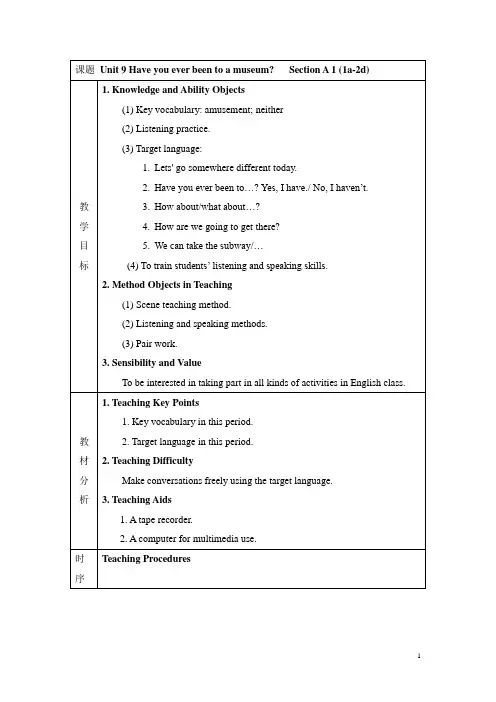
1 课题 Unit 9 Have you ever been to a museum? Section A 1 (1a-2d)
教
学
目
标 1. Knowledge and Ability Objects
(1) Key vocabulary: amusement; neither
(2) Listening practice.
(3) Target language:
1. Lets' go somewhere different today.
2. Have you ever been to…? Yes, I have./ No, I haven’t.
3. How about/what about…?
4. How are we going to get there?
5. We can take the subway/…
(4) To train students’ listening and speaking skills.
2. Method Objects in Teaching
(1) Scene teaching method.
(2) Listening and speaking methods.
(3) Pair work.
3. Sensibility and Value
To be interested in taking part in all kinds of activities in English class.
教
材
分
析 1. Teaching Key Points
1. Key vocabulary in this period.
2. Target language in this period.
2. Teaching Difficulty
Make conversations freely using the target language.
Unit 9 Have you ever been to a museum 单元知识点汇总
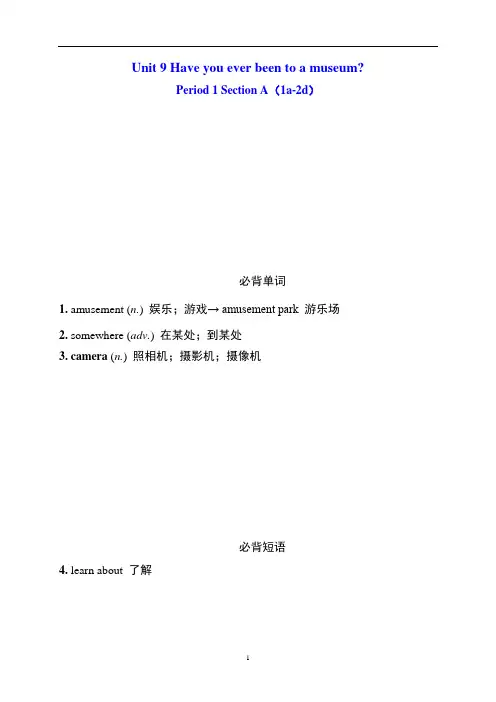
1 Unit 9 Have you ever been to a museum?
Period 1 Section A(1a-2d)
必背单词
1. amusement (n.) 娱乐;游戏→ amusement park 游乐场
2. somewhere (adv.) 在某处;到某处
3. camera (n.) 照相机;摄影机;摄像机
必背短语
4. learn about 了解
2 必背句子
5. —Have you ever been to a science museum?
你曾经去过一家科学博物馆吗?
— Yes, I’ve been to a science museum./No, I’ve never been to a science
museum.
是的,我曾去过一家科学博物馆。/ 不,我从未去过科学博物馆。
6. It’s a great way to spend a Saturday afternoon.
它是度过一个周六下午的很棒的方式。
Period 2 Section A(3a-3c)
必背单词
3 1. invent (v.) 发明;创造→ invention (n.) 发明;发明物
2. unbelievable (adj.) 难以置信的;不真实的→反义词:believable 可信的
3. progress (v./n.)进步;进展→ make progress (in... ) ( 在……方面)取得进步
4. rapid (adj.) 迅速的;快速的
5. unusual (adj.) 不寻常的; 特别的→ 反义词:usual 通常的,寻常的
6. toilet (n.) 坐便器;厕所
7. encourage (v.) 鼓励→ encourage sb. to do sth. 鼓励某人做某事
8. social (adj.) 社会的→ society (n.) 社会
Unit 9 Have you ever been to a museum 教案
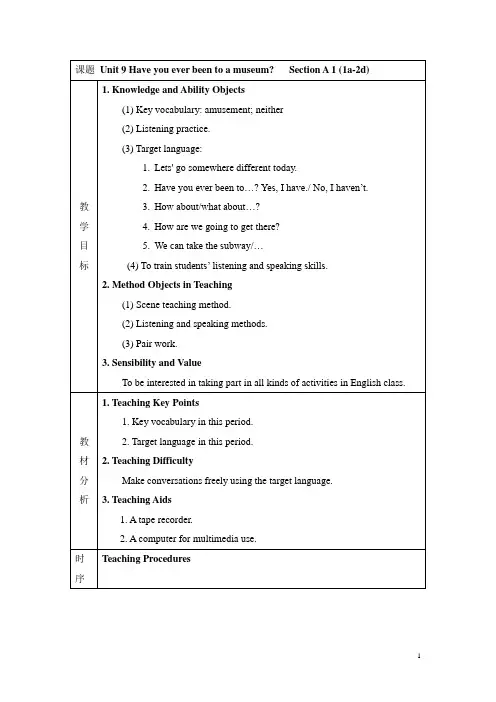
1 课题 Unit 9 Have you ever been to a museum? Section A 1 (1a-2d)
教
学
目
标 1. Knowledge and Ability Objects
(1) Key vocabulary: amusement; neither
(2) Listening practice.
(3) Target language:
1. Lets' go somewhere different today.
2. Have you ever been to…? Yes, I have./ No, I haven’t.
3. How about/what about…?
4. How are we going to get there?
5. We can take the subway/…
(4) To train students’ listening and speaking skills.
2. Method Objects in Teaching
(1) Scene teaching method.
(2) Listening and speaking methods.
(3) Pair work.
3. Sensibility and Value
To be interested in taking part in all kinds of activities in English class.
教
材
分
析 1. Teaching Key Points
1. Key vocabulary in this period.
2. Target language in this period.
2. Teaching Difficulty
Make conversations freely using the target language.
Unit 9 Have you ever been to a museum知识点总结
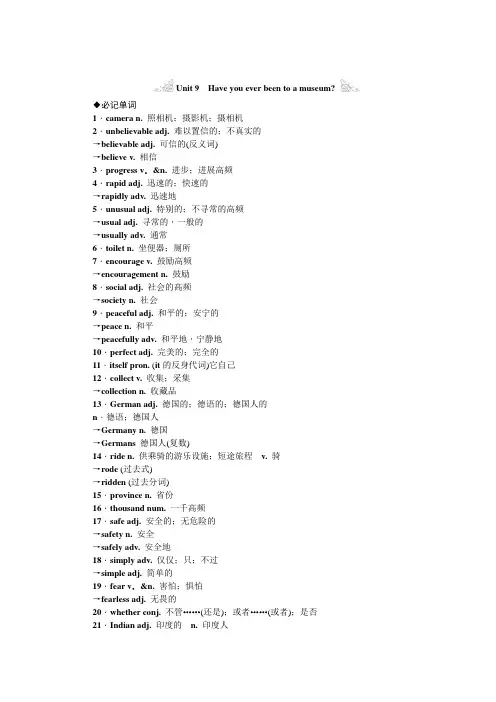
Unit 9 Have you ever been to a museum?
◆必记单词
1.camera n. 照相机;摄影机;摄相机
2.unbelievable adj. 难以置信的;不真实的
→believable adj. 可信的(反义词)
→believe v. 相信
3.progress v.&n. 进步;进展高频
4.rapid adj. 迅速的;快速的
→rapidly adv. 迅速地
5.unusual adj. 特别的;不寻常的高频
→usual adj. 寻常的,一般的
→usually adv. 通常
6.toilet n. 坐便器;厕所
7.encourage v. 鼓励高频
→encouragement n. 鼓励
8.social adj. 社会的高频
→society n. 社会
9.peaceful adj. 和平的;安宁的
→peace n. 和平
→peacefully adv. 和平地,宁静地
10.perfect adj. 完美的;完全的
11.itself pron. (it的反身代词)它自己
12.collect v. 收集;采集
→collection n. 收藏品
13.German adj. 德国的;德语的;德国人的
n.德语;德国人
→Germany n. 德国
→Germans 德国人(复数)
14.ride n. 供乘骑的游乐设施;短途旅程 v. 骑
→rode (过去式)
→ridden (过去分词)
15.province n. 省份
16.thousand num. 一千高频
17.safe adj. 安全的;无危险的
→safety n. 安全
→safely adv. 安全地
18.simply adv. 仅仅;只;不过
→simple adj. 简单的
19.fear v.&n. 害怕;惧怕
→fearless adj. 无畏的
八年级下册unit9Have you ever been to a museum导学案
1 宽城三中 八 年级下册 英语 学科导学案
主备人 刘秀芹 审核人 刘兴军 审批领导 袁海泉 授课时间 编号 1
课题 Unit 9 Have you ever been to a museum(第1课时)
Section A 1a-2c导学案
课时 1 课型 句型对话听说课
学习目标:,1.描述某人曾经去过哪些有趣的地方和谈论过去的经历,在此语境下继续学习现在完成时。2.学习neither的用法
能力目标:掌握如何表达现在完成时,提高听说能力。
情感目标 : 了解各类博物馆,主题公园。学会与别人分享快乐,发现身边美好事物。
重点难点:掌握用现在完成时谈论过去的经历。
环节预设:读学 // 对学 // 研学 // 展学
学习内容
一.课前自主学习
I. 写出下列动词的过去式和过去分词(温故而知新)。
is _____ _______ write ________ __________ read _______ ________study _______ ________
have/has _______ ______ eat _________ _________ see______ _______ live______ _______
help ________ _______ travel_______ __________ learn_______ ________ hear______
__________stop________ __________ play______ ______
II.找出下列词组(一)自学
Unit9 Have you ever been to a museum导学案
1 2016年第一学期八年级英语 温海燕
Unit9 Have you ever been to a museum?
一课时
【课堂目标】
1、学习9单元P65, P66的单词和短语,能够正确的拼写单词和短语。
2、复习现在完成时的用法 ,理解现在完成时的构成和意义。
3、完成听力训练,阅读听力材料,培养学生的听力技巧和能力。
一、、翻译下列短语及单词。
1)科学博物馆 2) 历史博物馆 3)不同的地方
4)去年 5)玩的开心 6)乘坐地铁
7)一个星期六的下午
翻译下列句子
1、你曾经去过太空博物馆吗?
2、我们打算怎么到达哪儿?
3、It’s a great way to spend a Saturday afternoon.
二、知识点清单,在完成时动词可以表示1.开始于过去持续到现在的动作或状态。2.也许还会继续进行下去的动作或状态。
例如:1) I have studied English since last year.
2) She has lived in Beijing for five years.
Unit+9+Have+you+ever+been+to+a+museum全单元教案
Unit+9+Have+you+ever+been+to+a+museum全单元教案
课
题
Unit 9 Have you ever been to a museum?(第 1 课时) 教课标注
一、教课三维目标
Knowledge and Ability Objects
(1) Key vocabulary: amusement; neither
(2) Listening practice. (3) Target language:
Lets' go somewhere different today.
Have you ever been to ⋯ ? Yes, I have./ No, I haven ’ t.
How about/what about ⋯?
How are we going to get there? We can take the subway/ ⋯
(4) To train students ’ listening and speaking skills.
2. 过程与方法: Method Objects in Teaching
(1) Scene teaching method. (2) Listening and speaking methods.
(3) Pair work
教
3. 感情态度与价值 学
To be interested in taking part in all kinds of activities in English class.
设 二、教课要点、难点
计1. Teaching Key Points 1. Key vocabulary in this period. 2. Target language in this period.
2. Teaching Difficulty
人教版八年级英语下册《Unit 9 Have you ever been to an amusement park.(通用)》教案_1
八年级英语·下 新目标【人】
Unit 9 Have you ever been to a museum?
第二课时 Section A 2a—2d
1.记忆单词和短语:camera,invention,have a great time,put up,take the subway。
2.掌握句型:Have you ever been to a science museum?
—I’ve been to the art museum many times.
—Me too.
—Have you ever been to a history museum?
—No,I haven’t.
—Me neither.
It’s really interesting ,isn’t it?
3.掌握含有been,ever和never的现在完成时的用法。
1.学习句型Have you ever been to…?及回答。
2.学习been,ever和never在现在完成时中的运用。
3.就相关话题进行交际教学。
1.含有been,ever和never的现在完成时的用法。
2.一般过去时与现在完成时的区别。
3.听懂参与讨论关于有趣的地方的话题。
本课教学内容是八年级下Unit 9第二课时, 在导入环节,利用一些漂亮的博物馆图片,通过提问,调动学生的积极性,活跃课堂气氛,引入本节讨论的话题,介绍本课的目标句型和单词,在听力环节,注重对学生听力策略的指导,消除学生对听力的“恐惧”心理,让学生能够高效做题。
2d教学是本课综合运用的体现。通过学习词组、重点句到对话的填空让学生的学习有渐进的过程;抽取学生进行角色扮演,对学生是知识升华的过程。
设计教学PPT,录音机,图片,多媒体。
StepⅠ.Lead in
[设计意图] 调动学生情感,激活他们头脑中关于过去去过的地方的情感,导入新授。
Leading in