
Unit10 I’d like some noodles教案
Unit 10 I’d like some noodles.
I. Teaching Contents: Unit 10 I’d like some noodles.
II: Analysis of the Teaching Material
1.Status and function
The topic of this unit is about food. The students will learn how to order food or take-away. In this unit, the s tudents will be able to use “would like” to express their need for food and learn how to ask others’ information and provide their personal information during the process.
2.Teaching aims and demands
(1)Knowledge objects
a.T o master how to order food or take-away;
b.T o master the modal verb “would” and “what” questions.
c.T o master the usage of countable nouns and uncountable nouns.
(2)Ability objects
a.To use “would like” to talk about the need for food.
b.To improve students’ ability of communication and social pra ctice.
(3) Sensibility objects:
Let the students experience the happiness of learning English, cultivate their ability
to do things and foster the spirit of cooperation in group activities.
3.Teaching difficult points and focus:
(1)Key words and target language and structures;
(2)To master the usage of countable nouns and uncountable nouns;
(3)To use “would like” to express their need for food and learn how to order food.
III. Target Language
(1) What kind of noodles would you like?
I’d like beef and tomato noodles, please.
(2) What size bowl of noodles would you like?
I’d like a large / medium / small bowl of noodles.
(3) What is your address?
My address is…
IV. Vocabulary
large, noodles, beef, chicken, mutton, potatoes, cabbage, dumplings, porridge, soup, green tea, orange juice, would like, address, kind, size, bowl.
V. Teaching Time
Five periods
POSTSCRIPT:(课后记)
若是需要更多2012新版七年级英语教案或课件,请Q我。
我的QQ号:1978499615。
Unit10-I’d-like-some-noodles教案精选全文完整版

可编辑修改精选全文完整版“聚焦教与学转型难点”的高效课堂教学设计课题名称:Unit10 I’d like some noodles(第一课时)姓名工作单位年级学科七年级教材版本一、教学难点内容分析(简要说明课题来源、学习内容、知识结构图以及学习内容的重要性)本堂课主要学习日常生活中有关的食物名称的单词noodles, mutton, beef, cabbage, potato,tomato, chicken等,掌握large, medium, small等描述分量大小的单词;学会would like句型的特殊疑问句及其回答。
难点:灵活应用新句型模拟生活场景进行点菜等对话。
二、教学目标(从学段课程标准中找到要求,并细化为本节课的具体要求,目标要明晰、具体、可操作,并说明本课题的重难点)英语新课程标准指出,基础教育阶段英语课程的总目标是培养学生的综合语言运用能力,而它又以学生语言知识、语言技能、学习策略、情感态度和文化意识五个方面的综合素养为基础。
根据总目标,结合本课教学内容及学生实际,我确定这节课的教学目标为:1、知识目标掌握新单词: noodles, beef, mutton, chicken, cabbage, potatoes, tomatoes, large.学会由would like构成的两个疑问句及回答,并能够使用该语言进行交际对话2、能力目标学生英语听说能力能够提高学生在角色扮演、自编对话的过程中锻炼表演能力和语言组织能力3、情感目标“从做中学”,在活动中学生能体会到学习英语的乐趣,树立学习英语的信心;模拟生活场景,在交流中增长生活经验,促进人际交往。
三、学习者特征分析(学生对预备知识的掌握了解情况,学生在新课的学习方法的掌握情况,如何设计预习)七年级学生有一定的语言基础,在小学英语学习和七年级上册英语学习中掌握了一定量的单词和句型,如hamburger, salad, ice-cream, egg,etc.What’s your favorite food ?What would you like ?他们充满好奇,有较强的求知欲、模仿能力和表现欲望。
Unit-10-I'd-like-some-noodles.教案 (1)
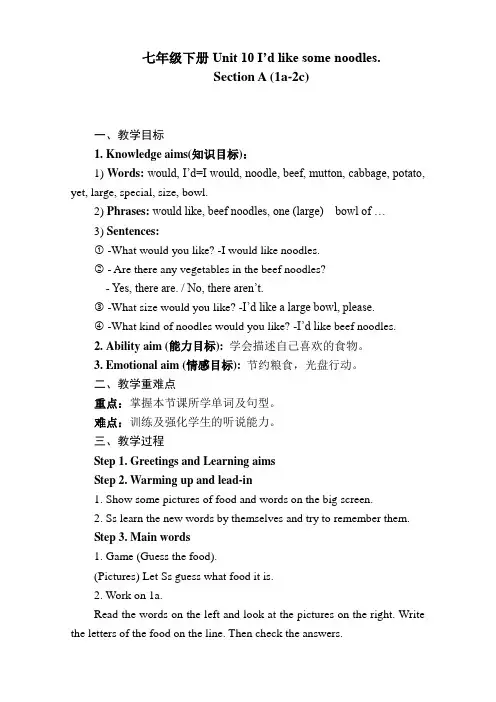
七年级下册Unit 10 I’d like some noodles.Section A (1a-2c)一、教学目标1. Knowledge aims(知识目标):1) Words: would, I’d=I would, noodle, beef, mutton, cabbage, potato, yet, large, special, size, bowl.2) Phrases:would like, beef noodles, one (large) bowl of …3) Sentences:① -What would you like? -I would like noodles.② - Are there any vegetables in the beef noodles?- Yes, there are. / No, there aren’t.③ -What size would you like? -I’d like a large bowl, please.④ -What kind of noodles would you like? -I’d l ike beef noodles.2. Ability aim (能力目标): 学会描述自己喜欢的食物。
3. Emotional aim (情感目标): 节约粮食,光盘行动。
二、教学重难点重点:掌握本节课所学单词及句型。
难点:训练及强化学生的听说能力。
三、教学过程Step 1. Greetings and Learning aimsStep 2. Warming up and lead-in1. Show some pictures of food and words on the big screen.2. Ss learn the new words by themselves and try to remember them.Step 3. Main words1. Game (Guess the food).(Pictures) Let Ss guess what food it is.2. Work on 1a.Read the words on the left and look at the pictures on the right. Write the letters of the food on the line. Then check the answers.Step 4. ListeningT: In the following conversation, one man is ordering some food. Now, let’s listen to the tape, find out the right noodles the person orders.Play the recording for the Ss to listen and check the answers.Step 5. Pair work1. Present the conversation and ask Ss to practice it.2. Make their own conversations using the noodles in the picture.3. Let some pairs act out their conversations.Step 6. Listening1. Work on 2a.Play the recording for the first time, students only listen carefully. Then, listen to the recording again, and check the names of the foods. Check the answers.2. Work on 2b.Play the recording twice. The first time Ss just listen. And the second time, Ss listen and write down the words.(If necessary, use the pause button to help Ss)3. Check the answers.Step 7. Pair work1. Show the conversations of 2a on the big screen to the Ss.2. Ss work in pairs and practice the conversations.Step 8. Summary and QuizStep 9. Video and Homework1. Review the words and expressions in this period.2. Save food from now on.四、板书设计。
Unit 10 I’d like some noodles 教案
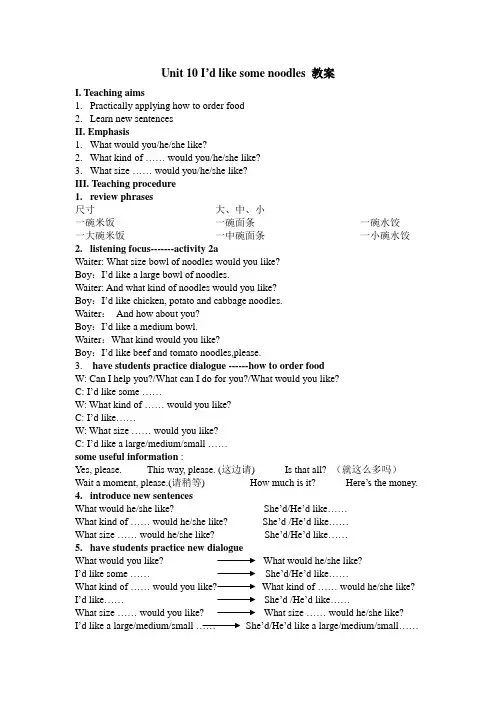
Unit 10 I’d like some noodles 教案I. Teaching aims1.Practically applying how to order food2.Learn new sentencesII. Emphasis1.What would you/he/she like?2.What kind of …… would you/he/she like?3.What size …… would you/he/she like?III. Teaching procedure1.review phrases尺寸大、中、小一碗米饭一碗面条一碗水饺一大碗米饭一中碗面条一小碗水饺2.listening focus-------activity 2aWaiter: What size bowl of noodles would you like?Boy:I’d like a large bowl of noodles.Waiter: And what kind of noodles would you like?Boy:I’d like chicken, potato and cabbage noodles.Waiter:And how about you?Boy:I’d like a medium bowl.Waiter:What kind would you like?Boy:I’d like beef and tomato noodles,please.3. have students practice dialogue ------how to order foodW: Can I help you?/What can I do for you?/What would you like?C: I’d like some ……W: What kind of …… would you like?C: I’d like……W: What size …… would you like?C: I’d like a large/medium/small ……some useful information :Yes, please. This way, please. (这边请) Is that all? (就这么多吗)Wait a moment, please.(请稍等) How much is it? Here’s the money.4.introduce new sentencesWhat would he/she like? She’d/He’d like……What kind of …… would he/she like? She’d /He’d like……What size …… would he/she like? She’d/He’d like……5.have students practice new dialogueWhat would you like? What would he/she like?I’d like some ……She’d/He’d like……What kind of …… would you like? What kind of …… would he/she like? I’d like……She’d /He’d like……What size …… would you like? What size …… would he/she like? I’d like a large/medium/small ……She’d/He’d like a large/medium/small……6.offer students some useful information to make a conversation happens in astorecolor size I’ll take it. What about this one? (这件怎么样?) It’s good.(不错)7.self-check8.homework: write a conversation happens in store。
Unit 10 I’d like some noodles教案
Unit 10 I’d like some noodles.Section A 1 (1a-1c)一、教学目标:1. 1) 能掌握以下单词:noodles, mutton, beef, cabbage, potato, special, would, would like能掌握以下句型:①— What would you like?②— I'm not sure yet. Are there any vegetables in the beef noodles?③— I’d like...2) 能了解以下语法:情态动词would的用法;2. 体会学习英语的乐趣。
养成一个良好的饮食习惯。
二、教学重难点1. 教学重点:1) 学习掌握本课时的重点词组及表达方式。
2) 引导学生们做听、说的训练。
2. 教学难点:通过role-play的方式掌握如何订餐等用语。
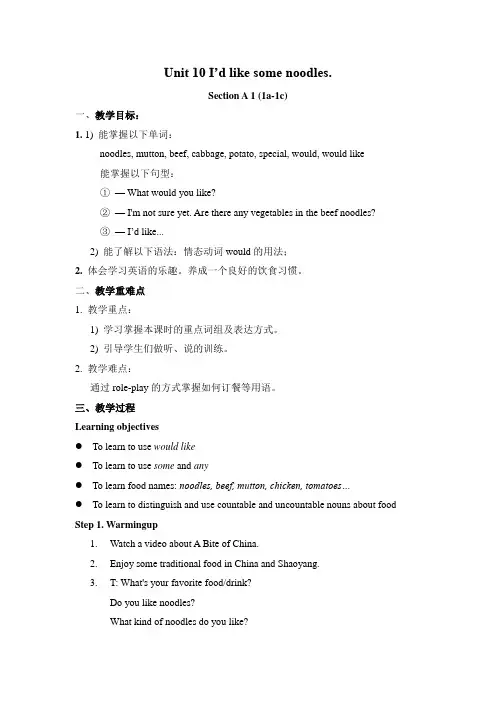
三、教学过程Learning objectives●To learn to use would like●To learn to use some and any●To learn food names: noodles, beef, mutton, chicken, tomatoes…●To learn to distinguish and use countable and uncountable nouns about food Step 1. Warmingup1.Watch a video about A Bite of China.2.Enjoy some traditional food in China and Shaoyang.3.T: What's your favorite food/drink?Do you like noodles?What kind of noodles do you like?Step 2. Presentation1. (show some pictures of food on the big screen)Present some new words and expressions to the Students.2. Students learn the new words and expressions by themselves and try to remember them.3. Work on 1a:Read the words on the left and look at the pictures on the right. Write the letters of the food on the line. Then check the answers.1. mutton __2. beef __3. noodles __4. chicken __5. cabbage __6. potatoes __7. tomatoes __8. carrots __Step 3. PresentationWork in pairs to practice the sentences.—What would you…?—I’d like…Step 4. Listening1. T: In the following conversation, one man is ordering some food. Now, let’slisten to the tape, find out the right noodles the person orders.____ Special 1 ____ Special 2 ____ Special 32. Play the recording for the Ss to listen and check the answers.3. Listen and complete the conversation.Waitress: ____________________?Boy: I’m not sure yet. Are there any vegetables in the ___________ ?Waitress: Yes, there are some _________.Boy: OK, I’d like the ___________, please.Step 5. Pair workWork on 1c.1. Make their own conversations using the noodles in the picture.2. Let some pairs act out their conversations.Step 6. Pair work1. Ask and answer questions with your partner. Use the information in 2a.2. Show the conversations of 2a on the big screen to the Ss.3. Make a model for the Ss.T: What kind of noodles would you like?S1: I'd like beef noodles, please.Step 7. Summary- What kind of … would you like?- I’d like …, please.- What size would you like?-I’d like a sm all/medium/large bowl, please.- Is /Are there any … in the …?- Yes, there .../ No, there ...May I take / have your order?Step 8. ExercisesⅠ. 根据句意及所给图片提示,写出句中所缺单词。
Unit 10 I’d like some noodles辅导教案
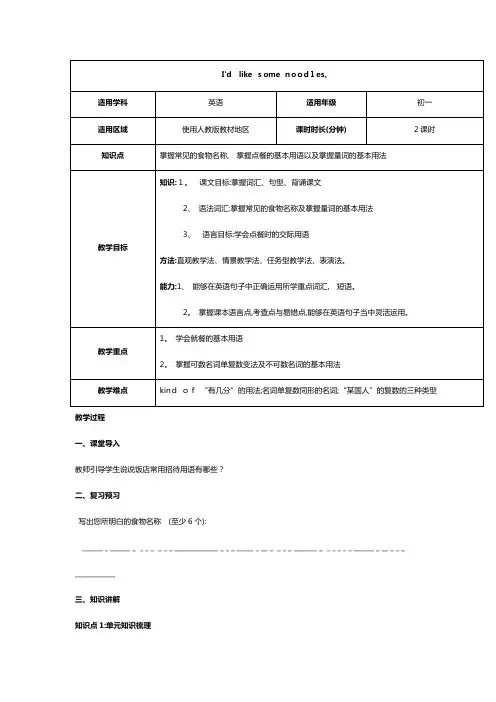
教学过程一、课堂导入教师引导学生说说饭店常用招待用语有哪些?二、复习预习写出您所明白的食物名称(至少6个):_____________________________________________________________________________________三、知识讲解知识点1:单元知识梳理1。
就餐用语2、词汇: 1)食物名称;2)kind of“有几分"的用法;3)名词单复数同形的名词;“某国人"的复数的三种类型、3、可数名词单复数变法及不可数名词的基本用法。
知识点2: 重点知识精讲1。
would like 想要【考查点】wouldlike想要(表示一种委婉的语气)其用法相当于want,would 是情态动词,没有人称与数的变化,可与人称代词缩写为'd, 与其它情态动词一样可帮助完成疑问句与否定句。
如: I’d likesome beef。
我想要些牛肉、/She would like toplay ping—pang。
她想去打乒乓球。
【易错点】Wouldyou like sth、? 是提建议的一种句型,如需用一些,用some而不用any。
肯定回答是: Yes, please、/ All right。
/ Yes、/OK、其否定回答是:No, thanks、如: - Wouldyoulike tosee thedolphins? —Yes, I’d like to、2、What kind of noodles would you like?【考查点】kind 在此句中作“种类”讲,a kind of一种,allkindsof 各种各样的。
kindof 有几分。
如: Acatis a kind ofanimal。
/ There are all kindsof animals in thezoo、/ The catis kind ofsmart、3、Can I help you? 我能为您做些什么?。
unit 10 i’d like some noodles教案3(鲁教版六年级下)

Unit 10 I’d like some noodles一.教学目标1.知识目标1) 词汇:large, medium, noodle, beef, green tea, cabbage, onions, juice, potato, special,size, dumpling, porridge, rice, soup, fish, drink, reason, menu, would like2)句型:What kind of noodles would you like?I’d li ke beef noodles, please.What size bowl of noodles would you like?I’d like a large / medium / small bowl of noodles.What kind of noodles would you like?I’d like mutton and potato noodles, please.2.能力目标.学生学会订购食物。
3.策略目标1)分角色表演对话。
2)通过听短文中的关键词来听懂整个文段。
4.情感目标关爱父母和他人,帮助他们做一些力所能及的家务事。
二.教学重点和难点1.教学重点1).--- What kind of noodles would you like?---I’d like beef noodles, please.2) ---- What size bowl of noodles would you like?---- I’d like a large / medium / small bowl of noodles.3)---- What kind of noodles would you like?----I’d like mutton and potato noodles, please.2.教学难点可数名词与不可数名词的概念。
Unit 10 I'd like some noodles教案3 四课时
UNIT 10 I’d like some noodles.Section A 第1课时(1a〜1c)自主学习方案1.自学生词,并记住拼读及拼写。
2.预习课本找出重点短语及句子。
(见学案自学导练内容)3.读记后完成自学导练内容。
课堂导学方案Step1 情景导入Everyone has his own taste. So what kind of food do you like?What’s your favorite food?Do you like noodles?What kind of noodles do you like?Today we'l talk about the kinds of noodles.环节说明:就学生感兴趣的身边的话题导入新课,简洁明了,引人入胜。
Step 2完成教材1a—1c的任务1.学生认真观察1a图片中的食物,然后将词语与图片搭配,集体核对答案。
(2分钟)2,老师领读单词,并纠正发音。
(2分钟)3.学生认真听录音,标出顾客所点的面条,集体核对答案,完成课本上1b的听力任务。
(3分钟)4.两人一组练习1a中的对话,然后编新对话进行练习,并请一些学生表演出他们的对话。
(5分钟)参考案例:A:What would you like?B: I,m not sure yet. Are there any vegetables in the mutton noodles?A:Yes,there are some cabbages.B:OK,I’d like the mutton noodles.5.小结训练。
(2分钟)(1)一Would you like some beef?— C .A. Yes,I wouldB. No,I wouldn’tC.Yes,pleaseD. Thanks(2)There are B hamburgers in our restrant. Would you like ?A.some;someB. some;anyC.any; anyD. any;some环节说明:听说结合,第一时间向学生传达语言目标,通过结对对话练习和小结训练,使语言目标得以强化。
Unit 10 I’d like some noodles.教案设计及反思
Unit 10 I’d like some noodles.教案教材分析本单元的中心话题为谈论如何在餐馆就餐,如何咨询价格、食物种类等具体涉与对于单复数名词、可数与不可数名词的掌握价格和食物种类的询问以与就餐所需的根本交际用语等。
语言技能和语言知识根本上都是围绕介绍中心话题“点餐〞而设计。
学情分析学生通过以前的学习已经储藏了一些食物方面的词汇,了解了本单元的目标句型。
学生在课前已经识记过本单元的单词。
教学目标一.知识目标1.能够通过师友互助或教师的教准确拼读和拼写核心词汇和短语。
2.能熟练使用如下目标语言。
〔1〕------What kind of noodles would you like?------ I’d like beef noodles, please.(2). ----What size would you like?--- I’d like a large bowl, please.(3). ---Would you like a large bowl?---- Yes, please.3.理解并掌握可数和不可数名词的用法。
二.能力目标1.能听懂简单的订餐的话题并获取有效信息。
2.能用正确的语言和语调朗读本单元中的对话和句型,并能用本单元所学的目标语言进展简单的交际。
3.能根据图片询问对某种事物的喜好,掌握打的订餐、点餐时常用的习惯用语。
了解英国和中国关于生日时吃事物的不同习俗。
4.能利用本单元学习的目标语言介绍饭店的事物与其价格。
三.情感目标1.通过对打订餐、餐馆点餐的学习,学会文明就餐以与尊重他人,提高人际交往的能力和实际生活的能力。
2.通过对不同食品价格的介绍,增强节俭意识。
四.文化意识目标了解中英国家生日食品的不同,在模拟的就餐情景中,学会与他人交流沟通,增强跨文化交际的意识和能力。
五.学习策略目标1.充分发挥师生双方在教学中的主动性和创造性。
2.重视学生之间的交流与合作以与动手实践与解决问题的能力,重视学生各种素质尤其是创新精神和实践能力的开展状况。
人教版七年级英语下册Unit-10-I’d-like-some-noodles教案
Unit 10 I’d like some noodles.I. Teaching Contents: Unit 10 I’d like some noodles.II: Analysis of the Teaching Material1.Status and functionThe topic of this unit is about food. The students will learn how to order food or take-away. In this unit, the s tudents will be able to use “would like” to express their need for food and learn how to ask others’ information and provide their personal information during the process.2.Teaching aims and demands(1)Knowledge objectsa.T o master how to order food or take-away;b.T o master the modal verb “would” and “what” questions.c.T o master the usage of countable nouns and uncountable nouns.(2)Ability objectsa.To use “would like” to talk about the need for food.b.To improve students’ ability of communication and social pra ctice.(3) Sensibility objects:Let the students experience the happiness of learning English, cultivate their abilityto do things and foster the spirit of cooperation in group activities.3.Teaching difficult points and focus:(1)Key words and target language and structures;(2)To master the usage of countable nouns and uncountable nouns;(3)To use “would like” to express their need for food and learn how to order food.III. Target Language(1) What kind of noodles would you like?I’d like beef and tomato noodles, please.(2) What size bowl of noodles would you like?I’d like a large / medium / small bowl of noodles.(3) What is your address?My address is…IV. Vocabularylarge, noodles, beef, chicken, mutton, potatoes, cabbage, dumplings, porridge, soup, green tea, orange juice, would like, address, kind, size, bowl.V. Teaching TimeFive periodsPOSTSCRIPT:(课后记)。
Unit10I’dlikesomenoodles教案
Unit 10 I’d like some noodles一、教学目标1.学习would like的用法2.学会使用询问和表达面条的种类以及各种尺寸的大小。
二.教学重点1)would like的用法。
2)句型的操练。
3) 名词的可数与不可数。
三.教学难点1) would like的用法。
2) 如何灵活的运用本单元的重点句型以及名词。
四、教学时间及安排:第1课时:Section A 1a-2b 第2课时:Section A 3-Section A 4 第3课时:Section B la-Section B 2C 第4课时:Section B 3a--Self checkPeriod 1 (Section A 1a—2b)Language goalTo order food. To ask for and give personal information.To write the ir own ad for foods.Teaching proceduresStep 1 Presentation1、Look at the picture . Please answer the questions below1)Can you see three bowls? 2)What are in them?3)Do you like noodles? 4)Can you find the differences among the three bowls of noodles?5) What size bowl of noodles would you like -----small, medium, or large? 6)Look at the sign ____Special 1,Special2,Special3.And understand their meanings.2、Look at the numbered list of ingredients .Read and repeat.3、Ask students to match each word with the foods.4、Ch eck the answers.Step 2 Listening1、Look at the three bowls of noodles. Ask: What ingredients are in these noodles?2、Play the recording the first time .Students only listen.3、Play the recording a second time.4、Correct the answers.Step3 Practice1、Read the conversation in the picture in 1a.2、Ask students to work in pairs. One person is the waiter, the other one is the customer.3、Perform the conversation in front of the classroom.Step4 Listening1、Look at the food in the picture in 2a and name each one.2、Read the numbered list of words.3、Say, you will hear a conversation. The people will talk about some of the foods, but they will not talk about others. Please check the names of the food you hear below.4、Play the recording a second time.5、Correct the answers.Step5 Listening1、Read the conversation in 2b. Point to the blank lines .Say ,listen again and fill in the blanks now.2、Check the answers.Step6 Practice1、Read the conversation in 2c yourselves.2、Work in pairs. Each student can be both the waiter and the customer. Say what you really like with your noodles.Step7 HomeworkCopy the new words. Do Exercises 1 and 2.教学后记:Period 2 (Section A 3-Section A 4)aimsTo order food. To ask for and give personal information.To write their own ad for foods.Language goalI’d like some noodles.What kind of noodles would you/he/she/they like?I’d/He’d/She’d/They’d like beef noodles.What size bowl of noodles would you/he/she/they like?Teaching proceduresStep One: Revision1 Revise the food words.2 Revise: What kind of noodles would you like? I’d like …Wha t size bowl of noodles would you like? I’d like…Step Two: Practice1 L ook at the picture .What’re they doing in 3a?2 Read all the questions yourselves and all the answers yourselves.3 Now please match each question with an answer. The first one is done as a sample.4 Check the answers.Step Three: Practice1 Read the conversation again in 3a.2 Now make your own conversation. Student A asks the questions from activity 3a. Student B gives true answers.3 Perform their dialogue for the class.Step Four: Game1 Look at the four different bowl of noodles on the table. Ask: What ingredients are in it ?2 Divide the students into groups of four. Ask and answer.3 Find out the most popular noodles in each group and report.Step5 HomeworkReview the phrases.教学后记:Period 3 (Section B: la-Section B: 2C)Step 1 Revision1. Revise the food words.2. Revise: What kind of noodles would you like? I’d like…Step 2 Presentation1. Look at the food on the table. Can you name them?2. Read the numbered list of words in 1a and repeat.3. Ask students to match each word with a picture. Write the letter of each food picture in the blank in front of the correct word.4 Check the answers.Step 3 Circling1 Read again the food on the table in 1a.2 Please circle the things you like and put an X in front of the things you don’t like.3 Read the dialogue on the right in 1b.4 Work in pairs . Tell each other what you like and don’t like.Step 4 Listening1 Read the eight words again in 1a.2 Say, you will hear a conversation. A boy is ordering food from a restaurant. As you listen, please circle each of the words in 1a that you hear.3 Play the recording the first time, students only listen.4 Play the recording a second time.5 Correct the answers.Step 5 Listening1 Look at the order from on Page 82. What information does it ask for ?2 Listen again . Please write down the information on the order form.3 Correct the answers.Step 6 Practice1 Look at the order form on Page 83.2 Work in pairs. Student A, you work in the House of Dumplings. Ask student B questions and fill out the order form.Step 7 Completing1 Read the list of words in 3a.2 Read the newspaper ad, and fill in the blank lines.3 Check the answers.Step 8 Practice1 Read the ad. Say, write a word in each blank.2 Check the answers.Step 9 Writing1 Look back at the ad .2 Now please write your own ad. You can use some of the sentences from activity 3a. But please use your own types of dumplings and choose different drinks. You can also change the prices.3 Read your ad for the class.Step 10 Practice1 Read your partner’s ad. Notice the kinds of food and prices. Then order food from your partner.2 Work in pairs and take turns ordering food and drink from their partner’s ad. Step 11 HomeworkCopy the words and phrases. Do exercises 3 in the Exercise Book.教学反思;______________________________________________________________________________ ______________________________________________________________________________ ______________________________________________________________________________ _____Period 4 (Section B: 3a--Self check)Te aching aims:Ss can use the present progressive tense to describe the pictures.Ss can ask and answer questions about the picture fluently.Language pointsTo use the following sentences: Here is a photo / pictu re of my family. I’m with my sister Gina.Thank you for your letter and the photos. To learn the following phrases.Thank you for sth. / doing sth. be withTeaching difficultiesHow to write the sentences about the present progressive tense correctly. Teaching steps1.warming-up and revision(1)The teacher asks Ss some questions.T: Hello, how are you? S1: I’m great. Than k you.T: How is your father? S1: He is very well.T: Where is your father? S1: He is at the mall.T: What is he doing? S1: He is shopping.T: Is your father shopping now? S2: No, he isn’t. He is watching TV.T: Where is he watching TV? S2: He is watching TV at home.(2) Show some pi ctures, let Ss ask and answer the questions in pairs.S1: Look! What is she doing? S2: She is reading a book.S1: Where is she reading a book? S2: She is reading a book under a tree.2. Work on 3a.Show the pictures of 3a and let Ss say it one by one.S1: He is playing basketball.S2: The girl is doing homework.Let Ss work in pairs, ask and answer about the photos like this.A: What is Mike doing in Photo 1? B: He is playing basketball.A: Is he playing basketball at school? B: Yes, he is.3.WritingShow the pictures to the Ss and let Ss finish the sentences, then check the answers.4.Group workT: Now take out your photos or pictures, please work in fours and tell your partners about your pictures or photos. I’ll give you two minutes to practice it.T: At this ti me I’ll ask several students to say something about your photos. 5. PracticeSs write the sentences in their exercise books, the teacher walks around the class and see if the Ss can write the sentences correctly. Give Ss some help if necessary. The teacher collects some pictures and sentences, shows them to the Ss and checks the answers.6. Fill in the blanks.Show the picture of 3b, let Ss say the picture like this:7. Homework.Review the words and phrases.教学后记:。