
Unit 6 Topic 2(Section D)导学案(仁爱版八年级下册)
点拨(二):pay attention to…---注意…注意:to是介词,后面用名词,代词,动名词等作宾语
练习:a.你的北京之旅怎么样?______________________________________________
b.上个星期我们进行了一次去科技中心的参观。
观察本文的日记,总结日记的写法。
3.完成1b
4.自读2 a,2b,总结时间状语从句和习惯用语。
合作探究
1. Read Michael’s diary of his trip to the Ming Tombs, and pay attention to the form of the diary.
点拨(一):a trip to…---一次去…的旅行
【预习达标】
1.他的明陵之旅_________________________________
2.注意…__________________
3.晴天_______________
4.日记的格式_______________________________
5.检查我们的自行车和背包_______________________________
译:______________________________________________________________________
点拨:have fun doing sth. ---干…很开心
链接:干…有困难_____________________________
思考(一):realize ---意识到,它后面的句子是_________从句,从句前面省略了引导词_________
11.拍照______________
12.朝着我们大喊_______________
13.感到害怕________________
14.骑上我们的自行车___________________
15.开心地考察__________________
16.到处寻找他_________________________
练习:听到这激动人心的消息,孩子们忍不住跳了起来。
The children______ _______ ________ , when they ________ the ____________ news.
展示提升
While we were having fun exploring, I realized Darren was lost.
We went on ___ ______ ___ theScienceCenter_____ _____.
c.A good teacher should pay more attention to the students’ moods in class.
译:______________________________________________________________________
2. They were very cute and we couldn’t help watching them.译:___________________________________________
点拨:can’t help doing sth.---忍不住做某事
区别:can’t help sb. (to) do sth.--- __________________பைடு நூலகம்_______
思考(二):lost在此是个_______词,意思是________,它的动词形式是________,过去式形式是_________
练习:a.孩子们正在开心地学英语。_________________________________________________________________
b.我们和父母交谈有些困难。_________________________________________________________________
6.两个半小时____________________________
7.在古代_______________________
8.下马_____________________
9.沿着七公里长的神道_________________________________
10.代表和平_____________
课题:unit6 topic2 sectionD
第四课时
备课人:审核人:班级:学生:
【学习目标】
1。学习新单词和短语。
2。学习有用表达。
3。复习时间状语从句。
4。学习写旅游日志。
【知识链接】
链接:一次去…的参观________________
链接:干…有困难_____________________________
17.请保安帮助________________
18.谢天谢地_________________
19.最后____________
20.多么特别的一次旅行啊! __________________________
【学习流程】
自学指导
1.自读并翻译1a。
2.根据下列关键词,复述1a.
rode to Ming Tombs----arrived at the Great Palace Gate ----rode their bikes along the7kmSacred Way ----had lunch----climbed up the Dragon and Phoenix Gate ----be lost ----lookred for Darren----asked the guard for help ----found Darren
复习,回答下列问题。
How did the three boys get to Ming Tom?
Did they find places to park their bikes?
When Darren pushed his way out ,what happened to him?
Did Darren’s friends find him at last?
仁爱版八年级下册英语导学案(直接打印版)

upset, worried, disappointed, unhappy (2)、学习其它新单词和短语:
invited, say thanks to, silly, smile, none, rich 2、掌握"linking verb+adj."结构的用法。
You look so excited.
A. disappointed, to
6 /6 79
仁爱版八年级下册英语导学案(直接打印版)
(三)、安家落户:用下列单词填空,注意形式! happy , worry, move , please,surprise
1.Andy thinks Love me once more,Mom is very _______, so he likes it . 2. Helen's English is poor,and it made her mother________. 3. —Mark got an Ain this English exam. Is he _____with the result?
(二)、你很聪明,定能挑战!单选串串烧。
( )1.—Did you see the movie Baobeijinhua ,Ran?
— No, I didn't.
—It's very funny. I hope you ___see it ____next time.
A .to, the B. can,the C. will, \ D. can , \
(一)、词汇城堡:根据汉语提示写出单词。
5 /5 79
仁爱版八年级下册英语导学案(直接打印版)
1.The soup has very little____(味道).
九年级英语仁爱版下册Unit6_Topic2_SectionD_知识梳理与练习

[主题教材互译]Unit 6 Entertainment and Friendship娱乐和友谊Topic 2 Who is your favorite character in literature?你最喜欢文学里的哪个人物?Section DGift of the Magi麦琪的礼物(N=Narrator D= Della J= Jim)N:Tomorrow will be Christmas.(明天就是圣诞节了)But Della feels very sad, because she has no money to buy a present for her husband, Jim.(但是黛拉很难过,因为她没有钱给她的丈夫吉姆买一件礼物。
)In fact, Della and Jim have two precious possessions.(其实,黛拉和吉姆有两件宝贝。
)They are Jim's gold watch and Della's long beautiful hair, which are the only wealth for them.(那就是吉姆的金表和黛拉漂亮的长发,这是他们仅有的财产。
)Della had her hair cut, sold it and bought a gold watch chain for Jim.(黛拉把头发剪了卖掉,给吉姆买了一个金表链。
)Now, Della is at home.(现在,黛拉到家了。
)(All of a sudden, the door opens and Jim comes in.)(突然门开了,吉姆走了进来。
)J:You...?你...?D:Jim. don't look at me that way.(吉姆,别那样看着我。
)I had my hair cut off and sold it because I couldn't have lived throughChristmas without giving you a present.(我把头发剪了卖掉了,因为我不能连圣诞节都不送你一份礼物。
仁爱版八年级下册Unit6 Topic2配套练习和单词
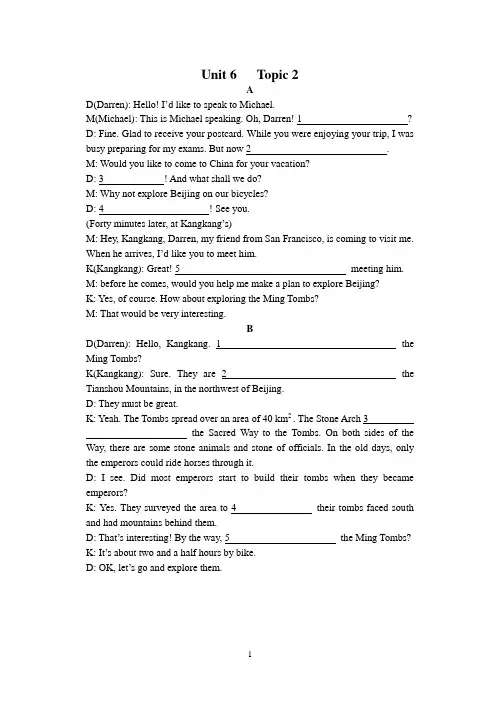
Unit 6 Topic 2AD(Darren): Hello! I’d like to speak to Michael.M(Michael): This is Michael speaking. Oh, Darren! 1 ? D: Fine. Glad to receive your postcard. While you were enjoying your trip, I was busy preparing for my exams. But now 2 .M: Would you like to come to China for your vacation?D: 3 ! And what shall we do?M: Why not explore Beijing on our bicycles?D: 4 ! See you.(Forty minutes later, at Kangkang’s)M: Hey, Kangkang, Darren, my friend from San Francisco, is coming to visit me. When he arrives, I’d like you to meet him.K(Kangkang): Great! 5 meeting him. M: before he comes, would you help me make a plan to explore Beijing?K: Yes, of course. How about exploring the Ming Tombs?M: That would be very interesting.BD(Darren): Hello, Kangkang. 1 the Ming Tombs?K(Kangkang): Sure. They are 2 the Tianshou Mountains, in the northwest of Beijing.D: They must be great.K: Yeah. The Tombs spread over an area of 40 km2 . The Stone Arch 3the Sacred Way to the Tombs. On both sides of the Way, there are some stone animals and stone of officials. In the old days, only the emperors could ride horses through it.D: I see. Did most emperors start to build their tombs when they became emperors?K: Yes. They surveyed the area to 4 their tombs faced south and had mountains behind them.D: That’s interesting! By the way, 5 the Ming Tombs? K: It’s about two and a half hours by bike.D: OK, let’s go and explore them.Unit 6 Topic 21. 在---脚下2. 休息3. 计划做某事4. 玩得高兴5. 云海6. 吃大餐7. 忙于做某事8. 进行9. 在度假10. 的确,当然11. .期望做某事12. 蔓延,拖延13. 的开端14. 在……的两边15. 在过去,在古代16. 开始做某事17. 确信18. 两个半小时19. 辨别….20. 在…东面(指…范围外/内/接壤)21. 停车场22. 寻找停车的空地23. 对……感到惊奇24. 拿出25. 照相26. 以不同方向27. 踏,踩28. 冲出29. 看不见,在视野之外30. 如此…以致…(引导结果状从)31. 以便,为了(引导目的状从)32. 直到…才…(引导时间状从)33. 互相34. 一…….就…(引导时间状从)35. 以……著名36. 禁不住做某事37. 对……感到满意38. 注意39. 象征40. 对……喊41. 到处42. 寻求某人的帮助43. 谢天谢地44. 收到,得到45. 明信片46. 考察,探险47. 对话48. 完美的,极好的49. 野营度假50. 远足,徒步旅行51. 西北52. 拱门53. 标明,作记号于54. 开始,开端55. 神的,神圣的56. 官员,高级职员57. 勘测,查看58. 骆驼59. 威望,声望60. 东方的,东部的61. 北,北方,北部62. 东北(部)63. 东,东方,东部64. 东南65. 参观,观光66. 空间67. 人群,拥挤68. 推69. 方向,方位70. 踩,走,脚步71. 脚趾72. 注意,布告73. 视线,情景74. 跳动,打败(某人),节拍75. 慢慢地76. 巨大的,庞大的77. 在……旁边78. 悲伤地,伤心地79. 发电子邮件80. 背包81. 卫兵,守卫82. 认识到,实现Unit 6 Topic 2 Section AI.根据汉语提示填空1. He (在度假)with his family in Hangzhou.2. Let’s (制定一个计划)to go hiking.3. Her English is (地道的). So let her read the (对话).4. They (忙于算出)the cost of the trip. II.选择题1. — Are you going to watch Yao Ming’s game tonight?—I’m a big fan of his.A. You bet!B. I’m sorry to hear thatC. No way!D. Sure. That would be very nice.2. — Can you finish the work before he tomorrow? — No problem.A. will get hereB. come backC. leaves for ShanghaiD. will arrive3. It was raining I arrived at the station.A. asB. whileC. whenD. as soon as4. We in the forest last weekend when it began to rain.A. enjoyed campingB. were enjoying campingC. enjoyed to campD. were enjoying to camp5. Did you presents your friends on your birthday?A. give, toB. send, toC. borrow, fromD. receive, fromSection BI.根据首字母或汉语提示填空1. — Can you (确保)that all the lights are off when you leave? — Yes, of course.2. (过去), people didn’t have enough food to eat.3. It’s about (骑车十分钟路程)from here to my school.4. There are many trees(在路两边)5. It’s hard to Lucy (区分))her twin sister.6. We use them in the desert for riding on or for carrying goods. They are calledc .II.选择题1. Fujian is the southeast of China, and Taiwan is the southeast of Fujian.A. in, toB. to, inC. to, toD. in, on2. There are many trees on side of the road.A. everyB. eachC. bothD. all3. —is it from our school to Lupu Bridge?— About half an hour’s bus ride.A. How longB. How oftenC. How farD. How much4. It took her to cook the delicious food.A. three and a half hourB. three and a half hoursC. a half and three hourD. three hour and a halfIII.用方框中所给单词的适当形式填空1. I read the story from to end yesterday.2. His house the sea. He can see the white beaches(沙滩)in his bedroom.3. We should the prices on the goods(商品)in the supermarkets.4. The disease over the whole village if we can’t stop it quickly.5. Shanghai is in China.Section CI.根据首字母提示填空1. The heart of an adult man b about 70 to 89 times a minute.2. It’s polite to make s for the old on the bus.3. A large c of people came to the square.4. The t started at the beginning of the summer vacation.5. The boy was so frightened because his mother was out of s .6. — Did you n a girl in white pass by just now.— Sorry, I was reading my book.7. Jack walked toward the d of the post office.II.请选出与句中画线部分意思相同或相近的选项1. Just push the button there, and the coffee comes out here.A. takeB. bringC. pullD. press2. The old man was afraid of falling down, so he stepped slowly in the snowy road.A. rushedB. walkedC. rodeD. flew3. He didn’t go home until the rain stopped.A. whenB. beforeC. afterD. as soon as4. She caught sight of a red car in front of her house.A. sawB. lookedC. looked forD. watched5. He has a big family.A. hugeB. largeC. greatD. manyIII1. I’2. Mother was doing some cleaning father was watching the football match.3. She danced she sang.4. He waited for me late at night.5. He couldn’t help crying he heard the bad news.Section DI.请选出与句中画线部分意思相同或相近的选项1. While we were having fun exploring, I found Darren was lost.A. good atB. enjoyingC. looking forward toD. having a good time2. While we were having fun exploring, I found Darren was lost.A. sawB. watchedC. heardD. noticed3. We found him at last.A. by the endB. finallyC. laterD. after a while4. The town stands at the foot of the mountains.A. sitsB. liesC. facesD. places5. Tom always puts his things here and there.A. somewhereB. some placeC. everywhereD. over thereII.根据汉语意思完成句子1. 这人从背包里掏出一些食物和饮料。
Unit 6 Topic 2【复习课件】八年级英语下册单元复习(仁爱版)
5.chairman 主席 10. memorial 纪念的
III. 根据单词写出汉语意思。
11.northwest 西北 16.sadly
悲伤地
12. northeast 东北 17.announce 宣布
13. southeast 东南 18. republic 共和国
14.crowd 15.slowly
6. 迫不及待做某事
can't wait to do sth.
7. 禁不住做某事
can't help doing sth.
8. 直到...才
not...until
9. 从做某事中得到乐趣 have fun doing sth.
10. 求助某人
turn to sb./ask sb. for help
1. 当她听到这个坏消息,她情不自禁地哭了。
WW高频aa考rrm点m导ii导nn航gg uupp
1. While you were enjoying your trip to Mount Tai, I was busy preparing for my exams. “当你在泰山旅行时, 我正忙于准备考 试。”
(1)be busy His sons who are busy wwoorrkkiinngg don’t care for him on his special day. “他那些忙于工作的儿子们在这个对他来说很特殊的 日子里不关心他。” (改编自 2021·四川泸州)
C.doing, doing
【答案】C 【解析】句意:——运动会那天你忙着做运动吗?——是的,我玩得很开心。
考查非谓语。固定短语be busy doing sth.意为“忙于做某事”;have a good time doing sth.意为“做某事很开心”。故选C。
(完整版)仁爱版英语八年级下册导学案(全册)
Topic 1 Why all the smili ng faces?Section A任务一:I 1听录音补全下面的答句。
1. How does Kan gka ng look?He looks ___________ .2. Why does Kan gka ng look excited?Because his pare nts want to _______ Jane's pare nts ___________________ t o the movies.3. Is Jane fond of the movie The Sound of Music?Yes, it is _______________ her favorite movies.4. What are Jane and Kan gka ng going to do on Saturday eve ning?They will _________ the evening at Kangkang ' ____________ .5. What will Kangkang ' mom do?She will __________ some delicious food ___________ them.II.读课文,翻译短语并完成解析。
1. How are you doing? ”的意思是________________ ,这是一个问候语,与之类似的还有How are you?/ How is it going? /How are you getting along? ,回答此类问候,常用:fine/ very well, + tha nk you/tha nks.2. Invite your parents to go to the movies "意思是_________________ ,我们可以总结"邀请某人做某事”,句型为__________________________ .例:Sally昨天邀请我参加她的生日聚3. spend the evening at my house.” 意思是__________________ 。
八年级下册英语教案设计unit6. topic2. sectionD
八年级下册教案设计Unit 6 Enjoying CyclingTopic 2 How about exploring Tian’anmen Square?Section DⅠ. Material analysis本节课建议用1课时学完。
主要活动为Section D的1a。
本课通过阅读Michael的旅行日记,复习时间状语从句的用法。
要求学生通过本课的学习活动掌握黑体单词和短语have fun doing sth., everywhere和Thank goodness. 学会写旅行日记的同时,培养学生热爱旅游、积极探索的态度,并向学生渗透迷路的应对策略,让学生树立安全意识,遇事不要惊慌,学会保护自己。
Ⅱ. Teaching aimsKnowledge aims:1. 学生能正确拼读并运用黑体单词和短语。
2. 学生能学会如何写旅行日记。
3. 学生能熟练掌握时间状语从句的用法。
Skill aims:1. 能听懂有关旅游经历的短文或对话,并从中获取信息。
2. 能使用英语简单陈述自己旅游与探险的心得与感受。
3. 能读懂旅行日记,并从中获取需要的信息。
4. 能用英语简单写自己的旅行日记。
Emotional aims:1. 具有积极参与课堂上各种英语实践活动的兴趣。
2. 培养学生热爱旅游、积极探索的态度,树立安全意识,遇事不要惊慌,学会自我保护。
Ⅲ. The key points and difficult pointsKey points:1. 学习有关叙述旅游经历的词汇、短语和句式的表达。
2. 掌握时间状语从句的用法。
Difficult points:用英语写自己的旅行日记。
Ⅳ. Learning strategies1. 善于创设情景,在情景中提高语言交际能力,突显语言交际功能。
2. 在日常学习中不断开阔视野,扩大知识面。
3. 善于分组活动,在小组内积极与他人协作,取长补短,共同完成学习任务。
Ⅴ. Teaching aidsComputer multimedia projector.Ⅵ. Teaching proceduresStep InteractionpatternStudent activity Teacher activityIntroduction (8 minutes)1. The wholeclass work.2. The wholeclass work.3. Group work.4. The wholeclass work.1. Students focus theirattention on theteacher.2. Students review thenouns of direction byasking and answering.3. Students have a contestamong groups toreview the adverbialclauses of time.4. Students report theirhomework. And thenprepare for learningthe new lesson.1. Greet the students andmake them ready forlearning.2. The teacher shows thepicture of 3a in Section B.Let the students reviewthe nouns of direction byasking and answering.3. The teacher guides thestudents to have a contestamong groups. In thelimited time, the teacherasks the students todiscuss in group of fourand write sentences of theadverbial clauses of timewith before, after, asuntil, while, when and assoon as as much aspossible. Then ask themto show their results. Thegroup which writes themost and correct sentences isthe winner.4. The teacher lets the studentsreport their homework:Read the story about oneof your travel experiences.Then lead to the newlesson:Kangkang, Michael andDarren also have an excitingexperience. Michael keeps adiary of the trip in orderto remember it forever.Let’s read it now.Presentation (10 minutes)class work.2.The wholeclass work.3.The wholeclass work.4.The wholeclass work.5. The wholeclass work.6. The wholeclass work.7. The wholeclass work.passage of 1a and findout the new words.2. Students read 1aquickly and mark thesentences containingadverbial clauses oftime.3. Students check theiranswers with theteacher.4. Students read 1a againand find out thedifficult points.5. Students tell thedifficult points. Otherstudents help themsolve the problems.6. Students underline thewords and phrases andmake a note.7. Students read thePassage, and then sumup the form of thediary.students to skim thepassage of 1a and find outthe new words.2.The teacher asks thestudents to read 1aquickly and mark thesentences containingadverbial clauses of time.3. The teacher asks twostudents to tell theiranswers.4. The teacher asks thestudents to find out thedifficult points.5. The teacher asks thestudents to tell thedifficult points. Ask otherstudents to help themsolve the problems.6. The teacher makes asummary to explain the keypoints and difficult points tothe students:(1) check out(2) ride to …(3) have fun doing sth.(4) Thank goodness!7. The teacher asks thestudents to read 1a againand sum up the form ofthe diary. The teachermakes a summary.Consolidation (10 minutes)class work.2. The wholeclass work.3. Individualwork.4. The wholeclass work.5. The wholeclass work.6. The wholeclass work.7. The wholeclass work.passage after therecording sentence bysentence.2. Students try to followthe speed, payingattention to thepronunciation andintonation.3. Students read 1a andfill in the blanks4. Students check theanswers with theteacher.5. Students put the keyinformation in theright order.6. Students check theanswers with theteacher.7. Students retell thestory with the correctconjunctions ingroups.recording sentence bysentence.2. The teacher plays therecording withoutstopping.3. The teacher lets the studentsread 1a and fill in the blanks.4. The teacher asks the studentsto tell the answers.5. The teacher asks the studentsto read 1a again and put thekey information in the rightorder.6. The teacher asks two studentsto tell their answers.7. The teacher asks the studentsto retell the story with thecorrect conjunctions ingroups.(1) Ask the students to makesure of the keys wordsand conjunctions.(2) Members B-F retell oneparagraph each.(3) Member A retells thewhole passage to thewhole class.Practice (10 minutes) 1. The wholeclass work.2. The wholeclass work.3. The wholeclass work.4. Individualwork.5. The wholeclass work.6. The wholeclass work.7. The wholeclass work.1. Students read throughSections A-C and fill inthe blanks of thegrammar table with thecorrect words.2. Students check theanswers with theteacher.3. Students read throughSections A-C and fill inthe blanks of the function stable with the correctwords.4. Students check theanswers with theteacher.5. Students write a dairyabout the experience oflast weekend.6. Students report theirdiaries.7. Students pay attention tothe form of the diary.1.The teacher asks the studentsto read through SectionsA-C and fill in the blanks ofthe grammar table with thecorrect words.2. The teacher asks twostudents to tell the answers.3. The teacher asks thestudents to read throughSections A-C and fill in theblanks of the functions tablewith the correct words.4. The teacher asks twostudents to tell theanswers.5. The teacher asks thestudents to write a diaryabout the experience of lastweekend. Encourage themto use the adverbial clausesof time and the usefulexpressions of this topic.(1) Make sure of the content.(2) Write down the key words.(3) Finish the diary.6. The teacher lets twostudents report their diariesin class.7. The teacher makes thesummary for their diaries.Production (7 minutes) 1. The wholeclass work.2. The wholeclass work andgroup work.3. The wholeclass work.4. Individualwork.5. The wholeclass work.6. The wholeclass work.7. The wholeclass work.8. Individualwork.1. Students observe thepictures. Understandthe general idea ofeach picture.2. Students talk about thepictures in groups.3. Students write morekey words.4. Students write a storybased on the picturesand the key words.5. Students read theirproductions.6. Students talk about thelast question to learnhow to care forthemselves.7. Students summarizeSection D with theteacher.8. Students finish thehomework after class.1. The teacher organizesthe students to describethe outdoor experiences.At first ask them toobserve the pictures.2. The teacher asks thestudents to talk about thepictures in groups withthe following questions.(1) Why was the boy lost?(2) How did he feel whenhe was lost?(3) Who did he ask forhelp?3. The teacher asks the studentsto write more key words.4. The teacher asks thestudents to write a storybased on the pictures andthe key words.5. The teacher asks thestudents to read theirproductions. Sum up thepassage.6. The teacher asks thestudents to talk about thelast question: What shouldwe do when we are lost?Tell the students to learnto take care of themselves.7. The teacher shows thesummary to the students.8. The teacher assignshomework:(1) Review the summaryafter class.(2) Write a passage aboutyour experiences ofgetting lost.(3) Collect the traffic rulesto Prepare for Topic 3.Teaching ReflectionThe students can write their traveling diaries well with the useful expressions. They can also grasp adverbial clauses of time better now. The teacher should design more exercises for them for consolidation.Ⅶ. Blackboard designUnit 6 Enjoying CyclingTopic 2 How about exploring Tian’anmen Square?Section D1. check out2. ride to …3. have fun doing sth.4. Thank goodness!。
仁爱版八年级地理导学案 第二章五到八节导学案
第五节 “齐鲁大地”——山东省 ①京沪线:通过 、 、 、②京九线:通过 、【学习目标】 ③胶济线: 至1、了解山东省简称及“齐鲁”的由来 ④兖石线: 至2、读图了解山东省所处的地理位置 4、海港: 、 、 ,海运便利,其中,位于山东省的沿海开放城市有 、3、了解山东发达的交通4、了解山东丰富的旅游资源,熟悉本区主要旅游景点的分布 三、旅游5、了解山东丰富的海洋资源,列举具有典型特色海产品 读课本P40图2-14,找出主要旅游景点,识记其大致位置及所在城市1、概况:资源丰富,“有山、有海、有圣人”【课前延伸】 2、旅游景点: 、 、 、 、 、 3、海滨城市: 、 、 、 。
回忆上册所学知识,回答下列问题 4、代表城市:泉城 、黄海明珠 、世界风筝之都 。
1、山东省的简称 ,省会 四、海洋资源1、条件: 长度和 面积约占全国 ,海洋资源得天独厚2、山东省的气候类型是 ,位于干湿地区中的 ,位于温度带中的 ,位于我国 地区 2、海产: 、 、 产量和出口量居全国第一3、山东省的人口数居全国第 位 3、海洋渔业基地: 、4、山东省所在的主要地形区是 4、海盐产区: 是全国著名的海盐产区【巩固练习】5、山东省的主要矿产资源有:煤炭 石油 (全国第 大油田) 金矿 . 位于山东省和河南省交界处的油田是 .(2008潍坊)齐鲁之邦的山东省,地理位置优越,工农业发达。
读山东省图,完成1-26、我国著名的 河从山东入海,途经山东的重要运河是7、途径山东的重要铁路干线有 、8、位于山东省的沿海开放城市有 、9、山东省的农作物熟制是 ,主要粮食作物是 ,油料作物是【自主互助合作学习】一、位置、名称1、名称:简称 ,又称“ ”,春秋战国时齐国和鲁国的所在地。
2、位置:地处 半岛, 下游,北临 ,东临 ,西北与 省为邻,西与 省为邻,南与 、 省为邻,与 省、 、 (国家)隔海相望。
二、交通1、概况:全国交通 省份之一, 、 、 、 、 等运输方式齐全2、公路:最为 ,省内重要城市都已由 连接起来。
Unit6Topic1(SectionD)导学案(仁爱版八年级下册)
Unit6Topic1(SectionD)导学案(仁爱版八年级下册)课题:Unit6 Topic1 SectionD(第四课时)制作人:一、学习目标1、能正确、流利地拼写出本课的词汇。
2、复习动词不定式“to do”的用法。
3、学习讨论有关旅游的话题。
二、学习过程(一)独立学习1.完成课文P31——32的练习。
2.解决本课的五个生词。
(二) 合作探究1. We had a wonderful time on Mount Tai last week.译:_________________________________点拨:have a wonderful time 玩的愉快类似的词组有have a good time ;have a great time2. As soon as we arrived there, we began to clime Mount Tai.译:__________________________点拨:as soon as 一…就…, 引导。
注意:as soon as引导的时间状语从句适用“主将从现”原则。
e.g. As soon as I get there, I’ll ring you up. 我一到那就给你打电话。
3.It took us almost the whole night to get to Wanghai Stone.译:________________________________________(回忆)这是:___________________________________句型,译:做某事花了某人多长时间。
4.I hope you can come to China.a.译:_______________________________________________b.hope 动词,名词“希望”,它的用法有:________________________________________________________________ ____________________________________________________________________________________________ ____________________ (三)当堂检测(检查学生对本话题的掌握情况)词汇A) 请根据句意及首字母提示填写所缺单词。
北京仁爱版初中英语八年级下册 Unit6 Topic2 课文填词(含课文原文)
仁爱英语八年级下册课文填词Unit6 Topic2 How about exploring Tian’anmen Square?SectionA-1aDarren:Hello! This is Darren. I'd like to to Michael.Michael:This is Michael (speak). Oh, Darren! How are you?Darren:Fine. Glad to receive your [ˈpəʊstkɑːd] . While you were (enjoy) your trip to Mount Tai, I was busy (prepare) for my (exam). But now I'm vacation.Michael:Would you like to come to China for your[veɪˈkeɪʃn]?Darren:Great idea! See you.(Forty minutes (late), at( Kangkang))Michael:Hey, Kangkang. Darren, my friend San Francisco, is (come) to visit me. I'd like you to meet him me when he (arrive).Kangkang:Great! I'm (look) [ˈfɔːwəd] to (meet) him.Michael:Would you help me make a plan to explore Beijing he comes? Kangkang:Yes, of course. How exploring Tian'anmen Square?Michael:That would be very [ˈɪntrəstɪŋ] .SectionB-1aDarren:Hello, Kangkang. Could you tell me (thing) about Tian'anmen Square? Kangkang:Sure. It is in the center Beijing City. It's largest city square in the world. It (cover)440 000 square meters. It's 880(meter) long from northto and 500 meters w from[iːst] to west. It can hold one [ˈmɪljən] people.Darren:That's (amaze)! Are there any great (building)?Kangkang:(c ertain). We can see the Mounment to the People's (h ero) in the center of the square. In the[nɔːθ] of the[skweə(r)] , we can see Tian'anmen Rostrum. There Chairman Mao Zedong(announce) the(found) of the People's Republic of China1949.Darren:The square must (be) quite (meaning) to all (China) people.Kangkang:Yes, there are many(story) about it. And we can see some[ˈʌðə(r)] great buildings there.Darren:Wow, I (can) wait see it. By the way, how far is it here to Tian'anmen Square?Kangkang:It's about one and a half (hour) by bike.SectionC-1aAfter they(ride) their bicycles for one and a half hours, Kangkang, Michael and(fill)(they) bicycles.After(park) their bicycles, they walked to Tian'anmen Square.Darren and Michael were(surprise) at Tian'anmen Square.They took out a camera and(take ) many(picture).As they were(explore) happily, more more peoplecame to square.W the crowd was pushing Darren in all (direction), someone stepped on his (foot)."Ouch! Don't[pʊʃ] !" he shouted.When Darren(final) pushed his way, he(could) find his friends.He was too(worry) to think what to do.His heart was (beat)fast.Slowly he walked to the near side the square and (sit) on a step beside a tree(sad).He raise his head until someone (call) him.It was Kangkang."Oh, Darren! There you are! It's great to find you!"As soon the three boys saw each other, they all jumped around (happy).Unit6 Topic2 How about exploring Tian’anmen Square?(课文原文)SectionA-1aDarren:Hello! This is Darren. I'd like to speak to Michael.Michael:This is Michael speaking. Oh, Darren! How are you?Darren:Fine. Glad to receive your postcard. While you were enjoying your trip to Mount Tai, I was busy preparing for my exams. But now I'm on vacation.Michael:Would you like to come to China for your vacation?Darren:Great idea! See you.(Forty minutes later, at Kangkang's)Michael:Hey, Kangkang. Darren, my friend from San Francisco, is coming to visit me. I'd like you to meet him with me when he arrives.Kangkang:Great! I'm looking forward to meeting him.Michael:Would you help me make a plan to explore Beijing before he comes? Kangkang:Yes, of course. How aout exploring Tian'anmen Square?Michael:That would be very interesting.SectionB-1aDarren:Hello, Kangkang. Could you tell me something about Tian'anmen Square? Kangkang:Sure. It is in the center of Beijing City. It's the largest city square in the world. It covers 440 000 square meters. It's 880 meters long from north to south and 500 meters wide from east to west. It can hold one million people.Darren:That's amazing! Are there any great buildings?Kangkang:Certainly. We can see the Mounment to the People's Heroes in the center of the square. In the north of the square, we can see Tian'anmen Rostrum. There Chairman Mao Zedong announced the founding of the People's Republic of China in 1949.Darren:The square must be quite meaningful to all Chinese people.Kangkang:Yes, there are many stories about it. And we can see some other great buildings there.Darren:Wow, I can't wait to see it. By the way, how far is it from here to Tian'anmen Square?Kangkang:It's about one and a half hours by bike.SectionC-1aAfter they rode their bicycles for one and a half hours, Kangkang, Michael and Darren arrived at a parking lot near Tian'anmen Square.The parking lot was full of tour buses, cars and bicycles, so they had to look for space to park their bicycles.After parking their bicycles, they walked to Tian'anmen Square.Darren and Michael were surprised at Tian'anmen Square.They took out a camera and took many pictures.As they were exploring happily, more and more people came to the square.While the crowd was pushing Darren in all directions, someone stepped on his feet."Ouch! Don't push!" he shouted.When Darren finally pushed his way out, he couldn't find his friends.He was too worried to think about what to do.His heart was beating fast.Slowly he walked to the near side of the square and sat on a step beside a tree sadly.He didn't raise his head until someone called him.It was Kangkang."Oh, Darren! There you are! It's great to findyou!"As soon as the three boys saw each other, they all jumped around happily.。
仁爱版英语八年级下册Unit6topic2SectionB导学案
仁爱版英语八年级下册Unit6topic2SectionB导学案2014年春丰都县第一中学校初2015级英语导学案用心爱心专心1Unit 6 Topic3 Section B课时:一课时主备人:Mr.Dong 审核人:周荣学习目标:1.继续学习动词不定式的用法2.谈论怎样预订票和房间一:自主学习1. 预订火车票____________________________ 6. 一个标准间_____________________2. 硬卧__________________________________ 7. 一个单人间_________________________3. 软卧__________________________________ 8. 发车时间___________________________4. 为…付钱______________________________ 9. 抵达时间___________________________5. 预定房间______________________________ 10. 总票价____________________________ 二.合作探究1. Kangkang is booking train tickets to Mount Tai. 译:__________________________________ 点拨:book 是动词,意为“预订”我能订一张去北京的火车票吗?________ I _________ a ticket ________ _______ ? 我想订一张二人餐桌。
I ’d like _______ ________a table _______ two. 点拨:book ,reserve ,order 都表示“预订”,但在搭配上有区别。
1.)说到“订票”“订出租车”、“订房间”,三个词都可以使用。