
巴塞尔协议第三版核心中英文词汇梳理
巴塞尔协议第三版核心词汇
I. 巴三六大目标
一、更严格的资本定义(Increased Quality of Capital):
1.一级资本金包括:
(1) 核心一级资本,(也叫普通股一级资本,common equity tier 1 capital):只包括普通股(common equity)和留存收益(retained earning),巴三规定,少数股东权益(minority interest)、递延所得税(deferred tax)、对其他金融机构的投资(holdings in other financial institutions) 、商誉(goodwill)等不得计入核心一级资本。
(2) 其他一级资本:永久性优先股(non-cumulative preferred stock)等
二、更高的资本充足要求(Increased Quantity of Capital)
1.核心一级资本充足率(common equity tier 1 capital):最低4.5%。
2.一级资本充足率:6%
3.资本留存缓冲(capital conservation buffer):最低2.5%,由普通股(扣除递延税项及其他项目)构成,用于危机期间(periods of stress)吸收损失,但是当该比率接近最低要求将影响奖金和红利发放(earning distributions)
4.全部核心一级资本充足率(核心一级资本+资本留存缓冲):最低7%
5.总资本充足率(minimum total capital):8%
6.总资本充足率+资本留存缓冲最低要求:10.5%
7.逆周期资本缓冲(counter-cyclical buffer)0—0.25%:在信贷增速过快(excessive credit growth),导致系统范围内风险积聚时生效。
*** 巴三新资本要求:
巴塞尔III将巴塞尔II中提出的一级资本、二级资本,并将一级资本重新划分为核心一级资本(主要包括普通股和留存收益)以及其他一级资本两大类。
同时,巴塞尔III还提出了留存资本缓冲和逆周期资本要求,强化了各级资本吸收损失的能力。
由普通股组成的资本部分将在持续经营的条件下首先吸收损失,最先提供补充的应是在经济周期向好时积累下来的逆周期资本,随后是留存资本缓冲,当缓冲资本无法覆盖损失时便需要使用普通股和留存收益构成的核心一级资本,而其他一级资本和二级资本则排在吸收损失的尾端。
*6%为一级资本充足率,一级资本包括核心一级资本及其他一级资本。
三、杠杆率要求(Introduction of leverage ratio):
杠杆率最低3%,即一家银行的总资产(包括表内和表外)不得超过该行总资本的33倍,可能导致银行系统的信贷减少(reduced lending)、银行抛售低利润资产(low margin asset)。
四、短期流动性指标(Short Term Liquidity Coverage):
流动性覆盖比率(LCR, 30-day liquidity coverage ratio),旨在增强银行应对短期流动性中断(liquidity disruption)的能力,降低银行挤兑(bank run)带来的风险;同时银行将必须持有更多流动性好的低收益资产(liquid, low-yielding asset)以达标,其盈利能力也将受到影响。
五、长期融资稳定(Stable Long-term Balance Sheet Funding)
净稳定融资比率(NSFR, Net Stable Funding Ratio),要求一家银行可获得的稳定融资总量(available stable funding)大于资产负债表所需的稳定融资总量(required stable funding),为达标银行需要增加一年期以上对公存款(corporate deposit with maturities greater than one year)的占比,而由于较高的融资成本,大部分银行难以实现。
六、加强风险覆盖-交易对手风险(counterparty risk)
II. 系统重要性银行监管(Systemically Important Banks)系统重要性银行的损失吸收能力(loss-absorbing ability)应更高于上述协议标准,针对这部分金融机构的综合监管方案正在研究和讨论,包括资本附加费(Capital Surcharges)、或有资本(Contingent Capital)、自救债务工具(Bail-in Debt)等。
III. 其他相关词汇
首尔G20峰会:G20 Summit in Seoul
系统重要性银行:systemically important bank
过渡期:transitional periods
税费:taxes and levies
“大到不能倒”:“Too Big to Fail”
压力测试:stress testing
公平的竞争环境:level playing field
逐步实行的时间表:a phase-in time line
风险加权资产:RW A,risk-weighted assets
多德弗兰克法案:Dodd-Frank Act
自营交易资本:proprietary trading capital
资产组合清理:disposals of portfolios 对冲策略:hedging strategies。
巴塞尔协议ⅲ 资本计量-概述说明以及解释

巴塞尔协议ⅲ资本计量-概述说明以及解释1.引言1.1 概述概述部分内容:巴塞尔协议Ⅲ是国际银行业监管领域的重要规范,旨在加强银行资本监管,提高银行的风险抵御能力。
本协议是在2008年全球金融危机爆发后制定的,旨在修正前两个巴塞尔协议存在的不足,进一步规范银行的资本计量和监管要求。
本文将探讨巴塞尔协议Ⅲ对资本计量的影响,以及其在提升国际金融体系稳定性方面的意义和局限性。
通过深入分析巴塞尔协议Ⅲ的背景和主要内容,我们可以更好地理解这一国际银行监管标准的重要性,以及其对银行业和全球金融市场的影响。
1.2 文章结构文章结构部分的内容可以包括对整篇文章的架构和发展逻辑的简要描述。
可以介绍文章的主要章节和各章节之间的逻辑关系,以及文章的重点内容和论点安排。
同时也可以说明本文将如何展开对巴塞尔协议Ⅲ资本计量的分析和讨论,以及最终目的是为了阐述对这一议题的观点和结论。
1.3 目的本文旨在分析巴塞尔协议Ⅲ对资本计量的影响,并探讨其意义和局限性。
通过深入研究巴塞尔协议Ⅲ的背景和主要内容,我们能够更好地理解当前金融监管制度中的资本计量规定,以及对金融体系稳定性和风险控制的影响。
同时,我们也将探讨巴塞尔协议Ⅲ的不足之处,以期为今后的金融监管制度改革提供参考和借鉴。
通过本文的研究,我们希望能够为读者提供有关资本计量和巴塞尔协议Ⅲ的深入了解,促进金融市场的健康发展。
2.正文2.1 巴塞尔协议Ⅲ的背景巴塞尔协议Ⅲ是指巴塞尔银行监管委员会于2010年发布的一项国际金融监管协议,也称为巴塞尔Ⅲ协议。
该协议是对前两个巴塞尔协议的修订和完善,旨在加强金融机构的资本监管,提高其资本充足性和抗风险能力,从而增强金融系统的稳定性。
巴塞尔协议Ⅲ的制定背景主要包括以下几个方面:1. 2007-2008年全球金融危机的爆发,暴露出金融机构资本不足、风险管控不力等问题,引发了对金融监管制度的反思和改革迫切性。
2. 前两个巴塞尔协议对于资本要求等方面的规定已经不能适应金融市场和金融机构发展的需要,亟需进行修订和完善。
[经济市场]巴塞尔新资本协议第三版中文版
![[经济市场]巴塞尔新资本协议第三版中文版](https://360docs-1393072327.cos.ap-beijing.myqcloud.com/59c09aef951ea76e58fafab069dc5022aaea4601.webp)
巴塞尔委员会Basel Committeeon Banking Supervision征求意见稿(第三稿)巴塞尔新资本协议The NewBasel Capital Accord 中国银行业监督管理委员会翻译目录概述 (10)导言 (10)第一部分新协议的主要内容 (11)第一支柱:最低资本要求 (11)信用风险标准法 (11)内部评级法(Internal ratings-based (IRB) approaches) (12)公司、银行和主权的风险暴露 (13)零售风险暴露 (14)专业贷款(Specialised lending) (14)股权风险暴露(Equity exposures) (14)IRB法的实施问题 (15)证券化 (15)操作风险 (16)第二支柱和第三支柱:监管当局的监督检查和市场纪律 (17)监管当局的监督检查 (17)市场纪律 (18)新协议的实施 (18)朝新协议过渡 (18)有关前瞻性问题 (19)跨境实施问题 (20)今后的工作 (20)第二部分: 对QIS3技术指导文件的修改 (21)导言 21允许使用准备 (21)合格的循环零售风险暴露(qualifying revolving retail exposures,QRRE)..22住房抵押贷款 (22)专业贷款(specialised lending, SL) (22)高波动性商业房地产(high volatility commercial real estate ,HVCRE).23信用衍生工具 (23)证券化 (23)操作风险 (24)缩写词 (26)第一部分:适用范围 (28)A.导言 (28)B.银行、证券公司和其他附属金融企业 (28)C.对银行、证券公司和其他金融企业的大额少数股权投资 (29)D.保险公司 (29)E.对商业企业的大额投资 (30)F.根据本部分的规定对投资的扣减 (31)第二部分:第一支柱-最低资本要求 (33)I. 最低资本要求的计算 (33)II.信用风险-标准法(Standardised Approach) (33)A.标准法 — 一般规则 (33)1.单笔债权的处理 (34)(i)对主权国家的债权 (34)(ii)对非中央政府公共部门实体(public sector entities)的债权 (35)(iii)对多边开发银行的债权 (35)(iv) 对银行的债权 (36)(v)对证券公司的债权 (37)(vi)对公司的债权 (37)(vii)包括在监管定义的零售资产中的债权 (37)(viii) 对居民房产抵押的债权 (38)(ix)对商业房地产抵押的债权 (38)(x)逾期贷款 (39)(xi)高风险的债权 (39)(xii)其他资产 (40)(xiii) 资产负债表外项目 (40)2.外部评级 (40)(i)认定程序 (40)(ii)资格标准 (40)3.实施中需考虑的问题 (41)(i)对应程序(mapping process) (41)(ii)多方评级结果的处理 (42)(iii)发行人评级和债项评级(issuer versus issues assessment) (42)(iv)本币和外币的评级 (42)(v)短期和长期评级 (43)(vi)评级的适用范围 (43)(vii)被动评级(unsolicited ratings) (43)B. 标准法—信用风险缓释(Credit risk mitigation) (44)1.主要问题 (44)(i)综述 (44)(ii) 一般性论述 (44)(iii)法律确定性 (45)2.信用风险缓释技术的综述 (45)(i)抵押交易 (45)(ii) 表内净扣(On-balance sheet netting) (47)(iii)担保和信用衍生工具 (47)(iv) 期限错配 (47)(v) 其他问题 (48)3.抵押品 (48)(i)合格的金融抵押品 (48)(ii) 综合方法 (49)(iii)简单方法 (56)(iv) 抵押的场外衍生工具交易 (57)4.表内净扣 (57)5.担保和信用衍生工具 (58)(i)操作要求 (58)(ii)合格的担保人/信用保护提供者的范围 (60)(iii)风险权重 (60)(iv)币种错配 (60)(v)主权担保 (61)6.期限错配 (61)7.与信用风险缓释相关的其他问题的处理 (62)(i)对信用风险缓释技术池(pools of CRM techniques)的处理 (62)(ii) 第一违约的信用衍生工具 (62)(iii)第二违约的信用衍生工具 (62)III. 信用风险——IRB法 (62)A.概述 (62)B.IRB法的具体要求 (63)1.风险暴露类别 (63)(i) 公司暴露的定义 (63)(ii) 主权暴露的定义 (65)(iii) 银行暴露的定义 (65)(iv) 零售暴露的定义 (65)(v)合格的循环零售暴露的定义 (66)(vi) 股权暴露的定义 (67)(vii)合格的购入应收账款的定义 (68)2.初级法和高级法 (69)(i)公司、主权和银行暴露 (69)(ii) 零售暴露 (70)(iii) 股权暴露 (70)(iv) 合格的购入应收账款 (70)3. 在不同资产类别中采用IRB法 (70)4.过渡期安排 (71)(i)采用高级法的银行平行计算资本充足率 (71)(ii) 公司、主权、银行和零售暴露 (72)(iii) 股权暴露 (72)C.公司、主权、及银行暴露的规定 (73)1.公司、主权和银行暴露的风险加权资产 (73)(i)风险加权资产的推导公式 (73)(ii) 中小企业的规模调整 (73)(iii) 专业贷款的风险权重 (74)2.风险要素 (75)(i)违约概率 (75)(iii)违约风险暴露 (79)(iv) 有效期限 (80)D.零售暴露规定 (82)1.零售暴露的风险加权资产 (82)(i) 住房抵押贷款 (82)(ii) 合格的循环零售贷款 (82)(iii) 其他零售暴露 (83)2.风险要素 (83)(i)违约概率和违约损失率 (83)(ii) 担保和信贷衍生产品的认定 (83)(iii) 违约风险暴露 (83)E.股权暴露的规则 (84)1.股权暴露的风险加权资产 (84)(i)市场法 (84)(ii) 违约概率/违约损失率方法 (85)(iii) 不采用市场法和违约概率/违约损失率法的情况 (86)2. 风险要素 (87)F. 购入应收账款的规则 (87)1.违约风险的风险加权资产 (87)(i)购入的零售应收账款 (87)(ii) 购入的公司应收账款 (87)2.稀释风险的风险加权资产 (89)(i)购入折扣的处理 (89)(ii) 担保的认定 (89)G. 准备的认定 (89)H.IRB法的最低要求 (90)1.最低要求的内容 (91)2.遵照最低要求 (91)3.评级体系设计 (91)(i)评级维度 (92)(ii) 评级结构 (93)(iv) 评估的时间 (94)(v)模型的使用 (95)(vi) 评级体系设计的记录 (95)4.风险评级体系运作 (96)(i) 评级的涵盖范围 (96)(ii) 评级过程的完整性 (96)(iii) 推翻评级的情况(Overrides) (97)(iv) 数据维护 (97)(v)评估资本充足率的压力测试 (98)5. 公司治理和监督 (98)(i)公司治理(Corporate governance) (98)(ii) 信用风险控制 (99)(iii) 内审和外审 (99)6. 内部评级的使用 (99)7.风险量化 (100)(i)估值的全面要求 (100)(ii) 违约的定义 (101)(iii) 重新确定帐龄(Re-ageing) (102)(iv) 对透支的处理 (102)(v) 所有资产类别损失的的定义 (102)(vi) 估计违约概率的要求 (102)(vii) 自行估计违约损失率的要求 (104)(viii) 自己估计违约风险暴露的要求 (104)(ix) 评估担保和信贷衍生产品成熟性效应的最低要求 (106)(x)估计合格的购入应收账款违约概率和违约损失率的要求 (107)8. 内部评估的验证 (109)9. 监管当局确定的违约损失率和违约风险暴露 (110)(i)商用房地产和居民住房作为抵押品资格的定义 (110)(ii) 合格的商用房地产/居民住房的操作要求 (110)(iii) 认定金融应收账款的要求 (111)10.认定租赁的要求 (113)11.股权暴露资本要求的计算 (114)(i)内部模型法下的市场法 (114)(ii) 资本要求和风险量化 (114)(iv) 验证和形成文件 (116)12.披露要求 (118)IV.信用风险--- 资产证券化框架 (119)A.资产证券化框架下所涉及交易的范围和定义 (119)B. 定义 (120)1. 银行所承担的不同角色 (120)(i)银行作为投资行 (120)(ii) 银行作为发起行 (120)2. 通用词汇 (120)(i) 清收式赎回(clean-up call) (120)(ii) 信用提升(credit enhancement) (120)(iii) 提前摊还(early amortisation) (120)(iv) 超额利差(excess spread) (121)(v)隐性支持(implicit support) (121)(vi) 特别目的机构(Special purpose entity (SPE)) (121)C. 确认风险转移的操作要求 (121)1.传统型资产证券化的操作要求 (121)2.对合成型资产证券化的操作要求 (122)3.清收式赎回的操作要求和处理 (123)D. 对资产证券化风险暴露的处理 (123)1.最低资本要求 (123)(i)扣减 (123)(ii) 隐性支持 (123)2. 使用外部信用评估的操作要求 (124)3. 资产证券化风险暴露的标准化方法 (124)(i) 范围 (124)(ii) 风险权重 (125)(iii) 对于未评级资产证券化风险暴露一般处理方法的例外情况 (125)(iv) 表外风险资产的信用转换系数 (126)(v)信用风险缓释的确认 (127)(vi) 提前摊还规定的资本要求 (128)(viii)对于非控制型具有提前摊还特征的风险暴露的信用风险转换系数的确定 (130)4.资产证券化的内部评级法 (131)(i)范围 (131)(ii) KIRB定义 (131)(iii) 各种不同的方法 (132)(iv) 所需资本最高限 (133)(v) 以评级为基础的方法 (133)(vi) 监管公式 (135)(vii)流动性便利 (137)(viii) 合格服务人现金透支便利 (138)(ix) 信用风险缓释的确认 (138)(x) 提前摊还的资本要求 (138)V. 操作风险 (139)A. 操作风险的定义 (139)B. 计量方法 (139)1.基本指标法 (139)2.标准法 (140)3.高级计量法(Advanced Measurement Approaches ,AMA) (141)C.资格标准 (142)1.一般标准 (142)2.标准法 (142)3. 高级计量法 (143)D.局部使用 (147)VI.交易账户 (148)A.交易账户的定义 (148)B.审慎评估标准 (149)1.评估系统和控制手段 (149)2.评估方法 (149)3.计值调整(储备) (150)C.交易账户对手信用风险的处理 (151)D.标准法对交易账户特定风险资本要求的处理 (152)1.政府债券的特定风险资本要求 (152)2.对未评级债券特定风险的处理原则 (152)3. 采用信用衍生工具套做保值头寸的专项资本要求 (152)4.信用衍生工具的附加系数 (153)第三部分:监督检查 (155)A.监督检查的重要性 (155)B.监督检查的四项主要原则 (155)C.监督检查的具体问题 (161)D:监管检查的其他问题 (167)第四部分:第三支柱——市场纪律 (169)A.总体考虑 (169)1.披露要求 (169)2.指导原则 (169)3.恰当的披露 (169)4. 与会计披露的相互关系 (169)5.重要性(Materiality) (170)6.频率 (170)B.披露要求 (171)1.总体披露原则 (171)2.适用范围 (171)3.资本 (173)4.风险暴露和评估 (175)(i)定性披露的总体要求 (175)(ii)信用风险 (175)(iii)市场风险 (183)(iv)操作风险 (184)(v)银行账户的利率风险 (184)附录1 创新工具在一级资本中的上线为15% (185)附录2 标准法-实施对应程序 (186)附录3 IRB法风险权重的实例 (190)附录4 监管当局对专业贷款设定的标准 (193)附录5 按照监管公式计算信用风险缓释的影响 (207)附录 6 (211)附录7 损失事件分类详表 (215)附录8 (220)概 述导言1.巴塞尔银行监管委员会(以下简称委员会)现公布巴塞尔新资本协议(Basel II, 以下简称巴塞尔II)第三次征求意见稿(CP3,以下简称第三稿)。
巴塞尔资本协议中英文完整版

概述导言1. 巴塞尔银行羁系委员会(以下简称委员会)现宣布巴塞尔新资本协议(Basel II, 以下简称巴塞尔II)第三次征求意见稿(CP3,以下简称第三稿)。
第三稿的宣布是构建新资本富足率框架的一项重大步调。
委员会的目标仍然是在今年第四季度完成新协议,并于2006年底在成员国开始实施。
2. 委员会认为,完善资本富足率框架有两方面的大众政策利好。
一是创建不但包罗最低资本并且还包罗羁系政府的监视查抄和市场规律的资本治理划定。
二是大幅度提高最低资本要求的风险敏感度。
3. 完善的资本富足率框架,旨在促进勉励银行强化风险治理能力,不停提高风险评估水平。
委员会认为,实现这一目标的途径是,将资本划定与当今的现代化风险治理作法紧密地结合起来,在羁系实践中并通过有关风险和资本的信息披露,确保对风险的重视。
4. 委员会修改资本协议的一项重要内容,就是增强与业内人士和非成员国羁系人员之间的对话。
通过多次征求意见,委员会认为,包罗多项选择方案的新框架不但适用于十国团体国度,并且也适用于世界各国的银行和银行体系。
5. 委员会另一项同等重要的事情,就是研究到场新协议定量测算影响阐发各行提出的反馈意见。
这方面研究事情的目的,就是掌握各国银行提供的有关新协议各项发起对各行资产将产生何种影响。
特别要指出,委员会注意到,来自40多个国度范围及庞大水平各异的350多家银行到场了近期开展的定量影响阐发(以下称简QIS3)。
正如另一份文件所指出,QIS3的结果表明,调解后新框架划定的资本要求总体上与委员会的既定目标相一致。
6. 本文由两部分内容组成。
第一部分简朴介绍新资本富足框架的内容及有关实施方面的问题。
在此主要的考虑是,加深读者对新协议银行各项选择方案的认识。
第二部分技能性较强,大要描述了在2002年10月宣布的QIS3技能指导文件之后对新协议有关划定所做的修改。
第一部分新协议的主要内容7. 新协议由三大支柱组成:一是最低资本要求,二是羁系政府对资本富足率的监视查抄,三是信息披露。
中级经济师巴塞尔协议怎么记

中级经济师巴塞尔协议怎么记
中级经济师备考巴塞尔协议的记忆方法可以从以下几个角度来
考虑:
1. 关键概念记忆,首先,要理解巴塞尔协议的核心概念。
巴塞
尔协议是国际上关于银行监管的重要协议,旨在规范银行的资本充
足率和风险管理。
关键概念包括资本充足率、风险加权资产、资本
工具等。
可以通过制作概念卡片或者整理概念思维导图的方式来记
忆这些概念。
2. 内容理解记忆,理解巴塞尔协议的具体内容也是记忆的关键。
协议主要包括三个版本,即巴塞尔协议I、巴塞尔协议II和巴塞尔
协议III。
每个版本都有不同的要求和改进措施。
可以通过将协议
内容分成几个部分,逐一理解和记忆,再进行整体梳理,加深记忆。
3. 实际案例记忆,学习巴塞尔协议时,可以结合实际案例进行
记忆。
了解一些国际金融风险事件,如次贷危机,了解这些事件与
巴塞尔协议的关系,可以帮助记忆协议的具体要求和目的。
4. 刷题巩固记忆,通过做相关的模拟题和真题,可以巩固对巴
塞尔协议的记忆和理解。
题目可以涉及协议的具体要求、计算资本充足率、评估风险加权资产等方面,这样可以更好地将理论知识应用到实际问题中,加深记忆。
5. 多角度学习,除了理解和记忆协议的内容,还可以通过多种途径学习,如阅读相关的教材、参考书籍、学术论文等,了解不同作者对巴塞尔协议的解读和观点,从多个角度来理解和记忆协议。
总之,记忆巴塞尔协议需要深入理解其核心概念和具体内容,并通过实际案例和题目的练习来巩固记忆。
同时,多角度学习可以帮助加深对协议的理解和记忆。
希望以上方法对你记忆巴塞尔协议有所帮助。
巴塞尔资本协议中英文完整版

巴塞尔资本协议 Basel Capital Accord1. 简介 Introduction巴塞尔资本协议(Basel Capital Accord)是由巴塞尔银行监管委员会(Basel Committee on Banking Supervision)制定的一项国际金融监管准则。
该准则旨在确保银行业机构具备足够的资本金来覆盖其潜在风险,并提高全球金融体系的稳定性。
巴塞尔资本协议于1988年首次发布,目前已经更新到第三版(Basel III)。
巴塞尔资本协议主要通过设立风险权重和资本充足率的指标,要求银行业机构根据其业务风险的不同,以一定比例的资本金抵御其风险敞口。
该协议对银行业机构的监管提出了一系列硬性要求,包括最低资本充足率、风险敞口计算方法等,以确保银行业机构在经济不稳定时期依然能够稳健运营。
2. 资本充足率和风险权重 Capital Adequacy Ratio and Risk Weight在巴塞尔资本协议中,资本充足率(Capital Adequacy Ratio)是一个关键指标,用于衡量银行业机构的偿付能力和承担风险的能力。
资本充足率是指银行业机构的核心资本与其风险加权资产之比。
核心资本包括股本和留存收益,风险加权资产则根据其风险程度分配不同的权重。
巴塞尔资本协议中规定了不同资产类别的风险权重,根据这些权重计算得出的风险加权资产总额将作为分母与核心资本相除,从而得出资本充足率。
不同风险权重反映了不同资产类别的风险程度,风险越高的资产需要投入更多的资本金进行覆盖。
3. 最低资本充足率 Minimum Capital Adequacy Ratio巴塞尔资本协议对银行业机构的最低资本充足率设定了硬性要求。
根据协议规定,银行业机构的资本充足率应不低于8%,其中核心资本至少占资本充足率的4.5%,附加资本占至少2.5%。
这意味着银行业机构至少需要将其风险加权资产的8%作为资本金。
此外,巴塞尔资本协议还规定了系统性重要性银行(Systemically Important Banks)的额外资本充足要求。
巴塞尔资本协议中英文完整版(03目录)
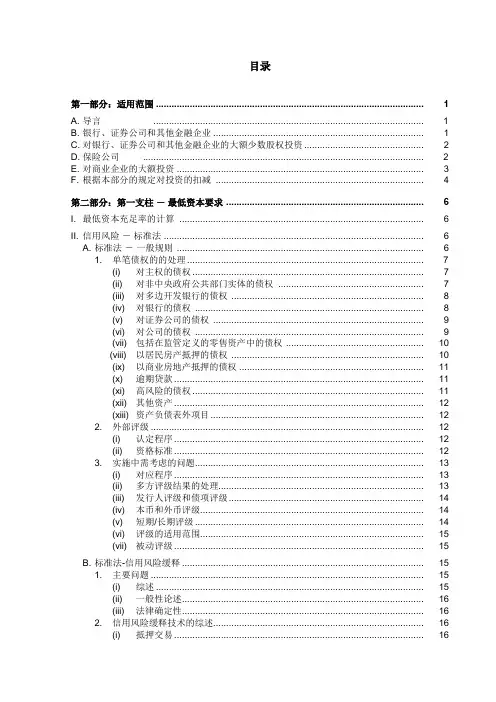
目录第一部分:适用范围 (1)A. 导言 (1)B. 银行、证券公司和其他金融企业 (1)C. 对银行、证券公司和其他金融企业的大额少数股权投资 (2)D. 保险公司 (2)E. 对商业企业的大额投资 (3)F. 根据本部分的规定对投资的扣减 (4)第二部分:第一支柱-最低资本要求 (6)I. 最低资本充足率的计算 (6)II. 信用风险-标准法 (6)A. 标准法-一般规则 (6)1. 单笔债权的的处理 (7)(i) 对主权的债权 (7)(ii) 对非中央政府公共部门实体的债权 (7)(iii) 对多边开发银行的债权 (8)(iv) 对银行的债权 (8)(v) 对证券公司的债权 (9)(vi) 对公司的债权 (9)(vii) 包括在监管定义的零售资产中的债权 (10)(viii) 以居民房产抵押的债权 (10)(ix) 以商业房地产抵押的债权 (11)(x) 逾期贷款 (11)(xi) 高风险的债权 (11)(xii) 其他资产 (12)(xiii) 资产负债表外项目 (12)2. 外部评级 (12)(i) 认定程序 (12)(ii) 资格标准 (12)3. 实施中需考虑的问题 (13)(i) 对应程序 (13)(ii) 多方评级结果的处理 (13)(iii) 发行人评级和债项评级 (14)(iv) 本币和外币评级 (14)(v) 短期/长期评级 (14)(vi) 评级的适用范围 (15)(vii) 被动评级 (15)B. 标准法-信用风险缓释 (15)1. 主要问题 (15)(i) 综述 (15)(ii) 一般性论述 (16)(iii) 法律确定性 (16)2. 信用风险缓释技术的综述 (16)(i) 抵押交易 (16)(ii) 表内净扣 (18)(iii) 担保和衍生工具 (18)(iv) 期限错配 (18)(v) 其他问题 (19)3. 抵押 (19)(i) 合格的金融抵押品 (19)(ii) 综合法 (20)(iii) 简单法 (27)(iv) 抵押的场外衍生工具交易 (27)4. 表内净扣 (28)5. 担保和衍生工具 (28)(i) 操作要求 (28)(ii) 合格的担保人/信用保护提供者的范围 (30)(iii) 风险权重 (30)(iv) 币种错配 (30)(v) 国家担保 (31)6. 期限错配 (31)(i) 期限的定义 (31)(ii) 期限错配的风险权重 (31)7. 与信用风险缓释相关的其他问题的处理 (32)(i) 对信用风险缓释技术库的处理 (32)(ii) 第一违约的信用衍生工具 (32)(iii) 第二违约的信用衍生工具 32 III. 信用风险——IRB法 (32)A. 概述 (32)B. IRB法的具体要求 (32)1. 风险暴露类别 (33)(i) 公司暴露的定义 (33)(ii) 主权暴露的定义 (35)(iii) 银行暴露的定义 (35)(iv) 零售暴露的定义 (35)(v) 合格的循环零售风险暴露的定义 (35)(vi) 股权暴露的定义 (36)(vii) 合格的购入应收帐款的定义 (36)2. 初级法和高级法 (37)(i) 公司、主权和银行暴露 (38)(ii) 零售暴露 (38)(iii) 股权暴露 (39)(iv) 合格的购入应收帐款 (39)3. 在不同资产类别中采用IRB法 (39)4. 过渡期安排 (39)(i) 采用高级法的银行平行计算资本充足率 (40)(ii) 公司、主权、银行和零售暴露 (40)(iii) 股权暴露 (40)C. 公司、主权、及银行暴露的规定 (41)1. 公司、主权和银行暴露的风险加权资产 (41)(i) 风险加权资产的推导公式 (41)(ii) 中小企业的规模调整 (41)(iii) 专业贷款的风险权重 (42)2. 风险要素 (42)(i) 违约概率(PD) (43)(ii) 违约损失率 (LGD) (43)(iii) 违约风险暴露(EAD) (43)(iv) 有效期限(M) (47)D. 零售暴露规定 (48)1. 零售暴露的风险加权资产 (49)(i) 住房抵押贷款 (49)(ii) 合格的循环零售贷款 (49)(iii) 其他零售暴露 (49)2. 风险要素 (50)(i) 违约概率(PD) 和违约损失率 (LGD) (50)(ii) 担保和信贷衍生产品的认定 (50)(iii) 违约风险暴露 (EAD) (50)E. 股权暴露的规则 (50)1. 股权暴露的风险加权资产 (51)(i) 市场法 (51)(ii) 违约概率/违约损失率法 (51)(iii) 不采用市场法和违约概率/违约损失率法的情况 (52)2. 风险要素 (52)F. 购入应收帐款的规则 (53)1. 违约风险的风险加权资产 (53)(i) 购入的零售应收帐款 (53)(ii) 购入的公司应收帐款 (53)2. 稀释风险的风险加权资产 (54)(i) 购入折扣的处理 (54)(ii) 担保的认定 (55)G. 准备的认定 (55)H. IRB法的最低要求 (55)1. 最低要求的内容 (56)2. 遵照最低要求 (56)3. 评级体系设计 (57)(i) 评级维度 (57)(ii) 评级结构 (57)(iii) 评级标准 (58)(iv) 评估的时间 (59)(v) 模型的使用 (60)(vi) 评级体系设计的记录 (60)4. 风险评级体系运作 (60)(i) 评级的涵盖范围 (61)(ii) 评级过程的完整性 (61)(iii) 推翻评级的情况 (61)(iv) 数据维护 (61)(v) 评估资本充足率的压力测试 (62)5. 公司治理和监督 (62)(i) 公司治理 (63)(ii) 信用风险控制 (63)(iii) 内审和外审 (63)6. 内部评级的使用 (64)7. 风险量化 (64)(i) 估值的全面要求 (64)(ii) 违约的定义 (65)(iii) 重新确定帐龄 (66)(iv) 对透支的处理 (66)(v) 所有资产类别损失的的定义 (66)(vi) 估计违约概率的要求 (66)(vii) 自行估计违约损失率的要求 (67)(viii) 自己估计违约风险暴露的要求 (68)(ix) 评估担保和信贷衍生产品效应的最低要求 (69)(x) 估计违约概率、违约损失率(或预期损失)的最低要求......................... . 718. 内部评估的验证 (72)9. 监管当局确定的违约损失率和违约风险暴露 (73)(i) 商用房地产和住宅用房地产作为抵押品资格的定义 (73)(ii) 合格的商用房地产/住宅用房地产的操作要求 (73)(iii) 认定金融应收账款的要求 (74)10. 认定租赁的要求 (76)11. 股权暴露资本要求的计算 (76)(i) 内部模型法下的市场法 (76)(ii) 资本要求和风险量化 (76)(iii) 风险管理过程和控制 (78)(iv) 验证和形成文件 (78)12. 披露要求 (80)IV. 信用风险–资产证券化框架 (80)A. 资产证券化框架下所涉及交易的范围和定义 (80)B. 定义 (80)1. 银行所承担的不同角色 (80)(i) 投资行 (80)(ii) 发起行 (81)2. 通用词汇 (81)(i) 清除式召回 (81)(ii) 信用提高 (81)(iii) 提前摊还 (81)(iv) 超额利差 (81)(v) 隐性支持 (82)(vi) 特别目的机构 (SPE) (82)C. 确认风险转移的操作要求 (82)1. 传统型资产证券化的操作要求 (82)2. 合成型资产证券化的操作要求 (83)3. 清除式召回的操作要求和处理 (83)D. 对资产证券化风险暴露的处理 (84)1. 最低资本要求 (84)(i) 扣减 (84)(ii) 隐性支持 (84)2. 使用外部信用评估的操作要求 (84)3. 资产证券化风险暴露的标准化方法 (85)(i) 范围 (85)(ii) 风险权重 (85)(iii) 未评级资产证券化风险暴露一般处理方法的例外情况 (86)(iv) 表外风险资产的信用转换系数 (86)(v) 信用风险缓释的确认 (87)(vi) 提前摊还规定的资本要求 (88)(vii) 具有控制型提前摊还特征的信用转换系数的确定 (89)(viii) 对于非控制型具有提前摊还特征的风险暴露的信用风险转换系数的确定. 904. 资产证券化的内部评级法 (91)(i) 范围 (91)(ii) K IRB的定义 (92)(iii) 各种不同的方法 (92)(iv) 所需资本最高限 (93)(v) 以评级为基础的方法 (RBA) (93)(vi) 监管公式 (SF) (95)(vii) 流动性便利 (97)(viii) 合格服务人现金透支便利 (98)(ix) 信用风险缓释的确认 (98)(x) 提前摊还的资本要求 (98)V. 操作风险 (98)A. 操作风险定义 (98)B. 计量方法 (98)1. 基本指标法 (99)2. 标准法 (99)3. 高级计量法 (AMA) (100)C. 资格标准 (101)1. 一般标准 (101)2. 标准法 (101)3. 高级计量法 (102)(i) 定性标准 (102)(ii) 定量标准 (102)(iii) 风险缓释 (105)D. 局部使用 (106)VI. 交易账户 (106)A. 交易账户定义 (106)B. 审慎评估标准 (107)1. 评估系统和控制手段 (107)2. 评估方法 (107)(i) 按照市场价格计值 (107)(ii) 按照模型计值 (108)(iii) 价格独立验证 (108)3. 计值调整,又称储备 (108)C. 交易账户对手方信用风险的处理 (109)D. 标准法对交易账户特定风险资本要求的处理 (109)1. 政府债券的特定风险资本要求 (110)2. 对未评级债券特定风险的处理原则 (110)3. 采用信用衍生工具套做保值头寸的专项资本要求 (110)4. 信用衍生工具的附加系数 (111)Part 3: 第二支柱——监督检查 (113)A. 监督检查的重要性 (113)B. 监督检查的四项主要原则 (113)C. 监督检查的具体问题 (119)D. 监督检查的其他问题 (124)Part 4: 第三支柱——市场纪律 (126)A. 总体考虑 (126)1. 披露要求 (126)2. 指导原则 (126)3. 恰当的披露 (126)4. 与会计披露的相互关系 (126)5. 重要性 (127)6. 频率 (127)7. 内部和保密信息 (127)B. 披露要求 (128)1. 总体披露原则 (128)2. 使用范围 (128)3. 资本 (129)4. 风险暴露和评估 (130)(i) 定性披露的总体要求 (130)(ii) 信用风险 (131)(iii) 市场风险 (136)(iv) 操作风险 (137)(v) 银行账户的利率风险 (137)附录 1 创新工具在一级资本中的上线为15% (138)附录2 标准法-实施对应程序 (139)附录 3 IRB 法风险权重的实例 (143)附录4 监管当局对专业贷款设定的标准 (145)附录5 例子:按照监管公式计算信用风险缓释的影响 (159)附录6 产品线对应表 (163)附录7 损失事件分类详表 (165)附录8 按照标准法和内部评级法的规定,计算金融抵押品担保交易的资本要求的方法概述 (168)附录9 简化的标准法 (170)。
巴塞尔资本协议中英文完整版(04缩写词(英文))
The New Basel Capital AccordLatest news29 April 2003The Basel Committee on Banking Supervision has issued a third consultative paper on the New Basel Capital Accord.Comments are due by 31 July 2003, and will be helpful to the Committee as it makes the final modifications to its proposal for a new capital adequacy framework. The goal of the Committee continues to be to complete the New Accord by the fourth quarter of this year, with implementation to take effect in member countries by year-end 2006. To that end, work already has begun in a number of countries on draft rules that would integrate Basel capital standards with national capital regimes.An overview paper accompanies the third consultative document. This paper provides a summary of the new capital adequacy framework. It also outlines changes to the proposal since the release in October 2002 of the QIS 3 Technical Guidance, which banks used to assess the impact of the New Accord on their portfolios. The Committee issued the results of the QIS 3 impact study on 5 May 2003.Read the documents from the Third Consultative Paper, April 2003Read the documents from the Second Consultative Paper, January 2001BackgroundIn January 2001 the Basel Committee on Banking Supervision issued a proposal for a New Basel Capital Accord that, once finalised, will replace the current 1988 Capital Accord. The proposal is based on three mutually reinforcing pillars that allow banks and supervisors to evaluate properly the various risks that banks face. The New Basel Capital Accord focuses on:minimum capital requirements, which seek to refine the measurement framework set out in the 1988 Accordsupervisory review of an institution's capital adequacy and internal assessment processmarket discipline through effective disclosure to encourage safe and sound banking practicesThe Basel Committee received more than 250 comments on its January 2001 proposals. In April 2001 the Committee initiated a Quantitative Impact Study (QIS) of banks to gather the data necessary to allow the Committee to gauge the impact of the proposals for capital requirements. A further study, QIS 2.5, was undertaken in November 2001 to gain industry feedback about potential modifications to the Committee's proposals.In December 2001 the Basel Committee announced a revised approach to finalising the New Basel Capital Accord and the establishment of an Accord Implementation Group. Previously, in June2001 the Committee released an update on its progress and highlighted several important ways in which it had agreed to modify some of its earlier proposals based, in part, on industry comments.During its 10 July 2002 meeting, members of the Basel Committee reached agreement on a number of important issues related to the New Basel Capital Accord that the Committee has been exploring since releasing its January 2001 consultative paper.The New Basel Capital AccordPlease note that full translations into French, German, Italian and Spanish will be available soon.Third Consultative Paper29 April 2003The Basel Committee on Banking Supervision has issued a third consultative paper on the New Basel Capital Accord.Comments are due by 31 July 2003, and will be helpful to the Committee as it makes the final modifications to its proposal for a new capital adequacy framework. The goal of the Committee continues to be to complete the New Accord by the fourth quarter of this year, with implementation to take effect in member countries by year-end 2006. To that end, work already has begun in a number of countries on draft rules that would integrate Basel capital standards with national capital regimes.An overview paper accompanies the third consultative document. This paper provides a summary of the new capital adequacy framework. It also outlines changes to the proposal since the release in October 2002 of the QIS 3 Technical Guidance, which banks used to assess the impact of the New Accord on their portfolios. The Committee issued the results of the QIS 3 impact study on 5 May 2003.DocumentsOverview of The New Basel Capital Accord (PDF, 18 pages, 103 kb)The New Basel Capital Accord by section:Scope of Application (PDF, 15 pages, 70 kb)Pillar One (PDF, 132 pages, 732 kb)Pillar Two (PDF, 16 pages, 88 kb)Pillar Three (PDF, 15 pages, 82 kb)Annexes (PDF, 48 pages, 220 kb)Press release (April 2003)The 1988 Capital AccordQuantitative Impact Study (QIS)Basel II ChronologyFull document (PDF, 1176 kb)Print-friendly version© Please see disclaimer and copyright informationBIS Home > Basel Committee > The New Basel Capital Accord > Third Consultative Paper。
《巴塞尔协议》相关概念
相关概念:1、资本充足率:资本充足率(CAR)是指资本总额与加权风险资产总额的比例(CAR=资产/风险)。
资本充足率反映商业银行在存款人和债权人的资产遭到损失之前,该银行能以自有资本承担损失的程度。
规定该项指标的目的在于抑制风险资产的过度膨胀,保护存款人和其他债权人的利益、保证银行等金融机构正常运营和发展。
作为国际银行监督管理基础的《巴塞尔协议》规定,资本充足率以资本对风险加权资产的比率来衡量,其目标标准比率为8%。
(我国商业银行:资本充足率=(资本—扣除项)/(风险加权资产+12.5倍的市场风险资本))2、核心资本充足率:核心资本又叫一级资本和产权资本,包括权益性资本和公开储备,其中权益性资本包括已发行并已缴足的普通股和非累计优先股,对银行的盈利水平和竞争力影响极大。
核心资本充足率是指核心资本与加权风险资产总额的比率(参考值>=4%)。
(我国商业银行:资本充足率=(资本—扣除项)/(风险加权资产+12.5倍的市场风险资本))3、风险加权系数:风险加权资产(又称风险加权系数)是指对银行的资产加以分类,根据不同类别资产的风险性质确定不同的风险系数,以这种风险系数为权重求得的资产。
银行业的总资产有很多资产是0风险权重的,有很多风险权重则很高。
这个要看每个银行的资产负债结构的配置,一般来说风险权重高的收益也更高。
(风险加权资产总额= 资产负债表内资产×风险权数+ 资产负债表外资产×转换系数×风险加权数)4、拨备率:拨备率实际上就是呆、坏账准备金的提取比率。
(我国:9%)此项比率越低越好,说明反应损失较小利润较高;比率越高说明风险越大,损失越大利润越小。
5、杠杆率:杠杆率一般是指资产负债表中总资产与权益资本的比率。
高杠杆率意味着在经济繁荣阶段,金融机构能够获得较高的权益收益率,但当市场发生逆转时,将会面临收益大幅下降的风险。
商业银行、投资银行等金融机构一般都采取杠杆经营模式。
第三版巴塞尔协议名词解释
第三版巴塞尔协议有关名词解释(2011-05-05 12:41:20)转载分类:银行股标签:杂谈银监会《指导意见》要求核心一级资本充足率、一级资本充足率和资本充足率分别不低于5%、6%和8%;并计提2.5%的留存超额资本要求和0-2.5%的逆周期超额资本;将系统重要性银行的附加资本要求,暂定为1%。
新标准实施后,正常条件下系统重要性银行和非系统重要性银行的资本充足率分别不低于11.5%和10.5%。
与旧规区别:银监会《指导意见》将监管资本从现行的两级分类(一级资本和二级资本)修改为三级分类,即核心一级资本、其他一级资本和二级资本。
1、核心一级资本指普通股,巴三规定不低于4.5%,我国银监会新规比巴三的规定高0.5个百分点,为5%。
2、一级资本指核心一级资本+其他一级资本。
其他一级资本的引入为新型资本工具的使用预留了空间,有助于降低未来普通股融资压力。
目前中国实质上并不存在其他一级资本,但该概念的引入,为未来新型资本工具(如优先股、有条件可转换债券(CoCos)等)的发行预留了空间,一旦此类新型资本工具成功发行,将有助于降低未来普通股融资压力。
我国规定为6%。
3、资本充足率指一级资本加附属资本。
包括非公开储备、重估储备、一般贷款损失准备、混合债务资本工具、中长期次级债务等。
4、资本留存缓冲巴三引入了2.5%的资本留存缓冲(Capital Conservation Buffer),由扣除递延税项及其他项目后的普通股权益组成。
这一留存缓冲的目的在于确保银行持有缓冲资金用于在金融和经济危机时期“吸收”损失。
尽管银行在危机期间可以利用这一缓冲,但资本比率越是接近最低要求,受到的限制也会越大。
一旦银行的资本留存缓冲比率达不到该要求,监管机构将限制银行拍卖、回购股份和分发红利等。
这一机制可以有效制止本次金融危机期间一些大银行在资本头寸恶化时也肆意发放奖金和高红利的情况。
该规定将于2016年1月起适用,并于2019年1月开始生效。
最新巴塞尔协议三中英对照
Group of Governors and Heads of Supervision announces higher global minimum capital standards12 September 2010At its 12 September 2010 meeting, the Group of Governors and Heads of Supervision, the oversight body of the Basel Committee on Banking Supervision, announced a substantial strengthening of existing capital requirements and fully endorsed the agreements it reached on 26 July 2010. These capital reforms, together with the introduction of a global liquidity standard, deliver on the core of the global financial reform agenda and will be presented to the Seoul G20 Leaders summit in November.The Committee's package of reforms will increase the minimum common equity requirement from 2% to 4.5%. In addition, banks will be required to hold a capital conservation buffer of 2.5% to withstand future periods of stress bringing the total common equity requirements to 7%. This reinforces the stronger definition of capital agreed by Governors and Heads of Supervision in July and the higher capital requirements for trading, derivative and securitisation activities to be introduced at the end of 2011.Mr Jean-Claude Trichet, President of the European Central Bank and Chairman of the Group of Governors and Heads of Supervision, said that "the agreements reached today are a fundamental strengthening of global capital standards." He added that "their contribution to long term financial stability and growth will be substantial. The transition arrangements will enable banks to meet the new standards while supporting the economic recovery." Mr Nout Wellink, Chairman of the Basel Committee on Banking Supervision and President of the Netherlands Bank, added that "the combination of a much stronger definition of capital, higher minimum requirements and the introduction of new capital buffers will ensure that banks are better able to withstand periods of economic and financial stress, therefore supporting economic growth."Increased capital requirementsUnder the agreements reached today, the minimum requirement for common equity, the highest form of loss absorbing capital, will be raised from the current 2% level, before the application of regulatory adjustments, to 4.5% after the application of stricter adjustments. This will be phased in by 1 January 2015. The Tier 1 capital requirement, which includes common equity and other qualifying financial instruments based on stricter criteria, will increase from 4% to 6% over the same period. (Annex 1 summarises the new capital requirements.)The Group of Governors and Heads of Supervision also agreed that the capital conservation buffer above the regulatory minimum requirement be calibrated at 2.5% and be met with common equity, after the application of deductions. The purpose of the conservation buffer is to ensure that banks maintain a buffer of capital that can be used to absorb losses during periods of financial and economic stress. While banks are allowed to draw on the buffer during such periods of stress, the closer their regulatory capital ratios approach the minimum requirement, the greater the constraints on earnings distributions. This framework will reinforce the objective of sound supervision and bank governance and address the collective action problem that has prevented some banks from curtailing distributions such as discretionary bonuses and high dividends, even in the face of deteriorating capital positions.A countercyclical buffer within a range of 0% - 2.5% of common equity or other fully loss absorbing capital will be implemented according to national circumstances. The purpose of the countercyclical buffer is to achieve the broader macroprudential goal of protecting the banking sector from periods of excess aggregate credit growth. For any given country, this buffer will only be in effect when there is excess credit growth that is resulting in a system wide build up of risk. The countercyclical buffer, when in effect, would be introduced as an extension of the conservation buffer range.These capital requirements are supplemented by a non-risk-based leverage ratio that will serve as a backstop to the risk-based measures described above. In July, Governors and Heads of Supervision agreed to test a minimum Tier 1 leverage ratio of 3% during the parallel run period. Based on the results of the parallel run period, any final adjustments would be carried out in the first half of 2017 with a view to migrating to a Pillar 1 treatment on 1 January 2018 based on appropriate review and calibration.Systemically important banks should have loss absorbing capacity beyond the standards announced today and work continues on this issue in the Financial Stability Board and relevant Basel Committee work streams. The Basel Committee and the FSB are developing a well integrated approach to systemically important financial institutions which could include combinations of capital surcharges, contingent capital and bail-in debt. In addition, work is continuing to strengthen resolution regimes. The Basel Committee also recently issued a consultative document Proposal to ensure the loss absorbency of regulatory capital at the point of non-viability. Governors and Heads of Supervision endorse the aim to strengthen the loss absorbency of non-common Tier 1 and Tier 2 capital instruments.Transition arrangementsSince the onset of the crisis, banks have already undertaken substantial efforts to raise their capital levels. However, preliminary results of the Committee's comprehensive quantitative impact study show that as of the end of 2009, large banks will need, in the aggregate, a significant amount of additional capital to meet these new requirements. Smaller banks, which are particularly important for lending to the SME sector, for the most part already meet these higher standards.The Governors and Heads of Supervision also agreed on transitional arrangements for implementing the new standards. These will help ensure that the banking sector can meet the higher capital standards through reasonable earnings retention and capital raising, while still supporting lending to the economy. The transitional arrangements, which are summarised in Annex 2, include:National implementation by member countries will begin on 1 January 2013. Member countries must translate the rules into national laws and regulations before this date. As of 1 January 2013, banks will be required to meet the following new minimum requirements in relation to risk-weighted assets (RW As):3.5% common equity/RW As;4.5% Tier 1 capital/RW As, and8.0% total capital/RW As.The minimum common equity and Tier 1 requirements will be phased in between 1 January 2013 and 1 January 2015. On 1 January 2013, the minimum common equity requirement will rise from the current 2% level to 3.5%. The Tier 1 capital requirement will rise from4% to 4.5%. On 1 January 2014, banks will have to meet a 4% minimum common equity requirement and a Tier 1 requirement of 5.5%. On 1 January 2015, banks will have to meet the 4.5% common equity and the 6% Tier 1 requirements. The total capital requirement remains at the existing level of 8.0% and so does not need to be phased in. The difference between the total capital requirement of 8.0% and the Tier 1 requirement can be met with Tier 2 and higher forms of capital.The regulatory adjustments (ie deductions and prudential filters), including amounts above the aggregate 15% limit for investments in financial institutions, mortgage servicing rights, and deferred tax assets from timing differences, would be fully deducted from common equity by 1 January 2018.In particular, the regulatory adjustments will begin at 20% of the required deductions from common equity on 1 January 2014, 40% on 1 January 2015, 60% on 1 January 2016, 80% on 1 January 2017, and reach 100% on 1 January 2018. During this transition period, the remainder not deducted from common equity will continue to be subject to existing national treatments.The capital conservation buffer will be phased in between 1 January 2016 and year end 2018 becoming fully effective on 1 January 2019. It will begin at 0.625% of RW As on 1 January 2016 and increase each subsequent year by an additional 0.625 percentage points, to reach its final level of 2.5% of RWAs on 1 January 2019. Countries that experience excessive credit growth should consider accelerating the build up of the capital conservation buffer and the countercyclical buffer. National authorities have the discretion to impose shorter transition periods and should do so where appropriate.Banks that already meet the minimum ratio requirement during the transition period but remain below the 7% common equity target (minimum plus conservation buffer) should maintain prudent earnings retention policies with a view to meeting the conservation buffer as soon as reasonably possible.Existing public sector capital injections will be grandfathered until 1 January 2018. Capital instruments that no longer qualify as non-common equity Tier 1 capital or Tier 2 capital will be phased out over a 10 year horizon beginning 1 January 2013. Fixing the base at the nominal amount of such instruments outstanding on 1 January 2013, their recognition will be capped at 90% from 1 January 2013, with the cap reducing by 10 percentage points in each subsequent year. In addition, instruments with an incentive to be redeemed will be phased out at their effective maturity date.Capital instruments that no longer qualify as common equity Tier 1 will be excluded from common equity Tier 1 as of 1 January 2013. However, instruments meeting the following three conditions will be phased out over the same horizon described in the previous bullet point: (1) they are issued by a non-joint stock company 1 ; (2) they are treated as equity under the prevailing accounting standards; and (3) they receive unlimited recognition as part of Tier 1 capital under current national banking law.Only those instruments issued before the date of this press release should qualify for the above transition arrangements.Phase-in arrangements for the leverage ratio were announced in the 26 July 2010 press release of the Group of Governors and Heads of Supervision. That is, the supervisory monitoring period will commence 1 January 2011; the parallel run period will commence 1January 2013 and run until 1 January 2017; and disclosure of the leverage ratio and its components will start 1 January 2015. Based on the results of the parallel run period, any final adjustments will be carried out in the first half of 2017 with a view to migrating to a Pillar 1 treatment on 1 January 2018 based on appropriate review and calibration.After an observation period beginning in 2011, the liquidity coverage ratio (LCR) will be introduced on 1 January 2015. The revised net stable funding ratio (NSFR) will move to a minimum standard by 1 January 2018. The Committee will put in place rigorous reporting processes to monitor the ratios during the transition period and will continue to review the implications of these standards for financial markets, credit extension and economic growth, addressing unintended consequences as necessary.The Basel Committee on Banking Supervision provides a forum for regular cooperation on banking supervisory matters. It seeks to promote and strengthen supervisory and risk management practices globally. The Committee comprises representatives from Argentina, Australia, Belgium, Brazil, Canada, China, France, Germany, Hong Kong SAR, India, Indonesia, Italy, Japan, Korea, Luxembourg, Mexico, the Netherlands, Russia, Saudi Arabia, Singapore, South Africa, Spain, Sweden, Switzerland, Turkey, the United Kingdom and the United States.The Group of Central Bank Governors and Heads of Supervision is the governing body of the Basel Committee and is comprised of central bank governors and (non-central bank) heads of supervision from member countries. The Committee's Secretariat is based at the Bank for International Settlements in Basel, Switzerland.Annex 1: Calibration of the Capital Framework (PDF 1 page, 19 kb)Annex 2: Phase-in arrangements (PDF 1 page, 27 kb)Full press release (PDF 7 pages, 56 kb)--------------------------------------------------------------------------------1 Non-joint stock companies were not addressed in the Basel Committee's 1998 agreement on instruments eligible for inclusion in Tier 1 capital as they do not issue voting common shares.最新巴塞尔协议3全文央行行长和监管当局负责人集团1宣布较高的全球最低资本标准国际银行资本监管改革是本轮金融危机以来全球金融监管改革的重要组成部分。