
三年级下册英语教案Module 6 Unit 1 What do you do on Sundays 外研社(三起)
Module 6 Unit 1 What do you do on Sundays? 教学设计
科目版本小学英语(三年级起点)外研版三年级下册
章节Module 6
课名Module 6 Unit 1 What do you do on Sundays?
学习目标 1. 能够听懂、会说并运用:do,Sunday,go swimming,ride a bike,eat,sleep,watch TV描述周末的活动安排。
2. 能够用“What do you do …?” 询问活动安排,并能正确回答。
重难点能够听懂、会说并运用:do,Sunday,go swimming,ride a bike,eat,sleep,watch TV描述周末的活动安排
教学环节/步骤学生活动教师活动设计意图
一、热身导入1.学生跟着录音歌唱
Module 5中呈现的韵
句。
2.学生观看动画,回答问
题。
1.[Let’s chant: Go to school]
教师组织学生说唱韵文“Go to school”,复习第五
模块的内容。
“同学们大家好,欢迎回到英语课堂。
Let’s chant
Go to school and answer: What do Mum and Dad
do on Mondays?首先,我们来跟着唱一唱Go to
school,告诉老师:妈妈爸爸周一通常做什么?”
复习第五模块所学习的
韵句,并导入新课。
学生在录音的辅助下分
角色复述对话。
1
师生分角色为该对话配
音。
(1) What do Mum and Dad do on Mondays?
(1) They go to work on Mondays.
原来,通常爸爸妈妈周一会去上班。
同学们你们回答对了
吗?
(2) What does my sister do on Mondays?
2
(2)My sister also goes to school on Mondays.
通常我的妹妹周一也去上学。
你们回答对了吗?
2.[Listen, point and say]
教师组织学生观看动画:“同学们掌握得真棒!
Let’s watch a video. What does the dog do on
Mondays? What activities can you hear?
好奇的小猫很想知道小狗周一会做什么呢?请
同学们认真看动画,然后用英文告诉可爱的小猫
3
吧!
原来,小狗每周一都会吃肉(eat meat),你们回答对了吗?
教师总结对话中出现的go swimming, ride a bike, eat meat, 并让学生重复。
教师引导学生为对话配音:“I am the cat. Who would like to be the dog? Now let’s role-play.”
二、新知呈现1. 学生带着问题观看动画,
并回答问题。
2. 学生根据问句和图片补
全对话。
1. Listen, point and find “What do you do…?”
Sam and Dalin are talking. Watch and listen.
教师组织学生带着问题观看动画:“同学们听录
音并告诉老师What does Sam do on Sundays?
What does Dalin do on Sundays?”
引导学生呈现情境,观看
Activity 2 中的动画,回
答相关问题。
4
学生在图片的帮助下,学习动词及词组。
3.学生跟读并分角色表演课文。
2. Let’s answer.
“你能将空缺的词补全吗?我们一起来试一试。
Look at the dialogue. Some words are missing. Can
you fill in the gaps?”
教师引导学生观看图片中的动作,教师分别扮演
Dalin以及Sam,要求学生根据问句和图片猜出
所缺的单词和词组。
同时,教师出示相关图片,引导学生学习该对话
中的动词及词组。
“Let’s learn the activities and do
the actions. 我们一起来学习这些活动并跟着做
做动作吧!”
学生复习对话中的五组有关活动的单词及短语。
教师做动作,学生迅速说出该英文词组。
3. Repeat and role-play.
教师播放幻灯片,学生跟读对话。
两名同学分角
色表演课文。
通过图片的帮助,学生回
忆对话中出现的活动。
教师教授对话中出现的
动词和词组,学生跟读并
记忆。
该环节提高学生听、说以
及表演的能力。
5
三、分步训练1.一名学生按PPT提示试
着问问题。
2. 两名学生示范同伴合作,
练习对话。
1.教师带领学生练习对话。
“Now let’s play a game. Who can ask the question?
Who would like to do pair-work?”
2.教师引导两名学生在幻灯片的提示下,练习问答日
常活动安排。
然后全体学生练习问答。
检验学生的认读能力。
操练“What do you
do…?”,并巩固本课的教
学重点。
四、初步应用1.小组内互相采访其他成
员,完成表格。
最后选一名
代表向全班汇报组内情况。
2.学生跟随教师朗读。
1. Let’s do.
教师在PPT上展示Questionnaire。
“现在一起调查一
下你的同学在周末通常做些什么?Let’s ask and
answer, and finish the table.”
教师发给每名学生一张调查表,学生用本课所学对
话,互相问答,完成调查表。
完成后,两名同学向
全班展示对话。
2.Let’s review
教师引导学生复习如何询问和回答周末的安排。
学生尝试将该对话应用
于模拟的生活情境中,以
便在未来实际生活中灵
活运用该对话。
作业布置今天我们学会了如何询问和回答周末的安排,大家
都学会了吗?课后别忘了用英文说一说你的周末安
排。
布置作业,鼓励学生课后
巩固复习。
进步标志1.能说出五种活动:sleep, eat, go swimming, ride a bike, and watch TV.
2.学生能够正确运用英文询问和回答周末的活动安排。
6。
三年级英语下册教案-Module 6 Unit 1 What do you do on Sunday

三年级英语下册教案-Module 6 Unit 1 What do you do onSundays (1)-外研版(三起)教学目标1.能听、说、读、写本单元的四会单词及句型;2.通过听、说训练,使学生能够掌握本单元中的日常活动;3.通过读、写训练,使学生能够用英语写出关于自己和别人在周末的日常活动。
教学重难点1.四会单词和句型;2.能够熟练地表达出自己和别人在周末所做的日常活动。
教学内容一、词汇1.read2.watch TV3.play computer games4.listen to music5.draw pictures6.ride a bike7.play basketball8.chat with friends9.visit grandparents10.go shopping二、句型1.What do you do on Sundays?2.I read books on Sundays.3.What does he/she do on Sundays?4.He/She watches TV on Sundays.教学过程一、听说训练1.让学生听老师读出各个单词,并跟读;2.让学生模仿老师的音调和语速,练习句型;3.在课堂上进行角色扮演练习,让学生用英语问别人周末都做什么,以及回答自己周末都做什么;4.通过故事、歌曲等方式激发学生的学习兴趣。
二、读写训练1.让学生听老师读出句子,并跟读;2.让学生自己写出和自己在周末相关的日常活动;3.通过小组合作,让学生互相交流自己的日常活动,并互相评价。
课后作业1.让学生练习在家用英语描述自己和别人在周末所做的日常活动;2.让学生收集与周末相关的英语单词和句子,以及和周末相关的图片,并制作成英语透视图或小报告;3.让学生准备一些与周末相关的英语游戏或小活动,以便下节课使用。
总结通过本课的学习,学生能够掌握本单元所教授的四会单词和句型,并熟练地表达出自己和别人在周末所做的日常活动。
外研版(三起)-英语-三年级下册--Module 6 Unit 1 What do you do on Sundays- 教案
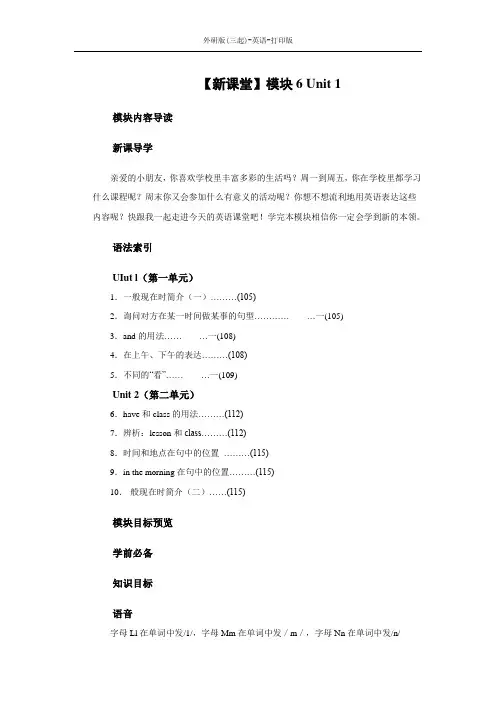
【新课堂】模块6 Unit 1模块内容导读新课导学亲爱的小朋友,你喜欢学校里丰富多彩的生活吗?周一到周五,你在学校里都学习什么课程呢?周末你又会参加什么有意义的活动呢?你想不想流利地用英语表达这些内容呢?快跟我一起走进今天的英语课堂吧!学完本模块相信你一定会学到新的本领。
语法索引UIut l(第一单元)1.一般现在时简介(一) (105)2.询问对方在某一时间做某事的句型………… …一(105)3.and的用法…… …一(108)4.在上午、下午的表达 (108)5.不同的“看”…… …一(109)Unit 2(第二单元)6.have和class的用法 (112)7.辨析:lesson和class (112)8.时间和地点在句中的位置 (115)9.in the morning在句中的位置 (115)10.-般现在时简介(二) (115)模块目标预览学前必备知识目标语音字母Ll在单词中发/1/,字母Mm在单词中发/m/,字母Nn在单词中发/n/词汇同学们,下列词汇要求你们能听懂、会说、会读,会写,你们能做到吗?单词do(做),Sunday(周日),eat(吃),in(在……期间),watch(观看),have(上……课),class(课),Chinese(语文,汉语),Maths<数学),Science(科学),sleep(睡觉),today (今天),Music(音乐),Art(美术),PE(体育)短语at school(在学校),on Sundays(在周日),play football(踢足球),play basketball (打球),watch TV(看电视),in the morning(在早上),in the afternoon(在下午) 知识目标同学们,下列词汇要求你们能听懂、会说、会读,你们能做到吗?单词timetable(时间表),pupil(小学生)短语make a timetable(制作时间表)句型同学们,下列句型要求你们能听懂、会说、会读,会写,你们能做到吗?1.询问对方或他人在学校上什么课并回答。
外研版(三起)-英语-三年级下册-Module 6 Unit 2 What does Lingling have at school.教案
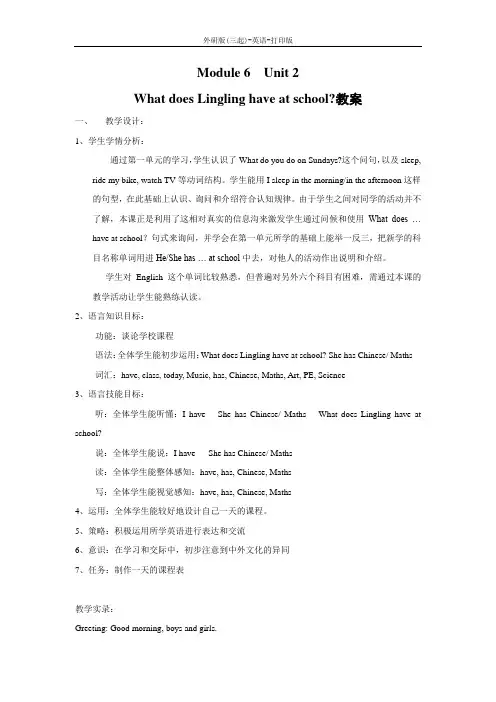
Module 6 Unit 2What does Lingling have at school?教案一、教学设计:1、学生学情分析:通过第一单元的学习,学生认识了What do you do on Sundays?这个问句,以及sleep, ride my bike, watch TV等动词结构。
学生能用I sleep in the morning/in the afternoon这样的句型,在此基础上认识、询问和介绍符合认知规律。
由于学生之间对同学的活动并不了解,本课正是利用了这相对真实的信息沟来激发学生通过问候和使用What does …have at school?句式来询问,并学会在第一单元所学的基础上能举一反三,把新学的科目名称单词用进He/She has … at school中去,对他人的活动作出说明和介绍。
学生对English这个单词比较熟悉,但普遍对另外六个科目有困难,需通过本课的教学活动让学生能熟练认读。
2、语言知识目标:功能:谈论学校课程语法:全体学生能初步运用:What does Lingling have at school? She has Chinese/ Maths--- 词汇:have, class, today, Music, has, Chinese, Maths, Art, PE, Science3、语言技能目标:听:全体学生能听懂:I have--- She has Chinese/ Maths--- What does Lingling have at school?说:全体学生能说:I have --- She has Chinese/ Maths---读:全体学生能整体感知:have, has, Chinese, Maths写:全体学生能视觉感知:have, has, Chinese, Maths4、运用:全体学生能较好地设计自己一天的课程。
5、策略:积极运用所学英语进行表达和交流6、意识:在学习和交际中,初步注意到中外文化的异同7、任务:制作一天的课程表教学实录:Greeting: Good morning, boys and girls.Lead-in:Show the hand-toy.Hi, I’m Martin. Hello boy! Hello girl! Hello everyone!I go swimming on Sundays. And I want to know what you do on Sundays, OK?Ask and answer with the drawings.What do you do on Sundays? (I play football.)What do you do on Sundays? (I play basketball.)What do you do on Sundays? (I go swimming.)What do you do on Sundays? (I ride my bike on Sundays.)Draw four pictures about the sports. Each one represents a goup, and the best group will get the beautiful signs.But for us pupils , the most important thing is to have classes.Words:板书:have 上(课)、class 课.Read after Martin: have class have class. One class, two classes( Write ‘es’with different colour), you know? Good.So what do you do at school? ( I have classes.)Activity 1:This is cat Mimi, and this is dog Wangwang. They are good friends. Let’s see what happened to them.播放视频。
初中英语《Module 6 Unit 1 Do you collect anything》优质课教案、教学设计

Module 6 HobbiesUnit 1 Do you collect anything?教学目标:1.Be able to remember the new words and phrases, such as stamp, tidy up.2.Be able to understand the listening materials .Talk about hobbies with your group members fluently.3.Develop healthy hobbies, and stay away from bad ones.教学重难点:Talk about your hobbies and other people’s hobbies in your own words.教学过程:Step 1 Pre-listening1.Read the new words following the tape.2.Free talk ”What’s your hobby?” “Do you collect anything?” 引导学生讨论自己的兴趣爱好,人人都能迅速投入到英语学习中来。
3.通过图片学习新单词,并为第一部分的听力做好铺垫。
Step2 While-listening小听力isten to the tape and complete the chart.(听前浏览图片,明确听力目标。
)2.Listen again and choose the correct answer.1)What does Tony’s mum want him to do?A tidy up his roomB put his things on the shelf2)Which hobby does Tony think is expensive?A collecting stampsB collecting toys3)Which hobby do you think takes up the most space?A collecting toy carsB collecting stamps(将活动二的问题以选择题形式出现,降低听力难度,为学生增加信心。
(完整版)三年级下册英语课件-Module6UnitWhatdoyoudoonSundays∣外研版
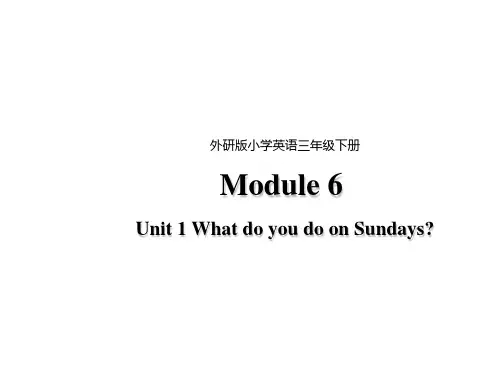
Listen, fill and say.
What do you do on Sundays?
What do you do in the afternoon?
I _ri_d_e_m__y__b_ik_e on Sundays. I _w_a_t_c_h_T__V_in
the afternoon.
Fill, ask and answer.
三、选择题 1. -- ___C_____?
--I watch TV. A. How are you B. Do you watch TV C. What do you do 2. --Do you go to school on Monday? --___C____. A. No, I do B. OK C. No, I don’t 3. She __B___ TV in the morning. A. watch B. watches C. watchs
Summary
1. 单词: do Sunday swimming go swimming eat in sleep watch TV 2. 句子:
--What do you do on Sundays? --I watch TV/…
Homework
1. Read the new words. 2. Listen and imitate “Unit 1”.
Let’s learn.
--What do you do in the morning?
--I eat eggs.
do 做,干
in 在……期间
eat 吃
ቤተ መጻሕፍቲ ባይዱ
Let’s learn.
--What do you do on Sundays? --I go swimming.
Module 6 Unit1 What do you do on Sundays?(教案)外研版(三

Module 6 Unit1 What do you do on Sundays?教学目标1.掌握词汇:read, draw, swim, play football, watch TV;2.能够表达周日的活动。
教学重点能够表达周日的活动。
教学难点写作:What do you do on Sundays?教学准备PPT课件,学生学习笔记本。
教学过程Lead-in1.对话:T:Hello, boys and girls. What day is it today? S1:Today is Sunday. T:Very good. What do you do on Sundays? S2:I read books on Sundays. T:Great. And what about you? S3:I watch TV on Sundays. T:OK. Today we are going to talk about what we do on Sundays.Presentation1.第一步,学习新词汇:read, draw, swim, play football, watch TV。
–T:Please look at the screen. We have five new words here. Can you read them with me?–T:read Ss:read T:draw Ss:draw T:swim Ss:swim T:playfootball Ss:play football T:watch TV Ss:watch TV2.第二步,帮助学生理解词汇。
–T:Let’s look at the pictures on the screen. What can you see in the first picture? Ss:A boy is reading a book. T:Very good. So what does read mean? Ss:It means to look at and understand words and letters. T:Yes. What about the second picture? Ss:A girl is drawing a picture. T:Excellent. What does draw mean? Ss:It means to make a picture with a pen or pencil. T:OK. Let’s go on. Do you know what swim means? Ss:Yes, it means to move through water using your arms and legs. T:Perfect. Anddo you know what play football means? Ss:Yes, it means to play a game where you kick a ball. T:Good job. And what does watch TV mean? Ss:It means to look at a TV screen and see what is happening. T:You all have learned the new words very well.3.第三步,问学生他们在周日都做些什么事情。
三年级下册英语教学设计 Module 6 What do you do on Sundays.教学设
三年级下册英语教学设计 Module 6 What do you do on Sundays.教学设计一、教学内容本教学设计基于外研社(三起)三年级下册英语课本 Module 6 What do you do on Sundays.二、教学目标1.学生能够掌握新词汇:do yoga, skateboarding, visit grandparents, watch TV, play computer games, read books2.学生能够掌握句型:What do you do on Sundays? I do yoga.3.学生能够运用所学词汇和句型描述周日的活动。
4.学生能够在交流中表达自己和他人的爱好和兴趣。
三、教学重点1.掌握新词汇和句型。
2.通过图片和视频帮助学生理解和掌握词汇和句型。
四、教学难点1.如何帮助学生在交流中自如运用所学句型和词汇。
2.如何培养学生口语表达能力。
五、教学准备1.多媒体教学设备(电脑、投影仪等)2. 课件3. 班级小游戏等(以帮助学生运用所学知识为基础)六、教学过程1. Warm-up•T: Good morning, boys and girls. How are you today?•S: Good morning, teacher. We’re fine, thank you.•T: What day is it today?•S: Today is Sunday.•T: Great! Today is Sunday. What do you usually do on Sundays?教师通过提问了解学生们平时在周日的活动,引出本节课的主题。
2. Introduction•T: Today, we are going to learn。
三年级下册英语教案-Module6 Unit1 What do you do on Sunday∣外
三年级下册英语教案-Module6 Unit1 What do you do onSunday∣外研社(三起)一、教学目标知识目标:1.掌握以下词汇:weekday, weekend, play the guitar, draw pictures, watch TV, feed the dog, visit grandparents。
2.理解并能运用以下句型:What do you do on weekdays/weekends? I play the guitar on weekends.能力目标:1.通过对话和游戏等形式,培养学生口语表达能力。
2.通过对词汇和句型的学习,提高学生听、说、读、写的综合技能。
情感目标:1.培养孩子们爱好读书、学习的兴趣和习惯。
2.让学生明白平时的生活和周末时间是需要好好安排和利用的。
二、教学重点1.词汇的认读和理解。
2.句型“What do you do on weekdays/weekends? I … onweekdays/weekends.”的运用。
三、教学难点1.句型“What do you do on weekdays/weekends? I … onweekda ys/weekends.”的运用。
2.对于游戏等形式的活动,理解和口齿表达的能力。
四、教学方法1.情境教学法2.活动教学法3.彩绘教学法4.游戏教学法五、教学过程1. Warming up1.Greet the students and ask them about their weekends.2.Ask students to stand up and stretch their arms and legs, then sit down and get ready for the class.2. Presentation1.Ask students to look at the pictures on page 44 of the textbook and tell the teacher what they see.e the attached flashcards to teach the words “weekday”, “weekend”, “play the guitar”, “draw pictures”, “watch TV”, “feed the dog”, and “visit grandparents”.3.Ask students to repeat the words after the teacher and identify the words’ meanings using the pictures.3. Practice1.Show the students a flashcard and ask, “What do you do on weekdays/weekends?” Students can answer with actions such as “I st udy on weekdays.” or “I play with my friends on weekends.” Repeat to practice the sentence structure and help students remember the vocabulary.2.Play a game called “What I like to do” where students write in a blank space what they enjoy doing in their free time, then read it aloud to the class. Afterwards, ask students to stand up and read out their classmates’ hobbies with actions.3.Divide the class into small groups and ask them to use the given vocabulary to create a story about what they did on the weekend. Afterwards, a representative from each group shares their story with the whole class.4. Production1.Ask students to work in pairs and practice the sentence structure “What do you do on weekdays/weekends? I … on weekdays/weekends.” and use the given vocabulary words to make sentences.2.Have the students fill out a worksheet with pictures of each of the new words and they must write sentences using the sentence structure taught in class.3.The students are to draw a picture of what they like to do ontheir weekends and share it with the class.5. Consolidation1.Review the new words, sentence structure, and the pupils’ production.2.Call on a couple of students to share one thing they learned today.3.End the lesson by telling the students the importance of using free time wisely.六、Homework1.Review the vocabulary and sentence structure taught in today’s class.2.Share with parents what we learned today and ask them to share their favorite activity with the student.3.Draw a picture of the favorite activity shared by their parents.七、Blackboard design1.Vocabulary: weekday, weekend, play the guitar, draw pictures, watch TV, feed the dog, visit grandparents。
三年级下册英语说课稿 Module 6 What do you do on Sundays.说课稿
三年级下册英语说课稿 Module 6 What do you do on Sundays一、教材分析1. 本模块教材本模块教材为外研社《三年级英语》下册第6模块,共2个单元,包括单元1“Do you like Saturdays?”和单元2“What do you do on Sundays?”。
2. 教学目标•语言技能目标:学生能够听、说、读、写本单元的词汇和句型。
•语言知识目标:学生能够了解并掌握本单元的词汇和基本句型。
•情感态度目标:培养学生热爱生活、积极向上的情感态度。
3. 教学重点•学习本单元的词汇和基本句型;•提高学生的听、说、读、写能力;•培养学生积极向上的情感态度。
4. 教学难点•学习本单元的新词汇,如“play soccer”、“read books”等;•听力训练,让学生听懂他人周末的活动;•口语训练,让学生能够流利地描述自己的周末活动。
二、教学设计1. 教学内容本节课主要教学内容为本单元的第二个单元“What do you do on Sundays?”。
2. 教学步骤(1)导入新课Step 1:问候与介绍老师向学生问好并介绍本堂课教学内容及目标。
Step 2:歌曲启蒙老师可以配合本单元的歌曲《What do you do on Sundays?》进行启蒙,让学生通过歌曲来熟悉新单元的主题。
(2)呈现新课Step 3:呈现图片老师呈现屏幕上的图片,分别展示学生们周末喜欢干的事情,如看书、踢足球等,并帮助学生掌握新单元的词汇和表达方式。
Step 4:看图说话通过看图片和表演的方式让学生掌握“do homework”、“watch TV”等日常生活用语。
(3)口语练习Step 5:听力训练老师播放周末活动录音,让学生听懂录音中描述的周末活动,并在听力训练中加强学生的口语理解能力。
Step 6:口语训练老师带领学生练习对话,并要求学生能够用英语口语描述自己周末的活动。
Step 7:小组讨论老师分小组进行讨论,讨论自己周末喜欢干的事情,并让学生在小组内进行英语交流,提高口语表达能力。
Module6Unit2WhatdoesLinglinghaveatschool(教案)-英语三年级
外研版三年级下册英语Module 6《Unit 2 What does Lingling have at school》教案一、教材分析:本教材单元主要介绍了关于学校学习课程的话题。
学生将学习并认读与学校学习相关的单词,如music(音乐)、Chinese(语文)、maths (数学)、art(美术)、PE(体育)、science(科学)等。
通过学唱歌谣 "We like school",学生可以表达对学校的喜爱之情。
同时,学生还将学习使用句型"What does she/he have at school? She/He has..."来谈论第三人学校的学习课程。
此外,学生还将学习认读字母Ll、Mm、Nn,并能正确书写这些字母。
二、教学目标:1. 能够听懂、会说并认读music, Chinese, maths, art, PE, science 等单词。
2. 听懂、理解活动12中的会话大意,并能正确朗读。
3. 能够使用句型"What does she/he have at school? She/He has..."谈论第三人学校的学习课程。
4. 学会唱歌谣"We like school"。
5. 认读并正确书写字母Ll, Mm, Nn。
三、教学重点和难点:重点:理解并朗读课文会话,正确运用所学单词和句型谈论他人的学校课程。
难点:理解并掌握“含有第三人称单数的特殊疑问句”的结构特点。
四、学情分析:学生是三年级的学生,对英语学习充满了好奇和兴趣。
他们已经具备了一定的英语基础,可以较好地理解简单的英语对话。
然而,在理解和运用特殊疑问句的过程中可能会遇到一些困难。
因此,需要通过活动和练习提高学生的听力理解能力和口语表达能力。
五、教学过程:Step 1: Warmup1. Greet the students and ask them how they are doing.2. Review the previous lesson by asking questions related to the topic. For example, you can ask, "What did we learn last time about school subjects?" or "Can you name some subjects you study in school?"Step 2: Presentation1. Introduce the new words: music, Chinese, maths, art, PE, science. Show pictures or flashcards of each subject and pronounce the words clearly. Have students repeat after you to practice pronunciation.2. Engage the students by asking questions like, "What subject is this?" while showing them the flashcards or pictures. Encourage students to answer using the correct vocabulary. For example, if you show a picture of a paintbrush, ask, "What subject is this? It's art!"Step 3: Listening and Speaking1. Play the audio for Activity 1. Have students listen and try to understand the conversations.2. Play the audio again and pause after each conversation. Ask prehension questions like, "What does Lingling have at school?" Encourage students to answer using the sentence pattern "She has..." For example, "She has music."3. Pair students up and have them practice the conversations in Activity 1. Monitor their pronunciation and provide feedback if necessary.4. Move on to Activity 2. Play the audio and have students listen carefully. Then, ask questions about the conversations, such as "What does Lingling have in the morning/afternoon?" Encourage students to answer using the sentence pattern "She has..." For example, "She has Chinese in the morning and maths in the afternoon."Step 4: Grammar Practice1. Introduce the sentence pattern "What does she/he have at school? She/He has..." on the board. Explain that we use "does" for the thirdperson singular pronouns (she/he).2. Give examples using the new vocabulary words. For example, write on the board, "What does Lingling have at school? She hasart and science."3. Have students practice the sentence pattern in pairs. Provide sentence prompts and encourage students to ask and answer questions about their classmates' school subjects. For example, one student can ask, "What does Sarah have at school?" and the other student can respond, "She has music and PE." Step 5: Phonics1. Introduce the letters Ll, Mm, Nn. Show the letter cards and pronounce the sounds clearly. For example, show the letter "L" and say, "This is L. It makes the sound /l/ like in 'lion'."2. Practice letter recognition and pronunciation through various activities. For example, you can have students match objects or flashcards with the corresponding letter sound. You can also do letter sound drills, where you say a letter sound and students respond by making the sound.3. Guide students to write the letters Ll, Mm, Nn on the board or in their notebooks. Provide tracing worksheets if needed, so they can practice forming the letters correctly.Step 6: Song1. Teach the song "We like school" using gestures and actions to make it more interactive. Sing the song slowly and clearly, demonstrating the gestures and actions as you go.2. Sing the song together with the students several times, focusing on pronunciation and rhythm. Encourage students to join in with the gestures and actions.Step 7: Consolidation and Extension1. Divide the class into small groups and have them create their own conversations using the sentence pattern "What does she/he have at school? She/He has..." and the vocabulary words they have learned. Provide sentence prompts if needed.2. Encourage students to present their conversations to the class, practicing their speaking and listening skills. Other students can provide feedback and ask questions about the presented conversations.3. Provide additional activities or worksheets for students to reinforce their understanding of the new vocabulary and sentence pattern. For example, you can ask students to draw pictures of their favorite subject and write a sentence about it using the sentence pattern.Step 8: Wrapup1. Recap the key points of the lesson, including the new vocabulary, sentence pattern, and letters Ll, Mm, Nn. Have students repeat the vocabulary words and sentence pattern together as a class.2. Ask students to share what they have learned and their favorite part of the lesson. Encourage them to use the vocabulary words and sentence pattern in their responses. 六、板书设计:[What does she/he have at school? She/He has...][music] [Chinese] [maths] [art] [PE] [science][Ll] [Mm] [Nn]七、教学反思:本节课通过多种教学活动,使学生在轻松愉快的氛围中学习了与学校学习相关的单词、句型和字母。