
初中英语语法之一般过去时
一般过去时态
1.表示过去某个时间发生的动作 (实义动词)如:
We played soccer yesterday afternoon.
或存在的状态。(be动词) 如:
He was very short when he was ten.
be动词的过去式
am is are
was
were
不 规 则 变 化
I
he she it
am
was is
we you they
are
were
1.I am a student . was a student 10 years ago . I ____ 2.She is a student was a student 10 years ago . She ____ 3.You are a student. You were ____ a student 10 years ago . 4.It is a small village. was a small village in 1997 . It____ 5.They are good friends . They were ____ good friends in 2001.
5. Our school trip was excellent.
6. It was Monday yesterday.
How was your school trip?
What day was ( it ) yesterday?
Miss Ma
She wasn't late for class this morning.
含was / were的一般疑问句 将was/ were置于句首。
Was ...? Were...?
将下列句子改为一般疑问句
1. They were on the farm last weekend.
Were they on the farm last weekend?
stopped shopped
studied worried
下列动词的过去式是什么?
answer look play show brush start listen help answered looked played showed brushed started listened helped want clean taste walk work stop live wanted cleaned tasted walked worked stopped lived
3.Were the strawberries good?
Yes, they were. / No, they weren't.
将下列句子改为一般疑问句
4. Was there any milk in the fridge the day before yesterday? Yes, there was. / No, there wasn't. 5. Were all the students very happy? Yes, they were. / No, they weren't. 6.Was your school trip excellent?
Was your school trip excellent?
含was / were的一般疑问句的回答
Was ...?
Yes , ... was
No , ... wasn’t/
Were...?
Yes , ... were.
No , ... weren’t .
将下列句子改为一般疑问句
1.Were they on the farm last weekend? Yes, they were. / No, they weren't. 2.Was the weather great yesterday? Yes, it was. / No, it wasn't.
一般过去时态
一 般 过 去 时 态
构成
动词的过去式
用法
1.表示过去某个时间发 生的动作或存在的状态。 2.表示过去经常或 反复发生的动作。
yesterday (morning / ...) last night /week/ ... 时间段+ ago in +过去时间(如:in2015)
常用时间
规则动词过去式的构成
注 意 读 音
下列动词的过去式是什么?
call study milk join talk ask wash called studied milked joined talked asked washed
注 意 读 音
cook dance learn save rain snow skate
cooked danced learned saved rained snowed skated
was excellent. 11. Our school trip ______
含was / were的否定句 在was/ were后加上not.
was were
not
was not = wasn't were not = weren't
将下列句子改为否定句。 1. I was at school just now(刚才).
注意读音
下列动词的过去式是什么?
like visit pick climb enjoy arrive love worry watch remember liked visited picked climbed enjoyed arrived loved worried watched remembered
例 如
用be动词的适当形式填空 1. I _______ was at school just now(刚才). was in Shanghai last week. 2. He ________ were students two years ago. 3. We ________ were on the farm last 4. They ________
规则动词过去式的构成
原形 work 一般在动词原形末尾加___ ed play hope 结尾是e的动词加___ d live 末尾只有一个辅音字母的 stop 双写 这 重读闭音节词,先_____ shop ed 个辅音字母,再加______ 结尾是“辅音字母+y”的动 study 词,先变“y”为“___ i ”再 worry ed 加-_____ 构成规则 过去式 worked played hoped lived
Yes, it was. / No, it wasn't.
含was / were的特殊疑问句句 对划线部分提问
疑问词+was/were + ...?
对划线部分提问 1. I was at school just now.
Where were you just now?
2. They were on the farm last weekend.
2. The weather was great yesterday.
Was the weather great yesterday?
3. The strawberries were good .
Were the strawberries good?
将下列句子改为一般疑问句
4. There was some milk in the fridge the day before yesterday.
Was there any milk in the fridge the day before yesterday?
5. All the students was very happy.
Were all the students very happy?
6. Our school trip was excellent.
last year.
was some milk in the 8. There ________
fridge the day before yesterday.
were very happy. 9. All the students ______ was late for class this morning . 10. She ____
原形 work ed 一般在动词原形末尾加___ play hope d 结尾是e的动词加___ live 末尾只有一个辅音字母的 stop 双写 这 重读闭音节词,先_____ shop ed 个辅音字母,再加______ 结尾是“辅音字母+y”的动 study i ”再 词,先变“y”为“___ worry ed 加-_____ 构成规则 过去式
将下列句子改为否定句。 4. There was some milk in the fridge the day before yesterday.
There wasn't any milk in the fridge the day before yesterday.
5. She was late for class this morning .
I wasn't at school just now.
2. He was in Shanghai last week.
He wasn't in last week.
3. The strawberries were good .
The strawberries weren't good.
Where were they last weekend?
3. The weather was great yesterday.
初中英语语法—一般过去时详解和习题
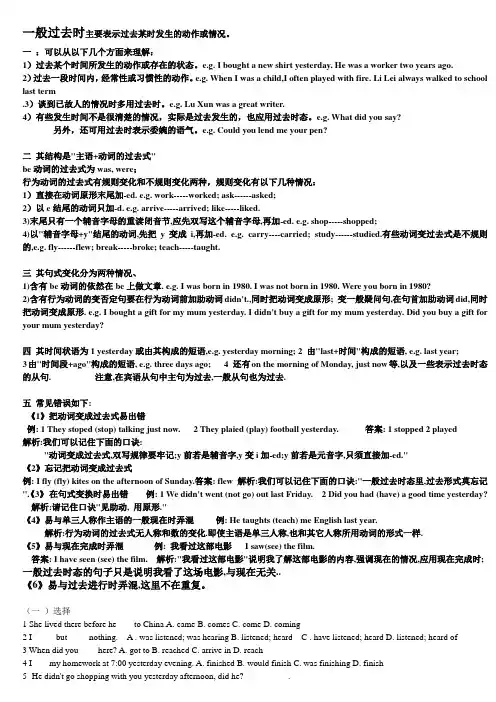
一般过去时主要表示过去某时发生的动作或情况。
一:可以从以下几个方面来理解:1)过去某个时间所发生的动作或存在的状态。
e.g. I bought a new shirt yesterday. He was a worker two years ago.2)过去一段时间内,经常性或习惯性的动作。
e.g. When I was a child,I often played with fire. Li Lei always walked to school last term.3)谈到已故人的情况时多用过去时。
e.g. Lu Xun was a great writer.4)有些发生时间不是很清楚的情况,实际是过去发生的,也应用过去时态。
e.g. What did you say?另外,还可用过去时表示委婉的语气。
e.g. Could you lend me your pen?二其结构是"主语+动词的过去式"be动词的过去式为was, were;行为动词的过去式有规则变化和不规则变化两种,规则变化有以下几种情况:1)直接在动词原形末尾加-ed. e.g. work-----worked; ask------asked;2)以e结尾的动词只加-d. e.g. arrive-----arrived; like-----liked.3)末尾只有一个辅音字母的重读闭音节,应先双写这个辅音字母,再加-ed. e.g. shop-----shopped;4)以"辅音字母+y"结尾的动词,先把y变成i,再加-ed. e.g. carry----carried; study------studied.有些动词变过去式是不规则的,e.g. fly------flew; break-----broke; teach-----taught.三其句式变化分为两种情况、1)含有be动词的依然在be上做文章. e.g. I was born in 1980. I was not born in 1980. Were you born in 1980?2)含有行为动词的变否定句要在行为动词前加助动词didn't.,同时把动词变成原形; 变一般疑问句,在句首加助动词did,同时把动词变成原形. e.g. I bought a gift for my mum yesterday. I didn't buy a gift for my mum yesterday. Did you buy a gift for your mum yesterday?四其时间状语为1 yesterday或由其构成的短语,e.g. yesterday morning; 2 由"last+时间"构成的短语, e.g. last year;3由"时间段+ago"构成的短语, e.g. three days ago; 4 还有on the morning of Monday, just now等,以及一些表示过去时态的从句. 注意,在宾语从句中主句为过去,一般从句也为过去.五常见错误如下:《1》把动词变成过去式易出错例: 1 They stoped (stop) talking just now. 2 They plaied (play) football yesterday. 答案: 1 stopped 2 played解析:我们可以记住下面的口诀:"动词变成过去式,双写规律要牢记;y前若是辅音字,y变i加-ed;y前若是元音字,只须直接加-ed."《2》忘记把动词变成过去式例: I fly (fly) kites on the afternoon of Sunday.答案: flew 解析:我们可以记住下面的口诀:"一般过去时态里,过去形式莫忘记".《3》在句式变换时易出错例: 1 We didn't went (not go) out last Friday. 2 Did you had (have) a good time yesterday? 解析:请记住口诀"见助动, 用原形."《4》易与单三人称作主语的一般现在时弄混例: He taughts (teach) me English last year.解析:行为动词的过去式无人称和数的变化.即使主语是单三人称,也和其它人称所用动词的形式一样.《5》易与现在完成时弄混例: 我看过这部电影I saw(see) the film.答案: I have seen (see) the film. 解析:"我看过这部电影"说明我了解这部电影的内容,强调现在的情况,应用现在完成时; 一般过去时态的句子只是说明我看了这场电影,与现在无关..《6》易与过去进行时弄混,这里不在重复。
(完整版)初中一般过去时详细讲解与练习
(完整版)初中一般过去时详细讲解与练习1. 什么是一般过去时?一般过去时是英语中用来表示过去发生的动作或状态的一种时态。
它通常用来谈论过去的经历、惯、或者过去的事实。
2. 一般过去时的构成一般过去时的动词构成通常依赖于动词的词尾。
下面是一般过去时的构成规则:- 对于大多数动词,直接在动词后面加上了"-ed"来构成一般过去时。
例如:walk -> walked,play -> played。
- 对于以不发音的"e"结尾的动词,只需要在"e"后面加上"-d"来构成一般过去时。
例如:like -> liked,love -> loved。
- 对于以辅音字母+y结尾的动词,将"y"变为"i"并加上"-ed"来构成一般过去时。
例如:study -> studied,cry -> cried。
- 部分动词的一般过去时需要进行不规则变化。
例如:go -> went,eat -> ate。
3. 一般过去时的用法一般过去时通常用来描述以下情况:- 过去发生的动作:I walked to school yesterday.- 过去的经历:He lived in London for five years.- 过去的事实:She was a teacher in the past.4. 一般过去时的句型练下面是一些练,帮助加深对一般过去时的理解和运用:1. 请用一般过去时填空:Yesterday, I ________ (watch) a movie at home.2. 完成句子:He _____ (visit) his grandparents last summer.3. 改写句子,使用一般过去时:I read a book yesterday. (改为否定句)4. 改写句子,使用一般过去时:They played basketball in the park. (改为疑问句)5. 总结一般过去时是用来表示过去发生的动作或状态的一种时态。
初中英语语法专项:一般过去时
• 6S. Mhey misonth’tergliokeins ghertostugdoenstsh.o(变pp一in般g疑to问m句o)rrow.
写出下列动词的过去式:
go
went
use
think thought live
be
was/ were wake
happen happened keep
give gave
say
become became clean
get got
buy
rain rained play
stay stayed learn
pass passed see
answer answered read
used lived woke kept said cleaned bought played learnt/ed saw read
run ran borrow borrowed grow grew watch watched write wrote smile smiled open opened begin began swim swam carry carried study studied
4、一般过去时句式变换
一般过去时态句式的构成
陈述句式
动词
肯定式
否定式
I was ….
I was not(wasn’t)….
He /She/it was…. He/She/It was not(wasn’t)…. be We/You/They were …. We/You/They were not
•元浊 /d/ ,即 ed 在元音,浊 辅音后面念 /d/ ,
初中英语语法一般过去时专项讲解及练习
初中英语语法一般过去时专项讲解及练习一般过去时是英语中常用的时态之一,用来表示发生在过去某个具体时间的动作或状态。
以下是一般过去时的用法及一些练题。
一般过去时的用法1. 表示过去某个具体时间发生的动作或状态。
- I played football yesterday.(我昨天踢了足球。
)- She was a teacher two years ago.(两年前她是一名老师。
)2. 表示过去经常性、惯性的动作或状态。
- We always went swimming in the summer.(我们夏天经常去游泳。
)- He used to live in the countryside.(他过去住在乡下。
)3. 表示过去的客观事实或真理。
- The sun rose in the east.(太阳从东方升起。
)- She knew the answer.(她知道答案。
)一般过去时练题请根据句子的意思,在括号中填上适当的动词的过去式。
1. My friend __________ (visit) me last week.(我朋友上个星期来看我。
)2. They __________ (watch) a movie yesterday evening.(他们昨晚看了一部电影。
)3. Helen and I __________ (play) tennis together when we were children.(海伦和我小时候一起打网球。
)4. He __________ (not go) to school yesterday because he was sick.(他昨天因为生病没去上学。
)5. We __________ (live) in that house for five years before we moved.(我们在那个房子住了五年才搬走。
)总结一般过去时用于表示过去某个具体时间发生的动作或状态,过去的经常性、习惯性动作或状态,以及客观事实或真理。
初中英语语法 八大时态之一般过去时课件

I study in Beijing. I studied in Beijing .
she stops. she stopped.
I go to school by bike every day. I went to school by bike yesterday.
以e结尾的,直接在词尾加d dance - danced 辅音加y结尾,变y为i加ed study - studied 重读闭音节结尾,双写词尾字母加 ed stop - stopped 3.不规则变化: 没有变化 cut -cut put-put come-come hit-hit let-let 特殊情况 have/has—had, go---went, eat---ate, say—said
1
last year
时间
last week
标志 2 last weekend
The day before
3 。。。。。。
一般过去时
动词的变化
一般过去时-含有be动词的
• She is in Beijing.
She was in Beijing .
• I am a student.
I was a student.
read — read
write — wrote say — said
play — played
learn — learned buy — bought cry — cried
study — studied swim — swam walk — walked
一般过去时主要动词的变化:
初中英语中考语法基础版复习讲义一般过去时

初中英语中考语法基础版复习讲义一般过去时一般过去时是表示过去发生的动作或存在的时间态。
在中考中,一般过去时主要考察以下几个方面:1.一般过去时的构成:一般过去时由动词的过去式来表示,动词过去式的构成规则一般有以下几种:- 直接加-ed:work — worked(以不发音的字母e结尾的动词直接加-d);- 以不发音的字母e结尾的动词,只需直接加-d:live — lived;- 以辅音字母+y结尾的动词,将y变为i再加-ed:study —studied;- 以重读闭音节结尾且末尾只有一个辅音字母的动词,双写末尾的辅音字母再加-ed:stop — stopped;- 不规则变化的动词,需特殊记忆:go — went;have — had;eat — ate;see — saw等。
2.一般过去时的用法:- 表示过去的经历、习惯或状态:We lived in the city for ten years.(我们在城市里住了十年。
)- 表示过去的状态或存在:They were at home yesterday.(昨天他们在家。
)- 表示过去的动作或事件:She played basketball with her friends last night.(昨晚她和朋友们打篮球。
)- 表示过去的真实条件或假设条件:If it rained, we stayed at home.(如果下雨的话,我们就呆在家里。
)3.一般过去时的否定形式和疑问形式:- 否定形式:在动词前加上助动词did和not的缩写形式didn't,主语不再需要变动。
例如:I didn't go to the party last night.(我昨晚没去参加派对。
)- 疑问形式:将助动词did置于句首,主语和动词调换位置。
例如:Did you finish your homework yesterday?(你昨天完成作业了吗?)注意:一般过去时的动词变化规则、否定形式和疑问形式适用于所有人称,即第一人称(I)、第二人称(you)、第三人称(he/she/it)和复数人称(we/you/they)。
初中英语知识点总结:一般过去时
知识点总结一般过去时表示过去某个时间里发生的动作或状态;过去习惯性、经常性的动作、行为;过去主语所具备的能力和性格。
我们可以先记一下一般过去时口诀:一般过去时并不难,表示过去动作、状态记心间。
动词要用过去式,时间状语句末站。
否定句很简单,didn't 站在动词原形前,其它部分不要变。
一般疑问句也好变,did放在句子前,主语、动原、其它部分依次站。
特殊疑问句也简单,疑问词加一般疑问句记心间。
最后一条请注意,动词过去式要牢记。
一、基本结构1. 肯定句形式:主语+动词过去式+其他否定句形式:①was/were+not; ②在行为动词前加didn't,同时还原行为动词一般疑问句:①was/were提到句首;②Did+主语+do+其他?例句She often came to help us in those days. I didn't know you were so busy.2. 行为动词的一般过去式。
A. 规则动词的变化规则:1、直接加ed:work—— worked look——looked play——played,2、.以e结尾的单词,直接加d:live ——lived hope——hoped use——used,3、以辅音字母+y结尾的,变y为i加ed:study—— studied carry——carried4、以元音字母+y结尾的,直接加ed:enjoy ——enjoyed5、以重读闭音节结尾的,双写最后的辅音字母+ed:stop—— stoppedplan——plannedB. 规则动词过去式的发音:在清辅音后读/t/,在元音和浊辅音后读/d/,在辅音/t/,/d/后读/id/。
C. 不规则动词变化需参看不规则动词表逐一熟记。
(一般和过去分词一起记忆)。
二、一般过去时的基本用法:1. 通常表示过去发生的而现在已经结束的事件、动作或情况。
Eg. Sam phoned a moment ago.I got up at eight this morning.2. 还可以表示刚刚发生的事情而没说明时间。
一般过去式语法知识点
一般过去式语法知识点一般过去时(Simple Past Tense)用于表示过去发生的动作或状态。
一般过去时的语法知识点如下:1.一般过去时的构成:通常,一般过去时由动词的过去式构成,当然也有一些特殊的动词需要根据一定的规则变化。
动词的过去式常见的变化规则有:- 一般动词的一般过去式一般在动词原形后面加上-ed或-d,如:play-played, watch-watched。
- 以不发音的字母e结尾的动词,直接加-d,如:live-lived,love-loved。
- 以辅音字母+y结尾的动词,去y加-ied,如:study-studied, carry-carried。
- 以辅音字母加y结尾的动词,在y前面加-ied,如:cry-cried,try-tried。
- 以重读闭音节结尾的动词,且末尾只有一个辅音字母,应先双写末尾的辅音字母,再加-ed,如:stop-stopped, shop-shopped。
2.一般过去时的用法:- 表示过去一些时间发生的动作或状态,如:I watched a movielast night.(我昨晚看了一部电影。
)- 表示过去的真实情况,如:She lived in London for two years.(她在伦敦住了两年。
)3.一般过去时的否定形式和疑问形式:- 否定形式:在助动词did之后加not,再接动词原形,如:I did not go to the party.(我没有参加聚会。
)- 疑问形式:将助动词did放在句首,直接将主语提前,后面接动词原形,如:Did you finish your homework?(你完成作业了吗?)4.一般过去时的时间状语:一般过去时常与表示过去的时间状语连用,如:yesterday(昨天),last week(上周),in 1990(在1990年),等等。
5.一般过去时的特殊情况:一些动词在一般过去时的用法有一些特殊情况,如:- be动词的一般过去时变化为was或were,如:I was tired yesterday.(昨天我很累。
初中英语语法一般过去时及练习题
初中英语语法一般过去时及练习题般过去时的用法般过去时表示过去某个时间发生的动作或存在的状。
常和表示过去的时间状语连用。
如:last year, terday等;也可表示过去经常反复发生的动作,常often, always等频率副词连用。
如:I saw him in the street yesterday. 昨天我在上看见他了。
Mei always went to school on foot last year. 去李梅总是步行上学。
意:也可以用“used to +动词原形”表示过去经常或复的动作。
We used to get up early. 我以前总是早起。
(意现在不早起了)一般过去时的形式:词be: 第一人称单数和第三人称单数用was, 其余的称一律用were。
词have: 一律用had, 没有人称和数的变化。
为动词:一律用过去式,没有人称和数的变化,行为词的过去式有两类,一类是规则动词,另一类是不规动词。
般过去时动词的肯定、否定、一般疑问句和简略回答及特殊疑问句的形式见列表:定、否定形式为动词的过去时的否定式,要使用助动词 do 的过去did,后面的谓语动词要还原为原形。
注意:在非正语如口语中,was not, were not, had not和did not 以分别缩写成wasn’t, weren’t, hadn’t和n’t。
般疑问句和简略回答殊疑问句和简略回答一般过去时的几种句型(这里只讲行为动词)肯定句结构为:主语+动词的过去式+其他。
如:He t to the toy store yesterday. 他昨天去玩具店了。
否定句结构为:主语+di d not (didn’t)+动词原形他。
如:He didn’t go to the toy store yesterday. 昨天没去玩具店。
一般疑问句的构成:Did+主语+动词原形+其他?:1) -Did you go to Beijing last week?-Yes, we did. (No, we didn't.)2) -Did you meet the businessman before?-No, I didn't. (Yes, I did.)特殊疑问句的构成:疑问词+did+主语+动词原形其他?如:1) -What did you do last night?-I did my homework.2) -Where did you go last week?-I went to Shanghai with my parents.一般过去时口诀一般过去时并不难,表示过去动作、状态记心间。
初中英语语法——一般过去时知识点总结归纳
初中英语语法——一般过去时知识点总结归纳一般过去时——表示过去发生的动作或事件。
概念: 1) 表示过去某个时间发生的动作或存在的状态。
常和表示过去的时间状语连用. 如: yesterday , last week , in 1998 , two days ago 等。
如: I went to a movie yesterday. 我昨天去看了一场电影。
2) 也可表示过去经常或反复发生的动作。
如: He always went to work by bike last week。
构成: (1) 主语+ be (was / were ) +……(2) 主语+ 实义动词过去式+【解析】常和表示过去的时间状语连用,如yesterday, last night, the day before yesterday, 3 days ago...含有be动词的句子,将be动词变为过去式。
am, is的过去式为was, are的过去式为were:I was at the butcher's.You were a student a year ago.The teacher was very beautiful ten years ago.★变否定句在be动词后面加notI was not at the butcher's.You were not a student a year ago.The teacher was not very beautiful ten years ago.★变疑问句将be动词移动到句首Were you at the butcher's?Were you a student a year ago?Was the teacher very beautiful ten years ago?★肯定回答否定回答Yes, I was. / No, I was not.Yes, you were. / No, you were not.Yes, he/she was. / No, he/she was not.★特殊疑问句What did you do?(必背)不含有be动词的句子,将动词变为过去式:I finished my homework yesterday.The boy went to a restaurant.The Sawyers lived at King Street a year ago.★变疑问句在句首加did,动词变为原型Did you finish your homework yesterday?Did the boy go to a restaurant?Did the Sawyers live at King Street a year ago?★变否定句在主语和动词之间加did notI did not finish my homework yesterday.The boy did not go to a restaurant.The Sawyers did not live at King Street a year ago.★肯定回答及否定回答Yes, I did. / No, I didn't.Yes, he did. / No, he didn't.Yes, they did. / No, they did not.。