
不定式、现在分词和过去分词
3“进行” ed分词表“完成”
1.China is a developing country =a country which is developing. 2.Japan is a developed country =a country which has developed. 3.I found him gone. =that he had gone.(表完成)
(3)下列动词接不定式与接~ing形式意义相近:
like,love, hate, dislike, begin, start, prefer, continue, intend,attempt等. e.g:I prefer making (to make) an outline before I do my oral
I didn't expect to find you here. They refused to accept his invitation. The little boy pretended to be asleep when his mother came in.
(2)下列动词通常用~ing形式作宾语:
admit, report, appreciate, deny, explain, mention, resist, stand, stop, imagine, recall, suggest, mind, finish, enjoy, keep, practise, miss, avoid, delay, excuse, escape, consider, advise等。
③remember to do记得要做某事(此事未做)/ remember doing记得某事已做过(此事已做) e.g.:I remember seeing her once somewhere. You must remember to take your umbrella when you leave home. ④go on to do继续做另一件事 go on doing接着做同 一件事 e.g. :She stood up and shook hands with me, and then she went on writing something. AfterIfinishedmyhomework,1wentontoreadthenovel. ⑤try to do企图/想做某事 try doing试着做某事(看看 有什么后果发生) e.g. :We tried to persuade him to go with us, but he wouldn’t listen. Let's try doing the work some other way.
▲在概念上,ing.表“抽象、习惯”,不定式表“具体、偶
然、将来”. *Swimming (抽象)is my favourite sport and I like swimming(习惯)every day, but I don’t like to swim(具 体)today, I would like to swim(将来)tomorrow.
(4)下列动词接不定式与接~ing形式意义不同: ①stop to do 停下(正在做的事)去做另一件事 / stop doing 停下正在做的事 e.g.:Seeing an old man carrying a big bag, I stopped to help him. Hearing the bell ,the students stopped playing and ran into the classroom. ②forget to do忘记做某事(此事未做)/ forget doing忘记曾做过某事(此事已做) He forgot to post the letter when he walked past the post office. I'll never forget seeing him for the first time.
I prefer to stay at home today.(具体某次行为) He prefers walking to cycling.(惯常行为) *一般说来不能用于进行时的动词如:realize, know,understand,see,lose等,多用不定式 如:I began to realize I had been wrong. We hate to lose the chance . Now we are beginning to see it more clearly.
1.非谓语动词大都可在句中作主语、宾语、宾语补足 语、表语、定语、状语等.
1.Swimming is his favourite sport. (作主语) 2.He enjoys swimming. (作宾语) 3.I found him swimming in the river. (作宾补) 4.His favourite sport is swimming. (作表语) 5.He is the man swimming in the river just now. (作定语) 6. Swimming in Summer ,we can get cool.
composition . We all like playing (to play) table tennis.
但也有细微区别: *指具体某次的行为常用不定式,指惯常的行为 常用~ing形式. 如:I like reading books of this kind.(惯常行为) I hate to say so,but really I can't go with you.(具体某次行为)
▲B.在语态上,ing分词表“主动”,ed分词表“被动” (多为及物动词)
1.I saw him writing a short novel. =that he was writing a short novel. 2.He was reading a novel written by Charles Dickens. =which was written by Charles Dichens.
▲C.分词的完成式一般不用来作定语,只 能用作状语.
The platform having been built will be used to perform on. × 作 1.The platform built will be used to perform on. √ 定 The platform which has been built will be used 语 to perform on. √ 2. Having given her opinion about the building, 作 she left the meeting. Having been used for a long time, the computer 状 语 needs repairing.
⑥mean to do (意思是) 打算做某事 mean doing意味着做某事
e.g. :Revolution means librating the productive force. Sorry ,I didn't mean to hurt you.
如 :1)Would you mind my smoking here ? 2) The girl was told to practise playing the piano for three hours every day. 3)Good news keeps coming. Tina suggested spending the weekend on her farm.
inf
完成式:(先与谓语动词之 to have made 前发生) 进行式:(在谓语动词动作 to be making 发生时正在进行)
2.非谓语动词在句中可作的语法成份
成份 类别
主 宾 表 定 宾 语 语 语 语 补 时
间
状
语
条 原 目 件 因 的
结 果
方 让 式 步
伴 随
不定 式 现在 × × 分词
D.▲ed+主句(不强调时间先后);Being ed+主句(强调 主句和从句动作同时发生);Having been ed+主句(强 调时间先后)如不强调时间先后可用ed,一般式来代替.
ed as a means of traffic in China,the bike is very useful. Written in simple English, the book is easy to read 2. Being used by me now,the bike can’t be lent to you. 3. Having been used for many years, the bike needs repairing. Having been told several times, he couldn’t 可以写成=Told several times, understand what I meant.
×
× × × ×
过去 × × 分词
动名 词 ×
×
×
×
1.To see you is glad. (作主语) =It’s glad to see you. (作宾语) 2.I want to see you. 3.I want him to see you. (作宾补) (作表语) 4.My hope is to see you. 5.He is the man to see you. (作定语) 6.I’m glad to see you. (作原因状语) (作目的状语) 7.I went to see you. 8.He went so early as to see you (作结果状语)
不定式、现在分词和过去分词

③remember to do记得要做某事(此事未做)/ remember doing记得某事已做过(此事已做)
e.g.:I remember seeing her once somewhere.
You must remember to take your umbrella when you leave home.
过去 × × 分词
××
动名 词
×
×
1.非谓语动词大都可在句中作主语、宾语、宾语补足
1.To see you is语g、lad表.语、定语、状语等.
=It’s glad to see you.
(作主语)
2.I want to see you.
(作宾语)
3.I want him to see you. (作宾补)
=that he was writing a short novel.
2.He was reading a novel written by Charles Dickens.
=which was written by Charles Dichens.
▲在概念上,ing.表“抽象、习惯”,不定式表“具体、偶 然、将来”. *Swimming (抽象)is my favourite sport and I like swimming(习惯)every day, but I don’t like to swim(具
如 :1)Would you mind my smoking here ? 2) The girl was told to practise playing the piano
不定式,动名词,现在分词,过去分词

非谓语动词:英语中两个动词不能直接放在一起,要么加TO,要么加ING!不定式:to do (表示事情没做,将要做)动名词:V+ing现在分词:V+ing(表主动,进行)过去分词:done(表被动,完成)特殊类动词直接加动原的:1.使役动词(have ,let, made ) 2.感观动词3.情态动词2.区别1.加to与加ing无区别的:start, begin, continue...2.加to do 与加ing 区别小的(前者表一次性的动作,后者表习惯性动作):like , love ,hate...3.加to do 与加ing 区别大的forget to do sth:忘记做某事(还没做) remember to do sth:记得做某事(还没做) forget doing sth忘记已经做了某事 rembember doing sth:记得已经做了某事stop to do sth:停止某事去做另外一件事regret to do sth:遗憾/后悔没做某事stop doing sth:停止正在做的事情rgeret doing sth:遗憾/后悔做了某事mean to do sth:打算做某事 try to do sth:努力做某事mean doing sth:意味着.. .try doing sth:尝试做某事三,接to do 还是V-ing (常考词)接to do 的词:want/hope/wish/agree/ask/choose/learn/plan/seek/fail/offer/manage/pretend/promise/ref use接V-ing的词:finish/avoid/mind/suggest/miss/practise/risk/feel like/give up/cann't help四,用现在分词还是过去分词Walking in the street, you must be careful.表主动,逗号后面的主语是人,用现在分词.Written in English, it is difficult to read.表被动,逗号后面的主语是物,用过去分词.五:特殊词:interest/excite 等词的非谓语动语结构:人+interested/excited/...物+interesting/exciting/...。
1现在分词、过去分词、不定式做状语讲解

现在分词/过去分词/不定式做状语详讲及分析一•现在分词做状语(表原因,时间,条件,让步,行为方式,伴随状况,现在分词与主句的主语一致,且形成主谓关系,就是说现在分词的动作发出者是主句的主语.例如:①Hearing the news, they got excited. (When they heard the news, they got excited.)现在分词逻辑主语.从这个例句中看出,现在分词的发出者是主句的主语they,且主句的主语与现在分词形成主谓关系②She got home, feeling very tired.逻辑主语现在分词主句的主语与feeling 形成主谓关系③Crossing the road, Jjsaw a girl crying. (Whenj_was crossing the road, I_saw a girl cryin g.)注:当句主句的主语与从句的动词表示动作正在进行.除了省略其连接词because, if , once, whe n从句中的主语,还要省略其be动词.④When he was climbi ng the step』e heard terrible voice.Climbing the step,岡heard terrible voice⑤Because上e is a child』e ca'e nter into the in terbar.Being a child, helca n'te nter into the in terbar当从句中出现主+ n/adj,且该从句的主语与主句的主语一致时,用be动词的现在分词形式.即|Bein[ +n/adj.Being excited, he speaks in cohere ntly.(Because he is excited, he speaks in cohere ntly.)注意:当主句的主语与从句的主语不一致时,那么从句现在分词是独立的主格结构。
不定式、动名词、现在分词、过去分词作表语的区别和用法

不定式,动名词,现在分词,过去分词作表语的区别不定式、动名词、现在分词和过去分词都可用作表语,但它们所表示的含义却各不相同一、什么是表语。
在形式上,位于系动词后的就是表语。
从含义上讲,表语是回答主语“是什么”或“怎么样”的语法成分。
如:1. Albert Einstein was a famous professor of physics.阿尔伯特.爱因斯坦是一位有名的物理学家。
2. The problem remains unsolved.问题仍未解决。
二、不定式、动名词与分词作表语的区别。
不定式和动名词作表语相当于一个名词作表语,含义是回答主语“是什么”;分词作表语相当于形容词作表语,含义是回答主语“怎么样”。
如:1. Our plan is to keep the affair secret.我们的计划是让这件事成为秘密。
(主语和表语是相等的)2.Their job is making wheelchairs for disabled people.他们的工作是为残疾人制造轮椅。
(主语和表语是相等的)3.The music they are playing sounds exciting.他们演奏的音乐听起来令人激动。
(主语并不等于表语)4.This beautiful village remains unknown to the rest of theworld.这个xx的村庄仍未外界所知。
(主语和表语是不相等的)三、不定式和动名词作表语的区别。
不定式和动名词作表语虽都是用于回答主语“是什么”的,但二者仍有一些区别。
不定式作表语强调的是一次性、具体的、将要发生的动作;动名词作表语强调的是一般性、抽象的、经常发生的动作。
如:1. His job is to paint the walls.他的工作是粉刷这些墙。
(一次性的,具体的,目前要做的事情,并不是他日常的工作)2.His job is painting walls.他的工作是粉刷墙。
现在分词,不定式,过去分词的区别
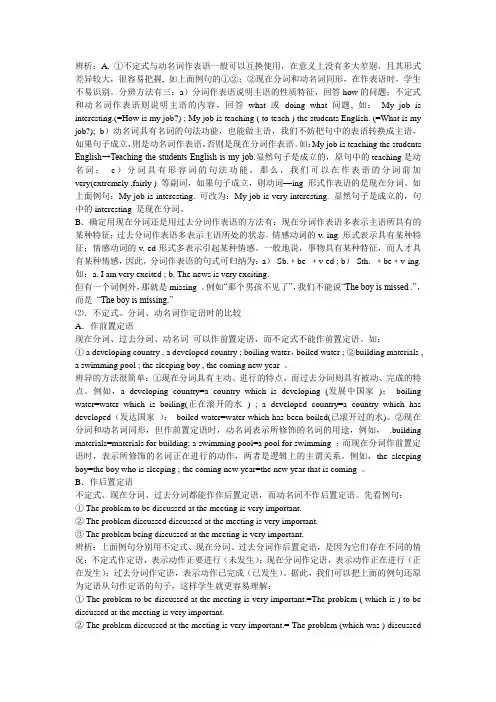
辨析:A. ①不定式与动名词作表语一般可以互换使用,在意义上没有多大差别,且其形式差异较大,很容易把握, 如上面例句的①②;②现在分词和动名词同形,在作表语时,学生不易识别。
分辨方法有三:a)分词作表语说明主语的性质特征,回答how的问题;不定式和动名词作表语则说明主语的内容,回答what 或doing what 问题, 如:My job is interesting.(=How is my job?) ; My job is teaching ( to teach ) the students English. (=What is my job?); b)动名词具有名词的句法功能,也能做主语,我们不妨把句中的表语转换成主语,如果句子成立,则是动名词作表语,否则是现在分词作表语。
如:My job is teaching the students English→Teaching the students English is my job.显然句子是成立的,原句中的teaching是动名词;c)分词具有形容词的句法功能,那么,我们可以在作表语的分词前加very(extremely ,fairly ) 等副词,如果句子成立,则动词—ing 形式作表语的是现在分词。
如上面例句:My job is interesting. 可改为:My job is very interesting. 显然句子是成立的,句中的interesting 是现在分词。
B.确定用现在分词还是用过去分词作表语的方法有:现在分词作表语多表示主语所具有的某种特征;过去分词作表语多表示主语所处的状态。
情感动词的v.-ing 形式表示具有某种特征;情感动词的v.-ed形式多表示引起某种情感。
一般地说,事物具有某种特征,而人才具有某种情感,因此,分词作表语的句式可归纳为:a)Sb.﹢be ﹢v-ed ; b)Sth. ﹢be﹢v-ing. 如:a. I am very excited ; b. The news is very exciting.但有一个词例外,那就是missing 。
(完整版)名词的非谓语动词形式讲解

(完整版)名词的非谓语动词形式讲解名词的非谓语动词形式是指名词在句子中充当动词而不是名词的功能。
非谓语动词有三种形式:不定式、现在分词和过去分词。
1. 不定式不定式是名词最常见的非谓语动词形式之一。
不定式可以表示目的、愿望、惯以及某些特定的动作或状态。
不定式的形式是“to + 动词原形”。
例如:- I want to go to the beach.(我想去海滩。
)- He likes to play basketball.(他喜欢打篮球。
)2. 现在分词现在分词是动词的一种形式,可以用作形容词或者动词。
现在分词的形式是动词原形加上-ing。
在名词中,现在分词用于描述正在进行的动作或者具有特定特征的人或物。
例如:- The running man is my brother.(那个跑步的人是我哥哥。
)- The interesting book is on the table.(有趣的书在桌子上。
)3. 过去分词过去分词是动词的一种形式,常用作形容词,表示完成的动作或状态。
过去分词的形式有规律变化和不规则变化。
在名词中,过去分词也用于描述或修饰人或物。
例如:- The broken vase was expensive.(那个破损的花瓶很贵。
)- She is interested in the written article.(她对那篇书面文章很感兴趣。
)综上所述,名词的非谓语动词形式主要包括不定式、现在分词和过去分词。
掌握这些形式的用法和规则可以帮助我们更准确地表达自己的意思,并丰富我们的语言表达能力。
*注意:以上内容仅供参考,具体语法使用请根据具体语境和句子结构进行判断和运用。
*。
不定式-现在分词-过去分词的区别
不定式:一般式,进行式,完成式,被动式,否定形式带to,不带to(被动式应还原to)现在分词:一般式,完成式,被动式,否定形式过去分词一、考查不定式、现在分词与过去分词的基本区别从时间关系上看,不定式表未来,现在分词表进行,过去分词表完成,同时注意不定式和现在分词的完成式也表完成(尤其是表示有明显的先后关系的完成);从主动与被动来看,不定式和现在分词表主动,过去分词表被动,同时注意不定式和现在分词的被动式也表被动(不定式的被动式在表被动的同时还兼表未来,现在分词的被动式表被动的同时还兼表进行)。
如:1. I send you 100 dollars today, the rest _________ in a year. (湖南卷)A. followsB. followedC. to followD. being followed【分析】答案选 C。
动词不定式表示未来的动作。
今天我寄给你100美元,剩下的年内会寄给你。
follow:go after, come after,在....之后,如:What to follow? 接下来吃什么?The dogs followed the fox.这些狗一齐追赶着那狐狸。
The ducklings followed their mother around the pond。
这个句子后半部分,和前半部分之间没有并列连接词and等,所以这不是一个并列句,也就是说,the rest____ in a year.这一部分不是一个句子,而是一个短语形式。
根据意思,the rest是在100 dollars 之后寄去,即the rest follows(go after,be sent)100 dollars ,所以the rest和follow之间应为主动含义。
A follows谓语形式,构成一个一般现在时的句子。
B followed 为一般过去式时,即谓语形式,构成一个句子。
非谓语动词的七种形态的用法和含义
非谓语动词的七种形态的用法和含义
非谓语动词的七种形态包括不定式、动名词、现在分词、过去分词、分词短语、不定式短语和动名词短语。
1.不定式:to do,常用于表示目的、原因、结果、条件等。
例如:She went to the market to buy some vegetables.
2.动名词:doing,可作主语、宾语、表语等,常用于表示动作的
进行与持续。
例如:Reading is her favorite hobby.
3.现在分词:doing,表示与主语同时或者正在进行的动作。
例如:The boy standing over there is my friend.
4.过去分词:done,可用作形容词或者与助动词连用表示完成的
动作。
例如:The work was done by the team.
5.分词短语:having done,表示在完成某个动作之后发生的事情。
例如:Having finished her homework, she went to bed.
6.不定式短语:to be done,表示被动或者完成的动作。
例如:The report is to be submitted by tomorrow.
7.动名词短语:enjoying swimming,表示主语进行的动作是令人愉快的。
例如:She enjoys swimming in the sea.
除了以上七种形态外,非谓语动词还可以组成短语或者从句,常用于虚拟语气、句子的修饰、分句或者非限制性定语从句等。
完全掌握非谓语动词的用法对于提高英语写作和阅读水平非常重要。
高考英语不定式现在分词和过去分词作宾补的区别
高考英语不定式、现在分词和过去分词作宾补的区别当宾语与作宾补的动词在逻辑上是主动关系时,用不定式(未来或全过程)或现在分词(正在进行或一直处于某种状态);当宾语与作宾补的动词在逻辑上是被动关系时,用过去分词。
现根据不同动词的不同用法分述如下,请在下列各例句中仔细体会不定式、现在分词或过去分词作补足语的区别。
■通常用带to的不定式作宾补的动词这类动词很多,常见的有:ask, invite, tell, want, encourage, wish, expect, beg, request, require, advise,order, force, cause, allow, permit, forbid, warn, remind, teach, send, call on, wait for, wouldlike / love / prefer等表示劝请、要求类动词后,用带to的不定式作宾补。
如:1. My advisor encouraged ________ a summer course to improve my writing skills. (北京卷)A. for me takingB. me takingC. for me to takeD. me to take【分析】答案选D。
encourage sb. to do sth. 鼓励某人做某事。
2. The teacher asked us ________ so much noise. (北京卷)A. don’t makeB. not makeC. not makingD. not to make【分析】答案选D。
即ask sb. not to do sth. 叫某人不要做某事。
3. The boy wanted to ride his bicycle in the street, but his mother told him ________. (全国卷)A. not toB. not to doC. not do itD. do not do【分析】答案选A。
英语非谓语动词:不定式,动名词和分词
英语非谓语动词:不定式,动名词和分词非谓语动词分为三种形式:不定式、动名词和分词(包括现在分词和过去分词)(一)动词不定式动词不定式可以作主语、宾语、宾语补足语、定语、状语、表语。
动词不定式由“to+动词原形”构成,否定形式“not to +动词原形”。
1.用法(1)作主语。
往往用it作为形式主语。
如:It is time to get up.(2)作宾语。
如果带有宾语补足语,往往把不定式短语放在宾语补足语之后,用it作形式宾语。
如:I find it interesting to study English.有些动词只能用动词不定式作宾语。
如:decide,plan,desire,hope,wish,promise,ask,agree, manage等。
(3)作宾语补足语A:带to的动词不定式有:ask,tell,want,teach,advise,allow,beg,invite等。
如:He asked me to do the work.B :接不带to的动词不定式有:see,watch,hear,make ,let等。
如:I often see him play football.使役动词不带to,动词有:一感二听三让四观看。
一感:feel 二听:hear, listen to 三让:let,have,make 四观看:observe,see,watch,look at注意:feel, hear,notice, see,watch,have,make等词后的补足语中,不定式不带to,但变成被动结构时,要带to.如:I often hear him cry. He is often heard to cry.注意:带but介词的不定式。
如果介词之前有行为动词do的各种形式,那么but后的不定式不带to,否则要带to。
另外,在can’t choose but...和can’t help but...等后面的不定式也省略to。