
采访刘翔英文翻译,英译汉
原文:Reporter: That moment when you're lining up to start the 110 meter hurdles final in Athens, what was going through you mind?Liu Xiang: To be honest, my mind at the time was a complete blank. I wasn't thinking about anything because I already felt like I'd achieved an important breakthrough. Until then, there had never been an Asian in the final of that event in the Olympics, so that was already an accomplishment. I just wanted to make sure I did the best I could, run as fast as I could. That was all I was thinking at the time.Reporter: That moment when you crossed the finish line and you realized you'd won -- what was the feeling?Liu Xiang: As I said, during that entire time, my mind was blank. When I won, everything felt surreal. It's hard to describe -- I felt like I was floating, that all my actions and my words...they weren't coming from me. It was like I was watching someone else doing those things, saying those things. I really couldn't express myself because I was too happy and excited. I couldn't take in everything that was going on. It was as if the whole world had turned upside down.Reporter: You say the world had turned upside down, well it certainly turned upside down for athletics, you'd broken through the barrier, an Asian man had won a major sprint event at the Olympics. How do you make sense of that? How do you realize the historical importance of that? Liu Xiang: It was important because in the past, the Europeans and Americans used to think that Asians weren't good enough to succeed in track and field events, that we weren't a threat. Especially in the men's events. And we ourselves... we used to think that because we're Chinese, track and field wasn't something we could do. And we thought we should stick to events that we were traditionally good at -- table tennis, diving, badminton, the technical sports like gymnastics. So I think that by winning, I achieved something for Asian athletes...I gave them the message that as long as we show dedication and belief, and as long as we give it our best, we can do anything. Reporter: It's been said, I think Colin Jackson the world record holder, said that you ran the perfect race, that you were the perfect hurdler. What does it mean to you to have that sort of compliment from someone like him?Liu Xiang: Collin Jackson was a little before my time and he was a really good athlete. I've raced with him, but he's now retired. He's a really good role model and someone that I've learnt a lot from. And of course his world record is always something to aim for. I felt I did pretty well in my race, but my start could have been better. If I work on that, if I can improve my power and strength, then maybe I can break his world record.Reporter: How much does winning a gold medal change your life?Liu Xiang: When the Olympics ended, I felt...that the world had changed, that MY world had changed a lot. There was endless interviews, photo opportunities, media events, speeches...there was just so much happening. From the moment I got off the plane coming home from the Olympics, I felt the glare of the spotlight on me. All the cameras everywhere, and everyday I was busy rushing from one thing to another...one interview to another. For a whole month after the Olympics, it just didn't stop. It wasn't the life I wanted. Things are better now that the attention has subsided a bit, and I'm happier. Now I can concentrate on what I'm supposed to do, that is, training and running. Despite everything that's happened, I feel like I'm still the same person. Reporter: Do you think that your win there has influenced another generation of athletes, young athletes in China to follow your lead?Liu Xiang: I feel that...well, I feel that the most important thing that I did was achieve the breakthrough for others. With my win, I hope I can encourage others, and tell them that no matter what obstacles they face, what difficulties there are, all they need is to work hard and face the challenges head on. Challenges are meant to be met and overcome. Everyone can do it! Reporter: Your mother said that when you were young you used to run around and jump everywhere. When did you realize that you had a sporting talent?Liu Xiang: When I was younger, I used to be a high jumper before I switched to hurdles. But I really felt that I wasn't very suited as a high jumper, because my skills weren't very good, and I wasn't getting any taller! So I decided to switch to hurdles. It was a good move -- the timing, the opportunity, the coach -- everything was right and it was a good decision to change disciplines. My coach is really someone I work well with, he and I have been a good fit. We're like partners, and hopefully we can have an even more successful future working together.Reporter: How much sacrifice do you have to give? How much dedication is needed to achieve that gold -- of winning gold?Liu Xiang: Honestly, training is very tough. It's very hard work. It's only when you get used to it that it's not so bad. You just have to do what it takes and be the best because this is your profession.I feel like I've been very fortunate to have won a gold medal at the Olympics. A lot of people have such dreams...I'm lucky to have realized mine.Reporter: It's been said of China -- China's been criticized for trying to manufacture athletes, for getting young children out of school and putting a lot of pressure on them to perform. Was that your experience?Liu Xiang: I don't see that happening with the athletes that you see now. Maybe it was that way in the past, but things have changed. There have been a lot of improvements to the system, and the talent of the athletes have increased a lot too. So what you've described doesn't happen as much these days. Take myself for example -- each day I train for only 3 hours, and a lot of it has become very scientific...from the massage I get, to the specially designed training schedule.Reporter: And of course there is a lot of pressure on you now will 2008 in Beijing coming up -- the expectation that you are going to win the gold medal. How do you deal with that?Liu Xiang: There is always pressure. But for me now, the most stressful time is over. Now, what I feel is more happiness, and satisfaction. Because I've realized my dream. I guess if you can realize a dream, it doesn't matter how great the pressure is; it's worth it in the end.Reporter: But Beijing 2008, there is so much to be expected of China, and so much to be expected of Chinese athletes, on running of gold medals. As the reigning gold medalist, how are you going to deal with that expectation?Liu Xiang: China has the largest population in the world, we have billions of people! So during the Games, not all of them are going to be able to watch the events in the stadium. Most of them will only be able to watch the competition on TV. I think China has a great number of excellent athletes. The number of gold medals we won in the 2004 Olympics in Athens was the second highest tally among all the countries. I think in 2008, we can surpass America in winning gold medals and become No. 1. That should be possible as long as everyone works hard and have that goal. For myself, I will try to forget the pressure and work as hard as I can to realize my dream for a second time!Reporter: It's been said that winning a gold medal is like winning a million dollars, that the endorsements and the sponsorships make you a wealthy man. Has it made you rich?Liu Xiang: I feel that often in life, material satisfaction is inferior to spiritual satisfaction. You just cannot compare the feeling of being emotionally fulfilled. That's really what I think. If a person has too much money, then money is just about numbers. It's actually very simple -- if you perform well and get good results, you will get rewarded. That's the way it works. At the moment, I think that among my peers, I consider myself a rich man (laughs). But I still think that spiritual wealth is so much more important than material wealth.Reporter: But how do you deal with the pressures of sponsorship and your responsibilities to sponsors and also maintain your commitment and dedication as a top athlete?Liu Xiang: I think that a top athlete should get involved in many different things. We are all members of society and we should be active in it. If I detach myself from society, I would feel very lonely. So I think everyone has a responsibility to try everything. And modern athletes should learn and be prepared to face different aspects of fame. I think that's important.Reporter: Yourself and Yao Ming a very much the faces of China, the icons of China's sporting success, you represent China to the international community. Do you compare yourself with him, and have you had the same opportunities, the same sponsorship opportunities that he's had?Liu Xiang: Oh, I've never thought about comparing myself with Yao Ming. Yes, of course we are both from Shanghai, and we are both Chinese. But there really is no need for comparison, because both of us have our own dreams and our own careers. And they are very different.What's more, our professions are different -- he plays basketball and I focus on track so there's no direct competition. We do often bump into each other and see each other at events, however, and when we do, we usually chat about life and all sorts of other things. I find those meetings very interesting and enjoyable. As for comparing our endorsements...I don't know how to answer this! I think the number of commercials that I do is reasonable. All of them are arranged and approved by the authorities. There are rules and regulations -- it's not as simple as just doing any advertisement or commercial endorsements that I want. But I'm an athlete, and as an athlete, my professional life isn't very long. I may have to retire in my thirties, so I think any athlete should try to make good use of his youth. Having said that, when doing endorsements, it's important to choose the right products. You need to choose products that match your image. Reporter: I read when you were going to train in France, and of course you compete a lot overseas as well. Is that something you enjoy, something you would like to do in the future -- live somewhere else outside of China?Liu Xiang: I'm not training in France. I was invited there as a special guest when France was bidding to host the 2012 Olympic Games. But I've never trained overseas. I only train in China, and with my own trainers. Of course, living overseas sounds nice, but I prefer being in China. This is the country that I grew up in, and my family is here. I'm also famlillar with the environment and have a lot of friends. If you move to another country, there are a lot of inconveniences and difficulties, because you have to start building your life from scratch.Reporter: What about the future for you? I read that someone in Hong Kong was talking about offering you a film contract. Is that something that you would like to do in the future?Liu Xiang: I think that's a rumour; something made up by the media. I'm just an athlete not an actor; I know nothing about acting. I feel that it's better to stick to what I do best and concentrate on my own athletic career. I think if a person can be very good at one thing in life that is already enough. There is no need to get involved and dabble in too many other things.Reporter: It's also said that you enjoy singing karaoke -- you're quite good at it. Would you like tosing, perhaps make a record at some time?Liu Xiang: I just sing karaoke with family and friends, when I want to relax. But it's only for entertainment! My singing is only at the amateur level. I'm definitely not good enough to sing in public. It's not what I'm good at. What I'm good at is track!Reporter: I also heard that you had been offered the chance to study for a doctorate in China. Will we see Dr. Liu Xiang?Liu Xiang: I was a university student when I came back from the last Olympic Games, and my university allowed me to continue for my masters and doctoral degree. But you know, it is never easy to obtain a doctoral degree. You have to make the effort to study and work hard for it. If you don't study, you won't be qualified to get the degree, even if they give you the certificate. Reporter: After 2008, are you likely to continue to run or will you stop?Liu Xiang: Yes I will definitely continue running. Because I will only be 26 years old in 2008. That's the best age in an athlete's career! So yes, I think I will stay with athletics for a few more years...maybe until I'm about 30 or so. If I'm lucky and my health permits, I could maybe even last longer. I'm very attached to track. This has been my life; it'll be very hard to leave it.译文:记者:当你在雅典排队开始110米栏决赛的那一刻,在你的脑海里闪现的是什么?刘翔:说实话,当时我的脑海里一片空白。
关于刘翔的英语作文
关于刘翔的英语作文英文回答:Liu Xiang is a Chinese former track and field athlete who specialized in the 110 meters hurdles. He is an Olympic gold medalist and a world champion in the event. I have always admired Liu Xiang for his determination and perseverance in the face of adversity. His story is truly inspiring and serves as a great example for people facing challenges in their own lives.One of the things I admire most about Liu Xiang is his ability to overcome obstacles. In the 2008 Beijing Olympics, he was expected to defend his title in the 110 meters hurdles, but unfortunately, he had to withdraw from the competition due to an Achilles tendon injury. This was a devastating blow for him and his fans, but he didn't let it define his career. Instead, he worked hard to recover and continued to compete at the highest level. This shows his resilience and never-give-up attitude, which is something Istrive to emulate in my own life.Another aspect of Liu Xiang's career that I find inspiring is his impact on the sport of track and field in China. He has motivated a whole generation of youngathletes to take up the sport and has raised the profile of track and field in the country. As a result, China has produced several talented hurdlers who have followed in his footsteps. This demonstrates the power of a role model in inspiring others to achieve their own goals.In addition to his athletic achievements, Liu Xiang is also known for his humility and sportsmanship. He has always been gracious in both victory and defeat, and he has used his platform to promote the values of fair play and hard work. This is something that I deeply respect and admire about him.中文回答:刘翔是一位中国前田径运动员,擅长110米栏项目。
英文介绍刘翔
Why?
The first reason
Commercial
kidnapping
The second reason
Being
stuck in "Chinese syestem"
Since
Beijing Olympic Games,Liu's image is changed in the public mind. the injury,Liu belongs to athletics and
Thank you for listening.
ห้องสมุดไป่ตู้
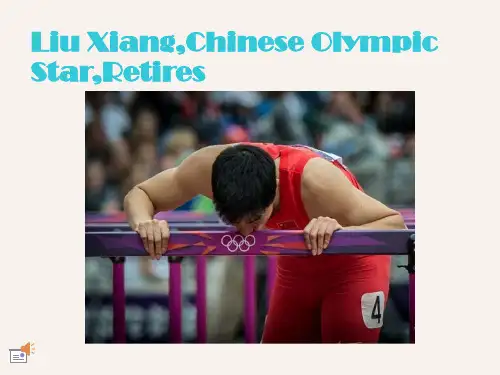
On April 7, 2015, Chinese flying man announced retirement.
The
German media"Sport 1"revived that Liu was once the most popular and the most tragic athlete in Chinese sports.
In 2001, Liu won his first world championship at World University Games in Beijing. Gold in 110m hurdles at 2002 Busan Asian Games is the first one of Liu's three consecutive titles of Asian Games. The acme of his career came in the summer of 2004. Liu became the first ever Chinese man to win a gold medal in track events at Olympics. In 2006, Liu set a new world record at the Super Grand Prix in Lausanne with a time of 12.88 seconds. He raced to victory in the 60m hurdles at 2008 IAAF World Indoor Championships in Valencia, Spain. It is his first and only title at World Indoor Championships.
一个伟大的运动员刘翔英语作文
一个伟大的运动员刘翔英语作文English:Liu Xiang, a great athlete in the world of track and field, has captivated audiences with his speed, agility, and determination. Born in Shanghai, China, in 1983, Liu quickly rose to fame in the hurdles event, setting numerous records and winning gold medals at the Olympics and World Championships. His drive and commitment to excellence were evident in his grueling training sessions and relentless pursuit of perfection. Despite facing setbacks and injuries throughout his career, Liu always showed resilience and a never-give-up attitude, inspiring millions of fans around the world. His impact goes beyond the track, as he has become a symbol of perseverance and dedication, embodying the spirit of sportsmanship and the pursuit of greatness. Liu Xiang's legacy will continue to inspire future generations of athletes to push their limits and strivefor success on and off the field.中文翻译:刘翔,作为田径界的一名伟大运动员,以他的速度、敏捷和决心征服了观众。
刘翔英文介绍50作文
刘翔英文介绍50作文Liu Xiang, an outstanding Chinese athlete, is widely known for his prowess in the hurdles. 刘翔,一位优秀的中国运动员,以其在跨栏比赛中的出色表现而闻名。
Liu Xiang was born on July 13, 1983, in Shanghai, China. 刘翔出生于1983年7月13日,中国上海。
From a young age, Liu Xiang showed promise as an athlete, and he eventually pursued a career in track and field. 从小,刘翔就展现出了优秀的运动天赋,并最终选择了田径运动作为自己的职业。
Liu Xiang achieved international fame when he won the gold medal in the 110-meter hurdles at the 2004 Athens Olympics. 在2004年雅典奥运会上,刘翔在110米栏比赛中获得了金牌,从而成为国际知名的体育明星。
His victory made him the first Chinese man to win an Olympic gold medal in track and field, and it also brought great pride to theChinese people. 他的胜利使他成为中国男子田径项目中获得奥运金牌的第一人,也为中国人民带来了极大的骄傲。
However, Liu Xiang faced significant challenges in the following years, including injuries that affected his performance and emotional strain. 然而,刘翔在接下来的几年中面临着重重挑战,包括受伤影响表现和情感压力等。
my hero刘翔英语作文80字
my hero刘翔英语作文80字English: My hero is Liu Xiang, a former Chinese track and field athlete.I admire him for his passion, dedication, and perseverance in pursuing his dreams. Liu Xiang made history by winning the gold medal in the 110m hurdles at the 2004 Athens Olympics, becoming the first Asian man to achieve this feat. Despite facing multiple injuries throughout his career, Liu Xiang never gave up and continued to train hard to overcome obstacles. His resilience and determination inspire me to never give up on my goals, no matter how challenging the journey may be. Liu Xiang's success on the track serves as a reminder that with hard work and determination, anything is possible.中文翻译: 我的英雄是刘翔,一位前中国田径运动员。
我钦佩他追求梦想时表现出的激情、奉献和坚韧不拔。
刘翔在2004年雅典奥运会上赢得110米栏金牌,创造了历史,成为第一个亚洲男子实现这一壮举的人。
尽管在职业生涯中多次受伤,刘翔从未放弃,继续努力训练以克服障碍。
描述刘翔的英文作文
描述刘翔的英文作文英文:Liu Xiang is a legendary athlete in China, especiallyin the field of track and field. He is a former Olympic champion and world record holder in the 110-meter hurdles. As a Chinese person, I am proud of his achievements and admire his perseverance and determination.Liu Xiang's story is a classic example of how hard work and dedication can lead to success. He started training in hurdling at the age of 13 and gradually improved his skills over the years. In 2004, he won the gold medal in the 110-meter hurdles at the Athens Olympics, becoming the first Chinese athlete to win an Olympic gold medal in track and field.However, Liu Xiang's journey to success was not without obstacles. In the 2008 Beijing Olympics, he was forced to withdraw from the competition due to an injury, which was ahuge disappointment for him and his fans. But he didn'tgive up. He continued to train hard and came back strongerin the 2012 London Olympics, where he reached the semi-finals and ran a season-best time of 13.24 seconds.Liu Xiang's success has inspired many young people in China to pursue their dreams and never give up. He is arole model for all of us and his legacy will continue to inspire generations to come.中文:刘翔是中国田径界的传奇人物,尤其是在110米栏项目上。
英文采访刘翔
A 外国记者B 记者翻译C 刘翔D 刘翻译A:First, congratulations to your success. How did you feel about this match?B:首先恭喜你获得比赛的冠军。
这次比赛你的自我感觉怎么样?C:这次感觉还不错吧,因为今天是今年第一场室外比赛,感觉就想跟所有的选手竞争一下。
D:It’s fine. This is the first outdoor competition of this year. And I would like to compete with other competitors.C:毕竟这是第一场室外比赛,还没有完全适应,跑出这个成绩已经挺不错了。
我自己非常满意。
D:Since this is the first outdoor match, I was not completely adapted to it. I think this result is pretty good.A: Today your opponent Oliver hit three hurdles. Which part do you think you do better than him? B:今天你的对手奥利弗一连打了三个栏,节奏被你带乱了,你觉得你今天战胜他主要是赢在哪里了?C:赢在啊……我感觉我赢在比较稳定吧。
过栏比较稳定。
他可能有点紧张了。
虽然他的力量比较大,但是重心没把握好,所以就慢了一点。
D:I think I was more stable when I was crossing the hurdles. He might be a little bit nervous. Although he has more strength, he didn’t control his center of gravity. So he was a little slow.A: 13.7sec was your best grade since you back to the track. So do you have confidence to go to the world champion competition?B:今天的13秒07 是伤后复出的最好成绩,那么进军世锦赛的信心更足了吧?C:我一直信心很足,通过这场比赛,我的信心会更足。
刘翔英文介绍50作文
刘翔英文介绍50作文Liu Xiang, a name that has resonated around the worldin the realm of track and field, especially in the event of the 110m hurdles. Born in Shanghai, China, on July 13, 1983, he is considered one of the greatest hurdlers in history, with his achievements and records speaking volumes of his dedication, talent, and hard work.Liu Xiang's journey to stardom was not an overnight success. It was a journey filled with perseverance, dedication, and countless hours of training. At a young age, he showed immense promise in the sport, and his coaches saw his potential. They nurtured him, trained him rigorously, and helped him hone his skills to perfection.His dedication to the sport was evident in the way he approached every training session. He was always the firstto arrive and the last to leave, putting in extra hours to perfect his technique and improve his speed. His hard work and perseverance paid off when he broke through to the international scene, winning medals and setting recordsthat would go down in history.One of Liu Xiang's most remarkable achievements was his gold medal win at the Athens Olympics in 2004. It was a moment that not only brought pride to China but also marked a significant milestone in Asian track and field history. His performance was nothing short of Phenomenal, as he crossed the finish line in a record-breaking time of 12.91 seconds, becoming the first Asian athlete to win the gold medal in the men's 110m hurdles at the Olympics.His success did not go unnoticed, and he soon became a household name around the world. His popularity grew as he continued to break records and win medals at various international competitions, including the World Championships and the Asian Games.However, success also brought its own set of challenges. Liu Xiang faced injuries and setbacks that threatened to derail his career. But he never gave up, always stayingtrue to his passion for the sport and coming back stronger every time.Despite the setbacks, Liu Xiang remained a force to be reckoned with in the track and field world. His legacy isnot just in the medals and records he set but also in theinspiration he gave to millions of people, especially in Asia, who saw him as a beacon of hope and a symbol of pride. Liu Xiang's impact on the sport is immeasurable. His success helped to raise the profile of track and field in China and Asia, inspiring a generation of athletes topursue their dreams and aspire to be like him. His story is a testament to the power of perseverance, dedication, and hard work, and his legacy will continue to inspire peoplefor generations.Today, Liu Xiang may not be actively competing on the track, but his impact and influence are still felt. He remains an icon in the sport and a role model for aspiring athletes around the world. His story is a reminder thatwith hard work, dedication, and perseverance, anything is possible.刘翔:中国跨栏的飞跃刘翔,这个名字在世界田径领域,尤其是在110米栏项目中,可谓如雷贯耳。
英文关于刘翔的作文
英文关于刘翔的作文英文:Liu Xiang, a name that represents greatness, perseverance, and determination. He is a Chinese athlete who has left an indelible mark on the world of sports. Liu Xiang is a former Olympic gold medalist and world record holder in the 110-meter hurdles. He is a true inspiration to millions of people around the world.I remember watching Liu Xiang compete in the 2004 Athens Olympics. He was the first Chinese man to win an Olympic gold medal in track and field. I was so proud of him and felt a sense of national pride. His victory was not just his own, but it belonged to the entire nation.Liu Xiang's journey to greatness was not an easy one. He faced many setbacks and obstacles along the way. In the 2008 Beijing Olympics, he had to withdraw from the competition due to an Achilles tendon injury. It was aheartbreaking moment for everyone who had been rooting for him.However, Liu Xiang did not give up. He continued to train and work hard to overcome his injury. He returned to the 2012 London Olympics and competed in the 110-meter hurdles. Although he did not win a medal, his perseverance and determination were an inspiration to everyone who watched him.中文:刘翔,一个代表着伟大、毅力和决心的名字。
Liu Xiang刘翔的英文介绍
Liu Xiang.This is a Chinese name; the family name is Liu.Liu XiangLiu Xiang in 2010Personal information Nationality ChineseBorn July 13, 1983 (age 30)Putuo District, Shanghai Height 1.89 m (6 ft 2 1⁄2 in)Weight 85 kg (187 lb)SportCountry ChinaSport AthleticsEvent(s) 110m hurdlesCompetitor forLiu Xiang (simplified Chinese: 刘翔; traditional Chinese: 劉翔; pinyin:Liú Xiáng; born July 13, 1983 in Putuo District, Shanghai) is a Chinese110 meter hurdler. Liu is an Olympic Gold medalistand World Champion.[1] His 2004 Olympic gold medal was the first in a men's track and field event for China.Liu is one of China's most commercially successful athletes and has emerged as a culturalicon.[2] He is the first Chinese athlete to achieve the "triple crown" of athletics: World Record Holder, World Champion and Olympic Champion. He was the favorite to win another gold in the 110 metre hurdles at the Beijing Olympics,[3] but he had to withdraw from competition at the last moment aftera false start and aggravation to a previously unrevealed injury. Again a gold medal favourite inthe 110 metre hurdles at the London Olympics he pulled his achilles tendon attempting to clear the first hurdle in the heats.[4]Contents[hide]∙ 1 Careero 1.1 Early careero 1.2 2004 Olympicso 1.3 2005 and 2007 World Championshipso 1.4 Beijing Olympicso 1.5 2009–2011: Return from injuryo 1.6 2012 season∙ 2 Personal life∙ 3 International competition record∙ 4 See also∙ 5 References∙ 6 External linksCareer[edit]Early career[edit]In May 2001, he won at the East Asian Games in Osaka, Japan with a time of 13.42 seconds. In August 2001, he won at the Universiade in Beijing,China with a time of 13.33 seconds.[5] He also won at the 9th National Games of the People's Republic of China that same year.[6]In 2002 he set an Asian record time at the Athletissima meeting, completing the event in13.12 seconds. This also broke Renaldo Nehemiah's long standing and world junior record, which had stood for almost 25 years. The following year he secured bronze medals in the 60 metres hurdles at the 2003 IAAF World Indoor Championships and the 110 m hurdles at the 2003 World Championships in Athletics.[7]2004 Olympics[edit]In May 2004 at an IAAF Grand Prix race in Osaka, Japan, Liu managed to beat Allen Johnson with a personal best record time of 13.06 seconds[citation needed]. He improved even further at the 2004 Athens Olympics. Although he was not considered a favourite for the event[citation needed], he won the Olympic final by some distance to take the gold medal in a world record-equalling time of12.91 seconds, matching the feat of Colin Jackson. This was a new Olympic record and was almost three tenths of a second faster than the runner-up Terrence Trammell. The performance had Liu the sixth man to run under 13 seconds for the event and was China's first men's Olympic gold medal in a track and field event.[7] On top of this, it defied the traditional thinking that Asian athletes could not compete in sprint events at the top level[citation needed]. He said that his gold medal "changes the opinion that Asian countries don't get good results in sprint races. I want to prove to all the world that Asians can run very fast."[8]Liu, a 21-year-old student at East China Normal University at the time of his Athens victory, became the object of a bidding war between commercial sponsors. The Chinese Track and Field Association restricted him to four such deals.[citation needed]Liu finished the season with four of the year's ten fastest clockings[citation needed]. Reaching 17 finals in the 60 m indoor hurdles and the 110 metre hurdles, he lost just two, both to American Allen Johnson[citation needed].2005 and 2007 World Championships[edit]In August 2005, Liu won a silver medal at the IAAF World Championships inAthletics in Helsinki, Finland, finishing 13.08 seconds, 0.01 seconds after champion Ladji Doucouré from France. In November 2005, he won at East Asian Games in Macau, China with 13.21 seconds.Off track, in May, he was awarded the Laureus World Sports Award for Newcomer of the Year for his breakthrough performance at the 2004 Summer Olympics in Athens.Liu set a new world record in the 110 metre hurdles, at the Super Grand Prix in Lausanne on July 11, 2006, with a time of 12.88 seconds (+1.1 m/s tailwind). The record was ratified by the IAAF.[9] In that same race, American Dominique Arnold had also beaten the previous record with a time of 12.90 seconds.[10] In September, he won gold at IAAF World Athletics Final in Stuttgart, Germany with 12.93 seconds.On August 31, 2007 at the World Athletics Championships in Osaka, Japan, Liu won gold in the 110 metre hurdles with 12.95 seconds to become the World Champion for the first time.On May 23, Liu participated in a test event at the Beijing National Stadium.[11] He pulled out ofthe Reebok Grand Prix in New York on May 31, citing hamstring problems. On June 8, hefalse-started at the Prefontaine Classic at Eugene, Oregon. Liu skipped the entire European circuit, preferring to train for the Olympics in China instead.Beijing Olympics[edit]Leading up to the Summer Olympics in Beijing, China, Liu bore national expectations of a repeat victory on home soil.[12] On August 18, Liu withdrew from the Olympic 110 metre hurdles. He walked off the track after a false start by another runner in his first-round heat,[12] leaving the crowd at the Beijing National Stadium in stunned silence,[13] confusion,[14] and tears.[11][12] According to JeréLongman of the New York Times, "China's greatest hope had been dashed".[15]According to China's track and field association, Liu suffered from a recurrence of chronic inflammation in his right Achilles tendon.[11] Liu's coach, Sun Haiping addressed the media during a press conference and stated that the hurdler had been hampered by a tendon injury for six or seven years.[13] He commented on the situation, saying "We worked hard every day, but the result was as you see and it is really hard to take."[13] Sun, who was in tears for most of the press conference, stated that Liu would be unable to compete for the remainder of 2008. Liu made a public apology to the Chinese media the following day, saying he could "do nothing but pull out of the race" because of his foot injury. He believed that the injury would not prevent him from future competitions and vowed to "come back" for the next Olympics.[16]Liu's injury was significant and also ruled him out of the following year's major competition, the 2009 World Championships in Athletics.[17] However, coach Sun Haiping was confident that he would return in time for the Chinese national championships and 2009 Asian Championships inAthletics in November.[18]2009–2011: Return from injury[edit]After a 13-month absence because of his injury, Liu finally returned to competition at the Shanghai Golden Grand Prix. Liu recorded a time of 13.15, tied with Terrence Trammell, but finished 0.01sbehind and was awarded second place. However, Liu said he was happy with hisperformance.[19][20] Nearing the end of the year, he competed at a number of major events on home turf. He won gold medals at the 2009 Asian Athletics Championships, the East Asian Games and the 11th Chinese National Games.[21][22]At the 2010 IAAF World Indoor Championships in Doha, admitting that his right foot has yet to fully recover,[23]Liu was able to finish in the finals of the 60 m hurdles, but managed only seventh place.[24] His sole appearance on the 2010 IAAF Diamond League circuit came at the Shanghai Grand Prix and he lost to national rival Shi Dongpeng for the first time.[25] Following a six-month break, he marked his return to form at the 2010 Asian Games. A crowd of 70,000 gathered atthe Guangdong Olympic Stadium to see him in the final and he easily won his third consecutive title at the competition, breaking the Games record with a run of 13.09 seconds – making him the third fastest athlete that season.[26]The Shanghai Golden Grand Prix in May 2011 saw Liu make a return to a world class level: he defeated David Oliver (the fastest hurdler in 2010) with a world-leading mark of 13.07 seconds to take his first win on the2011 IAAF Diamond League. Liu showed he had accomplished a transition in his technique, as he reduced his number of starting steps before the first hurdle from eight to seven, using his left leg for hurdling.[27]On August 29, 2011, Liu Xiang competed in the men's 110 m hurdles final in the IAAF World Championships in Daegu, South Korea. Liu finished the race in third place, but he eventually won the silver medal, as the winner Dayron Robles was disqualified for entering Liu's lane and pulling him back.[28]2012 season[edit]In Liu's first competition of 2012, he was matched up against Dayron Robles at the Birmingham Indoor Grand Prix and this time he won cleanly with an Asian record time of 7.41 seconds for the 60 m hurdles.[29] He was the favourite for the title at the 2012 IAAF World Indoor Championships, but was beaten into second place by Aries Merritt and left with the silver medal.[30] In the outdoor season he set a 110 m hurdles meet record at the Golden Grand Prix Kawasaki,[31] then ran12.97 seconds to win at his home nation 2012 IAAF Diamond League meet, the Shanghai Golden Grand Prix. This was his first run under 13 seconds since 2007 and he beat Americans David Oliver and Jason Richardson by some distance.[32] He followed this with a run of 12.87 seconds to win at the Prefontaine Classic, matching the world record time albeit with wind-assistance of 2.4 m/s.[33]In the 110 metre hurdles at the London Olympics in 2012 he pulled his Achilles tendon while taking off and attempting to clear the first hurdle, instead crashing straight into it. Liu hopped the full 110 metre stretch, was helped by a few of his fellow competitors and was put into a wheel chair and led away. He kissed the last hurdle before he left the track. Colin Jackson described it as a "very sad sight indeed" for the sport. Liu's loss echoed strongly in the Chinese press and public discourses.Some voices expressed support while others wondered why Liu chose to participate in spite of his injury. As per reports Liu Xiang is to have surgery on his Achilles tendon in Britain.[34] Personal life[edit]Liu is known for his low-profile appearance, but he has become one of the most popular athletes in China.[35]Liu Xiang was on Time magazine Asian edition's cover of the 2008 Summer Olympic Games titled "Liu Xiang & 99 More Athletes to Watch."[36]Liu donated approximately 2,500,000 yuan (364,000 USD) to 2008 Sichuan Earthquake relief efforts.[37]Although he is arguably one of the most popular sports stars in China, Liu admits that he has no time for a romantic relationship, citing that he wishes he had taken the chance to form one before the Athens Olympics, which catapulted him to fame: "There is no girlfriend. No time."[38]Liu's athletic gear is sponsored by Nike.[39] He is also a spokesperson for Coca Cola and Cadillac. International competition record[edit]Year Competition Venue Position Event Notes2000World JuniorChampionshipsSantiago,Chile4th110 mhurdles2001WorldUniversityGamesBeijing, China 1st110 mhurdles13.33secondsWorldChampionshipsEdmonton,Canada4th (semis)110 mhurdlesChineseNational GamesGuangzhou,China1st110 mhurdles13.36East AsianGamesOsaka, Japan 1st110 mhurdles13.42secondsYear Competition Venue Position Event Notes2002AthletissimaLausanne,Switzerland2nd110 mhurdles13.12seconds(WJR/AR)AsianChampionshipsColombo, SriLanka1st110 mhurdles13.56seconds IAAF World Cup Madrid, Spain DNF110 mhurdles—Asian GamesBusan, SouthKorea1st110 mhurdles13.27seconds2003World IndoorChampionshipsBirmingham,United Kingdom3rd60 mhurdles7.52secondsWorldChampionshipsParis, France 3rd110 mhurdles13.24secondsWorldAthleticsFinalMonaco4th110 mhurdles2004World IndoorChampionshipsBudapest,Hungary2nd60 mhurdles7.43seconds Olympic Games Athens, Greece 1st110 mhurdles12.91seconds(=WR)2005World Helsinki, 2nd110 m 13.08Year Competition Venue Position Event Notes Championships Finland hurdles secondsChinese National Games Nanjing, China 1st110 mhurdlesAsian Championships Incheon, SouthKorea1st110 mhurdlesEast Asian Games Macau, China 1st110 mhurdles13.21seconds2006 IAAF SuperGrand PrixLausanne,Switzerland1st110 mhurdles12.88seconds(WR)WorldAthleticsFinalStuttgart,Germany1st110 mhurdles12.93seconds World Cup Athens, Greece 2nd110 mhurdlesAsian Games Doha, Qatar 1st110 mhurdles13.15seconds2007WorldChampionshipsOsaka, Japan 1st110 mhurdles12.95seconds2008World IndoorChampionshipsValencia,Spain1st60 mhurdles7.46secondsYear Competition Venue Position Event NotesOlympic Games Beijing, China DNF110 mhurdlesCouldnotcompetedue toinjury2009ChineseNational GamesJinan, China 1st110 mhurdlesAsianChampionshipsGuangzhou,China1st110 mhurdles13.50secondsEast AsianGamesHong Kong,China1st110 mhurdles13.66seconds2010World IndoorChampionshipsDoha, Qatar 7th60 mhurdlesAsian GamesGuangzhou,China1st110 mhurdles13.09seconds2011AsianChampionshipsKobe, Japan 1st110 mhurdles13.22 CRWorldChampionshipsDaegu, SouthKorea2nd110 mhurdles13.27seconds2012World IndoorChampionshipsIstanbul,Turkey2nd60 mhurdles7.49seconds IAAF DiamondEugene,Oregon,United1st110 m12.87sSee also[edit]∙China at the 2004 Summer Olympics∙China at the 2008 Summer Olympics∙China at the World Championships in AthleticsReferences[edit]1. Jump up^"Liu sets new world hurdles record". BBC News. 2006-07-11. Retrieved2013-08-18.2. Jump up^ Zhang, Flora (August 18, 2008). "On China’s Web Sites, It’s O.K. to Cry forLiu Xiang". New York Times.3. Jump up^ Reynolds, James (May 24, 2008). "Hopes for hurdler amid earthquakegrief". BBC News.4. Jump up^"China's Liu Xiang stumbles into 1st hurdle of preliminary heat and leavesOlympics early again.". The Washington Post. Retrieved on 2012-08-08.5. Jump up^World Student Games (Universiade – Men). GBR Athletics. Retrieved on2010-11-28.6. Jump up^Chinese National Games. GBR Athletics. Retrieved on 2010-11-28.7. ^ Jump up to:a b Focus on Athletes - Liu Xiang. IAAF (2006-09-15). Retrieved on2012-06-04.8. Jump up^Top 10 influential characters in China's sports history. (2010-11-30). Retrieved on 2012-06-04.9. Jump up^"IAAF International Association of Athletics Federations – –Statistics – Records". . Retrieved 2013-08-18.10. Jump up^IAAF International Association of Athletics Federations – World AthleticsTour 2006 – News[dead link]11. ^ Jump up to:a b c Longman, Jeré (August 18, 2008). "China’s Big Hope in TrackDoesn’t Get Out of Blocks". New York Times.12. ^ Jump up to:a b c Coonan, Clifford (August 18, 2008). "Heartbreak for China as herolimps out before first hurdle". The Independent (London).13. ^ Jump up to:a b c"China's Liu Xiang pubnbjmuglls out of 110m hurdles". CanadianBroadcasting Corporation. August 18, 2008.[dead link]14. Jump up^ Reynolds, James (August 18, 2008). "Liu Xiang out". BBC News.15. Jump up^ Longman, Jeré (August 18, 2008). "China's Big Hope in Track Doesn't GetOut of Blocks". The New York Times.16. Jump up^ Yardley, Jim (August 19, 2008). "Star Hurdler Apologizes to China forWithdrawal". New York Times.17. Jump up^ Lei, Lei (2009-08-06). It's official, star hurdler to miss WorldChampionships. China Daily. Retrieved on 2009-08-06.18. Jump up^Liu clearing fitness hurdles. Press Association(2009-07-16). Retrieved on2009-08-07.19. Jump up^ Xiong Tong (September 21, 2009). "Chinese hurdler Liu Xiang back ontrack after 13 months' lay-off". Xinhua News Agency. Retrieved September 21, 2009.20. Jump up^"Liu finishes second on return to track". Shanghai Daily. RetrievedSeptember 21, 2009.21. Jump up^"Asian Athletics Association". . Retrieved 2013-08-18.22. Jump up^ Yung, Jean (December 14, 2009). "Chinese superstar Liu Xiang clearsmajor hurdle – Los Angeles Times". . Retrieved September 17, 2010.23. Jump up^"Liu Xiang to defend World Indoor title in Doha". . RetrievedSeptember 17, 2010.24. Jump up^ ' + gmt_datetime( CmsgList[i].m_datetime ) + '. "Liu Xiang competes at2010 World Indoor Athletics Championships in Doha – Sports News". SINA English. Retrieved September 17, 2010.25. Jump up^Home team ready to shine in Guangzhou – Asian GamesPreview. IAAF (2010-11-19). Retrieved on 2010-11-28.26. Jump up^70,000 watch Liu Xiang fly to 13.09sec victory – Asian Games, Day4. IAAF (2010-11-25). Retrieved on 2010-11-28.27. Jump up^ Rowbottom, Mike (2011-05-15). Liu Xiang is back – Shanghai REPORT –Samsung Diamond League. IAAF. Retrieved on 2011-05-27.28. Jump up^Liu Xiang regains honor at Daegu worlds, CCTV News, August 30, 201129. Jump up^ Brown, Matthew (2012-02-18). Liu Xiang, Clarke, Ennis and Defar delightBirmingham. IAAF. Retrieved on 2012-02-19.30. Jump up^ Arcoleo, Laura (2012-03-11). EVENT REPORT - Men's 60 Metres Hurdles- Final. IAAF. Retrieved on 2012-05-20.31. Jump up^"Liu Xiang equals men’s 110m hurdles world record". June 3, 2012.32. Jump up^ Johnson, Len (2012-05-19). Liu Xiang and G. Dibaba the standouts in rainyShanghai – Samsung Diamond League. IAAF. Retrieved on 2012-05-20.33. Jump up^ Gains, Paul (2012-06-02). Liu Xiang stuns with 12.87w victory in Eugene –Samsung Diamond League. IAAF. Retrieved on 2012-06-04.34. Jump up^"Injured Chinese hurdler Liu Xiang to have Achilles surgery in Britain".Retrieved August 9, 2012.35. Jump up^"Liu Xiang Most Popular Athlete in China". . Retrieved2013-08-18.36. Jump up^TIME Magazine – Asia Edition August 18, 200837. Jump up^刘翔零距离NIKE新浪竞技风暴新浪网38. Jump up^"Fame holds no attraction for Liu Xiang". . Retrieved2013-08-18.39. Jump up^"Article on the development of Nike's Aerofly and the Aerofly LX spikes(Liu's personalised shoe for the Beijing Olympics)". . 2008-07-20. Retrieved 2013-08-18.。