
Unit 4 Where’s my schoolbag 教学反思
Unit 4 Where’s my schoolbag? 教学反思本单元话题为“Talk about where things are”。
要求学生能用句型“Where’s …? It’s …”及“Where're …? They're …”询问物品的位置,并能根据实际情况做出回答;学会运用方位介词“on/in/under”表达物品的位置;同时引导学生采用Listening for key words和I nferring vocabulary的学习策略,识别不同物品的位置。
培养学生整齐地摆放自己物品的生活习惯。
在描述物品的位置的学习中获得英语学习的乐趣,逐步培养学生们对英语学习的兴趣。
在本堂课的教学中,我采用创设情境的教学方法,让学生运用句型“Where’s …? It’s …”“Where're …? They're …”来进行操练。
同时引导学生采用Listening for key words和I nferring vocabulary的学习策略,识别不同物品的位置。
在这节课的教学中存在这一些不尽如人意的地方。
由于时间把握不到位,句型操练的时间不够,教学效果没有达到预设目标;某些环节的过渡不太自然,新旧知识没有衔接到位。
在引入复数的时候,可用图片的形式,让学生自己去发现,加深他们的印象。
在以后的教学中,应加强语音教学;培养学生养成良好的学习习惯;多向其他经验丰富的老师学习,及时反思,不断提高自己的教学水平。
人教版新目标 七年级英语初一上册Unit4单元教案设计含教学反思
人教版新目标七年级英语初一上册Unit4单元教案设计含教学反思Unit 4 Where's My Schoolbag?n:XXX the n of objects and training students' four basic language skills: listening。
speaking。
reading。
and writing。
By asking about the n of objects。
students will learn some new words related to household items and school suppliesXXX。
they will learn the usage of singular and plural nouns and the pronoun "they." The unit aims to XXX cleanliness。
tidiness。
and reasonable placement of items.Unit Objectives:1.Knowledge and Skills:Master new vocabulary related to objects。
such as table。
bed。
dresser。
bookcase。
sofa。
chair。
drawer。
plant。
bag。
alarm clock。
CD。
video。
video cassette。
hat。
etc.Proficiently use XXX such as in。
on。
under。
behind。
in front of。
near。
etc.Master the usage of Where XXX.Understand the XXX "they."Learn how to accurately describe the n of objects in English.Learn how to ask about the specific n of one's or others' objects.XXX describe and design a room in English.2.Process and Methods:Use task-based language XXX。
Unit4 Where is my schoolbag反思
Unit4 Where is my schoolbag? SectionA 教学反思英语教学活动实际上就是对学生进行“听、说、读、写”的训练过程,是学生获得知识,培养能力,发展智力。
我讲的是七年级上册Unit4 《Where is my schoolbag ?》第一课时,本节课重点是通过学习让学生认识、会用这些有关物体位置的句子并理解三个方位介词的含义,能就身边的日常学习用品进行位置询问与回答。
这是一节趣味性不高的课,而且方位介词对学生也有一定的认知难度,处于七年级这个年龄段的孩子仍然具有好奇、好活动、爱表现、善模仿的特点,怎样激发学生的兴趣是这堂课重中之重。
因此备课和老师在课堂上的调控能力就起着至关重要的作用。
首先在备课方面,为了活跃课堂气氛,我这样设计教学过程。
一开始的热身运动,进行学生对旧知与新知的衔接。
然后自然的引入新课学习。
“What’s this? 引出schoolbag使学生很快进入到英语学习的课堂中来,体现出一种融洽的学习氛围。
兴趣永远是最好的老师。
新课的学习我采用猜猜schoolbag里有什么的游戏在复习学习用品等单词的同时,让学生感兴趣,继而用实物进行新单词的教学让学生对各种家具的名词有个整体的认知并学习句型“Where’s...? It’s....”。
在单词以及句型的掌握操练过程中,采用两个游戏,第一个用图片操练学生对本课新授单词的听说,第二个用对话操练对本课句型的听说。
方位介词认识是这节课的难点。
为了让学生能轻轻松松的学习并掌握,通过小老鼠汤姆与盒子的不同位置关系来学习介词in,on和under的区别与意思。
学生能快速轻松准确掌握。
然后通过图片让学生进行对话和举行的操练。
由于对课程的导入和难点介词的操练放得过重,时间有些紧张,有些环节的街接不是很紧凑,有些拖拉,以至于最后的重头戏Pair work练习时间有些紧张,学生只听懂了指令,做的操练不够。
还有单词练习的活动不够新颖独特,希望今后通过实践能设计出更多更好的适合小学生的游戏活动来。
七年级上册英语教案与教学反思:Where’smyschoolbag?

七年级英语教学设计与反思西咸新区沣东新城⾼桥中学魏美薇⼀、教学课题:⼈教版英语七年级上册Unit4 Where’s my schoolbag? Period 1⼆、教学设计思路:结合多媒体,利⽤图⽚、实物等帮助学⽣记忆相关物品的词汇;设置情境,帮助学⽣通过听说练习学会谈论物品的位置。
三、教学⽬标:(⼀)知识⽬标掌握本课⽣词,学习谈论物品的位置Where is/are…?It’s/They’re…。
(⼆)能⼒⽬标让学⽣学会如何听和谈论物品的位置。
(三)情感⽬标1. 培养学⽣良好的合作意识,⿎励学⽣⼤胆表达⾃⼰的想法和意愿。
2. 通过谈论物品的位置,培养学⽣养成良好的⽣活习惯。
四、教材分析:Period 1是Unit4的第⼀课,让学⽣提通过活动,学习如何表达物品的位置,并能就物品位置进⾏提问。
五、学⽣分析:七年级学⽣活泼好动,在教学中,充分利⽤多媒体,图⽚、实物等,使英语学习与学⽣的实际⽣活更贴近,激发学⽣学习兴趣,同时创设交际情境,让每个学⽣在课堂上动起来,积极参与到教学活动中去,更好的实现教学⽬标,达到理想的教学效果。
六、.重点及其突出⽅法:充分利⽤现代教育⼿段,创设交际情境,为学⽣提供图像和声⾳资源,进⾏语⾔操练和实践,加强学习效果。
七、.难点及其突破⽅法:培养良好的语⾔表达习惯。
发挥教师良好的⽰范作⽤,注重教师在课堂教学中对学⽣⽆意识的影响。
⼋、教学资源:多媒体;课件;教材九、教学过程:Step anization GreetingsStep 2.Revision1. Use a pen to ask and answer between the teacher and the students, and review the key sentences in Unit3.2. Use a picture of a bag to ask students to write a lost notice and a found notice, and review the lost and found notices, then lead to the new words with the picture(1a:P19).Hold up the picture and point to the objects : table, bed , bookcase, sofa, chair, schoolbag , book, key.T: What’s this in English?S: It’s a table/bed/...Encourage or help students to read the words correctly .Write them down on the blackboard.3. Quick reaction .Let the students look at the teaching picture in 1a, finish 1a, then check students’ answers.Step3. Lead inShow my English book and my two pens, then put them on my desk. Ask students to answer the questions: “Where is my English book?” and “Where are my pens?”.Try to ask more students similar questions:Where is your pencil?...Step3.PracticeAsk the students to look at some pictures and things in the classroom and practice talking about where things are.For example:-where is my clock?-It’s on the table.Ask students to work in pairs and make conversations.Step 4.Talking about the picture(1a:P19)1. Ask the students to practice 1c in pairs.2. Let the students work in pairs and talk about where the things in the picture are on Page19 .Step 5 ListeningHave students to listen to the conversations and number the things.Check the answers . Then ask students to read the conversations after the recording.Step 6 PracticeAsk students to describe their bedrooms.For example: My cat is on the chair. My English book is on the sofa .…Step7 Summary1.--- Where is + 单数主语?… … 在哪?--- It’s under/ on/ in…它在…下⾯/上⾯/⾥⾯。
人教版七年级英语第四单元教学设计与反思(供参考)
七年级英语教学设计与反思一、教学课题:人教版英语七年级上册Unit4 Where’s my schoolbag? Period 1 二、教学设计思路:结合多媒体,利用图片、实物等帮助学生记忆相关物品的词汇;设置情境,帮助学生通过听说练习学会谈论物品的位置。
三、教学目标:(一)知识目标掌握本课生词,学习谈论物品的位置Where is/are…?It’s/They’re…。
(二)能力目标让学生学会如何听和谈论物品的位置。
(三)情感目标1. 培养学生良好的合作意识,鼓励学生大胆表达自己的想法和意愿。
2. 通过谈论物品的位置,培养学生养成良好的生活习惯。
四、教材分析:Period 1是Unit4的第一课,让学生提通过活动,学习如何表达物品的位置,并能就物品位置进行提问。
五、学生分析:七年级学生活泼好动,在教学中,充分利用多媒体,图片、实物等,使英语学习与学生的实际生活更贴近,激发学生学习兴趣,同时创设交际情境,让每个学生在课堂上动起来,积极参与到教学活动中去,更好的实现教学目标,达到理想的教学效果。
六、.重点及其突出方法:充分利用现代教育手段,创设交际情境,为学生提供图像和声音资源,进行语言操练和实践,加强学习效果。
七、.难点及其突破方法:培养良好的语言表达习惯。
发挥教师良好的示范作用,注重教师在课堂教学中对学生无意识的影响。
八、教学资源:多媒体;课件;教材九、教学过程:Step anization GreetingsStep 2.Revision1. Use a pen to ask and answer between the teacher and the students, and review the key sentences in Unit3.2. Use a picture of a bag to ask students to write a lost notice and a found notice, and review the lost and found notices, then lead to the new words with the picture(1a:P19).Hold up the picture and point to the objects : table, bed , bookcase, sofa, chair, schoolbag , book, key.T: What’s this in English?S: It’s a table/bed/...Encourage or help students to read the words correctly .Writethem down on the blackboard.3. Quick reaction .Let the students look at the teaching picture in 1a, finish 1a, then check students’ answers.Step3. Lead inShow my English book and my two pens, then put them on my desk. Ask students to answer the questions: “Where is my English book?” and “Where are my pens?”.Try to ask more students similar questions:Where is your pencil?...Step3.PracticeAsk the students to look at some pictures and things in the classroom and practice talking about where things are.For example:-where is my clock?-It’s on the table.Ask students to work in pairs and make conversations.Step 4.Talking about the picture(1a:P19)1. Ask the students to practice 1c in pairs.2. Let the students work in pairs and talk about where the things in the picture are on Page19 .Step 5 ListeningHave students to listen to the conversations and number the things.Check the answers . Then ask students to read the conversations after the recording.Step 6 PracticeAsk students to describe their bedrooms.For example: My cat is on the chair. My English book is on the sofa .…Step7 Summary1.--- Where is + 单数主语?……在哪?--- It’s under/ on/ in…它在…下面/上面/里面。
学科教学融合创新示范课例七年级英语Where Is my schoolbag教学反思表
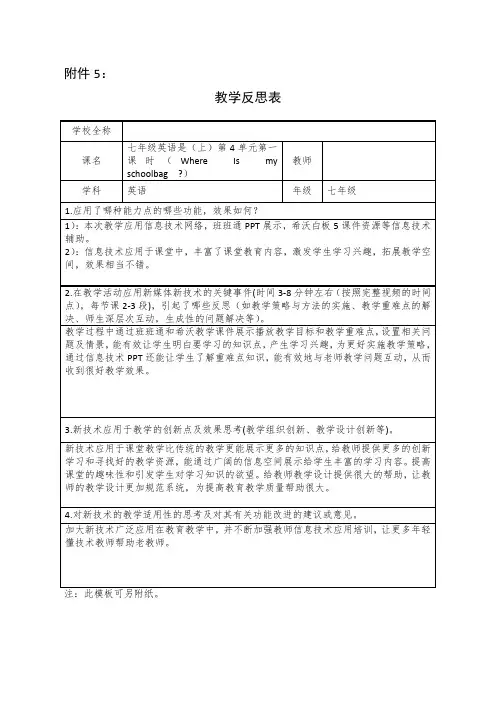
教学反思表
一课时(Where Is my schoolbag ?)
教师
学科
英语
年级
七年级
1.应用了哪种能力点的哪些功能,效果如何?
1):本次教学应用信息技术网络,班班通PPT展示,希沃白板5课件资源等信息技术辅助。
2):信息技术应用于课堂中,丰富了课堂教育内容,激发学生学习兴趣,拓展教学空间,效果相当不错。
4.对新技术的教学适用性的思考及对其有关功能改进的建议或意见。
加大新技术广泛应用在教育教学中,并不断加强教师信息技术应用培训,让更多年轻懂技术教师帮助老教师。
注:此模板可另附纸。
2.在教学活动应用新媒体新技术的关键事件(时间3-8分钟左右(按照完整视频的时间点),每节课2-3段),引起了哪些反思(如教学策略与方法的实施、教学重难点的解决、师生深层次互动,生成性的问题解决等)。
教学过程中通过班班通和希沃教学课件展示播放教学目标和教学重难点,设置相关问题及情景,能有效让学生明白要学习的知识点,产生学习兴趣,为更好实施教学策略,通过信息技术PPT还能让学生了解重难点知识,能有效地与老师教学问题互动,从而收到很好教学效果。
3.新技术应用于教学的创新点及效果思考(教学组织创新、教学设计创新等)。
新技术应用于课堂教学比传统的教学更能展示更多的知识点,给教师提供更多的创新学习和寻找好的教学资源,能通过广阔的信息空间展示给学生丰富的学习内容。提高课堂的趣味性和引发学生对学习知识的欲望。给教师教学设计提供很大的帮助,让教师的教学设计更加规范系统,为提高教育教学质量帮助很大。
人教版英语上册七年级Unit 4 Where’s my schoolbag?教学设计与反思作业

StepThree(5分钟)
Step Four (10分钟)
Step Five (9分钟)
Step One Warming up(8minutes)
Play an English song before class.
Revise some school things by asking questions.
2. in, on, under
3. —Where is …? —It's in/on/under…
—Where are …? —They're in/on/under…
4. —Are the books on the sofa?
—No, they aren't. They're on the table.
Step Five
设计意图:
Improve students’
listening skill.
课堂小结
2分钟
Summary: A memory test
Show a picture of a room, give the students one minute to look at it, then ask them what kind of things they saw and where the things are. Have a competition among groups. See which group can remember all the things and places.
布置作业
1分钟
Homework:
Copy the new words and try to remember them.
人教版七年级上册英语-Unit4 Where’s my schoolbag 单元教案
Unit 4 Where’s my schoolbag?教案【单元教材分析】本单元以谈论物品位置(Things around the house)为话题,要求学生学会方位介词on,in,under,behind等的用法。
题材颇具现代气息,贴近学生日常生活,内容丰富,词汇量大,通过描述物品位置、找寻物品、设置理想化居室等系列活动,让学生在听、说、读、写、做中学习语言知识,培养运用语言知识的能力,激发创新精神。
【单元学情分析】本单元的主要内容是谈论物品所在的位置。
通过这一话题,训练学生的听、说、读、写四项基本技能,让学生通过询问物品的位置,学习一些有关家居物品和学习用品的单词,以及方位介词in,on,under,behind 等的用法;学习并掌握Where问句的问答,一般疑问句提问并用方位介词来回答;学习名词单复数及人称代词they 的用法,同时培养学生养成干净、整洁、合理摆放物品的好习惯。
【单元总体目标】知识目标:A. 掌握有关物品的新单词:table,bed,dresser,bookcase,sofa,chair,drawer,plant,bag,clock,tape,hat,etc;B. 熟练运用in,on,under介词;C. 熟练运用Where问句和一般疑问句及其回答;D. 掌握名词单复数及人称代词they的用法。
能力目标:A.学会用英语准确描述物品所在的位置;B. 学会用英语询问自己的或他人物品的具体位置;C. 能够合理地描述和设计房间。
情感目标:A. 培养学生整齐地摆放自己物品的生活习惯;B.通过小组对话、讨论、调查和设计等一系列的课堂活动,培养学生的合作精神。
学习策略:A. 交际策略: 学会与他人合作交流,并能把语言材料用到真实的生活中去;B.资源策略:学会利用一切可利用的学习资源,如词典,音像资料,网络等来获取更多的学习信息;C.认知能力:积极思考,及时反馈;D.调控策略:在反思,顿悟和自醒中不断调整自己的学习策略。
人教新目标七年级英语上册:Unit 4 Where's my schoolbag教案(含教学反思)
Unit 4Where's my schoolbag?Period 1 Section A (1a~1c)Teaching important points【教学重点】1.Key words & phrases:where,table,bed,bookcase,sofa,chair,on,under2.Key sentences:Where's my pencil box?It's in your schoolbag.Where are my books?They're on the sofa.Where's my computer game?It's under your bed.Teaching difficult points【教学难点】Be able to describe where the things are by using the prepositions correctly.Teaching aids【教具】pictures,CAI,objects,a tape playerTeaching procedures and ways【教学过程及方法】★Step Ⅰ Revision and lead-in复习导入Guessing game:T:What's in my bag?You can guess by using the sentence pattern “Is it a/an …?” to ask me.S1:Is it an apple?T:It sounds you like fruit very much.But it isn't an apple.S2:Is it a cellphone?T:No,it isn't.It's something that we need to write with.S3:Is it a pen?T:Well,let's have a look together.What's this?Ss:It's a pen.T:You are right.My pen is in my bag.Oh,where is my English book?Ss:Your English book is on the desk.T:Oh,yes,thank you!Today we will learn to tell where things are.★Step Ⅱ Self-studying and guiding自学指导Self-study guide 1:Self-study the new words:where,table,bed,bookcase,sofa,chair,on,under.Learn to pronounce them according to the phonetic symbols.And you can listen to the tapes to help you pronounce them correctly or ask others for help.Self-study guide 2:Self-study 1a,read the conversations by yourselves and match the words with the things in the pictures.Questions for thinking:(1)在桌子里面________________(2)在床上____________________(3)在椅子下面________________The teacher walks around the classroom to watch and help the students study while the students are self-studying.Encourage students to find out their problems in self-studying both in pronunciation and understanding.Time for questions:Discuss the difficulties that most students have and explain the language points that most students can't understand.Maybe it is necessary to discuss the usage of prepositions.★Step Ⅲ Check up检查核对Check up 1:Words teaching:Ask a few students to read the new words and help them correct the mistakes in pronunciation if necessary.Check up 2:Check the answers to Part 1a.Ask a team of students to give the answers one by one,and help them correct the mistakes in pronunciation if necessary.Then check the answers to exercises in self-study.Check up 3:Ask some students to make a conversation with their partner and see if they can respond correctly.★Step Ⅳ Cooperative inquiry合作探究1.Listening (1b)Listen and number the things[1-4].Play the recording twice.Then check the answers.2.Pair workMake some conversations with your partner using the words below.baseball bookcaseschoolbag tablebooks chairkeys sofaSample:A:Where is your baseball?B:It is under the chair.Where are your books?A:They are on the table.Where are my keys?B:They are on the sofa.…3.Act outAsk some pairs of students to act out their dialogs in front of the class. ★Step Ⅴ Practice 练习 一.对画线部分提问。
unit 4 where's my schoolbag课例分析
七年级英语教学课例分析Unit4Where is my schoolbag?七年级英语教学课例分析Unit4 Where is my schoolbag?[案例背景]Unit4 Where is my schoolbag?是人教版新目标英语七年级上册第四单元的第一课时。
本单元的话题是谈论物品的位置。
通过单元学习,要求学生在掌握物品的名称的基础上用方位介词熟练地表达物品的位置,并能对where问句进行提问并回答。
七年级学生的抽象思维能力较低,形象思维能力强,但注意力容易分散。
因此,在教学过程中我精心设计各种游戏活动,给学生展示丰富多彩的画面,从而增强学生的兴趣和唤起他们的注意力,进而充分调动学生的学习积极性和主动性。
[案例描述]ⅠTeaching Aims:1.正确使用方位介词on,in,under描述物品所在的位置。
2.正确使用where引导的特殊疑问句询问物品的位置。
Ⅱ Teaching proceduresLead-inReview the new words by using a reading game “Mr. Boom i s coming!”Step1. Lets do.1a Match the words with the things in the picture.Step2. Lets watch a video.Watch the video carefully and then answer the question. “on/in/under song”And then think and answer the questions:视频中反复出现了哪三个单词?(方位介词:表示人和物的位置) Let’s play a game! “Who has the best eyes?”Step3 Look and say(1)出示图片学习介词短语(2)学习句型---Where’s ...? ---Where’re...?---It’s... ---They’re...Step4 Think and discuss in groups.Where + is/are + 物品?1.是由___引导的特殊疑问句,用来询问_______.2.若物品是单数时,用_____提问, 回答时用_________.3.若物品是复数时,用______提问,回答时用____________.Step5 1b Listen and number the things in the picture (1-4).说明听力要求,学生听录音完成听力练习(学生看图听音,冲击视觉系统,加强了学生本课语言目标的印象,加快接受速度,培养学生从图中和文中搜索信息,处理信息的能力和听力能力). Step6 Role-play the conversation.Step7 Make sentences as many as you can.学生两人一组看图,仿照对话进行问答练习,然后编写自己的对话,叫几组同学在班上表演他们的对话。
七年级上册unit4whereismyschoolbag教学反思[精选5篇]
七年级上册unit4whereismyschoolbag教学反思[精选5篇]第一篇:七年级上册unit 4 where is my schoolbag教学反思七年级上册unit 4 where is my schoolbag?教学反思本节课我所教授的内容是人教版七年级上册unit 4 where is my schoolbag? 这是一节新授课,主要教授的内容是词汇教学,以新授单词where, table, bed, bookcase, sofa, chair, on, under, come on, desk, hat, head。
这节课我以复习旧单词作为本节课的导入,出示图片让学生对所学单词进行回顾。
接下来呈现新知,以图片与单词结合的形式呈现给学生,在讲解过程中通过单词的发音,其组合方式,给学生讲解识记单词的技巧,发现学生很喜欢这种词汇识记方法,从课堂上的反应来看,效果还是挺明显的。
接下来讲解三个表示方位的介词 in, on, under.通过展示一张老鼠和一个箱子的位置关系来形象说明这三个介词所表示的意思,也很便于学生理解。
为了能够让学生充分理解并应用所学单词,布置了一个pairwork,同桌之间利用学习用具来编对话。
最后我设计的是一个听力环节,学生听录音三遍,完成听力练习。
本节课既有精彩的地方也有令人不太满意的地方。
主要体现在,首先没有准备充分,没有将table 和chair的区别加以讲解。
其次,上课过程中过于急躁,节奏把握的较快,发现学生对所学单词的发音掌握的不太好,以后应当注意对单词的领读,以及对错误发音的纠正。
最后,本节课本设计的是词汇教学,但是在练习的设计上没有涉及,这也是及其需要注意的地方。
词汇教学是英语教学的核心,需要英语教师的不断反思总结,不断成长。
第二篇:七年级上册《春》教学反思《春》教学反思——姜雄首先,这是我作为一名资教生第一次碰到写景的散文课,同学们很信任我,可是这样的好文章我该怎么讲呢?传统模式?不,绝不。