
unit5 DO you have a soccer ball教学设计
Unit 5 Can you come to my party?
一、教学目标
1. 知识与能力
Section A的主要内容是学会用have对物品的所属进行提问以及应答,学会使用do和does引导的一般疑问句。
2. 过程与方法
采用Discussion and guess和Classifying的学习策略,利用教学幻灯片来展开课堂Pair work问答式的口语交际活动,使用have对物品的所属进行提问及回答。
3. 情感态度价值观
该部分学习内容贴近学生的生活,谈论的主题是符合学生喜爱运动的心理,极易于激发学生学习英语的欲望和兴趣,使他们乐于参与各种英语实践活动。
二、教学重、难点
重点
学习运用重点句型Do you/they have… ? Does he/she have…?等;
语法难点
行为动词have的一般现在时的用法;使用do和does引导的一般疑问句的构成和使用。
三、教学步骤
Steps Teacher’s Activity Student’s Activity Preparation
Lead in Introduce myself to the
students.
Listen
My friends call my Miss
Forget. I always forget
what is in my bag.
PowerPoint
Task I Target language:
Aim Familiar with the target language and the key words
1 Show my bag and something
in it, and ask “
Do I have… in my bag?”
Look at the picture, and
try to answer: “Yes, you
do./ No, you don’t.”
PowerPoint
2 Show the target language:
Do you have a watch?
Yes, I do. I have a watch.
Do you have a ruler?
No, I don’t. I don’t
Look at the example, and
try to understand
have a ruler.
3 Ask Ss to talk about the
picture in 1a.
Finish 1a. Recorder
4 Show the sports things
and learn the new words.
Some students stand up to
teach the new words.
PowerPoint
5 Ask students to practice
the target language with
the new words.
Some students show their
conversations.
6 Listening practice. Listen to the tape and
finish 1b.
Recorder Task II A survey: Group work
Aim Get to know others’ ownership
1 Play the recorder Listen and finish 2a P26-2a Check the answers Give the answers Recorder Play the recorder Listen and finish 2b P26-2b Check the answers Give the answers Recorder
2 Let Ss know others’
ownership
Use the target language,
and talk to others
Does he have …?
Yes, he does.
No, he doesn’t.
Chart
3 Guess Talk about some famous
sports stars.
Does Deng Yaping have a
ping-pang ball?
Yes, she does.
PowerPoint
Task III Grammar
Aim Study grammar
1 Interview(采访) your
group mates. Ask them if
he or she has the things.
Finish the chart with
target language.
Powerpoint
2 Ask Ss to fill in the
blanks.
Talk and finish the chart
3
Can you make more example? Discuss with your group mates about the usage of the verb “have ”. Discuss in groups and get to know how to use “have ” 4
Ask Ss to finish some exercise. finish some exercise. Homework
Do some Exercise
Memorize all the new words and new sentences.
Blackboard
Design Unit 5 Can you come to my party?
Basketball
Soccer ball
Tennis ball
Baseball
Ping-pang ball
四、教学反思:
本堂课我先利用Miss Forget 设置情境引入新句型,大部分学生能够很好的感知和理解,但有一部分学生反应较小。
我应该在提问时尽量扩大提问面积,或增强语言的感染力,吸引更多的学生积极思考。
在教授新单词时,我让有预习过课文的同学来代替我讲,这样能够给他们一定的成就感,也给其他学生一个好的学习榜样。
我设计了几个训练新句型的口语练习,总体感觉不是很好,主要问题是,材料前后重复,让学生缺乏新鲜感,训练形式过于机械,没有形成好的使用语言的环境,另外训练时间不足,有些仓促。
在最后,我本设想通过完成任务的形式让学生感知“have ”的用法及其一般疑问句和肯否回答这一语法知识,但是时间有些紧张,内容没有完全展开,但是学生们配合的不错,经过小组讨论,大部分学生掌握了这一用法,这一点在我之后的练习题当中得到印证。
在本次讲课过程中我还发现了自己长期存在的两个问题就是语速过快,安排课容量不够合理。
这还是与我参赛经验不足,心里紧张有关,是我接下来要克服的主要问题。
Tennis racket Ping-pang bat Baseball bat Do you have a baseball? Yes, I do./No, I don ’t. Does he have a tennis ball? Yes, he does./No, he doesn ’t.。
《Unit 5 Do you have a soccer ball教案 (省优一等奖)
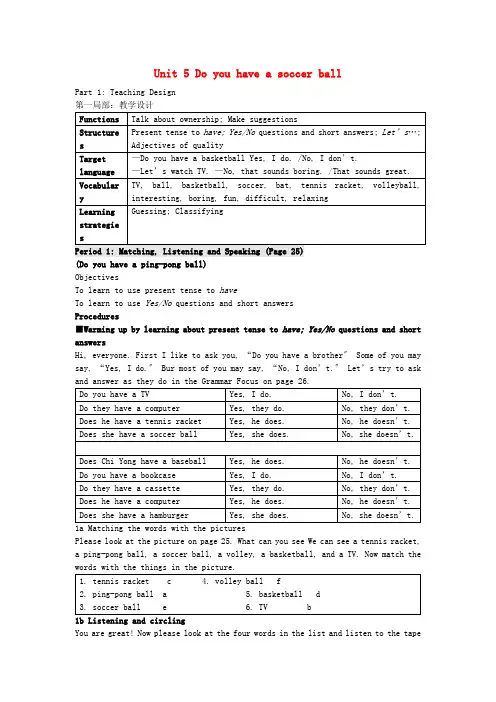
Unit 5 Do you have a soccer ballPart 1: Teaching Design第一局部:教学设计(Do you have a ping-pong ball)ObjectivesTo learn to use present tense to haveTo learn to use Yes/No questions and short answersProcedures■Warming up by learning about present tense to have; Yes/No questions and short answersHi, everyone. First I like to ask you, “Do you have a brother〞 Some of you may say, “Yes, I do.〞Bur most of you may say, “No, I don’t.〞Let’s try to ask and answer as they do in the Grammar Focus on page 26.1a Matching the words with the picturesPlease look at the picture on page 25. What can you see We can see a tennis racket, a ping-pong ball, a soccer ball, a volley, a basketball, and a TV. Now match the words with the things in the picture.1b Listening and circlingYou are great! Now please look at the four words in the list and listen to the tape1c PAIRWORK 结对活动/替换活动Now please read the conversation in the box in 1c and practice it in pairs. Ask andPeriod 2: Listening, Numbering, Circling and Speaking (Page 2)(Does your brother Alan have a soccer ball)ObjectivesTo learn to use present tense to haveTo learn to use Yes/No questions and short answersProcedures■Warming up by asking and answeringHello, class. Is this your volleyball, Li Huaqing Do you have a volleyball Yes, I do. /No, I don’t. Does she, Qian Tu, have a volleyball Yes, she does./ No, she doesn’t. Where’s your volleyball Your volleyball is in the drawer. My volleyball is under the desk. His volleyball is on the floor.Now let’s go to page 26.2a Listening and numberingNow let’s go to page 26. Please look at these four pictures and listen to four conversations. Listen carefully and number the four pictures. (Keys: 3-1-4-2)2b Listening and matchingListen to the recording again and match the people with the balls. (Keys: 3-2-1-4) Now go to page 85 to read the four conversations. While reading you underline all2c PAIRWORK 结对活动/替换活动Look at the things in the picture on page 26. ask and answer if your partner andPeriod 3: Filling and Speaking (Page 27)(Let’s play ping -pong.)ObjectivesTo learn to make suggestionsTo learn to use Let’s…Procedures■Warming up by making sentences with Let’s …Good, morning. Do you know the words: Let’s… It means “让我们……〞. Now let’s make sentences with “〞 “让我们……〞.3a Reading and fillingPlease look at the pictures in 3a. What are they talking about OK, please read the conversations and fill in the blanks with the words from the box.of the conversation we have just heard and read.3b GROUPWORK 小组活动/替换活动Now please make conversations with your partner talking about the pictures on pageWhat sports do you like to play Who are your favorite sportsmen and sportswomen Please look at the poster in part 4 on Page 27. Complete the form and introduce yourselfNow let’s read the poster on page 27 again. Let’s write as they do.Period 4: Listening, Repeating, Writing, Asking, Matching, Completing and Filing (Page 4)(Let’s play computer games.)ObjectivesTo learn to make suggestionsTo learn to use Let’s…Procedures■Warming up by greeting making sentences with Let’s…Hello, class. How are you Are you FineThen look at this , “Let’s…〞 . It means“让我们……〞in Chinese. Now let’s make sentences with “Let’s…〞. OK1a Looking and MatchingHere on page 28 are five words in 1a. Read them loudly and match each picture with1b Drawing and guessingNow please draw a picture of one of the five words interesting, boring, fun, difficult or relaxing. Then let your partner see the pictures and guess what the picture means.2a Listening and checkingLook at the five words again. Next we’ll listen to a conversation and check theWhat does Tony say about each activity Listen to the conversation again and writeNow go to page 86 to read this conversation. While reading try to find all the sentences with Let’s….And also underline all the expressions. That’s grammarNow let’s try to talk by imitation.Imitation talking is using the structure of an example conversation as a form to talk about something of our own.2c PAIRWORK 结对活动/替换练习Now practice the dialogue in pairs. One student plays Tony and the other one plays Jenny, talking about the activities in 2c.Period 5: Reading, Filling and Writing (Page 29)(Ed Smith has a great sports collection.)ObjectivesTo learn to talk about ownershipTo learn to use present tense to haveProcedures■Warming up by making a listHello, class. Do you play sports What sports things do you have Now in pairs make a list of them. Let’s see who has the most sports things in our class.Look at the picture in 3a please. Can you name the sports things that Ed Smith has in the picture Good! He has a great sports collection. Read the text and circle the words of sports things. While reading remember to cut/ the sentence into thought groups, study all the predicates, circle all the linking words and underline all the expressions. That’s grammar study, too.Read the magazine article aloud to the recording. Let’s see who read loud the text the best.Now read the text again to turn it into a conversation.3b Reading and fillingLook at the picture and name everything you see in the picture. Read the article3c Thinking and writingNow please write about yourself. What sports do you play What sports things do you have What other things do you do4 SURVEY 调查Just now you wrote about yourselves. Do you want to know what your classmates haveOK, let’s make a survey. Look at the sample questions and read them aloud. Then write as many questions as possible like these sample ones and survey yourSection B1 1a-2e一、教学目标:2) 能掌握以下句式结构:① ─What are you going to do next year─I’m going to take guitar lessons.② Many resolutions have to do with self-improvement.③ They’re going to take up a hobby like painting.④ Sometimes the resolutions may be too difficult to keep.2. 情感态度价值观目标:每个人都有自己的梦想和对未来的打算,对于将来想要从事的职业也充满了憧憬。
Unit5 Do you have a soccer ball教学设计与反思

Unit5 Do you have a soccer ball教学设计要求:每位老师按照学科组确定的研究的主题提交1份教学设计,教学设计要突出“小课题”研究的精神,可按照下面模板提交也可以自己设计,但是内容应包含以下模块,不得网上抄袭。
Unit5 Do you have a soccer ball?(2a-2c)教学反思执笔者:本节课是人教版七年级第五单元SectionB第二课时,本单元的内容以运动项目为主题。
本节课以“Do you have a soccer ball?及Do he/she have a soccer ball?...”为句型展开话题,并以此为依托,在语言目标“Yes,I do./No,I don’t;Yes,he/she does./No,he/she doesn’t.”中能够正确运用一般疑问句询问物品所属关系并作简单回答,并学会正确使用形容词对事物发表基本看法。
在阅读教学双边活动中,学生学会了快读、慢读文章,掌握关键词,提升学生的阅读技巧,有效提升阅读效率,为日后的阅读习惯及方法打下坚实基础。
另外,这样贴近生活的话题,引导学生养成积极锻炼,热爱生活的良好习惯,激发了学生对以后的一般现在时的正确运用的学习兴趣。
在教学中,我通过学生谈论自己拥有的运动词汇入手,运用所学运动项目词汇,正确使用I have...,but I don’t have...,并以此导入2b的阅读教学,通过听录音、让学生自主默读(包括快读、慢读方式),以及教师围绕课文内容提出问题,教会他们抓住关键词以及表达方式的不同来理解课文,让他们能正确理解句意,准确回答问题,以此来提升学生的阅读技巧、效率,准确回答问题的能力。
同时也激发了学生对阅读理解的兴趣,培养了他们良好的阅读习惯。
这节课,课堂气氛活跃,学生能积极思考,主动回答问题,激发了学生对阅读理解的兴趣,培养了他们良好的阅读习惯。
但也存在一些不足之处,在阅读过程中,也要让学生自主学习,提出阅读过程中的问题,如单词的拼读,固定短语、重要句式的理解,这样,经过质疑,更能加深学生的理解掌握;另外,还可以再进行课外拓展阅读训练,以此来提升学生的阅读技巧运用的能力。
Unit5 Do you have a soccer ball教学设计
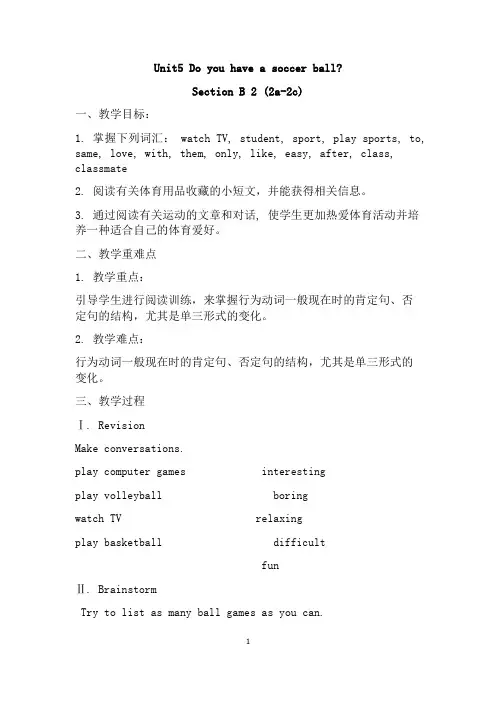
Unit5 Do you have a soccer ball?Section B 2 (2a-2c)一、教学目标:1. 掌握下列词汇: watch TV, student, sport, play sports, to, same, love, with, them, only, like, easy, after, class, classmate2. 阅读有关体育用品收藏的小短文,并能获得相关信息。
3. 通过阅读有关运动的文章和对话, 使学生更加热爱体育活动并培养一种适合自己的体育爱好。
二、教学重难点1. 教学重点:引导学生进行阅读训练,来掌握行为动词一般现在时的肯定句、否定句的结构,尤其是单三形式的变化。
2. 教学难点:行为动词一般现在时的肯定句、否定句的结构,尤其是单三形式的变化。
三、教学过程Ⅰ. RevisionMake conversations.play computer games interestingplay volleyball boringwatch TV relaxingplay basketball difficultfunⅡ. BrainstormTry to list as many ball games as you can.Ⅲ. Writing1. Find the sports words in the unit. Write them in the correct column.2. Make a report to your partner first.S1: I have a soccer ball, a volleyball, two tennis balls, three ping-pong bat…I don't have a basketball, a tennis bat, a baseball bat…3. Exchange the chart with your partner. Report yourpartner's sports collection.S2: He has a soccer ball, a volleyball, two tennis balls, three ping-pong bat…He doesn't have a basketball, a tennis bat, abaseball bat…Ⅳ. Reading1. Our school magazine made a survey about sports collection. This is the survey results. Read the passageand answer the question:Do you have a soccer ball?2. Ss read the passage quickly and find the answer to the question.3. Check the answer. Let some students say their answer and say why?(指导:在读短文时,应重点抓住soccer ball,通过对比文中的信息,从而轻松地就能知道答案。
Unit 5 Do you have a soccer ball 教学设计
Unit 5 Do you have a soccer ball ? 教学设计一、教学内容分析本课主要学习球类单词和句型Do you have....?教会学生能够根据场景熟练运用do you have....?进行询问,且能正确的使用肯定和否定回答,并拓展到do I have / we have进行回答,在讲解句型之前,先让学生认知单词,可采用图片和实物等方法进行教学。
二、教学目标1.能掌握本课重点词汇:do,have,ball,tennis,soccer,volleyball,basketball2.能初步口头运用Do you have...?Does he/she have...?等句型询问物品的所属关系,并能作出相应回答。
3.能基本听懂含有本课重点词汇和目标语言的听力材料。
4.能通过谈论体育运动,增加同学间的了解和对体育运动的热爱。
三、学习者特征分析学生在掌握了介绍自己和介绍家人的句型后,在第4 单元能够谈论具体物品的位置,在前四个单元的词汇量输入之后,在第五单元能通过谈论体育运动,增加同学间的了解和对体育运动的热爱。
三、教学策略选择与设计采用 ask and answer role-play联想教学法、情景交际法、自主学习与合作学习相结合加上适当PPT展示的学习策略。
四、教学重点及难点重点:学会运用Do you have...? Does he/she have...?句型询问物品的所属关系,并能作出相应回答。
难点:恰当使用助动词do/don’t和does/doesn’t;初步了妥have和has的用法。
会用祈使句来向对方提出建议。
五、教学过程教师活动1.让学生观看球类运动的视频,输入关于球类的相关单词。
2.展示各种各样球类的图片,学习新单词并朗读。
3.问题导入Do you have a soccer ball ?Do you like soccer ball ? Why ?4.展示出描述球类运动的形容词,为什么喜欢这个球类运动以及为什么不喜欢,引出单词interesting,fun boring relaxing 等。
人教版英语七年级上册Unit 5 Do you have a soccer ball教学设计
人教版英语七年级上册Unit 5 Do you have a soccer ball教学设计一. 教材分析人教版英语七年级上册Unit 5主要围绕着球类运动展开,本节课将学习到关于足球的词汇和句型。
教材通过介绍不同球类运动,引导学生运用英语进行交流,提高他们的语言运用能力。
本节课的主要内容包括词汇:soccer ball, basketball, volleyball, table tennis等,以及句型:Do you have a …? Yes, I do. No, I don’t. How many … do you have?二. 学情分析七年级的学生已经掌握了基本的英语语法和词汇,具备一定的听说读写能力。
他们在日常生活中对球类运动有浓厚的兴趣,因此本节课的主题能够激发他们的学习兴趣。
然而,部分学生可能在英语表达上还存在一定的困难,需要教师在课堂上给予更多的关注和引导。
三. 教学目标1.知识目标:学生能够掌握关于球类运动的词汇和句型,正确运用Doyou have a …? 和How many … do you have? 进行交流。
2.能力目标:学生能够在小组活动中用英语介绍自己的球类运动用品,提高他们的语言运用能力。
3.情感目标:培养学生对球类运动的热爱,增强他们的团队协作精神。
四. 教学重难点1.重点:学生能够掌握关于球类运动的词汇和句型。
2.难点:学生能够正确运用Do you have a …? 和How many … do youhave? 进行交流。
五. 教学方法1.任务型教学法:通过设置不同的任务,让学生在实践中运用英语,提高他们的语言能力。
2.合作学习法:通过小组活动,培养学生的团队协作精神,激发他们的学习兴趣。
3.游戏教学法:通过球类游戏,让学生在轻松愉快的氛围中学习英语。
六. 教学准备1.教师准备:提前准备球类运动的图片、词汇卡片、录音机等教学用具。
2.学生准备:带上课本、笔记本,提前预习本节课的内容。
Unit5Doyouhaveasoccerball教案

Unit5Doyouhaveasoccerball教案一、教学分析(一)教学内容分析本文学习的内容是询问物体的所有权,并以运动器材为载体,学习了各种球类的说法,学习了助动词do和does,以及实义动词have。
(二)学生分析本课的学生是针对七年级基础中等的学生设计的。
(三)教学目标让学生询问物体的主人了解do和does分别在什么情况下使用感受实义动词have 的用法掌握各种球类的说法(四)教学重点和难点重点:1. Do,does 的用法2. 实义动词have 的意思和用法3. 球类的说法难点:1. does的用法2. has 的用法3. 助动词开头的一般疑问句的问法及回答(五)教学设计思路1. 备课思维过程这节课主要是通过对询问运动器材的所有权来学习助动词开头的疑问句,因此本课设计的思路主要依靠一条操练do、does一般疑问句的主线来进行,同时,为了使课程的脉络更加清晰,更吸引学生,本课也另外贯穿了一条关于爱好的主线,来拓展话题,通过询问球类到询问其他物品的过渡。
2. 课堂教学活动要求学生自带各种所收藏的球类,并通过这种所属感通过小组活动来感知Do you have …?和Does he/ she have…? 的含义,并学会运用。
3. 教学内容调整本课所教授的学生基础在中等水平,因此要根据学生在课中的反应进行调整。
二、教学过程1. 通过图片引入话题通过几张关于体育明星的照片,引出关于球类的话题。
2. 词汇输入请七位学生到讲台前边展示自己的球类,边教授全班该球类的单词,包括语音及拼写。
3. 单词输出通过书本1a部分的的练习来巩固单词。
4. 快速反应通过球类的图片快闪,进行一个叫Quick response 的游戏,请知道如何拼读球类单词的学生进行迅速起立大声说出,学生在这个游戏中锻炼了反应能力,并且提高了相互竞争的意识,同时最重要的是操练了词汇的拼读。
5. 引出主线回顾之前的运动明星,他们的爱好就是职业,再通过爱好,引出我的家庭成员,展示一张我的全家福,并且请学生猜测人物关系,以及猜测响应的人物所拥有的爱好。
Unit 5 Do you have a soccer ball_教案
Unit 5 Do you have a soccer ball?Section A Grammar focus and 3a-3c一、Teaching aims and demandsKnowledge and skills :1.掌握句型Let’s play soccer. That sounds good. Do you play volleyball?2. 熟练掌握词汇let, us, play, well, sound, great3.能正确运用Let’s …来向别人提出建议。
4.能使用That sounds …/I don’t have …回答别人的建议。
Teaching process and methods:通过教师讲解,对话展示,图片描述,自主探究等活动,熟练使用Grammar focus重点句型。
Emotional attitudes and values:在询问物品所属关系中获得英语学习的乐趣,逐步培养学生们对英语学习的兴趣并养成良好的收藏习惯。
二、教学重点:1.掌握句型:Let’s play soccer. That sounds good. Do you play volleyball? Have 和has的句型。
2. 熟练掌握词汇let, us, play, well, sound, great3.能正确运用Let’s …来向别人提出建议。
4.能使用That sounds …/I don’t have …回答别人的建议。
三、教学难点:1.训练学生在不同情景下运用所学句型来询问物品所属关系的能力。
2.能在实际生活中运用所学句型询问物品所属关系。
四、教学方法:运用自主探究、合作交流法、小组合作、情景交际等教学方法。
五、教学准备:ppt, exercises,a computer and some balls六、教学过程设计:Step 1 RevisionFirst,the teacher show a basketball,a volleyball and a ping pong ball and ask the questions: What’s this in English? Do you have a basketball?According to the pictures ,let students answer the questions. Do you have a tennis racket? Where is the tennis racket? Does Tom have .......? Does Mary have........? Step2 Study new words and expressions.Great,play ,sound,Let’s play...., That sounds goodStep 3 Practice words and expressions in pairs.1.A: Do you have a volleyball ? B: Yes, I do.A: Let’s play volleyball. B: That sounds good /great.2.Show some pictures ,then let students ask and answer in pairs.A: Does he / she have a .....? B: Yes, he /she has a ....A: Does he / she have a .....? B: No, he /she doesn’t have a ....Step 4 Study Grammar FocusLet students read these sentences and remember them,then let students fill the blanks according to Chinese.Step 5 According to the pictures ,let students study the sentences: I have a ....,but I don’t have a ..... She has a ....,but she doesn’t have a.... He has a... but he doesn’t have a...Step 6 总结have /has用法(学生总结,教师补充)have和has与主语搭配:(肯定句)I SheWe HeYou have … It has…They The boyTony and Jenny Jenny可见,现在时态里,主语为第三人称单数时用has,其余人称都用have。
Unit 5 Do you have a soccer ball 教案
Unit 5 Do you have a soccer ball?一、单元教材分析本单元主要学习动词have的一般现在时的用法;使用do和does引导的一般疑问句的构成以及简单回答。
本单元围绕“和朋友一起欢度时光”这一话题安排了三个任务:一是列举所学的运动项目,从中挑选出各自喜欢的体育项目,并说明原因,目的是巩固并新学一些体育项目的名词;二是让学生互相询问所爱好的运动,并根据情况发出邀请,学会用have对物品的所属进行提问与回答,掌握用do和does引导的一般疑问句的构成及使用,了解用Let’s提建议的句型;三是写作,把任务一、二的完成情况写成日记,进一步复习、巩固所学的语言目标。
通过本单元的学习,学会用have对物品的所属进行提问与回答;学会用let’s…句型提建议;能够谈论自己喜欢哪些球类运动,不喜欢哪些球类运动及原因;能够谈论怎样和自己的朋友度过一段愉快的时光。
二、单元学情分析本单元的主题是使用have对物品的所属进行提问及回答,以掌握行为动词在一般现在时中的构成和使用;同时引导学生使用所学的句型谈论自己在球类运动中的喜好。
行为动词在一般现在时的肯定句、否定句和一般疑问句中的构成和使用是初中英语教学中非常重要的内容,本单元知识的掌握程度将直接影响今后的英语学习。
学生在以前的学习中已经掌握了be动词在一般现在时中的构成和使用,在学生的头脑中也已经形成了一个模式,这种模式将直接影响学生对本单元知识内容的接受,所以教师在教学中一定要善于引导,以免学生养成不良习惯。
该部分学习内容贴近学生的生活,谈论的主题是符合学生喜爱运动的心理,极易于激发学生学习英语的欲望和兴趣,使他们乐于参与各种英语实践活动。
三、单元教学建议利用教学图片、幻灯片、画纸和蜡笔等来展开课堂Pair work问答式的口语交际活动和小组活动,使用have对物品的所属进行提问及回答。
本单元的教学法建议:语音教学——让学生进行模仿操练;词汇教学——采取演示讲解的方式进行教学,让学生进行情景操练、反复使用;口语教学——采取pair work问答式的口语交际活动互相操练练习;阅读教学——让学生学会抓住主要词汇和句型;听力教学——采取图文配对和对话选择的方式;写作教学——以填空、造词为主;语法教学——总结规律、模仿操练。
Unit 5 Do you have a soccer ball_教案
41’09’’---
41’22’’
Help the Ss set a correct attitude.
Sports make us healthy! Playing sports with friends make us happy!
Ss conclude and try to feel and getthecorrect moral attitude.
利用电子白板清晰标注标题问句及每段第一句话中的关键词,帮助学生迅速得出答案。用图片表达猜测与事实不符合的惊讶,引起学生好奇。利用电子白板圈出三个孩子不只是回答了标题的问句,还各自有阐述。为后文做铺垫
2b
While-reading (Scanning)
12’04’’--
19’19’’
Guide the Ss to understand the reading passage well.
A: Do you have a …?
B: Yes, I do. I have a…/No, I don’t . I don’t have a…
Ask and answer.
利用电子白板展示很多学生学习过的球类名词图片,激发学生的学习兴趣,使教学环境更加真实生动。
Free talk
2’56’’---
利用电子白板对比标注指令中的中英文,学生能很快理解老师的指令,帮助其消除学习新课的紧张。
Situation Presentation
6’18’’---
6’34’’
To set a big situation for the whole lessonand lead in 2b, the reading material naturally.
Unit5Doyouhaveasoccerball教案
Unit 5 Do you have a soccer ball?1. Teaching aims:A. Knowledge aims: Students could grasp the words (soccer ball, basketball, volleyball, ping-pong, tennis) and the sentence structures (Do you have a xxx? Does he/she have a xx)B. Ability aims: Students could know more things about sports and talk about part of them freely.C. Emotional aims: Students could be more interested in Sports and English learning.2. Key & Difficult pointsA. Key points: Names of several sports and the Yes/No questions.B. Difficult points: The differences between do and does, have and has.3. Teaching Procedures:A. Warm-up & lead-inShow a short video of 2018 FIFA World Cup and lead to the topic.Q1: What’s the video about?Q2: Do you like soccer ball?Q3: Do you have a soccer ball?B. Presentationa. L et’s visit the Ball World together and check the balls.Present the words in 1a by pictures and sounds,and then do a “What’s missing” game to check.b. A nalyze the picture and let students get familiar to the items in it. Then finish 1a.c. I b: Lead the students to read the words once and then finish the listening.d. S entences①Do you have a ping-pang bat? Yes, I do. I have ...②Do you have a tennis ball? No, I don’t. I have ....C. PracticePlay the chain games to practice the sentence structure.D. Listeninga. P re-listeningLead to the sentence structure “Does....?”Q1: Do you have...?Q2: Does he have...?Q3: Does she have..?Q4: Does Yao Ming have..?Q5: Does xx have...?b. L istening①Read the 4 names after the teacher and then number the pictures.②Finish 2ac. F ill in the blnks.Post-listeningRole-play: Role-play the conversation between Cindy and Dale.E. Conclusion.Words & sentencesF. ExtensionSports are beneficial to building our bodies.。