
英译汉翻译技巧省略法
英译汉翻译技巧省略法
省略法(omission)是为了行文的简洁和更符合目的与习惯,将一些重复的词语或一些已被涵盖的意义省去的翻译方法,而原文的意义并未因此受到任何损失。
1.When she could no longer decide, she became depressed. Whenever Dwight picked up the baby to take him to his place or to the doctor’s for a checkup, she felt relief.
她无法抉择,心情压抑,而前夫马赛一把孩子接走或是送到诊所接受检查她就会有一种轻松感。
2.Rupert with his flexible young knees sat in a hunch-and-crouch pose in imitation of the natives.
鲁珀特年龄小,双膝柔韧,学着当地人的样子,弓背缩身地跪坐着。
3.Stainless steel possess good hardness and high strength.
不锈钢硬度大,强度高。
4.Penicillin works by not allowing a bacterium to build its cell wall.
青霉素的作用是不让细菌制造细胞壁。
5. This is the solid rocky bottom under the ooze and mud of the ocean floor.
海底软泥和泥层下面是坚硬的岩石层。
6. There is a 30% increase of our installed capacity with this year.
今年,我们的装机容量增加了 30%。
7.在工作中,我们必须避免犯不必要的的错误。
We must avoid making mistakes in our work.
8.质子带阳电,电子带阴电,而中子既不带阳电也不带阴电。
A proton has a positive charge and an electron a negative charge, but a neutron has neither.
9. He put his hand into his pockets and then shrugged his shoulders.
他双手插进口袋,耸了耸肩。
10. Smoking is not allowed in the store-house.
仓库重地,严禁吸烟。
11. 匪军所至,杀戮人民,奸淫妇女,焚毁村庄,掠夺财物,无所不用其极。
Wherever they went, they massacred and raped, burned and looted, and stopped at nothing.
12.前怕龙后怕虎的态度不能造就干部。
“Fearing dragons ahead and tigers behind” will not produce cadres.
13.我们党结束了那个时期的社会动荡和纷扰不安的局面。
Our Party has put an end to the social unrest and up heaval of that time.
14.这种人闹什么东西呢?闹名誉,闹地位,闹出风头。
What are these people after? They are after fame and position and want to be in the limelight.。
英语翻译技巧第十节 省略法

第十节省略法省略是删去一些可有可无的,或违背译文语言习惯的词。
一.从语法角度来看(一)省代词1.省略作主语的人称代词(1)英语中通常每句都有主语,如主语不变,译成汉语时不必重复。
1)He was thin and haggard and he looked miserable. 2)But it’s the way I am, and try as I might, I haven’t been able to change it.3)They had murdered his father, they had taken the best of him, they had crushed his whole family.4)Laura wished now that she was not holding that piece of bread-and-butter, but there was nowhere to put it and she couldn’t possibly throw it away.1)他消瘦而憔悴,()看上去很惨。
2)但我就是这个脾气,()虽然几经努力,()却未能改变过来。
3)他们害死了他的父亲,()榨干了他的精力,()毁了他的全家。
4)这时劳拉宁愿()手里没有这块涂上黄油的面包,拿着又没有地方放,()又不可能扔掉。
作业:1.I am 78 years old; I have been confined to my room with a paralytic stroke for the past 14 months.2. Like his friend he had many wonderful ideas, but he only put a few into practice.3. We can measure the amount of water in a pot, but we can’t measure its heat. We haven’t an instrument for that.4. The Grand Dukes always liked new ideas, and later they were good friends of Galileo.(2)泛指的英语人称代词作主语时,即使是第一个主语,汉译时也可省略。
第九讲 英语翻译技巧省略法
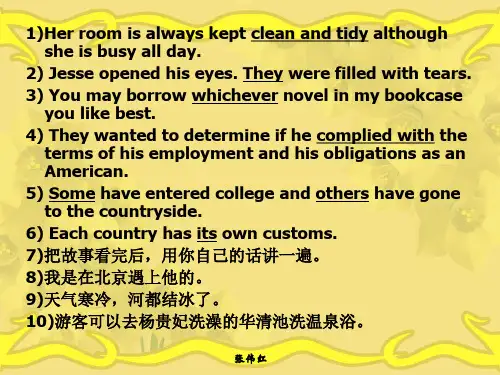
you like best. 4) They wanted to determine if he complied with the
terms of his employment and his obligations as an American. 5) Some have entered college and others have gone to the countryside. 6) Each country has its own customs. 7)把故事看完后,用你自己的话讲一遍。 8)我是在北京遇上他的。 9)天气寒冷,河都结冰了。 10)游客可以去杨贵妃洗澡的华清池洗温泉浴。
张伟红
1) Her room is always kept clean and tidy though she is busy all day.
尽管她整天忙忙碌碌, 她的房间却保持得干干净净,利利落落。
2) Jesse opened his eyes. They were filled with tears. 杰西睁开眼睛, 眼里充满了泪水。
1.省略某些重复词语 2.省略表示范畴的词语 3.省略可能影响译文修辞效果的词语
四、汉译英练习
张伟红
一、英汉翻译中的省略技巧
Eg.1)You can never tell who is right. 很难说谁对谁错。(省略人称代词) 2)Those who are in favor please hold up their hands. 赞成的请举手。(省略指示代词、关系代词和物主代词) 3)It’s necessary to develop our computer science at
省略法
∙英译汉翻译技巧∙省略法∙首先请试译下面的句子:∙Dr. John resumed his experiment as soon as he came into the laboratory.∙译文一:约翰博士一到实验室,他就继续做实验。
∙译文二:约翰博士一到实验室就继续做实验。
∙译文一将主从句的主语都译出,貌似“忠实”,但产生歧义,可能让人以为“他”和”约翰博士”是两个人。
∙省略法(omission),是指在翻译中,原文中有些词在译文中可以省略,不必翻译出来。
因为译文(汉语)中虽然没有这个词,但是已经具有了原文这个词所表达的意思,或者这个词在译文中的意义是不言而喻的。
省略的目的在于使译文更加通顺流畅,更符合译文习惯(idiomatic)。
一般地说,英译汉并不随便删减词语,但汉语有其简洁的特点,如果过分强调表达一切,把每一个词都译出,反而因为保全了一些次要部分而破坏了整体,即所谓因小失大。
因此,只有敢于牺牲一些不影响原意的词句,才能更好地突出重点。
∙Definition∙By omission we mean we properly omit some words or expressions in order to make the translated version brief, concise and clear. Proper omission in English-Chinese translation often involves the omitting of some words (such as prepositions, articles, certain pronouns, conjunctions, etc.) that are indispensable in the SL text but not in the TL text.∙Omission is based on the differences between English and Chinese. For example, Chinese has no articles or infinitive markers. And pronouns, conjunctions, and prepositions are not used as frequently as those of English. So when we translate English sentences with articles and infinitive markers into Chinese, we often omit these articles or infinitive markers.∙Principles1. Omission should be aimed at smoothness and conciseness or succinctness.2. Omission does not go against ‘faithfulness’. Omission does not mean subtracting meanings from the original work.3. What is omitted may not be necessarily confined to certain parts of speech, as the traditionalists often say. Any parts of speech may be liable to be omitted depending upon the context and the translator’s translation techniques.∙一个认真负责的译者往往不仅善于保全,而且也善于牺牲。
英文翻译技巧之减词法
翻译技巧之减词法一、从语法角度来看(一)省略代词英语代词的使用频率远远高于汉语。
因此,英文汉译时往往按照汉语习惯将原文中的一些代词省略。
1.省略作主语的人称代词根据汉语习惯,在指代关系明确的情况下,假如前后两句主语相同,就不必重复出现。
英语通常每句都有主语,因此做主语人称代词往往多次出现,这种代词汉译时常常可以省略。
(1)He who never reached the Great Wall is not a true man. 不到长城非好汉。
(2) We live and learn. 活到老,学到老。
2.英语中有些作宾语的代词,不管前面是否提到过,翻译时往往可以省略。
(1) I’ve received your letter and read it with delight. 我收到了你的来信,愉快地读了。
3.省略物主代词英语中的物主代词,汉译时往往可以省略,例如,I wash my face in the morning. 汉语只需说“我早上洗脸”,而不必说“我早上洗我的脸”。
(二)省略代词it英语中代词it既可用作人称代词,又可用作非人称代词、先行代词或强调句型中。
下面侧重讨论it在其他几种用法中英语汉译时的省略。
1.非人称代词it的省略非人称代词it在句中做主语时实际上是个虚词,并不指代上下文中具体的事物,一般主要用于表示自然现象、时间、距离、环境及一般情况等。
汉译时,常将这一非人称代词it省略。
(1)It was just growing dark, as she shut the garden gate. 她关上园门时,已是暮色苍茫了。
(2) I glanced at my watch. It was earlier than I thought. 我看了一下手表,发现时间比我想象的要早。
2.先行代词it的省略先行代词it的主要作用是充当语法规则所要求的形式主语或形式宾语。
它本身也是个虚词,没有具体的词汇意义,因此汉译时往往可以省略。
英译汉翻译技巧——省略法

小结
1. 省译法不是任意省略、删减。从以上各例句中 不难看出,某些词语如果不删减,译文必定不够简 洁,或累赘不堪,甚至影响整体意思的表达。采用 省略法不仅使译文读起来流畅、自然,而且突出了 原文的整体意思。 2. 应该特别注意的是,省略绝不能影响原文的中 心思想和整体意思,否则就是违背“忠实”这一基 本原则。从原则上讲,翻译不能对原文内容作任何 删减,所以,采用省略法必须以不损害原文的内容 为前提。 3. 与增译法(amplification)相比,减省的情况要 少得多,所以,省略法要慎用,绝不可想删就删, 随心所欲。
Smoking is prohibited in public places. 公共场所不准吸烟。
(六)省略动词
英语句子中一般必须有谓语动词。而汉语的谓语 并不一定非由动词充当,形容词和名词等同样可 以作谓语。
When the pressure getห้องสมุดไป่ตู้ low, the boilingpoint becomes low. 气压低,沸点就低。
(五)省略介词 一般说来,表示时间和地点的英语介词,译成汉 语如出现在句首,大都可以省略,出现在句尾大 都不省略。 The People's Republic of China was founded in 1949.
一九四九年中华人民共和国成立。
比较:中华人民共和国成立于一九四九年。(介词
译成汉语在句首时可以省略,在句尾就没有省略)
根据汉语习惯,前句出现一个主语,后句如仍为同一主语 ,就不必重复出现。英语中通常每句都有主语,因此人称 代词作主语往往多次出现,这种人称代词汉译时常常可以 省略。
英语中有些作宾语的代词,不管前面是否 提到过,翻译时往往可以省略。
英译汉翻译技巧——省略法
省略法
首先请试译下面的句子:
Dr John resumed his experiment as soon as he came into the laboratory.
译文一:约翰博士一到实验室,他就继续做实验。 译文二:约翰博士一到实验室就继续做实验。
译文一将主从句的主语都译出,貌似“忠 实”,但产生歧义,可能让人以为“他”和”语有冠词,汉语没有冠词;因此,英译汉时往往可 将冠词省略。
A teacher should have patience in his work. 当教员的应当有耐心。(省略不定冠词A)
It is out of the question to fly to the moon in the past.
试比较:……树叶从树上落下来,草也枯死了。 前者简明洗炼。
小结
1. 省译法不是任意省略、删减。从以上各例句中 不难看出,某些词语如果不删减,译文必定不够简 洁,或累赘不堪,甚至影响整体意思的表达。采用 省略法不仅使译文读起来流畅、自然,而且突出了 原文的整体意思。 2. 应该特别注意的是,省略绝不能影响原文的中 心思想和整体意思,否则就是违背“忠实”这一基 本原则。从原则上讲,翻译不能对原文内容作任何 删减,所以,采用省略法必须以不损害原文的内容 为前提。 3. 与增译法(amplification)相比,减省的情况要 少得多,所以,省略法要慎用,绝不可想删就删, 随心所欲。
Smoking is prohibited in public places. 公共场所不准吸烟。
(六)省略动词
英语句子中一般必须有谓语动词。而汉语的谓语 并不一定非由动词充当,形容词和名词等同样可 以作谓语。
When the pressure gets low, the boilingpoint becomes low. 气压低,沸点就低。
7省略法的翻译(教师版)
英汉翻译常用技巧----省略法Oct. 17th–21st 省略是指原文中有些词在译文中不翻译出来。
原因是译文中虽无其词但已有其意,或者在译文中是不言而喻的。
换言之,省略是删去一些可有可无的,或者有了反嫌累赘或违背译文语言习惯的词。
但省略并非把原文的意义删去。
一、从语法结构考虑的省略1. 代词的省略A.省略作主语的代词。
汉语习惯中,前句出现一个主语,后句如仍为同一主语,就不必重复。
英语中则通常每句都有主语,人称代词往往多次出现。
英译汉中该类人称代词常常可以省略。
eg1. He was thin and haggard and he looked miserable.他消瘦而憔悴,看上去一幅可怜相。
eg2. Like his friends he had many wonderful ideas, but he only put a few into practice.像他的朋友一样,他头脑里虽然有许多美妙的想法,却只有少数付诸实施。
eg3. My elder brother did not come yesterday, he went to his friend’s home.我的弟弟昨天没来,到朋友家去了。
B. 泛指的代词常常不译。
eg4.When will he arrive? – You can never tell.他什么时候到?很难说。
eg5. One is never too old to learn.活到老,学到老。
eg6. All those years in the military, where there were certain standards and rules; where young men treated their superiors with respect; where you gave an order and it was obeyed; where a uniform meant you were all on the same side.多年来的军队生涯,那里总是有一定的标准和规则;年轻人尊敬上级;发出命令,人人遵守;同样的制服就意味着站在同一边。
从目的论的角度论汉英翻译中的省略法
从目的论的角度论汉英翻译中的省略法李波;胡然【摘要】The omission is a common technique used in translation. Being restricted by the traditional standard of equivalency, the omission is often undervalued in Chinese-English translation. In order to bring this technique into full play, this paper discusses the application of the omission in Chinese-English translation based on Skopostheorie. Typical examples are studied in fields of introductions, advertisements, law texts, business texts and literature. The various reasons for applying the omission in all examples are concluded, with the principal ones being to meet readers" interests and to realize expected effects. The conclusion is drawn that under the guidance of Skopostheorie, the omission sometimes produces an unexpected appropriate effect and it can and should be encouraged in translation.%省略法是翻译中的常用手段,由于受到传统“等值”翻译观的种种限制,该翻译手段在实际汉英翻译中的作用被大大低估。
英语翻译之省略法
• He declined to amplify on the President’s statement, since he had not read the text.
• 他没有看到总统讲话的文本,不愿意加以发挥. • If I had known it,I would not have joined in it.早知
• 众所周知,重量是地球作用在物体上的引力。
• ③强调句中的it,本身无词义,省译。 • 例 : It is a man’s social being that
determines his thinking. • 是人们的社会存在,决定人们的思想。
• ⑺同义词或近义词的省译
• 英语中,特别是科技英语中,有些同义词 或近义词连在一起用,或者表示强调,使 意思更加明确,或者表示一个名称的不同 说法。英译汉时,往往只译其中的一个, 或把意思综合起来译即可。
• 例:When heated, gases act in exactly the same way as liquid acts.
• 气体受热时所发生的变化与液体完全一样。
• 在实践中,动词省译还见于下列两种情况: • •某些系动词,如be, become, get等,如以形容
词或介词短语作表语时,这类动词常可省译。
• 化学反应的速度和反应物的浓度成正比。
• The basic function of the triode is as an amplifier. • 三极管的基本功能是作电流放大器。 • ⑵省译介词
• 英语中,词与词的关系通常是用介词来表示的。而汉语 中,词与词的关系是通过语序和逻辑关系
• 来表示。所以,英译汉时,许多介词可省略不译。 比如,表示时间、地点的介词,译成汉语时出现 在句首的可省译。
第九讲 省略译法
(二) 省略译法(Omission)
• 词的省译或叫省略法,指的是原文中的有 些词,译时不译出来。译文中虽无其词, 但已有其意,或是属于不言而喻,译出来 反倒累赘或是违背译文的语言习惯。省略 译法的目的是为了使译文简明扼要、通顺。 要特别注意,省略法不是,也不能删去其 中 的 内 容 。 ( conciseness, smoothness and brevity)
⒈ 英译汉时的省译
• 从语法和修辞的角度看,省略有下列几种情况: • ⑴省译冠词(Article) • 英语中冠词用得很多,汉语中却没有冠词。汉译英 时要注意加上名词前面的冠词,而英译汉时,冠词 往往可以省译。 • 例:The rate of a chemical reaction is proportional to the concentration of the reacting substance. • 化学反应的速度和反应物的浓度成正比。
• ⑷省译代词(pron.) • 英语中常常每句都有主语。根据汉语习惯,前面 如果出现一个主语,后句如果仍为同一主语,就 不必重复出现,所以,用来代替句子中曾出现 • 过的某一名词的人称代词或指示代词that或these 等,有的可省略不译。泛指的人称代词作主语也 常可省译。作定语用的物主代词,往往可省译。 • 例:It is never too late to mend. • 改过不嫌迟。
• If you know the frequency, you can find the wavelength. • 如果知道频率,就可以求出波长。 • 根据汉语习惯,某些用作宾语或同位语的反身代 词可省略不译。 • Why do we feel cooler when we fan ourselves? • 扇扇子时,我们为什么感到凉快些?