
6Bunit2 good habits 第1课时(Story time)教案
英语(六年级下册)Unit 2 Good habitsStory time苏州市沧浪新城二实小何芳Teaching contents 教学内容Story timeTeaching aims and learning objectives 教学目标1. 能听懂、会说、会读、会写“He gets up early in the morning.”“He never goes to bed late. He also does well at home.”等句型以及messy、tidy、early、late、habit、never、finish、fast、put … in order、bad、sleepy、last night等词汇。
2. 能正确朗读课文,理解其大意,并能复述课文内容。
3. 能尝试根据所学短语和句型来描述自己和别人的习惯。
4. 能分清好坏习惯,并知道以好的习惯来要求自己,让自己拥有更多好的习惯。
Focus of the lesson and predicted area of difficulty 教学重点和难点教学重点:1. 能听懂、会说、会读、会写“He gets up early in the morning.”“He never goes to bed late. He also does well at home.”等句型以及messy、tidy、early、late、habit、never、finish、fast、put … in order、bad、sleepy、last night等词汇。
2. 能正确朗读课文,理解其大意,并能复述课文内容。
教学难点:能尝试根据所学短语和句型来描述自己和别人的习惯。
Teaching procedures 教学过程Step 1 Learning aimsT: Let’s look at what we will learn today. (PPT呈现本节课学习目标)T: First, we can read the story. Second, we can retell the story. Third, we can try totalk about the good habits.【设计意图:让学生对本节课的教学内容有所了解。
】Step 2 Presentation1. T: We have a good friend, Yang Ling. Do you want to know her well?Listen to my chant carefully. (初步感知新的短语词汇)2. T: You know my good friend in my chant. She gets up early and never goes to bedlate. (板书get up early, never …) What does “never goes to bed late” mean, A or B? (PPT呈现小图,新授early & late)T: Do you get up early and go to bed early?I think we should get up early and go to bed early.T: And Yang Ling often puts her things in order. (板书put … in order,通过before, morning引导学生读order)T: Do you often put your things in order?S: Yes, I do./No, I don’t.T: Good. She often puts her things in order, so she keeps her room clean and tidy.(新授tidy = not messy)T: In the chant, do you remember when she finishes her work?S: She finishes her work befo re nine o’clock. (PPT呈现句子)T: When do you usually finish your homework? (板书finish one’s homework …) S: I usually finish my homework at/before …3. T: Look at the four sentences. What are they about? They are about habits.So today we’ll learn a new les son—Unit 2 Good habits. (揭示并带读课题) 【设计意图:通过引入契合本单元主题的儿歌,既揭示课题又为Story time的学习扫除语言障碍。
】Step 3 Story time1. T: You know a lot about Yang Ling’s habits. Look, who are they?S: They’re Wang Bing and Liu Tao. (贴人物头像)T: What habits do they have? Discuss in pairs.S: Maybe Wang Bing …/Maybe Liu Tao …T: Well, I have some choices. Let’s read them first.T: Please watch the cartoon, and then finish the match in groups of four. (教师先播放卡通,然后学生小组讨论后一起回答)S: Wang Bing finishes his homework early. Wang Bing puts his things in order.Wang Bing gets up early.Liu Tao does his homework late at night. (板书do one’s homework late)Liu Tao goes to bed late. Liu Tao helps his parents. (板书help …)2. T: What other habits do they have? Please read the story again and find them.S: Wang Bing brushes his teeth in the morning and before bedtime. (板书brush one’s teeth …)T: Before bedtime means he brushes teeth …S: He brushes teeth before he goes to bed.Liu Tao listens to his teachers and keeps his room clean and tidy.(板书listen to the teachers …keep the room …)3. T: Good. They have a lot of habits here.But which are good habits? And which are bad habits?(学生小组讨论后汇报答案)T: We know Liu Tao often does his homework late at night and goes to bed late, so he often feels … in the morning.S: So he often feels sleepy in the morning. (板书feel sleepy …)4. Think & write(指导学生完成P18 Think and write)5. Reading time(1) Listen & imitate(2) S: Read the story in boys/girls. (Boys read “Wang Bing”. Girls read “Liu Tao”.)6. Retell the story【设计意图:从整体感知到寻找细节,然后对习惯分类并通过18页的练习进行巩固,由浅入深地完成Story time的教学。
】Step 4 ConsolidationT: We are going to have a class meeting to talk about good habits and bad habits.a. Name some good/bad habits.b. Talk about your good habits and bad habits.c.Talk about your friend’s good habits and bad habits.(学生可以两人或四人一组,小组讨论并课堂汇报)【设计意图:通过设定新的场景,给学生使用语言提供平台,既复习所学内容,又培养学生的语用能力。
】Homework 家庭作业1. Listen and read the Story time three times.2. Retell the story to your friends.3. Talk about your good habits and bad habits to your parents.4. Find out more good habits and bad habits.Teaching aids 教学准备教学准备:PPT板书设计:Unit 2 Good habitsWang Bing (人物头像) Liu Tao(人物头像)get up early, never … listen to the teachers …brush teeth … keep the room …put … in order help …finish one’s homework … do one’s homework late …feel sleepy …说课本课以习惯为话题开展教学,源于生活,学生有话可说,有感可谈。
要让学生在学习过程中反思自我,能分辨出哪些是好习惯,哪些是坏习惯,并能针对自己和他人的坏习惯提出改进意见。
本课是本单元的第一课时,学习的主要内容是Story time中Wang Bing和Liu Tao的好习惯和坏习惯,学生要学会谈论两个人物的习惯,并由此说出自己的好习惯和坏习惯。
译林版6B Unit2 Good habits优秀教学设计
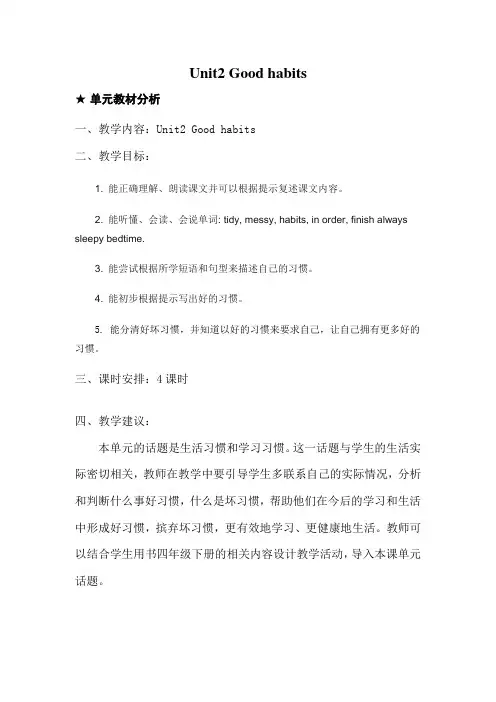
Unit2 Good habits
★单元教材分析
一、教学内容:Unit2 Good habits
二、教学目标:
1. 能正确理解、朗读课文并可以根据提示复述课文内容。
2. 能听懂、会读、会说单词: tidy, messy, habits, in order, finish always sleepy bedtime.
3. 能尝试根据所学短语和句型来描述自己的习惯。
4. 能初步根据提示写出好的习惯。
5. 能分清好坏习惯,并知道以好的习惯来要求自己,让自己拥有更多好的习惯。
三、课时安排:4课时
四、教学建议:
本单元的话题是生活习惯和学习习惯。
这一话题与学生的生活实际密切相关,教师在教学中要引导学生多联系自己的实际情况,分析和判断什么事好习惯,什么是坏习惯,帮助他们在今后的学习和生活中形成好习惯,摈弃坏习惯,更有效地学习、更健康地生活。
教师可以结合学生用书四年级下册的相关内容设计教学活动,导入本课单元话题。
单元课题Unit2 第1课时(总4课时)
单元课题Unit2 第2课时(总4课时)
单元课题Unit2 第3课时(总4课时)
单元课题Unit2 第4课时(总4课时)。
Unit2Goodhabits第1课时Storytime教案(含反思)
作用与目的:
-帮助学生提前了解本节课的核心知识点,为课堂学习做好准备。
-培养学生的自主学习能力和独立思考能力。
2.课中强化技能
教师活动:
-导入新课:教师通过故事、案例或视频等方式,引出本节课的主题,激发学生的学习兴趣。
-讲解知识点:详细讲解本节课的核心知识点,结合实例帮助学生理解。
4.学习能力:学生能够通过自主学习、合作学习和探究学习,提高自己的学习效果,培养自己的学习兴趣和学习本节课的核心词汇包括good, bad, healthy, unhealthy, brush teeth, exercise等。教师需要通过图片、实物等直观手段,帮助学生理解和记忆这些词汇。
2.文化意识:学生能够理解好习惯和坏习惯的概念,并能够理解不同文化背景下人们的行为习惯,培养了一定的文化意识。
3.思维品质:学生能够通过分析故事中的情节,培养自己的逻辑思维和批判性思维能力,能够对好习惯和坏习惯进行简单的判断和表达。
4.学习能力:学生能够通过自主学习、合作学习和探究学习,提高自己的学习效果,培养了自己的学习兴趣和学习动力。
教学重点为:1.能够听懂、会说、会读故事中的核心词汇和句型;2.能够通过故事理解好习惯和坏习惯的概念,并能够进行简单的判断和表达。
教学难点为:1.正确运用核心词汇和句型进行日常交流;2.理解并能够表达自己的好习惯和坏习惯。
核心素养目标
本节课旨在培养学生的英语学科核心素养,主要包括语言能力、文化意识、思维品质和学习能力。通过学习本节课,学生能够:
1.导入:通过图片、歌曲等方式,引导学生谈论好习惯和坏习惯。
2.新课展示:讲解故事内容,呈现核心词汇和句型。
译林英语六下教案Unit 2 Good habits 第一课时

译林英语六下教案Unit 2 Good habits 第一课时Unit 2 Good habits 第一课时本课时的主题是好习惯,通过学习此课时,学生将会了解什么是好习惯,了解如何建立和养成好习惯。
本节课主要围绕阅读、讨论和写作展开。
教学目标:1. 了解什么是好习惯,如何建立和养成好习惯。
2. 通过阅读文章和讨论,锻炼学生的英语阅读和口语表达能力。
3. 提高学生的书面表达能力,通过写一篇短文来表达自己对好习惯的理解。
教学重点:1. 了解什么是好习惯,如何建立和养成好习惯。
2. 通过阅读文章和讨论,锻炼学生的英语阅读和口语表达能力。
3. 提高学生的书面表达能力,通过写一篇短文来表达自己对好习惯的理解。
教学难点:1. 如何描述和举例说明好习惯的重要性。
2. 如何让学生掌握合理的养成好习惯的方法。
教学准备:1. 教师准备PPT或者黑板,能够展现教学重点和难点。
2. 学生准备笔记和听讲纸。
3. 学生和教师准备口语和书面表达相关的词汇。
Step 1:引入主题1. 教师引导学生回想在家中或学校里,一天中能见到的明显的好习惯。
2. 教师向学生引入好习惯的概念,告诉学生好习惯的重要性。
3. 通过引入,让学生对好习惯有了初步的了解和认识。
Step 2:阅读和讨论文章1. 教师发放阅读材料,让学生阅读一篇关于好习惯的文章,帮助学生更好地理解和认识好习惯。
2. 查看学生理解和记忆文章的程度,询问问题,让学生表达自己的观点和想法。
3. 让学生以小组为单位,商讨如何养成好习惯以及如何改掉坏习惯,通过讨论,让学生掌握养成好习惯的方法和技巧。
Step 3:写作训练1. 教师安排书面表达训练,让学生写一篇关于好习惯的文章。
2. 教师提供好习惯的题目,引导学生围绕主题展开文章的写作。
3. 让学生互相交换文章,帮助祥或者改进,提高写作水平。
Step 4:总结和反馈1. 教师让学生回顾本课阶段,总结好习惯的重要性和如何养成好习惯的方法。
Unit2Goodhabits第一课时(教案)译林版英语六年级下册

提示动词、大小写
3.Let’s say
Good habits benefit for life.
板书设计
Unit2 Good habits
Wang Bing
gets up early and goes to bed late
brushes his teeth in the morning and before bedtime
Liu Tao is a good boy, too.
... listens to ...
... keeps ... clean and tidy
... helps...
But he has some bad habits.
... does ... late
... goes ... late, ... feels...
2.Listen and answer
T:Does WangBing have many good habits?
T:Who has any bad habits?
Step2 Presentation & Practice〔用时:25分钟〕
1.Watch and choose:
a.does his homework late at night.
think and choosekeeps his room clean and tidy
A.tidy
B.mess
Guess:What will happen?
5.Read and find
You shouldn’t go to bed late, Liu Tao.
Let’s learn:
walk fast
教案精选:小学六年级英语《Good habits》教学设计
教案精选:小学六年级英语《Good habits》教学设计教案精选:小学六年级英语《Good habits》教学设计本单元的课文是一个学生耳熟能详的童话故事——丹麦著名作家安徒生笔下的《狮子和老鼠》。
课文以叙述故事的手法,呈现了一般过去时。
教学重难点是一般过去时陈述句的表达和be动词及规则动词的过去式构成。
教师可以借助故事情境,帮助学生初步感知和理解一般过去时,同时通过朗读、角色扮演等教学活动,使学生能够自然地运用所学内容,从而为后三个单元一般过去时的继续学习做好铺垫。
Teaching aims and learning objectivesBy the end of the lesson, students will be able to1.能听懂、会说、会读课文Good habits2.能听懂、会说、会读常用语及句型He/She gets up / goes to school in themorning. He/She never goes to bed late.3.能听懂、会说、会读、会写词汇put…in order, bad ,sleepy, last night, go into, slowly, badly4. 能听懂、会说、会读词汇child, habit, never, late, finish, tidy, fast5. 能听懂、会唱歌曲This is the way6. 能听懂会说且准确发音字母or在单词中的读音。
Teaching important points1. 能听懂、会说、会读常用语及句型He/She gets up / goes to school in the morning. He/She never goes to bed late.2. 能听懂、会说、会读、会写词汇put…in order, bad ,sleepy, last night, go into, slowly, badly3. 能听懂、会说、会读词汇child, habit, never, late, finish, tidy, fast4. 能听懂、会唱歌曲This is the way5. 能听懂会说且准确发音字母or在单词中的读音Teaching difficult points1. 能听懂、会说、会读常用语及句型He/She gets up / goes to school in the morning. He/She never goes to bed late.2. 能听懂、会说、会读、会写词汇put…in order, bad ,sleepy, last night, go into, slowly, badly3. 能听懂、会说、会读词汇child, habit, never, late, finish, tidy, fastPeriods五课时Story time 第1课时Grammar time and Fun time 第2课时Sound time and Cartoon time 第3课时Song time, Check time and Ticking time 第4课时Review and do some exercises of Unit 2 第5课时第二单元第1课时Teaching contentStory time.Teaching aims and learning objectivesBy the end of the lesson, students will be able to1. 能正确理解、朗读课文并可以根据提示复述课文内容。
小学英语6BUnit2Goodhabitsstorytime教案(译林英语)
小学英语6B Unit2 Good habits story time教案(译林英语)译林英语6B Unit2 Gd habits第一时(str tie)一、Teahing ntents教学内容:str tie二、Teahing ais and betives教学目标:1 能正确理解、朗读并可以根据提示复述内容。
2 能听懂、会读、会说单词: tid, ess, habits, in rder, finish alas sleep bedtie3 能尝试根据所学短语和句型描述自己的习惯。
4 能初步根据提示写出好的习惯。
能分清好坏习惯,并知道以好的习惯要求自己,让自己拥有更多好的习惯。
三、Fus f the lessn教学重点:1 能正确理解、朗读并可以根据提示复述内容。
2 能听懂、会读、会说单词: tid, ess, habits, in rder, finish alas sleep bedtie3 能尝试根据所学短语和句型描述自己的习惯。
四、predited area f diffiult教学难点:1 能尝试根据所学短语和句型描述自己的习惯。
2 能初步根据提示写出好的习惯。
3 能分清好坏习惯,并知道以好的习惯要求自己,让自己拥有更多好的习惯。
五、Preparatin前准备:挂图,头饰,多媒体(PPT)六、Teahing predures教学过程:Step1 ar up1 Let’s l hat d e learn tda Sh the learning ais2 I a ur ne English teaher nae is Fann I a thirt D u ant t n e ell?3 Listen t hant arefull(初步感知新的短语词汇。
)hant: I’Fann,I a thirtI get up earl, never g t bed lateI eep r lean and tidI ften put things in rderI finish r befre nine ’lStep2 Presentatin1 T: u n in hant , I sa, I get up earl ,never g t bed late Thin abut :never g t bed late, eans A r B?(sh the pitures)Read the ne rd并板书。
(完整版)译林英语6BUnit2Goodhabits教学案例
译林英语6B Unit 2 Good habits (story time)----first period课例连云港市赣榆区城南中心小学李利霞Teaching contents: (story time) first periodAnalysis of the contents and the students:本文围绕Good habits这一话题展示两个学生的生活习惯,让学生通过实际人物的习惯学习相关词汇及句型。
六年级译林英语是新教材,学生之前的知识储备不够扎实,一定要做好课前准备,为新授课做好充分的准备。
学生开口能力差,尽量降低口语表达的难度,激发其上进心;为他们创设更多真实的口语交际情景,让学生在学中感受英语的乐趣。
Teaching aims and objectives:1.知识目标:(1).能正确理解、朗读课文并可以根据提示复述课文内容。
(2).能听懂、会说、会读、会写单词:habit,never,late,finish,tidy,fast.句型:He/She gets up/goes to school early in the morning.He/She never goes to bed late.2.能力目标:能在现实生活中比较自如地运用本单元的句型和日常交际用语。
3.情感目标:能分清好坏习惯,并知道以好的习惯来要求自己,让自己拥有更多好的习惯。
Focus of the lesson:1.能正确理解、朗读课文并可以根据提示复述课文内容。
2.能听懂、会说、会读、会写单词:habit,never,late,finish,tidy,fast.句型:He/She gets up/goes to school early in the morning.He/She never goes to bed late.Teaching difficulty:1.能尝试根据所学短语和句型来描述自己的习惯。
小学英语6B Unit2 Good habits story time教案(译林英语)
小学英语6B Unit2 Good habits story time教案(译林英语)本资料为woRD文档,请点击下载地址下载全文下载地址译林英语6BUnit2Goodhabits第一课时(storytime)一、Teachingcontents教学内容:storytime二、Teachingaimsandobjectives教学目标:.能正确理解、朗读课文并可以根据提示复述课文内容。
2.能听懂、会读、会说单词:tidy,messy,habits,inorder,finishalwayssleepybedt ime.3.能尝试根据所学短语和句型来描述自己的习惯。
4.能初步根据提示写出好的习惯。
5.能分清好坏习惯,并知道以好的习惯来要求自己,让自己拥有更多好的习惯。
三、Focusofthelesson教学重点:.能正确理解、朗读课文并可以根据提示复述课文内容。
2.能听懂、会读、会说单词:tidy,messy,habits,inorder,finishalwayssleepybedt ime.3.能尝试根据所学短语和句型来描述自己的习惯。
四、predictedareaofdifficulty教学难点:.能尝试根据所学短语和句型来描述自己的习惯。
2.能初步根据提示写出好的习惯。
3.能分清好坏习惯,并知道以好的习惯来要求自己,让自己拥有更多好的习惯。
五、Preparation课前准备:挂图,头饰,多媒体(PPT)六、Teachingprocedures教学过程:Step1warmup.Let’slookwhatdowelearntoday.Showthelearningaims.2.IamyournewEnglishteacher.mynameisFanny.Iamthirty.Do youwanttoknowmewell?3.Listentomychantcarefully.chant:I’mFanny,Iamthirty.Igetupearly,nevergotobedlate.Ikeepmyroomcleanandtidy.Ioftenputmythingsinorder.Ifinishmyworkbeforenineo’clock.Step2Presentation.T:youknowinmychant,Isay,Igetupearly,nevergotobedlat e.Thinkabout:nevergotobedlate,meansAorB?(showthepictures)Readthenewword并板书。
六年级下册英语教案Unit2goodhabits第一课时译林版
牛津译林版英语六年级下Unit2第一课时教学设计课题Good habits单元Unit 2学科英语年级六年级下学习目标1. 能初步听懂、会读词汇habit, never, late, put…in order, finish, tidy, bad, sleepy.2. 掌握一般现在时态及动词变单三式的规则。
3. 能理解并会读故事。
4. 通过学习本课的故事,让学生懂得好的习惯对人一生的重要性。
重点:1. 能初步听懂、会读词汇habit, never, late, put…in order, finish, tidy, bad, sleepy.2. 掌握一般现在时态及动词变单三式的规则。
3. 能理解并会读故事。
难点:掌握一般现在时态及动词变单三式的规则。
教学过程一、导入新课1. Free talk.老师预设几个和本课相关的话题:Do you get up early(早的) or late(晚的)? Do you go to bed early or late? Is your bedroom tidy(整洁) or messy(凌乱)?学生们进行讨论并积极发言。
引出本课新词。
学生分小组进行讨论,积极大胆的进行猜测和想象以此激发学生的好奇心和学习兴趣,自然引出新课。
二、讲授新课1. Let’s learn.(1)播放图片,学习反义词late—early, messy—tidy。
(2)学生听读单词,然后跟老师读,注意记忆单词。
2. Read and match.读单词,将互为反义词的一组相匹配,看谁做得快!3. Let’s look.播放本课的图片插图,提出问题He is Wang Bing. Do you want to know him well? He is Liu Tao. Do you want to know him well? What habits do they have? 从而引出本课的故事。
6BUnit2Storytime教案
6B Unit2 Good habits一、教学内容: Story time二、教学目标:1. 能听懂、会读、会说单词: tidy, messy, habits, finish,always ,sleepy, bedtime,put...in order2. 能正确理解、朗读课文,可以根据提示复述课文。
3. 能根据所学单词、句型来描述自己的习惯。
4. 能分清好习惯与坏习惯,并知道以好的习惯来要求自己。
三、教学重点:1. 能听懂、会读、会说单词: tidy, messy, habits, finish,always ,sleepy, bedtime,put...in order2. 能正确理解、朗读课文,可以根据提示复述课文。
3. 能根据所学单词、句型来描述自己的习惯。
四、教学难点:1. 能根据所学单词、句型来描述别人的习惯。
2. 动词第三人称单数的发音及其变化规律。
五、课前准备:教学光盘, PPT六、教学过程:Step1. Warming upT: When do you get up? S:When do you go to bed? S:Do you brush your teeth every day? S:Do you finish your homework early? S:T: Oh, you have good habits.(设计意图:通过与学生的交谈,让学生初步感知哪些习惯是好的,从而过渡到本课的课题上来,这样的过渡显得自然。
)Step 2. Presentation and practice:(设计意图:通过表格形式,帮助学生对课文内容进行梳理,并进行了笔头训练;在学生回答的过程中,也锻炼了学生的语言组织能力。
)6.Ss read the passage after the tape.(设计意图:学生跟读磁带,模仿其语音、语调,提高学生“读”的能力。
) 7.Ss look at the form, try to recite the passage.(设计意图:学生根据表格中的提示,尽量去复述课文。