
人教版选修六Unit 2 Poems Learning about language课时作业
Unit 2 Poems Learning about language课时作业Ⅰ.单句语法填空1.I'm glad to hear that.Many congratulations(congratulate)on you.2.He could not account for his foolish mistake.3.Are you studying at a middle school attached(attach)to Beijing University?4.This made top news in the surrounding(surround)countryside.5.Some scarecrows in the fields can scare away birds,and animals.6.In general,the present economic situation is good.7.It takes time and patience(patient)to photograph wildlife.8.She passed away in Shanghai on June 11,at the advanced age of 101.9.He rushed into the room,excited(excite).10.Can you give a description(describe)of your hometown?Ⅱ.完成句子1.他一开门,一条狗就跑了进来。
The instant he opened the door,a dog ran in.2.乒乓球是一项很有趣的运动,以致全世界的人都参加这项运动。
Table tennis is such an interesting game that people all over the world play it.3.他们决定更换使用的材料。
They decided to change the material used.4.他现在工作得多么努力呀!How hard he is working now!5.他虽然年轻,却很有经验。
Young in year,he is old in experience.Ⅲ.微写作用本单元词汇或句式完成写作任务1.重要的时刻来了。
2.家庭聚会对我们来说非常重要。
3.汉字福被贴到门上。
我们搭建装饰品和燃放烟花来吓走怪物“年”。
4.就我而言,我不能够平静下来。
5.节日的高兴难以描述。
【参考范文】The important occasion came at last.Family gathering was important for all of us.The Chinese character Fu was attached to the door.We put up decorations and let off fireworks to scare away monster Nian.As far as I was concerned,I couldn't calm down.And the joy on the festival was beyond description.IV.阅读理解February has long been a month of romance.With the sweet smell of roses in the air,romantic films hit cinemas and love stories fill newspapers and magazines.On the 14th day,it is customary for a boy to take his girlfriend out to dinner,buy her flowers and chocolates,write poems,sing to her or even spell out her name with rose petals!This is the scene that greets you on Valentine's Day,named after Valentine who was a priest in third century Rome.When the emperor decided that single men made better soldiers than those with wives,he banned marriage.But Valentine continued to perform marriage ceremonies for young lovers in secret.When his actions were discovered,the emperor had him put to death.While in prison,it is said that Valentine fell in love with the daughter of his prison guard.Before his death,he wrote her a letter,which he signed “From your Valentine”,an expression that is still in use today.Valentine died for what he believed in and so was made a Saint,as well as becoming one of history's most romantic figures.Nowadays,Valentine's Day wins the same popularity among Chinese young people.It is a time when students “don't want to be alone” according to Gao Shunjie,a student reporter for 21st Century Teens in Jinling High School,Nanjing.Some of her classmates are planning to make Valentine's cards for parents,teachers and friends.Others want to hold parties at which they will exchange small gifts and eat heartshaped cakes.The idea is to have fun and encourage people to share in the spirit of St Valentine.【语篇解读】二月作为浪漫的月份由来已久。
在这个时节,空气中弥漫着玫瑰花的芳香,影院里放映浪漫的电影,而爱情故事在各种报刊上令人目不睱接。
2月14日是情人节,你们了解情人节的由来吗?1.Why is February a month of romance?A.Because people will enjoy the pleasant feeling that the sweet smell roses bring them.B.Because a lot of romantic films will be on show in February.C.Because people can read a lot of love stories in newspapers or magazines.D.Because Valentine's Day is on the 14th February,when many romantic things will happen.D[细节理解题。
根据第二段可知,在2月14日这一天,男孩通常都要邀请女朋友共赴晚餐,还要为女朋友买花和巧克力,为她写诗,为她歌唱,所以二月份会有许多浪漫的事情发生。
]2.The emperor banned marriage,because he .A.was not satisfied with the marriage ceremonies held by priestsB.thought a single man was better than a married man as a soliderC.envied men marrying womenD.thought marriage was evilB[细节理解题。
根据第三段最后一句可知,罗马皇帝认为单身男人比有妻子的男人更适合当兵打仗,于是他下令禁止结婚。
]3.If a girl receives a letter at the end of which “From your Valentine” is signed,the letter is written by .A.a man also called ValentineB.her pet called ValentineC.her boyfriend who is also called ValentineD.her loverD[推理判断题。
根据第五段可知,瓦伦丁给狱卒的女儿写了一封信,信中他签上了“来自你的瓦伦丁”。
这一措辞沿用至今。
据此可以推断,在信尾签有“来自你的瓦伦丁”的应当是女孩子的爱人。
]4.The purpose of the passage is to tell us .A.a love story happening between Valentine and a daughter of a guardB.the history of Valentine's Day and it wins popularity among Chinese young peopleC.a priest who loved bravely facing pressure from the emperorD.that February is a month of romanceB[主旨大意题。
通读全文内容可知,文章主要帮助我们了解情人节的历史,以及它在中国年轻人当中的普及程度。
高中英语人教版英语选修6课文原文及课文译文

高中英语人教版英语选修6课文原文及课文译文Unit 1 Art 第一单元艺术ReadingA SHORT HISTORY OF WESTERN PAINTINGArt is influenced by the customs and faith of a people. Styles in Western art have changed many times. As there are so many different styles of Western art, it would be impossible to describe all of them in such a short text. Consequently, this text will describe only the most important ones. Starting from the sixth century AD.The Middle Ages(5th to the 15th century AD)During the Middle Ages, the main aim of painters was to represent religious themes. A conventional artistof this period was not interested in showing nature and people as they really were. A typical picture at this time was full of religious symbols, which created a feeling of respect and love for God. But it was evident that ideas were changing in the 13th century when painters like Giotto di Bondone began to paint religious scenes in a more realistic way.The Renaissance(15th to 16th century)During the Renaissance, new ideas and values gradually replaced those held in the Middle Ages. People began to concentrate less on religious themes and adopt a more humanistic attitude to life.At the same time painters returned to classical Roman and Greek ideas about art. They tried to paint people and nature as they really were. Rich people wanted to possess their own paintings, so they coule decorate their superb palaces and great houses. They paid famous artists to paint pictures of themselves, their houses and possessions as well astheir activities and achievements.One of the most important discoveries during this period was how to draw things in perspective. This technique was first used by Masaccio in 1428. When people first saw his paintings, they were convinced that they were looking through a hole in a wall at a real scene. If the rules of perspective had not been discovered, no one would have been able to paint such realistic pictures. By coincidence,oil paints were also developed at this time, which made the colours used in paintings look richer and deeper. Without the new paints and the new technique, we would not be able to see the many great masterpieces for which this period is famous.Impressionism(late 19h to early 20th century)In the late 19th century, Europe changed a great deal,from a mostly agricultural society to a mostly industrial one. Many people moved from the countryside to the new cities. There were many new inventions and social changes also led to new painting styles. Among the painters who broke away from the traditional style of painting were the Impressionists, who lived and worke in Paris.The Impressionists were the first painters to work outdoors. They were eager to show how light and shadow fell on objects at different times of day. However, because natural light changes so quickly, the Impressionists had to paint quickly. Their paintings were not as detailed as those of earlier painters. At first, many people disliked this style of painting and became very angry about it. They said that the painters were careless and their paintings were ridiculous.Modern Art(29th century to today)At the time they were created, the Impressionist paintingswere controversial, but today they are accepeted as the beginning of what we call 'modern art'. This is because the Impressionists encouraged artists to look at their environment in new ways. There are scores of modern art styles,but without the Impressionists, many of these painting styles might not exsist. On the one hand, some modern art is abstract; that is, the painter does not attempt to paint objects as we see them with our eyes, but instead concentrates n certain qualities of the object, using colour, line and shape to represent them. On the other hand, some paintings of modern art are so realistic that they look like photographs. These styles are so different. Who can predict what painting styles there will be in the future?西方绘画艺术简史西方艺术风格变化较大,而中国艺术风格变化较小。
选修 6Unit 2 Poems
围绕诗歌这一话题设置了三个练习。前两个练习引导学生回顾儿时所接触的诗歌;第三个练习引导学生探讨写诗的目的。
★Pre-reading
主要让学生认识诗歌的种类和不同国家所赋诗歌的文化差异。该部分设置了两个练习,第一个练习让学生交流所喜爱的诗歌;第二个练习就阅读课文设计图表,让写诗从内容和写作风格两个方面认识阅读课文中的诗歌。
eg.You don't want to convey the impression that there's anything illegal going on.
(2)formal to take or carry something from one place to another synonym transport:传送、传输
本单元学习表达与过去事实相反的假设。
3.词汇及短语
必会:conveyconcrete flexible minimum branch eventually transform bare
appropriate exchange sponsor
take it easy run out of make up of in particular try out let out
eg.nursery education/teacher/school/rhyme
3.rhyme
(1) [countable]a short poem or song, especially for children, using words that rhyme诗、韵文
eg.nursery rhyme
学习策略目标
1.认知策略:总结语言材料中有关倒装的句子并在活动中加以观察思考,总结归纳用法,最终结合语境使用。
人教版选修六Unit 2 Poems教案
Unit 2 Poems Ⅰ. 单元教学目标Ⅱ. 目标语言Ⅲ. 教材分析与教材重组1. 教材分析本单元以Poems为话题,从学生初次接触诗歌,一直谈到诗歌创作的动机、有关诗歌的一些基本知识(包括诗歌的种类、风格)等。
旨在通过本单元的学习,使学生在初步了解和掌握诗歌这一文学形式的基本常识的基础上,进行简单的诗歌创作。
1.1 Warming Up部分要求学生回顾所学诗歌,启发学生以小组活动形式分析、列举人们进行诗歌创作的原因。
1.2 Pre-reading 部分首先要求学生说出自己最喜欢的中英文诗歌并阐明理由;然后通过快速阅读Reading部分内容填写列表,区分诗歌种类。
1.3 Reading部分是一篇介绍诗歌基础知识的文章。
文章从诗歌创作的动机、种类、特点及读者对象等方面简要介绍了五种不同风格、特色的诗歌。
1.4 Comprehending 部分根据阅读内容设置了三个习题。
第一个习题要求学生通过读文章、听录音感受诗歌特色,判断自己所喜欢的诗歌类型并说出理由;第二个习题就文章总体内容提出了五个问题,帮助学生进一步了解不同类型诗歌的不同特点;第三个习题通过十一个具体问题考查学生对文中某些细节内容的理解并要求分析诗歌创作者的情感、态度。
1.5 Learning about Language分words and expressions和structures两部分。
第一部分设置了两个练习:第1个练习要求从所学诗歌中找出与所给词汇压韵的词并添加其它韵词;第2个练习要求用所给词汇的正确形式填空。
第二部分通过四个小练习对所学诗歌中出现的两种结构形式进行训练。
1.6 Using Language共设置了三个任务:第一项任务通过一首小诗展开听力、口语、阅读训练,加深学生对诗歌韵律知识的理解;第二项任务通过Miss Jiang与学生谈论诗歌竞赛的一段录音学习,练习“意愿(intentions)”的表达。
第三项任务要求学生运用所学诗歌知识,根据所给提示进行模仿习作训练。
高中英语(人教版)选修六Unit 2 Poems-learning about language课件(46张PPT)

-5-
Section Ⅱ— Learning about Language,Using Language,Summing Up & Learning Tip
预习导引
核心归纳
一二三四
四、补全对话,所给选项中有两项是多余选项 A: 1 C B:I am going back to my hometown and then I’d like to travel with my friends. A:Really? 2 A B:I haven’t decided yet.Can you give me some advice? A:I suggest you should go to Yunnan for a visit.It’s great.I went there last summer. B: 3 G A:Well,in that case,Shanghai must fit you most.What do you think? B:Shanghai is good,but I have just been there this May holiday.
123456789
预习导引 核核心心归归纳纳
The price is too high,and moreover,the house isn’t in a suitable position. 价格太高,而且房屋的地点也不太适合。 It is right to put everything in its proper use. 每件东西都应该用得其所。
预习导引
核心归纳
一二三四
一、学习下面的生词,并选择合适的词或词组完成句子
librarian n.图书馆馆 长;图书馆管理员
英语:unit 2《poems》教案-writing(新人教版选修6)
(四)On teaching procedures
Teaching steps
Teacher’s activity
Students’activity
Designing purpose
1. Lead-in
Show the students two Read the two poems and Get the students to poems try to discover the features. discover the features themselves so that it will be easier for them to write.
designed according to this subject. In this unit, different forms of poems are introduced. The students are
required to learn about the features of different forms of poems as well as try to write simple poems and appreciate beautiful literature works. Lessons arrangement Period 1: Warming up & Reading Period 2: Language Points Period 3: Word study &Using language Period 4: Listening Period 5: Grammar teaching Period 6: Writing 2.The function of this lessonin the unit
英语:unit 2《Poems》教案-reading1(新人教版选修6)
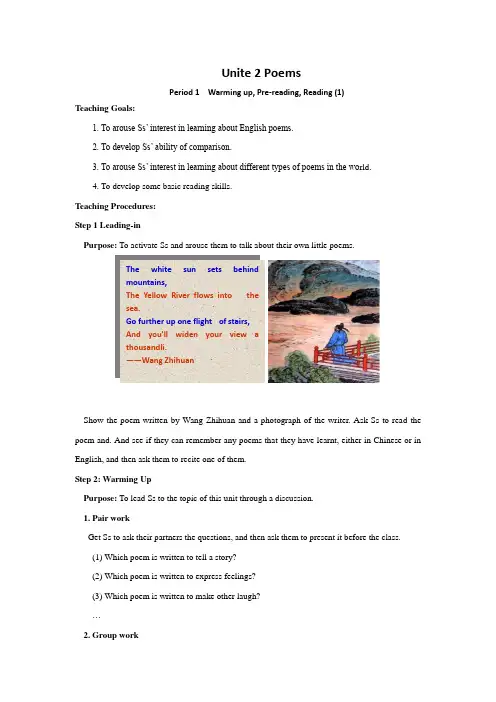
Unite 2 PoemsPeriod 1 Warming up, Pre-reading, Reading (1)Teaching Goals:1. To arouse Ss’ interest in learning about English poems.2. To develop Ss’ ability of comparison.3. To arouse Ss’ interest in learning about different types of poems in the wo rld.4. To develop some basic reading skills.Teaching Procedures:Step 1 Leading-inPurpose: To activate Ss and arouse them to talk about their own little poems.The white sun sets behindmountains,The Yellow River flows into thesea.Go further up one flight of stairs,And you'll widen your view athousandli.——Wang ZhihuanShow the poem written by Wang Zhihuan and a photograph of the writer. Ask Ss to read the poem and. And see if they can remember any poems that they have learnt, either in Chinese or in English, and then ask them to recite one of them.Step 2: Warming UpPurpose: To lead Ss to the topic of this unit through a discussion.1. Pair workGet Ss to ask their partners the questions, and then ask them to present it before the class.(1) Which poem is written to tell a story?(2) Which poem is written to express feelings?(3) Which poem is written to make other laugh?…2. Group workGet Ss to talk about the world famous poets. The pictures below can be used for Ss to talk about, and Ss can also talk as much as they can.William Shakespeare George Gordon Byron Li Bai威廉·莎士比亚乔治·戈登·拜伦李白(1) William Shakespeare: English playwright and poet whose body of works is consideredthe greatest in English literature. His plays, many of which wereperformed at the Globe Theatre in London, include historical works,such as Richard II, comedies, including Much Ado about Nothing andAs You Like It, and tragedies, such as Hamlet, Othello, and KingLear. He also composed 154 sonnets. The earliest collected edition ofhis plays, the First Folio, contained 36 plays and was publishedposthumously (1623).(2) George Gordon Byron: British poet acclaimed as one of the leading figures of theRomantic Movement. The Byronic hero lonely, rebellious, andbrooding first appeared in Manfred (1817). Among his other works areChilde Harold (1812-1818), The Prisoner of Chilton (1816), and theepic satire Don Juan (1819-1824). Byron was notorious for his loveaffairs and unconventional lifestyle. He died while working to secureGreek independence from the Turks.(3) Li Bai: Chinese poet who spent much of his time wandering and composingromantic, wine-inspired verse.Conclusion: All these poets are well known to the whole world and do you know any poems written by them? Can you recite to all the class?Step 3. Pre-readingPurpose: To help Ss learn about the context of the Reading part.1. Group workAsk Ss to discuss the questions with their partners in groups of four.(1) Do you have a favorite poem in Chinese?(2) Why is it your favorite poem?(3) Do you have a favorite poem in English?(4) Why is it your favorite poem?For example:(1) My favorite poem in Chinese is: 去年今日此门中,人面桃花相映红。
人教版高中英语选修6《Unit 2 Poems》教案2篇
人教版高中英语选修6《Unit 2 Poem s》教案2篇Teaching plan of unit 2 Poems编订:JinTai College人教版高中英语选修6《Unit 2 Poems》教案2篇前言:英语作为在许多国际组织或者会议上都是必需语言,几乎所有学校选择英语作为其主要或唯一的外语必修课。
英语教学涉及多种专业理论知识,包括语言学、第二语言习得、词汇学、句法学、文体学、语料库理论、认知心理学等内容。
本教案根据英语课程标准的要求和教学对象的特点,将教学诸要素有序安排,确定合适的教学方案的设想和计划、并以启迪发展学生智力为根本目的。
便于学习和使用,本文档下载后内容可按需编辑修改及打印。
本文简要目录如下:【下载该文档后使用Word打开,按住键盘Ctrl键且鼠标单击目录内容即可跳转到对应篇章】1、篇章1:人教版高中英语选修6《Unit 2 Poems》教案2、篇章2:人教版高中英语选修6《Unit 2 Poems》教案篇章1:人教版高中英语选修6《Unit 2 Poems》教案教学准备教学目标教学目标(Teaching Aims)知识与技能(Knowledge and Skills)1.了解教学大纲关于语法填空的命题特点。
2.能够根据语法填空的命题特点自己编语法填空的题目3.掌握语法填空的解题方法与技巧过程与方法(Process and Methods)让每一位同学都能参与到课堂教学与活动中来,以小组或结对的形式进行相互学习和讨论。
情感态度与价值观(Feeling, Attitudes and Values)学习应对语法填空是与课文相结合,让学生在了解各种不同诗歌形式的背景下学习语法填空的设题与解题特点,从而更加理解英语诗歌的特色,更加懂得如何阅读和欣赏英语诗歌。
教学重难点教学重点(Important Points):1.让学生了解语法填空的命题特点2.掌握语法填空的解题方法与技巧教学难点(Difficult Points):语法填空中词性的转换教学过程(Teachers’ Activities)Step I: Lead-in① Review the new words and expressions of this unit by them together, and then do Task 1---speak out the other forms according to the giv en words② Listen to the song Jingle Bells and try tofill a word into each blank.Step II : Pre-practising1.Questions① Do you think it is difficult to complete the items of blank-filling with grammar knowledge?② Have you figur ed out the characteristics of the item?2.ExplainingIn this item there are 10 blanks for you to fill in with less than one proper word① some blanks with a given word while otherswith none② fill in the blanks with the proper form of the given word according to its grammatical and logical meaning.③ choose a preposition, pronoun, conjunction or an article to fill in the blank without any given word.3.DiscussionHow can we finish the items step by step with our grammar knowledge?① ___________________________________________.② _ __________________________________________.③ ___________________________________________.Step III : While-practising1.Making an item of grammatical blank-filling based on the para graph of the text.① more than 5 blanks.② some blanks with given word.③ others with none.2.exchange the item you made for your partner to complete it .3.The whole class finis h the one the teacher prepared for them.Step IV : Post-practising1.Check some of the students’ anwsers and give comments.2.Draw a conclusionStep V: Homework Assign ment1.Further improve your skills of dealing with the grammar filling.plete Ex.2 on Page 10, Nanfang New Class篇章2:人教版高中英语选修6《Unit 2 Poems》教案【按住Ctrl键点此返回目录】教学准备教学目标Teaching goals1.Target languagea. Important words and phrasesPoem, poetry, recite, aspect, convey, nursery, rhyme, diamond, cottage, balloon, sparrow, tease, salty, endless, translate, nursery rhyme, take it easy, run out of, make up ofb. Important sentencesWhich poem is about things that don’t make sense?Poets use many different forms of poems toexpress themselves.I hadn’t taken my eye off the ball.We hadn’t taken it easy.The poem is made up of five lines.A lot of Tang poetry has been translated into English. The translations have a free form that English people like to copy.2.Ability goalsa. Enable Ss to talk about different types of poems: nursery rhymes; list poems; cinquain,; haiku; Tang poemsb. Enable Ss to talk about different purposes of writing poems.c. Understand the main theme of each poem.d. Enable Ss to chant some of their favorite poems.3.Learning abilityEnable Ss to distinguish different types of poems 教学重难点Teaching important points1.Talk about five main types of poems.2.Understand the main purpose of writing the poems.Teaching difficult points1.Find the rhythm of each poem.2.Chant the poem.3.Understand the main purpose of writing the poems.教学过程Teaching procedures to share a feeling or experience; to describe something in detail or give an impression; to get the reader to think about an idea; to express a point of view; to make the reader experience the sight, sounds, smells, feel and tastes of something; to create a mood, to play with words--- their sounds, rhyme and rhythm.)If time permits, in small groups or as a class, discuss the kinds of topics that poets write about.( people, animals, nature, landscapes, the sea, the seasons, stories, death, war, youth and old age,feeling and experiences, emotions like love, hate, sadness, regret and desire, etc.)Step 4.Pre-readingPeople from different countries write different kinds of poems. Get Ss to discuss the questions on Page 9 with their partners: Do you have a favorite poem in Chinese? Why ? Do you have a favorite poem in English? Why?As to exercise 2, give Ss practice in animportant reading skill: scanning a text, that is, looking through a text quickly to find specific information. Read the table in exercise 2 with the Ss. Tell them that they are going to look for the information in the table, just in the poems themselves, not in the other parts of the text. They are to look only for those pieces of information and not readevery word. Do an example with them.Suggested answers to exercise 2:Step 5.ReadingScanningGet the Ss to read the passage quickly and accurately and meanwhile help the Ss to form a good habit of reading. Teacher gives Ss a couple of minutes to look through the whole passage. Tell them to read the text silently and then ask some detailed questions about the text on the slide show . Teacher should encourage Ss to express their ideas.Q1.Why do people write poetry?Q2.How many forms of poems are mentioned in the passage? What are they?Q3.What does “nursery rhyme” mean? Why do they delight small children?Q4.What’s the characteristic of “list poems”? What about “cinquain”?Q5.Why do English People like “Haiku”?Q6.Are you familiar with Tang Poems? Do you know the title of the last poem in the text?ListeningBefore Ss read the text, have them close their books and listen to the text with their eyes closed. This gives Ss the opportunity to listen to the sounds or “music” of the poems before reading them in detail. Tell them that it doesn’t ma tter if they don’t understand every word.First readingGet Ss to read the text carefully, finding the one sentence that sums up the paragraph of each part.. Underline the topic sentence.Second readingTell Ss that they are going to look at the rhythm of two of the poems. Make sure they know what rhythm is. Read the limerick aloud and have Ss listen for the strong beats. Then have them clap the strong beats asyou read. Mark the strong beats on the limerick on the board.There was an old man with a beardWho said “it is just as I feared”.“Four insects and thenTwo birds and a henHave all made a home in my beard”.Now read the poem A & B. Ask them to mark the strong beats on the two poems that have a strong rhythm. Check their answers . Then play the tape and get them to clap to the strong beats in those two poems.Third readingJust as any scene can serve as the subject of a painting, so any part of daily life can provide material for a poem.. Of course, the choice that the artist or poet makes relates to his or her purpose. Poetry is usually short and compact, so it should beread several times, preferably aloud, to appreciateits meaning. Read the last poem (Poem H), and answer the following questions:Q1.What parts of the poem suggest that the woman loves her husband?Q2.How do you understand the sentence” Shouldthe journeyer return, this stone would utter speech.”? Explain the sentence in your own words.Q3.What picture do you have in your mind when you read the above sentences?Q4.Do you know the Chinese title of this poem? Do you know the Chinese version of the poem?Step 6.Make a short summary of this period.课后习题Homework1.Surf some websites to find out more information about poets.2.Review the content of the reading passage.3.Finish the exercises on Page 12& 13.-------- Designed By JinTai College ---------。
最新人教版选修六unit 2《poems》教案2.doc
Period 2 Language Study整体设计教学内容分析The emphasis of this period will be placed on the important new words,phrases and sentence patterns in Warming Up,Pre-reading,Reading,Comprehending and Discovering useful words and expressions in Learning about Language.There are altogether 50 new words and phrases in these five parts.22 of them are marked with triangles,which shows that the students needn't learn them by heart.It is enough to recognize them when meeting them while reading the passage.The other 28 should all be remembered,among which the following 8 words and expressions are even more important:concrete,take it easy,in particular,flexible,eventually,transform,run out of,be made up of.They are all very useful and important.So are the sentence patterns “Some poems tell a story or describe something in a way that will give the reader a strong impression.”,“Some rhyme(like B) while others do not(like C).” and “Another simple form of poem that students can easily write is the cinquain,a poem made up of five lines.” We ought to pay more attention to them.三维目标设计Knowledge and skills1.To get the students to learn to use the following important new words and phrases freely:rhyme,concrete,pattern,tease,endless,translation,take it easy,in particular,convey,flexible,branch,eventually,transform,forever,run out of,be made up of.2.To get the students to understand and use the following important and useful sentence patterns:(1)Some poems tell a story or describe somethingin_a_way_that_will_give_the_reader_a_strong_impression.(2)Some rhyme(like B) while others do not(like C).(3)Another simple form of poem that students can easily write is the cinquain,a poem made_up_of_five_lines.Process and methods1.To help the students to understand the meanings of the above useful new words and expressions in the context,and then give some explanations about them,and at last offer some exercises to make the students master their usages.2.To ask the students to make up their own sentences by imitating the above sentence patterns.3.At the end of the class,make students do more exercises for consolidation.In doing so,they can learn,grasp and use these important language points well.Emotion,attitude and value1.To stimulate students' interest in learning English.2.To develop students' sense of cooperation and teamwork.教学重、难点1.Important new words and expressions:rhyme,concrete,pattern,tease,endless,translation,take it easy,in particular,convey,flexible,branch,eventually,transform,forever,run out of,be made up of.2.Important and useful sentence patterns:(1)The attributive clause with the antecedent “way”.(2)Compound sentences with “while”.(3)Past participles as the postpositive attributive.3.Some difficult and long sentences in the text.教学过程Step 1Revision1.Check the homework exercises.2.Ask some students to tell about some simple forms of English poems.Step 2Reading and findingGet students to read through Warming Up,Pre-reading,Reading,Comprehending and Discovering useful words and expressions in Learning about Language to underline all the new words and useful expressions or collocations in these parts.Read them aloud and copy them down in the exercise book.Step 3Practice for useful words and expressions1.Turn to Page 12.Go through the exercises in Discovering useful words and expressions with students and make sure they know what to do.2.Give them several minutes to finish the exercises.They may first do them individually,and then discuss them with their partners.3.Check the answers with the whole class and explain the problems they meet where necessary.Step 4Vocabulary studyⅠ.简单知识扫描1.poem/poetry(P9)Poet(P10)【原句再现】These little poems and songs might have been some of the first poetry you learned.这些小诗歌或许就是你最早学到的一些诗歌。
人教选修6二单元Poems 课文
I saw a person twelve-feet high,
they all were true.
I saw a cottage in the sky,
I saw a balloon made of lead,
I saw a coffin drop down dead, I saw two sparrows run a race, I saw two horses making lace,
I saw a fish-portal all on fire I saw a kitten wear a hat,
I saw a fish-pond all on fire, I saw a man who saw these too,
I saw a house bow to a squire, And said though strange
H
Where she awaits her husband On and on the river flows. Never looking back,Transformed into stone.Day by day upon the mountain top,wind and rain revolve.Should the traveller return,this stone would utter speech. (by Wang Jian)
③if we hadn't run out of
energy.
We would have won ...
if we'd been better!
④Another simple form of poem that students can easily write is the cinquain, a poem made up of five lines. With these, students can convey a strong picture in just a few words. Look at the examples (D and E) on the top of the next page.
(完整版)人教版高中英语选修6各单元课文原文
选修6 Unit 1 Art-ReadingA SHORT HISTORY OF WESTERN PAINTINGArt is influenced by the customs and faith of a people. Styles in Western art have changed many times. As there are so many different styles of Western art, it would be impossible to describe all of them in such a short text. Consequently, this text will describe only the most important ones, starting from the sixth century AD.The Middle Ages (5th to the 15th century AD)During the Middle Ages, the main aim of painters was to represent religious themes. A conventional artist of this period was not interested in showing nature and people as they really were. A typical picture at this time was full of religious symbols, which created feeling of respect and love for God. But it was evident that ideas were changing in the 13th century when painters like Giotto di Bondone began to paint religious scenes in a more realistic way.The Renaissance (15th to 16th century)During the Renaissance, new ideas and values graduallv replaced those held in the Middle Ages.People began to concentrate less on religious themes and adopt a more humanistic attitude to life. At the same time painters returned to classical Roman and Greek ideas about art. They tried to paint people and nature as they really were. Rich people wanted to possess t heir own paintings, so they could decorate their superb palaces and great houses. They paid famous artists to paint pictures of themselves, their houses and possessions as well as their activities and achievements.One of the most important discoveries during this period was how to draw things in perspective. This technique was first used by Masaccio in 1428. When people first saw his paintings, they were convinced that they were looking through a hole in a wall at a real scene. If the roles of perspective had not been discovered, no one would have been able to paint such realistic pictures. By coincidence, oil paints were also developed at this time, which made the colours used in paintings look richer and deeper. Without the new paints and the new technique, we would not be able to see the many great masterpieces for which this period is famous.Impressionism (late 19th to early 20th century)In the late 19th century, Europe changed a great deal. from a mostly agricultural society to a mostly industrial one. Many people moved from the countryside to the new cities. There were many new inventions and social changes. Naturally, these changes also led to new painting styles. Among the painters who broke away from the traditional style of painting were the Impressionists, who lived and worked in Paris.The Impressionists were the first painters to work outdoors. They were eager to show how light and shadow fell on objects at different times of day. However, because natural light changes so quickly, the Impressionists had to paint quickly. Their paintings were not as detailed as those of earlier painters. At first, many people disliked this style of painting and became very angr about it. They said that the painters were careless and their paintings were ridiculous.Modern Art (20th century to today)At the time they were created, the Impressionist paintings were controversial, but today they are accepted as the beginning of what we call "modem art". This is because t he Impressionists encouraged artists to look at their environment in new ways. There are scores of modern art styles, but without the Impressionists, many of these painting styles might not exist. On the one hand, some modem art is abstract; that is, the painter does not attempt to paint objects as we see them with our eyes, but instead concentrates on certain qualities of the object, using colour, line and shape to represent them. On the other hand, some paintings of modern art are so realistic that they look like photographs. These styles are so different. Who can predict what painting styles there will be in the future?THE BEST OF MANHATTAN’S ART GALLERIESThe Frick Collection (5th Avenue and E.70th Street)Many art lovers would rather visit this small art gallery than any other in New York. Henry Clay Frick, a rich New Yorker, died in 1919, leaving his house, furniture and art collection to the American people. Frick had a preference for pre-twentieth century Western paintings, and these are well-represented in this excellent collection. You can also explore Frick's beautiful home and garden which are well worth a Visit.Guggenheim Museum(5th Avenue and 88th Street)This museum owns 5,000 superb modern paintings, sculptures and drawings. These art works are not all displayed at the same time. The exhibition is always changing. It will appeal to those who love Impressionist and Post-Impressionist paintings. The Guggenheim Museum building is also world-famous. When you walk into gallery, you feel as if youwere inside a fragile, white seashell. The best way to see the paintings is to start from the top floor and walk down to the bottom. There are no stairs just a circular path. Themuseum also has an excellent restaurant.Metropolitan Museum of Art (5th Avenue and 82nd Street)The reputation of this museum lies in the variety of its art collection. This covers more than 5,000 years of civilization from many parts of the world, including America, Europe, China, Egypt, other African countries and South America. The museum displays more than just the visual delights of art. It introduces you to ancient ways of living. You can visit an Egyptian temple, a fragrant Ming garden, a typical room in an 18th century French house and many other special exhibitions.Museum of Modern Art (53rd Street, between 5th and 6th Avenues)It is amazing that so many great works of art from the late 19th century tothe 21st century are housed in the same museum. The collection of Western art includes paintings by such famous artists as Monet, Van Gogh, Picasso and Matisse. A few words of warning: the admission price is not cheap and the museum is often very crowded.Whitney Museum of American Art (945 Madison Avenue, near 75th Street)The Whitney holds an excellent collection of contemporary American painting and sculpture. There are no permanent displays in this museum and exhibitions change all the time. Every two years, the Whitney holds a special exhibition of new art by living artists. The museum also shows videos and films by contemporary video artists.选修6 Unit 2 Poems-ReadingA FEW SIMPLE FORMS OF ENGLISH POEMSThere are various reasons why people write poetry. Some poems tell a story or describe something in a way that will give the reader a strong impression. Otherstry to convey certain emotions. Poets use many different forms of poetry to express themselves. In this text, however, we will look at a few of the simpler forms.Some of the first poetry a young child learns in English is nursery rhymes. These rhymes like the one on the right (A) are still a common type of children's poetry. The language is concrete but imaginative, and they delight small children because they rhyme, have strong rhythm and a lot of repetition. The poems may not make sense and even seem contradictory, but they are easy to learn and recite. By playing with the words in nursery rhymes, children learn about language.A Hush, little baby, don't say a word, Papa's going to buy you a mockingbird. Ifthat mockingbird won't sing, Papa's going to buy you a diamond ring. If that diamond ring turns to brass, Papa's going to buy you a looking-glass. If that looking-glass gets broke, Papa's going to buy you a billy-goat. If that billy-goat runs away, Papa's going to buy you another today.One of the simplest kinds of poems are those like B and C that list things. List poems have a flexible line length and repeated phrases which give both a pattern and a rhythm to the poem. Some rhyme (like B) while others do not (like C).B I saw a fish-portal all on fireI saw a fish-pond all on fire,I saw a house bow to a squire,I saw a person twelve-feet high,I saw a cottage in the sky,I saw a balloon made of lead,I saw a coffin drop down dead,I saw two sparrows run a race,I saw two horses making lace,I saw g girl just like a cat,I saw a kitten wear a hat,I saw a man who saw these too,And said though strange they all were true.C Our first football matchWe would have won ...if Jack had scored that goal,if we'd had just a few more minutes,if we had trained harder,if Ben had passed the ball to Joe,if we'd had thousands of fans screaming,if I hadn't taken my eye off the ball,if we hadn't stayed up so late the night before,if we hadn't taken it easy,if we hadn't run out of energy.We would have won ...if we'd been better!Another simple form of poem that students can easily write is the cinquain, a poem made up of five lines. With these, students can convey a strong picture in just a few words. Look at the examples (D and E) on the top of the next page.D Brother Beautiful, athletic Teasing, shouting, laughing Friend and enemy too MineE Summer Sleepy, salty Drying, drooping, dreading Week in, week out EndlessF A fallen blossom Is coming back to the branch. Look, a butterfly!( by Moritake)G Snow having melted, The whole village is brimful Of happy children.(by Issa)Haiku is a Japanese form of poetry that is made up of 17 syllables. It is not a traditional form of English poetry, but is very popular with English writers. It is easyto write and, like the cinquain , can give a clear picture and create a special feeling using the minimum of words. The two haiku poems (F and G) above are translations from the Japanese.H Where she awaits her husband On and on the river flows. Never looking back,Transformed into stone.Day by day upon the mountain top,wind and rain revolve.Should the traveller return,this stone would utter speech.,(by Wang Jian)Did you know that English speakers also enjoy other forms of Asian poetry - Tang poems from China in particular? A lot of Tang poetry has been translated into English. This Tang poem (H) is a translation from the Chinese.With so many different forms of poetry to choose from, students may eventually want to write poems of their own. It is easier than you might think and certainly worth a try!I'VE SAVED THE SUMMERI've saved the summerAnd I give it all to youTo hold on winter morningsWhen the snow is new.I've saved some sunlightIf you should ever needA place away from darknessWhere your mind can feed.And for myself I've kept your smileWhen you were but nineteen,Till you're older you'll not knowWhat brave young smiles can mean.I know no answersTo help you on your wayThe answers lie somewhereAt the bottom of the day.But if you've a need for loveI'll give you all l ownIt might help you down the roadTill you've found your own.(by Rod McKuen)选修6 Unit 3 A healthy life-ReadingADVICE FROM GRANDADDear James,It is a beautiful day here and I am sitting under the big tree at the end of the garden. I have just returned from a long bike ride to an old castle. It seems amazing that at my age I am still fit enough to cycle 20 kilometres in an afternoon. It's my birthday in two weeks time and I'll be 82 years old! I think my long and active life must be due to the healthy life I live.This brings me to the real reason for my letter, my dear grandson. Your mother tells me that you started smoking some time ago and now you are finding it difficult to give it up. Believe me, I know how easy it is to begin smoking and how tough it is to stop. You see, during adolescence I also smoked and became addicted to cigarettes. By the way, did you know that this is because you become addicted in three different ways? First, you can become physically addicted to nicotine, which is one of the hundreds of chemicals in cigarettes. This means that after a while your body becomes accustomed to having nicotine in it. So when the drug leaves your body, you get withdrawal symptoms. I remember feeling bad-tempered and sometimes even in pain. Secondly, you become addicted through habit. As you know, if you do the same thing over and over again, you begin to do it automatically. Lastly, you can become mentally addicted. I believed I was happier and more relaxed after having a cigarette, so I began to think that I could only feel good when I smoked. I was addicted in all three ways, so it was very difficult to quit. But I did finally manage.When I was young, I didn't know much about the harmful effects of smoking. I didn't know, for example, that it could do terrible damage to your heart and lungs or that it was more difficult for smoking couples to become pregnant. I certainly didn't know their babies may have a smaller birth weight or even be abnormal in some way. Neither did I know that my cigarette smoke could affect the health of non-smokers. However, what I did know was that my girlfriend thought I smelt terrible. She said mybreath and clothes smelt, and that the ends of my fingers were turning yellow. She told me that she wouldn't go out with me again unless I stopped! I also noticed that I became breathless quickly, and that I wasn't enjoying sport as much. When I was taken off the school football team because I was unfit, I knew it was time to quit smoking.I am sending you some advice I found on the Internet. It might help you to stop and strengthen your resolve. I do hope so because I want you to live as long and healthy a life as I have.Love fromGrandadReading and discussingBefore you read the poster below, discuss what you know about HIV/AIDS with your classmates. Make a list of words that you might come across in this poster.HIV/AIDS:ARE YOU AT RISK?HIV is a virus. A virus is a very small living thing that causes disease. There are many different viruses, for example, the flu virus or the SARS virus. HIV weakens a person's immune system; that is, the part of the body that fights disease. You can have HIV in your blood for a long time, but eventually HIV will damage your immune system so much that you body can no longer fight disease. This stage of the illness is called AIDS. If you develop AIDS, your chances of survival are very small.HIV is spread through blood or the fluid that the body makes during sex. For a person to become infected, blood or sexual fluid that carries the virus, has to get inside the body through broken skin or by injection. One day scientists will find a cure for HIV/AIDS.Until that happens, you need to protect yourself. Here are some things you can do to make sure you stay safe.If you inject drugs:do not share your needle with anyone else. Blood from another person can stay on or in the needle. If a person has HIV and you use the same needle, you could inject the virus into your own blood.do not share anything else that a person has used while injecting drugs.Blood could have spilt on it.If you have sex with a male or a female:use a condom. This will prevent sexual fluid passing from one person to another.The following statements are NOT true.A person cannot get HIV the first time they have sex.WRONG. If one sexual partner has HIV, the other partner could become infected.You can tell by looking at someone whether or not they have HIV.WRONG. Many people carrying HIV look perfectly healthy. It is only when the disease has progressed to AIDS that a person begins to look sick.Only homosexuals get AIDS.WRONG. Anyone who has sex with a person infected with H1V/AIDS risks getting the virus. Women are slightly more likely to become infected than men.If you hug, touch or kiss someone with AIDS or visit them in their home, you will get HIV/AIDS.WRONG.You can only get the disease from blood or sexual fluid.Unfortunately, people with HIV sometimes lose their friends because of prejudice.Many people are afraid that they will get HIV/AIDS from those infected with HIV!AIDS. For the same reason, some AIDS patients cannot find anyone to look after them when they are sick.You can get HIV/AIDS from mosquitoes.WRONG. There is no evidence of this.选修6 Unit 4 Global warming-ReadingTHE EARTH IS BECOMING WARMER-BUT DOES IT MATTER?During the 20th century the temperature of the earth rose about one degree Fahrenheit. That probably does not seem much to you or me, but it is a rapid increase when compared to other natural changes. S o how has this come about and does it matter? Earth Care’s Sophie Armstrong explores these questions.There is no doubt that the earth is becoming warmer (see Graph 1) and that it is human activitythat has caused this global warming rather than a random but natural phenomenon.All scientists subscribe to the view that the increase in the earth's temperature is due to the burning of fossil fuels like coal, natural gas and oil to produce energy. Some byproducts of this process a re called "greenhouse" gases, t he most important one of which is carbon dioxide. Dr Janice Foster explains: "There is a natural phenomenon that scientists call the 'greenhouse effect'. This is when small amounts of gases in the atmosphere, like carbon dioxide, methane and water vapour, trap heat from the sun and therefore warm the earth. Without the 'greenhouse effect', the earth would be about thirty-three degrees Celsius cooler than it is. So, we need those gases. The problem begins when we add huge quantities of extra carbon dioxide into theatmosphere. I t means that more heat energy tends to be trapped in the atmosphere causing the global temperature to go up."We know that the levels of carbon dioxide have increased greatly over the last 100 to 150 years. It was a scientist called Charles Keeling, who made accurate measurements of the amount of carbon dioxide in the atmosphere from 1957 to 1997. He found that between these years the carbon dioxide in the atmosphere went up from around 315 parts to around 370 parts per million(see Graph 2).All scientists accept this data. They also agree that it is the burning of more and more fossilfuels that has resulted in this increase in carbon dioxide. So how high will the temperature increase go? Dr Janice Foster says that over the next 100 years the amount of warming could be as low as 1 to 1.5 degrees Celsius, but it could be as high as 5 degrees.However, the attitude of scientists towards this rise is completely different. On the one hand, Dr Foster thinks that the trend which increases t he temperature by 5 degrees would be a catastrophe. She says, "We can't predict the climate well enough to know what to expect, but it could be very serious." Others who agree with her think there may be a rise of several metres in the sea level, or predict severe storms, floods, droughts, famines, the spread of diseases a nd the disappearance o f species. On the other hand, there are those, like George Hambley, who are opposed to this view, believe that we should not worry about high levels of carbon dioxide in the air. They predict that any warming will be mild with few bad environmental consequences. In fact, Hambley states, "More carbon dioxide is actually a positive thing. It will make plants grow quicker; crops will produce more; it will encourage a greater range of animals - all of which will make life for human beings better."Greenhouse g ases continue to build up in the atmosphere. Even if we start reducing the amount of carbon dioxide and other greenhouse g ases, the climate is going to keep on warming for decades o r centuries. No one knows the effects of global warming. Does that mean we should do nothing? Or, are the risks too great?WHAT CAN WE DO ABOUT GLOBAL WARMING?Dear Earth Care,I am doing a project on behalf of my school about global warming. Sometimes I feel that individuals can have little effect on such huge environmental problems. However, 1 still think people should advocate improvements in the way we use energy today. As I'm not sure where to start with my project, I would appreciate any suggestions you may have.Thank you!Ouyang GuangDear Ouyang Guang,There are many people who have a commitment like yours, but they do not believe they have the power to do anything to improve our environment. That is not true. Together, individuals can make a difference. We do not have to put up with pollution. The growth of the greenhouse gas, carbon dioxide in the air actually comes as a result of many things we do every day. Here are a few suggestions on how to reduce it. They should get you started with your project.1 We use a lot of energy in our houses. It is OK to leave an electrical appliance on so long as you are using it - if not, turn it off! Do not be casual about this. So if you are not using the lights, the TV, the computer, and so on, turn them off. If you are cold, put on more clothes instead of turning up the heat.2 Motor vehicles use a lot of energy- so walk or ride a bike if you can.3 Recycle cans, bottles, plastic bags and newspapers if circumstances allow you to. It takes a lot of energy to make things from new materials, so, if you can, buy things made from recycled materials.4 Get your parents to buy things that are economical with energy - this includes cars as well as smaller things like fridges and microwaves.5 Plant trees in your garden or your school yard, as they absorb carbon dioxide from the air and refresh your spirit when you look at them.6 Finally and most importantly, be an educator. Talk with your family and friends about global warming and tell them what you have learned.Remember - your contribution counts!Earth Care选修6 Unit 5 The power of nature-ReadingAN EXCITING JOBI have the greatest job in the world. I travel to unusual places and work alongside people from all over the world. Sometimes working outdoors, sometimes inan office, sometimes using scientific equipment and sometimes meeting local people and tourists, I am never bored.Although my job is occasionally dangerous, I don't mind because danger excites me and makes me feel alive. However, the most important thing about my job is that I help protect ordinary people from one of the most powerful forces on earth - the volcano.I was appointed as a volcanologist working for the Hawaiian Volcano Observatory (HVO) twenty years ago. My job is collecting information for a database about Mount Kilauea, which is one of the most active volcanoes in Hawaii. Having collected and evaluated the information, I help other scientists to predict where lava from the volcano will flow next and how fast. Our work has saved many lives because people in the path of the lava can be warned to leave their houses. Unfortunately, we cannot move their homes out of the way, and many houses have been covered with lava or burned to the ground.When boiling rock erupts from a volcano and crashes back to earth, it causes less damage than you might imagine. This is because n o one lives near the top of Mount Kilauea, where the rocks fall. The lava that flows slowly like a wave down the mountain causes far more damage because it buries everything in its path under the molten rock. However, the eruption itself is really exciting to watch and I shall never forget my first sight of one. It was in the second week after I arrived in Hawaii. Having worked hard all day, I went to bed early. I was fast asleep when suddenly my bed began shaking and I heard a strange sound, like a railway train passing my window. Having experienced quite a few earthquakes in Hawaii already, I didn't take much notice. I was about to go back to sleep when suddenly my bedroom became as bright as day. I ran out of the house into the back garden where I could see Mount Kilauea in the distance. There had been an eruption from the side of the mountain and red hot lava was fountaining hundreds of metres into the air. It was an absolutely fantastic sight.The day after this eruption I was lucky enough to have a much closer look at it. Two other scientists and I were driven up the mountain and dropped as close as possible to the crater that had been formed during the eruption. Having earlier collected special clothes from the observatory, we put them on before we went any closer. All three of us looked like spacemen.We had white protective suits that covered our whole body, helmets, big boots and special gloves. It was not easy to walk in these suits, but we slowly made our way to the edge of the crater and looked down into the red, boiling centre. The other two climbed down into the crater to collect some lava for later study, but this being my first experience, I stayed at the top and watched them.Today, I am just as enthusiastic about my job as the day I first started. Having studied volcanoes now for many years, I am still amazed at their beauty as well as their potential to cause great damage.THE LRKE OF HERVENChangbaishan i s in Jilin Province, Northeast China.Much of this beautiful, mountainous area is thick forest . Changbaishan is China's largest nature reserve and it is kept in its natural state for the people of China and visitors from all over the worldto enjoy. The height of the land varies from 700 metres above sea level to over 2,000 metres and is home to a great diversity of rare plants and animals. Among the rare animals are cranes, black bears, leopards and tigers. Many people come to Changbaishan t o study its unique plants and animals. Others come to walk in the mountains, to see the spectacular waterfalls or to bathe in the hot water pools. However, the attraction that arouses the greatest appreciation in the reserve is Tianchi or the Lake of Heaven.Tianchi is a deep lake that has formed in the crater of a dead volcano on top of the mountain. The lake is 2,194 metres above sea level, and more than 200 metres deep. In winter the surface freezes over. It takes about an hour to climb from the endof the road to the top of the mountain. When you arrive you are rewarded not onlywith the sight of its clear waters, but also by the view of the other sixteen mountain peaks that surround Tianchi.There are many stories told about Tianchi. The most well-known concerns three young women from heaven. They were bathing in Tainchi when a bird flew above them and dropped a small fruit onto the dress of the youngest girl. When she pickedup the fruit to smell it, it flew into her mouth.Having swallowed the fruit, the girl became pregnant and later gave birth to a handsome boy. It is said that this boy, who had a great gift for languages and persuasion, is the father of the Manchu people.If you are lucky enough to visit the Lake of Heaven with your loved one, don't forget to drop a coin into the clear blue water to guarantee your love will be as deep and lasting as the lake itself.。