
CIMA F2 2010年5月试题
Financial PillarF2 – Financial Management27 May 2010 – Thursday Afternoon SessionInstructions to candidatesYou are allowed three hours to answer this question paper.You are allowed 20 minutes reading time before the examination begins during which you should read the question paper and, if you wish, highlight and/or make notes on the question paper. However, you will not be allowed, under any circumstances , to open the answer book and start writing or use your calculator during this reading time.You are strongly advised to carefully read ALL the question requirements before attempting the question concerned (that is all parts and/or sub-questions).ALL answers must be written in the answer book. Answers written on the question paper will not be submitted for marking.You should show all working as marks are available for the method you use. ALL QUESTIONS ARE COMPULSORY.Section A comprises of 5 questions and is on pages 2 to 6. Section B comprises of 2 questions and is on pages 8 to 11. Maths tables and formulae are provided on pages 13 to 15.The list of verbs as published in the syllabus is given for reference on page 19.Write your candidate number, the paper number and examination subject title in the spaces provided on the front of the answer book. Also write yourcontact ID and name in the space provided in the right hand margin and seal to close.Tick the appropriate boxes on the front of the answer book to indicate the questions you have answered.F 2 – F i n a n c i a l M a n a g e m e n t© The Chartered Institute of Management Accountants 2010SECTION A – 50 MARKS[Note: the indicative time for answering this section is 90 minutes]ANSWER ALL FIVE QUESTIONS IN THIS SECTIONQuestion OneDF is preparing its consolidated financial statements for the year ended 31 December 2009. DF has a number of investments in other entities. Details of some of these investments are provided below:Investment in ABDF acquired 90% of the issued ordinary share capital of AB on 1 July 2009 for $6 million, when the book value of the net assets was $5.8 million. The fair value of these net assets was estimated at $6.8 million at the date of acquisition. The difference between the fair value and book value of the net assets related to depreciable property with a remaining useful life at the date of acquisition of 40 years.Investment in GHDF acquired 40% of the issued ordinary share capital of GH on 1 January 2008 for $2 million, when the book value of the net assets was $5.5 million. The fair value of these net assets was estimated at $6 million at the date of acquisition.Investment in JKAt the date of acquisition of AB, AB held 65% of the issued ordinary share capital of JK. The operations of JK do not fit within the strategic plans of DF and so the directors plan to sell this investment. The investment is currently being actively marketed with a view to selling it within the next 4 months.Investment in LMDF acquired 15% of the issued ordinary share capital of LM on 1 January 2004 for $1 million. On 1 October 2009, DF acquired a further 40% of issued ordinary share capital for $4.5 million. The fair value of the net assets at 1 October 2009 was $12 million and on 1 January 2004 was $8 million. The previously held interest had a fair value on 1 October 2009 of $1.7 million.The group policy is to value non-controlling interest at the date of acquisition at the proportionate share of the fair value of the net assets.Required:(a) Explain the basis on which each of the investments should be accounted for inthe consolidated financial statements of the DF Group for the year ended 31December 2009 (calculations are not required).(8 marks)(b) Briefly explain the impact of the investment in AB, in the consolidated incomestatement for the year ended 31December 2009.(2 marks)(Total for Question One = 10 marks) Financial Management 2 May 2010Question TwoJK is a motor dealership which prepares its financial statements to 30 November. In the year to 30 November 2009, transactions included the following:(a) JK had motor vehicles on its premises that were supplied by a car manufacturer,SB. Trading between JK and SB was subject to a contractual agreement. Thisagreement stated that JK could hold up to 100 vehicles on its premises althoughthe legal title of the vehicles remained with SB until they were sold by JK to a thirdparty. JK was required to inform SB within 5 working days of any sale, at whichtime SB would raise an invoice at the price agreed at the original date of delivery.JK had the right to return any vehicle at any time without incurring a penalty. JKwas responsible for insuring all the vehicles on its property.Required:Briefly discuss the economic substance of JK’s contractual agreement with SB andexplain which entity should recognise the vehicles in inventory during the period thatthey were held at JK’s premises.(5 marks)(b) JK granted 1,000 share appreciation rights (SARs) to its 120 employees on 1December 2007. To be eligible, employees must remain employed for 3 years fromthe grant date. The rights must be exercised in December 2010.In the year to 30 November 2008, 12 staff left and a further 15 were expected toleave over the following two years.In the year to 30 November 2009 8 staff left and a further 10 were expected toleave in the following year.The fair value of each SAR was $15 at 30 November 2008 and $17 at 30November 2009Required:Prepare the accounting entries to record, for the year to 30 November 2009, theexpense associated with the SARs.(5 marks)(Total for Question Two = 10 marks) Section A continues on the next pageTURN OVER May 2010 3 Financial ManagementQuestion ThreeOn 1 January 2009 CSA, a listed entity, had 3,000,000 $1 ordinary shares in issue. On 1 May 2009, CSA made a bonus issue of 1 for 3.On 1 September 2009, CSA issued 2,000,000 $1 ordinary shares for $3.20 each. The profit before tax of CSA for the year ended 31 December 2009 was $1,040,000. Income tax expense for the year was $270,000.The basic earnings per share for the year ended 31 December 2008 was 15.4 cents.On 1 November 2009 CSA issued convertible loan stock. Assuming the conversion was fully subscribed there would be an increase of 2,400,000 ordinary shares in issue. The liability element of the loan stock is $4,000,000 and the effective interest rate is 7%.CSA is subject to income tax at a rate of 30%.Required:(a) Calculate the basic earnings per share to be reported in the financial statements ofCSA for the year ended 31 December 2009, including comparative, in accordancewith the requirements of IAS 33 Earnings Per Share.(4 marks)(b) Calculate the diluted earnings per share for the year ended 31 December 2009, inaccordance with the requirements of IAS 33 Earnings Per Share.(3 marks)(c) Briefly explain why the bonus issue and issue at full market value are treateddifferently in arriving at basic earnings per share.(3 marks)(Total for Question Three = 10 marks) Financial Management 4 May 2010Question FourMX acquired 80% of the 1 million issued $1 ordinary share capital of FZ on 1 May 2009 for $1,750,000 when FZ’s retained earnings were $920,000.The carrying value was considered to be the same as fair value with the exception of the following:•The carrying value of FZ’s property, plant and equipment at 1 May 2009 was $680,000.The market value at that date was estimated at $745,000. The remaining useful life of the property, plant and equipment was estimated at 5 years from the date ofacquisition.•FZ had a contingent liability with a fair value of $100,000. There was no change to the value of this liability at the year-end.MX estimates that the costs of reorganising the combined entity following acquisition will be $200,000.MX depreciates all assets on a straight line basis over their estimated useful lives on a monthly basis.FZ sold goods to MX with a sales value of $300,000 during the 8 months since the acquisition. All of these goods remain in MX’s inventories at the year end. FZ makes 20% gross profit margin on all sales.The retained earnings reported in the financial statements of MX and FZ as at 31 December 2009 are $3.2 million and $1.1 million respectively. There has been no impairment to goodwill since the date of acquisition.The group policy is to measure non-controlling interest at fair value at the date of acquisition. The fair value of non-controlling interest at 1 May 2009 was $320,000.Required:Calculate the amounts that will appear in the consolidated statement of financialposition of the MX Group as at 31 December 2009 for:(i) Goodwill;(ii) Consolidated retained earnings; andinterest.(iii) Non-controlling(Total for Question Four = 10 marks)TURN OVER May 2010 5 Financial ManagementQuestion FiveYou are a trainee accountant with a large accountancy firm and a training day has been organised to update all technical staff on a range of topics across various technical disciplines.You have been asked to prepare a brief report for inclusion in the course notes which will be distributed to all staff attending the training day. The report is to cover the recent attempts at convergence between IFRS and US GAAP.Required:Prepare the report, explaining the progress to date of the convergence project. Include four examples of areas of accounting where convergence has been achieved.(Total for Question Five = 10 marks)(Total for Section A = 50 marks)End of Section ASection B starts on page 8Financial Management 6 May 2010This page is blankTURN OVER May 2010 7 Financial ManagementSECTION B – 50 MARKS[Note: the indicative time for answering this section is 90 minutes]ANSWER BOTH QUESTIONS IN THIS SECTION – 25 MARKS EACHQuestion SixThe statements of comprehensive income for three entities for the year ended 30 September2009 are presented below:UVPBSOT$000$000 $000Revenue 6,720 6,240 5,280Cost of sales (3,600)(3,360)(2,880)Gross profit 3,120 2,880 2,400Administrative expenses (760) (740) (650)Distribution costs (800) (700) (550)Investment income 80 - -Finance costs (360) (240) (216)Profit before tax 1,280 1,200 984Income tax expense (400) (360) (300)Profit for the year 880 840 684Other comprehensive incomeActuarial gains on defined benefit pension plan 110 - 40Tax effect of other comprehensive income (30) - (15)Other comprehensive income for the year, netof tax 80 - 25Total comprehensive income for the year 960 840 709Additional information1. SOT acquired 160,000 of the 200,000 $1 issued ordinary share capital of PB on 1 May2009 for $2,800,000. The reserves of PB at 1 May 2009 were $2,050,000. A year endimpairment review indicated that goodwill on acquisition of PB was impaired by 10%. Thegroup policy is to charge impairment losses to administrative expenses. The grouppolicy is to value the non-controlling interest at the proportionate share of the fair value ofthe net assets at the date of acquisition.The fair value of the net assets acquired was the same as the book value with theexception of property, plant and equipment, which was higher by $960,000. The uplift invalue related to a depreciable property with an estimated total useful life of 50 years. Atthe date of acquisition PB had owned and used this property for 10 years. The grouppolicy is to charge depreciation on buildings to administrative expenses on a monthlybasis from the date of acquisition to the date of disposal.2. SOT disposed of 40,000 $1 ordinary shares of UV on 1 July 2009 for $960,000. SOT hadacquired 75,000 of the 100,000 $1 issued ordinary share capital of UV for $980,000 on 1November 2006, when the balance on reserves was $1,020,000. The fair value of theshareholding retained at 1 July 2009 was $792,000. There was no evidence of goodwillhaving been impaired since the date of acquisition. The reserves of UV at 1 October2008 were $1,300,000.Financial Management 8 May 20103. PB paid a dividend of $100,000 on 1 September 2009 and SOT has recorded its share ininvestment income.4. SOT holds several available for sale investments, and accounts for these in accordancewith IAS 39 Financial Instruments: recognition and measurement. Gains on subsequent measurement of $46,000 occurred in the year. The financial controller, however isunsure how this should be presented within the statement of comprehensive income and so has yet to include it.5. SOT also disposed of an available for sale investment during the year to 30 September2009 for $630,000, when the carrying value of the investment was $580,000. The gain on disposal of $50,000 is included in administrative expenses. Previously recognised gains associated with this investment of $40,000 still remain in other reserves.Assume that all income and gains for the three entities accrue evenly throughout theyear.Ignore any further tax impact of available for sale investments.Round all figures to the nearest $000.Required:Prepare the consolidated statement of comprehensive income for the SOT group forthe year ended 30 September 2009.(Total for Question Six = 25 marks)TURN OVER May 2010 9 Financial ManagementQuestion SevenA friend is seeking advice on one of his investments, KER. KER manufactures stationerysupplies. The entity appointed a new Chairman in 2008 and since then has beenimplementing an expansion strategy aimed at pursuing new markets with its existing productbase.The Chairman’s report included in the 2009 annual report announces the success of theexpansion plan, citing increased revenues and profits as evidence of the entity’s success, andnoting that the entity has invested in non-current assets to ensure revenue continues toincrease. Your friend is intending to retain his investment in KER based on the positivechairman’s report but has asked you to consider the financial information to assess whetherthe figures support the chairman’s claims.The statement of financial position as at 31 December 2009 and its comparative is shownbelow:2008 2009$m $mASSETSNon-current assetsProperty, plant and equipment 480 404Investment in associate 177 -Available for sale investments 150140807544Current assetsInventories 145 65Receivables 247 134Cash and cash equivalents - 22392221Total assets1,199765EQUITY AND LIABILITIESEquityShare capital 100 100Revaluation reserve 74 32Other reserves 32 22Retained earnings 457333Total equity 663487Non-current liabilitiesLoans 400 210Current liabilitiesPayables 99 68Overdraft 37 -136 68Total liabilities 536278Total equity and liabilities 1,199765Financial Management 10 May 2010The statement of comprehensive income for the year ended 31 December 2009 and itscomparative is shown below:2008 2009$m $mRevenue 1,430 1,022Cost of sales (1,058) (705)Gross profit 372 317Administrative expenses (74) (62)Distribution costs (158) (100)Finance costs (60) (30)Share of profit of associate 80 -Profit before tax 160 125Income tax expense (40) (33)Profit for the year 120 92Other comprehensive income:Revaluation gain on property, plant and equipment 45 15Gains on Available for sale investments 16 6Tax effects of other comprehensive income (14) (5)Other comprehensive income for the year, net oftax 47 16Total Comprehensive income for the year 167 108Required:(a) Analyse the financial performance and financial position of KER for the year to 31December 2009 and comment on the Chairman’s claims on expansion (8 marksare available for the calculation of relevant ratios).(20 marks)(b) Differences in accounting policies and estimates can affect the comparison offinancial statements of two or more entities. Discuss three examples of wheresuch differences could affect comparability between entities.(5 marks)(Total for Question Seven = 25 marks)(Total for Section B = 50 marks)End of Question PaperMaths Tables and Formulae are on pages 13 to 15This page is blankMATHS TABLES AND FORMULAEPresent value tablePresent value of $1, that is (1 + r)-n where r = interest rate; n = number of periods until payment or receipt.PeriodsInterest rates (r)(n) 1% 2% 3% 4% 5% 6% 7% 8% 9% 10%1 0.990 0.980 0.971 0.962 0.952 0.943 0.935 0.926 0.917 0.9092 0.980 0.961 0.943 0.925 0.907 0.890 0.873 0.857 0.842 0.8263 0.971 0.942 0.915 0.889 0.864 0.840 0.816 0.794 0.772 0.7514 0.961 0.924 0.888 0.855 0.823 0.792 0.763 0.735 0.708 0.6835 0.951 0.906 0.863 0.822 0.784 0.747 0.713 0.681 0.650 0.6216 0.942 0.888 0.837 0.790 0.746 0.705 0.666 0.630 0.596 0.5647 0.933 0.871 0.813 0.760 0.711 0.665 0.623 0.583 0.547 0.5138 0.923 0.853 0.789 0.731 0.677 0.627 0.582 0.540 0.502 0.4679 0.914 0.837 0.766 0.703 0.645 0.592 0.544 0.500 0.460 0.42410 0.905 0.820 0.744 0.676 0.614 0.558 0.508 0.463 0.422 0.38611 0.896 0.804 0.722 0.650 0.585 0.527 0.475 0.429 0.388 0.35012 0.887 0.788 0.701 0.625 0.557 0.497 0.444 0.397 0.356 0.31913 0.879 0.773 0.681 0.601 0.530 0.469 0.415 0.368 0.326 0.29014 0.870 0.758 0.661 0.577 0.505 0.442 0.388 0.340 0.299 0.26315 0.861 0.743 0.642 0.555 0.481 0.417 0.362 0.315 0.275 0.23916 0.853 0.728 0.623 0.534 0.458 0.394 0.339 0.292 0.252 0.21817 0.844 0.714 0.605 0.513 0.436 0.371 0.317 0.270 0.231 0.19818 0.836 0.700 0.587 0.494 0.416 0.350 0.296 0.250 0.212 0.18019 0.828 0.686 0.570 0.475 0.396 0.331 0.277 0.232 0.194 0.16420 0.820 0.673 0.554 0.456 0.377 0.312 0.258 0.215 0.178 0.149 PeriodsInterest rates (r)(n) 11% 12% 13% 14% 15% 16% 17% 18% 19% 20%1 0.901 0.893 0.885 0.877 0.870 0.862 0.855 0.847 0.840 0.8332 0.812 0.797 0.783 0.769 0.756 0.743 0.731 0.718 0.706 0.6943 0.731 0.712 0.693 0.675 0.658 0.641 0.624 0.609 0.593 0.5794 0.659 0.636 0.613 0.592 0.572 0.552 0.534 0.516 0.499 0.4825 0.593 0.567 0.543 0.519 0.497 0.476 0.456 0.437 0.419 0.4026 0.535 0.507 0.480 0.456 0.432 0.410 0.390 0.370 0.352 0.3357 0.482 0.452 0.425 0.400 0.376 0.354 0.333 0.314 0.296 0.2798 0.434 0.404 0.376 0.351 0.327 0.305 0.285 0.266 0.249 0.2339 0.391 0.361 0.333 0.308 0.284 0.263 0.243 0.225 0.209 0.19410 0.352 0.322 0.295 0.270 0.247 0.227 0.208 0.191 0.176 0.16211 0.317 0.287 0.261 0.237 0.215 0.195 0.178 0.162 0.148 0.13512 0.286 0.257 0.231 0.208 0.187 0.168 0.152 0.137 0.124 0.11213 0.258 0.229 0.204 0.182 0.163 0.145 0.130 0.116 0.104 0.09314 0.232 0.205 0.181 0.160 0.141 0.125 0.111 0.099 0.088 0.07815 0.209 0.183 0.160 0.140 0.123 0.108 0.095 0.084 0.079 0.06516 0.188 0.163 0.141 0.123 0.107 0.093 0.081 0.071 0.062 0.05417 0.170 0.146 0.125 0.108 0.093 0.080 0.069 0.060 0.052 0.04518 0.153 0.130 0.111 0.095 0.081 0.069 0.059 0.051 0.044 0.03819 0.138 0.116 0.098 0.083 0.070 0.060 0.051 0.043 0.037 0.03120 0.124 0.104 0.087 0.073 0.061 0.051 0.043 0.037 0.031 0.026Cumulative present value of $1 per annum,Receivable or Payable at the end of each year for n years r r n−+−)(11Interest rates (r)Periods(n) 1% 2% 3% 4% 5% 6% 7% 8% 9% 10%1 0.990 0.980 0.971 0.962 0.952 0.943 0.935 0.926 0.917 0.9092 1.970 1.942 1.913 1.886 1.859 1.833 1.808 1.783 1.759 1.7363 2.941 2.884 2.829 2.775 2.723 2.673 2.624 2.577 2.531 2.4874 3.902 3.808 3.717 3.630 3.546 3.465 3.387 3.312 3.240 3.1705 4.853 4.713 4.580 4.452 4.329 4.212 4.100 3.993 3.890 3.7916 5.795 5.601 5.417 5.242 5.076 4.917 4.767 4.623 4.486 4.3557 6.728 6.472 6.230 6.002 5.786 5.582 5.389 5.206 5.033 4.8688 7.652 7.325 7.020 6.733 6.463 6.210 5.971 5.747 5.535 5.3359 8.566 8.162 7.786 7.435 7.108 6.802 6.515 6.247 5.995 5.75910 9.471 8.983 8.530 8.111 7.722 7.360 7.024 6.710 6.418 6.14511 10.368 9.787 9.253 8.760 8.306 7.887 7.499 7.139 6.805 6.49512 11.255 10.575 9.954 9.385 8.863 8.384 7.943 7.536 7.161 6.81413 12.134 11.348 10.635 9.986 9.394 8.853 8.358 7.904 7.487 7.10314 13.004 12.106 11.296 10.563 9.899 9.295 8.745 8.244 7.786 7.36715 13.865 12.849 11.938 11.118 10.380 9.712 9.108 8.559 8.061 7.60616 14.718 13.578 12.561 11.652 10.838 10.106 9.447 8.851 8.313 7.82417 15.562 14.292 13.166 12.166 11.274 10.477 9.763 9.122 8.544 8.02218 16.398 14.992 13.754 12.659 11.690 10.828 10.059 9.372 8.756 8.20119 17.226 15.679 14.324 13.134 12.085 11.158 10.336 9.604 8.950 8.36520 18.046 16.351 14.878 13.590 12.462 11.470 10.594 9.818 9.129 8.514Interest rates (r)Periods(n) 11% 12% 13% 14% 15% 16% 17% 18% 19% 20%1 0.901 0.893 0.885 0.877 0.870 0.862 0.855 0.847 0.840 0.8332 1.713 1.690 1.668 1.647 1.626 1.605 1.585 1.566 1.547 1.5283 2.444 2.402 2.361 2.322 2.283 2.246 2.210 2.174 2.140 2.1064 3.102 3.037 2.974 2.914 2.855 2.798 2.743 2.690 2.639 2.5895 3.696 3.605 3.517 3.433 3.352 3.274 3.199 3.127 3.058 2.9916 4.231 4.111 3.998 3.889 3.784 3.685 3.589 3.498 3.410 3.3267 4.712 4.564 4.423 4.288 4.160 4.039 3.922 3.812 3.706 3.6058 5.146 4.968 4.799 4.639 4.487 4.344 4.207 4.078 3.954 3.8379 5.537 5.328 5.132 4.946 4.772 4.607 4.451 4.303 4.163 4.03110 5.889 5.650 5.426 5.216 5.019 4.833 4.659 4.494 4.339 4.19211 6.207 5.938 5.687 5.453 5.234 5.029 4.836 4.656 4.486 4.32712 6.492 6.194 5.918 5.660 5.421 5.197 4.988 7.793 4.611 4.43913 6.750 6.424 6.122 5.842 5.583 5.342 5.118 4.910 4.715 4.53314 6.982 6.628 6.302 6.002 5.724 5.468 5.229 5.008 4.802 4.61115 7.191 6.811 6.462 6.142 5.847 5.575 5.324 5.092 4.876 4.67516 7.379 6.974 6.604 6.265 5.954 5.668 5.405 5.162 4.938 4.73017 7.549 7.120 6.729 6.373 6.047 5.749 5.475 5.222 4.990 4.77518 7.702 7.250 6.840 6.467 6.128 5.818 5.534 5.273 5.033 4.81219 7.839 7.366 6.938 6.550 6.198 5.877 5.584 5.316 5.070 4.84320 7.963 7.469 7.025 6.623 6.259 5.929 5.628 5.353 5.101 4.870FORMULAEAnnuityPresent value of an annuity of $1 per annum receivable or payable for n years, commencing in one year, discounted at r % per annum:PV = ⎥⎥⎦⎤⎢⎢⎣⎡+−n r r ][1111PerpetuityPresent value of $1 per annum receivable or payable in perpetuity, commencing in one year, discounted at r % per annum:PV = r 1Growing PerpetuityPresent value of $1 per annum, receivable or payable, commencing in one year, growing in perpetuity at a constant rate of g % per annum, discounted at r % per annum:PV =g r −1This page is blankThis page is blankThis page is blankLIST OF VERBS USED IN THE QUESTION REQUIREMENTSA list of the learning objectives and verbs that appear in the syllabus and in the question requirements for each question in this paper.It is important that you answer the question according to the definition of the verb. LEARNING OBJECTIVEVERBS USEDDEFINITIONLevel 1 - KNOWLEDGEWhat you are expected to know. List Make a list ofState Express, fully or clearly, the details/facts ofDefine Give the exact meaning of Level 2 - COMPREHENSIONWhat you are expected to understand. Describe Communicate the key features Distinguish Highlight the differences betweenExplainMake clear or intelligible/State the meaning or purpose ofIdentify Recognise, establish or select afterconsiderationIllustrate Use an example to describe or explainsomething Level 3 - APPLICATIONHow you are expected to apply your knowledge. Apply Calculate Put to practical useAscertain or reckon mathematically Demonstrate Prove with certainty or to exhibit by practical meansPrepare Make or get ready for useReconcile Make or prove consistent/compatible Solve Find an answer toTabulate Arrange in a table Level 4 - ANALYSISHow are you expected to analyse the detail of what you have learned. Analyse CategoriseExamine in detail the structure of Place into a defined class or divisionCompare and contrastShow the similarities and/or differences betweenConstruct Build up or compile Discuss Examine in detail by argumentInterpret Prioritise Translate into intelligible or familiar termsPlace in order of priority or sequence for actionProduce Create or bring into existence Level 5 - EVALUATIONHow are you expected to use your learning to evaluate, make decisions or recommendations. Advise Evaluate Recommend Counsel, inform or notifyAppraise or assess the value of Advise on a course of actionFinancial Pillar Management Level Paper F2 – Financial ManagementMay 2010 Thursday Afternoon Session。
2010mba全国联考真题-综合及详解.PDF

的赠品,任意两位顾客所选的赠品中,恰有 1 件品种相同的概率是
(A) 1 6
(B) 1 4
(C) 1 (D) 1
3
2
(E) 2 3
袁进解析:第六题,在这 25 个题当中唯一不能确定的就是第六题,我觉得第六题还有一些
小问题,我下面得把第六题考虑好再说,第六题我现在有点问题,我算的答案这里面没有,
所以第六题我下去考虑一下。
这个题我现在还后悔当初给大家讲一下其实有两个一个就是axdy3我知道串讲有好几个最大最小去年我们讲过的所以正确答案719718720720719720719718720240答案c13某居民小区决定投资15万元修建停车位据测算修建一个室内车位的费用为5000元修建一个室外车位的费用为1000元考虑到实际因素计划室外车位的数量不少于室内车位的2倍也不多于室内车位的3倍这笔投资最多可建车位的数量为a78b74c72d70e66袁进解析
(E) x + 3
袁进解析: 第七题是很简单的题,第七题这个题不用做的,你们知道两个相等对应的系数
相等,一个是 X-1,一个是 X-2,但是合起来应该减 6,所以那个一定是负 3,所以正确答
案是 X-3,正确答案是 B,根本不需要算 A、B 的。两个多项相等对应系数趋等常数大于负
6,正 2 乘负 3 才是正 6,所以这个答案是 B。
我们那是自行车,摩托车,汽车,所以答案是 B。
老师解析:解析 B;方法一: 130 +110 + 90 −140 − 30× 3 = 50 2
⎧
a + x + c + m = 110
方法二:如图,有
⎪ ⎪⎪⎨c
+
z
+
CIMA E2 2011年9月考试题目及答案

The Examiner's Answers – September 2011E2 - Enterprise ManagementSECTION ASome of the answers that follow in Sections A and B are fuller and more comprehensive than would be expected from a well-prepared candidate. They have been written in this way to aid teaching, study and revision for tutors and candidates alike.Answer to Question OneThere are a number of different management styles and leadership theories which could be used to compare and contrast J’s approach and the approach senior management thinks she should adopt.It would seem from the scenario information that J’s approach is more people centred than task centred. Adair’s action centred leadership model is based on the premise that effective leadership requires the bringing together of task, team and individual needs. In J’s case, senior management is suggesting that J has a focus on the needs of the individual and the group, but has not paid sufficient attention to the task achievement.The Blake and Mouton managerial grid provides a useful framework for understanding and applying effective management. The grid was developed from the precept that management is essentially concerned with production and people. The grid suggests that any combination of concern for production and concern for people may be present in an organisation.Using the Blake and Mouton grid, perhaps J could be viewed as adopting the country club approach to management where the emphasis is on people. People are encouraged and supported and any inadequacies are overlooked on the basis that they are doing their best and that coercion or a more authoritive/directive approach would not improve things.It could be argued that senior management wants J to adopt a task oriented style where the emphasis is on achieving the task, without concern for people. J would be responsible for planning, directing and controlling the work of her subordinates, treating people as commodities or machines.In fact the most effective approach would bring together both J’s current approach and the approach her senior management team suggests. This is a team style, and whilst it might be viewed as idealistic it advocates a high degree of concern for both production and people. It endeavours to discover the best and most effective solutions aimed at the highest attainable level of production to which all involved contribute and in which everyone finds a sense of achievement. In adopting this approach J would assume that employees are committed to the organisation, and that any conflict which occurs can be successfully managed.Note from examiner: Although this answer has been based on Adair’s action centred leadership, and Blake and Mouton Managerial Grid, alternative management style and leadership theories could be used to develop the answer.Answer to Question TwoPorter's Diamond is based on four interacting determinants that assist the country, and hence individual organisations operating in that country, to be more competitive in international markets. These are factor conditions; home demand conditions; related and supporting industries; firm strategy, structure and rivalry.Taking each determinant in turn:•Factor conditions refer to the factors of production that go into making a product or service. Different nations have different stocks of factors which can be categorised as human resources; physical resources; knowledge; capital; infrastructure. It is notsufficient to have an abundance of the factors, rather it is the efficiency with whichthey are deployed that is important.Porter also distinguished between basic factors, which he claims are unsustainableas a source of competitive advantage, and advanced factors.•Home demand conditions refer to the nature of the domestic customer becoming a source of competitive advantage. Dealing with sophisticated and demandingcustomers with high expectations in an organisation's home market will help driveinnovation and quality, which in turn will help an organisation to be effective in othercountries.Although economies of scale are relevant, it is not necessarily about the quantity ofhome demand but the information that the home market gives organisations and theimpetus to innovate. If the customer needs are understood in the home market earlier than in the world market, the firms benefit from the experience.•Related and Supporting Industries. Porter proposes that a nation's competitive industries are clustered, where a cluster is a linking of industries through relationships which are either vertical (buyer-supplier) or horizontal (common customers,technology, skills).Related and supporting industries of local clusters of related and mutually supportive industries can be a source of competitive advantage. In other words, competitivesuccess in one industry is linked to the success in related industries. Having adomestic supplier industry can be preferable to a good foreign supplier as proximity to managerial and technical people along with cultural similarity can facilitate free andopen information flows.•Firm strategy, industry structure and rivalry are related to the fact that nations are likely to secure competitive advantage in industries that are more culturally suited totheir normal management practices and industrial structures. For example, industries in different countries have different time horizons, funding needs and infrastructures.Fierce domestic rivalry and competition will drive innovation, force down costs anddevelop new methods of competing. This can enhance global competitive advantage.Answer to Question ThreeRequirement (a)A matrix structure is based on a dual chain of command and is often used as a structure in project management. In the case of C Consultancy Company, it would involve establishing cross specialist teams, as necessary, to work on particular consultancy projects.Since the consultancy projects will be time bound, a matrix structure provides a way of resourcing and organising work, bringing people together to work on a particular client project and then returning to their specialist area.Consultants would have a dual role in terms of belonging to their specialist area as well as being a member of a project team. This would mean reporting to both the senior manager of the specialist area and the project manager for their work on a particular consultancy project. Requirement (b)The matrix structure could bring a number of advantages to consultancy project work. For instance, it would bring together a wide range of expertise cutting across specialisms to work on a client project. This would also enable the company to offer a broader portfolio of consultancy interventions. From an employee perspective, it can facilitate the development of new skills and adaptation to unexpected problems, broadening a specialist’s outlook by working with others.Whilst there are benefits, there can be disadvantages to the matrix project structure. One of the main problems is associated with the lack of clear responsibilities and potential clashes and tensions between the different priorities of the project tasks and the specialist area. Employees may end up being confused by having to report to two bosses and deciding whose work should take precedence. Conflicts may arise due to the differences in the backgrounds and interests of staff from different specialist areas working together, and some attention will be required to assist team development in the early stages of the project.The project manager may be reluctant to impose authority as they may be subordinates in later projects.Answer to Question FourRequirement (a)In explaining why undertaking competitor analysis is important, the presentation should include points on the following:•The overriding purpose of gathering competitor intelligence is to identify the specific competitive advantage of rival organisations. This would help the company indeveloping a better understanding of strengths and weaknesses of its potentialcompetitors and to help predict competitor behaviour.•It should also help management in understanding the competitive advantage (or indeed disadvantage) of the organisation relative to competitors.•It can help in generating insights into the past, present and potential strategies of its competitors and how they have reacted. This in turn will provide an informed basis for developing future strategies to sustain and establish advantage over competitors and to assist with the forecasting of the returns on strategic investments when decidingbetween alternative strategies.Requirement (b)The second part of the presentation should include points to highlight the types of information that should be collected on competitors.The first point would be to identify the competitors for which information should be collected. This could be based on which competitors it perceives as posing the greatest threat. Other types of information that should be collected as part of competitor analysis include: •The present strategies of key competitors, for example; how is the firm competing and where the firm is competing.•Identifying competitors' current goals and objectives. For example, is a particular competitor seeking sales growth or market share growth in an aggressive manner? Is it investing in new premises?•Information on competitors' current products and services. Also their segmentation strategies, branding and image, and the customer segments targeted.•Identifying the competitors' resources and capabilities. This will therefore involve gathering information on their management profiles, organisational structure, financial strength and technologies to understand not only what they are doing now, but alsowhat they are capable of doing in the future. The scale and size of the company'sresources are both important indicators of the competitor's threat.Answer to Question FiveCompetitive advantage refers to the significant advantages that an organisation has over its competitors. It can be gained on the basis of price or through some form of differentiation, such as quality of service, product design or branding which allows an organisation to charge higher prices for its products/services.The resource based view (RBV) to achieving competitive advantage is a more recent paradigm of strategic management. This is an inside-out-view where competitive advantage is gained from the exploitation of an organisation's resources, competences and capabilities. In other words, it refers to the distinctive groups of skill that would allow an organisation to provide particular benefits and deliver competitor advantage and is not dictated by the constraints of the external environment.The RBV approach emphasises the development of strategy based on internal capability, hence an organisation would need to use strategic management frameworks that would help it in understanding the internal aspects of the organisation. In other words, to determine what it is good at, what its strengths are and what its weaknesses are.Adopting the RBV means that superior profitability would depend on its possession of unique resources or abilities that cannot be easily imitated by its rivals. The assumption here is that an organisation is a collection of resources, capabilities and competences that are relatively unique. These can provide the basis for an organisation's strategic development and its ability to compete better than those of competitors.The RBV has developed from the work of Prahalad and Hamel’s work on core competences which focuses on the strategic intent of an organisation to leverage its internal capabilities and core competences to confront competition. This is sometimes referred to as strategic stretch.Resources can be tangible, such as plant and equipment, access to raw materials and finance, trained/skilled workforce or intangible such as brand and intellectual property. However, it is the way the resources are used which provides the capability to compete. For resources to be unique, Barney (1991) suggests that they must add value, be rare, difficult to imitate and cannot be easily substituted.Intangible resources are often the most likely to create sources of competitive advantage, as it is argued that they are more difficult for competitors to understand and imitate. In addition, it is the way resources are integrated with each other to perform a task or activity that provides the capability or competence for an organisation to compete. Therefore, one of the most important resources for an organisation is the skill and knowledge possessed by the organisation's employees, which is acquired over time and embedded in its culture.SECTION BAnswer to Question SixRequirement (a)PRINCE2 is an acronym for Projects In Controlled Environments and is a structured approach to project management. Essentially it provides a project framework with a set of project tools, guidelines and standards. It includes bureaucratic controls on the planning and execution so that any potential problems that may arise are identified and can be resolved early in the process. Whilst it could be argued that aspects of PRINCE2 could be considered to be just good project management, the difference is in the level of structure and documentation required.The key processes of PRINCE2 methodology offer a number of features that would help the client management IT system project, including:• A defined management structure of roles and responsibilities• A system of plans• A set of control procedures• A focus on product based planningThe key processes and documentation of PRINCE2 would provide the project team with a clear structure of authority and responsibility between members in the project team, so that each party has clear objectives. As part of this, the control responsibilities of the various members of the project team would be determined.The methodology can help in the future planning of the project, which R will need to do to get the project back on track. The PRINCE2 hierarchy of plans include:•The overall project plan.•Individual work plans for each project team member.•Stage plans - which involves preparing plans for each stage. This assists in managing stage boundaries in terms of ensuring that all deliverables planned in a current stage have been completed as defined before authorising the next stage.•The exception plan which is used when there are signs that the project is slipping behind schedule or deviating from budget or quality targets. If the project is going toexceed its tolerance, for example variances in time, cost or quality, this would bereported to the project board including B, the project sponsor. The implications on the whole project deliverables would then be discussed and plans amended to reflect any changes needed to ensure the project delivers its objectives.PRINCE2 has a set of progressive documents for a project and control is achieved through the authorisation of work packages. These include controls on quality, time and costs and identify reports and handover requirements, all of which appear to be problems with regard to the client management IT system project.The methodology also includes a series of ‘management products’, for example, project initiation documents, project budget, quality plan and various checkpoint and progress reports which would improve controls for the project.PRINCE2 would divide the project into:•Technical products, which are the things the project has been set up to provide to users.•Quality products, which define the quality standards the technical product must achieve.•Management products, which include project management structure planning documentation and reports.Requirement (b)B, as the project sponsor, is the person who will initiate the project and appoint the project manager. She will make the resources available for the project and would be responsible for approving the project plan. B will also expect to receive status reports as the project progresses to see that key milestones have been reached. If any changes are made to the plan during the project lifecycle, then the project sponsor will need to be informed.The project sponsor will primarily take the role of watching over the project, she will not get involved in the day to day operational aspects of project management. However, she will provide support and senior management commitment to the project, acting when appropriate as a champion for the project. B will also be responsible for overseeing the financial aspects of the project, and may need to approve any capital expenditure if it is over a certain budget. In contrast, R, as the project manager, will take responsibility for planning the various activities of the project. He will want to ensure the success of the project in terms of delivering its objectives on time and within budget. He will need to secure stakeholder approval, inform key stakeholders of progress and manage the different expectations of the various stakeholders including, for instance, the project sponsor and the project customer.R's role will involve co-ordinating, controlling and communicating project activities on a day to day basis. This will involve securing and allocating project resources, monitoring project progress and controlling costs. He will need to keep B, the project sponsor, informed of progress and alert her to any serious problems which could impact on achieving the project objectives, should they occur.As project manager, R will be responsible for leading and motivating the project team and fostering a collaborative working environment. He may need to manage any conflicts within the project team.However well planned a project is, if problems do occur it will be the responsibility of the project manager to be the negotiator and to resolve problems.Answer to Question SevenRequirement (a)Organisational conflict can occur on a number of different levels and can have a detrimental impact on the business. The conflict in Z Company is best characterised as horizontal conflict. This is where conflict occurs between groups or departments at the same level in the hierarchy. A number of factors play a part in creating the conflict:Goal incompatibility is often the main cause, where the goals of one area block the achievement by other areas. In Z Company, the functional structure of the organisation could encourage employee loyalty to particular departments with employees wanting to concentrate on their own goals. The goals of different departments are often seen as mutually exclusive. This can result in conflict and lack of cooperation between different departments during the New Product Development (NPD) process.Goals of innovation often can cause more conflict than other goals since the NPD process requires departments to co-operate. However, where there is an increase in task interdependence between different departments, then the potential for conflict increases. This is because the greater interdependence means that departments may exert pressure for fast response because the work in one department has to wait on other departments. Employees will need to spend time sharing information and communicating. As a result, differences in goals and attitudes can emerge leading to conflict. There appears to be a lack of understanding and appreciation of the pressures and needs of other departments during the NPD process.For example whilst the Research & Development (R & D) Department wants to come up with the best possible product range from a technical perspective, in doing so it may not take account of the cost aspect, nor of the implications for the production of the new products, which will be of concern for the Production Department.The marketing sales staff will want a new product range ready for the sales team. The Finance Department is viewed very much as a controller and an obstacle to the NPD process. The marketers and R&D staff may see finance as only taking a short term view rather than investing for the future of the company.Another source that can lead to horizontal conflict are the differences in the personalities, attitudes and experience of managers in different functional departments. This is often apparent between the different values of those working in marketing, finance and R &D. This stems from the different skills, qualifications and time horizons of the people working in these different areas.Requirement (b)Meetings can take up a significant amount of time and should, ideally, be seen to benefit those who attend. However, as in the scenario, people often leave meetings feeling frustrated at the time spent without any useful outcomes for them.As a first step, the Finance Director should prepare for the meeting, set clear objectives onthe purpose of the meeting, and establish who from the project team needs to attend. This should ensure that the time is not wasted for people who do not need to be there and to ensure the objectives of the meeting can be achieved. A practical aspect is to make arrangements in terms of the location and time of the meeting to encourage attendance.An agenda should be drawn up by the Finance Director in advance and circulated to those attending. The agenda should provide a focus for the discussion and allow people to prepare before coming to the meeting, ensuring that they have relevant information with them. In the scenario, it is likely this had not been done since the necessary information from finance was not brought along to the meeting.Other common problems that can occur during the meeting stem from having an ineffective chairperson, which can then result in the domination of discussion by a few people, conflict between attendees and the agenda items being unrealistic or badly structured. These problems can be addressed by the Finance Director acting as an effective chairperson. Ideally there will also be a secretary or administrator who will be responsible for taking the minutes at the meetings.The Finance Director should impose some order on the meeting and ask participants to contribute in accordance with meeting protocols, such as time constraints. His role is to facilitate discussion at the meeting. The Finance Director should also be able to manage conflict should it arise in a meeting and control any disruptive elements. Whilst encouraging constructive debate the skill is in limiting the scope of the discussion to agenda items.Throughout the meeting the Finance Director should summarise and clarify key points made, explaining any jargon used and check understanding by all attending the meeting. He should note the actions that need to be taken, by whom and when, so that it is clear who is responsible for what. At the end of the meeting, a summary of the results should be gone through so that all participants are clear on the action points and their commitment is gained.The Finance Director needs to bear in mind that the level of attention of participants diminishes towards the end of a meeting, particularly when it goes on too long. People may agree to anything towards the end of the meeting simply to get away.After the meeting, the main problem is that actions are not always carried out. Therefore, minutes should be distributed to the attendees and other interested parties so that the outcomes are not lost, and team members are reminded of their responsibilities, priorities and action points. This should be kept as brief as possible to improve the chances of the minutes being read and action points acted upon. The minutes should form the basis of the next meeting so that failure to carry out actions is identified.。
2010年全国数学建模A题答案
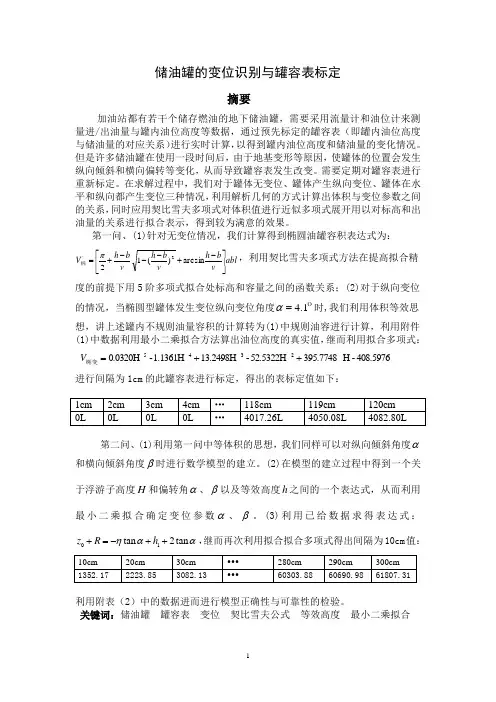
储油罐的变位识别与罐容表标定摘要加油站都有若干个储存燃油的地下储油罐,需要采用流量计和油位计来测量进/出油量与罐内油位高度等数据,通过预先标定的罐容表(即罐内油位高度与储油量的对应关系)进行实时计算,以得到罐内油位高度和储油量的变化情况。
但是许多储油罐在使用一段时间后,由于地基变形等原因,使罐体的位置会发生纵向倾斜和横向偏转等变化,从而导致罐容表发生改变。
需要定期对罐容表进行重新标定。
在求解过程中,我们对于罐体无变位、罐体产生纵向变位、罐体在水平和纵向都产生变位三种情况,利用解析几何的方式计算出体积与变位参数之间的关系,同时应用契比雪夫多项式对体积值进行近似多项式展开用以对标高和出油量的关系进行拟合表示,得到较为满意的效果。
第一问、(1)针对无变位情况,我们计算得到椭圆油罐容积表达式为:abl v b h v b h v b h V ⎥⎦⎤⎢⎣⎡-+---+=arcsin )(122'π椭,利用契比雪夫多项式方法在提高拟合精度的前提下用5阶多项式拟合处标高和容量之间的函数关系;(2)对于纵向变位的情况,当椭圆型罐体发生变位纵向变位角度O =1.4α时,我们利用体积等效思想,讲上述罐内不规则油量容积的计算转为(1)中规则油容进行计算,利用附件(1)中数据利用最小二乘拟合方法算出油位高度的真实值,继而利用拟合多项式:408.5976-H 395.774852.5322H-13.2498H 1.1361H- 0.0320H 2345++=椭变V进行间隔为1cm 的此罐容表进行标定,得出的表标定值如下:第二问、(1)利用第一问中等体积的思想,我们同样可以对纵向倾斜角度α和横向倾斜角度β时进行数学模型的建立。
(2)在模型的建立过程中得到一个关于浮游子高度H 和偏转角α、β以及等效高度h 之间的一个表达式,从而利用最小二乘拟合确定变位参数α、β。
(3)利用已给数据求得表达式:ααηtan 2tan 10++-=+h R z ,继而再次利用拟合拟合多项式得出间隔为10cm 值:利用附表(2)中的数据进而进行模型正确性与可靠性的检验。
2010.Nov.CIMA.E2.QP.final

E 2 – E n t e r p r i s e M a n a g e m e n tEnterprise PillarManagement LevelE2 – Enterprise Management23 November 2010 - Tuesday Afternoon SessionInstructions to candidatesTURN OVERSECTION A – 50 MARKS[You are advised to spend no longer than 18 minutes on each question in this section] ANSWER ALL FIVE QUESTIONS IN THIS SECTIONQuestion OneTS Consultants has been asked to investigate the issues underlying the underperformance and low staff morale of the Finance Department in YR Hospital.The consultants have access to various sources of information such as the recent staff satisfaction survey which shows that staff morale in the department is low. In addition, statistics from the HR Department reveals that both absenteeism and staff turnover are exceptionally high in the Finance Department. There have also been many complaints from other areas of the hospital about both the management and staff working in the department. However, staff enjoy competitive salaries and other excellent working conditions such as free car parking, a subsidised canteen and access to sports facilities.The consultants have run some focus groups with members of staff working in the department to try to gather more information to help them better understand the causes of underperformance and low staff morale. The findings suggest that there appears to be very much a “them and us” culture between management and staff, with the managers in the department exerting power based on their position and status. Staff say that they are only allowed to undertake the specific activities included in their narrow job descriptions and feel unable to fully contribute as a result of the chain of command in the Finance Department. Staff also say that they are not involved in decisions regarding the department’s activities, and many say they have not had any training. They mentioned that there are very few career progression opportunities because of this. They feel their contributions are not recognised by management and that they never receive feedback on their performance. Staff characterise the leadership and management of the department as task-focused, with tight controls and close supervision.Having undertaken the review, the consultants are preparing the recommendations on how to improve the poor performance and low staff morale.Section A continues on the opposite pageEnterprise Management 2 November 2010M is a business that sells custom made computer-based information systems. Each customer order is for a unique system, which will involve experts from many functional areas within M. Each customer expects a high level of individual attention. Some systems take only four to six months to design and produce and cost less than €50,000, whereas other systems cost several million Euros and can take up to three years to complete. Projects are continually being completed and started.A Management Consultant's review of M's organisational effectiveness has concluded that the matrix structure is the most appropriate for M.Question ThreeJB has recently joined the Finance Department of P Company as a trainee management accountant. As part of the Company's induction, she has been offered a mentor. However, since JB has not had any previous experience of mentoring, she is unconvinced of the benefits. She has asked LC, the facilitator of the induction session, to explain what is involved in the process of mentoring and how it might be a benefit to her as a new member of staff.Section A continues on the next pageTURN OVER November 2010 3Enterprise ManagementPRC Company, a retailer of baby clothes and toys, has been in existence for 20 years. Its approach to strategy has tended to be informal and emergent rather than planned. However, the company is facing uncertain times and at a recent Board meeting, one of the directors suggested that the company should adopt a more formal approach to how it develops its strategy. He has suggested that the use of strategic management tools and techniques could help and, as a start, has recommended that the company should undertake a corporate appraisal.Question FiveThe data on sales performance in LS Company has shown a significant downward trend over the last year. The Marketing and Sales Department is blaming the Finance Department for the poor performance, since it was the pressure from the Finance Department that led the Marketing and Sales Department to increase the product price. The Marketing and Sales Department staff say that, in current market conditions, this was inappropriate and was the main reason for the loss of market share. They feel that the Finance Department staff are short sighted, too focused on costs in pricing decisions and do not appreciate that there are other factors that should be considered in product price setting. However, the Finance Department thinks that the Marketing and Sales Department has been complacent and has not had an aggressive marketing and sales strategy in place. Perhaps not surprisingly, communications and cooperation between the staff in the two departments is at an all time low and in meetings there is constant in-fighting and disagreements.To make matters worse, a consequence of the drop in sales has been that the senior management is proposing that there will need to be job losses in the Production Department. The trade union which represents the production workers is now threatening to take industrial action.(Total for Section A = 50 marks)End of Section ASection B starts on the opposite pageEnterprise Management 4 November 2010SECTION B – 50 MARKS[You are advised to spend no longer than 45 minutes on each question in this section] ANSWER BOTH QUESTIONS FROM THIS SECTION – 25 MARKS EACHQuestion SixS Company operates in the consumer electronics industry designing and producing component parts which it assembles into products such as mobile phones, laptops and MP3 players.To date, it has only sold its products in D Country, its home market, where until recently it was market leader. However, the competitive landscape has changed significantly as companies from PP Country have entered D Country's market, competing aggressively on product innovation, quality and price. Market intelligence gathered by S Company on the new competitors suggests that they are supported in pursuit of their international strategies by sources of national competitive advantage.Looking to the future, S Company is evaluating its options on how to respond to the increased competition, including how it could better position itself, and what alternative strategies it could pursue. One option under review is to sell its products in new markets. GR, the Sales and Marketing Director, has identified NN Country as a possible market opportunity. As the first step in understanding whether this is a viable option, he has asked his team to undertake an initial assessment of the external environment in NN Country.Section B continues on the next pageTURN OVER November 2010 5Enterprise ManagementQuestion SevenV is a regional authority, which is about to invest in a new sporting facility in one of the main towns in the region. The sporting facility will include a large swimming pool, an athletics track and a number of indoor facilities such as a gymnasium and indoor tennis courts. It is hoped that this facility will attract major sporting events to the town and will encourage more local people, particularly school children, to take part in more sporting activities.The Finance Director of V has been appointed as the project manager and is in the early stages of setting up the project. This will be a complex project involving the construction of a range of new buildings and facilities involving a large number of specialist building contractors and equipment suppliers. The project is a collaborative venture funded by the regional authority and investment from three large local businesses. The Finance Director has been informed by the Board of V that this is a very high profile project for the regional authority and that overspending on this project is not allowed.It has recently been reported in the local newspaper that the local residents living near to the proposed site for the new sporting facility are not happy with the proposal. This is largely because the proposed site is in a wealthy area on the edge of the town and local residents feel that it would be more appropriate if the new facility was located more centrally.The new sporting facility would mean that two other smaller sporting facilities in the town, currently owned and run by the regional authority, would be closed down and staff relocated to the new facility. In the first meeting held by the project manager to communicate the proposals to staff, he was met with a hostile reaction, with many of them being very unhappy about moving to the new site.The Finance Director is aware that it is a complex project and that the use of project management software will be an important tool in making the project objectives achievable. He is also aware that he must consider the needs of the different stakeholders throughout the duration of the project.(Total for Section B = 50 marks)End of Question PaperEnterprise Management 6 November 2010LIST OF VERBS USED IN THE QUESTION REQUIREMENTSA list of the learning objectives and verbs that appear in the syllabus and in the question requirements foreach question in this paper.It is important that you answer the question according to the definition of the verb.LEARNING OBJECTIVE VERBS USED DEFINITION1 KNOWLEDGEWhat you are expected to know. List Make a list ofState Express, fully or clearly, the details of/facts ofDefine Give the exact meaning of2 COMPREHENSIONWhat you are expected to understand. Describe Communicate the key featuresDistinguish Highlight the differences betweenExplain Make clear or intelligible/State the meaningpurpose ofIdentify Recognise, establish or select afterconsiderationIllustrate Use an example to describe or explainsomething3 APPLICATIONHow you are expected to apply your knowledge. ApplyCalculate Put to practical useAscertain or reckon mathematicallyDemonstrate Prove with certainty or to exhibit bypractical meansPrepare Make or get ready for useReconcile Make or prove consistent/compatibleSolve Find an answer toTabulate Arrange in a table4 ANALYSISHow you are expected to analyse the detail of what you have learned. AnalyseCategoriseExamine in detail the structure ofPlace into a defined class or division Compare and contrast Show the similarities and/or differencesbetweenConstruct Build up or compileDiscuss Examine in detail by argumentInterpret Translate into intelligible or familiar terms Prioritise Place in order of priority or sequence for action Produce Create or bring into existence5 EVALUATIONHow you are expected to use your learning to evaluate, make decisions or recommendations. AdviseEvaluateRecommendCounsel, inform or notifyAppraise or assess the value ofPropose a course of actionNovember 2010 7Enterprise ManagementEnterprise PillarManagement Level PaperE2 – Enterprise ManagementNovember 2010Tuesday Afternoon Session Enterprise Management 8 November 2010。
2010年全国数学建模A题

储油罐的变位识别与罐容表标定摘要本文解决了地下储油罐体因发生变位而需对罐容表进行重新标定的问题。
首先,通过二重定积分,得到了椭圆柱体水平放置时,容油量与液位高度的函数关系。
并通过进一步分析,找到了水平放置与倾斜时液位高度替换关系,进而得到了倾斜时容油量与液位高度的函数关系;其次,建立了储油罐两侧球冠部分容油量的函数表达式,再仿照上述的替换关系,得到了实际储油罐容油量与液位高度的函数关系,并通过matlab软件对上述函数关系进行分析;最后,本文又通过matlab软件对所给实际数据进行拟合,得到了实际测量值与理论计算值近似相等的结论,验证了模型的正确性,也给出了椭圆柱体储油罐变位后油位高度间隔为1cm的罐容表标定值以及实际罐体变位后油位高度间隔为10cm的罐容表标定值。
关键词:储油罐变位;罐容表标定;定积分;matlab软件1 问题的提出通常加油站都有若干个储存燃油的地下储油罐,并且一般都有与之配套的“油位计量管理系统”,采用流量计和油位计来测量进/出油量与罐内油位高度等数据,通过预先标定的罐容表(即罐内油位高度与储油量的对应关系)进行实时计算,以得到罐内油位高度和储油量的变化情况。
许多储油罐在使用一段时间后,由于地基变形等原因,使罐体的位置会发生纵向倾斜和横向偏转等变化(以下称为变位),从而导致罐容表发生改变。
如此,会给经营的双方带来难以估量,和不可见的经济损失。
因此,提高储油罐计量系统的精度,准确的测量储存油料的液位、密度、压力、温度、体积、和质量等,已成为目前油料储存信息化建设的关键性基础环节。
按照有关规定,需要定期对罐容表进行重新标定。
图1是一种典型的储油罐尺寸及形状示意图,其主体为圆柱体,两端为球冠体。
图2是其罐体纵向倾斜变位的示意图,图3是罐体横向偏转变位的截面示意图。
这里我们需要掌握罐体变位后对罐容表的影响,即通过建立合适的数学模型找到罐内储油量与油位高度及变位参数(纵向倾斜角度α和横向偏转角度β)之间的一般关系。
2010年5月技能答案及11月全部答案

2010年11月三级人力资源管理师专业能力试卷标准答案与评分标准一、简答题(本题共2题,第1小题15分,第2小题15分,共30分)1、评分标准:P162(15分)一项具有良好适用性、实用性和可行性的企业培训制度应包含:(1)制定企业员工培训制度的依据;(3分)(2)实施员工培训的宗旨与目的;(3分)(3)企业员工培训制度实施办法;(3分)(4)企业培训制度的核准与施行;(3分)(5)企业培训制度的解释与修订权限的规定。
(3分)2、评分标准:P178(15分)(1)确保考评的准确性;(3分)(2)重视考评的公正性;(3分)(3)慎重选择考评结果的反馈方式;(3分)(4)对考评使用表格进行再检验;(3分)(5)对考评方法进行再审核。
(3分)二、计算题(本题共1题,共20分。
先根据题意进行计算,然后进行必要分析,只有计算结果没有计算过程不得分)评分标准:P238(20分)(1(2)设计各评价要素和指标权重的基本要求在企业中,不同类别的岗位具有不同的性质和特点,在设计各评价要素及其指标的权重时,应根据其性质和特点,确定各岗位评价要素和指标的权重值,以体现出各类岗位(如管理岗位、技术岗位、生产岗位等)之间的差异性。
(4分)三、综合分析题(本题共2题,第1小题15分,第2小题18分,共33分)1、评分标准:P86(15分)(1)人员配置的原理①要素有用原理;(1分)②能位对应原理;(1分)③互补增值原理;(1分)④动态适应原理;(1分)⑤弹性冗余原理。
(1分)(2)对策由于大多数售后服务人员不适应既是服务人员、又是销售人员的角色,人岗不匹配,能位不对应,因此销售业绩难以提高。
为此,可以采取以下对策:①淘汰不能够适应交叉销售经营战略的员工,招聘新的合适的员工;(2分)②提供有吸引力的提成工资,激励越来越多的售后服务人员去销售产品;(2分)③聘请培训咨询机构,根据公司的需要,设计专门的培训课程,对员工进行系统的培训,大力培养适用的专门人才,进一步促进公司实现交叉销售的经营战略;(2分)④选拔优秀员工,树立交叉销售的标杆,发挥其引导和示范作用;(2分)⑤建立完善员工的交流平台,鼓励员工之间相互帮助、不断交流成功的经验,总结失败的教训,从而提高整体的销售水平。
2010年MBA联考综合真题及答案
2010年全国攻读工商管理硕士学位研究生入学考试综合试卷考生需知1.选择题的答案须用2B铅笔填涂在答题卡上,其他笔填涂的或做在试卷或其他类型答题卡上的答案无效。
2.其他题一律用蓝色或黑色钢笔或圆珠笔在答题纸上按规定要求作答,凡做在试卷上或未做在指定位置的答案无效。
3.交卷时,请配合监考人员验收,并请监考人员在准考证相应位置签字(作为考生交卷的凭据)。
否则,所产生的一切后果由考生自负。
2010年管理类专业学位全国联考综合能力真题一.问题求解:第1-15小题,每小题3分,共45分,下列每题给出的A 、B 、C 、D 、E 五个选项中,只有一项是符合试题要求的,请在答题卡上将所选项的字母涂黑1. 电影开演时观众中女士与男士人数之比为5:4,开演后无观众入场,放映一个小时后,女士的20%,男士的15%离场,则此时在场的女士与男士人数之比为(A )4:5 (B )1:1 (C )5:4 (D ) 20:17 (E )85:642.某商品的成本为240元,若按该商品标价的8折出售,利润率是15%,则该商品的标价为(A )276元 (B )331元 (C )345元 (D )360元 (E )400元3.三名小孩中有一名学龄前儿童(年龄不足6岁),他们的年龄都是质数(素数),且依次相差6岁,他们的年龄之和为(A )21 (B )27 (C )33 (D )39 (E )514.在右边的表格中每行为等差数列,每列为等比数列,x+y+z=(A )2 (B )52 (C ) 3 (D ) 72(E )45.如图1.在直角三角形ABC 区域内部有座山,现计划从BC 边上某点D 开凿一条隧道到点A ,要求隧道长度最短,一直AB 长为5km ,AC 长为12km,则所开凿的的隧道AD 的长度约为(A )4.12km (B )4.22km (C )4.42km (D )4.62km (E )4.92kmAB D 图一 C6.某商店举行店庆活动,顾客消费达到一定数量后,可以在4中赠品中随即选取2个不同的赠品,任意两位顾客所选赠品中,恰有1件品种相同的概率是(A )16 (B ) 14 (C )13 (D )12 (E )237.多项式 326x ax bx ++- 的两个因式是x-1和x-2,则第三个一次因式为(A ) x-6 (B ) x-3 (C ) x+1 (D )x+2 (E )x+38.某公司的员工中,拥有本科毕业证,计算机登记证,汽车驾驶证得的人数分别为130.110,90,又知只有一种证的人数为140,三证齐全的人数为30,则恰有双证的人数为(A )45 (B )50 (C )52 (D )65 (E )1009.甲商品销售某种商品,该商品的进价每件90元,若每件定位100元,则一天内能售出500件,在此基础上,定价每增1元,一天能使少售出10件,甲商店获得最大利润,则该商品的定价应为(A ) 115元 (B )120元 (C )125元 (D )130元 (E )135元10.已知直线ax-by+3=0(a>0,b>0)过圆224210x x y y ++-+= 的圆心,则a-b 的最大值为(A )916 (B ) 1116 (C )34 (D )98 (E )9411.某大学排除5名志愿者到西部4所中学指支教,若每所中学至少有一名志愿者,则不同的分贝方案共有(A )240种(B )144种 (C )120种 (D )60种 (E )24种12.某装置的启动密码是由0到9中的3各不同数字组成,连续3次输入错误密码,就会导致该装置永久关闭,一个仅记得密码是由3个不同数字组成的人能够启动此装置的概率为(A )1120 (B )1168 (C )1240 (D )1720(E )31000 13.某居民小区决定投资15万元修建停车位,据测算,修建一个室内的费用为5000元,修建一个室外车位的费用为1000元,考虑到实际因素,计划室外车位的数量不少于室内车位的2倍,也不多于室内车位的3倍,这笔投资最多可见车位的数量为(A )78 (B )74 (C )72 (D ) 70 (E )6614,如图2,长方形ABCD 的两天边分别为8m 和6m ,四边形OEFG 的面积是42m ,则阴影部分的面积为(A )32 2m (B)28 2m (C) 24 2m (D)202m (E)162mDB F C15.再一次竞猜活动中,设有5关,如果连续通过2关就算闯关成功,小王通过每关的概率都是12,他闯关成功得该率为 (A )18 (B) 14 (C) 38 (D )48 (E)1932 二、条件充分性判断:第16-25小题,每小题3分,共30分。
2010年(车工)理论试卷A
2010年北京市职工职业技能大赛数控车床理论知识试卷(A)题号一二三四总分分数得分评卷人一、单项选择题(本大题共50个小题,每题l分,满分50分)(选择一个正确的答案,将相应的字母填入题内的括号中)1.安全事故来源于( )。
A、时间紧B、劳动强度大C、侥幸心理干扰工作D、操作不熟练2.组织有关人员协同作业,建立正常的( ),进行有节奏的均衡生产。
A、管理机构B、技术质量C、生产秩序D、工艺准备3.某机床用低压断路器作电源引入开关,就不须安装( )作短路保护。
A、熔断器B、接触器C、继电器D、刀闸4.梯形螺纹标柱只标( )公差带代号。
A、中径B、大径C、小径D、外径5.相关原则是形位公差和尺寸公差相互( )的一种公差原则。
A、有关B、无关C、补偿D、补偿6.表面越粗糙的零件,在间隙配合中,由于磨损加而使间隙( )。
A、为零B、不变C、减小D、增大7. HRA、HRB、HRC符号是代表金属材料( )的符号。
A、强度B、布氏硬度C、洛氏硬度D、维氏硬度8.下列铝合金牌号中( )是硬铝合金牌号。
A、5A02B、2A11C、7A03D、2A509.用于加工高速切削高温合金和热喷涂材料工件,应选用( )非金属材料。
A、氮化硼B、人造金刚石C、陶粒D、立方氮化硼10.G50除有坐标系设定功能外,还有主轴( )转速设定功能。
A、一般B、最低C、最高D、慢11.车削中心是以全功能型数控车床为主体,实现( )复合加工的机床。
A、多工序B、单工序C、双工序D、任意12.可编程控制器PLC(Progyammable Controller)是以微处理器为基础的( )型自动控制装置。
A、单一B、通用C、专业D、信息13.机械误差补偿功能可以自动补偿机械传动部件因( )产生的误差的功能。
A、刀具B、装夹C、间隙D、加工14.选择零件主视图的一般原则:符合零件的工作位置,较多地反映零件形状特征和( )等。
A、确定其他视图B、位置特征C、形位公差D、图纸尺寸15.工序分散就是整个工艺过程中所安排的工序数量( )。
CIMA—F2模拟题及分析(4)
CIMA—F2模拟题及分析(4)1.EMR made an investment in a debt instrument on 1 July 2010 at its nominal value of $4,000,000. Theinstrument carries a fixed coupon interest rate of 7%, which is receivable annually in arrears. The instrument will be redeemed for $4,530,000 on 30 June 2014. Transaction costs associated with the investment were $200,000 and were paid on 1 July 2010. The effective interest rate applicable to this instrument has been calculated at approximately 8.4%. EMR intends to hold this investment until its redemption date.Required:(a) (i) Explain how this investment should be classified and prepare the journal entry to initially record it in accordance with relevant accounting standards.(ii) Calculate the carrying value of the investment to be included in EMR’s statement of financial position as at 30 June 2012, in accordance with IAS 39 Financial instruments: recognition and measurement.(5 marks)EMR’s main business risk is the price of raw materials. As a manufacturer of jewellery, its profits can be significantly affected by the price of precious metals. Therefore, in order to minimise the risk of future price increases adversely affecting its future profits, EMR entered into a forward contract on 1 May 2012, at nil cost, to purchase 100,000 units of metal A at $105 per unit on 1 August 2012.At 30 June 2012, the forward rate for purchasing 100,000 units of metal A was $101 per unit. EMR adopts hedge accounting where permitted by IAS 39 Financial instruments: recognition and measurement.Required:(b) Explain how this forward contract should be accounted for by EMR in its financial statements for the year ended 30 June 2012, in accordance with IAS 39 Financial instruments: recognition and measurement.(5 marks) Total for Question Four = 10 marks2.SR is a service-based entity, listed on its local stock exchange, which relies on its human resources to generaterevenue. The directors believe that the information provided by the annual financial report fails to provide a complete picture of the resources available to the entity. They are keen to ensure that current and potential investors are aware of the investment the entity has made in its employees and are considering including a narrative report in respect of human capital.Required:(a) Discuss, referring specifically to the recognition principles of the IASB’s Framework for the Preparation and Presentation of Financial Statements, why human resources cannot be recognised as an asset in the financial statements of SR.(3 marks)(b) Discuss the pressures in the current economic climate to extend narrative reporting in corporate reports AND the potential advantages that could be gained by investors if SR included voluntary narrative disclosures specifically in respect of human capital.(4 marks)(c) Discuss the potential drawbacks to investors of relying on voluntary disclosures as part of their investment appraisal.(3 marks) Total for Question Five = 10 marks3.The statements of financial position for AB and CD as at 30 June 2012 are provided below:ASSETS AB$000 CD$000Non-current assetsProperty, plant and equipment58,0008,500Available for sale investment (note 1) 7,000 -Current assets 65,000 8,500Inventories 15,500 2,000Receivables 16,500 4,750Cash and cash equivalents 3,000 75035,000 7,500Total assets 100,000 16,000EQUITY AND LIABILITIESEquityShare capital ($1 equity shares)50,0002,500Retained earnings 18,975 6,500Other components of equity 1,025 -Total equity 70,000 9,000Non-current liabilities 9,750 2,000Current liabilities 20,250 5,000Total liabilities 30,000 7,000Total equity and liabilities 100,000 16,000Additional information:1. AB acquired a 10% investment in CD on 1 February 2009 for $800,000. The investment was classified as available for sale with any associated gains or losses recorded within other components of equity in AB’s individual financial statements.On 1 January 2012, AB acquired an additional 60% of the equity share capital of CD at a cost of$5,175,000. The fair value of the original 10% investment at 1 January 2012 was $1,000,000. In its own financial statements, AB continues to hold the investment in CD as an available for sale asset and it is recorded at its fair value of $7,000,000 as at 30 June 2012.At 1 January 2012, the fair value of the net assets acquired was assessed to be the same as their carrying value, with one exception, property, plant and equipment (PPE). Property, with a carrying value of $3,200,000, had a fair value of $4,000,000. The remaining useful life of this asset is 10 years from the date of acquisition. Depreciation on PPE is charged on a monthly straight line basis.2. It is the group policy to value non-controlling interest at fair value at the date of acquisition. The fair value of the non-controlling interest at 1 January 2012 was $2,700,000.3. The profit for the year of CD was $2,500,000 and profits are assumed to accrue evenly throughout the year.4. CD sold goods to AB for $1,000,000. Half of these goods remained in AB’s inventories at 30 June 2012. CD earnsa 25% margin on all sales.5. Neither entity paid a dividend in the year ended 30 June 2012.Required:(a) Prepare the consolidated statement of financial position as at 30 June 2012 for the AB Group.(20 marks)AB purchased a further 10% of the ordinary share capital of CD on 1 July 2012 for $1,172,000.Required:(b) (i) Explain how the acquisition of this additional investment will be accounted for in the consolidated financial statements of AB for the year to 30 June 2013.(ii) Prepare the journal entry that records the purchase of the additional 10% of CD’s share capital in the consolidated financial statements of AB.(5 marks) Total for Question Six = 25 marks4.TYU is a listed entity that operates in a highly competitive market. A new entrant to this market (entered on 1May 2011) has created pressure amongst the competitive entities by developing a marginally lower quality product and selling it at a lower price. The result has been a shift in market share to this new entrant in the last few months.You have been asked to review the financial performance and position of TYU for a large institutional investor who had identified TYU as a potential investment for 2012.TYU’s share price had fallen significantly due partly to a downturn in the stock market that TYU is listed on and partly to the poor interim results that TYU posted in November 2011. The share price recovered slightly following the announcement of a final dividend shortly before the year-end. The share price at 31 March 2012 was $2.50 (31 March 2011 $4.34).The financial statements for TYU are provided below:Consolidated statement of financial position at 31 March 2012 2011 ASSETS $m $mNon-current assetsProperty, plant and equipment 393 353Investment in associate 21 24Current assets414377Inventories 210 110Trade and other receivables 118 103Cash and cash equivalents - 24328237Total assets742 614EQUITY AND LIABILITIESEquity attributable to owners of the parentShare capital ($1 shares) 20 20Share premium 67 67Revaluation reserve (Note 4) 20 -Retained earnings (Note 3) 278 298385 385Non-controlling interest 24 19Total equityNon-current liabilities409404Long-term borrowings (Note 1) 90 90Current liabilitiesTrade and other payables 196 120Short-term borrowings (Note 2)Total liabilities47243333- 120210Total equity and liabilities742614Notes:1. The long-term borrowings are repayable in 2015.2. TYU has a facility in place permitting short-term borrowings up to a maximum of $50 million.3. TYU and its subsidiary both paid a dividend in the year.4. TYU changed its group policy on Property, plant and equipment in the year to 31 March 2012 and now hold these assets at valuation.Required:(a) Calculate the earnings per share AND the price/earnings ratio for TYU for the year ended 31 March 2012 and the comparatives for 2011.(2 marks)(b) Analyse the financial performance and financial position of TYU and make a recommendation as to TYU’s suitability for investment based upon the information that has been presented to you.(6 marks are available for the calculation of relevant ratios which are additional to those calculated in part (a) above.)(20 marks)(c) Discuss what post year-end information might be available that would provide your client with additional information before making an investment decision.(3 marks) Total for Question Seven = 25 marks试题答案:1、【答案】RationaleThis question tested the classification and measurement of a held to maturity investment and the ability of the candidates to calculate amortised cost. The second part tested the treatment ofa derivative instrument where hedge accounting is adopted.The question tested learning outcomes B1(d) and B1(e).Suggested approachCandidates should have been able to identify a held to maturity investment from the information given in the question. The calculation of amortised cost should have been straightforward provided candidates realised that it was an investment and not a liability.For part (b), provided candidates understand that hedge accounting is largely about changing the rules of recognition for a derivative that is linked to another item, the first few marks should have been easy to attain.(a) (i) The investment should be classified as held to maturity investment because EMR intends to hold the investment until its redemption date. Initially the investment will be measured at its fair value (which in this case is its cost), plus any associated issue costs. The initial journal entry required is therefore:DR: Investment in HTM investment $4,200,000CR: Cash $4,200,000(ii) Subsequent measurementYear end 30 June Opening balance Effective interest 8.4% Interest received 7% x $4m Closing balance$000 $000 $000 $0002011 4,200 353 (280) 4,2732012 4,273 359 (280) 4,352The investment will be held at $4,352,000 in the statement of financial position at 30 June 2012.(b) This forward contract is an example of a derivative and in accordance with IAS 39 such derivative contracts are classified as an asset or liability held at fair value through profit and loss. This would mean that at each year end the contract would need to be re-valued to its fair value (being the difference between the derivative price and the market price of the underlying asset under the contract). Any gains or losses would usually then be recorded in profit or loss. However this contract is specifically intended to mitigate the risk of future adverse cash flows as a result of potential increases in raw material prices. This contract is therefore being used as a cash flow hedge (because it’s being used to fix the price of material to be acquired in the future on 1 August). In such circumstances IAS 39 has some special hedge accounting rules. Hedge accounting allows the gains or losses on a derivative contract being used in a cash flow hedge to be taken to reserves until the cash flow it is designed to hedge against is recognised in the financial statements. In this case, the gains or losses will be held in reserves until the year ended 30 June 2013, which is the year in which the cash flow is actually incurred, and then released to the profit or loss.In this case, a loss on the derivative of $400,000 (100,000 x $(105-101)) will be included in reserves at 30 June 2012.2、【答案】RationaleThis question tested Section D of the syllabus, and required an element of application by candidates. Human capital accounting and intellectual property are areas that candidates should be aware of as there has been much debate in recent years about the reasons for and against their recognition.This question tested learning outcome D1 (a) and (d).Suggested ApproachCandidates will have seen questions testing this area in previous diets, however it was intended to require them to focus on the specifics of the question. The key element being the recognition principles of IFRS. Part (b) focussed on the increasing voluntary disclosures and the benefits to investors and part (c) asked for limitations of these voluntary disclosures.(a) RecognitionThe framework defines an asset as a resource controlled by an entity and from which economic benefits will flow. The amount also has to be measured with sufficient reliability to be recognised in the financial statements. The value associated with human capital cannot be controlled as employees are free to leave, taking their skills elsewhere. In addition, the amount of potential value created is uncertain. There is no way of measuring this with sufficient reliability. Therefore human capital is not recognised in the financial statements.(b) Pressure to extend narrative reporting and advantages to investorsFinancial statements are by their nature backward-looking, based primarily on historical information and are therefore limited in their usefulness for decision-making by investors. In addition, this entity is service-based and as the main resource is not included on the financial statements it is difficult for users to estimate future revenue streams. This has led to general pressure by the markets and investors for entities to provide additional information to that contained in the financial statements.Investors in SR would benefit in this case from additional information on the resources available to the entity in order to generate future revenue. This information could be useful for users in estimating future profits and returns. It would also help users identify any key personnel or skills that the entity relies on and this helps users determine the risks that threaten the future income streams of SR. In addition, it would help show the hidden assets of the business without which traditional ratios like ROCE are meaningless, preventing comparison with other entities.(c) Potential drawbacksThe absence of formal guidance on the content and structure of voluntary disclosures does reduce the level of comparability between entities. In addition, reporting entities are free to choose the information they wish to report which often results in the voluntary disclosures being more of a PR exercise by only reporting the positive aspects.Voluntary information is not likely to be audited and therefore may not be reliable. This reduces the usefulness of the information.The inclusion of voluntary disclosures will incur additional costs of preparation and therefore reduces the future returns available to shareholders.3、【答案】RationaleThis question tested consolidation. The first section tested the basics of preparing a s tatement of financial position for a group, including the calculation of goodwill, NCI and group retained earnings. The complex area tested in part (a) was acquiring a controlling interest in the year but the basic consolidation techniques accounted for more than 80% of the marks.Part (b) dealt specifically with an acquisition (control to control) and an adjustment to parent’sequity.This question tested learning outcomes A1(a) and (b).Suggested ApproachThe most time-efficient method would have been to set up the pro-formas for the SOFP and then systematically work through the headings, preparing consolidation adjustments where required. Annotating the additional information highlighting the balances that require adjustment is always a worthwhile exercise.(a) Consolidated statement of financial position for the AB Group as at 30 June 2012: All workings in $000ASSETS AB$000Non-current assetsProperty, plant and equipment (58,000+8,500+760(W1))67,260Goodwill (W2) 325Current assets 67,585Inventories (15,500 +2,000 - 125 (W3)) 17,375Receivables (16,500 + 4,750) 21,250Cash and cash equivalents (3,000+ 750) 3,75042,375Total assets 109,960EQUITY AND LIABILITIESEquityShare capital ($1 equity shares)50,000Retained earnings (W4)Other components of equity (W5) 19,935- 69,935Non-controlling interest (W6) 3,025Total equity 72,960Non-current liabilities (9,750 + 2,000) 11,750Current liabilities (20,250+ 5,000) 25,250Total liabilities 37,000Total equity and liabilities 109,960Working 1 FV adjustments $000 $000 $000Uplift in PPE 800Additional dep’n (800/10 yrs x 6/12) (40) 760Working 2 Goodwill $000 $000Consideration transferred for the 60% 5,175Fair value of 10% holding at 1 January 2012 1,000Fair value of non-controlling interest 2,7008,875Net assets acquired:Share capital 2,500Retained earnings (6,500 – (2,500 x 6/12)) 5,250FV adjustment (W1) 800 (8,550)Goodwill at acquisition 325Working 3 Unrealised profit on inventories $000Sales from CD to AB 1,00050% in inventories 500Profit margin 25% 125Working 4 Retained earnings AB CD$000 $000As at 30 June 2012 18,975 6,500Pre-acquisition (W2) (5,250)Less unrealised profit of CD (W3) (125)FV adjustment (W1) (40)Group share 70% 760 1,085Group profit on derecognition of AFS Investment – to deemed disposal date, 1 January 2012 (1,000 – 800)200Consolidated retained earnings 19,935Working 5 Other components of equity and AFS investments $000Cost of 60% investment (1 Jan 2012) 5,175Cost of 10% investment (1 Feb 2009) 800Therefore, cost of 70% investment 5,975Compared with fair value of 70% investment (30 June 2012) 7,000Resultant gain recognised by AB in individual accounts since 1 Feb 2009 and balance in other reserves of AB 1,025This gain will be removed from the consolidated accounts as the group gain on derecognition of the original investment is the relevant figure for the consolidated accounts, leaving a balance of NIL in the group accounts for other reserves.Working 6 Non-controlling interest $000Fair value at 1 January 2012 2,700Plus 30% adjusted post-acquisition reserves of 1,085 (W4) 325NCI at 30 June 2012 3,025(b) (i) Additional acquisition of sharesThe purchase of the additional 10% of CD’s share capital is treated as a transaction between owners of the entity, as NCI reduces and parent’s share increases. No additional goodwill is calculated as AB already controls CD and goodwill is only calculated when control is attained. Any difference between the consideration paid by AB and the reduction in the NCI is adjusted through group retained earnings.(ii) Adjustment to parent’s equity $000 $000Dr Reduction in NCI at 1 July 2012 (10/30% x $3,025,000) 1,008Dr Retained earnings 164Cr Bank - consideration transferred 1,172Being adjustment to parent’s equity4、【答案】The question was a standard-style analysis question covering Section C of the syllabus. Candidates were required to calculate EPS and P/E and then select and calculate a further 6 ratios in order to analyse the financial performance and position of the entity.This question tested learning outcomes C1(a), C2(a) and C2(b).Suggested ApproachCandidates should have calculated ratios and then considered the results in conjunction with the opening scenario. The analysis should have included the candidates’ recommendations based on the information available and then highlighted the post-year end info that could be available to investors.(a) Earnings per share 2012 2011Profit attributable to parent $8,000,000 $14,000,000Equity shares in issue 20,000,000 20,000,000Eps 40 cents 70 centsP/E ratioShare price $2.50 $4.34Eps 40 cents 70 centsP/E (share price/eps) 6.25 6.2(b) Report to client Re TYUGross profit margin has fallen from 35% to 32.4%, which is likely to be a direct impact of the pressure on selling prices from the new market entrant. TYU appears to have reacted well to this and has controlled expenses resulting in an increase in operating profit margin from 4.9% to 5.2%. This indicates TYU management are reasonably able to react quickly and positively to changes in economic conditions. The profit for the year has reduced but largely due to the loss making activities of the associate. The attention to cost control has resulted in ROCE increasing, despite the increase in capital employed from the revaluation of PPE.The current ratio has fallen significantly although still offers sufficient cover of liabilities, however the quick ratio shows that TYU have an immediate problem that threatens going concern. The quick ratio has fallen from 1.1 to 0.5 at the year-end. This is due to issues with all the component parts of working capital. Cash has fallen from a positive $24m to an overdraft of $47m and is dangerously close to breaching the agreed banking terms for short-term borrowings. This may have been the motivation for holding back on payments to creditors, resulting in an increase in payables days from 109 days to 156 days. This increase is unlikely to have been authorised as TYU was already being extended 3 months of credit. This is likely to put TYU in an unfavourable position with its suppliers, not a good position when the suppliers have a new entrant to switch to. Despite the cash crisis, TYU has failed to collect its debts timeously, with receivables days sliding from 61 days to 64 days. Inventories days have also increased significantly from 100 days to 167 days at the year-end. This may indicate TYU has an issue with obsolete inventory resulting from the inflow of cheaper products in the market.Conversely, it could mean that TYU has been stocking up at the year-end for a concerted sales promotion to combat the competition.Gearing has increased during the year due to the increase in short-term borrowings, despite thefact that there has been a revaluation in the year. The change in revaluation policy may be a deliberate attempt to boost equity and make the gearing level appear more attractive, to enable TYU to raise additional long-term finance. Although this is sometimes seen as misleading, it is a commercially valid adjustment as the property is likely to act as security for any loan and having an updated valuation makes good business sense. The interest cover however has dropped from 3.8 to 1.8 and shows an increased risk. This increased risk is reflected in the average rate of borrowing which has increased from 8.9% to 13.9%. The short- term borrowings are being charged at a much higher rate and it is imperative that TYU secures longer-term finance to ease the cash flow issue, pay suppliers and hopefully lower interest payable.TYU announced a final dividend despite the cash crisis suggesting that it is under significant pressure from shareholders to provide a return. The P/E ratio has remained constant despite the reduction in earnings per share, which suggests that investors still have confidence in the management of TYU.ConclusionDespite the current cash crisis the management team appears to have reacted positively to the market pressures, by reducing prices to be more competitive and by actively cutting costs to maintain margins. Provision of longer-term finance would enable TYU to pay suppliers and meet interest payments which must be seen as a priority. TYU remains a possible target for investment, although some additional information is required.(c) Additional informationThe post-year-end situation will, to a certain extent, answer the main questions raised about cash availability. If the dividend has been paid, then this suggests that finance has in fact been raised. Corporate research will highlight if the entity’s suppliers have taken action to recover amounts due – if not, then it is likely again that finance has been raised/generated and supplier accounts settled. It must be remembered that there will be limited information in the public domain, but if TYU has survived this cash crisis then it indicates a strong management team and an investment that is worth pursuing.参与CIMA的考生可按照复习计划有效进行,另外高顿网校官网CIMA考试辅导高清课程已经开通,还可索取CIMA考试通关宝典,针对性地讲解、训练、答疑、模考,对学习过程进行全程跟踪、分析、指导,可以帮助考生全面提升备考效果。
技能认证车工5级考试(习题卷4)
技能认证车工5级考试(习题卷4)第1部分:单项选择题,共74题,每题只有一个正确答案,多选或少选均不得分。
1.[单选题]数控机床进给系统减少摩擦阻力和动静摩擦之差,是为了提高数控机床进给系统的( )。
A)传动精度B)运动精度和刚度C)快速响应性能和运动精度D)定位精度答案:C解析:2.[单选题]车削时,( )切削速度最容易形成积屑瘤,应尽量避开。
A)高等B)中等C)低等D)任意答案:B解析:3.[单选题]在设计直动平底从动件盘形凸轮机构时,若出现运动失真现象,应( )。
A)减小基圆B)增大基圆C)减小平底宽度D)增大平底宽度答案:B解析:4.[单选题]以下四种机构中,具有自锁作用的传动机构是( )。
A)带传动B)齿轮传动C)链传动D)蜗杆传动答案:D解析:5.[单选题]尾座偏移量的计算公式是( )。
A)s= [(D-d)/2L]L0B)s= (D-d)/2LC)s= (D-d)/L0D)s= (D/2L)L0答案:A解析:6.[单选题]M5是( )指令。
A)程序结束B)主轴正转C)主轴反转D)主轴停止答案:D解析:7.[单选题]百分表的测量范围是指齿杆的有效最大移动量,以下那种是属于百分表的测量范围的一种。
( )A)0-3mmB)5-10mmC)10-20mmD)0-25mm答案:A解析:8.[单选题]用螺纹量规测量时,如果通规难以旋入,应对螺纹的( )进行检查,经过修正后再用量规检验。
A)直径、牙型、螺距和表面粗糙度B)大径、螺距和表面粗糙度C)小径、螺距和表面粗糙度D)中径、牙型、螺距和表面粗糙度答案:A解析:9.[单选题]在零件尺寸链中,封闭环是加工形成的,应该选择何种类型的尺寸为封闭环( )A)最重要的B)不太重要的C)最不重要的D)不重要答案:A解析:二、10.[单选题]步进电动机步距角θ=360°/kmz,其中k指()。
A)逻辑供电状态系数B)定子绕组数C)转子铁心系数D)其他答案:A解析:11.[单选题]精加工时,尽可能选择较( )的切削深度。