
牛津英语七年级下unit4语法
Unit4 Save the trees二,掌握下列句子释义:1. be harmful to sb =do harm to sb = be bad for sb(对...有害)2. Thank sb for (doing) sth = thanks for sb (doing) sth (感谢某人做某事)3. A lot = very much; a lot of = many/much (很多)5. Too... to = so...that = not...enough (太...以至于)6,be in (great) danger =be not safe (处于危险)7. Look after (well) = take (good) care (照顾)语法现在进行时:一、用法1.表示说话时正在进行的动作。
常和now,Look!Listen!。
Eg1.I am reading a book now.Eg2.Look!They are having a basketball match.Eg3.Listen!He is playing the piano.Eg4.It’s 7:00 pm.The Greens are watching TV.2.表示现阶段正在进行着的动作但说话时不一定正在进行。
Eg1.He is working in a shoe factory these days.(临时性的工作)Eg2.Mr.Green is writing another novel.(说话时并未在写,只处于写作的状态。
)3.表示在按计划要进行的动作。
即用现在进行体表示将来要发生的动作。
但一般要与将来时间连用,而且仅限于少量动词。
例如:come,go,start,arrive,leave,stay等表移动的词。
Eg1.Mr.Smith is leaving for London tomorrow.Eg2 Are you staying here till next week?二、构成(肯定,否定,一般疑问,特殊疑问)1、主语+be+现在分词The students of Class Two are singing . 二班的学生正在唱歌。
2、主语+be+not+现在分词I am not looking at the blackboard . 我没有正在看黑板。
3、be+主语+现在分词Is she dancing? 她正在跳舞吗?4、特殊疑问词+be+主语+现在分词What are you doing now?你正在做什么?三、注意动词的现在分词的变化。
动词现在分词构成:1.正常变化是在动词原型后加ing如:read----reading ; drink---drinking ; eat---eating ; listen--- listening jump---jumping ; wear---wearing ; grow---growing ;collect---collecting2.特殊变化:1) 以e结尾的动词,去掉e再加ing如:write ---writing ; make--- making ; ride---riding ;take---taking2).以重读闭音节结尾的动词,如果末尾只有一个辅音字母,(只有一个元音字母,而其后跟有一个辅音字母时)要双写结尾的辅音字母再加ing例如sit---sitting ; swim---swimming ; put--- putting ; run--- running get----getting现在进行时专练一、写出下列动词的现在分词stand_________ swim_________ play__________ skate _________run__________ ride__________ come_________ sing__________have_________ write________ dance_________ sit___________二、用括号中动词的适当形式填空:1. My parents _______(watch)TV now.2. Look. Three boys _______(run).3. What _______ your mother _______(do)now?4. _______ your dog _______ now?(sleep)5. _______ you _______(listen)to music? Yes, I am.6. Look, Miss Chen _______ football.(play)7. Tom and his sister _______(wait)for you over there.8. Now Class 3 and Class 4_______(have)a test.9. Listen, someone _______(sing)in the classroom.10. ——Where is Zhang Yan?——She _______(talk)with her teacher in the teacher’s office.三.选择填空:()1. Who ______ over there now?A. singingB. are singC. is singing( 2. It’s nine ten. The students ______ a music class.A. haveB. havingC. are having()3. Listen! The boy _______.A. cryingB. is cryingC. cries()4. Don’t talk here. Grandparents ______.A. sleepB. is sleepingC. are sleeping()5. Is the man _______ tea or milk?A. drinksB. drinkC. drinking三、根据提示完成下列句子1.The students_____________(正在上英语课)2.Some girls__________________(正在跳舞)3.I_______________________(正在骑自行车)4.My mother_________________(正在做家务)5._______the boys__________(正在打篮球吗)课堂作业一、用所给词的正确形式填空。
1. Water pollution is ________ (harm) to our health.3. Judy is ________ (collect) some facts for a class project on pollution.4. We all know that tigers are in ______ now .(dangerous)5. Do you enjoy ________(breathe)fresh air?6. I______ very ________ ______ (interest) playing the piano.7. Every year, people _______ (destroy) many forests.8 Look ! The _______ of that tree are too long , They reach the window of our living room ( branch )9 Trees are _________ plants, so people use them to make a lot of things ( use )10 First, the workers put some soil in the _________( contain )二、单项选择。
1. Our Earth will be _________ if we go on cutting down millions of trees every year.A. in great dangerB. dangerC. dangerouslyD. out of danger2. Students will make great progress (进步) if they __________ a subject.A. are interested inB. are interestingC. are interestedD. are interesting in3. Look! The baby ________ happily now because he ________ you are his friends.A. similes;is knowingB. is smiling; is knowingC. is smiling; knowsD. smiles; knows4. The train __________ for Beijing soon. The passengers who are still on the platform (月台) should get on the train at once.A. leavesB. is leavingC. leftD. leaving5. Books give us knowledge (知识) and make us ________ happy.A. feelingB. feelC. feelsD. felt6. They’re the biggest and oldest ________ things on Earth.A. lifeB. liveC. livingD. alive7. The boy enjoys ___________ in the evening.A. play the guitarB. playing the guitarC. playing guitarD. play guitar8. Look, who __________ on the playground?A. is playingB. playingC. playsD. played9. It i s going to rain. You’d better __________ an umbrella.A. bringB. havingC. hadD. to have10. Jin Yong is one of the greatest and oldest _________ writers. He is still ________.A. living; aliveB. living; livingC. alive; livingD. alive; alive三、根据汉语提示,补全句子。
牛津译林初中英语七年级下学期unit4语法 方位介词
方位介词(教师版)学员编号:年级:七年级课时数: 3学员姓名:辅导科目:英语学科教师:授课类型T 知识梳理 C 典例练习T 方法总结授课日期及时段2020年方位的介词的用法本单元学习介词+定冠词the+名词构成介词短语的用法,介词后面可以跟名词和代词做宾语,构成介词短语。
今天我们主要学习一下用来表示方位的介词和介词短语。
方位的介词的用法:1. on介词on表示“在某物之上”的意思,它通常表示一个物体在另一个物体之表面上面。
两者之间有接触。
例如:Your book is on the desk. 你的书在课桌上面。
2. in介词in表示“在某物的里面”,它通常表示一个物体在另外一个物体的内部、中间或者在某个范围之内。
例如:Your pen is in the pencil case. 你的钢笔在铅笔盒里面。
3. under介词under表示“在某物的下面”,它通常表示一个物体在另外一个物体的垂直正下面,两者之间没有接触。
例如:My bike is under the tree. 我的自行车在树的下面。
The shoes are under the chair. 鞋在椅子的下面。
拓展:under和below 的区别under表示“在……之下”,通常表示位置处于正下方,与介词over“在……上方”相对应。
例如: There is a book under the table. 桌子下面有一本书。
below表示“在……之下”,“在……的下游”,与介词above相对应,常指在某物体之下,但不一定在该物的正下方。
例如:He is below the average at school.他的学习成绩在水准以下。
4. behind介词behind表示“在某物的后面”,它通常表示一个物体在另外一个物体的后面。
例如:Your brother is behind the tree. 你的弟弟在树的后面。
5. next tonext to是由形容词next和介词to构成的介词短语表示“紧挨着、在某物的旁边”的意思。
译林牛津版七年级英语下册7B unit4 知识点梳理

7B Unit4 <重点短语>1.have to 不得不,必须2.go straight on 一直往前走3.lie down all day long 整天躺着4.walk along 沿着...走5.turn left 向左转6.cross the bridge过桥7.walk past步行经过8.traffic lights 红绿灯9.plenty of大量,足够10.the way to 去...的路<重点句型>1.Sunshine Zoo is north of Sunshine Middle School.阳光动物园在阳光中学的北面。
2.--How will we get there?我们将怎样到那里?--We’ll get there by bus.我们将乘公共汽车到那里。
3.Go straight on, and you’ll find the Panda House.一直向前走,你们就会看到熊猫馆。
4.Remember that they are dangerous.记住它们很危险。
5.Birds make beautiful sounds when they sing.鸟儿在唱歌时会发出美妙的声音。
6.They jump around and make people laugh.它们上蹿下跳,惹得人们大笑。
7.Cross the bridge, and you will see the elephants.过了桥,你们会看到大象。
8.The food is above the drinks.食物在饮料的上方。
9.Walk past the house, turn left and walk along the path next to the river.走过这座房子,向左转,沿着河边的小路走。
10.The treasure is under the ground in front of the third tree on the left.宝藏在左边第三棵树前面的地下。
牛津译林版七年级英语下册Unit4GrammarⅠ说课稿
3.课堂展示:鼓励学生分享自己的家庭故事,增进情感交流,提高表达能力。
4.师生互动:通过提问、回答、反馈等方式,激发学生的思考,提高课堂氛围。
四、教学过程设计
(一)导入新课
为了快速吸引学生的注意力和兴趣,我将以一个简短的热身活动开始新课。我会邀请几名学生到讲台前,让他们模仿家庭成员的动作和习惯,如爸爸看报纸、妈妈做饭、弟弟玩游戏等。这些生活化的场景将立即引起学生的共鸣,激发他们的兴趣。接着,我会提出问题:“How do you usually describe what your family members do every day?”让学生思考并尝试用英语回答,自然过渡到一般现在时的学习。
4.设计填空、改错等练习,让学生在实际操作中掌握一般现在时的运用。
5.分组讨论,让学生互相交流,总结一般现在时的特点和用法。
(三)巩固练习
为了帮助学生巩固所学知识并提升应用能力,我将设计以下巩固练习和实践活动:
1.角色扮演:学生分组扮演家庭成员,用一般现在时进行对话,描述日常活动。
2.小组竞赛:开展“动词变形大赛”,鼓励学生快速准确地说出动词第三人称单数形式。
4.鼓励学生分享自己的家庭故事,增强他们对课堂内容的共鸣;
5.对学生在课堂上的表现给予积极评价和反馈,提高他们的自信心和成就感。
直接输出。
三、教学方法与手段
(一)教学策略
在教学过程中,我将采用以下主要教学方法及其理论依据:
1.情境教学法:该方法通过模拟真实的语言环境,使学生能够在具体情境中自然地运用所学知识。依据是交际语言教学理论,强调语言学习的实践性和功能性。
1.多媒体课件:展示与家庭、朋友相关的图片、视频,辅助情境教学,提高学生的学习兴趣和注意力。
牛津译林版英语七年级下册Unit4 方位介词用法解析
方位介词用法解析介词是表示句子结构中词与词或句子成分之间关系的一种虚词。
它是各地中考英语常考的一个词类,所以大家一定要掌握好介词的相关知识。
今天对方位介词的分类及用法作一简单归纳。
常用介词用法歌诀in在里面on在上,by和beside在近旁;above表示在上方,below恰好为反向。
若表正上用over,under表示正下方。
in front of表在前,反义behind在后面。
从里穿过用through,表面通过across。
进到里面用into,落到上面用onto。
from表示自何方,to和towards表朝向。
小小介词用处大,反复实践掌握它。
一、表示方位的介词on意为“在……的上面”;over意为“在……(垂直)的正上方”;above意为“在……(不一定垂直)的上方”;under意为“在……(垂直的)正下方”;below意为“在……(不一定垂直)的下方”;near意为“在……附近”;next to意为“紧挨着……”;round / around意为“在……周围”;by意为“在……旁边”;表示两者的位置关系时in表示“在同一区域内或同一范围内”;on表示“接壤;相邻”;to表示“相离;相隔”,两者不属同一范围,也不接壤。
二、表示运动方向的介词across意为“从……表面穿过”,或沿某一条线的方向而进行的动作;through 意为“从……内部穿过”,past和by表示“从旁边经过或路过”。
如:Please be careful when you go ________ the street.Look! The mosquito is trying to fly ________ the window.We often go ________ a bakery on our way to school.。
译林牛津七年级下册英语unit4知识点总结
7BU4 Finding the wayWelcome 语言点1. A is +方向of B (A在B的什么方位)上海在南京的东面Shanghai is of Nanjing. =Shanghai is to the east of Nanjing.A is in the +方向of B(A在B里面什么方位)上海在中国的东面Shanghai is of China. 台湾在中国的东南Taiwan is in the southeast of China.美国在加拿大的南面。
The US is (to the) south of Canada.公园在学校的西北面。
The park is (to the) northwest of the school.北京在中国的北部。
Beijing is in the north of China. =Beijing is in the northern part of China.北京在江苏的北面。
Beijing is (to the) north of Jiangsu.山东在江苏的北面。
Shandong is (to the)north of Jiangsu.香港在中国的南部,澳门在香港的西部。
(Hong Kong, Macau)2. Follow me, Eddie. =Come with me. (follow=come/go after)follow sb. to sp. 请跟我到图书馆。
Please follow me to the library.跟我来,我会告诉你路线。
Follow me and I’ll show you the way.冬去春来。
Spring follows winter. 沿着这条街走到公交车站。
Follow the street to the bus stop. 3. Are you sure, Hobo? be sure 确信,有把握(1) be sure to do sth. 表示说话人推测“一定,必然会”。
牛津上海版七年级英语下册-Unit 4 Let's go shopping-知识点复习汇总
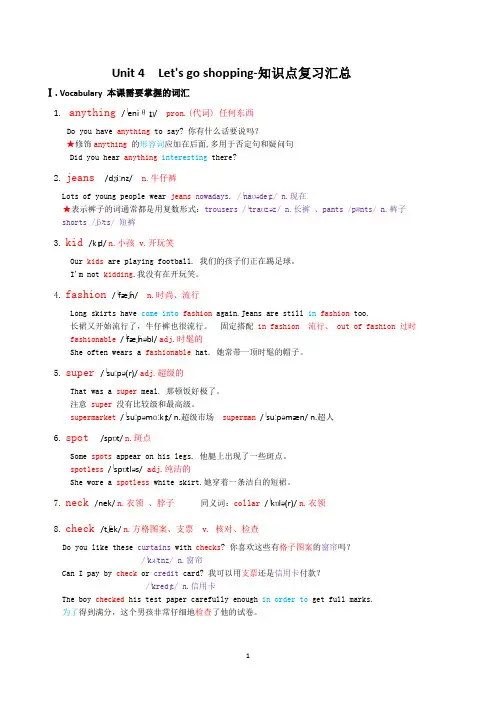
Unit 4 Let's go shopping-知识点复习汇总Ⅰ.Vocabulary本课需要掌握的词汇1. anything /ˈeniθɪŋ/ pron.(代词) 任何东西Do you have anything to say? 你有什么话要说吗?★修饰anything的形容词应加在后面,多用于否定句和疑问句Did you hear anything interesting there?2.jeans /dʒiːnz/ n.牛仔裤Lots of young people wear jeans nowadays. /ˈnaʊədeɪz/ n.现在★表示裤子的词通常都是用复数形式:trousers /ˈtraʊzəz/ n.长裤、pants /pænts/ n.裤子shorts /ʃɔːts/ 短裤3.kid /kɪd/ n.小孩 v.开玩笑Our kids are playing football. 我们的孩子们正在踢足球。
I'm not kidding.我没有在开玩笑。
4.fashion /ˈfæʃn/ n.时尚、流行Long skirts have come into fashion again.Jeans are still in fashion too.长裙又开始流行了,牛仔裤也很流行。
固定搭配in fashion流行、 out of fashion 过时fashionable /ˈfæʃnəbl/ adj.时髦的She often wears a fashionable hat. 她常带一顶时髦的帽子。
5.super /ˈsuːpə(r)/ adj.超级的That was a super meal. 那顿饭好极了。
注意super没有比较级和最高级。
supermarket /ˈsuːpəmɑːkɪt/ n.超级市场superman/ˈsuːpəmæn/ n.超人6.spot /spɒt/ n.斑点Some spots appear on his legs. 他腿上出现了一些斑点。
牛津译林版七年级英语下册Unit4重点短语及核心句型归纳
牛津译林版七年级英语下册Unit4重点短语及核心句型归纳课时1 Comic strip & Welcome to the unit重点短语1.follow me 跟着我2.a path between the hills 山间的一条小道3.go down here 从这儿下去4.go up上去5.go on a trip 去旅行6.be north of 在······北边7.be west of在·······西边8.be south of在·······南边9.be east of在······东边10.three kilometres away 三千米远11.have to不得不,必须核心句型1.Don't be afraid.别害怕。
e with me.跟我来。
3. Sunshine Zoo is north of Sunshine Middle School.阳光动物园在阳光中学的北面。
4.Let's go on a trip!我们去旅行吧!5.It's north of the school, about three kilometres away.它在学校北边,大约三千米远。
6.-How will we get there? 我们怎么去那儿?-We'll get there by bus.我们将乘公共汽车去那儿。
课时2 Reading重点短语1.a trip to the zoo 一次动物园之旅2.go straight on 径直往前走3.like to eat bamboo喜欢吃竹子4. lie down all day long 整天躺着e here to see them 来这儿看它们6.walk along the road 沿着路走7.to the north of...在·······北边8.the king of the animal world 动物世界之王9.never go near them千万别靠近它们10.turn left/right向左/右拐11.make beautiful sounds 发出美妙的声音12.be clever and funny聪明而滑稽13.jump around 蹦来蹦去14.make people laugh 使人们大笑15.eat the leaves from trees 吃树上的树叶16.cross the bridge 过桥17.be like open fans 像敞开的扇子18.all kinds of animals 各种动物核心句型1. Go straight on, and you'll find the Panda House一直往前走,你就会看到熊猫馆。
译林牛津版七年级英语下册7B Unit4 按课时知识点梳理及拓展
9. Remember that they are dangerous. 记得他们很危险。
remember (that)+句子 forget, stop
1
7B Unit4 知识重点及拓展
remember to do … 记得去做某事 (未做) Remember to close the window when you leave remember doing … 记得做过某事 (已经做过)
(4) A is to the…of B (A 与 B 不接壤)
Japan is to the east of China.
Cross the bridge, and you’ll see the elephants.= If
you walk across the bridge, you’ll see the elephants.
go up here 从这儿上去
1. a trip to the zoo . the way to school . the key to the door
go up/ upstairs/ downstairs
. the answer to the question
5. Don’t be afraid. . be afraid of sth. /doing sth.
Japan lies to the east of China. 日本位于中国的东边。
lie, lay 躺,位于 lie, lied 撒谎 lie, lying
躺下 lie down 躺在草地上 lie on the grass
4. all day long = the whole day 整天
. all day and all night 整日整夜
初中英语 牛津译林版七年级下册 Unit 4 Finding your way 知识点
牛津译林版七年级下册Unit4 Finding your way1.Let’s go down here.让我们一起下去吧。
go down 下降,沉没,屈服,被记下At sunset, the sun looks as if it is going down.日落时,太阳看起来好像在降落。
Go down to the grocer’s and get some sugar.去杂货店给我买点糖来。
2.Don’t be afraid. Come with me.不要害怕。
跟着我来。
Don’t be afraid to pet the dog.不要害怕抚摸这条狗。
3.I think we have to go up again.我觉得我们必须再次上去了。
have to 不得不,必须We’ll have to change the bulb again.我们又得换个灯泡了。
与must 的区别:have to 通俗用语,指受客观条件或环境迫使而“不得不”做某事,突出客观性。
must 通常表示命令或说话人主观认为必须要做某事,含强调语气,侧重主观性。
I have to have someone to look after.我必须去照顾某人。
Then you must be my cousin.那么你一定是我的远亲了。
go up 增长,建起,炸毁Go up to the fork and turn left.走到岔口处向左拐。
Production is going up in leaps and bounds.产量飞速增长。
4.Sunshine Zoo is north of Sunshine Middle School.阳光动物园在阳光中学的北面。
be + 方位词+ of ... (某地)在(另一地)的......方向Our school is south of the zoo.我们学校在动物园的南面。
英语中东南、东北、西南和西北的表达分别是south-east, north-east, south-west, north-west。
(完整版)深圳牛津英语七年级下unit4savethetrees知识点总结和单元测试,推荐文档
Unit 4 Save the trees 一、单词二、短语三、句型1.Trees are good for….be good for 对…..有利eg:运动有益于健康。
Exercise is good for health.be bad for 对…..有害eg:吸烟对健康有害。
Smoking is bad for health.2.A lot of the furniture is made of wood.①furniture 不可数名词,家具。
a set of furniture 一套家具; 一件家具a piece of furniture。
②be made of 由….制成从产品中能够看出原材料be madefrom 由….制成。
从产品中看不出原材料。
拓展:be made up of 由……组成be made in 在……地方制造(比如made in China)be made by 由……(人)制造be made into 被制成......3.I can’t imagine a world without trees.imagine vt. 想像;猜想;臆断. imagine doing sth. 想像做某事如:Can you imagine living with such a boring man?你能想象和这样一个无聊的人生活在一起吗?4.She can skate at a very high speed because she practises a lot.practises vt. 训练,练习。
如:I should practise speaking English.practice n. 练习如:Playing the piano needs a lot of practice.5.But the speaker did not stop speaking until twenty past twelve.not…..until 意为:直到…..才…..。