
鲁子问《英语教学论》课后习题(Chapter13 TeachingEnglishCulture
Chapter 13 Teaching English Culture and Affection in Schools
Section 1
1. Please describe the cultural connotations of the following words in Chinese and Western countries.
(1) bat, dog, dragon;
(2) peasant, intellectual, politician
Key: (1) In Chinese culture, “bat”symbolizes “luck”since it has the same sound of “福”, meaning luck, however it is often associated with death and blood in western culture; “dog” often carries a derogative meaning in Chinese culture, implying something degrading in expressions like “狗仗人势” and “狗眼看人低”, while it is often associated with “loyalty”and “faithfulness”in English; “dragon” often symbolizes authority and good luck in Chinese culture, however it implies something terrifying in western culture.
(2) In Chinese culture, “peasant”means farmer, an agricultural worker, however it is derogative in western culture, implying someone who have rough unrefined manners; “intellectual”refers to someone who has received education and even a high school student would be called an intellectual in rural areas, however in western culture, it is limited to university professors with academic prestige, excludes university students and sometimes is derogative; “politician”is positive in meaning in Chinese, indicating someone who is
engaged in politics while it is derogative in English, meaning someone who is skilled at handling people or situations, or at getting people to do what he wants.
2. The following is a page from Go For It!, 8B by People’s Education Press. Please design a teaching process with the culture experience method.
Key: Free answer is favored.
Section 2
Analyze the emotions and attitudes of the student below, and design a solution to the problem. Zhang, a 15-year-old boy, is a junior middle school student in class 2, grade 3. His father is a small private business owner. Zhang’s score is average and he has little interest in learning English. He says, “I just can’t learn it well. What’s more, it is useless to me. I’ll take over my father’s busines s after graduation.” As an English teacher, what will you do?
Key: Zhang doesn’t have a strong motivation towards learning English and he bears a negative attitude towards it.
As an English teacher, I will tell him that his opinions are wrong. In the first place, he CAN learn English well as long as he devotes more time and efforts to English; secondly, English is USEFUL to him. He cannot hasten into the decision that he will take over his father’s business because one can never be too sure about the future; he may probably change his decision three years later. Besides, even if he takes over his father’s business, English will still be useful. We can see foreigners everywhere in China. They are in the cake shop, in the book store and in the café and may have cooperation with his business. It’s better to be armed with the language of English.。
中小学英语教与学的评价(鲁子问)

评价案例2:(二级听力评价)
• 听录音,涂颜色。根据听到的内容 给下面的图画涂上正确的颜色。 • 录音材料: • This is Mary. She wears a red cap and a yellow coat. Her trousers are
green. Her shoes are brown. Look
(九)合理设计和实施初中毕业学业考试 • 初中毕业英语学业考试是义务教育 阶段英语学科的终结性考试,目的 是全面、准确地考查初中毕业生在 英语学习方面达到本标准所规定级 别水平的程度。
(八)合理设计和实施初中毕业学业考试
• 英语学业考试应着重考查学生听 、说、读、写等四种英语语言技 能的综合实践能力以及灵活运用 语言知识的能力。
课标教学要求教师要通过创设接近实际生活的各种语境采用循序渐进的语言实践活动以及各种强调过程与结果并重的教学途径和方法如任务型语言教学途径等培养学生用英语做事情的能力齿轮箱和发电机用一个柔性轴连接在风机的操作期间联轴器补偿两平行性偏差和角度误差
中小学英语教与学的评价
鲁子问 华中师范大学
目录
一、中小学英语学习评价 二、中小学英语教学评价
(二)体现学生在评价中的主体地位 • 评价标准的确定、评价内容和方式
的选择以及评价的实施等均应以促
进学生的发展为目标。
• 在各类评价活动中,学生都应该是
积极的参与者和主动的合作者。
(二)体现学生在评价中的主体地位 • 教育行政部门、教研部门和学校应
当树立以学生为主体的评价观念,
完善评价机制。
(三)依据课程目标要求确定评价内容与标准
语言运用能力。
课标解读
• 义务教育阶段英语课程的总目标是:
通过英语学习使学生形成初步的综合
鲁子问英语教学论英文版考研课后习题和答案

鲁子问英语教学论英文版考研课后习题和答案鲁子问《英语教学论》(英文版)课后习题详解目录Chapter 1 Concepts for English Teaching in SchoolsChapter 2 ELT Methods and Approaches in and outside China Chapter 3 Elements of English Teaching in SchoolsChapter 4 Principles of English Teaching in SchoolsChapter 5 Strategies of English Teaching in SchoolsChapter 6 Instructional Design for English TeachingChapter 7 Process of English Teaching in SchoolsChapter 8 Activities of Teaching English in SchoolsChapter 9 Teaching English Language Knowledge in Schools Chapter 10 Teaching English Listening and Speaking in Schools Chapter 11 Teaching English Reading and Writing in Schools Chapter 12 Teaching English Learning Strategies in Schools Chapter 13 Teaching English Culture and Affection in Schools Chapter 14 Educational Technology and Resources for English Teac hing in SchoolsChapter 15 Assessment and Testing for English in SchoolsChapter 16 Evaluation on Teaching English in SchoolsChapter 17 Research on English Teaching in SchoolsChapter 18 Professional Development of English Teachers in School s•试看部分内容Chapter 1 Concepts for English Teaching in Schools Section 11. Based on the theories in this unit, what are the main educationalfactors that cause teacher L’s wholehearted enthusiasm to meet w ith cold indifference from his students?Key: In the first place, teaching is an interactive activity in which bo th teachers and students become more developed. Teacher L condu cts a completely exam-oriented teaching, which is boring and mund ane. He is ignorant of students’learning needs and there is no int eraction between them. Secondly, in language teaching, the more i mportant factor is students’positive and active approach to learni ng. Teacher L obviously doesn’t care about students’motivation a nd incentive; he crams learning materials and exam content in the students, regardless of students’emotional response. Lastly, teaching should be teacher-led but students-centered activity. Here teacher L takes teaching as teacher-led and exam-centered. He is putting th e cart before the horse. Only by focusing on students’learning ne eds and motivation can they perform well in exams and achieve lea rning goals.2. In your opinion, what kind of classroom teaching activity conform s to the essence of education?Key: The essence of teaching is to lead students to develop and th e teacher’s job is to help students to find answers by themselves a nd to explore language learning methods by themselves. Therefore, the teaching activity that conforms to the essence of education is a series of questions thrown to students to help deduce proper ans wers.Section 21. What do you think are the main causes for the misunderstanding in the argument “English teaching in elementary and middle schoo ls in China cannot be communicative competence oriented”? Key: It ignores the fact that language is the tool for communication and communication is the function of language. It is through inter personal communication that language remains active and vigorous. Therefore, one of the teaching goals of elementary and middle school English should be to develop student’s communicative compet ence. If communication is removed from the goals of English teachi ng, then language learning becomes a boring process of memorizat ion. There’s no fun in it. Besides, without focusing on communicati on, language learning will be far from effective, since communicatio n is the best way to learn all languages.2. After reflection on your own English study, identify what your ma in learning problems are.Key: The main learning problems may include: 1) fear of speaking E nglish, especially in public; 2) lack of motivation; 3) imbalance of fu n and homework.Section 31. What do you think is the major mistake in the viewpoint “one’s vocabulary size is the indicator of whether one’s English learning i s successful”?Key: This statement overemphasizes the role of vocabulary. It shoul d be noted that vocabulary constitutes only a part of language; the re is also grammar. Even if one has a good mastery of vocabulary and grammar, there are still culture and style to bear in mind. A su ccessful English learner should have certain awareness of culture wit h a good command of vocabulary and grammar. S/he should be ab le to adjust his or her style on different occasions; his or her knowledge of English should be able to satisfy his or her needs successfu lly.2. What do you think the essential difference between an English la nguage curriculum and an English literacy curriculum is? How do yo u understand the instrumental nature of English curriculum and the humanist nature of English curriculum in the National Curriculum S tandards for English in Schools in China (MOE, 2001)?Key: 1) The essential difference is that an English language curriculu m is to develop students’overall competence in English. Its teachi ng and learning process is to cultivate students’proficiency in the basic four skills: listening, speaking, reading and writing. By the end of the learning, students should be able to communicate effectivel y in English, have certain knowledge of English culture and develop some value and abilities. However, an English literacy curriculum is to focus on students’reading ability. The main job involved is to teach students to read and perhaps to write. The teaching objective and learning purpose is narrowed down to master a set of words; communication is absent in this curriculum.2) It’s instrumental in that it views English as a tool for communic ation. To achieve effective communication, not only vocabulary and grammar but culture is embodied in the teaching goals. Besides, it i s instrumental in that it sets English as a tool help understand oneself and the world. The job is not only to learn language but to dev elop and better oneself. It is humanist in that it concerns not only the learning of language but the development of children. Chapter 2 ELT Methods and Approaches in and outside China Section 11. Based on what you just learned, give suggestions to Miss M to help solve her problem of having nothing to teach after the second week of the term.Key: Miss M should follow certain theories in teaching. She should work out the teaching plan at the beginning of the term and adjust her teaching to the usual pace. Most importantly, she should take into consideration of students’learning realities, including questions like: how do students like her teaching method? Have students ach ieved the supposed goals after the teaching? Does her teaching me et students’present language level? Has the teaching covered less than expected or something unnecessary? She should first conduct a needs analysis of students, then works out the teaching plan base d on the needs and finally assess teaching and learning after a cert ain period.2. What do you think is the best language teaching approach or m ethod?Key: The Communicative Approach is the best language approach in that it covers the most important aspect of language learning: lan guage is learned to communicate, to exchange meaning and inform ation and to share feelings. It is the language in use that injects lif e and vitality into language and that makes it a more real existence of life. Language teaching and learning should be centered on co mmunication, which should be regarded as a proper method and th e final goal.Section 21. What is the problem with Mr. N’s complaints that the course bo ok does not explain much about grammar, does not have enough grammar exercises, and has too many activities?Key: The problem is the contradiction between the design of textbo ok and the actual assessment of teaching and learning. The design of the textbook is based on the task-based approach: students are supposed to achieve learning goals through the completion of a ser ies of tasks. The main activity involved is communication. However, Mr. N has to find lots of grammar materials outside the textbook f or students because little is mentioned in the book and what is me ntioned cannot meet the requirements of exams, which includes lots of grammar and little completion of tasks. There is certainly a gap between the textbook design and the assessment and this causesmuch challenge for both teachers and students. To bridge up the g ap, either should be adjusted to adapt to the other.2. Consider the style of a teacher you know. Do you think his/her t eaching is in line with the National Curriculum Standards? Please gi ve reasons and examples.Key: My high school English teacher’s teaching is not consistent wi th the National Curriculum Standards. In the first place, the focus of his teaching is on vocabulary and grammar. English lessons are fill ed with mechanical and meaningless drills instead of meaningful tas ks. Besides, his teaching does not allow too much communication. T hroughout the class, he spent much time explaining grammatical po ints and little time is devoted to communication. Finally, his teachin g doesn’t encourage holistic development for he was always haste ning for exams and ignoring students’learning needs. There was n o time for value-imparting or affection-influencing. All these contrad ict with the National Curriculum Standards.。
《英语教学论》课程作业与思考题
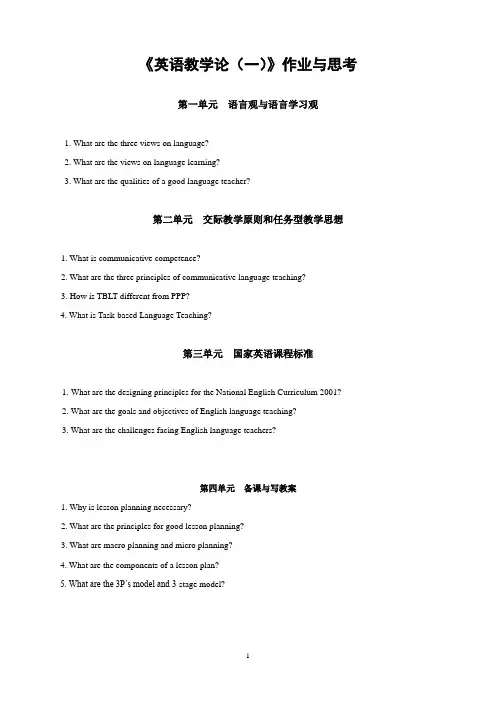
《英语教学论(一)》作业与思考第一单元语言观与语言学习观1. What are the three views on language?2. What are the views on language learning?3. What are the qualities of a good language teacher?第二单元交际教学原则和任务型教学思想1. What is communicative competence?2. What are the three principles of communicative language teaching?3. How is TBLT different from PPP?4. What is Task-based Language Teaching?第三单元国家英语课程标准1. What are the designing principles for the National English Curriculum 2001?2. What are the goals and objectives of English language teaching?3. What are the challenges facing English language teachers?第四单元备课与写教案1. Why is lesson planning necessary?2. What are the principles for good lesson planning?3. What are macro planning and micro planning?4. What are the components of a lesson plan?5. What are the 3P’s model and 3-stage model?1.What are the main roles teachers can play before, during and after the class?2.How to give effective classroom instructions?3.What are the different ways for student grouping?4.How to ask effective questions?5.How to treat students’ errors in the classroom?第六单元语音教学1.What is the goal of teaching pronunciation?2.What aspects of pronunciation do we need to teach?第七单元语法教学1.What are the major types of grammar presentation methods?2.What are the major types of grammar practice activities?第八单元词汇教学1. What does knowing a word involve?2. How can we present new vocabulary items effectively?3. What are some effective ways to consolidate vocabulary?《英语教学论(二)》作业与思考第九单元听力教学1.What are the characteristics of the listening process?2.What are the models of teaching listening?3.What are the common activities in teaching listening?1. What are the main characteristics of spoken language?2. What are the characteristics of successful speaking activities?3. What are the main types of speaking activities?第十一单元阅读教学1. What are the main reading skills?2. What are the main reading models for teaching reading?3. What types of activities can we use in teaching reading?第十二单元写作教学1.What are the problems in writing tasks in existing textbooks and classroom teaching?2. What is called process approach to teaching writing?3. What are the main procedures of process writing?第十三单元综合技能教学1. Why should we integrate the four skills?2. How do we organize activities of integrated skills?3. What are the implications for integrating teaching?第十四单元语言教学中的道德教育1. What does morality involve according to William J. Hutchins?2. State briefly the four models to moral development.第十五单元语言教学中的评价方法1. What is assessment? What are the differences between testing, assessment and evaluation?2. What are the purposes of assessment in language teaching?3. What are the methods of assessment?4. What are the assessment principles?第十六单元学习者个体差异与学习策略培养1. What is the theory of multiple intelligence? What are its implications for language teaching?2. What is learner training?第十七单元英语教育资源与技术的开发与利用1. How to use available resources?2. How to explore hidden resources?第十八单元教材的评估与改编1.What are the purposes for the teacher to evaluate and adapt textbook?2.What are the methods of evaluating textbooks?3.What are the features of good textbooks?4.How should the teacher select textbooks?5.What are the methods of adapting textbooks?外国语学院教师教育教研室编写。
鲁子问《英语教学论(英文版)》章节题库-Teaching English Culture and A

Chapter 13 Teaching English Culture and Affection in SchoolsSection 11. Please describe the cultural connotations of the following words in Chinese and Western countries.(1) bat, dog, dragon;(2) peasant, intellectual, politicianKey: (1) In Chinese culture, “bat”symbolizes “luck”since it has the same sound of “福”, meaning luck, however it is often associated with death and blood in western culture; “dog” often carries a derogative meaning in Chinese culture, implying something degrading in expressions like “狗仗人势” and “狗眼看人低”, while it is often associated with “loyalty”and “faithfulness”in English; “dragon” often symbolizes authority and good luck in Chinese culture, however it implies something terrifying in western culture.(2) In Chinese culture, “peasant”means farmer, an agricultural worker, however it is derogative in western culture, implying someone who have rough unrefined manners; “intellectual”refers to someone who has received education and even a high school student would be called an intellectual in rural areas, however in western culture, it is limited to university professors with academic prestige, excludes university students and sometimes is derogative; “politician”is positive in meaning in Chinese, indicating someone who isengaged in politics while it is derogative in English, meaning someone who is skilled at handling people or situations, or at getting people to do what he wants.2. The following is a page from Go For It!, 8B by People’s Education Press. Please design a teaching process with the culture experience method.3a Read the article about a theme park. Circle the places, things, and activities you think are interesting. Underline the ones you think are boring.Have you ever been to Disneyland?Most of us have probably heard of Mickey Mouse, Donald Duck, and many other famous Disney characters. Perhaps we have ever seen them in movies. But have you ever been to Disneyland? In fact, there are now several different Disneyland amusement parks around the world.Disneyland is an amusement park, but we can also call it a theme park. It has all the normal attractions that you can find at an amusement park, but it also has a theme. The theme, of course, is Disney movies and Disney characters. For example, you can find a roller roaster in most amusement parks, but in Disneyland, the theme of the roller coaster is Disney characters. This means that you can find Disney characters all over the roller roaster. You can also watch Disney movies, eat in Disney restaurants, and buy Disney gifts. And you can see Disney characters walking around Disneyland all the time!Have you ever heard of a Disney Cruise? These are huge boats that also have the Disney theme. You can take a ride on the boat for several days, and you cansleep and cat on board. There are also many attractions on board, just like any other Disneyland. You can shop, go to Disney parties, and cat dinner with Mickey Mouse! The boats take different routes, but they all end up in the same place. That is Disney’s own island.It is just so much fun in Disneyland!3b PairworkRead the article again and write a conversation. Then practice the conversation with your partner.A: I’d like to go on a Disney Cruise.B: What’s that?A: It’s like Disneyland, bat it’s o n a boat.B: Why do you want to go on that?A: Well, you can travel to Disney’s own island.4 PairworkAnswer the survey and then interview your partner.A: Have you ever traveled to another province?B: Yes, I have.Key:Teaching Design1. Teaching Aims: To help students understand the culture of Disneyland to arouse students’ cultural awareness. Furthermore, to help students master the use of present perfect tense.2. Teaching Target: middle school students3. Teaching Material: PowerPoint, pictures, and a promotional video of Disneyland4. Teaching Methods: culture experience method (Direct experience)The experiential method is to let students obtain cultural knowledge, form positive cultural attitudes, and finally build culture competence through personal experience in teaching culture activities. In foreign language teaching, there are two kinds of experiences: direct experience and indirect experience. Direct experience is more suitable for clear and targeted instruction of culture and is good for teaching culture in middle schools.5. Teaching Procedures:Section One Pre-reading Activitiesa. Warming-up: Good morning class, today, our topic is on Disneyland. First, Iwant to ask you several questions:Q1: Have you ever been to Disneyland?Q2: Do you know where there is a Disneyland amusement park?Q3: What impressed you most at Disneyland?b. Group discussion:The whole students are divided into four groups and they should have a discussion of the above three questions. Each group select three representatives to answer the three questions.Section Two Global Readinga. First, to play the promotional video of Disneyland and let students generally understand the culture of Disneyland and evoke the memories o f some students’ experiences in Disneyland.b. Second, I will give students three minutes to read the whole passage and circle the places, things, and activities they think are interesting.Students’ possible answers: “Disneyland” “Mickey Mouse” “Donald Duck” “theme park” “Disney movies” “Disney characters” “roller roaster” “Disney Cruise” “Disney parties” and so on.Section Three Detailed Readinga. Grammar FocusHave you ever been to Disneyland? 你去过迪斯尼乐园吗?(present perfect tense)present perfect tense: a perfective tense used to express action completed in the presentb. Words and ExpressionsDisneyland: n. an amusement park in America created in 1955 by Walt Disney amusement park: n. a commercially operated park with stalls and shows for amusementMickey Mouse: n. a fictional mouse created in animated film strips by Walt Disney Donald Duck: n. a fictional duck created in animated film strips by Walt Disney theme park: n. an amusement park that is organized around some theme (as the world of tomorrow)Disney characters: 迪士尼卡通人物roller coaster: 过山车Disney Cruise: 迪斯尼巡游take a ride: 兜风end up:结束c. Sentence PatternsHave you ever been to…?H ave you ever heard of…?d. PairworkRead the article again and write a conversation. Then practice the conversation with your partner.A: I’d like to go on a Disney Cruise.。
鲁子问《英语教学论(英文版)》题库-Educational Technology and Resou
Chapter 14 Educational Technology and Resources for English Teaching inSchoolsSection 11. What kind of E-media do you frequently use? What do you take into consideration when you choose it: the effect or convenience? Please give your reasons.Key: I often use the computer since it’s both effective and convenient. On the computer, I can display English songs or audio materials and pictures and even audiovisual films. It’s easy to operate and saves a lot of time. And students can learn better with the pictures and sounds presented.2. Is the instructional media that you use most the most effective one? Please share your experience with your partner.Key: Perhaps not. The teaching aids should be chosen according to the actual needs of students and teaching and there is no need to turn to multi-media if there is no necessity, say, the teacher is to explain a grammar point. Never should too many sounds or pictures be piled together on the screen. They should be organized in order and to the point.Section 21. Is the saying “the more resources, the better” correct? Why?Key: The saying is not correct. The reasons include 1) more resources cause too much burden, which may be too much for students to assimilate at a time; 2) some of the resources may have nothing to do with teaching content and should be eliminated; 3) even if they are all useful for the teaching, they should be filtered since there is a limit of time of each lesson. As long as resources are ordered to the point and can successfully achieve the goal of teaching, they are good enough.2. How can we develop supplementary resources?Key: In order to develop appropriate supplementary resources, we should first analyse the learning contents and find what the gap is between these and the students’learning objectives. We can then develop learning resources in keeping with the language difficulty of the learning contents as well as the learning objectives for students’study of the text, thus accelerating the realization of the learning objectives.。
鲁子问《英语教学论》课后习题(Chapter2 ELTMethodsandApproache
Chapter 2 ELT Methods and Approaches in and outside ChinaSection 11. Based on what you just learned, give suggestions to Miss M to help solve her problem of having nothing to teach after the second week of the term.Key: Miss M should follow certain theories in teaching. She should work out the teaching plan at the beginning of the term and adjust her teaching to the usual pace. Most importantly, she should take into consideration of students’ learning realities, including questions like: how do students like her teaching method? Have students achieved the supposed goals after the teaching? Does her teaching meet students’ present language level? Has the teaching covered less than expected or something unnecessary? She should first conduct a needs analysis of students, then works out the teaching plan based on the needs and finally assess teaching and learning after a certain period.2. What do you think is the best language teaching approach or method?Key: The Communicative Approach is the best language approach in that it covers the most important aspect of language learning: language is learned to communicate, to exchange meaning and information and to share feelings. It is the language in use that injects life and vitality into language and that makes it a more real existence of life. Language teaching and learning should be centered on communication, which should be regarded as a proper method and the finalgoal.Section 21. What is the problem with Mr. N’s complaints that the course book does not explain much about grammar, does not have enough grammar exercises, and has too many activities?Key: The problem is the contradiction between the design of textbook and the actual assessment of teaching and learning. The design of the textbook is based on the task-based approach: students are supposed to achieve learning goals through the completion of a series of tasks. The main activity involved is communication. However, Mr. N has to find lots of grammar materials outside the textbook for students because little is mentioned in the book and what is mentioned cannot meet the requirements of exams, which includes lots of grammar and little completion of tasks. There is certainly a gap between the textbook design and the assessment and this causes much challenge for both teachers and students. To bridge up the gap, either should be adjusted to adapt to the other.2. Consider the style of a teacher you know. Do you think his/her teaching is in line with the National Curriculum Standards? Please give reasons and examples. Key: My high school English teacher’s teaching is not consistent with the National Curriculum Standards. In the first place, the focus of his teaching is on vocabulary and grammar. English lessons are filled with mechanical andmeaningless drills instead of meaningful tasks. Besides, his teaching does not allow too much communication. Throughout the class, he spent much time explaining grammatical points and little time is devoted to communication. Finally, his teaching doesn’t encourage holistic development for he was always hastening for exams and ignoring students’ learning needs. There was no time for value-imparting or affection-influencing. All these contradicts with the National Curriculum Standards.。
英语教学理论练习及答案
《英语教学理论》作业号:1 题型:单选题本题分数:2内容:使用全身反应法的教师希望全身反应法能帮助学生在轻松自如的学习环境中掌握初步的__能力。
选项:a、听、说b、读、写c、听、读d、听、说、读、写答案:a--------------------------------------------------------------------------------号:2 题型:单选题本题分数:2内容:在直接法的课堂里,教学活动有如下几个特点:1.全外语的教学,并___。
2.模仿、朗读和问答是主要的教学活动形式。
3.教师要求学生在提问或对教师的问题作答时,均以完整的句子说出问句或答句。
选项:a、广泛使用直观手段b、用外语讲解语法c、使用翻译帮助理解d、努力创造信息沟答案:a--------------------------------------------------------------------------------号:3 题型:单选题本题分数:2内容:使用听说法的教师认为语言是一套习惯(Language is a set of habits),学习外语就得养成一套新的习惯。
而要这样做,就得超量地学习(overlearn)语言,通过大量的模仿、记忆和操练,熟练掌握各种语言结构(包括语音、语法和词汇的结构),在运用各种语言结构进行交际时,能___。
学生们必须克服母语的旧习惯对外语新习惯的干扰。
选项:a、使用所掌握的有关语言的知识来组织语言b、自动化地应用语言c、根据不同的情景使用合适的语言d、使用得体的语言答案:b--------------------------------------------------------------------------------号:4 题型:单选题本题分数:2内容:当教师希望学生练习句型Is it + adj. (colour)? 时,教师说:我脑子里想着一个球,球是个有颜色的球,你知道球是什么颜色的吗? 学生可以说:Is it white/yellow/black/green?等等。
鲁子问《英语教学论(英文版)》课后习题详解(Chapter8 ActivitiesofTeac
Chapter 8 Activities of Teaching English in SchoolsSection 11. What are the features of classroom teaching activities?Key: The features of classroom teaching activities include the following points: 1) they are designed according to students’needs; 2) they are conducive to students’language learning; 3) they are consistent with language learning theories.2. What should teachers pay attention to carrying out classroom teaching activities?Key: Teachers should pay attention to 1) the time of each teaching activity: an activity should be completed in a proper period of time and shouldn’t last too long nor too short; 2) students’ understanding of and reaction to the activities: if students don’t respond actively to the task, then the teacher should reflect upon the task and maybe adjust the task a little; 3) the consistency of activities and teaching goal: any activity that doesn’t conform to the supposed goal of teaching should be adapted.3. Please talk about the difficulties of designing classroom teaching activities and ways to overcome these difficulties based on your own teaching practice. Key: There are various difficulties: 1) the teacher may not know students’preferences of activities; 2) the teacher cannot successfully predict students’reactions to the activities; 3) the teacher doesn’t know what kind of teaching activity best suits students.To avoid the difficulties, the teachers should have a good knowledge of teachings goals and students’language level and learning styles before designing the activities. While designing the activities, the teacher can prepare extra activities in case students should fail to cooperate.Section 21. What are the features of extracurricular English activities for elementary and middle school?Key: The features include: 1) the extracurricular activities are consistent with The National Curriculum Standards; 2) they are interesting and can arouse students’interest and activate their motivation; 3) they are educational in that students can enhance their language learning.2. What should be focused on when English teachers in elementary and middle schools design extracurricular activities for students?Key: When designing extracurricular activities, teachers should pay attention to students’ learning needs, strike a balance between the time of extracurricular activities and the time of entertainment, provide samples and instructions of the activities and allows voluntary participation.。
鲁子问《英语教学论(英文版)》课后习题详解(Chapter5 StrategiesofEngl
Chapter 5 Strategies of English Teaching in SchoolsSection 11. How should we arrange the seats in the classroom? How should we give instructions to our students? What interaction patterns should we employ in class? What should we do if there are discipline problems? After reading this chapter, do you know what strategy they belong to? What kind of management strategy did your teachers use? What are the similarities and differences among their management strategies? Why do you think they used them? Can you summarize your own ideas on effective management strategies?Key: 1) The seats of the classroom should be arranged according to the size of the class. The arrangement should meet different kinds of classroom activities. Meanwhile, it should help the teacher to monitor the class and students to see the teacher’s presentation.2) Different interaction patterns may be adopted based on the needs. It can be the interaction between teacher and the whole class and can also be the interaction between one student and another student, one student and several other students or a group of students and another group of students.3) If discipline problems arise, teachers should be calm enough to evaluate the situation and be flexible enough to make judgments as to whether some changes should be made.4) They belong to the teacher-strategy since they are concerned with how the teacher manages and leads the class.5) For classroom management, my teachers invariably adopt the orderly rows, since the class is very big and much of the time is spent on listening to the teacher. Not many movements are involved. As for instruction strategy, my teachers demonstrate after giving out clear instructions and always check whether we have understood their meaning. And for activity-selection strategy, they combine the participation-oriented strategy and the goal-oriented strategy.6) They all want to ensure the discipline of the class and make sure the class goes on as expected. The difference is that some teachers are too focused on one single strategy and are at a loss when something goes wrong.7) They use the strategies partly because they are effective and best for the existent circumstances, partly because they are the most common strategies know to the teaching circle.8) Effective management strategies are important in that they are part of the teaching. Whether management strategies are effective or not will decide the quality of teaching and learning. Without proper management strategies, all the preparation work might become futile.2. Do you still remember the way that your teachers gave instructions? Use the principles mentioned in this section to evaluate if they were effective.Key: When my teachers were giving instructions, they would first clearly state the instructions and then they will demonstrate how to do the tasks. Finally, they willask “Do you understand?” to check our understanding. If the questions are too easy to understand, they will not spend too much time explaining. They are effective because most often we can complete the tasks effectively.3. What types of activity have you experienced in your English learning experience? Key: There are many kinds of activities, such as: the whole class work, pair work, group work, presentation, role-play and so-on. They are effective in that they can successfully fulfill the purposes of teaching and invites students’ participation as well.Section 2How many types of questions are mentioned in this section? What are they? What are their respective features?Key: 1) Seven questions are mentioned in this section.2) They are knowledge questions, comprehension questions, application questions, inference questions, analysis questions, synthesis questions and evaluation questions.3) Knowledge questions are used to elicit factual answers; comprehension questions are used for interpretation and elaboration; application questions are used to supply information to new situations; inference questions are used to infer extra information from the materials; analysis questions are used to break down one question into several parts; synthesis questions are used to combine elements into a new pattern; evaluation questions are used to elicit judgments.Section 3How many presentation strategies are mentioned in this section? What are they? What are their respective features?Key: Fifteen strategies are mentioned. They are:1) Use previous knowledge to introduce new knowledge: it’s easier for students to accept the new knowledge;2) Use realia or pictures: it is vivid and interesting; 3) Use performance: it can arouse students’ interest; 4) Use daily communication: it is common and east to understand; 5) Do it step by step: it’s gradual and can facilitate understanding; 6) Use translation: it can attract students’attention to the new content; 7) Use circular presentation and practice: students can become familiar with the content taught ; 8) Use the new language items in advance: it can arouse curiosity; 9) Ask our students to solve problems: it can push students to find the answer by themselves; 10) Use questions: it can push students to think; 11) Use explanation: it can clarify points; 12) Use inductive learning: it can help students understand the general; 13) Use deductive learning: it can develop students’ analytic ability;14) Use inquiry learning: it invites students to be active learners; 15) Use exemplification and imitation: it is vivid and lifelike.Section 4After studying this section, have you deepened your knowledge of classroom assessment strategies? Think about the purpose of classroom assessment andspecific strategies.Key: The purpose of classroom assessment is to check the quality of teachers’teaching and students’learning. The strategies include self-assessment, peer assessment and teacher assessment, which can be conducted with the help of questionnaires, quantitative surveys, question and answer and verbal discussions.。
鲁子问《英语教学论(英文版)》章节题库-Elements of English Teaching i
Chapter 3 Elements of English Teaching in SchoolsSection 11. What do you think successful language learners have in common?Key: Successful language learners have definite goals, lasting enthusiasm and focused attention and systematic learning plan; they are not afraid of making mistakes and they seize every opportunity to try out language and solve their confusions; they are curious about language and are interested in language; they take the initiative in learning and learn with autonomy; they have a clear understanding of themselves and know what style is best for themselves; they reflect upon their learning and adjust for improvements.2. How can you cultivate learner strategies in elementary and middle school? Key: First, the importance of learner strategy should be made known to students; models of learner strategies can be provided for students to choose to suit their own styles; practices should be designed for students to practise the strategies.Section 21. In what ways have teachers’ roles changed following the implementation of the National Curriculum Standards?Key: Traditionally, teachers are regarded as the master and the dominator of class.The class is teacher-centered. However, the National Curriculum Standards require a teacher-centered classroom shifted to the learner-centered one. The “master”and “dominator”should be changed to a helper, a resource-provider, a participant and an assessor. The teacher’s job is to assist students learning and create atmosphere and opportunities for students.2. What are the attributes of a highly efficient English teacher’s teaching behaviour?Key: A highly efficient English teacher is proficient in the basic skills: listening, speaking, reading and writing; s/he should have a good command of pedagogical theories and should be able to adapt teaching to student’s learning realities; s/he should be the embodiment of a set of values: integrity, honesty, optimism, judgment ability and so-on; s/he does reflection after class in time and figure out where to improve next time; s/he has the sense of constant learning and is always ready to get recharged.Section 31. What characterizes teaching content in elementary and middle school?Key: 1) The teaching content should be scientific: the content must be informed by relevant research; 2) It should be ideological: it should integrate emotional development, enhance students’ moral values, develop patriotism and foster an international outlook; 3) It should be: basic: it should include the basicknowledge and skills essential for competent citizens in the future; 4) It should be well-organized and suit students’learning habits; 5) It should be suitable: it must meet the actual needs of the students, pay attention to students’personalities, diversities and uniqueness; 6) It should be forward-looking: it should be based on the highest quality educational research and be forward-looking to contribute to social development; 7) It should be practical: it should be consistent with teaching practice.2. What are the categories of English teaching content in elementary and middle school?Key: 1) In language knowledge, students should be proficient in pronunciation, vocabulary, and grammar and they should be familiar with some general topics; 2) In language skills, students should acquire skills of listening, speaking, reading and writing; 3) In emotional attitudes, students should develop certain interest, perception, confidence as well as national identity and international outlook; 4) In learning strategies, students should develop effective learning strategies to facilitate life-long learning; 5) In cultural awareness, students should cultivate cultural awareness of both languages in actual communication.Section 41. What are the main elements of the English language teaching and learning environment?Key: The main elements of English language teaching and learning environment include the social environment, the school environment and personal circumstances: the social environment mainly refers to the social system, the nation’s education policy, foreign language educational policy, economic development, scientific and technological level and social needs for the English language and so on; the school environment includes factors such as classroom teaching, the frequency of exposure to English, class size, teaching facilities, English extra-curricular activities and interpersonal relationships etc.; personal circumstances include the social status and occupation of the family members, attitudes towards learning English, experiences in learning English, learning styles and so-on.2. How can you build good English teaching and learning environments?Key: Overall coordination is needed to adjust environmental factors and create a positive and harmonious environment; certain characteristics of the environment should be highlighted to enhance students’ interest and awareness of learning English; existing favorable conditions in schools, families and society explored to provide a wide variety of learning experiences; information and materials should be screened to retain appropriate and authentic contents.。