
英语诗歌修辞手法简介Figuresofspeech
Her lips were red, her looks were free,
Her locks were yellow as gold.
Her skin was white as leprosy,
The Nightmare Life-in-Death was she,
Major figures of speech in poetry
Simile 直喻
Simile is a figure of speech which makes a comparison between two unlike elements having at least one quality or characteristic in common.
16. Irony 17. Sarcasm 18. Satire 19. Ridicule 20. Innuendo 21. Parody 22. Climax 23. Anti-climax 24. Alliteration 25. Assonance 26. Onomatopoeia 27. Transferred epithet 28. Pun 29. Parallelism 30. Repetition
purpose of making comparisons or calling up pictures in the reader’s or listener’s mind are used figuratively.
colourful
In “a colourful garden” the word colourful is used in its literal sense to describe the many different colours of the flowers
the chief functions of figures of speech
to embellish, to emphasize or to clarify.
to give tone or atmosphere to discourse, to provide vivid examples to stimulate thought to give life to inanimate objects, to amuse, or to ornament.
Examples
she has a face that's as round as the moon.
Time flies like an arrow. You run like a rabbit. Life is a yo-yo . It's a series of ups and
downs. All the world's a stage, And all the men
Metaphor 暗喻
A metaphor, like a simile, also makes a comparison between two unlike elements, but unlike a simile, this comparison is implied rather than stated.
Words are either literal or figurative
Literal 原意 Words used in their original . Figurative 比喻义 Words used in extended meanings for the
1. simile 2. metaphor 3. personification 4. metonymy 5. Synecdoche 6. Antonomasia 7. euphemism 8. Hyperbole 9. litotes 10. Antithesis 11. Paradox 12. Oxymoron 13. Epigram 14. Apostrophe 15. rhetorical question
in “a colourful life” or “a colourful career” the word is used in its figurative sense because neither life or career has any colour.
Figures of Speech (2)
Who thicks man's blood with cold.
她的唇色鲜红,她的表情 不羁。
她的枷锁黄如金。 她的皮肤白如麻风。 梦魇般的死中生命是她的 存在,
用冰冷浓稠了的血液。
The Waning Moon By Percy Bysshe Shelley
And like a dying lady, lean and pale, Who totters forth, wrapped in a gauzy veil, Out of her chamber, led by the insane And feeble wanderings of her fading brain, The moon arose up in the murky east, A white and shapeless mass.
英语诗歌修辞手法简介Figuresofspeech
Definition
Figures of speech are forms of expression that depart from normal word or sentence order or from the common literal meanings of words, for the purpose of achieving a special effect.
英语修辞简介

Some Common Forms of Figures of Speech宋德文(讲义)Figures of speech are ways of making our language figurative. When we use words in other than their ordinary or literal sense to lend force to an idea, to heighten effect, or to create suggestive imagery, we are said to be speaking or writing figuratively. Now we are going to talk about some common forms of figures of speech.原文作者在文章中使用修辞手法,是为了使语言更加形象生动,鲜明突出;或者使语言更加整齐匀称,音调铿锵,以便更深入地阐明事件的意义或刻画人物的性格。
因此,译文中若不能正确表现原文的修辞格,就不能准确地表达作者的思想和文风,就不符合“忠实、通顺”的翻译标准。
修辞(figures of speech / rhetorical devices / rhetoric) 大体分为三类:音韵修辞格(phonological rhetorical devices)词义修辞格(semantic rhetorical devices)句法修辞格(syntactical rhetorical devices)(一)音韵修辞格(phonological rhetorical devices)1. Alliteration: (头韵) It has to do with the sound rather than the sense of words for effect. It is a device that repeats the same sound at frequent intervals(间隔) and since the sound repeated is usually the initial consonant sound, it is also called "front rhyme". For instance, the fair breeze blew, the white foam flew, the furrow followed free.头韵与拟声修辞方式能使语言具有音韵美,可增加口头或书面表达的实际音感,给人以声情并茂的美感。
figures of speech

Simile(明喻)
• 1. Simile通常由三部分构成:本体(tenor or subject),喻体(vehicle or reference)和比喻 词(comparative word or indicator of resemblance)。
• 虚拟句型 • 最常见的是as if/though • Eg: Einstein only had a blanket on, as if he had just walked out of a fairy tale.
• 爱因斯坦身上披了一条毯子,就好像从童 话故事里走出来的一样。
Metaphor(隐喻)(暗喻)
★以人或动物代替其特性 There is still much of the schoolboy in him. 他身上还有许多小学生的气质。 The wolf and the pig mingled together in his face. • 凶残与贪婪交织在一起,浮现在他的脸上。 • • • •
• ★动词型 • The boy wolfed down the food the moment he grabbed it. • 那男孩儿一抓到食物便狼吞虎咽般地吃了 下去。
• ★形容词型 • She has a photographic memory for detail. • 她对细节有照相机般的记忆力。 • The mountainous waves swallowed up the ship.
• 他们永远都攒不下钱买新房子,因为他们 都花钱如流水。
• ★ as 型 • as在明喻句中用作介词,后跟名词。也可用作连 词,后跟状语从句,表示动作或行为的方式。此 外,还有两个常用句型,即as…as…和as…so…。 • (as) firm as a rock 坚如磐石 • (as) light as a feather 轻如鸿毛 • (as) close as an oyster 守口如瓶 • (as) mute as a fish 噤若寒蝉 • (as) strong as a horse 强壮如牛
Figures of speech

Type Three: what
Two Patterns: A is to B what C is to D. What C is to D, A is to B.
Type Three: what
Reading is to the mind what exercise is to the body. The pen is to a writer what the gun is to a fighter. 作家的笔犹如战士的枪。 .
Metaphor
A figure of speech in which one thing is described in terms of another. The basic figure in poetry. A comparison is usually implicit; whereas in simile it is explicit. ( A Dictionary of Literary Terms)
Type Four: than
w A home without love is no more than a body without a soul. w He had no more idea of money than a cow
Type Five: and
w Love and cough can not be hid. 爱情像咳嗽一样是掩盖不了的。 w Truth and roses have thorns about them. w Kings and bears often worry their keepers. w A word and stone let go cannot be recalled. 说出去的话就像抛出去的石子,是收不 回的。
英语修辞手法figuresofspeech[文字可编辑]
![英语修辞手法figuresofspeech[文字可编辑]](https://360docs-1393072327.cos.ap-beijing.myqcloud.com/f03e3e5ece2f0066f53322c7.webp)
colourful
?In “a colourful garden” the word colourful is used in its literal sense to describe the many different colours of the flowers
Plato
?“…the greatest thing by far is to be a master of metaphor. It is the one thing that cannot be learnt from others, and it is also a sign of genius, since a good metaphor implies an intuitive perception (直觉) of the similarity in dissimilars.”
?An implied comparison between two objects that are generally different but share a recognizable similarity without the use of “like” or “as”.
The girl was a fish in the water. The clown was a feather floating away.
?Simile 直喻 ?Metaphor 暗喻
What's the difference?
英语诗歌修辞手法简介Figures_of_speech
因为我不能停下来等待死神 他便好心地停下来等我—— 那辆车上只载我们两个—— 以及永生。 我们慢慢驱车——他不慌不忙 我也把我的劳与闲 统统丢掉一边, 为了他的礼让—— …… 离那时已是几个世纪 却仿佛过了还不到一天, 我首次猜测到, 马头在朝向永恒奔窜。
Who thicks man's blood with cold.
她的唇色鲜红,她的表情不 羁。
她的枷锁黄如金。 她的皮肤白如麻风。 梦魇般的死中生命是她的存 在,
用冰冷浓稠了的血液。
The Waning Moon By Percy Bysshe Shelley
And like a dying lady, lean and pale, Who totters forth, wrapped in a gauzy veil, Out of her chamber, led by the insane And feeble wanderings of her fading brain, The moon arose up in the murky east, A white and shapeless mass.
women merely players; …
Her lips were red, her looks were free,
Her locks were yellow as gold.
Her skin was white as leprosy,
Figures of speech
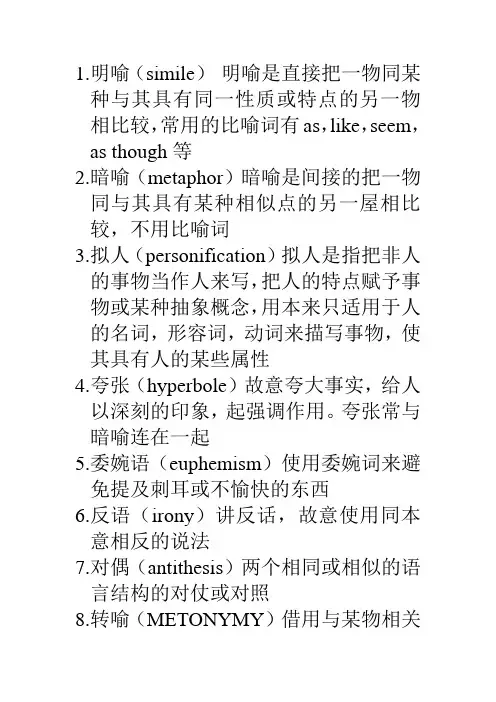
1.明喻(simile)明喻是直接把一物同某种与其具有同一性质或特点的另一物相比较,常用的比喻词有as,like,seem,as though等
2.暗喻(metaphor)暗喻是间接的把一物同与其具有某种相似点的另一屋相比较,不用比喻词
3.拟人(personification)拟人是指把非人的事物当作人来写,把人的特点赋予事物或某种抽象概念,用本来只适用于人的名词,形容词,动词来描写事物,使其具有人的某些属性
4.夸张(hyperbole)故意夸大事实,给人以深刻的印象,起强调作用。
夸张常与暗喻连在一起
5.委婉语(euphemism)使用委婉词来避免提及刺耳或不愉快的东西
6.反语(irony)讲反话,故意使用同本意相反的说法
7.对偶(antithesis)两个相同或相似的语言结构的对仗或对照
8.转喻(METONYMY)借用与某物相关
或关联的东西代称某物
Gray hair should be respected 老人应该受到尊重这里的gray hair代表老人
9.类比(ANALOGY)巴两种本质上不同的事物之间的共同点加以比较,来说明道理,把抽象的概念具体化,吧深奥的哲理浅显化
10.矛盾修饰法(oxymoron)修饰语与被修饰语之间看来似乎是矛盾的,但实则相反相成poor rich men 贫穷的富人
11.对照(contrast)把意义相反的字词、短语或句子等平行的排列起来,在结构上对称,揭示出事物间的对立或矛盾12.排比(parallelism)结构类似的句子成分或句子,几个单词连串。
英语修辞手法讲义figures of speech
A doctor must have the heart of a lion and the hand of a lady.狮子般的胆量
Figures of resemblance
Personification: a figure that endows objects, animal, ideas, or abstractions with human forms, characters, or sensibility.
Figures of emphasis/understatement
Oxymoron ---a kind of antithesis that links together two sharply contrasting terms.
Happy tears/ glorious defeat
Climax---arrangement of phrases or sentences in ascending order of importance.
Some books are to be tasted, others to be swallowed and some few to be chewed and digested.
Anti-climax---the sudden appearance of an absurd or trivial idea following one or more significant or elevated ideas. Anticlimax is usually comic in effect.
Understatement
Figures of sound
Figures of speech (II)英语修辞
Without knowing anything more about the context, it is easy to see that Neely was a extremely upset. Therefore, Lyon Burke was witty to refer to Anne‘s remark She’s a little upset as a classic understatement. In the novel, Anne was depicted as a little reserved - typical bearing of New Englanders. Her understatement here can be seen as a manifestation of this quality.
Figures of Speech
Euphemism
The use of pleasant, mild or indirect words or phrases in place of more accurate or direct ones. In old Greek, ‗eu‘ means ‗well‘ or ‗sounding well‘; ‗pheme‘ means speech(说话).
As fair art thou, my bonnie lass, So deep in luve am I, And I will luve thee still, my dear, Till a‘ the seas gang dry, Till a‘ the sea gang dry, my dear, And the rocks melt wi‘ the sun! And I will luve thee still, my dear, While the sands o‘ life shall run.
(完整版)英文修辞手法详解Figuresofspeech
Figures of speech (修辞)are ways of making our language figurative. When we use words in other than their ordinary or literal sense to lend force to an idea, to heigh ten effect, or to create suggestive imagery, we are said to be speaking or writing fi guratively. Now we are going to talk about some common forms of figures of speec h.1) Simile:(明喻)It is a figure of speech which makes a comparison between two unlike elements having at least one quality or characteristic (特性)in common. To make the comparison, words like as, as...as, as if and like are used to transfer the quality we associate with one to the other. For example, As cold waters to a thirst y soul, so is good news from a far country.2) Metaphor:(暗喻)It is like a simile, also makes a comparison between two unli ke elements, but unlike a simile, this comparison is implied rather than stated. For example, the world is a stage.3) Analogy: (类比)It is also a form of comparison, but unlike simile or metaphor which usually uses comparison on one point of resemblance, analogy draws a parall el between two unlike things that have several common qualities or points of resem blance.4) Personification: (拟人)It gives human form of feelings to animals, or life and personal attributes(赋予) to inanimate(无生命的) objects, or to ideas and abstraction s(抽象). For example, the wind whistled through the trees.5) Hyperbole: (夸张): It is the deliberate use of overstatement or exaggeration t o achieve emphasis. For instance, he almost died laughing.6) Understatement: (含蓄陈述)It is the opposite of hyperbole, or overstatement. It achieves its effect of emphasizing a fact by deliberately(故意地) understating it, i mpressing the listener or the reader more by what is merely implied or left unsaid than by bare statement. For instance, It is no laughing matter.7) Euphemism: (委婉)It is the substitution of an agreeable or inoffensive(无冒犯) expression for one that may offend or suggest something unpleasant. For instance, we refer to "die" as” pass away".8) Metonymy (转喻)It is a figure of speech that has to do with the substitution of the mane of one thing for that of another. For instance, the pen (words) is mi ghtier than the sword (forces).9) Synecdoche (提喻)It is involves the substitution of the part for the whole, or the whole for the part. For instance, they say there's bread and work for all. She was dressed in silks.10) Antonomasia (换喻)It has also to do with substitution. It is not often mentio ned now, though it is still in frequent use. For example, Solomon for a wise man. Daniel for a wise and fair judge. Judas for a traitor.11) Pun: (双关语)It is a play on words, or rather a play on the form and meani ng of words. For instance, a cannon-ball took off his legs, so he laid down his arm s. (Here "arms" has two meanings: a person's body; weapons carried by a soldier.)12) Solipsism: (一语双叙)It has two connotations. In the first case, it is a figure by which a word, or a particular form or inflection of a word, refers to two or m ore words in the same sentence, while properly applying to or agreeing with only o n of them in grammar or syntax(句法). For example, He addressed you and me, an d desired us to follow him. (Here we are used to refer to you and me.)In the second case, it a word may refer to two or more words in the same sente nce. For example, while he was fighting, and losing limb and mind, and dying, othe rs stayed behind to pursue education and career. (Here to losing one's limbs in liter al; to lose one's mind is figurative, and means to go mad.)13) Zeugma: (轭式搭配)It is a single word which is made to modify or to gover n two or more words in the same sentence, wither properly applying in sense to o nly one of them, or applying to them in different senses. For example, the sun shal l not burn you by day or the moon by night. (Here noon is not strong enough to burn)14) Irony: (反语)It is a figure of speech that achieves emphasis by saying the opposite of what is meant, the intended meaning of the words being the opposite of their usual sense. For instance, we are lucky, what you said makes me feel realgood.15) Innuendo: (暗讽)It is a mild form of irony, hinting in a rather roundab out (曲折)way at something disparaging(不一致) or uncomplimentary(不赞美) to the person or subject mentioned. For example, the weatherman said it would be worm. He must take his readings in a bathroom.16) Sarcasm: (讽刺)It Sarcasm is a strong form of irony. It attacks in a taunting and bitter manner, and its aim is to disparage, ridicule and wound the feelings of the subject attacked. For example, laws are like cobwebs, which may catch small f lies, but let wasps break through.17) Paradox: (似非而是的隽语)It is a figure of speech consisting of a statement or proposition which on the face of it seems self-contradictory, absurd or contrary t oestablished fact or practice, but which onfurther thinking and study may prove to be true, well-founded, and even to contain a succinct point. For example more hast e, less speed.18) Oxymoron: (矛盾修饰)It is a compressed paradox, formed by the conjoinin g(结合) of two contrasting, contradictory or incongruous(不协调) terms as in bitter-s weet memories, orderly chaos(混乱) and proud humility(侮辱).19) Antithesis: (对照)It is the deliberate arrangement of contrasting words or i deas in balanced structural forms to achieve emphasis. For example, speech is silver; silence is golden.20) Epigram: (警句)It states a simple truth pithily(有利地) and pungently(强烈地). It is usually terse and arouses interest and surprise by its deep insight into certain aspects of human behavior or feeling. For instance, Few, save the poor, feel for the poor.21) Climax: (渐进)It is derived from the Greek word for "ladder" and implies the progression of thought at a uniform or almost uniform rate of significance or inte nsity, like the steps of a ladder ascending evenly. For example, I came, I saw, I co nquered.22) Anti-climax or bathos: (突降) It is the opposite of Climax. It involves stating one's thoughts in a descending order of significance or intensity, from strong to weak, from weighty to light or frivolous. For instance, But thousands die, without or this or that, die, and endow(赋予) a college, or a cat.23) Apostrophe:(顿呼)In this figure of speech, a thing, place, idea or perso n (dead or absent) is addressed as if present, listening and understanding what is being said.For instance, England! awake! awake! awake!24) Transferred Epithet: (转类形容词)It is a figure of speech where an epithet (an adjective or descriptive phrase) is transferred from the noun it should rightly m odify(修饰) to another to which it does not really apply or belong. For instance, I s pent sleepless nights on my project.25) Alliteration: (头韵)It has to do with the sound rather than the sense of wo rds for effect. It is a device that repeats the same sound at frequent intervals(间隔) and since the sound repeated is usually the initial consonant sound, it is also calle d "front rhyme". For instance, the fair breeze blew, the white foam flew, the furrow followed free.26) Onomatopoeia: (拟声)It is a device that uses words which imitate the soun ds made by an object (animate or inanimate), or which are associated with or sug gestive(提示的) of some action or movement。
完整word版,英语修辞手法总结(双语),推荐文档
英语修辞手法总结Figures of speech (修辞)are ways of making our language figurative. When we use words in other than their ordinary or literal sense to lend force to an idea, to heighten effect, or to create suggestive imagery, we are said to be speaking or writing figuratively. Now we are going to talk about some common forms of figures of speech.1) Simile:(明喻)It is a figure of speech which makes a comparison between two unlike elements having at least one quality or characteristic (特性)in common. To make the comparison, words like as, as...as, as if and like are used to transfer the quality we associate with one to the other. For example, As cold waters to a thirsty soul, so is good news from a far country.2) Metaphor:(暗喻)It is like a simile, also makes a comparison between two unlike elements, but unlike a simile, this comparison is implied rather than stated. For example, the world is a stage. 3) Analogy: (类比)It is also a form of comparison, but unlike simile or metaphor which usually uses comparison on one point of resemblance, analogy draws a parallel between two unlike things that have several common qualities or points of resemblance.4) Personification: (拟人)It gives human form of feelings to animals, or life and personal attributes(赋予) to inanimate(无生命的) objects, or to ideas and abstractions(抽象). For example, the wind whistled through the trees.5) Hyperbole: (夸张)It is the deliberate use of overstatement or exaggeration to achieve emphasis. For instance, he almost died laughing.6) Understatement: (含蓄陈述)It is the opposite of hyperbole, or overstatement. It achieves its effect of emphasizing a fact by deliberately(故意地) understating it, impressing the listener or the reader more by what is merely implied or left unsaid than by bare statement. For instance, It is no laughing matter.7) Euphemism: (委婉)It is the substitution of an agreeable or inoffensive(无冒犯) expression for one that may offend or suggest something unpleasant. For instance, we refer to "die" as " pass away".8) Metonymy (转喻)It is a figure of speech that has to do with the substitution of the mane of one thing for that of another. For instance, the pen (words) is mightier than the sword (forces). 9) Synecdoche (提喻)It is involves the substitution of the part for the whole, or the whole for the part. For instance, they say there's bread and work for all. She was dressed in silks.10) Antonomasia (换喻)It has also to do with substitution. It is not often mentioned now, though it is still in frequent use. For example, Solomon for a wise man. Daniel for a wise and fair judge. Judas for a traitor.11) Pun: (双关语)It is a play on words, or rather a play on the form and meaning of words. For instance, a cannon-ball took off his legs, so he laid down his arms. (Here "arms" has two meanings: a person's body; weapons carried by a soldier.)12) Syllepsis: (一语双叙)It has two connotations.In the first case, it is a figure by which a word, or a particular form or inflection of a word, refers to two or more words in the same sentence, while properly applying to or agreeing with only on of them in grammar or syntax(句法). For example, He addressed you and me, and desired us to follow him. (Here us is used to refer to you and me.)In the second case, it a word may refer to two or more words in the same sentence. For example, while he was fighting , and losing limb and mind, and dying, others stayed behind topursue education and career. (Here to losing one's limbs in literal; to lose one's mind is figurative, and means to go mad.)13) Zeugma: (轭式搭配)It is a single word which is made to modify or to govern two or more words in the same sentence, wither properly applying in sense to only one of them, or applying to them in different senses. For example, The sun shall not burn you by day, nor the moon by night. (Here noon is not strong enough to burn)14) Irony: (反语)It is a figure of speech that achieves emphasis by saying the opposite of what is meant, the intended meaning of the words being the opposite of their usual sense. For instance, we are lucky, what you said makes me feel real good.15) Innuendo: (暗讽)It is a mild form of irony, hinting in a rather roundabout (曲折)way at something disparaging(不一致) or uncomplimentary(不赞美) to the person or subject mentioned. For example, the weatherman said it would be worm. He must take his readings in a bathroom. 16) Sarcasm: (讽刺)It Sarcasm is a strong form of irony. It attacks in a taunting and bitter manner, and its aim is to disparage, ridicule and wound the feelings of the subject attacked. For example, laws are like cobwebs, which may catch small flies, but let wasps break through.17) Paradox: (似非而是的隽语)It is a figure of speech consisting of a statement or proposition which on the face of it seems self-contradictory, absurd or contrary to established fact or practice, but which on further thinking and study may prove to be true, well-founded, and even to containa succinct point. For example more haste, less speed.18) Oxymoron: (矛盾修饰)It is a compressed paradox, formed by the conjoining(结合) of two contrasting, contradictory or incongruous(不协调) terms as in bitter-sweet memories, orderly chaos(混乱) and proud humility(侮辱).19) Antithesis: (对照)It is the deliberate arrangement of contrasting words or ideas in balanced structural forms to achieve emphasis. For example, speech is silver; silence is golden.20) Epigram: (警句)It states a simple truth pithily(有利地) and pungently(强烈地). It is usually terse and arouses interest and surprise by its deep insight into certain aspects of human behavior or feeling. For instance, Few, save the poor, feel for the poor.21) Climax: (渐进)It is derived from the Greek word for "ladder" and implies the progression of thought at a uniform or almost uniform rate of significance or intensity, like the steps of a ladder ascending evenly. For example, I came, I saw, I conquered.22) Anti-climax or bathos: (突降)It is the opposite of Climax. It involves stating one's thoughts ina descending order of significance or intensity, from strong to weak, from weighty to light or frivolous. For instance, But thousands die, without or this or that, die, and endow(赋予) a college, or a cat.23) Apostrophe:(顿呼)In this figure of speech, a thing, place, idea or person (dead or absent) is addressed as if present, listening and understanding what is being said. For instance, England! awake! awake! awake!24) Transferred Epithet: (转类形容词)It is a figure of speech where an epithet (an adjective or descriptive phrase) is transferred from the noun it should rightly modify(修饰) to another to which it does not really apply or belong. For instance, I spent sleepless nights on my project.25) Alliteration: (头韵)It has to do with the sound rather than the sense of words for effect. It isa device that repeats the same sound at frequent intervals(间隔) and since the sound repeated is usually the initial consonant sound, it is also called "front rhyme". For instance, the fair breeze blew, the white foam flew, the furrow followed free.26) Onomatopoeia: (拟声)It is a device that uses words which imitate the sounds made by an object (animate or inanimate), or which are associated with or suggestive(提示的) of some action or movementExplanation version1一、什么是修辞格修辞格(figures of speech)是提高语言表达效果的语言艺术。