
含有be动词变否定句,一般疑问句复习过程
含有b e动词变否定句,一般疑问句
含有be动词变否定句,一般疑问句
1.She’s from Japan.
变否定句 ____________________________________
变一般疑问句 _____________________________________? 肯定/否定回答 ____________________________________
2.Tom is from the U.K.
变否定句 ____________________________________
变一般疑问句 _____________________________________? 肯定/否定回答 ____________________________________
3.This is Lucy’s pen pal.
变否定句 ____________________________________
变一般疑问句 _____________________________________? 肯定/否定回答 ____________________________________
4.Those are his parents.
变否定句 ____________________________________
变一般疑问句 _____________________________________? 肯定/否定回答 ____________________________________
5.Singapore is a very interesting country.
变否定句 ____________________________________
变一般疑问句 _____________________________________?
肯定/否定回答 ____________________________________
6.There are many countries in the world.
变否定句 ____________________________________
变一般疑问句 _____________________________________? 肯定/否定回答 ____________________________________
7.Pandas are very cute.
变否定句 ____________________________________
变一般疑问句 _____________________________________? 肯定/否定回答 ____________________________________
8.His favourite subject is math.
变否定句 ____________________________________
变一般疑问句 _____________________________________? 肯定/否定回答 ____________________________________
9.I’m 14 years old.
变否定句 ____________________________________
变一般疑问句 _____________________________________? 肯定/否定回答 ____________________________________
10.It’s rainy in August.
变否定句 ____________________________________
变一般疑问句 _____________________________________? 肯定/否定回答 ____________________________________
11.My favourite food is hot dog.
变否定句 ____________________________________
变一般疑问句 _____________________________________? 肯定/否定回答 ____________________________________
12.I learn English by myself.
变否定句 ____________________________________
变一般疑问句 _____________________________________? 肯定/否定回答 ____________________________________
13.We are best friends.
变否定句 ____________________________________
变一般疑问句 _____________________________________? 肯定/否定回答 ____________________________________。
重点语法含有be动词的句型转换肯定句变否定句

重点语法含有be动词的句型转换肯定句变否定句一、肯定句变否定句的基本原则在转换肯定句变否定句时,我们需要根据句子的结构和语法规律来进行相应的调整。
以下是一些常见的句型转换规则:1.句子结构为主语 + be动词 + 表语肯定句:主语 + be动词 + 表语否定句:主语 + be动词的否定形式(比如is not, am not, are not)+ 表语肯定句:She is a doctor.否定句:She is not a doctor.2.句子结构为主语 + be动词 + 表语 + 其他成分肯定句:主语 + be动词 + 表语 + 其他成分否定句:主语 + be动词的否定形式 + 表语 + 其他成分肯定句:They are studying English in the library.否定句:They are not studying English in the library.3.句子结构为主语 + be动词 + 其他成分肯定句:主语 + be动词 + 其他成分否定句:主语 + be动词的否定形式 + 其他成分肯定句:He is sleeping right now.否定句:He is not sleeping right now.二、特殊情况下的句型转换规则除了上述基本原则外,还有一些特殊情况需要特别注意。
1.当be动词为am时,否定形式为am not,而不是is not或are not。
肯定句:I am happy.否定句:I am not happy.2.当be动词为is时,否定形式为is not,而不是am not或are not。
肯定句:It is a beautiful day.否定句:It is not a beautiful day.3.当be动词为are时,否定形式为are not,而不是am not或is not。
肯定句:We are good friends.否定句:We are not good friends.通过上述规则和例子,我们可以清楚地了解如何将重点语法含有be动词的肯定句转换成否定句。
人教版英语七年级上册 Unit 2 基础语法学习 (无答案)

Unit 2 基础语法学习语法一:含有be动词的句型变化1. 含有be动词的肯定句如何变否定句,一般疑问句及回答。
口诀:变否定,很容易,be后not加上去。
变疑问,往前提,句首大写要牢记,句末问号别忘记。
肯定句:Wang Lingling is a student. 王玲玲是一个学生。
把be动词提到句首,be动词要变大写。
注意第一人称I 变you, we变you,my 变your, our变your。
回答时用yes或no表示,结构:Yes, 主语+be动词,No, 主语+be动词+not。
如:It is a book. 变为:Is it a book? 回答:Yes, it is. /No, it isn’t.例句:陈述句:I am a boy. 变为一般疑问句:Are you a boy?2.句中含有be动词的肯定陈述句变否定句。
(先找肯定陈述句中的be动词,在be动词后加not.)如:It is a book. 变为: It is not a book.●【典型例题】按要求完成下列句子1.That’ s my pencil case.(变否定句) _______ _______ my pencil case.2.Are you a teacher? (做肯定回答) _______ , ______ _______.3.These are my friends. (变否定句) _______ _______ my friends.4.My books are in the bag. (变一般疑问句) ______ ______books in the bag ?5.The sweater is on the bed. (变一般疑问句) ______ ______ ________ on the bed ?6.Some apples are on the bed. (变为一般疑问句) ________ ________ ________on the bed ?7.He’s in Class One. (变为否定句) He _________ in Class One.8.They are Lucy and Lily. (变为否定句) They ______ _______ Lucy ______ Lily.9.Is this your dictionary? (作否定回答) No, _______ _________.10.There are some photos on the wall. (变否定句) There ________ ________ photos on the wall.语法二:指示代词(1)定义:用于中表示“这个;那个”“这些,那些”等指示概念的代词叫作指示代词。
否定句及一般疑问句
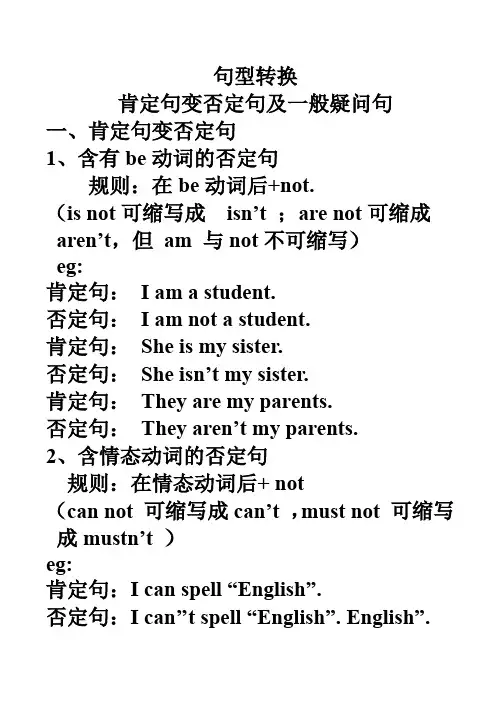
句型转换肯定句变否定句及一般疑问句一、肯定句变否定句1、含有be动词的否定句规则:在be动词后+not.(is not可缩写成isn’t ;are not可缩成aren’t,但am 与not不可缩写)eg:肯定句:I am a student.否定句:I am not a student.肯定句:She is my sister.否定句:She isn’t my sister.肯定句:They are my parents.否定句:They aren’t my parents.2、含情态动词的否定句规则:在情态动词后+ not(can not 可缩写成can’t ,must not 可缩写成mustn’t )eg:肯定句:I can spell “English”.否定句:I can’’t spell “English”.English”.肯定句:I must find it.否定句:I mustn’t find it.3、含有实义动词的句子的否定句构成(1)第三人称单数做主语。
(he、she、it或表示单个人或物的第三人称名词)规则:要在行为动词前加上助动词doesn’t,然后将动词恢复原形。
eg :肯定句:He has a soccer ball.否定句:He doesn’t have a soccer ball.(2)其它人称做主语规则:在行为动词前加don’t ,句子中的行为动词用原形。
eg:肯定句:They like bananas.否定句:They don’t like bananas.注:(1)在变否定句时,如遇some应变any Here are some books.Here aren’t any books.二、肯定句变一般疑问句1、含有be动词的句子变一般疑问句规则:把be动词提至句首,第一人称变第二人称,句末句号变问号。
(I/we变成youMy/our变成your)肯定句:I am a student.一般疑问句:Are you a student?肯定句:She is my sister.一般疑问句:Is she your sister?肯定句:They are my parents.一般疑问句:Are they your parents?2、含有情态动词的句子变一般疑问句规则:把情态动词提至句首,第一人称变第二人称,句末句号变问号。
初一英语上册:含be动词一般疑问句考点
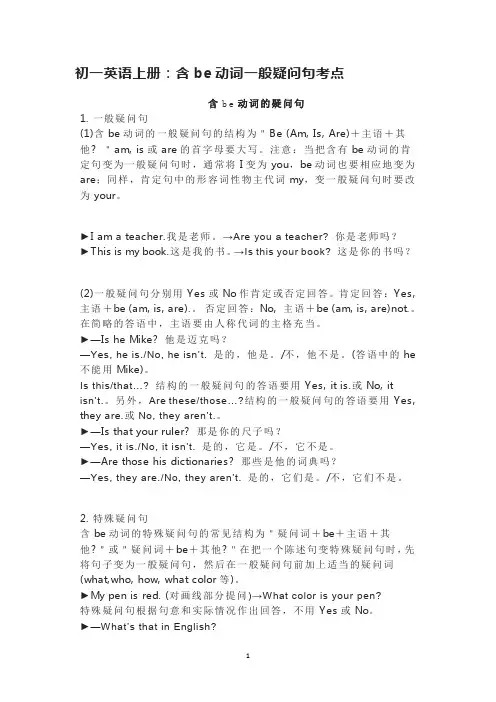
初一英语上册:含be动词一般疑问句考点含be动词的疑问句1. 一般疑问句(1)含be动词的一般疑问句的结构为"Be (Am, Is, Are)+主语+其他? "am, is或are的首字母要大写。
注意:当把含有be动词的肯定句变为一般疑问句时,通常将I变为you,be动词也要相应地变为are;同样,肯定句中的形容词性物主代词my,变一般疑问句时要改为your。
►I am a teacher.我是老师。
→Are you a teacher? 你是老师吗?►This is my book.这是我的书。
→Is this your book? 这是你的书吗?(2)一般疑问句分别用Yes或No作肯定或否定回答。
肯定回答:Yes, 主语+be (am, is, are).。
否定回答:No, 主语+be (am, is, are)not.。
在简略的答语中,主语要由人称代词的主格充当。
►—Is he Mike? 他是迈克吗?—Yes, he is./No, he isn’t. 是的,他是。
/不,他不是。
(答语中的he 不能用Mike)。
Is this/that…? 结构的一般疑问句的答语要用Yes, it is.或No, it isn’t.。
另外,Are these/those…?结构的一般疑问句的答语要用Yes, they are.或No, they aren’t.。
►—Is that your ruler? 那是你的尺子吗?—Yes, it is./No, it isn’t. 是的,它是。
/不,它不是。
►—Are those his dictionaries? 那些是他的词典吗?—Yes, they are./No, they aren’t. 是的,它们是。
/不,它们不是。
2. 特殊疑问句含be动词的特殊疑问句的常见结构为"疑问词+be+主语+其他?"或"疑问词+be+其他?"在把一个陈述句变特殊疑问句时,先将句子变为一般疑问句,然后在一般疑问句前加上适当的疑问词(what,who, how, what color等)。
be动词用法及句型转换

_A__re_ you and Kangkang 14?
12. These are oranges.
_A__re_ these oranges?
13. Those are apples.
_A_r_e_ those apples?
一般疑问句的回答
肯定: Yes,主语+be(不缩写). 否定: No, 主语+be+not(缩写). 注:主语必须是相应的人称代词。
12. These are oranges.
→These are not oranges.
13. Those are apples.
→Those are not apples.
总结
把陈述句变为一般疑问句:
→1.找到be动词(am, is, are)
2.然后把be动词提到句首。 3.一二人称要互变,三人称不变。
8. Liu Xiang is from China.
_I_s_ Liu Xiang from China?
9. We are from England.
A__r_e_ y__o_u_ from England?
10. They are Jane and Maria.
_A__r_e_ they Jane and Maria?
9. We are from England.
→We are not from England.
10. They are Jane and Maria.
→They are not Jane and Maria.
11. Kangkang and I are 14.
→Kangkang and I are not 14.
句型转换总复习(二)

句型转换总复习(二)一般疑问句及否定句一、含有be动词的陈述句变一般疑问句和否定句1 The student is at school.(否定句)(一般疑问句)(回答)__________ ______________2 The students are at school.(否定句)(一般疑问句)(回答)__________ ______________3 His father is an English teacher.(否定句)4 These cats are crying.(否定句)(一般疑问句)(回答)__________ ______________5 He is crying under the tree.(否定句)(一般疑问句)(回答)__________ ______________6 His birthday is on the twentieth of November.(否定句)7 Mrs. Li and Kitty are in a big shop.(一般疑问句)(回答)__________ ______________8 Everybody is in the classroom.(否定句)(一般疑问句)(回答)__________ ______________9 The boy under the tree is hungry.(否定句)(一般疑问句)(回答)__________ ______________10 Your brother’s aunt is on the chair.(否定句)11 There’s an eraser on the desk.(否定句)(一般疑问句)(回答)__________ ______________12 Those are your keys.(一般疑问句)(回答)__________ ______________13 John is his first name.(否定句)(一般疑问句)(回答)__________ ______________14 My father is fine.(否定句)(一般疑问句)(回答)__________ ______________15 This is a short.(否定句)16 There’re two pens in the pencil case.(否定句)17 The boys are my goog friends.(否定句)二、不含be动词(即含行为动词)的陈述句变一般疑问句和否定句1 They can swim.(一般疑问句)(回答)__________ _________2 I like to read English.(否定句)(一般疑问句)(回答)__________ ______________3 I go to school on foot. (否定句)4 He likes English.(否定句)(一般疑问句)(回答)__________ ______________5 His father goes to work by bus(否定句)(一般疑问句)(回答)__________ ______________6 He goes to school every day.(否定句)7 I want to have a model car.(一般疑问句)(回答)__________ ______________8 She wants a cup of coffee.(否定句)(一般疑问句)(回答)__________ ______________9. I do my homework after school.(否定句)10. The boy does some housework at home.(否定句)(一般疑问句)(回答)__________ ______________11. The children had a good time in the park. (否定句)(一般疑问句)(回答)__________ ______________12 Jim has some story-books.(否定句)作业1.His sister has computer games(改为一般疑问句)______his sister _______ computer games?2. Ann and Mary have baseballs(改为一般疑问句)_______ Ann and Mary _______ baseballs?3.She has some pens. (同上) _____she _____ ________pens?4.We like fruit and eggs.( 同上) _____ _____ _____ fruit _____ eggs.5.I want to go to a movie.( 同上)______you ______to go to a movie?6. I can play ping-png.( 改为一般疑问句) ______can you _____?7.She can run fast.( 改为一般疑问句) _____ _____run fast?8.Those are their pencil cases.(改为一般疑问句,并作肯定回答)_____ ______ their pencil cases?.9.He is an English teacher.(改一般疑问句)______ he an English teacher?10.She has a backpack.(否定句) she _______ ________ a backpack.11.Jim can play computer games. (否定句)Jim _______ _______ computer games.12. He likes pens.( 否定句) He_______ _________pens.13.I know her name(改否定句) I _____ know her name.14.She likes volleyball.(否定句) She____ _____ volleyball15.That is his dictionary. (否定句) That ____ his dictionary16. My brother wants to join the music club .(改为否定句)17.My brother ______ ________ to join the music club18.Gina doesn’t play golf every day (改为肯定句) Gina ______ golf every day19. Do you have tennis rackets? (改为肯定句)______ _______ tennis rackets.20.Jim doesn’t have a ba g.(肯定句) Jim _____a bag. 44.Can you sing ?(作否定回答)_____,I _____ .21.Does he like speaking English ?(作肯定回答)______ ,he ______ _______ .22.Can Jane speak Chinese?(否定回答) ______,_____ _____23.Is this boy your brother? (肯定回答) ____, _____ ____24.Are those her books?否定回答)___, ______ ____二、把下面的句子变成否定句 1. They like French fries. They __ __ ___ __ French fries.2. Sandra likes watching TV. Sandra ____ ____ watching TV3. My father has breakfast at home. My father ________ ______breakfast at home.4. The shop sells clothes. The shop _____ _____ clothes.5.I draw pictures on the wall. I ______ ________ pictures on the wall.6. I do my homework at 7:00. I _____ _____ my homework at 7:00.7. They are my brothers. They _________ _________ my brothers8.My last name is Smith. My last name ______ _______ Smith9. This is my grandmother. This _______ my grandmother.10. These are her brothers. These _______ her brothers.11. There are some notebooks in my backpack. There ___ ___ notebooks in my backpack.12. There are some nice tomatoes here. There ________ ________nice tomatoes here.13. Is he your friend?(肯定回答) ________, _________ _________.14. Are they your teachers?(否定回答) ________, _________ _________.15. Can you bring the ruler to me? (否定回答)No, ________ ________.16. Is this Lucy’s room?(否定回答),17. Is it on the dresser? (作否定回答) __________, it __________.18. Does she like eggs for dinner? (否定回答) _________, she __________.19. Does Tom like eggs for breakfast?(否定回答)_____ , ______ _________.20. She doesn’t have meat for lunch.(变为肯定句) She ________ meat for lunch.21. I have some English books.(否定句)I _______ ______ _______ English books.22. She has some pictures.(一般疑问句)______ _____ _______ _______ pictures?23. I read the book yesterday. (一般疑问句)________ ________ _______ the book yesterday?。
be动词引导的否定句和一般疑问句英语七年级上册语法-
Grammar be动词引导的否定句和一般疑问句➢疑问句是用于提出疑问的句子,一般疑问句是疑问句中的一种,翻译为“......吗?”➢陈述句:She is a teacher.否定句:She is not a teacher. = She isn’t a teacher.➢be动词随主语的变化而变化:当主语是三单和不可数名词时be动词用is , 当主语是非三单时用are 。
找出下列陈述句中的主语并改为一般疑问句:1)I am a student. 改为一般疑问句:2)We are playing basketball. 改为一般疑问句:3)You are a handsome boy. 改为一般疑问句:4)She is Adam’s sister. 改为一般疑问句:5)He is a policeman. 改为一般疑问句:6)It is an English book. 改为一般疑问句:7)They are lions. 改为一般疑问句:8)This is a book.改为一般疑问句:9)That is a book.改为一般疑问句:10)These are apples.改为一般疑问句:11)Those are apples.改为一般疑问句:➢一般疑问句的回答方式:用Yes / No作肯定或否定回答,再看用什么问就用什么答。
——A:Are you a student?——B:Yes, I am.(肯定回答)/ No, I’m not.(否定回答)——A:Is he / she / Peter / your father / your mother a teacher?——B:(肯定回答)/ (否定回答)——A:Are they / these / those / the apples ...?——B:(肯定回答)/ (否定回答)——A:Is it / this / that / the apple / the dog ...?——B:(肯定回答)/ (否定回答)一般疑问句专项练习Name:一、将陈述句改为一般疑问句1.I am a pupil(小学生).2.Lily is an English teacher.3.This is your pen.4.Those are your books.5.These are my pens.二、对一般疑问句进行回答1.——Are you eight?——Yes, / No, 2.——Are they students?——/ 3.——Is that her pet?——/ 4.——Is he Fan Chengcheng?——/ 5.——Are those apples?——/ 6.——Is your mother a nurse?——/三、把下列陈述句改为否定句一般疑问句并做出回答1.This is our classroom.否定句:一般疑问句:肯定回答:否定回答:2.She is Miss Smith.否定句:一般疑问句:肯定回答:否定回答:3.I am in China.否定句:一般疑问句:肯定回答:否定回答:4.Miss Zhang is our English teacher.否定句:一般疑问句:肯定回答:否定回答:5.Tom is under the tree.否定句:一般疑问句:肯定回答:否定回答:6.Tom and Tim are good friends.否定句:一般疑问句:肯定回答:否定回答:。
有be动词的陈述句变一般疑问句的变型步骤
(含有be动词)的陈述句变一般疑
问句的变型步骤
1.先找be动词
2.将be动词提前
3.首字母大写;原句首字母变回小写
4.其他不变照抄,句号变问号
5.一二人称代词需互换。
【I(我)变you(你);we(我们)变you(你们);
my(我的)变your(你的)】
例1:
She is a teacher.(陈述句)
Is she a teacher?(一般疑问句)
(肯定句。
前面是肯定回答短句,后面是肯定句完整句子)
No, she isn’t.She isn’t a teacher.
(否定句。
前面是否定回答短句,后面是否定句完整句子)
例2:
I am a boy.(陈述句)
Are you a boy?(一般疑问句)
Yes, I am . I am a boy.(肯定句)No, I am not. I am not a boy.(否定句)
9月5日
1.She is Cici.
Is she Cici?
Yes, she is. She is Cici.
No, she isn’t. She isn’t Cici.
2.It is a cat.。
精编制作be动词的否定句和一般疑问句PPT课件
It is not Sam.
It isn’t Sam.
I’m Alice Wang.
I’m a pupil. I’m nine years old. I’m tall.
I’m not Alice Wang.
I’m not a pupil. I’m not nine years old. I’m not tall. Nice to meet you.
4. Kangkang and Zhao Lin are from China.(对画线部分提问)
Where are Kangkang and Zhao Lin from? 5.She is from England.(改为否定句)
She isn’t from England. 6. Dingding and Nana are from England.(对划线部分提问) Who are from England?
You are a queen. He’s short. It isn’t a pencil. I’m a boy. You’re not nine. She is small.
概念 : 简单地说,能用Yes / No(或相当 于Yes / No)回答的疑问句叫一般疑 问句。
有Be动词的陈述句改为一般疑问句的 基本步骤
He is Eddie.
Is he Eddie?
①找出be动词
②将be动词放到最前面
③首字母大写,原来的首 字母改掉,其他照抄 ④句号改成问号
答语 :
• 一般疑问句常用Yes或No回答. • 其完整形式 : • 肯定回答: • Yes,主语+be • 否定回答: No,主语+be not. • 缩写 (n’t / ’t) (am not)
PEP小学英语语法复习之be动词,一般疑问句的使用,肯定否定回答,陈述句变一般疑问句的学习
姓名:科目:教
师:
课题Be动词的使用,肯定句改为否定句,陈述句改为一般疑问句
教学内容
一、be动词用法总结
我(I)用am,你(you)用are, is连着他(he),她(she),它(it);
单数名词用is,复数名词全用are。
变疑问,往前提,句末问号莫丢弃。
变否定,更容易, be后not莫忘记。
疑问否定任你变,句首大写莫迟疑。
思考:这首口诀的每一句分别是什么意思?
2、语法归纳
Be动词的使用
我(I)用am,你(you)用are, is连着他(he),她(she),它(it);
这些是固定用法:
I am a boy. (你不能说 I is a boy) You are a student.
He is a boy. She is a girl. It is a cat.
Tom is a boy. Amy is a girl. They are good friends.
单数名词用is,复数名词全用are。
(主语个数是一个时,谓语用单数is,主语个数为2个或以上,谓语用复数are.)如:
The book is over there.(一本书)
The books are over there.(多本书)
针对性练习:
1.用适当的be动词填空。