
鲁教版英语八上Unit 7《Have you ever been to a museum》ppt复习课件
4. 现在完成时与一般过去时的区别: 现在完成时强调过去发生的事情对现在造成
ቤተ መጻሕፍቲ ባይዱ
的影响或结果,强调的是现在的情况,不能和表
示过去的时间连用.如:yesterday, last night,
three days ago, in 1999等.
I have seen this film since three days ago. (T) I have seen this film three days ago. (F)
• 2)表示从 过去 __ 某个时间开始并一直持续到 ___ 现在 的动作或状态,句中的动词必须是 一段 ______ 时间状语 延续性 动词。常和表示 ___ 连用。如:these days, for two years, since … • eg. 我认识李雷三年了。 • I have ___ known ___ Li Lei for three years / ________three years ago. since
随堂练
gave (give)up smoking last year. 1) Mr Chen ___________ has already found 2) Jack _______________ (already find) his watch. went 3)She ____________ (go) to the zoo last week. haven’t 4)They ______________ (not have) been to the Great Wall. Has • 5)A: _________ (have) she ever been to China? B: went Yes, she ________ (go) there in 1989. • 6) My brother ________ bought (buy) a car last month.
27.一些吃的东西 something to eat 28.四分之三 three quarters 29.睡着的 be asleep 30.是…还是 whether… or 31.醒着的 be awake 32.更自然的 more natural 33.例如 such as 34.最重要的要求 the most important requirement 35.在白天 during the daytime 36.考虑着做某事 think about doing sth./sth. 37.强调结构 It is/was +被强调部分+that/who +其他
21.讲英语的国家 an English-speaking country leave school 22.而不是 rather than 23.离校/毕业 24.采用不同的航线 take different routes 25.多于 more than 26.练习做某事 practice doing sth.
二.课文重点: 1.现在完成时的结构:(Present Perfect Tense) 主语+ have / has + 动词的过去分词(done) 否定结构:主语+haven’t / hasn’t + 过去分词+… 一般疑问句结构: Have\ Has +主语+ 过去分词+
2. 用法:
1)表示过去发生或已经完成的动作对 现在 ____ 造成的 影响或结果。 eg. 我已经吃过早餐了。 eaten breakfast. I have _____ already _______ (吃早餐这个动作发生在 过去 ____ , 对现在造成的影响是 我吃饱了,不饿了 ___________ )
3. 现在完成时经常与already( 已经 )常用于肯定 还没有 曾经 ), never 句, yet( )常用于否定句, ever( (从不), before, for, since连用。 用for, since填空: 1)We haven’t seen each other ____ for a long time. since 10 2) His father has been in the Party _____ years ago. for 20 minutes. 3) The film has been on _____ since he came 4) Mr Green has worked here ______ to China.
Unit7 复习课件
一.复习重点短语: space museum (2)听说 hear of/about (1)太空博物馆 ______________ amusement park 许多乐趣 much fun (3)娱乐公园________________(4) water park (5)水上公园 ____________ (6)乘地铁 take the subway (7)玩得愉快 have a great time(其他) take lessons )去过某地 have been to 8)上课____________9 10)去了某地_______ have gone to11)乘船 __________ take a boat/by boat see sb. doing… 12)看到某人在做……_____________________ be close to 14)在东南亚_________ in Southeast Asia 13)紧靠 _________ 15)醒来 ______________ 16)度假___________ wake up take a holiday year round go on vacation/go 17) 一年到头all ____________ for a trip 18) 导游___________ tour guide end up with sth./ doing sth. 19) 结束,以……结尾__________________ 20)做某事有困难 have some problems (in)doing …
八年级英语上册Unit7Haveyoueverbeentoamuseum?SectionA3a-3c精品教案鲁教版五四制
4. India has the most advanced toilet. ( ) 5. Linlin didn’t know why her grandpa loved drinking and collecting
encourage, social, peaceful, performance, perfect, itself, collect 2. Target language: 1) I wonder how much more computer will be able to do in the future 教 学 目 标 2) Watching them prepare the tea with the beautiful tea sets is just as enjoyable as drinking the tea itself 3. To train students’ reading ability 4. To get students know some knowledge about many kinds of museums. II. Method Objects in Teaching 1) Skimming for details. 2) Reading for comprehension. 3) Communicative approach. III. Sensibility and Value To raise students’ interest of learning English. I. Teaching Key Points 1. Key vocabulary: unbelievable, progress, rapid, unusual, toilet, encourage, social, peaceful, performance, perfect, itself, collect 2. Target language: 教 材 分 析 1) I wonder how much more computer will be able to do in the future 2)Watching them prepare the tea with the beautiful tea sets is just as enjoyable as drinking the tea itself II. Teaching Difficulties 1) How to improve reading skill. 2) To understand the passage and the culture. III. Teaching Aids 1. A computer for multimedia use.
鲁教八年级英语上册Unit 7 Have you ever been to a museum 课件
现在完成时
Read and translate the following sentences. 1. I have just heard the news. 2. They haven’t returned from America yet. 3.I have already finished my homework. 4. My mother isn’t at home. She has gone
1、书籍是朋友,虽然没有热情,但是非常忠实。2022年4月22日星期五2022/4/222022/4/222022/4/22 2、科学的灵感,决不是坐等可以等来的。如果说,科学上的发现有什么偶然的机遇的话,那么这种‘偶然的机遇’只能给那些学有素养的人,给那些善于 独立思考的人,给那些具有锲而不舍的人。2022年4月2022/4/222022/4/222022/4/224/22/2022 3、书籍—通过心灵观察世界的窗口.住宅里没有书,犹如房间里没有窗户。2022/4/222022/4/22April 22, 2022
I ____ (see) many kinds of animals thheraev.e learned
7. We _____ _______ (learn) English for
more tr. Wang? -- Hhea_s_g_on_e____ (go) to the
5. He _h_a_s_ ever _b__ee_n__ (be) to the History Museum several times.
6. -- _H__a_v_eyou ever b__ee_n__ (be) to the zoo? went -- Yessa.wI _____ (go) there last summer.
鲁教版英语八年级上Unit7 Have you ever been to a museum SectionA
Unit 7Have you ever been to a museum?Section A一、The analysis of teaching material:本节课的教学内容取自八年级上第七单元Section A 第二课时(3a--4c)。
教学内容主要是3a-3c的短文阅读,短文介绍了世界上的三个博物馆,三个博物馆各有特色,内容完全不同。
美国的计算机博物馆介绍了计算机的历史及发明人;印度的厕所博物馆最不寻常,陈列了各种各样的博物馆;而中国杭州的茶博物馆则展示了中国深厚悠久的茶文化和历史。
4a--4c则针对阅读材料和本单元的语法进行练习。
无论是博物馆的题材还是迪士尼乐园的小练习,都可以让学生学会如何介绍自己去过的某个地方,为下一课时的写作做铺垫。
二、The analysis of learning situation:初三的学生拥有一定的词汇量,但他们对阅读英语短文兴趣不高,甚至在阅读过程中存在很多阅读障碍。
他们需要真正地学会阅读,因此,在阅读过程中有关阅读策略和阅读技巧的学习就更加重要。
二、Teaching aims:1.Knowledge targets:能根据阅读目的在阅读材料中获取所需的知识。
2.Ability targets:能根据阅读中获得的信息与自己已有的知识相联系,并进行口头表达。
3.Emotion targets:能够了解世界各地的不同历史和文化,对不同历史阶段的文化和科技发展有更加深刻的理解,。
四、The teaching importance and difficult points:如何快速有效地获取所需信息。
五、Teaching strategies:采用任务型教学方法进行自主学习、小组合作探究、和Role—playing的学习策略,利用教学图片、幻灯片、视频等来展开课堂教学、通过Pairwork问答式的口语交际活动互相询问同桌是否曾经去过某个博物馆或地方。
采取学生自学、教师点拨、小组合作等方式完成本节课的教学任务。
【最新】鲁教版八年级英语上册Unit7_Have_you_ever_been_to_a_museum
Unit7 Have you ever been to amuseum?Section B (2a--2b)教学设计Unit7 Have you ever been to a museum?Section B (2a---2b)Huantai Experimental SchoolYu WeiweiTeaching aims1. To learn the new words and phrases:Indian; Japanese; southeast; equator; on the one hand, on the other hand; thousands of.2. To improve the students’ reading and writing skills.3. To help the students know more about China and form the spirit of patriotism.Key points and difficult points1. To learn to find information in the reading.2. To master some useful reading skills.Teaching methodsMultimedia visual teaching method; Task reading methodTeaching proceduresStep 1 Warming-upWatch a video about places of interest around the world.Have a free talk:I have ever been to _______.I have been in _______ for _______ days.(设计意图:视频能够快速导入新课,激发学生学习兴趣,让学生保持积极的学习状态。
鲁教版五四制英语八年级上册Unit 7 Have you ever been to a museum
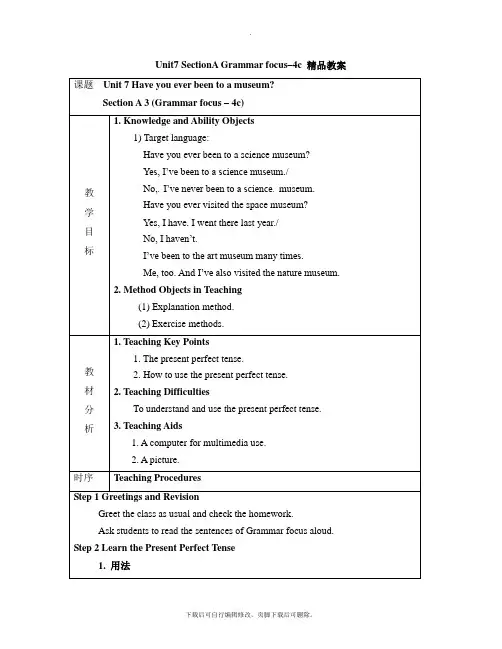
Unit7 SectionA Grammar focus–4c 精品教案课题Unit 7 Have you ever been to a museum?Section A 3 (Grammar focus – 4c)教学目标1. Knowledge and Ability Objects1) Target language:Have you ever been to a science museum?Yes, I’ve been to a science museum./No, I’ve never been to a science museum.Have you ever visited the space museum?Yes, I have. I went there last year./No, I haven’t.I’ve been to the art museum many times.Me, too. And I’ve also visited the nature museum.2. Method Objects in Teaching(1) Explanation method.(2) Exercise methods.教材分析1. Teaching Key Points1. The present perfect tense.2. How to use the present perfect tense.2. Teaching DifficultiesTo understand and use the present perfect tense.3. Teaching Aids1. A computer for multimedia use.2. A picture.时序Teaching ProceduresStep 1 Greetings and RevisionGreet the class as usual and check the homework.Ask students to read the sentences of Grammar focus aloud. Step 2 Learn the Present Perfect Tense1. 用法肯定式否认式I/You/We/They have finished the work. He/She/It has finished the work. I/You/We/They have not finished the work.He/She/It has not finished the work.构成:have(助动词has(第三人称单数助动词) + p.p疑问式答复Have I/you finished the work? Has he/she finished the work? Yes, you/I have. No, you/I haven’t. Yes, he/she has. No, he/she hasn’t.have not 常缩略为haven’thas not 常缩略为hasn’t现在完成时的用法Have you had your lunch yet?Yes, I have. I have just had it.(现在我不饿了〕表示过去发生或已经完成的动作对现在造成的影响或结果。
鲁教版英语八年级上Unit7 Have you ever been to a museum SectionA (5)

Unit 7 Have you ever been to a museum ?Section A授课人备课时间上课时间执教班级课题Unit 7 Have you ever been to amuseum ?Section AGrammar Focus- 4c教学课时教学课型(新授、复习、习题、实验等)NEW教学目标知识目标:1.学习并掌握新词汇:tea art , performance , perfect ,tea set , itself , collect , a couple of , German , theme , ride , province 2. 能正确使用以下语法要点:1)I’ve ever been to the American Computer Museum .2) It’s unbelievable that technology has progressed in such a rapid way !3)I’ve recently been to a very unusual museum in India .4) It also encourages governments and social groups to think about ways to improve toilets in thefuture .5) Last year I went to the Hangzhou National Tea Museum .能力目标:熟练运用语法要点中的句型和他人对话。
情感目标:通过本课的学习,互相交流曾经旅游过的地方,增长知识,开阔学生的视野,热爱祖国壮丽河山。
立志学习,积极进取。
教学重点、难点熟练运用语法要点中的句型和他人对话。
媒体运用归纳法;任务型教学法预设过程(应包括课程导入、预习自学、展示交流、当堂练习检测等)I. Preparation准备让学生观察Grammar Focus 表格中的例句。
八年级英语上册Unit7Haveyoueverbeentoamuseum课件鲁教版五四制
uncommon
unusual
quick
rapid
Unit 9
Have you ever been to a museum?
Section B
Period 1 (1a-1d)
1a Match the pictures with the names.
________ the Terracotta Army ________ the Great Wall ________ the Bird’s Nest ________ the Palace Museum
Yes, I have. I went to the National Science Museum last year.
Have you ever been to a history
museum?
No, I haven’t.
Me neither. Let’s go to one tomorrow.
Complete the word map with the words from the reading.
names
of
kinds of
places animals seasons languages food
China, lions, summer, Chinese,
Singapore Night Safari all year round Chinese, English
Neither the two teachers nor that student is from America. 那两个老师和那个学生都不是来自美国。
Rewrite the sentences.
1. Ann doesn’t like popular songs. I don’t like them, either.
鲁教版英语八上Unit 7 Have you ever been to a museum Secti
鲁教版英语八上Unit 7 Have you ever been to a museum Section B 3a-Selfcheck 教学设计一. 教材分析鲁教版英语八上Unit 7 Have you ever been to a museum Section B 3a-Selfcheck 主要讲述了一篇关于博物馆参观的阅读文章。
文章通过描述两个人的博物馆之旅,让学生们了解到参观博物馆的重要性和乐趣。
本节课的主要内容是让学生通过阅读文章,掌握相关的词汇和语法知识,提高阅读理解能力。
二. 学情分析学生在学习本节课之前,已经掌握了相应的英语基础知识,如词汇、语法和阅读理解技巧。
但是,对于一些特定的词汇和表达方式可能还不够熟悉,需要通过本节课的学习来进行巩固。
此外,学生可能对博物馆参观有一定的了解,但可能没有系统的参观经验,因此需要通过阅读文章来拓宽视野。
三. 教学目标1.知识目标:学生能够掌握文章中的新词汇和语法知识,如“have beento”、“once”等。
2.能力目标:学生能够提高阅读理解能力,能够理解文章的主旨和细节信息。
3.情感目标:学生能够激发对博物馆参观的兴趣,增强对文化历史的认识。
四. 教学重难点1.重点:学生能够掌握文章中的新词汇和语法知识。
2.难点:学生能够运用所学知识进行阅读理解,并能够运用到实际生活中。
五. 教学方法1.阅读理解法:通过阅读文章,让学生掌握相关的词汇和语法知识,提高阅读理解能力。
2.情景教学法:通过模拟博物馆参观的情景,让学生更好地理解文章内容,并能够运用到实际生活中。
3.小组讨论法:通过小组讨论,激发学生的思维能力,提高学生的口语表达能力。
六. 教学准备1.教师准备:准备好相关的教学材料,如文章、词汇表、语法讲解等。
2.学生准备:学生需要预习文章,了解文章的大致内容。
七. 教学过程1.导入(5分钟)教师可以通过提问方式引导学生谈论博物馆参观的经历,激发学生的兴趣。
新鲁教版八年级英语上册Unit 7 Have you ever been to a museum? SectionA 1a-2d 精品教案
A. Today B. Yesterday C. Last year
2)When did Claudia visit the nature museum?
st year B. last summer C. Last school trip
T: OK. Now open your books on Page 65. In Part 1a, 6 places are given. Please read the names of these places. (Teacher writes the names on the blackboard.) Which of these places would you like to visit? Rank them from 1 to 5
4.How are we going to get there?
5.We can take the subway/…
(4) To train students’ listening and speaking skills.
2. Method Objects in Teaching
(1) Scene teaching method.
(2) Listening practice.
( 3) Target language:
1.Lets' go somewhere different today.
2.Have you ever been to… ? Yes, I have./ No, I haven’t.
3.How about/what about…?
鲁教版英语八年级上Unit7 Have you ever been to a museum
Unit 7 Have you ever been to a museum ?授课人备课时间上课时间执教班级课题Unit 7 Have you ever beento a museum ?教学课时教学课型(新授、复习、习题、实验等)NEW教学目标知识目标:1. 学习并掌握下列单词:thousand , thousands of, on the one hand ... on the other hand , safe , simply , fear , whether , Indian , Japanese , fox , all year round , equator , whenever , spring , mostly , location ,2. 能正确使用以下常用表达:thousands of , on the one hand ... on the other hand ,3. 学会使用以下句型:1)Have you ever been to Singapore?2)This is the best time to watch them.3)One great thing about Singapore is that the temperature is almost the same all year round.4)This is because the island is so close to the equator.能力目标:通过阅读训练,培养学生的良好的阅读理解能力,同时使学生在理解的基础上对文章进行进一步的解读,以实现对学生进行有利的情感教育的目的。
情感目标:通过本课的学习,培养学生面对困难,想方设法积极应对的精神。
教学重点、难点重点词汇、常用表达及句型。
对学生进行阅读技能的培养媒体运用情景教学法;任务型教学法预设过程(应包括课程导入、预习自学、展示交流、当堂练习检测等)I. Preparation准备1. Free talk “自由交际”Ask and answer in pairs:1)A:Have you been to the Great Wall ?B:Yes , I have / No, I haven’t .2)A: Have you been to the Bird’s Nest ?.B:Yes , I have / No, I haven’t .3)A: Have you seen Terracotta Army ?B:Yes , I have / No, I haven’t .4) A:Have you tried Chinese food ?B:Yes , I have / No, I haven’t .5)A: Have you visited the Palace Museum ?B:Yes , I have / No, I haven’t .2) Role play the conversation.(1d)2. Revision “复习检查”通过检查上节课布置的作业落实作业完成情况,进而为新课的导入铺路搭桥。